Quotulatiousness

February 11, 2020

QotD: Agriculture and the rise of the state

Filed under: Food, Government, History, Quotations — Tags: , , , , — Nicholas @ 01:00

Why should cereal grains play such a massive role in the earliest states? After all, other crops, in particular legumes such as lentils, chickpeas, and peas, had been domesticated in the Middle East and, in China, taro and soybean. Why were they not the basis of state formation? More broadly, why have no “lentil states,” chickpea states, taro states, sago states, breadfruit states, yam states, cassava states, potato states, peanut states, or banana states appeared in the historical record? Many of these cultivars provide more calories per unit of land than wheat and barley, some require less labor, and singly or in combination they would provide comparable basic nutrition. Many of them meet, in other words, the agro-demographic conditions of population density and food value as well as cereal grains. Only irrigated rice outclasses them in terms of sheer concentration of caloric value per unit of land.

The key to the nexus between grains and states lies, I believe, in the fact that only the cereal grains can serve as a basis for taxation: visible, divisible, assessable, storable, transportable, and “rationable.” Other crops — legumes, tubers, and starch plants — have some of these desirable state-adapted qualities, but none has all of these advantages. To appreciate the unique advantages of the cereal grains, it helps to place yourself in the sandals of an ancient tax-collection official interested, above all, in the ease and efficiency of appropriation.

The fact that cereal grains grow above ground and ripen at roughly the same time makes the job of any would-be taxman that much easier. If the army or the tax officials arrive at the right time, they can cut, thresh, and confiscate the entire harvest in one operation. For a hostile army, cereal grains make a scorched-earth policy that much simpler; they can burn the harvest-ready grain fields and reduce the cultivators to flight or starvation. Better yet, a tax collector or enemy can simply wait until the crop has been threshed and stored and confiscate the entire contents of the granary.

Compare this situation with, say, that of farmers whose staple crops are tubers such as potatoes or cassava/manioc. Such crops ripen in a year but may be safely left in the ground for an additional year or two. They can be dug up as needed and the reaminder stored where they grew, underground. If an army or tax collectors want your tubers, they will have to dig them up tuber by tuber, as the farmer does, and then they will have a cartload of potatoes which is far less valuable (either calorically or at the market) than a cartload of wheat, and is also more likely to spoil quickly. Frederick the Great of Prussia, when he ordered his subjects to plant potatoes, understood that, as planters of tubers, they could not be so easily dispersed by invading armies.

The “aboveground” simultaneous ripening of cereal grains has the inestimable advantage of being legible and assessable by the state tax collectors. These characteristics are what make wheat, barley, rice, millet, and maize the premier political crops. A tax assessor typically classifies fields in terms of soil quality and, knowing the average yield of a particular grain from such soil, is able to estimate a tax. If a year-to-year adjustment is required, fields can be surveyed and crop cuttings taken from a representative patch just before harvest to arrive at an estimated yield for that particular crop year. As we shall see, state officials tried to raise crop yields and taxes in kind by mandating techniques of cultivation; in Mesopotamia this included insisting on repeated ploughing to break up the large clods of earth and repeated harrowing for better rooting and nutrient delivery. The point is that with cereal grains and soil preparation, the planting, the condition of the crop, and the ultimate yield were more visible and assessable.

James Scott, Against The Grain: A deep history of the earliest states, 2017.

January 30, 2020

QotD: Nutrition and aging from the middle ages to the 20th century

Filed under: Europe, Food, Health, History, Quotations — Tags: , , , — Nicholas @ 01:00

Those of us who didn’t grow up in the first world (second and a half at best!) know d*mn well how people lived in the 20th century, with nominal indoor plumbing, but without a lot of changes of clothing, washers and dryers, heated houses, etc. (The trains from the mountains, where it was colder, in winter, smelled like a mix of VERY unwashed bodies and wood smoke. You never forget that smell.) The particular etc. I have in mind in this case is the lack of refrigeration.

Look Portugal is fertile enough that a careful planner can feed a family on less than an acre of land (particularly the area I come from, apparently one of the oldest inhabited in Europe and whose name in Indo European translated as wet and fertile valley.) I’m sure the food available to us in the 20th century when you could buy improved seeds, etc. was way better than the one available to people in the middle ages.

But … yeah, no. We didn’t eat like people do now. Not even close. For one, meat was fairly scarce. We mostly ate fish (thanks to the coasts!) and vegetables. Oh, and we were relatively lucky. A lot of people got almost no protein. The most common lunch among the people was the “isca” that is a bit of fried flour which might or might not have a couple of shreds of codfish in it. The very poor ate a lot of vegetable soup.

And again this was in the 20th century. In winter vegetables more or less vanished and the only fruit available were the wrinkled, flour-like apples.

Christmas treats were dried fruit, not cookies. It tells you all you need to know. (Yes, it was healthy too except for the scarce protein for most people, but no one said the way we eat is particularly healthy.)

I’m not complaining, but I know that we ate massively better than my parents did in the mid 20th century. And they ate better than their parents. So, kindly, do not tell me some serf on a medieval estate got his choice of however many flavors of ice-cream.

Sure the very rich ate well, if sometimes oddly. But the average person, not so much.

And as for living as long? Yeah, no.

I still remember vividly — as do many our age — when 60 was old, 70 VERY old.

Yes, I’m concerned for my parents in their late eighties. And that’s, as my dad puts it “after 80, that’s old”. But it would surprise no one is they lived another 10 years. Because a lot of people do now. And now one makes a big deal of people who turn 100. (Even though 114 seems to be, a little inexplicably, our hard drop-off limit.)

And besides we KNOW. Shakespeare at 58 — two years older than I’m now — was “very old.”

So kindly take your “people lived about as long,” fold it all in corners and put it where the sun don’t shine, even if people in the arctic in winter will be a little puzzled by it.

Sarah Hoyt, “What if I Told You?”, According to Hoyt, 2019-11-05.

January 11, 2020

Feature History – Emu War

Filed under: Australia, History, Military — Tags: , , — Nicholas @ 02:00

Feature History
Published 25 Jan 2017

Hello and welcome to a Feature History special; featuring the Emu Wars, the incompetence of my own country, and my miserable attempt at doing the accent I should have.

Patreon
https://www.patreon.com/FeatureHistory
Twitter
https://twitter.com/Feature_History
———————————————————————————————————–
The credit for this video goes to Feature History’s employee of the month, me, for the art, animation, script, voice-over.
Music
Kevin MacLeod – “Drankin’ Song”
Kevin MacLeod – “Bama Country”

November 26, 2019

Communal farming nearly killed off the Plymouth Colony

Filed under: Britain, History, USA — Tags: , , , , — Nicholas @ 05:00

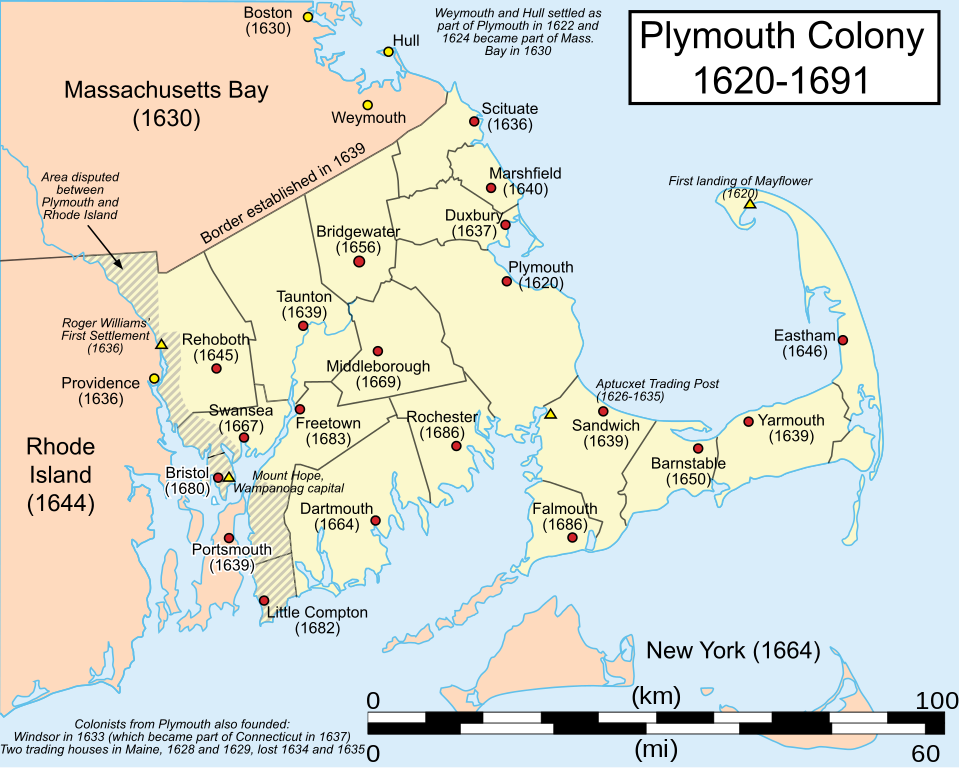
What saved them was abandoning the “common property” communalism and adopting private ownership of the farms:

The Plymouth Colony 1620-1691.
Map by Hoodinski via Wikimedia Commons.

The first few years of the settlement were fraught with hardship and hunger. Four centuries later, they also provide us with one of history’s most decisive verdicts on the critical importance of private property. We should never forget that the Plymouth colony was headed straight for oblivion under a communal, socialist plan but saved itself when it embraced something very different.

In the diary of the colony’s first governor, William Bradford, we can read about the settlers’ initial arrangement: Land was held in common. Crops were brought to a common storehouse and distributed equally. For two years, every person had to work for everybody else (the community), not for themselves as individuals or families. Did they live happily ever after in this socialist utopia?

Hardly. The “common property” approach killed off about half the settlers. Governor Bradford recorded in his diary that everybody was happy to claim their equal share of production, but production only shrank. Slackers showed up late for work in the fields, and the hard workers resented it. It’s called “human nature.”

The disincentives of the socialist scheme bred impoverishment and conflict until, facing starvation and extinction, Bradford altered the system. He divided common property into private plots, and the new owners could produce what they wanted and then keep or trade it freely.

Communal socialist failure was transformed into private property/capitalist success, something that’s happened so often historically it’s almost monotonous. The “people over profits” mentality produced fewer people until profit — earned as a result of one’s care for his own property and his desire for improvement — saved the people.

Over the centuries, socialism has crash-landed into lamentable bits and pieces too many times to keep count — no matter what shade of it you pick: central planning, welfare statism, or government ownership of the means of production. Then some measure of free markets and private property turned the wreckage into progress. I know of no instance in history when the reverse was true — that is, when free markets and private property produced a disaster that was cured by socialism. None.

A few of the many examples that echo the Pilgrims’ experience include Germany after World War II, Hong Kong after Japanese occupation, New Zealand in the 1980s, Scandinavia in recent decades, and even Lenin’s New Economic Policy of the 1920s.

November 25, 2019

QotD: The origins of the state

Filed under: Government, History, Quotations — Tags: , , — Nicholas @ 01:00

Taxation most likely began ten thousand years ago, when nomadic hunter-gatherers gave up their wandering ways — and the tools associated with them — settled down, and started growing crops and herding livestock, which requires an entirely different suite of tools than hunting. The hunter-gatherers’ tools could be used as weapons because that’s essentially what they were — ask any mastodon — the farmers’ could not. As a result, anti-productive marauders who had been held off by the hunters’ tools (or the ability of the hunters and their families to escape and evade) took advantage of those who were stuck to the plots of land they had learned to farm with clumsy agricultural implements (which could not be wielded as easily by females, relegating them to a subordinate role for fifty centuries), and forced to to pay tribute to the bandits. Go take another look at the 1960 movie masterpiece The Magnificent Seven for illustration. The thieves eventually learned to call themselves “government” and the goods they stole, “your fair share”.

L. Neil Smith, “What Would Real Tax Reform Look Like?”, Libertarian Enterprise, 2017-10-29.

August 26, 2019

Australian fertilizer run-off and the (remains of the) Great Barrier Reef

Filed under: Australia, Environment, Government — Tags: , , , , — Nicholas @ 03:00

The Great Barrier Reef used to be one of the natural wonders of the world, but as we were told about ten years ago, unless Australians gave up fossil fuels (or was it electricity?), the reef had bare months to survive. As we’re years past that inflexible deadline, we have to assume that the reef is now dead, dead, dead. Yet there are apparently still state or federal regulations in place to protect the (former) reef that Australian farmers are struggling against:

Great Barrier Reef by James_W_Thompson
“IMG_5035-1” by James_W_Thompson is licensed under CC BY-NC-SA 2.0

Our man in Tolga (north Queensland) has written to the local press on the absurd green tape tying up farmers.

QUOTE
The ever-tightening regulatory stranglehold on farmers by governments “for the health of the Reef” (The Express, 21/8) is based on what Professor Peter Ridd has called “faulty science”.

Fertilisers are expensive and they aren’t used wastefully. They’re plant food; if the crops don’t consume them then the neighbouring vegetation, on land or in waterways, will – long before they get to the Reef.

If fertilisers were running off farms there’d be big green plumes leading downhill from them, easily visible on Google Earth. There aren’t. Likewise with herbicides and pesticides, there’d be big plumes of dead flora or fauna visible to drones. Again; there aren’t. It may have happened in the past, but these aren’t current problems.

Terrestrial silt run-off is a different matter to fertilisers and herbicides/pesticides. It has been pluming out from rivers since time began. The coastal reefs have always experienced it.

Just 15,000 years ago during the last ice-age the seas were 120 metres lower, the Reef’s current site was a coastal plain, and the Reef clung to the edge of the continental shelf. Everything that came out of the rivers washed over the whole Reef. And, yes, there was a lot of silt during the ice-age. CO2 was much lower due to the cooler seas (Henry’s Law), so plants were sparser. It was colder and drier so there was less rain to water what plants there were.

Aboriginal tribes were doing it tough, so they used firestick farming to get what small game there was. That left a lot of bare earth which blew as dust into valleys and was washed out to sea when the rains did come.

But it’s different now. Much of the main Reef area is 40 to 70 kilometres out to sea, and as Professor Ridd said, the prevailing south-easterly wind and currents keep terrestrial run-off much closer to shore. Professor Ridd also notes that more clean ocean water flows through the Reef each day than flows from our rivers each year.

Nonetheless, the mud-meme is being heavily promoted at present; “Earlier this year, a muddy plume of polluted water hit our Reef. It was so big you could see it from space.” Search the internet for “Muddy plume extends to Great Barrier Reef images from space” and there’s several alarmist websites (including “our” ABC) showing just one obviously-modified image.

May 17, 2019

The EU’s trade distortions harm African farmers in many ways

Filed under: Africa, Economics, Europe — Tags: , , , — Nicholas @ 05:00

One of the unifying themes of the European Union is its dedication to farm subsidies, which are very popular among some European farmers. EU farming subsidies and trade policies also do significant measurable harm to African farmers:

spiked: How does the EU harm African economies?

Sam Akaki: Thanks to the EU’s Common Agricultural Policy, which heavily subsidises EU farmers, Africa’s markets are flooded with their cheap excess produce. If you go to any African market, you can buy all kinds of European produce sold at very, very cheap prices. This is driving African farmers out of the market. At the same time, the EU imposes strict limitations on what African countries can export to the European market. In particular, African farmers cannot export value-added goods. So if a farmer in Ghana is producing cocoa, or a farmer in Kenya is producing coffee, they can perhaps get less than a dollar for their product as they have to export it raw. Only a fraction of the money you pay for a jar of coffee goes to an African farmer. The value-added goods, such as processed coffee, are then produced in Europe. Germany, especially, has been doing a lot of harm.

EU lobby groups and NGOs are not working in the interests of Africa and are opposed to African attempts to get themselves out of poverty. For instance, many African farmers work with genetically modified (GM) crops. One of the big issues about GM food is that Western companies sell GM seeds that don’t produce new seeds for the next season. Farmers have to go back to companies like Monsanto every year. In Uganda, at the Kawanda Agricultural Research Institute, scientists have been working on their own way of producing local GM seeds that will be reusable each year. Europe is against this and tries to stop it.

[…]

spiked: How have EU sanctions affected Africa?

Akaki: The clearest examples are Zimbabwe and Eritrea. Of course, these countries have human-rights issues. But human rights are a question of development. Countries go through developmental stages. There would have been enormous human-rights abuses in Europe 100 years ago. The UK and the EU use their influence selectively to impose economic and diplomatic sanctions on African countries. We should follow a consistent policy. We impose sanctions on African countries but we are happy to trade with other human-rights abusers like Saudi Arabia. One danger is that these sanctions are driving African countries closer and closer into the arms of the Chinese. This is a real own goal.

Sanctions are a blunt instrument. The leaders responsible for human-rights abuses are protected. They still have access to the best lifestyles money can buy. Their money is stashed away in British and other foreign banks. Sanctions don’t touch them at all. Instead, they hit the poorest hardest. Sanctions are directly contributing to poverty and mass migration. We should promote human rights, certainly, but we shouldn’t use human rights to punish the very poorest.

April 2, 2019

The not-so-ancient extinction of Madagascar’s megafauna

Filed under: Africa, Environment, History, Science — Tags: , , , , — Nicholas @ 03:00

At The Conversation, Nick Scroxton, Laurie Godfrey, and Stephen Burns discuss their new theory on the megafauna extinction in Madagascar just over a thousand years ago:

Giant 10-foot-tall elephant birds, with eggs eight times larger than an ostrich’s. Sloth lemurs bigger than a panda, weighing in at 350 pounds. A puma-like predator called the giant fosa.

They sound like characters in a child’s fantasy book, but along with dozens of other species, they once really roamed the landscape of Madagascar. Then, after millions of years of evolution in the middle of the Indian Ocean, the populations crashed in just a couple of centuries.

Scientists know that over the past 40,000 years, most of Earth’s megafauna – that is, animals human-size or larger – have gone extinct. Woolly mammoths, sabre tooth tigers and countless others no longer roam the planet.

What’s remarkable about the megafaunal crash in Madagascar is that it occurred not tens of thousands of years ago but just over 1,000 years ago, between A.D. 700 and 1000. And while some small populations survived a while longer, the damage was done in a relatively short amount of time. Why?

Over the last three years, new investigations into climate and land use patterns, human genetic diversity on the island and the dating of hundreds of fossils have fundamentally changed scientists’ understanding of the human and natural history of Madagascar. As two paleoclimatologists and a paleontologist, we brought together this research with new evidence of megafaunal butchery. In doing so we’ve created a new theory of how, why and when these Malagasy megafauna went extinct.

Many of the forests that originally existed on Madagascar are now replaced by more open, human-modified landscapes, like this palm savanna at Anjohibe.
Laurie Godfrey, CC BY-ND

March 31, 2019

Irish Potato Famine – Lies – Extra History

Filed under: Britain, Europe, Food, Health, History — Tags: , — Nicholas @ 06:00

Extra Credits
Published on 30 Mar 2019

Writer Rob Rath talks about all the cool stories and facts we didn’t get to cover in the Irish Potato Famine series.

Join us on Patreon! http://bit.ly/EHPatreon

From the comments:

Extra Credits
1 day ago

Recommended reading:
The Great Hunger, by Cecil Woodham-Smith
The Graves Are Walking: The Great Famine and the Saga of the Irish People, by John Kelly
Podcast: Irish History Podcast

Say hi to Rob’s newest family member!
4:43 – what exactly was the blight?
7:35 – flags, flags, flags
9:20 – difference between “British” and “English”
10:26 – the psychology behind low-balling numbers
18:52 – we couldn’t do an episode on the Battle of Mrs. McCormick’s Cabbage Patch 🙁
22:57 – what’s next on Extra History!
23:27 – Walpole fact!

March 30, 2019

QotD: Organic spices are a racket

Filed under: Bureaucracy, Business, Environment, Food, Health, Quotations, USA — Tags: , , — Nicholas @ 01:00

There’s a whole other piece to be written about organic spices, but the short version is that demanding organic spices is never going to be good for the farmers growing them. The U.S. standards for organic products amounts to ridiculously expensive and oftentimes unnecessary practices for small farmers who just don’t have the resources to do it. There are plenty of ways to arrive at ethical treatment of animals and land that are not part of our complicated organic laws. And that’s not to mention the people who demand organic products but will also freak out at the sight of a bug or won’t buy something that’s even a little bit misshapen or with a tiny brown spot on it. You can have pesticides or you can have pests.

Caitlin PenzeyMoog, “Salt grinders are bullshit, and other lessons from growing up in the spice trade”, The A.V. Club, 2017-04-06.

March 17, 2019

Irish Potato Famine – The Young and the Old – Extra History – #5

Filed under: Britain, Food, History — Tags: , , , — Nicholas @ 09:00

Extra Credits
Published on 16 Mar 2019

Irish leaders entered the picture when the 1847 Poor Laws backfired, leading landowners to mass-evict their starving tenants. Daniel O’Connell tried to maintain an alliance with the Whigs, and failed. The Young Irelanders split off from the Repeal Association, and as a result, both the rebellious and the moderate minds of the country lost significant traction, unable to fight the famine alone.

March 10, 2019

Irish Potato Famine – The American Wake – Extra History – #4

Filed under: Britain, Cancon, Food, History, Religion, USA — Tags: , , , , , — Nicholas @ 06:00

Extra Credits
Published on 9 Mar 2019

Not all of the 214,000 Irish immigrants in 1847 made it safely to their new homes — and of those who did, many faced classism and xenophobia and even bullying from the “Ulster Irish” or “Scots-Irish” folks who had previously established themselves. In New York City specifically, the Five Points neighborhood became an infamous center of conflict — while local Irish-American John Joseph Hughes became instrumental in restoring Irish Catholicism.

Join us on Patreon! http://bit.ly/EHPatreon

March 4, 2019

Irish Potato Famine – Black ’47 – Extra History – #3

Filed under: Britain, Food, History — Tags: , — Nicholas @ 04:00

Extra Credits
Published on 2 Mar 2019

Watching the Irish suffer from the view of London, Sir Charles Trevelyan believed that the potato famine was part of God’s will. Inspired by the meritocracy-based philosophy of starvation that Thomas Malthus held, Treveylan created a relief plan with the sole goal of protecting the markets, and not the people. Thus the new year of “Black ’47” brought chaos and horror to the Irish people.

Join us on Patreon! http://bit.ly/EHPatreon

February 26, 2019

Laissez-faire versus “Fairtrade”

Filed under: Africa, Britain, Business, Economics — Tags: , , , , — Nicholas @ 05:00

In the Guardian, a sad tale of the fading bright hopes of the (relatively small number of) affluent westerners who passionately supported the “Fairtrade” movement:

When, in 2017, Sainsbury’s announced that it was planning to develop its own “fairly traded” mark, more than 100,000 people signed a petition condemning the move. Today, on the eve of Fairtrade Fortnight, the fact that most supermarkets have moved away from the standards developed by the Fairtrade Foundation is worrying.

While some grocery chains have sought the foundation’s stamp of approval, many have gone their own way. This means most consumers have little sense of which organisation is doing what to protect the wages and rights of developing world workers. Over the next two weeks, the foundation plans to focus its publicity efforts on cocoa farmers in west Africa and the way the Fairtrade mark can improve their lives.

[…]

That is a sad situation. After the great financial crash of 2008, a commodity boom that lasted from 2013 to 2017 turned into a slump that has robbed farmers and developing world governments of vital cash. Just as they were managing to stabilise their finances and set aside money to invest, the world price tumbled and wiped out their profit. Fairtrade practices protect farmers from this sort of setback and allow them to plan for the future.

Of course they have their critics. These are most mostly from the US – people who favour unfettered markets and seek to undermine the Fairtrade ideal, saying it is a form of protectionism that dampens innovation and ultimately ruins farms.

Theirs is an almost religious adherence to the free market that discounts the gains in stability and security that Fairtrade provides, and the scope of the community premium to promote universal education and the rights of women.

But without large employers making strides to adopt the standardised and transparent Fairtrade practices put forward by the foundation, it will be left to consumers to drive the project forward.

At the Continental Telegraph, Tim Worstall responds:

The Guardian tells us that the Great White Hope of global trade, Fairtrade, isn’t in fact working. On the basis that no one seems to be doing very much of it. To which the answer is great – for the only fair trade is laissez faire.

This does not mean that Fairtrade should not have been tried – to insist upon that would be to breach our basic insistence upon the value of peeps just getting on with doing what they want, laissez faire itself. But the very value of that last is that we go try things out, see whether they work and if they don’t we stop doing them. If they do then great, we do more of them.

[…]

So, trying out Fairtrade, why not? Let’s go see how many other people feel the same way? In exactly the same way we find out whether people like Pet Rocks, skunk or Simon Cowell. Product gets put on the market we see whether it adds to human welfare or not. If people value it – and revealed preferences please, by actually buying it – at more than the use of those scarce resources in other uses then that’s adding to human welfare and long may it thrive. If it doesn’t, if it’s subtracting value from the human experience, then we’ll stop doing it as those trying go bust.

This is not an aberration of the system it is the system and it’s why laissez faire works. Peeps get to do whatever and we keep doing more of what works, less of what doesn’t.

Fairtrade? No, I never thought it was going to work as anything other than virtue signalling for Tarquin and Jocasta but that’s fine. Why shouldn’t Tarquin and Jocasta gain their jollies by virtue signalling? As it turns out, now that we’ve tried it, no one else gives a faeces*. So, we can stop. Except, obviously enough, for those specialist outlets like the Co Op where the odd can still gain their jollies. It being that very mark of a laissez faire, liberal, society that the jollies of the odd are still catered to in due proportion to the desire for them.

*From Gibbon, all the fun stuff’s in Latin.

Irish Potato Famine – The Corn Laws – Extra History – #2

Filed under: Britain, Food, History — Tags: , — Nicholas @ 04:00

Extra Credits
Published on 23 Feb 2019

Prime Minister Robert Peel was caught between the political pressures of the Whigs and the Tories. He repealed the corn laws in Britain to keep food prices low in Britain, with the secondary goal of famine relief for Ireland, but that bureaucratic multi-tasking would not help the Irish very much…

Join us on Patreon! http://bit.ly/EHPatreon

« Newer PostsOlder Posts »

Powered by WordPress