
Lake Superior Railroad Museum & NS Scenic Railroad
Published 5 Jun 2020Railroads came up with lots of great ideas to make things more efficient. Many of those ideas, like bottled water, and the red carpet, are part of our daily lives … as we have shown you in previous episodes.
Today, we talk about an idea that sounded good, but didn’t work out: The Bopper Car. A combination of hopper car and box car. Only a few were made, and the remaining ones were donated to the Lake Superior Railroad Museum. Today they’re used as storage for many of the shop’s parts.
(more…)
October 2, 2022
What is a Bopper Car?
Comments Off on What is a Bopper Car?
QotD: US intelligence failures in the Tet Offensive
[In The Tet Offensive: Intelligence Failure in War, James] Wirtz argues that Tet was not an intelligence failure in the sense that “the Allies” (his term) had no idea it was coming. US analysts had lots of information indicating a pending attack — indeed, sometimes too much information. Nor was it a complete failure to analyze the available information — lots of US analysts were in the ballpark about the size, direction, and even timing of the attack, and one analyst, Joseph Hovey, produced a report that predicted the whole thing with astonishing accuracy. Rather — and this is my term, not Wirtz’s — it was a failure of narrative.
By summer 1967, MACV (for convenience) had convinced itself that the North Vietnamese no longer had the resources to win the war militarily, and they knew it. This conclusion was based in large part on metrics coming in from field commanders. Specifically, MACV argued that by mid-1967, the Communists had passed what they, MACV, termed the “inflection point” — the North Vietnamese were losing more forces than they could replace, which led to a significant decrease in NVA / VC fighting capacity, plummeting morale, etc.
At no point, it seemed, did they question this assumption, or the bases of this assumption, the key to which was: Kill ratio. We all know how that goes, no need to get into the weeds, but note that everything hinges on the North Vietnamese not only losing the war, but knowing themselves to be losing.
[…]
So, too, with ever-increasing reports that the Viet Cong were going to launch major attacks on South Vietnamese cities. Since US analysts assumed the VC didn’t have the forces for that, these reports were dismissed as propaganda.
Finally, the assumption that the NVA knew themselves to be losing was seemingly confirmed with the siege of the big US firebase at Khe Sanh. It shared a similar geography with Dien Bien Phu, and when some of the same units that had participated in the original battle showed up to take on the Marines, US analysts concluded that the Communists, desperate for a psychological victory, were trying to make another Dien Bien Phu out of Khe Sanh.
At most, US analysts reasoned, Khe Sahn was another Battle of the Bulge — a last-ditch “saving throw”-type attack by an almost-beaten enemy. Much like German forces in the Ardennes, then, the North Vietnamese would attack the Americans, because they were the strongest part of the Allies, and therefore the most immediate military threat.
In fact, almost the exact opposite was true, pretty much all the way down the line. The NVA’s plan was to attack ARVN (the South Vietnamese Army) because they were the weakest, and would be even weaker during Tet, when half of them would be on furlough. But ARVN wasn’t out on the perimeter and along the DMZ. They were in the cities. The whole point of the attack on Khe Sanh (and of a whole series of skirmishes called “the border battles”) was to keep US forces out on the perimeter and away from the cities.
It worked spectacularly, too — even as Tet was unfolding, Gen. Westmoreland assumed it was a diversion, to draw American troops away from Khe Sanh. Half the country had been overrun before Westy began to think maybe Khe Sanh wasn’t the target after all; he only really believed it when the NVA broke off the siege and withdrew.
It was Narrative uber alles.
Severian, “Book Rec: Tet, Intelligence Failure”, Founding Questions, 2022-06-30.
Comments Off on QotD: US intelligence failures in the Tet Offensive
August 19, 2022
The DeLorean Story
Big Car
Published 5 Jan 2020There’s much more to the DeLorean Motor Company than Doc’s 88mph time machine in Back to the Future. It’s a story of a playboy founder with a meteoric rise, a story of hope and regeneration in an area torn apart after a decade of fighting, and of a cocaine smuggling fall from grace. Yes, this story has it all!
(more…)
Comments Off on The DeLorean Story
August 16, 2022
“Penguin Random House is a vampire corporation”
Belatedly, as I was away for the weekend, here’s something from the latest SHuSH newsletter on the Random Penguin court case:

At the beginning of the millennium, Random House (pre-Penguin) had revenues of $2.3 billion (all US figures) and a profit margin of 9 per cent. At the end of the aughts, it had revenues of 2.3 billion and a profit margin of 9 per cent. It was the biggest publishing company on the planet but it had ceased to grow.
Growth matters, especially to Random House’s parent company, Bertelsmann SE, a public company. People buy shares in publicly listed companies because they believe the entity will grow and produce larger profits in the future, making the share price rise and the investor happy. That is the whole game for public companies.
When an asset at a public company does not contribute to growth it is dead weight. It needs to be fixed or jettisoned.
Bertelsmann decided to fix Random House. In 2012, it struck the richest deal in book publishing history, acquiring 53 per cent of Penguin Books, which it then merged with Random House to make the biggest publisher even bigger.
It was said at the time that the two publishers, with combined revenues of $3.9 billion, would be able to share costs, attract better talent, take more risks, offer new products, develop new markets, and otherwise innovate. Together they would have the scale to stand up to bookselling chains like Barnes & Noble and the massive digital players, Amazon and Apple.
It was a lot of hype, of course. Random House had its pick of talent, all the size it needed to negotiate with Barnes & Noble, and it would never be in the same league as Amazon. Markus Dohle, CEO of Penguin Random House, is lucky to get a mid-level account manager on the phone at Amazon.
But the deal went ahead and expectations for the new Penguin Random House were sky high. They had to be. Bertelsmann’s purchase price valued Penguin at $3.5 billion, or more than twenty times its annual profits of $171 million. Penguin Random House would have to be far more than the sum of its parts to justify that price.
Over the next several years, Bertelsmann doubled down on its bet, scooping up the remaining 47 per cent of Penguin in two separate transactions to eventually own it outright.
Did any of the anticipated magic happen?
The first full year of a combined Penguin Random House was 2014. Revenues were about $4 billion, and that’s where they’ve been ever since (leaving aside a nice bump in 2019, the year of Michelle Obama). Profits are up, which might be considered a good sign. But they didn’t grow as a result of the combined firm’s increased scale, new competitive muscle, better talent, new markets, new products, or innovations. As far as I can tell, the improved profitability was achieved the old-fashioned way: the payroll shrunk from a high of 12,800 to 10,800. Also, e-books and audiobooks improved the profitability of all publishers. And the Obamas each knocked one out of the park.
The point is that seven years down the road, Penguin Random House remained exactly the sum of its parts, minus 2000 workers. The acquisition was a big-time bust. Most of the $3.5 billion purchase price was wasted.
Comments Off on “Penguin Random House is a vampire corporation”
August 11, 2022
QotD: Logistical limits to Spartan military action against Athens
During the first phase of the Peloponnesian War, called the Archidamean war, after the Spartan king who conducted it, Sparta invaded Attica functionally every year in an effort to inflict enough agricultural devastation that the Athenians would be forced to come out and fight […] The core problem is that it just isn’t possible to do a meaningful amount of damage in the short campaigning season before the army has to go home.
And I want to be clear just how long they bang their head against this rock. The Spartans invade in 431, besiege a minor town, accomplish nothing and leave (Thuc. 2.18-20), and in 430 (Thuc. 2.47), in 429, because of a plague in Athens, they instead besiege tiny Plataea (Thuc. 2.71ff) and then leave, but in 428 they’re back at it in Attica (Thuc. 3.1), and in 427 (Thuc. 3.26), and in 426 but turn back early due to earthquakes (Thuc. 3.89). But they’re back again in 425 (Thuc. 4.2), leaving each time when supplies run out. Sparta mounts no attack in 424 because Athenian naval raiding forces them to keep the army at home (Thuc. 4.57); in 423 they have a year-long truce with Athens (Thuc. 4.117). They only finally suggest the creation of a permanent base in Attica in 422/1 (Thuc. 5.17) but the war ends first (they’ll actually fortify a small outpost, Decelea, only when the war renews in 413).
Thucydides is in several cases (e.g. Thuc. 3.1.3) explicit that what causes these armies to fail and disperse back home is that they run out of supplies. They are two days – on foot! – from a major friendly trade port (Corinth), and they run out of supplies. Their last invasion was six years after their first and they still had not resolved the logistics problem of long-term operations in what is effectively their own backyard.
Bret Devereaux, “Collections: This. Isn’t. Sparta. Part VII: Spartan Ends”, A Collection of Unmitigated Pedantry, 2019-09-27.
Comments Off on QotD: Logistical limits to Spartan military action against Athens
July 27, 2022
Italy’s Worst Machine Gun: The Breda Modello 30
Forgotten Weapons
Published 28 Jul 2017http://www.patreon.com/ForgottenWeapons
Cool Forgotten Weapons merchandise! http://shop.bbtv.com/collections/forg…
The Breda Model 30 was the standard Italian light machine gun of World War II, and is a serious contender for “worst machine gun ever”. Yes, given the choice we would prefer to have a Chauchat (which really wasn’t as bad as people today generally think).
The Breda 30 suffered from all manner of problems. To begin with, it was far more complicated than necessary. The amount of machining needed to build one is mind boggling compared to contemporary guns like the ZB26/Bren or BAR. And for all that work, it just didn’t work well in combat conditions.
Mechanically, the Breda used a short recoil action with a rotating bolt. The recoil action meant that the barrel moved with each shot, so the sights were mounted on the receiver to keep them fixed. This seems like a good idea, but it meant that the sights would need to be re-zeroed each time the barrel was changed. To compound this, the gun fired from a closed bolt which made it more susceptible to overheating and it was recommended to change barrels every 200 rounds or so. An oiling mechanism was built in to lightly oil each cartridge on feeding. This allowed the gun to extract without ripping rims off the cases, but was a disaster waiting to happen on the battlefield. In places like North Africa, the oil acted as a magnet for sand and dust, leading to quick jamming if the gun were not kept scrupulously clean.
The next huge judgment error on Breda’s part was the magazine. The thought behind it was that magazine feed lips are easily damaged in the field, and they can be protected by building them into the gun receiver rather than in each cheap disposable box magazine (the Johnson LMG and Madsen LMG recognized this issue as well). However, Breda’s solution was to make the 20-round magazine a permanent part of the gun. The magazine was attached to the receiver by a hinge pin, and was reloaded by special 20-round stripper clips. This meant that reloading took significantly longer than changing magazines, and any damage to the one attached magazine would render the gun inoperable. As if anything else were needed, the magazine was made with a big opening on top to allow the gunner to see how many rounds remained – and to let more of that North African sand into the action.
Most of the Breda Model 30s were made in 6.5 Carcano, but a small number were made in 7.35 Carcano when that cartridge was adopted. The rate of fire was about 500 rounds per minute, which was a bit slower than most other machineguns of the day.
(more…)
Comments Off on Italy’s Worst Machine Gun: The Breda Modello 30
July 4, 2022
(Very expensive) roads, bridges, and railways to nowhere
In Palladium, Brian Balkus wonders why American can’t build anything any more:
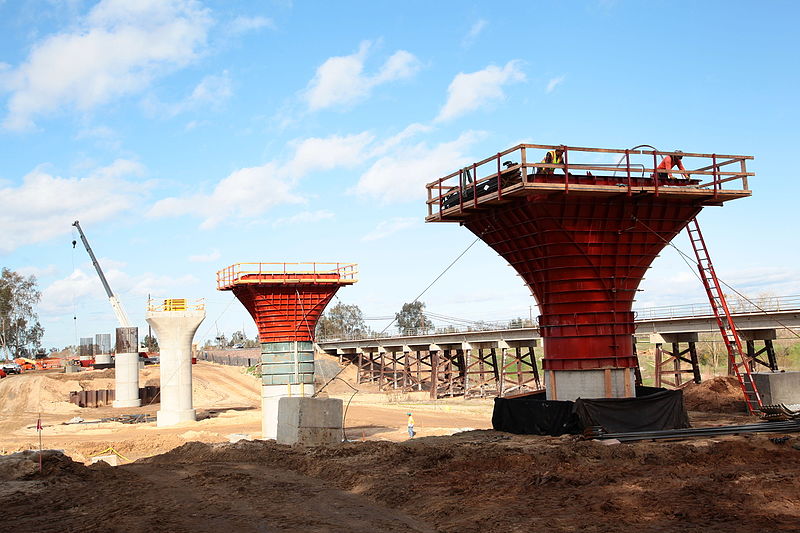
Construction of the Fresno River Viaduct in January 2016. The bridge is the first permanent structure being constructed as part of California High-Speed Rail. The BNSF Railway bridge is visible in the background.
Photo by the California High-Speed Rail Authority via Wikimedia Commons.
Sepulveda’s cost and schedule overrun aren’t even the worst of it. Just as unattainable as a shortened commute is the Californian dream of building a bullet train that could take you from Los Angeles to San Francisco in under three hours. In 2008, a year before the Sepulveda project began, the state tried to turn this dream into a reality after voters approved a 512-mile high-speed rail (HSR) project. Amid failing overseas wars and financial crises, at the time it could’ve become a symbol of renewal not just for California but the entire country. Instead, it came to exemplify a dysfunctional government that lacks the capacity to build.
At the time California began accelerating the development of its HSR system it only had 10 employees dedicated to overseeing what was the most expensive infrastructure project in U.S. history. It ended up 14 years (and counting) behind schedule and $44 billion over budget. Incredibly, the state has not laid a single mile of track and it still lacks 10 percent of the land parcels it needs to do so. Half of the project still hasn’t achieved the environmental clearance needed to begin construction. The dream of a Japanese-style bullet train crisscrossing the state is now all but dead due to political opposition, litigation, and a lack of funding.
Despite its failure, the HSR project inaugurated the U.S.’s megaproject era. Once a rare type of project, by 2018 megaprojects comprised 33 percent of the value of all U.S. construction project starts. An alarming number of these have spiraled out of control for many of the same reasons that killed the California bullet train. The decade that followed the financial crisis was a kind of inflection point in the industry; this was when construction projects became noticeably worse and when the long-term implications could no longer be ignored. One of the most cited studies of the U.S.’s declining ability to build reviewed 180 transit megaprojects across the country, revealing that today, U.S. projects take longer to complete and cost nearly 50 percent more on average than those in Europe and Canada.
Having joined Kiewit in 2010, I witnessed these changes first-hand. I have since moved on, but have remained in the broader industry, including working on what are called “strategic pursuits” — the process by which companies compete for megaprojects. This experience has provided insight into the mechanics of how these projects are awarded and why they so frequently fail.
Even if the construction had proceded close to schedule, the economic justification for California’s high speed rail line was never strong … and it’s unlikely the service would have come close to breaking even. It almost certainly would have added significant ongoing costs to Californian taxpayers, and due to the nature of high speed rail services, been effectively a subsidy from working-class Californians to the laptop elites of Los Angeles and the San Francisco Bay area.
All of that, however, are merely additional reasons to believe the project was doomed from inception. Broadly speaking, all major infrastructure projects in the United States are struggling with paperwork and compliance requirements mostly driven by state and federal environmental regulations passed with the best possible intentions (as the saying goes):
Sepulveda’s numerous lawsuits and stakeholder conflicts are an example of a phenomenon that can be traced back to the passage of the National Environmental Policy Act (NEPA) in 1969. NEPA mandates developers to provide environmental impact statements before they can obtain the permits necessary for construction on huge swathes of infrastructure.
Shortly following the passage of NEPA, California’s then-governor Ronald Reagan signed the California Environmental Quality Act (CEQA) into law, which required additional environmental impact analysis. Unlike NEPA, it requires adopting all feasible measures to mitigate these impacts. Interest groups wield CEQA and NEPA like weapons. One study found that 85 percent of CEQA lawsuits were filed by groups with no history of environmental advocacy. The NIMBY attitude of these groups has crippled the ability of California to build anything. As California Governor Gavin Newsom succinctly put it, “NIMBYism is destroying the state”.
It is also destroying the U.S.’s ability to build nationally. The economist Eli Dourado reported in The New York Times that “per-mile spending on the Interstate System of Highways tripled between the 1960’s and 1980’s.” This directly correlates with the passage of NEPA. If anything, the problem has gotten worse over time. Projects receiving funding through the $837 billion stimulus plan passed by Congress in the aftermath of the financial crises were subject to over 192,000 NEPA reviews.
The NEPA/CEQA process incentivizes the public agencies to seek what is often termed a “bulletproof” environmental compliance document to head off future legal challenges. This takes time, with the average EIS taking 4.5 years to complete. Some have taken longer than a decade. A cottage industry of consultants is devoted to completing these documents, earning themselves millions in fees.
Comments Off on (Very expensive) roads, bridges, and railways to nowhere
June 6, 2022
“I ask, sir, what is the militia? It is the whole people except for a few public officials”
George Mason, quoted in the title of this post, had a very expansive view of the US militia. Most Americans of the day did not seem to share this view, as Chris Bray explains:
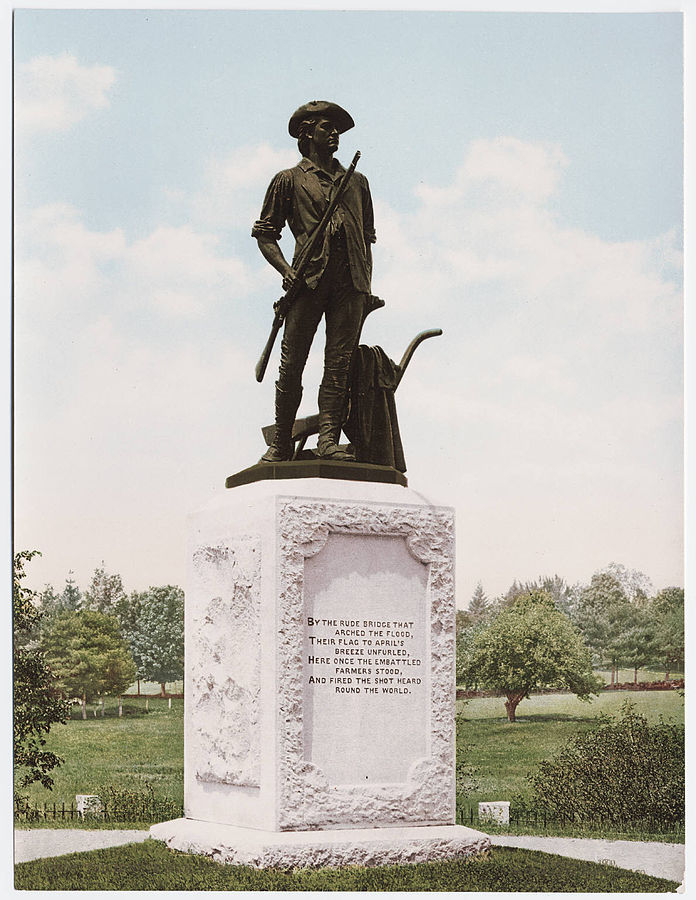
How Congress may have visualized the individual minutemen who would compose the militia of the United States after 1792.
Postcard image of French’s Concord Minuteman statue via Wikimedia Commons.
In the second Militia Act of 1792, Congress defined a uniform militia in all of the states:
That each and every free able-bodied white male citizen of the respective States, resident therein, who is or shall be of age of eighteen years, and under the age of forty-five years (except as is herein after excepted) shall severally and respectively be enrolled in the militia … That every citizen, so enrolled and notified, shall, within six months thereafter, provide himself with a good musket or firelock, a sufficient bayonet and belt, two spare flints, and a knapsack, a pouch, with a box therein, to contain not less than twenty four cartridges, suited to the bore of his musket or firelock, each cartridge to contain a proper quantity of powder and ball … and shall appear so armed, accoutred and provided, when called out to exercise or into service, except, that when called out on company days to exercise only, he may appear without a knapsack.
So, by federal law, every military-age white male in the country (except men who were exempted by the states, like clergymen) had to report to the local militia commander to be enrolled in their local company, and had to own a long list of equipment, and had to show up to train with that equipment when ordered.
They mostly didn’t. For decades, states reported their militia enrollment to the War Department, and it sometimes appeared that some states, by trying really hard, sometimes almost made it to something in the neighborhood of half participation. In 1826, the Barbour Board — named after Secretary of War James Barbour — evaluated the unmistakable failure of the federally defined uniform militia, and suggested trying again with a smaller group of select militiamen. The board’s report was universally ignored, because by 1826 the federal government, like, couldn’t even: Everyone knew the model of widely shared militia service had failed.
Historians have usually described the failure of universal white male militia service in the early republic as a top-down policy blunder in which political leaders didn’t try hard enough to make the thing work. But a marginal historian named Chris Bray, in a dissertation that generated no excitement of any kind in academia, argued that the universal white male militia obligation was doomed by something else: widespread irritation and popular resistance. The militia obligation reached into the lives of militiamen in ways they didn’t expect and wouldn’t tolerate, so they stopped showing up.
There are many different ways to tell this story, but let’s do it quickly.
Comments Off on “I ask, sir, what is the militia? It is the whole people except for a few public officials”
May 30, 2022
Technocratic meddling in developing countries at the local level
One of the readers of Scott Alexander’s Astral Codex Ten has contributed a review of James Ferguson’s The Anti-Politics Machine. The reviewer looked at a few development economics stories that illustrate some of the more common problems western technocrats encounter when they provide their “expert advice” to people in developing countries. This is one of perhaps a dozen or so anonymous reviews that Scott publishes every year with the readers voting for the best review and the names of the contributors withheld until after the voting is finished:

But even if the project was in some sense a “failure” as an agricultural development project, it is indisputable that many of its “side effects” had a powerful and far-reaching impact on the Thaba-Tseka region. […] Indeed, it may be that in a place like Mashai, the most visible of all the project’s effects was the indirect one of increased Government military presence in the region
As the program continued to unfold, the development officials became more and more disillusioned — not with their own choices, but with the people of Thaba-Tseka, who they perceived as petty, apathetic, and outright self-destructive. A project meant to provide firewood failed because locals kept breaking into the woodlots and uprooting the saplings. An experiment in pony-breeding fell apart when “unknown parties” drove the entire herd of ponies off of cliffs to their deaths. Why, Ferguson’s official contacts bemoaned, weren’t the people of Thaba-Tseka committed to their own “development”?
Who could possibly be opposed to trees and horses? Perhaps, the practitioners theorized, the people of Thaba-Tseka were just lazy. Perhaps they “didn’t want to be better”. Perhaps they weren’t in their right mind or had made a mistake. Perhaps poverty makes a person do strange things.
Or, as Ferguson points out, perhaps their anger had something to do with the fact that the best plots of land in the village had been forcibly confiscated to make room for wood and pony lots, without any sort of compensation. The central government was all too happy to help find land for the projects, which they took from political enemies and put in the control of party elites, especially when it could use a legitimate anti-poverty program as cover. In Ferguson’s words, the development project was functioning as an “anti-politics machine” the government could use to pretend political power moves were just “objective” solutions to technical problems.
A local student’s term paper captured the general discontent:
In spite of the superb aim of helping the people to become self-reliant, the first thing the project did was to take their very good arable land. When the people protested about their fields being taken, the project promised them employment. […] It employed them for two months, found them unfit for the work, and dismissed them. Without their fields and without employment they may turn up to be very self-reliant. It is rather hard to know.
Two things stand out to me from this story. First, the “development discourse” lens served to focus the practitioners’ attention on a handful of technical variables (quantity of wood, quality of pony), and kept them from thinking about any repercussions they hadn’t thought to measure.
This is a serious problem, because “negative effects on things that aren’t your primary outcome” are pretty common in the development literature. High-paying medical NGOs can pull talent away from government jobs. Foreign aid can worsen ongoing conflicts. Unconditional cash transfers can hurt neighbors who didn’t receive the cash. And the literature we have is implicitly conditioned on “only examining the variables academics have thought to look at” — surely our tools have rendered other effects completely invisible!
Second, the project organizers somewhat naively ignored the political goals of the government they’d partnered with, and therefore the extent to which these goals were shaping the project.
Lesotho’s recent political history had been tumultuous. The Basotho Nationalist Party (BNP), having gained power upon independence in 1965, refused to give up power after losing the 1970 elections to the Basotho Congress Party (BCP). Blaming the election results on “communists”, BNP Prime Minister Leabua Jonathan declared a state of emergency and began a campaign of terror, raiding the homes of opposition figures and funding paramilitary groups to intimidate, arrest, and potentially kill anyone who spoke up against BNP rule.
This had significant effects in Thaba-Tseka, where “villages […] were sharply divided over politics, but it was not a thing which was discussed openly” due to a fully justified fear of violence. The BNP, correctly sensing the presence of a substantial underground opposition, placed “development committees” in each village, which served primarily as local wings of the national party. These committees spied on potential supporters of the now-outlawed BCP and had deep connections to paramilitary “police” units.
When the Thaba-Tseka Development Project started, its international backers partnered directly with the BNP leadership, reasoning that sustainable development and public goods provision could only happen through a government whose role they primarily viewed as bureaucratic. As a result, nearly every decision had to make its way through the village development committees, who used the project to pursue their own goals: jobs and project funds found their way primarily to BNP supporters, while the “necessary costs of development” always seemed to be paid by opposition figures.
The funding coalition ended up paying for a number of projects that reinforced BNP power, from establishing a new “district capital” (which conveniently also served as a military base) to constructing new and better roads linking Thaba-Tseka to the district and national capitals (primarily helping the central government tax and police an opposition stronghold). Anything that could be remotely linked to “economic development” became part of the project as funders and practitioners failed to ask whether government power might have alternate, more concerning effects.
As we saw earlier, the population being “served” saw this much more clearly than the “servants”, and started to rebel against a project whose “help” seemed to be aimed more at consolidating BNP control than meeting their own needs. When they ultimately resorted to killing ponies and uprooting trees, project officials infatuated with “development” were left with “no idea why people would do such a thing”, completely oblivious to the real and lasting harm their “purely technical decisions” had inflicted.
Comments Off on Technocratic meddling in developing countries at the local level
May 27, 2022
Minoru Yamasaki and the Pruitt–Igoe urban housing project
Joseph Kast recounts the story of a post-war government scheme to demolish slums, re-house the slum-dwellers in a massive public housing project and the architect whose career was forever blighted by the failure of the design:
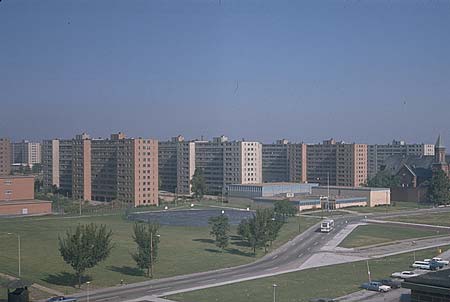
An undated overview of some of the 33 buildings of the Pruitt-Igoe complex in St. Louis, Missouri. Designed by Japanese-American architect Minoru Yamasaki and built in the early 1950s. All had been demolished by 1976.
Uncredited photo from Wikimedia Commons.
Can society be designed? Can an expert engineer alleviate people’s pains and struggles with a good-enough central plan and blueprint?
Minoru Yamasaki thought so.
Yamasaki was one of America’s most well-respected architects in the 20th century and was a member of the school of thought that people’s human nature could be improved (whether those people needed or wanted improving) by a properly planned building surrounding them.
Yamasaki got to test his theory by designing the public housing complex that promised to be a template for all public housing going forward. The complex, St. Louis’ Pruitt-Igoe, was made possible by post-war New Deal housing and urban development programs. And like many New Deal initiatives, Pruitt-Igoe was guided by the idea that good intentions, centralized planning, and strong government power would progress society more than protecting people’s rights or personal choices.
Pruitt-Igoe and Yamasaki’s designs were sold as the solution to poverty, crime, and housing in America’s major cities, but within just a few years, the complex would show the dangerous consequences when government planners take away people’s liberties and homes.
As with so many vast schemes to use the government’s power to reshape people’s lives, the hopes of the central planners quickly fell afoul of economic and social realities that the plan never took into account.
St. Louis quickly realized that Pruitt-Igoe was a problem. But it was unclear who, if anyone, could fix it. The federal government, the St. Louis Housing Authority, the state, and the City of St. Louis itself all shared responsibility for the complex. When a problem belongs to everyone, it belongs to no one.
Within five years of its launch, Yamasaki was regularly apologizing for his role in the project. Though the final design of the complex differed from his original vision, he came to question the core assumption behind the project: that people’s lives could be effectively engineered through urban design. He expressed regret for his “deplorable mistakes” with Pruitt-Igoe. By the late 1950s, he was giving eloquent speeches about the “tragedy of housing thousands in exactly look alike cells,” which “certainly does not foster our ideals of human dignity and individualism.”
To the Detroit Free Press, he put it more simply: “Social ills can’t be cured by nice buildings.”
By the early 1970s, the 33 concrete tombstones lining St. Louis’ skyline were a cautionary tale for utopian housing schemes. It was a den of crime and misery, rather than anything anyone could call home. When the decision came to demolish the complex, occupancy was only 10 percent.
The day the demolitions began at Pruitt-Igoe, architectural historian Charles Jencks declared the death of high modernist architecture and its grand assumptions: “It was finally put out of its misery. Boom, boom, boom.”
Three towers were demolished in 1972. The last tower finally came down in 1976, leaving nothing of Pruitt-Igoe behind.
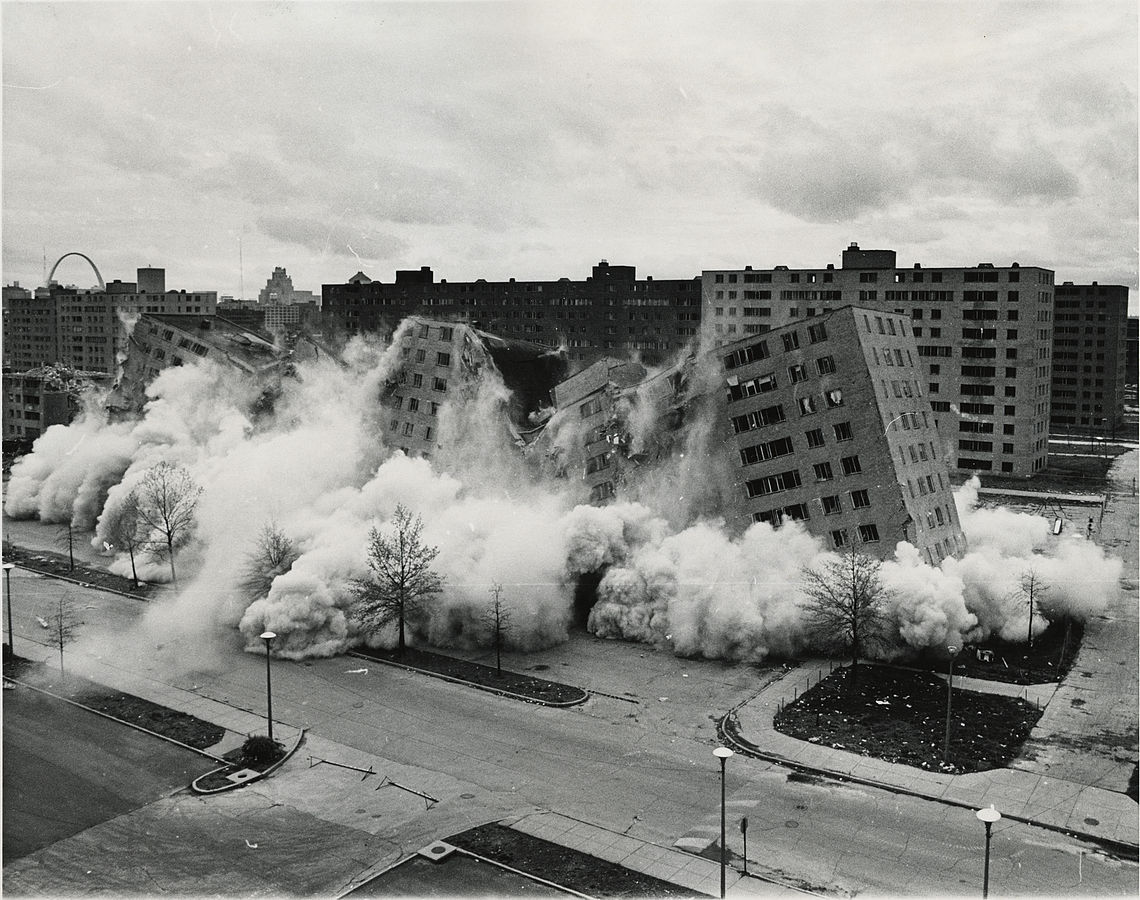
The demolition of one of the Pruitt-Igoe buildings, which began in 1972 with the final building demolished in 1976.
Uncredited image from Wikimedia Commons.
Comments Off on Minoru Yamasaki and the Pruitt–Igoe urban housing project
April 30, 2022
God Help These British Agents – WW2 – Spies & Ties 16
World War Two
Published 28 Apr 2022We’ve seen it time and time again in this war. Supposed Allies arguing with each other instead of fighting the enemy. But when SOE and MI6 begin vying for leadership of Britain’s secret war, it’s more than cross words. Now there are lives at stake.
(more…)
Comments Off on God Help These British Agents – WW2 – Spies & Ties 16
April 21, 2022
L8(T) Enfield: The British Army Fails to Make a Sniper
Forgotten Weapons
Published 14 Dec 2021http://www.patreon.com/ForgottenWeapons
https://www.floatplane.com/channel/Fo…
Cool Forgotten Weapons merch! http://shop.forgottenweapons.com
We looked at the 7.62mm conversion of the No4 Enfield into Rifle L8 yesterday. Part of that program was an attempt to develop a new sniper rifle on the L8 platform. To this end, six good-quality No4(T) Lee Enfield sniper rifles were tested for accuracy, then made into L8 rifles and fitted with No.32 telescopic sights (the standard scope from the .303 days) and tested for accuracy again. Much to the chagrin of the Army, the new L8(T) rifles were barely able to match the performance of the .303 rifles they began as. The goal was to significantly improve on the No4(T) accuracy, and that was clearly not happening.
However, at this same time, British civilian competition shooters were having excellent success making 7.62mm versions of the No4. It was only when Enfield was willing to collaborate with the British NRA and others that they were able to successfully create the L42A1 rifle, which at last met the accuracy goals of the program.
The rifle we are looking at today is one of those original six trials L8(T) rifles. Many thanks to the generous collector who allowed me to film it for you!
Contact:
Forgotten Weapons
6281 N. Oracle 36270
Tucson, AZ 85740

Comments Off on L8(T) Enfield: The British Army Fails to Make a Sniper
March 15, 2022
For military procurement blunders, “no nation has mastered the ability to step on every bloody rake quite as well as Canada”
Germany has announced that they will be purchasing US F-35 stealth fighters as part of their re-armament program. My favourite headline on this was over at Blazing Cat Fur: “Germany To Buy 35 Lockheed F-35 Fighter Jets From U.S. Amid Ukraine Crisis … Canada Will Buy Cool ‘Fighter Jet Stickers’ With Eco-Friendly Adhesive”
On a more serious tone — but with sadly the same basic message — Mitch Heimpel looks at the multi-generational rolling catastrophe that is Canadian military procurement since the unification of the forces in 1968:

Browning High Power 9mm, the standard side-arm of the Canadian army since WW2. When I was in the reserves, we were told this was due for replacement in a few years. I was in the reserves from 1976-1980. It still hasn’t been replaced.
To say we have a checkered history with military procurement, fails to capture exactly how bad it is. Our political leadership has failed us continually over the course of half a century. No party has done it well. Some have done it better than others. But no one can claim any kind of bragging rights.
Fighter jet procurement in this country is so fraught it once caused the birth of a new political party. Trying to buy helicopters helped bring down a government. We only successfully bought those helicopters after they [the old helicopters] became a greater danger to the personnel manning them than they were to any potential adversary. We have been running a procurement for the next generation of fighter jets for an entire generation. Even Yes, Minister writers would have given up on something that absurd.
Our submarine fleet seems to be almost permanently in dry dock. Our most recent ship procurement resulted in the absolutely monstrous prosecution of one of the country’s most accomplished military leaders.
And we just issued a revised bid to finally replace our Second World War-era pistols … last week.
Just cataloguing that level of incompetence is exhausting. No leader or party looks good. The civil service, as the one constant through all these cartoonish blunders, surely has to wear some of this, too. The fact that we seem to repeat the same mistakes can, at least in part, be attributed to a significant institutional memory failure on the part of the people trusted with having the institutional memory.
Now, it is worth noting in fairness that no nation has an easy time with large scale military procurement. Ask the Americans about the development of the V-22 sometime. But, still, no nation has mastered the ability to step on every bloody rake quite as well as Canada.
I’m not a hardware expert. I can’t tell you which pistol we should buy. There’s also genuine policy questions here that need to be settled — I don’t know whether we should focus on the navy because we’re an Arctic nation, or the air force because it allows us to participate more readily in allied force projection exercises — like, say, no-fly zones? The necessary mix for Canada is no doubt some of both, and it’s fine to have disagreements between parties on what the right mix is.
But setting that aside, I want to talk about what it would take politically, to get us to start taking procurement seriously — just a few basic rules that any government would need to follow to procure anything that they chose was important for Canada to have.

Comments Off on For military procurement blunders, “no nation has mastered the ability to step on every bloody rake quite as well as Canada”
February 21, 2022
OSS Flying Dragon: A Silent Poisoned Dart Gun
Forgotten Weapons
Published 7 Apr 2018The OSS experimented with a lot of … unorthodox weapons during World War Two, and one of their overarching goals was a weapon with a 100 yard lethal range but without flash or noise. To this end they experimented with a number of suppressed firearms as well as weird stuff like various crossbow designs, silenced dart gun pistol conversions, and in this case a CO2 powered dart gun. It was code-named the Flying Dragon, and first mentioned in documents in 1943. In the summer of 1945, 15 were manufactured, and 12 of these remained in OSS stocks at the end of the war.
In July 1945 testing, the Flying Dragon was found the be the second-quietest option (the William Tell crossbow was quieter, at 66 decibels to the Dragon’s 69 decibels). However, the testing board noted that a simple suppressed .22 pistol was pretty much just as good, and quite a lot cheaper (and more reliable, I would expect). The problem with a dart gun like this one is that if it is not reliably lethal, the whole point of it being silenced is lost. Anyone shot by that big dart and not killed by it (which would require a pretty significant muzzle velocity) will immediately start making a heck of a lot of noise. OSS investigated options for poison on the darts to give the weapon the necessary lethality, but was unable to find a suitable solution. This led to discussion of using a small hypodermic syringe as a projectile, an even less practical idea — but this was the freewheeling OSS, where such things were not uncommon to consider.
http://www.patreon.com/ForgottenWeapons
Cool Forgotten Weapons merch! http://shop.bbtv.com/collections/forg…
If you enjoy Forgotten Weapons, check out its sister channel, InRangeTV! http://www.youtube.com/InRangeTVShow
Contact:
Forgotten Weapons
6281 N Oracle #36270
Tucson, AZ 85704

Comments Off on OSS Flying Dragon: A Silent Poisoned Dart Gun
January 31, 2022
The Ram | Canada’s Most Successful Failure
Red Wrench Films
Published 4 Dec 2020A Canadian Franken-tank that pre-dated the M4 Sherman, the Ram would be an icon of Canada’s industry in the early war years. Ultimately a failure as a battle tank, variants of the vehicle would see combat in Normandy and beyond, as the Kangaroo APC which revolutionised mechanised warfare in 1944 and 1945.
Any feedback is greatly appreciated, I’m always trying to improve.
Any suggestions for the next video? Leave it down in the comments or message me. 🙂
((Like and subscribe))
Please note that the footage I can find on these vehicles is scarce and sometimes the video will not match properly or will perhaps be slightly inaccurate.
Sources:
https://tanks-encyclopedia.com/ww2/ca…
https://www.dday-overlord.com/en/mate…
https://www.friends-amis.org/index.ph…
http://panzerserra.blogspot.com/2015/…Intuit256 by Kevin MacLeod is licensed under a Creative Commons Attribution 4.0 licence. https://creativecommons.org/licenses/…
Source: http://incompetech.com/music/royalty-…
Artist: http://incompetech.com/

Comments Off on The Ram | Canada’s Most Successful Failure


