
Published on 20 Feb 2015
Welcome to IT’S HISTORY! We are kicking off this new history channel by taking you on a journey through the Industrial Revolution. In our first episode about INVENTIONS, Brad Explains everything about the history of the light bulb – it was a long way from the discovery of fire till the first electrical lightning. Learn who else, besides Thomas Alva Edison and Nikola Tesla helped form the technology that illuminates our nights to this day!
March 4, 2017
Let There Be Light – The Invention Of The Light Bulb I THE INDUSTRIAL REVOLUTION
Comments Off on Let There Be Light – The Invention Of The Light Bulb I THE INDUSTRIAL REVOLUTION
January 25, 2017
QotD: Microfibres and innovation
New and improved fabric technologies haven’t attracted public enthusiasm since the backlash against leisure suits and disco shirts made synthetics declassé in the early 1980s. ‘Pity poor polyester. People pick on it,’ wrote The Wall Street Journal’s Ronald Alsop in 1982, describing DuPont’s efforts to rehabilitate the fibre’s image.
What ended the consumer hatred of polyester wasn’t a marketing campaign. It was a quiet series of technical innovations: the development of microfibres. These are synthetics, most often polyester or nylon, that are thinner than silk and incredibly soft, as well as lightweight, strong, washable and quick-drying. Their shapes can be engineered to control how water vapour and heat pass through the fabric or to create microcapsules to add sunscreen, antimicrobial agents or insect repellent. Over the past decade, microfibres have become ubiquitous; they’re found in everything from wickable workout wear to supersoft plush toys.
Microfibres are one reason the ‘air-conditioned’ fabrics Loewy and his fellow designers foresaw in 1939 have finally come to pass. These fabrics just aren’t promoted in the pages of Vogue or highlighted on the racks at Banana Republic. They don’t attract attention during New York Fashion Week. Their tribe gathers instead at the big Outdoor Retailer trade shows held twice a year in Salt Lake City. There, outdoor-apparel makers and their suppliers tout textiles that keep wearers warm in the cold and cool in the heat; that block raindrops but allow sweat to escape; that repel insects, screen out UV rays and control odour. By establishing that truly weather-resistant fabrics were possible, Gore-Tex (first sold in 1976) and Polartec synthetic fleece (1979) created an industry where engineers now vie to find ever-better ways to conquer the elements. For instance, ‘smart textiles’ originally developed for spacesuits use microencapsulated materials that melt when they get hot, keeping wearers comfortable by absorbing body heat; when temperatures fall, the materials solidify and warm the body.
[…]
Looking forward, academic researchers have bigger things in mind. Noting that ‘a large portion of energy continues to be wasted on heating empty space and non‑human objects,’ the materials scientist Yi Cui and his colleagues at Stanford envision replacing central heating systems with ‘personal thermal management’, using breathable fabrics coated in a solution of silver nanowires. The fabrics not only trap body heat: given an imperceptible bit of electric charge, they can actually warm the skin.
Other scientists are looking at ways to make fabric turn body heat or motion into usable energy for low-powered electronics. And some hope to make the temperature-regulating effects of smart textiles work without liquids, whose microencapsulation requires substantial energy use. Shifting the focus from outdoor leisure to indoor life – from fighting the elements to everyday energy use and climate control – dramatically reframes several decades of fabric advances, making textiles part of a larger story about energy and the environment.
Virginia Postrel, “Losing the Thread: Older than bronze and as new as nanowires, textiles are technology — and they have remade our world time and again”, Aeon, 2015-06-05.
Comments Off on QotD: Microfibres and innovation
January 23, 2017
Ironclads The Great Ships Broadside Collection History Channel Documentary
Published on 13 Oct 2015
Covering some of the same territory is my post on British battleship design from the end of the Napoleonic era to the 1880s.
Comments Off on Ironclads The Great Ships Broadside Collection History Channel Documentary
January 21, 2017
QotD: 1815’s other triumph
[In] 1815, George Stephenson, a humble, self-taught engine-wright with an impenetrable Geordie accent (to which he probably gave the name), put together all the key inventions that — at last — made steam locomotion practicable: the smooth wheels, counter-intuitively less likely to slip if heavily laden; the steam-blast into the chimney to accelerate the draught over the coals; the vertical cylinders connecting directly with the wheels; the connecting rods between the wheels. A year later came his redesign of rails themselves, then later his multi-tubular boiler.
As his biographer, Samuel Smiles, put it:
“Thus, in the year 1815, Mr Stephenson, by dint of patient and persevering labour … had succeeded in manufacturing an engine which … as a mechanical contrivance, contained the germ of all that has since been effected. It may in fact be regarded as the type of the present locomotive engine.”
Suddenly the movement of goods and people fast and cheaply over long distances became possible for the first time.
Not content with that, in 1815 Stephenson also invented the miner’s safety lamp (though snobbish London grandees, unable to conceive that such a humble man could have done so, gave and have continued to this day to give the credit to Sir Humphry Davy). The year of Waterloo was an annus mirabilis of the industrial revolution, putting Britain on course to dominate and transform the world, whether we beat Boney or not. Steam, followed by its offspring internal combustion and electricity, would catapult humankind into prosperity.
Incidentally, there is a tenuous connection between Napoleon and Stephenson. If Bonaparte’s conquests and the corn laws had not driven up the price of corn, then horse feed would have been cheaper and the coal owners who employed Stephenson would not have risked so much money in letting him build a machine to try to find a less expensive way to pull wagons of coals from the pithead in Killingworth to the staithes on the Tyne.
Matt Ridley, “Waterloo or railways”, Matt Ridley Online, 2015-06-18.
Comments Off on QotD: 1815’s other triumph
January 16, 2017
“Crafting. Needs. To. End. It is ruining gaming”
John Ringo posted this on Facebook, and while I don’t play the particular games he references, I’m also finding that in-game crafting (which seemed like such a cool idea when I first heard of it) is really just an extended PITA:
Comments Off on “Crafting. Needs. To. End. It is ruining gaming”
November 27, 2016
QotD: Fabric as technology
In February 1939, Vogue ran a major feature on the fashions of the future. Inspired by the soon-to-open New York World’s Fair, the magazine asked nine industrial designers to imagine what the people of ‘a far Tomorrow’ might wear and why. (The editors deemed fashion designers too of-the-moment for such speculations.) A mock‑up of each outfit was manufactured and photographed for a lavish nine-page colour spread.
You might have seen some of the results online: an evening dress with a see-through net top and strategically placed swirls of gold braid, for instance, or a baggy men’s jumpsuit with a utility belt and halo antenna. Bloggers periodically rediscover a British newsreel of models demonstrating the outfits while a campy narrator (‘Oh, swish!’) makes laboured jokes. The silly get‑ups are always good for self-satisfied smirks. What dopes those old-time prognosticators were!
The ridicule is unfair. Anticipating climate-controlled interiors, greater nudity, more athleticism, more travel and simpler wardrobes, the designers actually got a lot of trends right. Besides, the mock‑ups don’t reveal what really made the predicted fashions futuristic. Looking only at the pictures, you can’t detect the most prominent technological theme.
‘The important improvements and innovations in clothes for the World of Tomorrow will be in the fabrics themselves,’ declared Raymond Loewy, one of the Vogue contributors. His fellow visionaries agreed. Every single one talked about textile advances. Many of their designs specified yet-to-be-invented materials that could adjust to temperature, change colour or be crushed into suitcases without wrinkling. Without exception, everyone foretelling the ‘World of Tomorrow’ believed that an exciting future meant innovative new fabrics.
They all understood something we’ve largely forgotten: that textiles are technology, more ancient than bronze and as contemporary as nanowires. We hairless apes co-evolved with our apparel. But, to reverse Arthur C Clarke’s adage, any sufficiently familiar technology is indistinguishable from nature. It seems intuitive, obvious – so woven into the fabric of our lives that we take it for granted.
Virginia Postrel, “Losing the Thread: Older than bronze and as new as nanowires, textiles are technology — and they have remade our world time and again”, Aeon, 2015-06-05.
Comments Off on QotD: Fabric as technology
October 14, 2016
QotD: You can’t fix network security by changing the users
Every few years, a researcher replicates a security study by littering USB sticks around an organization’s grounds and waiting to see how many people pick them up and plug them in, causing the autorun function to install innocuous malware on their computers. These studies are great for making security professionals feel superior. The researchers get to demonstrate their security expertise and use the results as “teachable moments” for others. “If only everyone was more security aware and had more security training,” they say, “the Internet would be a much safer place.”
Enough of that. The problem isn’t the users: it’s that we’ve designed our computer systems’ security so badly that we demand the user do all of these counterintuitive things. Why can’t users choose easy-to-remember passwords? Why can’t they click on links in emails with wild abandon? Why can’t they plug a USB stick into a computer without facing a myriad of viruses? Why are we trying to fix the user instead of solving the underlying security problem?
Bruce Schneier, “Security Design: Stop Trying to Fix the User”, Schneier on Security, 2016-10-03.
Comments Off on QotD: You can’t fix network security by changing the users
August 16, 2016
Austro-Hungarian Pistols of WW1 I THE GREAT WAR Special feat. C&Rsenal
Published on 15 Aug 2016
Check out Othais channel C&Rsenal to learn all about the history of WW1 firearms: https://www.youtube.com/c/candrsenal
We partnered with Othais again a few months ago for a livestream showing the Austro-Hungarian weapons of WW1. This is the 2nd episode about the surprising variety of pistols.
Comments Off on Austro-Hungarian Pistols of WW1 I THE GREAT WAR Special feat. C&Rsenal
May 22, 2016
Perhaps the US Navy can learn from Denmark on getting the “Little Crappy Ships” right
On the National Interest Blog, James Hasik points out that the idea of the Littoral Combat Ships of the US Navy was successfully implemented more than twenty years ago (and much more economically, too):
In contrast, we know it’s possible to get modularity right, because the Royal Danish Navy has been getting it right since the early 1990s. Way back in 1985, Danyard laid down the Flyvefisken (Flying Fish), the first of a class of 14 patrol vessels. The ships were intended to fight the Warsaw Pact on the Baltic — a sea littoral throughout, with an average depth of 180 feet, and a width nowhere greater than 120 miles. Any navy on its waters might find itself fighting surface ships, diesel submarines, rapidly ingressing aircraft, and sea mines in close order. On the budget of a country of fewer than six million people, the Danes figured that they should maximize the utility of any given ship. That meant standardizing a system of modules for flexible mission assignment. The result was the Stanflex modular payload system.
At 450 tons full load, a Flyvefisken is much smaller than a Freedom (3900 tons) or an Independence (3100 tons). Her complement is much smaller too: 19 to 29, depending on the role. At not more than 15 tons, the Stanflex modules are also smaller than the particular system designed anew for the LCSs. But a Flyvefisken came with four such slots (one forward, three aft), and a range of modules surprisingly broad […]
Swapping modules pier-side requires a few hours and a 15-ton crane. Truing the gun module takes some hours longer. Retraining the crew is another matter, but modular specialists can be swapped too. The concept has had some staying power. The Flyvefiskens served Denmark as recently as 2010. In a commercial vote of confidence, the Lithuanian Navy bought three secondhand, and the Portuguese Navy four (as well as a fifth for spare parts). Over time, the Royal Danish Navy has provided Stanflex slots and modules to all its subsequent ships: the former Niels Juel-class corvettes, the Thetis-class frigates, the Knud Rasmussen-class patrol ships, the well-regarded Absalon-class command-and-support ships, and the new Ivar Huitfeldt-class frigates.
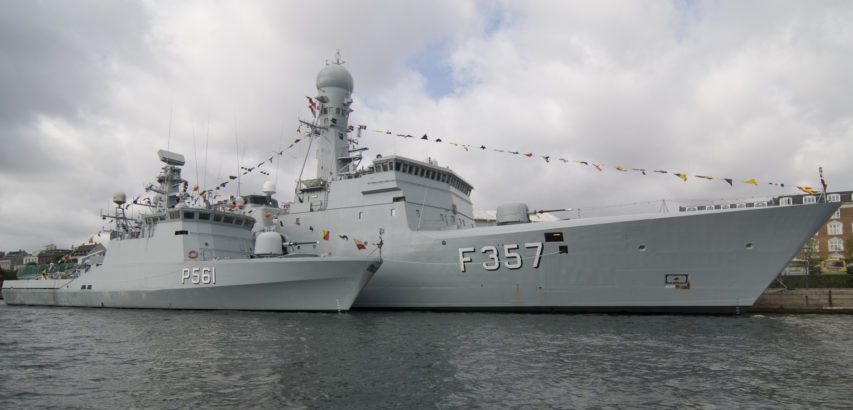
Flyvefisken-class patrol ship HDMS Skaden (hull number P561) and HDMS Thetis (F357) in Copenhagen (via WikiMedia)
In short, 25 years ago the Danes figured out how a single ship could hunt and kill mines, submarines and surface ships. A small ship can’t do all those things well at once, but that’s a choice in fleet architecture. Whatever we think of the LCS program, we shouldn’t draw the wrong lessons from it. Why is this important? Modularity is economical, as the Danes have long known. Critically, modularity also lends flexibility in recovering from wartime surprise, in that platforms can be readily provided new payloads without starting from scratch. Because on December the 8th, when you need a face-punched plan, you’d rather be building new boxes than new whole new ships.
Wikipedia has this image of the HDMS Iver Huitfeldt:

HDMS Iver Huitfeldt during a port visit in Århus, 20 January 2012
Comments Off on Perhaps the US Navy can learn from Denmark on getting the “Little Crappy Ships” right
April 11, 2016
Clarkson’s Car Years – How Japan Took Over The World… And Then Lost It.
Comments Off on Clarkson’s Car Years – How Japan Took Over The World… And Then Lost It.
April 4, 2016
Inventions That Changed the World – The Gun
Comments Off on Inventions That Changed the World – The Gun
December 2, 2015
Can the Royal Navy fund a “cheap and cheerful” frigate?
In the most recent British government SDSR plan, the Royal Navy’s hopes to get 13 new Type 26 frigates have been trimmed down to only eight. Save the Royal Navy speculates on developing a cheaper ship design that could perhaps fill the gap:
Is it really possible to produce a fully effective frigate that is significantly cheaper than a T26? Let us call it the ‘Type 31’, It still requires point defence missiles, anti-ship weaponry, a hangar and small flight deck (even if only for a UAV or Lynx size helicopter), plus a command and control system and suite of sensors. Although the hull size could be reduced, a simpler propulsion system used and the anti-submarine capability eliminated or reduced. You might cut the cost by 30%, and get a general purpose ship but there is still the cost of developing a new design. (At least £200M has already been spent on the T26 design as well as various development ‘blind alleys’ along the way.) A second frigate type will also need its own equipment support logistics and training pipelines.
The desire to create an exportable frigate is laudable but will we not be re-inventing the wheel when there are already cheaper foreign designs that could be licensed or adapted. The highly successful German MEKO design and the Danish Stanflex system are good examples.
If your warship is designed to cope in high-intensity conflict then it will need expensive weapons and sensors. Today’s generation of supersonic anti-ship missiles are truly formidable. Modern surface ships face greater and more diverse threats than ever. To counter this requires good sensors, agile missiles and an array of decoys, backed up by last-ditch close in weapon systems (CIWS). Although the general purpose frigate may not be dedicated to hunting submarines, it will still need a decent sonar to give some hope of prosecuting a submarine or detecting and avoiding torpedo attack. Submarines are also getting more and more stealthy with a growing arsenal of weapons. Without quiet propulsion and sophisticated sonars (i.e. towed arrays) that can detect threats at range and helicopters to attack, the Type 31 could ‘just be another target’.
If your escorts are really going to escort anything eg. an aircraft carrier or merchant shipping, then it needs more than just last-ditch self-defence weapons. A Phalanx CIWS may defend the ship it is mounted on, but it is little use protecting another vessel. If the escort ship can only defend itself, it has very limited use or must be permanently on the offensive. The Sea Ceptor being fitted to the Type 23 and Type 26 frigates has the major advantage over the Sea Wolf it replaces by having more than double the range (around 25Km), significantly extending the size of the protection umbrella over ships being escorted. Frigates are traditionally built to hunt submarines, if our Type 31 has no real ASW capability then it is pretty limited in a wartime role.
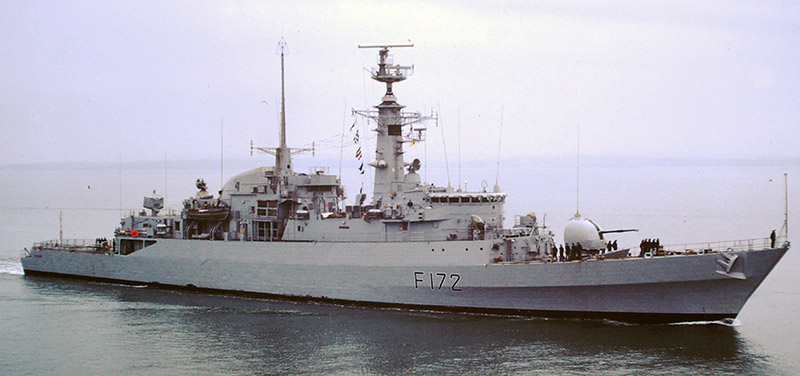
Sleek, fast and loved by their crews, the Type 21 was the poster child for the cheap frigate. There is a very fine line between a successful ‘less capable, cheaper frigate’ and a compromised warship design that becomes a liability. The Type 21 Frigate design of the 1970s was designed by a private company and accepted by the RN as a way to get a modern and affordable frigate to sea. Unfortunately when tested in the heat of the Falklands war their deficiencies became obvious. A top-heavy design on a lightweight hull, they suffered structural problems in the prolonged South Atlantic operations. They were also inadequately armed and suffered accordingly. God help them if they had gone up against Soviet aircraft or missiles. Ironically the surviving Type 21s still soldier on today in the Pakistani navy. Upgraded with a Phalanx system and Chinese SAMs / Harpoon missiles they are now slightly more potent.
Comments Off on Can the Royal Navy fund a “cheap and cheerful” frigate?
November 6, 2015
The evolution of the Royal Navy’s ship designs
This post is a nice summary of the Royal Navy’s frigates, destroyers, and cruisers from the Second World War through to the present day:
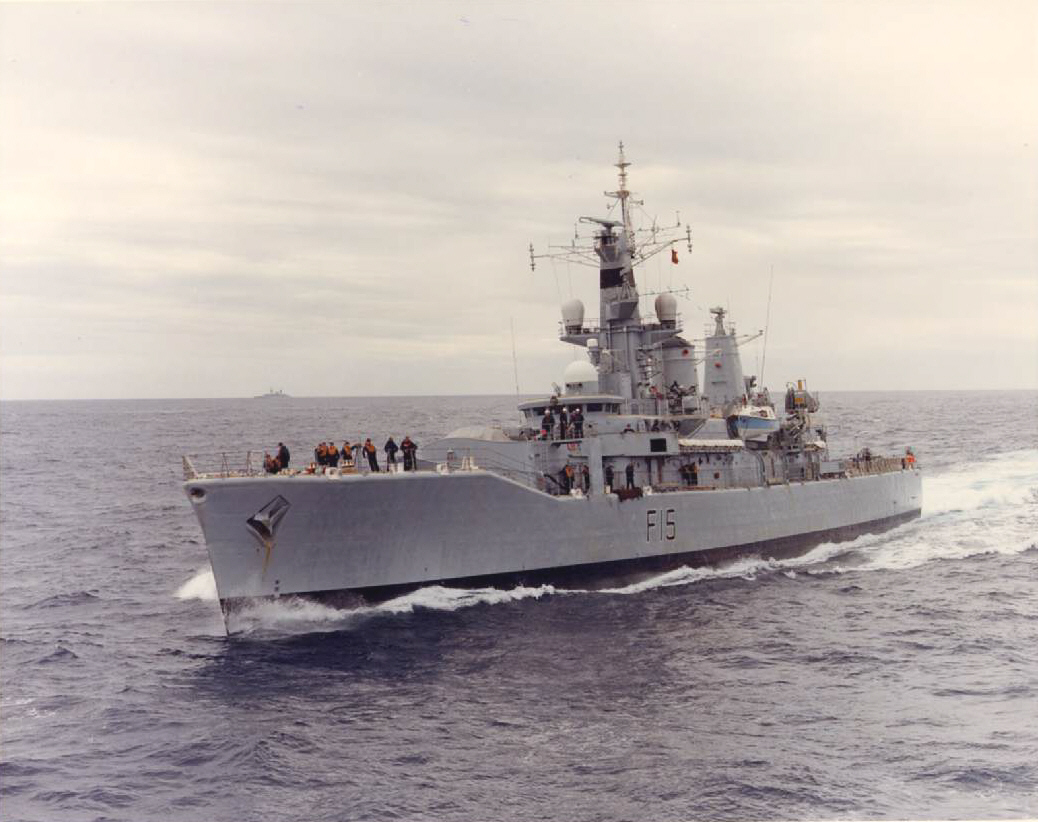
Before the Second World War the RN was predominantly a “cruiser navy”, holding down a range of global deployments with its 15 heavy and 41 light cruisers. These ships had endurance and combat power at the core of their designs, each could operate alone for extended periods, effectively defend itself in most circumstances and demonstrate the interest or resolve of the government in a particular region. The ensuing World War and the Cold War radically changed the type of warships the RN needed. Instead of cruisers built for endurance and complex warfighting the navy built a profusion of smaller frigates and destroyers, mainly to guard convoys and fight submarines close to the UK and in the North Atlantic. To carry out these tasks the navy could make do with smaller, cheaper, ships with relatively shorter legs and far less ability to act independently in high threat environments. Trade-offs like these were made in order to ensure the navy got enough escorts to protect the convoys which would be vital to Britain’s survival in the event of a war; and to hunt the Soviet ballistic missile submarines that threatened NATO. These were ships designed to act as part of a military system that would defeat the threat posed by hostile submarines. This system also included land based aircraft, anti submarine helicopters, aircraft and helicopter carriers and the enormous US/NATO SOSUS fixed sonar array. The Leander class is probably the most famous example of these sort of light frigates, operated by the RN into the early 1990s. When the immediate and pressing threat from submarines operating in the North Atlantic, be they German or Soviet, ceased to exist so the naval forces the UK had constructed to defeat them also fell by the wayside. These ships were, broadly speaking, a product of their time and a deviation from the much older structure that had served the RN well for centuries. This structure consisted of a core “battle fleet”, made up of capital ships; mainly there to act as a deterrent, supported by powerful forward deployed cruisers that conducted most of the day to day activity.
HMS Euryalus, one of 26 Leander Class frigates built for the RN
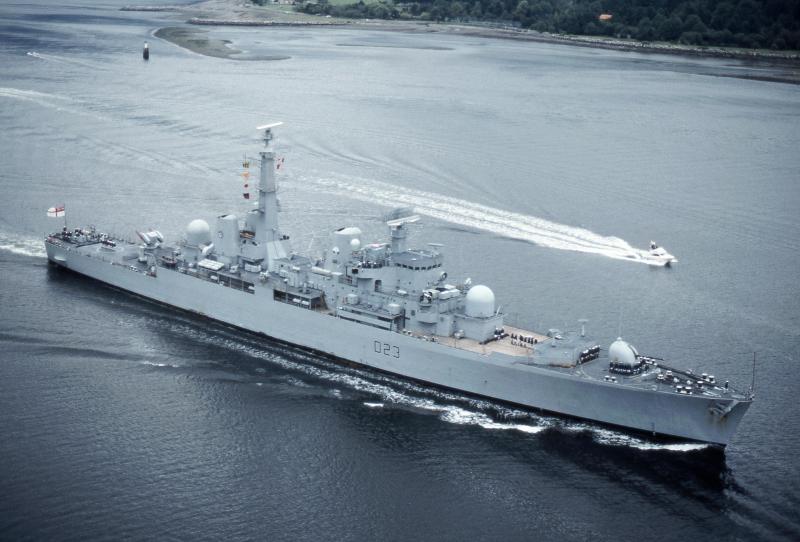
By modern standards almost all of the cheap and numerous frigates and destroyers of the past, even the excellent Leanders, would be classed as lightly armed corvettes. The simple fact was that these cheap and numerous ships sacrificed a lot of capability in order to achieve the affordability necessary to build them in numbers. They were still recognisable as frigates built in the convoy escort mold. Similarly the Type 42 anti-aircraft warfare destroyers, in service from the mid-1970s, were also a design that compromised range and armament for numbers. At only 3500 tonnes the Batch 1 Type 42s were clearly a very light and economical design. When compared with their American counterparts, the 8000 tonne Spruance class, it’s clear that these ships sacrificed range and armament for economy and numbers. Both the Leanders and the Type 42s are recognisable as frigates and destroyers, light warships designed to act in groups and alongside other warships, auxiliaries and aircraft to be effective in combat. The closest the RN came to “cruiser” designs during the Cold War were the eight County Class missile destroyers commissioned in the early 1960s and HMS Bristol, the sole survivor of the pre-1968 carrier escort programme. While these destroyer classes were cruiser-like in some aspects, they carried a far more comprehensive armament and had a greater range (in terms of fuel) than their contemporaries, they lacked the self-sustainment ability, protection, survivability and range of “true” cruisers. While Bristol was initially labelled a light cruiser by Jane’s, the Royal Navy always saw her for what she was: an oversize missile destroyer with the similar limitations to the navy’s other destroyers.
HMS Bristol, the closest the RN came to a new cruiser during the Cold War
With the later Type 22 and 23 frigates the RN moved to fewer, more individually capable, platforms. This change was partly necessitated by the introduction of a new generation of bigger towed array sonars which required larger ships to operate effectively. Despite their greatly improved self defence ability, achieved by fitting the Sea Wolf point defence missile system, these ships were still designed to be expendable escorts and lacked the endurance of cruisers. That said, these two classes signalled the start of the navy’s shift from a fleet of numerous, small and cheap escorts to fewer, larger ships capable of independent operations in a high threat environment.
Comments Off on The evolution of the Royal Navy’s ship designs
May 13, 2015
Driving a Dymaxion replica … Buckminster Fuller’s 1933 car of the future
Published on 24 Apr 2015
Buckminster Fuller’s 1933 foray into automobiles gave us the Dymaxion Car, and enthusiast Jeff Lane has one of the only working replicas in the world. WSJ‘s Rumble Seat columnist Dan Neil takes the road zeppelin for a spin…or should we say wobble?
H/T to Open Culture for the link … and do at least check out the over-the-top trailer for The Last Dymaxion on Facebook.
Comments Off on Driving a Dymaxion replica … Buckminster Fuller’s 1933 car of the future
December 27, 2014
The Railroad Signal – New York Central Railroad Educational Documentary 1948
Uploaded on 30 Nov 2011
New York Central Railroad Educational Documentary from 1948 that gives an overview of railroad signals and related safe working infrastructure used by trains, as well as the ongoing improvements to the signalling systems due to technological advances.
The film was released as part of the NYC’s “Running the Railroad” series, and features many examples of different signalling systems in use by the New York Central Railroad, as well as lots of scenes of passenger and freight trains. .
Comments Off on The Railroad Signal – New York Central Railroad Educational Documentary 1948


