
This one surprised me: the vending machine was invented not for Coca-Cola or cigarettes or snack foods, but for books.
Richard Carlile was a shit-disturbing English bookseller. He insisted on selling Thomas Paine’s The Age of Reason despite it being seditious and blasphemous for its attacks on organized religion, particularly the Church of England. Impressively stubborn, Carlile was arrested in 1819, imprisoned, and fined a massive £1,500 for selling Paine’s work. While a guest of the state, his wife, Jane, and other associates kept selling The Age of Reason, leading to more arrests.
Sometime around his release in 1822, Carlile came up with the idea of automating sales. His device was crude, but effective. A person inserted coins and pulled a lever that opened a compartment from which a copy of The Age of Reason could be retrieved without human intervention. Police had no one to arrest for selling seditious material.
The book vending machine didn’t keep Carlisle out of jail — he would spend nine years locked up for acts of political rebellion. Nor was he able to patent his device. I admire the hell out of him, tho.
Jump ahead to the early twentieth century and vending machines were being used in France and Germany to sell newspapers, postcards, maps, as well as books. The idea crossed the English Channel in 1937. Allen Lane, who single-handedly invented the modern paperback and founded Penguin Books with his brothers in 1935, launched the Penguincubator two years later. Based on the German machines, it was described by the Times as “an unfamiliar contraption of metal and glass”. Lane installed it at 66 Charing Cross Road, outside Collet’s bookshop.
Lane’s contraption was no more successful than Carlile’s. It got wheeled out of Collet’s shop at closing time every night and wheeled back in every morning when the shop opened. Another Charing Cross bookseller recalled seeing letters shoved under the shop’s door each morning complaining of coins lost in the machine. Customers also learned that you only had to pound the side of the box in order for it to disgorge about a third of its inventory. The Bookseller reported that when this was pointed out to the manager of Collet’s, he “gave his incontinent robot a terrific thrashing. As a result of this all the rest of the Penguin’s promptly fell out.”
That perhaps explains why I couldn’t find a mention of the Penguincubator in Stuart Kells’ otherwise excellent book, Penguin and the Lane Brothers: The Untold Story of a Publishing Revolution.
Ken Whyte, “Have I got a business for you!”, SHuSH, 2024-09-06.
December 8, 2024
QotD: Who invented the vending machine?
November 20, 2024
Disturbing facts about missing indigenous women in Canada
Karli Lewis at Woke Watch Canada:
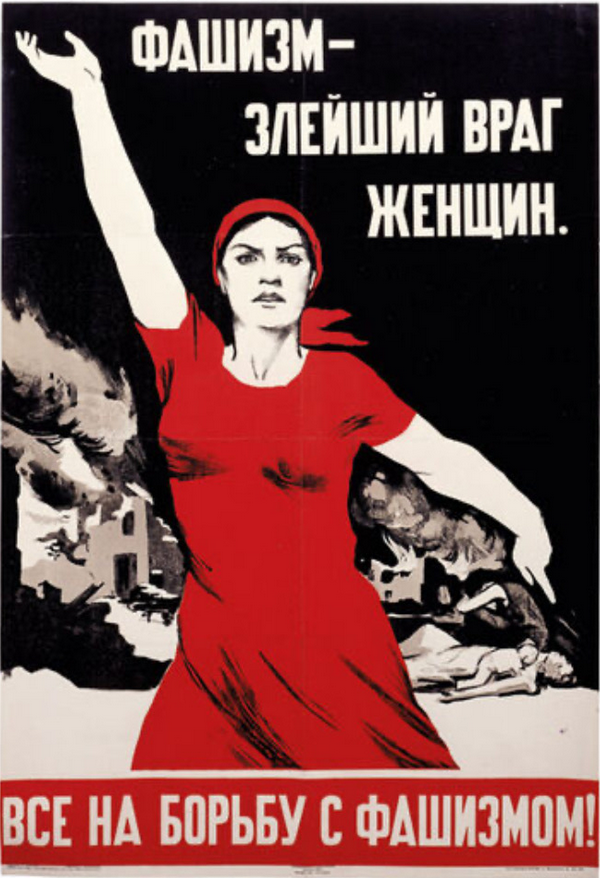
Exhibition poster of Nina Vatolina’s Fascism – The Most Evil Enemy of Women. Everyone to the Struggle Against Fascism!, 1941. Vatolina’s poster was published five weeks after the Nazi invasion of the Soviet Union, and was used as socialist propaganda.
Some facts to keep in mind upon the invasion of red dresses and alphabetical hashtags sweeping your newsfeed:
- Indigenous women make up 10% of the women currently missing in Canada. That means that 90% of women missing are non-indigenous. And we can’t even know for sure if they are biological women or men identifying as women as current missing persons data accounts for “gender identity” rather than sex. So who knows how many of that 10% of “missing and murdered women” are actually men.
Recent motions within Canadian parliament have been made to call the 10% a “national genocide”. How can we call 10% a genocide without acknowledging the other 90% as being an even larger genocide? I’d be interested in hearing these activist politicians’ response. It is a pity no side of the House dare pose such questions.
- StatsCan tell us that 22% of the adults missing right now are “non-white”. That would mean that 78% of the adults currently missing in Canada are white. Yet it’s difficult to find data specifying race, when it comes to non-indigenous populations. Instead, you go to look up “missing women by race” and find numerous headlines about “missing white woman syndrome.” You know why it might seem like there is something as absurd as “missing white woman syndrome”? Because the majority of women missing are white.
- The majority of missing people (57%) are identified as males (even though, again, we can’t even know for sure if they are biological males or females identifying as males)
- Similiar to caucasian women, the majority of indigenous women are murdered by a family member or spouse. I feel like too many people carry this false notion that indigenous women are in danger of going missing or getting murdered by someone who isn’t indigenous. I get it; it’s the way this coercive narrative has been framed. But can we please stop acting like we’re suddenly scared of every white guy that happens to drive by on the Rez? The number of these men who’ve turned out to be simple Amazon delivery drivers is getting ridiculous.
- When taking key socioeconomic factors into consideration, like homelessness, history of child abuse, sexual assault, mental health, drug use and trust in neighbours, indigenous people were NOT at a higher risk of victimization than other populations.
- A study from BC found that more than 75% of missing indigenous women were working as prostitutes at the time of disappearance.
On one hand, it’s good that people are being made aware of the dangers of trafficking, and would like to prevent any uptick in this troubling trend.
On the other hand, we should just want ALL women, no matter their race, to be safe. If you’re a decent person who isn’t a full blown racist, you should probably at least try to refrain from using terms like “missing white woman syndrome” whenever you see a woman missing on the news.
November 15, 2024
“OK, you’re here to accuse me of causing offence but I’m not allowed to know what it is. Nor can I be told whom I’m being accused by? How am I supposed to defend myself, then?”
At the current rate, future generations will have to be persuaded that Franz Kafka wasn’t actually and Englishman:

Franz Kafka’s The Trial opens with the novel’s protagonist, Josef K., being arrested early in the morning by two officers of the law. When he asks them to explain their reasons, one of the men tells him: “That’s something we’re not allowed to tell you. Go into your room and wait there. Proceedings are underway and you’ll learn about everything all in good time.” He never finds out, of course. Even after the story’s abrupt and chilling end, the reader is none the wiser as to why any of this has occurred.
And so it is hardly surprising that Telegraph columnist Allison Pearson described it as “Kafkaesque” that she was visited by two police officers on the morning of Remembrance Sunday. She was informed that she had been accused of “stirring up racial hatred” by means of an unspecified social media post from a year ago. Anyone who is familiar with Allison’s writing will understand just how improbable this is. Her account of the discussion that followed could have been lifted directly from The Trial itself:
“What did this post I wrote that offended someone say?” I asked. The constable said he wasn’t allowed to tell me that.
“So what’s the name of the person who made the complaint against me?”
He wasn’t allowed to tell me that either, he said.
“You can’t give me my accuser’s name?”
“It’s not ‘the accuser’,” the PC said, looking down at his notes. “They’re called ‘the victim’.”
Ah, right. “OK, you’re here to accuse me of causing offence but I’m not allowed to know what it is. Nor can I be told whom I’m being accused by? How am I supposed to defend myself, then?”
The term “Kafkaesque”, like “Orwellian”, has become something of a cliché, precisely the kind of writing that Orwell continually urged us to avoid. But what else are we to call it? I am reminded of Christopher Hitchens’s account of his visit to Prague in 1988 to report on the Communist regime. He had decided in advance that he would be “the first visiting writer not to make use of the name Franz Kafka”. As it transpired, this resolution was impossible to fulfil. During one of Václav Havel’s “Charter 77” committee meetings, police burst into the building, threw Hitchens against a wall, and arrested him. When he asked for the details of the charge, he was told that he “had no need to know the reason”. How else could he describe this other than “Kafkaesque”? As he was later to say at a lecture at the University of Western Ontario: “They make you do it”.
This is all very well for the Státní bezpečnost, but I’m not sure even Hitchens could have imagined that such behaviour would become routine in the United Kingdom in the twenty-first century. I have written previously on my Substack about the phenomenon of “non-crime hate incidents” (NCHIs), but it’s worth repeating here the key points. Estimates suggest that the police in England and Wales have recorded over a quarter of a million NCHIs since the practice began in 2014. Those who are so branded are often not informed, and these can show up on DBS (Disclosure and Barring Service) checks, thereby impeding their employment prospects. According to the Times, three thousand people are arrested each year in the UK for offensive comments posted online, even in cases where a joke had clearly been intended. This is because Section 127 of the Communications Act 2003 criminalises online speech that can be deemed “grossly offensive”. Whatever that means.
November 14, 2024
Germans are perfectly free to post anything to the internet as long as it doesn’t criticize politicians
Once again, eugyppius helpfully illustrates the broad range of freedoms German citizens enjoy in their online activities and the totally reasonable and not-at-all-insane restrictions to those rights:



It’s been a while since I last wrote about the highly advanced democratic freedoms that we enjoy in Germany. Here in the Federal Republic, the police will never fine you or harass you or raid your house for criticising the government – except, of course, when they do all of these things, because you happened not even to tweet, but merely to retweet, the wrong image.
Stefan Niehoff is a 64 year-old retiree who lives in the small town of Burgpreppach in Lower Franconia. He runs an X account with 1,200 followers, where he occasionally expresses his dissatisfaction with the present state of German politics and with the Greens in particular.
In June 2024, he retweeted this image …
… which appropriates the logo of a popular cosmetic brand to suggest that Robert Habeck, our Green Minister of Economic Affairs, might be a “professional moron”.
Habeck and his associates are notorious for pursuing internet users who share highly illegal content of this nature. They brought Niehoff’s retweet to the attention of authorities, and the Bamberg public prosecutor’s office decided that Niehoff was indeed guilty of a criminal speech offence. The Bamberg District Court then issued an order permitting the police to search Niehoff’s residence and confiscate his electronic devices.
In this order, reproduced by NiUS, the judges explained their rationale as follows:
On the basis of the investigations to date – in particular the screenshots of the posts and the investigations into the user of the X-account “IchbinFeinet” – there exists the following suspicion of a criminal offence:
The accused is the user of the account “IchbinFeinet” on the internet platform X with approx. 901 followers.
At a time that cannot now be determined more precisely, in the days or weeks before 20 June 2024, the accused published an image file using his account that showed a portrait of the Federal Minister of Economic Affairs with the words “professional moron” … in order to defame Robert Habeck in general and to make his work as a member of the federal government more difficult.
The public prosecutor’s office affirms the public interest in criminal prosecution.
This is punishable as defamation directed against persons of political life in accordance with §§ 185, 188 para. 1, 194 StGB. …
The measures ordered are proportionate to the severity of the offence and the strength of the suspicion and are necessary for the investigation …
Armed with this document, Schweinfurt police showed up at Niehoff’s house at 6:14am yesterday morning and took his tablet. Police later told the press that the raid was one in a series of enforcement actions – part of something called “an action day against cybercrime”. By harassing a lot of cybercriminals all at once, police and prosecutors hope to send a message to the people of Germany that they cannot just retweet anything, and that they may only retweet the right things.

November 4, 2024
Violence and sex differences
Lorenzo Warby discusses some basic biological differences between men and women and how those differences account for much of the variance in violent behaviour:
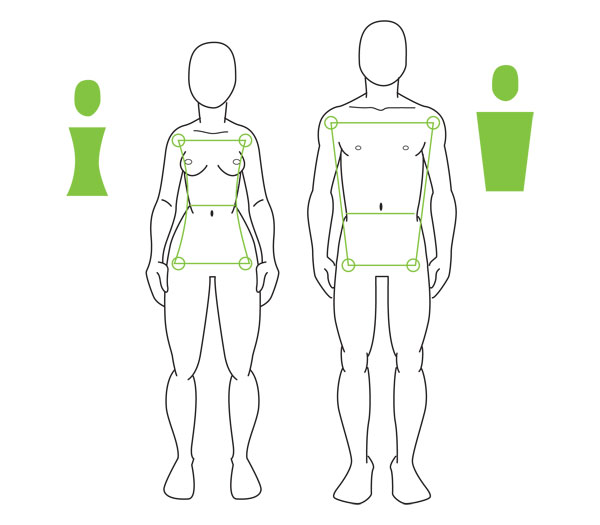
Human anatomy fundamentals: advanced body proportions
design.tutsplus.com
(Note on usage: Sex is biological — i.e., which gametes a body is structured to produce. Sex roles are the behavioural manifestation of sex. Gender is the cultural manifestation of sex.)
Adult human males have, on average, about twice the lean upper body mass of adult human females. This means that adult human females have, on average, 52 per cent of the upper body strength of adult human males.
The consequence of this is that men dominate violence between adults. They dominate victims — another male is far more likely to be a physical threat or obstacle than a woman. Men even more strongly dominate perpetrators.
A Swedish study found that one per cent of the population committed almost two-thirds of all violent crimes. That one per cent was almost entirely male. Four per cent of the population committed all the violent crimes. That four percent was almost 90 per cent male1 and constituted just over seven per cent of the male population.
These patterns of behaviour do not require any “hard wired” differences by sex in human brains. They merely require that men have about twice the upper body strength of women. They represent strategic behaviour within that context.
Indeed, these results are not compatible with sex-differentiation being strongly “hard-wired” in brains by sex. The overwhelming majority of men do not commit any violent crimes, while some of the perpetrators —almost eleven per cent — were female.
What makes it even clearer that these patterns represent strategic behaviour—that is, responses grounded in (biological) constraints and capacities — is that men and women each make up about half the perpetrators of violence against children.
When women are dealing with the physically stronger sex, they are much less likely to use violence than is the physically stronger sex. When they are dealing with a systematically weaker group of Homo sapiens — children — they are as likely to be perpetrators of violence as men.
These patterns represent strategic behaviour. They represents actions responding to constraints and capacities. You get sex-differentiated patterns when the constraints are different between men and women. Our sex-differentiated biology is enough, on its own, to produce sex-differentiated patterns of behaviour.
So, even in (then) peaceful Sweden, one in 14 men are violent. That a significant proportion of men are violent predators informs female behaviour, as the systematically physically weaker sex.
Men dominate sexual violence because they are physically stronger, have penises and cannot get pregnant. That is enough to have men dominate sexual violence without any sex differentiation in the “hard-wiring” of brains at all.
We are embodied agents. How we are embodied makes a difference for our behaviour.
Women have, on average, half the lean upper body mass as men not so much because they are smaller—the average differences in height and weight are nowhere near as large. A much more significant factor is that women have a higher fat content to their body, especially their upper body.
They have a higher fat content because human brains are energy hogs, and women are structured to be able to support not just one, but two or more, energy-hog brains — i.e. babies and toddlers. More fat means more readily-available stored energy. That extra female fat enables us Homo sapiens to be the most body-shape dimorphic of the primates: far more so than any of our ape cousins.
This goes to the other biological constraint that produces sex-differentiated behaviour. Women can get pregnant, men cannot. The risk profile differs for men and women, and not just for the risks of pregnancy and childbirth but also for child-rearing.
1. The text of the paper and the summary table have different numbers for female offenders. As the text states that 10.9 per cent of offenders were females, which agrees with the table but not the figures given in the text, I have corrected accordingly. Fortunately, it does not affect the logic being presented.
November 2, 2024
The mirage of Trudeau’s mediagenic gun control efforts
To hear the Prime Minister talk about his gun control strategy, it’s been a stunning success. Many police chiefs’ responses thoroughly denounce this as, at best, self-serving spin:
As police unions pillory federal gun bans for doing nothing to address skyrocketing gun crime, an Ontario police department revealed this week that virtually all its crime guns are now illegal imports from the United States.
“Approximately 90 per cent of (the) firearms that we seize are directly traced back to the U.S. And I can say in reality the remaining 10 per cent are likely also from the U.S.,” Peel Regional Police Chief Nishan Duraiappah said at a Monday press conference. The 10 per cent referred to guns that have been modified or had their serial numbers removed, making them harder to trace.
Duraiappah was announcing the results of Project Sledgehammer, the breakup of a gun smuggling ring that included the seizure of a shipment of so-called “giggle switches” — black market devices that can turn a regular handgun into an automatic machine pistol.
But during the press conference, police revealed that both gun crime — and the number of illegal guns in the community — is unlike anything they’ve ever seen.
The Peel Regional Police cover an area immediately to the west of Toronto that includes Mississauga and Brampton. Duraiappah said that only 10 years ago, if a criminal in the Peel Region wanted an illegal gun, “it was doable, but it required a lot of work.”
Now, Peel Police are seizing an illegal gun about once every 30 hours — an 87 per cent increase over the year prior. Illegal guns are now so ubiquitous that they often show up in unrelated investigations, such as an impaired driver having one in his glove compartment.
“The availability of firearms has just saturated the community,” said Duraiappah.
This has all occurred in tandem with a nationwide spike in gun crime, including fatal shootings.
Earlier this year, Statistics Canada published 2022 data showing that “firearm-related violent crime” was at the highest rate recorded since they started tracking it in 2009.
September 19, 2024
German opinions are changing on the migration question
On of our key European commentators is back from a brief internet vacation and reports on recent changes in official German views on mass immigration:

There are other matters too, but before I can get to any of them, I must get this piece on the changing politics of mass migration in Germany off my chest. This is the most important issue facing Europe right now – more important than the folly of the energy transition, more crucial even than the fading memory of pandemic repression.
For nearly ten years, migration has felt like one of the most intractable problems in our entire political system. However crazy the policies, however contradictory and irrational, there was always only the towering mute wall of establishment indifference. It felt like the borders would be open forever, that we would have to sing vapid rainbow hymns to the virtues of diversity and inclusivity for the rest of our lives.
Suddenly, it no longer feels like that. Over the past weeks, a perfect storm of escalating migrant violence and electoral upsets in East Germany have changed the discourse utterly.
The cynical among you will say that none of this matters, that the migrants are still coming, that our borders are still open, and of course that’s true – as far as it goes. But it’s also true that there’s an order of operations here. A lot of things have to happen before we can turn return to a regime of normal border security, and I suspect they have to happen in a specific sequence: 1) Migrationist political parties have to feel electoral pressure and taste defeat at the ballot box first of all. 2) Then, as the establishment realises they are up against the limits of their ability to manipulate public opinion, the discourse around mass migration will have to shift, to deprive opposition parties of Alternative für Deutschland of their political advantage. Specifically, the lunatic oblivious press must begin to question the wisdom of allowing millions of unidentified foreigners to take up residence in our countries. This will then open the way for 3) the judiciary to revise their understanding of asylum policies and begin to interpret our laws in more rational, sustainable ways.
In Thüringen and Saxony, we have already had the electoral defeat of 1), and we will soon have more of it in Brandenburg. As a consequence of 1), we are now seeing some powerful glimmerings of 2). This is very important, because as the press expands the realm of acceptable discourse, a great many heretofore tabu thoughts and opinions are becoming irreversibly and indelibly conceivable.
Ten years ago, diversity was our strength, infinity refugees were our moral obligation and there were no limits to how many asylees we could absorb. Since August, not only Alternative für Deutschland but also that offshoot from the Left Party known as the Bündnis Sahra Wagenknecht, the centre-right Christian Democrats, a substantial centrist faction of the Social Democrats, and many others beyond whatever “the extreme right” is supposed to be, agree that migration is in fact an enormous problem. They also agree that our moral obligations to the world’s poor and disadvantaged are finite, and that there are indeed clear limits to the number of asylees Germany can support. What is more, they are saying all of these things in the open.
September 10, 2024
QotD: Contempt of court
Steve H., “Was I Wrong About Cooper? Don’t Think So”, Hog On Ice, 2005-07-06.
August 30, 2024
Two-Tier Keir’s “mask off” moment(s)
Millennial Woes presents a disturbingly long summary of British Prime Minister Keir Starmer’s responses to popular non-violent protests:

The situation in Britain now is so perverse that, if you could convey it to people from a century ago, I think they, after getting over the disbelief and astonishment and accepting that this really was true, would assume it could not possibly have come about by chance. Whatever their complaints about the Britain of 1900, they wouldn’t have believed it capable — on its own — of the degeneration we have seen. They would insist that it must have been wickedly subverted, every failsafe removed, and entire systems of governance, culture and morality repurposed, made to achieve the opposite of their purported function.
I hardly need list the symptoms of this, but for the sake of posterity …
- The control nexus (of which the government is merely one node) ships massive numbers of unassimilable foreigners into the country against the repeatedly expressed wishes of the natives, and in clear violation of their best interests.
- Natives who complain about this are hounded, doxed, demonised, made unemployable, and often imprisoned.
- Their children are systematically indoctrinated by fiction media to accept their dispossession. They are encouraged to despise the “bigoted” attitudes of their parents and grandparents, and to loathe their nation’s history. The boys are encouraged to idolise non-native men. The girls are encouraged to race-mix with them.
- Teachers deliver the same indoctrination in the classroom — in every classroom. You won’t be allowed to become a teacher unless you voice enthusiasm for such things. Alternative views have been eradicated from the classroom and the lecture hall.
- Natives are systematically disadvantaged in numerous sectors of education and employment.
- Natives are demonised in fiction and news media while non-natives are made to look wonderful.
- The mass sexual abuse of native children by non-natives is systematically down-played by news media, who shift discussion to false “equivalents”.
- Natives’ history is systematically distorted in education and fiction media.
- The very existence of the natives, as a group, and their ownership of their homeland, are systematically denied by education, fiction media, news media, and phoney “science”.
- The police do whatever they are told to do, kneeling for the participants in one riot, hunting down the participants in a different riot.
- Judges pass obviously outrageous prison sentences upon certain people, for blatantly political reasons. These people are denied bail and pressured to plead guilty for fear of sentences even more outrageous. All of this is to send a message to other people: “don’t dare complain or the same will happen to you”.
- The media rushes to concoct fake narratives about events, to keep the public misinformed.
- A so-called “charity”, which is heavily linked to the government and the civil service, seeks to indoctrinate the young and ruin the lives of “troublemakers”, and actively aids the government in concocting fake narratives in order to control public thought and direct events.
- Fake news from such Establishment agents is forgiven, fake news from the Establishment’s enemies is answered with threats of prosecution.
- The media “memory hole” stories of appalling violence by non-natives, explain away such incidents with talk of mental illness, tell natives “don’t look back in anger”, and at all costs defend the suicidal ideologies that make such incidents possible.
- The prisons are emptied of rapists, child molesters and murderers so that troublesome natives can be assigned their cells. They are placed alongside non-natives who might well be violent to them, and journalists gloat about it.
- The slaughtering of three little girls by a non-native is dismissed by the Prime Minister, who says “it doesn’t matter” that the rioting was a response to this outrageous crime, which was enabled by the outrageous government policies that the natives have been complaining about for decades. Their shock, their trauma, their resentment, their dignity, their pain… “doesn’t matter”. This is in stark contrast with how he reacted to Black people rioting several years before.
- The natives’ freedom of speech is continually undermined, one government after another actively seeking to erode it further.
- Not one single organisation is fighting for the wellbeing, rights or interests of the natives.
- Any political party that would do anything about any of this is refused the right to stand in elections, debanked, demonised and, in most cases, destroyed.
Any one of these examples would, in itself, be cause for great alarm. The whole lot together indicate a society that is not just largely, not just fundamentally, but wholly opposed to the continued existence of its native population. To underline: British society is actively perpetrating the destruction of the native British people.
It has been said that the ruthless authoritarian response of the fledgling Starmer government to this summer’s (White) riots is a “mask off” moment for the Labour Party. Others have called it a “mask off” moment for the British Establishment, which transcends the particular party in office. Indeed, things that didn’t happen under the Conservatives have suddenly happened under Labour; things that one would more neatly associate with the former have instead happened under the latter. That can only mean either that the Labour Party has utterly lost its sense of itself, or that the particular party in office simply doesn’t matter, because the Establishment abides.
I think, in fact, all of these statements are true. It has been a “mask off” moment for the Labour Party, and for Keir Starmer himself, and for the Establishment which enables and directs them. The Labour Party has lost its sense of itself — or, to put it less romantically, has been completely repurposed. And the Establishment does abide; no matter which party is in office, things only ever evolve in one direction. And after all, while Starmer’s behaviour casts a bad light on him, he is only Prime Minister in the first place because the Establishment wanted him, not someone who might have reacted to these riots in a different manner. (Boris Johnson is good at stoking war abroad, but not so willing to stoke it at home.)
But in the end it doesn’t really matter. We don’t need to pin the blame on Starmer, Labour, the British Establishment or Davos; they are all one and the same miasma. Yes, the Conservative Party might have reacted differently to the riots, so to some extent we can blame Labour’s ideology or Starmer’s personality, but the pendulum is kept swinging for a reason. One empty suit is shifted out, another is shifted in. Each one might be enthusiastically on-board with the agenda or compelled to go along with it, this being the only variance. And thus the Establishment abides, always getting what it wants against the wishes of the natives, and always degrading and dispossessing them.
August 27, 2024
Britain as the modern Panopticon
Jeremy Bentham proposed a new kind of prison in the 1700s, one where all of the prisoners in their cells were under constant observation by the guards. What sounds like a horrific way to live to any sensible rational person seems to have a fascinating appeal to the kind of micromanaging, busybody control freak who runs for office in British politics today:
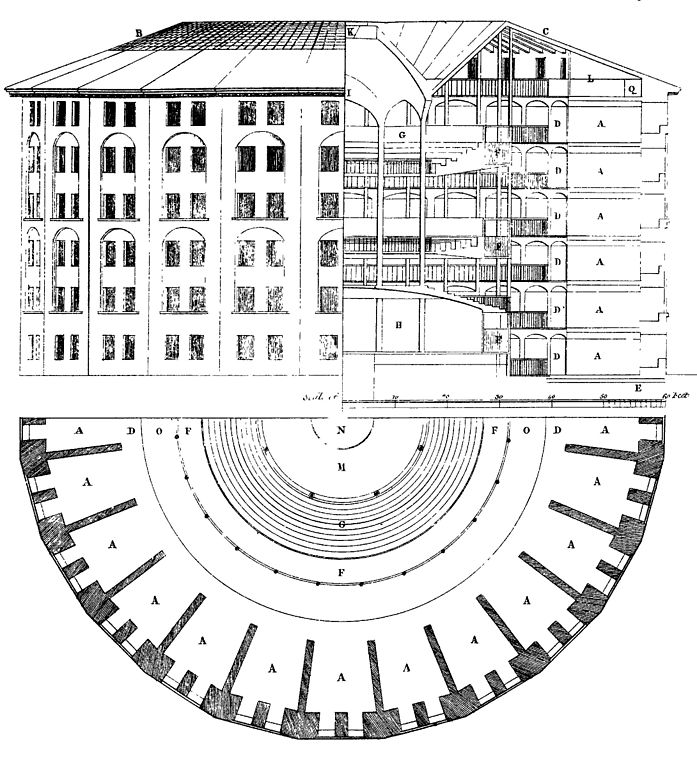
An illustration of Jeremy Bentham’s Panopticon prison.
Drawing by Willey Reveley, 1791.
In Britain authorities use cameras to monitor private individuals in real time. They track cars using number plate software, and human beings using facial recognition software and analysis of gait.
The rationale for these intrusive measures is to prevent illegal activity as well as recording crimes for use in trials.
This troubles many since it places unsupervised control mechanisms in the hands of politicians and authorities increasingly out of touch with the interests of the majority.
Full-spectrum surveillance
The British Government has recently threatened to use this surveillance technology to clamp down on “extremists”.
Currently that means anti-immigration protestors, although there is provision for “anti-establishment” protestors too.
There is much Britain’s political class will not tolerate in the people who elevate them to power.
They have promised to relentlessly hound detestables using advanced spy technology, principally facial recognition software. This is specifically designed to identify individuals and track their movements in real time.
None of this has been requested by the public, and polls reflect considerable unease, particularly with facial recognition software, a powerful tool few are comfortable with.
Advocates of surveillance claim this erosion to our privacy is a necessary step to tackle crime. Cameras enable the police and authorities to identify criminals as well as detect and record the crimes they commit.
To the casual observer it sounds plausible and even reasonable. We won’t be using it to spy on you, only them. It has some public benefits.
This seems like a workable idea. So why is it so useless at stopping a very visible crime?
August 25, 2024
“Does your vote count?” or how to set up an automatic vote-generation scheme
Elizabeth Nickson on recent reporting about voting scams in various US states:

After engineer and data scientist Kim Brooks worked on cleaning the voter rolls in Georgia for a year, she realized she was on a stationary bicycle. She’d clear a name for various reasons, dead, felon, stolen ID, living at a seasonal campground for twenty years, duplicate, moved out of state, 200 years old, etc., and back it would come within a month. At that juncture she realized that a program within the Georgia voter registration database was methodically adding back fake names.
She looked deeper. For new registrants, the culprit was principally Driver’s Services creating new registrations and in this case, the manufacturer was a person, or persons. Within the government office, someone was stealing names and duplicating, even tripling that person’s vote and then forging their signature. Sometimes it was someone who just died, or a teacher who had no voting record. In the case of a nurse who died in 2022 with three registrations, she was registered to vote in two counties, and all three of her voted in the 2022 election and the 2024 primary. Each signature was slightly different, the last three letters spelled, ly, ley, and lley
This operation works under AVR, or automatic voter registration, and is being used to register migrants. They will not vote, but their names have been entered into the Voter Registration database when they apply for a driver’s license and their vote will be voted for them. I imagine that this is repeating something everyone knows, but the borders are open for precisely this reason, so the Democrat/RINO machine can steal their votes. By the way, the process for advancing permanent residency has been cut from 11 months to two.
In 2020, twenty states used operation AVR. Of those, Trump lost 18.
That’s because there are registration fraud rings, as identified in the Arabella doc. and in the work of Omega4America. This worked well in Michigan, where, according to Captain Seth Keshel, who is one of the leads on this fight, believes that Trump likely got 576,443 more votes than were counted and won Michigan by 8.5%.
Every state is host to a dozen or more NGO’s which do nothing but fill out ballots for the faked registrants. Peter Bernegger’s team in Wisconsin has video of NGO functionaries doing just that in Wisconsin in 2020 at 1 am, early morning after Election Day.
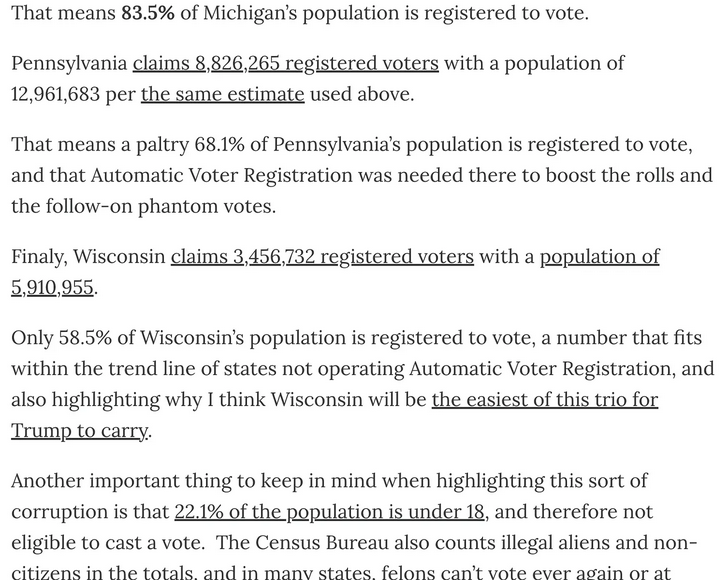
Michigan has two million more registered voters than they should have. 83.5% of the state is registered to vote but only 77.9% is over 18. – Seth Keshel
Seth works with demographic trends and does detailed statistical analysis; travelling almost ceaselessly to teach Americans how to stop the cheat. AVR was launched in Michigan, after Trump’s win in 2016. By 2020 there were 547,460 net new registrants in Michigan. Today, more voters are registered to vote than there are people old enough to vote. Keshel:
Per Keshel’s analysis, the Democrats and RINOs are frantically operating a dying political coalition which began to shift hard after Obama’s performance in his first four years, when not only did nothing change for the working class, it worsened. Democrat registrations in Michigan collapsed to the point where the Dems lost 16,000 as of 2016. Enter AVR and boom, 500+K new registrants.
August 14, 2024
Premier Doug Ford’s weird plan to hold the justice system to account
The problem with Premier Ford’s as-yet-unelaborated plan to collect formal statistics on the products of the criminal justice system is that it’s weird. And Canadians don’t like weird things because something something Donald Trump something something Hitler. Despite that, Colby Cosh thinks it’s a good idea:
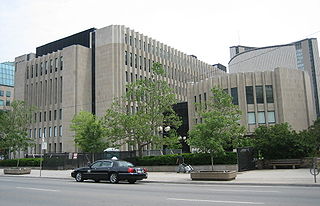
Superior Court of Justice building on University Avenue in Toronto (formerly the York County Court House).
… the very idea of addressing a social problem by gathering quantitative information is so un-Canadian as to seem radical and startling. It certainly seemed that way to the lawyers and civil libertarians who freaked out at Ford’s mention of “accountability” for judges who fail to protect the public from criminal predators.
Judicial independence is an axiom of our constitution — but to the degree that judges become policymakers, which is perpetually increasing as they discover creative new applications of the Charter, their lack of oversight by elected legislators and by the voting public is also a serious and obvious problem, purely in principle. It is no wonder the legal guild takes fright at the notion of “accountability” if it is interpreted to mean that judges might be subject to enforceable performance measures or firing by a minister.
But, of course, the word “account” is visible in there, and measurement of a social crisis is necessary to establish that one exists, even if almost everybody believes it to exist. Our courts are the first to castigate a government that makes some legislative change affecting individual rights without an attempt at inquiry into its reasonability and urgency. Ford, in proposing to establish the dimensions of preventable re-offending, is doing exactly what a legislator hoping to reduce crime ought to do: gather numbers. Collect and publish information. And let us specify that we mean publish publish, in an open, dependable, accessible way, with maximum detail.
Frankly, Ford’s announcement seems as much as anything like a reaction to being backed into a corner by an unresponsive Liberal government, which controls bail policy and the content of the Criminal Code, and by judges, whose irrational bail and sentencing decisions flood what’s left of our news media. Provincial politicians are bound to be judged by voters on the perceived prevalence of crime, but about all they can actually do about it is to, well, buy more choppers for the coppers and start collecting local data about revolving-door justice.
Update: Fixed broken link.
August 9, 2024
Domicidal maniacs in charge
Lorenzo Warby provides an oh-so-useful word to accurately capture what the diversity-at-all-costs elites running most western countries these days are actually up to:
Domicide is the destruction of home. It comes in the “hard” version — the physical destruction of houses and infrastructure.
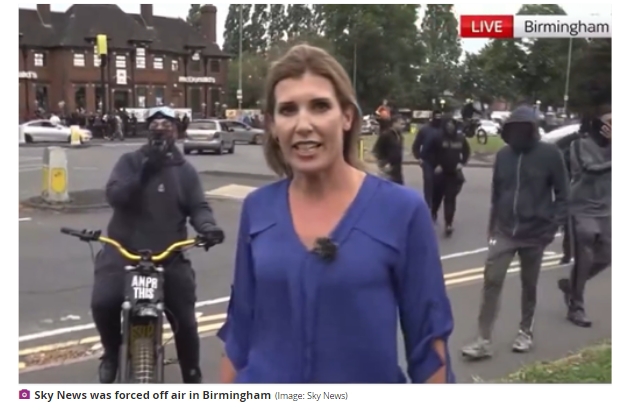
Domicide also comes in a “soft” version — flooding localities with new people, separating people from, and otherwise degrading, their heritage. When folk say Britain is becoming “unrecognisable”, it is the domicidal effect of mass migration they are referring to.
The UK is suffering from a domicidal elite, one that uses mass migration to break up working-class communities; asymmetric multiculturalism to elevate incoming cultures over those of native English (the Celtic fringe get minority brownie points); favours non-“white” faces in advertising; asymmetric race-swapping in entertainment against the native English; denigration of British history as racist, white supremacist, imperialist, colonialist, etc.
Much of this is insulting virtue-signalling allied to, or presenting, cartoonish (simplified) and caricature (distorted) history. It all undermines social cohesion. But it is the use of migration policy as a systematic weapon against the resident working class which does the most damage. Though two-tier policing — obviously treating Muslims in particular with a deference not shown to the natives, especially when it comes to policing speech — is also highly corrosive of social cohesion.
Many working-class communities in Britain were already fairly dysfunctional — though the British state is not innocent in those dysfunctions1 — and sections of the British working class are very far from admirable. None of this justifies the use of mass migration to make things worse for such folk, however much it may help to explain the moralised class contempt that underlies so much of modern progressivism and modern managerialism.
To improve such things, to “level up”, requires a strong sense of how to create and maintain social order. Modern progressivism is strongly antipathetic to such understanding. To “level up” also requires a strong sense of custodianship, which managerialism typically lacks: particularly progressivist managerialism.
Indeed, modern feminist, progressivist, managerialism—in its lack of custodianship; lack of social solidarity;2 in its antipathy to taking the problems of social order seriously — is running the British state into the ground. The post-medieval British aristocratic and mercantile elite did a much better job of state management. But those elites had mechanisms — such as duelling, that forced men to defend their reputation at the risk of their life, and grand country houses, that turned into expensive investments in social isolation if you behaved badly — that selected for character.
Nowadays, the British elite only selects for capacity and even that is being degraded by DEI undermining the signals of competence. It turns out, over the longer term, character matters more than capacity. For capacity without character selects for manipulative, anti-social personalities that degrade institutions over time.
1. For a particularly brutal depiction in fiction of the dysfunctional British welfare state — especially its school system — see Christopher Nuttall’s Mystic Albion series, especially the first book.
2. Feminisation of institutions and discourse has tended to degrade social solidarity, see Benenson et al, 2009. The most conspicuous example of this in the UK is how uncouth it is in elite circles to mention the systematic rape and sexual exploitation of underage working class girls by overwhelmingly Muslim gangs.
August 6, 2024
Britain’s immigration debate turns violent
At The Last Ditch, Tom discusses how the immigration issue has become the issue in modern Britain:
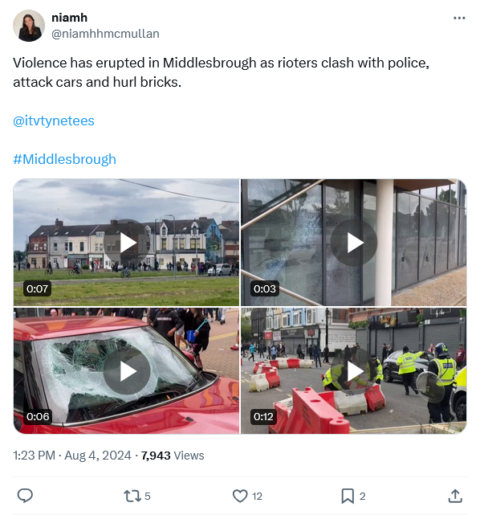
Protest and counter-protest in Middlesbrough over the weekend of August 3-4.
Margaret Thatcher famously quoted Kipling’s Norman and Saxon to President Mitterand of France in an EU meeting;
The Saxon is not like us Normans. His manners are not so polite.
But he never means anything serious till he talks about justice and right.
When he stands like an ox in the furrow – with his sullen set eyes on your own,
And grumbles, “This isn’t fair dealing”, my son, leave the Saxon alone.She was trying, perhaps not as delicately as her diplomats would have wished, to explain how the apparently calm British will react – eventually – to being wronged.
I spent twenty years in three other countries and worked closely in business with people from many more. I have often smiled to myself since returning when I hear British people speak of our unique sense of fair play. It’s not unique at all. Everyone has it. We do not own fairness. We do not own tolerance.
We do, however, traditionally pride ourselves on both and the way we see ourselves has shaped our reactions over the last twenty-five years as we welcomed more immigrants than in the previous two millennia. A few years ago I listened quietly to a Bangladeshi friend – a would-be human rights lawyer – talk about racism in our country. I asked her where in the world was a better place to live as a member of an ethnic minority. On reflection, she agreed with me that there is nowhere.
I am not saying we couldn’t treat each other better. Of course we could and should try. But let’s take a moment, as our streets burn and our elites condemn us as far-right racists, to be proud of how we’ve behaved in general towards so many new arrivals in such a short time.
[…]
One day history may reveal which politician in the capital of an old European empire realised there was a ready supply of workers in the former colonies. People who spoke our languages and were familiar with our systems of government – because both had been forced on their ancestors. It was a perilous idea that may yet prove to be the end of European civilisation but he must have looked like a genius to his peers.
The doors were opened and cheap labour flooded in. From the lofty heights where the elites survey us, it looked like a perfect solution. On the ground, not always so much. Mostly we’ve been welcoming, accepting and tolerant. We’ve sometimes even gone beyond tolerance and flattered our new arrivals that they’ve enhanced our magnificent old culture with their jerk chicken and curries.
Yet already when I was a youngster practising criminal law problems had begun to emerge. A custody sergeant with whom I used to chat when waiting to see clients in the cells told me suicide rates among Muslim girls in our Midlands city were disturbingly high. Asked why that was, he said they were not suicides, but honour killings – the first time I’d heard that phrase. No-one, he said, commits suicide by pouring paraffin over themselves and setting themselves alight. It’s just too painful. Muslim men were killing their daughters and sisters. Asked why there were no prosecutions, he said senior police officers made it clear to their subordinates that it was “racist” to suggest the dead girls’ families’ stories of suicide were untrue.
Fresh out of my university law faculty, I sneered that his bosses were right and he was a racist. I will never forget the last words he said to me;
Young man, then you’re part of the problem.
And I was. In that moment, I’d turned away from murdered women to preserve my smug world view. Just as, decades later, council staff and police officers in cities all over Britain turned away from young girls groomed and raped by Muslim men, for fear of being called bad names.
Gary Fouse in the New English Review asks whatever happened to Merry Olde England:
If you have been following the news out of England for the past week, you might think that the country has all but fallen into civil war. Riots and various forms of violent protests and counterprotests have broken out in cities all over the country in reaction to a shocking murder that occurred in the town of Southport last week. On July 29, a group of little schoolgirls were attending some sort of Taylor Swift-themed dancing class when a 17-year-old son of Rwandan immigrants (who was born in England) attacked them with a knife. Three of the schoolgirls (ages 6. 7, and 9) have died and eight others went to the hospital with serious knife wounds.
The entire nation has erupted in shock and anger. Obviously, the anger is being directed at immigrants in general — given the country’s out of control migration situation and long-simmering tensions with the largely-radicalized Muslim communities. It seems that now-finally — the people have had enough. At least one migrant shelter has been attacked, and several Muslim young men are showing up to counter-protest and do battle with young white men. Now the cops in several cities are trying to keep the two sides apart.
I should state at this point that I will not condone the violence and destruction that is taking place and the objects being thrown at police who are trying to keep order. While I do not condone the violence, I think I can understand why it is taking place. I recall back in the 1960s when there were many riots in inner city areas of the US during the Civil Rights era and in response to the murders of black civil rights leaders like Martin Luther King and Medgar Evers. Many responsible black leaders condemned the violence but also added that they could understand the reasons for it. It was a different era then in America, and in the South, segregation had the force of local laws behind it. Many blacks felt that the government was not responding to their grievances.
[…]
The fact is that far too many nations in the West, including ours, have suffered from bad political leadership. We see it in our cities, we see it in our state capitals, and we see it in Washington DC. Bad political leadership results in bad cities, bad states, and a bad country. The fish rots from the head, and what we need to do-in England-in France, in America, etc is elect responsible people who recognize that their government’s number one duty is to protect the citizens. When a government fails to do so, eventually what happens is what we see in England today.
July 22, 2024
QotD: Post-apartheid South Africa
All of this brought tons of international condemnation onto the Zimbabwean regime, and a lot of countries looking for ways to pressure it to stop the atrocities. The glaring exception was Mbeki’s South Africa, which staunchly defended Zimbabwe for years as the killing and the starvation just kept ratcheting up. It’s unclear why they did this, beyond the ANC and ZANU-PF (the Zimbabwean ruling party) having a certain ideological and familial kinship, both being post-colonialist revolutionary parties that had overthrown white minority rule. But whatever the reason, this was the straw that finally caused Western politicians and celebrities to wake up a little bit and realize that South Africa was now ruled by thugs.
The second, even more catastrophic event that caused the South African government to lose the sheen of respectability was the AIDS epidemic and their response to it. The story of how Mbeki buried his head in the sand, embraced quack theories on the causes of AIDS, and condemned hundreds of thousands of people to avoidable deaths is well known at this point, but Johnson’s book is full of grimly hysterical details that turn the whole story into the darkest comedy you’ve ever seen.
For example: I had no idea that Mbeki was so ahead of his time in outsourcing his opinions to schizopoasters on the internet. According to his confidantes, at the height of the crisis the president was frequently staying up all night interacting pseudonymously with other cranks on conspiracy-minded forums (an important cautionary tale for all those … umm … friends of mine who enjoy dabbling in a conspiracy forum or two). These views were then laundered through a succession of bumbling and imbecilic health ministers such as Nkosazana Dlamini-Zuma or Mantombazana Tshabalala-Msimang who gave surreal press conferences extolling the healing powers of “Africanist” remedies such as potions made from garlic, beetroot, and potato.
Actually, the potions were a step up in some respects, the original recommendation from the South African government was that AIDS patients should consume “Virodene”, a toxic industrial solvent marketed by a husband-wife con-artist duo named Olga and Siegfried Visser. Later documents came to light revealing large and inexplicable money transfers between the Vissers and Tshabalala-Msiming. The Vissers then established a secret lab in Tanzania where they experimented on unsuspecting human subjects, engaged in bizarre sexual antics, and performed cryonics experiments on corpses. Despite this busy schedule, they also produced a constant stream of confidential memos on AIDS policy that were avidly consumed by Mbeki.
The horror of it all is that by this point there were very good drugs that could massively cut the risk of mother-child HIV transmission and somewhat reduced the odds of contracting the virus after a traumatic sexual encounter. There were a lot of traumatic sexual encounters. A contemporaneous survey found that around 60 percent of South Africans believed that forcing sex on somebody was not necessarily violence, and a common “Africanist” belief was that sex with a virgin could cure AIDS, all of which led to extreme levels of child rape. The government then did everything in its power to prevent the victims of these rapes from accessing drugs that could stave off a deadly disease. At first the excuse was that they were too expensive, then when the drug companies called that bluff and offered the drugs for free, it became that they caused “mutations”.
John Psmith, “REVIEW: South Africa’s Brave New World, by R.W. Johnson”, Mr. and Mrs. Psmith’s Bookshelf, 2023-03-20.


