
When I was still in grad school, there was a big pot bust in College Town. Big enough to merit statewide notice, anyway — a couple hundred pounds, something like that, obviously not El Chapo level but enough to where some kind of actual, organized smuggling was involved.
Cynical bastard that I am, I immediately wondered just how they’d managed this feat of law enforcement. College Town being, well, a college town, it had a surprisingly large police force, but the cops dealt overwhelmingly with quality-of-life stuff. I doubt they had more than one or two full time detectives (if that) chasing burglars; I don’t recall College Town ever having a homicide. They certainly didn’t have narcs on the force, is what I’m getting at, so how on earth did they disrupt this small-time, amateurish, yet still legit (on volume alone) drug smuggling operation?
I forget the details, but as you’d surmise from this story taking place in Clown World, they were fake and gay. I’m slightly fictionalizing, and slightly exaggerating, but it really was on the level of “A prowl car saw a guy driving erratically and pulled him over, at which point smoke started billowing out of the windows. The cop looked in and found a felony amount of pot sitting in a garbage bag on the front seat, and the driver copped a plea — he ratted out his supplier, and when the cops showed up with a warrant, that knucklehead, too, had his bales of marijuana sitting out in plain view on the living room couch.”
Most crime works like that, as it turns out. Even in the big cities, where police departments have bigger budgets and more combat power than a lot of European armies. Homicides, for instance, are 99% paperwork, I’m told. Everyone knows that Peanut shot Ray Ray over a pair of sneakers, not least because Peanut is walking around in the damn things, and probably still has the gun shoved in the waistband of his track suit, too. “Solving” the homicide is just a matter of putting the paperwork through. Stone cold whodunits, like big sophisticated undercover narcotics operations, are vanishingly rare, because the cost of enforcement, let’s call it, is extremely high.
I know, I know, The Wire was a tv show, but people I know who really do work in law enforcement say it’s close enough to the real thing for our purposes. Drug dealers down in the ‘hood aren’t nearly as smart and sophisticated and above all self-disciplined as the Barksdale Crew, but the basic principle is the same: Since the low-level people are inevitably going to get busted, make sure that the low-level people don’t have anything on the guys one level higher, and your drug dealing operation is more or less safe. Just as Peanut could probably get away with blasting Ray Ray in broad daylight if he were smart enough not to wear the shoes around, so the pot dealers in College Town could’ve gotten away with their operation more or less forever, provided they weren’t stupid enough to be driving around high on their own supply, with said supply in plain view in the passenger seat.
Severian, “The Cost of Enforcement”, Founding Questions, 2021-09-29.
February 26, 2025
QotD: The banality of crime
February 12, 2025
QotD: Jacob Zuma – South Africa’s answer to Donald Trump
The ANC bosses did not like Zuma. For decades the ANC had been dominated by elite, western-educated, communist Xhosas, but Zuma was none of those things. Zuma came from nothing — his mother was a janitor and his father died when he was 3. Zuma was so illiterate and uncultured that Mbeki tapped him to be deputy president on the theory that it would keep his own position secure, since nobody would ever let Zuma be president (yeah this backfired spectacularly). Most shocking of all, Zuma was a Zulu. He danced in a loincloth and leopard skin with the Zulu king at the Shaka festival. The idea of this savage wildman becoming president was just beyond the pale. Something had to be done to stop him.
The last chance to stop Zuma was a credible-seeming rape accusation from a family friend. The ANC pounced on this, and initiated a high-profile criminal trial. This incensed Zuma’s supporters, who insisted that the prosecution was politically motivated (given that over the past decade the ANC had all but stopped prosecuting rape cases in society more broadly, they may have had a point). The trial was a total debacle. Countless thousands of young activists showed up outside the courtroom wearing t-shirts with slogans like “One hundred percent Zuluboy”, “Burn the bitch”, and “Zuma was raped”. When summoned to the witness stand, the president-to-be performed war dances and led the crowds in song. The prosecution collapsed after the accuser’s story was found to be inconsistent on numerous points, and a triumphant Zuma rode the backlash all the way to the presidency.
There’s another way Jacob Zuma is like Donald Trump: the corrupt and failed ruling classes of both South Africa and the United States find it convenient to blame these men for everything that has gone wrong in their countries ever since. In fact in Zuma’s case, history has begun to be rewritten so that he can be blamed for things that happened before he became president. Many of the South Africans I’ve spoken to will confidently assert that some problem (say, the power outages) is all due to Zuma. When I gently point out that those outages began in 1998 and innocently ask who was president then, they shut down entirely. Zuma is the scapegoat for the failings of an entire country, and making him the sole source of all evil plays the important social role of allowing everybody to pretend that things were great until he showed up (things were not great). In a similar vein, I will not be shocked if decades from now, Donald Trump is blamed for starting the fentanyl epidemic.
John Psmith, “REVIEW: South Africa’s Brave New World, by R.W. Johnson”, Mr. and Mrs. Psmith’s Bookshelf, 2023-03-20.
February 3, 2025
Rational response to Trumpish provocations? Don’t be silly, we must run in circles with our hair on fire!
My first entry in the “Trump tariff diary” on social media perhaps takes the situation too flippantly:

President Trump trolled Justin Trudeau about Canada becoming the 51st state.
Trump tariff diary, day 1: Governor Justin Trudeau of the Great State of Canada struck back at the Big Orange Meany by wearing particularly fashionable socks to his press conference. Ontario will remove all bottles of Jack Daniels from the government liquor monopoly distribution system. The American national anthem will be formally booed at all NHL games played in Canada from now on.
At the National Post, Tristin Hopper offers much more substantive and serious suggestions:
Order Ryan Reynolds to defame American directors until free trade is restored.
Spend 10 years relentlessly kneecapping the Canadian economy for no reason to show Trump we’re not scared of him.
Politely suggest that the U.S. may have confused us with China. Say that although both countries start with the letter C, China is the one seeking to destroy American hegemony via economic means, and we’re just an obsequious neighbour who sells them raw materials.
As a gesture of fealty to American continental supremacy, immediately adopt the U.S. Constitution as Canadian law. Uphold it about as loosely as our existing constitution so there’s no material change.
Volunteer an honour guard of Mounties to serve alongside the Secret Service. Force them to wear red serge if Trump asks.
Offer to pillory a Trudeau at Mar-a-Lago if the tariff threats stop, but don’t specify which one.
Put sugar in the crude oil so all the U.S. refineries seize up.
Instead of shutting off Canadian electricity exports, export too much electricity so that their toast burns and the coffee is too hot.
Send Trump a bentwood box filled with smoked salmon as a gesture of goodwill. When he opens it, it’s just filled with bees.
On a rather more serious note, PPC leader Maxime Bernier posted this on the social media platform formerly known as Twitter:
It’s important to understand that the 25% tariffs announced by President Trump today are NOT imposed on Canada — they will be paid by American consumers and businesses who buy goods imported from Canada. Tariffs are a tax, and Americans who will have to pay more or go without our products will be the first to suffer.
Of course, Canadian exporters of these goods will as a consequence lose clients, contracts and sales, and will be forced to cut down on production and lay off workers. Or they will lower their prices to keep market shares and will see their profits diminish.
Because 75% of our exports go south of the border, our economy will for sure be very negatively impacted by this.
The stupidest thing our government can do however to deal with this crisis is to impose the same kind of tariffs “dollar for dollar” against US imports.
The US economy is ten times bigger than ours, much less reliant on trade than ours, and much less dependent on our market than we are on theirs.
Not only would retaliatory tariffs have much less impact on American exporters, they would immediately impoverish Canadian consumers forced to pay more for imported goods, as well as destabilize Canadian businesses that need inputs from the US in their production processes. It would more than double the harm of the US tariffs to our economy.
Trade wars are bad for everyone, but they are much worse for a small country with fewer options. We simply cannot win a trade war with the US. It’s very unlikely that Trump will back down. All we will do is provoke a massive economic crisis in Canada, until we are forced to capitulate.
Another self-destructive thing to do would be to set up giant “pandemic-level” bailout plans to support everyone affected by this trade war. This will simply bankrupt our governments even more than they already are and make us even weaker.
So what should we do?
1. Double down on efforts to control our border, crack down on fentanyl dealers, deport all illegals, and impose a complete moratorium on immigration, to answer Trump’s immediate concerns about Canada.
2. Tell the US administration that we are ready to renegotiate North American free trade and put dairy supply management and other contentious issues on the table.
3. Wait and see to what extent Trump is willing to keep tariffs in place despite the harm it does to the US economy. Despite his pretenses that Americans don’t need our stuff, the reality is that on the contrary they have few other options for crucial resources like oil, lumber, uranium and other minerals, etc. He will stop acting like a bully when he sees that he can get more results by sitting down and negotiating.
3. To reduce our dependence on the US market, immediately implement an ambitious plan to tear down interprovincial trade barriers and help our impacted exporting industries find alternative markets in other countries.
4. Immediately implement a series of bold reforms to make our economy more productive, including: reduce corporate and personal taxes, abolish the capital gains tax, abolish all corporate subsidies, get rid of excessive regulation, remove impediments to the exploitation and export of natural resources, drastically cut government spending, mandate the Bank of Canada to stop printing money and start accumulating a gold reserve to prepare for the global monetary reset (which is likely part of Trump’s plan).
In short, instead of adopting a suicidal strategy to confront Trump, we must do what we should have done a long time ago to strengthen our economy and our bargaining position. The transition will be rough, but not as much as complete bankruptcy and disintegration.

My strong suspicion is that Trump’s extended tantrum directed at Canada is actually a way to provide pressure against other future tantrum targets … “if he’d do that to friendly neighbour Canada, what won’t he do to us?” An updated version of Voltaire’s quip that Britain needed to shoot an admiral every now and again pour encourager les autres.
Coyote Blog facepalms over Trump’s self-sabotage of the US economy:
Trump’s first few weeks have been a mix of good and bad for this libertarian, all against a backdrop of horror at how Imperial the presidency has become. […] Because we are all tired of those fentanyl-toting Canadians crossing the border illegally. I mean, we all saw the Proposal and know how all those Canadians are trying to cheat US immigration law.
Seriously, this is beyond awful — and not just because of the threat of retaliation, though that is real. Even if all the affected countries roll over and accept these modified tariffs without response, this is still a terrible step for the US. No matter how Trump and his very very small group of protectionist economist friends sell this, this is a tax on 300 million US consumers to benefit a small group of producers. I don’t have time right now to give an updated lesson on free trade — that will have to wait for when I am not on vacation. But I will offer a few ironies:
- After campaigning hard on inflation, Trump is slapping a 10-25% consumption tax on foreign goods. That is a straight up consumer price increase for a variety of key products including much of the lumber we use to build homes, a lot of our oil and gas, a lot of our grain and beef, and many of our cars and appliances.
- Much of this inflation is going to disproportionately hurt Trump’s base. No one is going to care much if a Hollywood actor has the fair trade coffee they buy at Whole Foods go up in price, but Trump voters are going to see a direct effect of this on prices at Wal-Mart.
- Republicans have spent 4 years (rightly) condemning Federal and State governments for the economic disruptions of COVID lockdowns and restrictions. While some of the inflation of the last 4 years was due to ridiculously high government deficits, another major cause was the COVID supply chain disruptions. And now Trump is voluntarily recreating them.
The only small hope I have is that Trump is steeped from his business career in a certain style of brinksmanship bargaining that consists of taking an entirely destructive and irrational position in hopes that they folks on the other side of the table will back down and give him more than he should. My son won poker tournaments like this because he would do so much crazy stuff that no one at the table wanted to challenge him. I have always said that I don’t think Trump is a particularly good business person — he has run business after business that has failed. But he is a good negotiator, and has exited numerous bankruptcies with his creditors giving him far more than one would think was necessary.
January 31, 2025
“… and 10% for the Big Guy”
In the New English Review, Bruce Bawer reviews Miranda Devine’s new book, The Big Guy: How a President and His Son Sold Out America:

Even now, roughly half of Americans seem to believe that all the attention that’s been paid to Hunter Biden and his laptop has to do with his love of prostitutes and drugs rather than with high crimes and misdemeanors committed by him on behalf of his dad and other members of the clan. Even now, many Americans seem to be blithely unaware of the mountains of evidence showing that Hunter has long been fleecing foreign firms on Daddy’s behalf. For some reason those clueless Americans, even if capable of accepting that Hunter was up to no good, simply can’t believe that his pop – good old Lunchpail Joe – has ever been guilty of anything. (These same people, of course, are convinced that Donald Trump is the most corrupt politician ever to come down the pike.)
This blindness to facts – or stubborn refusal to pay attention to them – is immensely frustrating. And it must be especially frustrating for Miranda Devine, the Australian-American New York Post journalist who, in Laptop from Hell: Hunter Biden, Big Tech, and the Dirty Secrets the President Tried to Hide (2021), detailed the contents (by turns sordid and criminal) of Hunter’s celebrated computer, the story of which her newspaper broke 20 days before the 2020 presidential election, and who in her new book, The Big Guy: How a President and His Son Sold Out America, focuses on the cover-up.
To say that Devine tells her story in impressive detail would be an understatement. Like War and Peace, The Big Guy opens with a long list of the main players, just in case you lose track of who’s who. And you will. Reading this book isn’t just like reading War and Peace – it’s like reading War and Peace at the same time as One Hundred Years of Solitude. You have to remember a slew of foreign-sounding names, many of which sound very much alike, all the while following an exceedingly labyrinthine narrative.
To be sure, this tale also involves plenty of Americans, some of them public officials who, when they scented the heady whiff of corruption in the Biden circle, actually did their jobs by digging into the facts and gathering evidence. Others, alas, are people who also held positions of authority but who did their damnedest to put up “roadblocks” or “obstructions” or “delays” or “logjams” – to use some of the many synonyms that Devine uses to describe efforts to keep the public in the dark.
And boy, was there a lot to cover up. Among the expenses that Hunter tried to write off on his taxes – not that he was quick to pay them, mind you – were disbursements to prostitutes and drug dealers and memberships in sex clubs. During one “crack and hooker bender” in 2018, he spent $8,000 on a single sex worker, $140,000 on a stay in Las Vegas, and $34,000 on a sojourn at the Chateau Marmont in L.A. The Chateau Marmont is legendary for playing host to celebrities on drug binges, but Hunter caused so much damage to his room that he was banned from the place thereafter, which even he suspected was a first.
Part of the reason why Hunter was able to go through a small fortune so quickly was that he had a “sugar daddy” by the name of Kevin Morris, who for reasons that still remain a mystery chose to give him millions of dollars over the years to save him from financial crises (such as the ones posed by the relatively modest monetary demands of Hunter’s baby mama in Arkansas). A 2019 book contract with Simon & Schuster also netted Hunter a $750,000 advance, even though the book (surprise!) ended up selling so few copies that it made back only a tiny fraction of that sum. Then there were his paintings, which brought in at least $1.5 million. People laughed when Hunter first revealed his artworks to the world in 2020, but I didn’t: they’re no worse than a hell of a lot of contemporary art – and, after all, the art market these days is as much about laundering money than it is about aesthetics.
But Hunter’s main sources of mazuma were foreign companies. One of them was Barisma in Ukraine. Another, in Russia, was run by a man named Zlochevsky who said that Hunter, whom Joe Biden had called the smartest man he knew, was in fact stupider than Zlochevsky’s dog. A third was the Chinese energy company CEFC, a leading promoter of China’s Belt and Road Initiative. CEFC put Hunter on its board – and paid him millions – in exchange for his promise to use his father’s name to “open … doors around the world” for the firm.
Collecting loot from all these sources and funneling some of it to family members involved a complex network of bank accounts and shell companies that was designed to make the moolah tough to trace. To illustrate the process, Devine follows the path of a single $5 million payment by a CEFC affiliate to one of Hunter’s firms, HWIII. Over time, Hunter transferred most of that $5 million to another firm of his, Owasco; in addition, he wired some of it to his uncle Jim’s company, after which Jim’s wife, Sara, withdrew a fraction of that sum and deposited it in the couple’s personal account and dispatched a $40,000 check to Joe Biden.
January 28, 2025
What Britain desperately needs is common-sense pointy stick controls
Britain’s gun laws make Canada look like the wild west, yet the government still wants far greater control over objects that can be used as weapons. The conviction of the Southport murderer, who used a knife obtained through Amazon, seems to have given the British government under Kurt Stürmer Keir Starmer an excuse to crack down even further on any kind of device with a sharpened blade rather than the criminals who wield them:

Southport murderer Axel Rudakubana.
Photo released by Merseyside Police.
“Time and again, as a child, the Southport murderer carried knives. Time and again, he showed clear intent to use them,” U.K. Prime Minister Keir Starmer wrote in a piece for The Sun about Axel Rudakubana, who admitted murdering three girls and injuring others at a Taylor Swift-themed dance class last year. “And yet tragically, he was still able to order the murder weapon off of the internet without any checks or barriers. A two-click killer. This cannot continue. The technology is there to set up age-verification checks, even for kitchen knives ordered online.”
What Starmer mentioned but glossed over is that Rudakubana was three times referred to a program intended to divert people from radicalization and terrorism before authorities lost interest in him. At the time of his arrest, he had a copy of an Al Qaeda training manual, which led him to being charged and sentenced for terrorism. He also possessed the deadly poison ricin that he’d manufactured himself in sufficient quantity to conduct a mass attack.
Rudakubana was a human bomb waiting to go off. But Starmer focused not on officials’ failure to pay attention, but on knives — edged tools that are among humans’ earliest and most important creations.
“Online retailers will be required to ask for two types of ID from anyone seeking to buy a knife under plans being considered by ministers to combat under-age sales after the Southport murders,” reports Charles Hymas of The Telegraph. “Buyers would have to submit an ID document to an online retailer and then record a live video or selfie to prove their age.”
It’s difficult to see how an ID check is going to stand between those planning mayhem and tools first crafted 2.6 million years ago in their most primitive form and still used by people every day. My dentist forges knives in his backyard for fun. One of my nephews turns files into knives on a grinding wheel. Scraping an appropriate material against a stone will give you an edge and a point. ID checks don’t seem like a barrier to people with bad intentions and the ability to make ricin in their bedrooms.
A Case History in Ridiculously Restrictive Policies
This is why the U.K. strikes many Americans as the reductio ad absurdum of policies that demonize objects rather than targeting bad actors. Opponents of authoritarian laws ask: What will the authorities do once they’ve made firearms difficult to legally acquire, and crime continues? Will they ban knives?
The answer from the U.K., which already has restrictive gun laws, is yes, they will ban knives — or at least impose access and carry restrictions and consider forbidding blades to have points. The result has been a black market in smuggled and illicitly manufactured firearms that will inevitably extend to knives. Harmless people are now arrested for having Swiss Army knives in car glove compartment or for possessing locking knives on the way home from jobs that require them. And the country’s crime problems continue to grow.
That’s bad enough, but U.K. authorities, like those elsewhere, also prefer to surveil the entire population to detect anything they could call a danger to public order, rather than focusing on specific individuals harming others.
“There are now said to be over 5.2 million CCTV cameras in the UK,” according to Politics.co.uk. “Surveillance footage forms a key component of UK crime prevention strategy,” but “the proliferation of CCTV in public places has fueled unease about the erosion of civil liberties and individual human rights, raising concerns of an Orwellian ‘big brother’ culture.”
The British government also monitors online activity to an extent that Edward Snowden deemed it “the most extreme surveillance in the history of western democracy.”
That surveillance turns up comments, jokes, and rants authorities just don’t like. “Think before you post,” the government warns people. “Content that incites violence or hatred isn’t just harmful – it can be illegal.” But the authorities enforce a broad definition of unacceptable material. People have been arrested for dressing as terrorists for Halloween, for making intemperate online remarks, and for just getting things wrong when posting on the internet (they’ll need a big paddy wagon for that one).
January 27, 2025
Davos is so over, even the high-priced escort girls are giving it a miss this year
Elizabeth Nickson enjoys a nice, rich dish of schadenfreude as the “elite” of the Davos gab-fest dimly begin to realize that their high times are over:
It was a great ride while it lasted, hey, lefties? But it’s over now. You have been left in the screech forward of history. That stink? It’s the burning wreckage of your “ideas”. All you weasely little people like the slender tight-mouthed beta-males at the Biden White House, or the cross-dressing central banker Mark Carney who is laughably trying to be Prime Minister of Canada after bankrupting not one but TWO countries, are history. Like Rory Stewart, the regime apologist in the U.K., who says things like “there’s something really dark and nasty behind the right“. Like Macron, Jacinta Ardern, Trudeau, like the nasty little snake people at Davos right now trying to extract yet more blood and treasure from us. KNEEL and take your SUSTAINABLE DEVELOPMENT GOALS OR YOU ARE RACIST.
You sold your birthright for power. You sold us for power. You sold the future for power. When you get to heaven this is what you should say: I failed, I ruined three generations. I need to be broken down into my component parts and remade into a new being, with a new soul. The old one is stained with the killing of innocents. Like the thousands dead from your obsession with psychopathic primitive Muslims, like the child migrants in cartel sex slavery.
All your projects are in ruins. All your toys lie broken. Your failure is one for the Ages. It will be discussed in heaven and hell for millennia. You have bankrupted the world. Even the freaking oligarchs abandoned you. Even the central bankers decided they badly needed growth or they and their heirs will be living underground for the next five hundred years, hunted like the ghastly little demons they worship. Trump means growth. Big big growth.
You probably don’t know who Rory Stewart is, but he is useful as an example. Not for him, the careful measured sentimental meaningless pap that comes out of every leftie politician’s mouth. Nope, he’s a gabber. He loves attention, in fact, he never ever shuts up, so he is their interlocutor, their dark shrunken snobbish soul.
Stewart is a “writer” and a Westminster gadfly, “much loved” in the British way of saying, “he’s so cute”. He advises, he hangs out with Afghan warlords, he speaks at gatherings of the great and the good. He runs for office, he writes editorials. He is a product of the British elite educational system, and the administrative left, which is to say the outfit that until Monday ran the world. And he has an ego the size of his big stretchy mouth.
This is what he had to say about Trump on Monday. Imagine a rich spoiled debutante drawling this and you’ll get his character.
“He’s so lowering.” By which he means he brings down the tone. Like for instance, the interviewer says Trump tweeted at Gavin Newsom they day after the fires, “Congratulations Gavin New Scum.”
Now, of course, that is how I think of Newscum.
[…]
“We need ideas”
“We need a plan for growth”
“We need to explain how we’re going to sort out the economy”
“and society”.
Buddy, your lot has been in power since Thatcher.
Someone said recently that the reason the English do absolutely NOTHING about those raped, sodomized, beaten little girls is that the upper classes view the lower as less than human, so they don’t care. They don’t care about the freezing old ladies in council houses, the fact that women can’t walk down streets safely, or the farmers not being able to feed people.
For these benevolent rulers protected in their rural retreats and policed neighbourhoods, the multicultural ideal is more important than their fellow citizens.
These are the people who have taken the ideas of Marxism, merged them with predatory capitalism, and from their offices and through countless conferences and meetings a year, try to distribute goods “fairly”, as they determine. Which country shall rise, which shall be invaded, whose resources do we want next? What delicious war shall we start?
That’s what they mean when they say “our democracy”. It’s theirs and nobody else’s.
For more than half a century they have focused on impoverishing middle America. Not the upper middle class, no, they’re fine. Like western Europe, they were broken early and are happy servants, mouthing legacy media propaganda like good little serfs with nice houses and a chance for their children to join the betas taking their orders from the grim oligarchs behind the scenes.


January 26, 2025
German democracy under further threat from extremely extreme extreme right
German voters seem to be under the misapprehension that their votes should have something to do with the composition of the government. Because the voters increasingly cast their votes for the extreme right, government in Germany finds itself under incredible pressure to actually pay attention to the pestiferous voters:

This is a potentially huge story. It could be the beginning of a sea-change in German politics, that is how big it is. At the same time, it could be also be nothing. We’ll have to wait and see.
For those who don’t want to read my ramblings (this will be a longer post), I offer this TL;DR: The cordon sanitaire against Alternative für Deutschland is showing signs of serious rupture. The centre-right CDU are suddenly – without warning – reconsidering their long-standing tabu against cooperating with the “extreme right” opposition. It is this singular tabu that has kept the traditional German party system frozen in amber despite a massive rightward political shift across the West. Should the cordon sanitaire crack even a little, its days are numbered. The simple arithmetic of parliamentary majorities would sooner or later make the most noxious political fixtures of current-year Germany, like the Green Party, broadly irrelevant at the federal level. The German left would be deprived at once of almost all their power.
I am sceptical that this can really be happening. Yesterday, I would’ve expected a change like this in 2029 at the earliest. Many are saying (justifiably) that the CDU should not be trusted, that they will say anything to get elected and that nothing will come of their promises. All that may well be true. Words, however, matter all by themselves: In 2019, tacit cooperation in Thüringen between the CDU and the AfD unleashed an entire national scandal; the press hyperventilated for weeks. Now the federal leadership of the CDU is openly pledging to pass legislation with AfD votes in the Bundestag, and major CDU-adjacent journalists are writing long opinion pieces about why this is just the right thing to do.
This development arises directly from the pressure of mass migration, and specifically from the four recent deadly migrant attacks I have covered in the past year:
- On 31 May 2024, an Afghan migrant to Germany named Sulaiman Ataee killed the policeman Rouven Laur and severely wounded five others in a knife attack in Mannheim.
- On 23 August 2024, at a “Festival of Diversity” in Solingen, a Syrian migrant to Germany named Issa al Hasan killed three people and wounded eight in an apparently Islamist attack for which the Islamic State claimed responsibility.
- On 20 December 2024, a Saudi migrant to Germany named Taleb al-Abdulmohsen drove a rented BMW through the Christmas Market in Magdeburg, killing 6 people and wounding 299.
- On 22 January 2025, an Afghan migrant to Germany named Enamullah Omarzai killed two people and wounded three in a knife attack in Aschaffenburg.
Mannheim, Solingen, Magdeburg and now Aschaffenburg: That is the catalogue of migrant terror pounding like remorseless waves on the brittle outdated politics of the Federal Republic.
These attacks have become a symbol for the entire mess migrationism has wrought. The dead and the wounded count for a lot in themselves, but they have also come to represent the dwindling social cohesion, the stretched financial resources and the erosion of domestic security that accepting entire foreign populations into one’s nation entails. All of it is for nothing, nobody has any solutions and there is no end in sight.
In liberal democracies, policies have to be normie-friendly, and mass migrationism was normie-friendly only until enough migrants crossed our borders to make their presence felt socially and culturally. Mass migration isn’t normie-friendly anymore. It’s become a foul political poison.
Mass migration is also a very hard nut to crack. We have outsourced a great part of our border security and migration policy to highly bureaucratised international authorities and a tangle of high-minded humanitarian legislation that leaves us little room to manouevre. Solving mass migration will require a great deal of political resolve and a willingness to pick fights with globaloid EU pencil-pushers. All of this meant that, until Mannheim, Alternative für Deutschland had a near-monopoly on hardline anti-migration politics. The unrelenting series of attacks by people who have no business being in Germany, together with the collapse of the government and the impending early elections in February, have left the centre-right CDU desperate to stake their own claim to this increasingly central political space. That, and perhaps a healthy dash of the Trump Effect, are the forces currently pushing the traditional party system of the Federal Republic to the brink.
January 25, 2025
The stabbings will continue until morale improves
Sebastian Wang discusses the stabbing attacks in Southport, Merseyside last year:
On the 29th July 2024, a man went on a stabbing spree in Southport, Merseyside, killing three children and injuring ten others. The attacker, Axel Muganwa Rudakubana, the son of Rwandan immigrants, was arrested at the scene. By all accounts, the attack was shocking not only in its savagery, but in its attendant circumstances. Witnesses report that Mr Rudakubana shouted slogans as he killed that suggested he was an Islamic terrorist. Almost at once, social media was filled with questions and with speculation. Also, protests began in several northern cities – Manchester, Leeds, and Bradford, for example – where demonstrators blamed the Government and the ruling class for immigration policies that had made the killings both possible and likely.
Instead of considering these protests and promising to address the causes of the crime, the British Government and the legacy media focussed on managing the narrative and silencing comment on the immigration policies that had allowed Mr Rudakubana’s family into the country. Keir Starmer, the new Prime Minister, seemed more worried about potential “violence against Muslims” than the actual brutality of Mr Rudakubana’s attack on English people. “For the Muslim community I will take every step possible to keep you safe,” he said in his first public statement on the killings. On the protests he added: “It is not protesting, it is not legitimate, it is crime. We will put a stop to it“. His focus was not on the victims, but on ensuring that no one questioned the system that had allowed this to happen.
In the days after the attack, several men were arrested for spreading what the government called “misinformation” online. Their crime? Posting details about Mr Rudakubana’s background and motivations — details that turned out to be broadly correct. Despite being right, these men were prosecuted and imprisoned under Britain’s hate speech laws. The most recently convicted, Andrew McIntyre, was sentenced earlier this month to seven and a half years in prison for postings on social media. Peter Lynch, a man of 61, was sent to prison last August for two years and eight months for the crime of shouting “scum” and “child killers” at the police. Last October, he hanged himself in prison. I am told he was seriously “mistreated” in prison. British prisons for many years have been overcrowded. Room was found for these prisoners of conscience after the Government began releasing violent criminals.
The injustice of this is glaring. These men were punished not because they lied, but because they spoke approximate truths the government wanted to suppress. Their imprisonment sends a clear message: in modern Britain, it’s better to be wrong on the side of the Government than right and against it.
A Carefully Managed Narrative
The media played its part in the cover up. At first, Mr Rudakubana was described, without name, as “originally from Cardiff“. It took days before we were told he was a child of asylum seekers from Rwanda. Even then, the coverage was carefully balanced by a picture of him as a respectable schoolboy – not at the beast in human form shown by more recent photographs.
Only much later, when the story had faded from the headlines, did the real facts emerge. Mr Rudakubana was not just a troubled individual. His phone contained materials linked to terrorism and genocide, and his actions appeared to have an ideological motivation. Yet by the time these details came out, they barely caused a ripple. The public had been moved on to the next distraction.
It’s hard not to assume that the British media was fully in on gaslighting the public about the accused murderer, when you compare the photo that almost universally was used in the time before the trial and a more recent image:

Say what you like about Axel Rudakubana, the slaughterer of three English girls under ten years old, but — unlike the British Prime Minister, the Home Secretary, the Liverpool Police and most of the court eunuchs in the UK media — he appears to be an honest man:
It’s a good thing those children are dead … I am so glad … I am so happy.
He has always been entirely upfront about such things, telephoning Britain’s so-called “Childline” and asking them:
What should I do if I want to kill somebody?
Judging from his many interactions with “the authorities” (including with the laughably misnamed “Prevent” programme), the British state’s response boiled down to: Go right ahead!
It seems likely that the perpetrator of Wednesday’s Diversity Stabbing of the Day — the Afghan “asylum seeker” who killed a two-year-old boy and seriously wounded other infants in the Bavarian town of Aschaffenburg — is also “so happy”. Like Mr Rudakubana, the “asylum seeker” deliberately targeted a gathering of the very young — in this case, a kindergarten group playing in a municipal park. Like Mr Rudakubana, the “asylum seeker” did not just deliver sufficient stab wounds to kill: he plunged his knife into each target dozens and dozens of times. Like Mr Rudakubana, the “asylum seeker” was well known to the authorities: he had been detained for “violence” at least thrice.
Did these guys also enjoy it? From our pal Leilani Dowding:
For the benefit of American readers, being stabbed in Asda, Argus and Sainsbury’s is like being stabbed in Kroger, Costco and Wegman’s. As you may recall, a DC jury awarded climate mullah Michael E Mann a million bucks because someone unknown gave him a mean look in Wegman’s supermarket. No one stabbed in a UK supermarket will get a seven-figure sum: it’s increasingly a routine feature of daily life — per Sir Sadiq Khan, part of what it means to live in a great world city.
Sir Keir Stürmer and every outpost of the corrupt British state have lied to the public about every aspect of the Southport mass murder since the very first statements by the Liverpool chief constable passing off the killer as a “Cardiff man”. Her officers knew within hours that the Welsh boyo who loved male-voice choirs was, back in the real world, an observant Muslim in possession of the Al-Qaeda handbook and enough ricin to kill twelve thousand of his fellow Welshmen. But they did not disclose this information for months — not until freeborn Britons minded to disagree with Keir Stürmer’s Official Lies by suggesting that this seemed pretty obviously merely the umpteenth case of Islamostabbing had been rounded up, fast-tracked through Keir’s kangaroo courts, gaoled for longer than Muslim child rapists, and in at least one case driven to his death. Does Sir Keir feel bad about the late Peter Lynch? Or does he take the same relaxed attitude to his victims as Axel Rudakubana?
It’s a good thing that that far-right extremist is dead … I am so glad … I am so happy.
Even now, six months on, the organs of the state are still lying — although, with all the previous lies being no longer operative, Stürmer & Co have had the wit to introduce a few new ones. For example:
‘A total disgrace’ that Southport killer could buy a knife on Amazon aged 17, says Cooper
That would be Yvette Cooper, the Home Secretary — which is the equivalent of what Continental governments usually call the Minister of the Interior, because that’s where the knives penetrate.

January 20, 2025
“You can’t have genuine equality for women while also letting them duck through the trap door of but I didn’t mean it, like children, when their choices have unhappy outcomes”
Kat Rosenfield shares her concerns about what the accusations against Neil Gaiman indicate about the problems with allowing women to be legally unreliable narrators:

There’s a moment in the Gaiman exposé where the main accuser, Scarlett Pavlovich, sends him a text message asking him how he’s doing. Gaiman says he’s struggling: he’s heard from people close to him that Pavlovich plans to accuse him of rape. “I thought that we were a good thing and a very consensual thing indeed,” he writes.
“It was consensual (and wonderful)!” she replies.
Except: she doesn’t mean it. We know this because Lila Shapiro, the author of the piece, breaks in to tell us as much:
Pavlovich remembers her palms sweating, hot coils in her stomach. She was terrified of upsetting Gaiman. “I was disconnected from everybody else at that point in my life,” she tells me. She rushed to reassure him.
But also, we know this because she didn’t mean it is sort of an ongoing theme, here. And that’s what I want to talk about.
By this point in the article we’ve been instructed, explicitly and repeatedly, that you can’t assume a relationship was consensual just because all parties involved gave consent. “Sexual abuse is one of the most confusing forms of violence that a person can experience. The majority of people who have endured it do not immediately recognize it as such; some never do,” Shapiro writes in one section. In another, she explains that it doesn’t matter if the women played along with Gaiman when he asked them to call him “master” or eat their own feces because “BDSM is a culture with a set of long-standing norms” to which Gaiman didn’t strictly adhere (as the meme goes, it’s only BDSM if it comes from the BDSM region of France, otherwise it’s just sparkling feces-eating sadomasochism.)
Shapiro spends a lot of time thumbing the scale like this, and for good reason: without the repeated reminders that sexual abuse is so confusing and hard to recognize, to the point where some victims go their whole lives mistaking a violent act for a consensual one, most readers would look at Pavlovich’s behavior (including the “it was wonderful” text message as well as her repeated and often aggressive sexual overtures toward Gaiman) and conclude that however she felt about the relationship later, her desire for him was genuine at the time — or at least, that Gaiman could be forgiven for thinking it was. To make Pavlovich a more sympathetic protagonist (and Gaiman a more persuasive villain), the article has to assert that her seemingly self-contradictory behavior is not just understandable but reasonable. Normal. Typical. If Pavlovich lied and said a violent act was consensual (and wonderful), that’s just because women do be like that sometimes.
Obviously, this paradigm imposes a very weird, circular trap on men (#BelieveWomen, except the ones who say they want to sleep with you, in which case you should commence a Poirot-style interrogation until she breaks down and confesses that she actually finds you repulsive.) But I’m more interested in what happens to women when they’re cast in this role of society’s unreliable narrators: so vulnerable to coercion, and so socialized to please, that even the slightest hint of pressure causes the instantaneous and irretrievable loss of their agency.
The thing is, if women can’t be trusted to assert their desires or boundaries because they’ll invariably lie about what they want in order to please other people, it’s not just sex they can’t reasonably consent to. It’s medical treatments. Car loans. Nuclear non-proliferation agreements. Our entire social contract operates on the premise that adults are strong enough to choose their choices, no matter the ambient pressure from horny men or sleazy used car salesmen or power-hungry ayatollahs. If half the world’s adult population are actually just smol beans — hapless, helpless, fickle, fragile, and much too tender to perform even the most basic self-advocacy — everything starts to fall apart, including the entire feminist project. You can’t have genuine equality for women while also letting them duck through the trap door of but I didn’t mean it, like children, when their choices have unhappy outcomes.

January 16, 2025
The allegations against author Neil Gaiman
I haven’t read the article in question, but it certainly looks ugly if even a few of the allegations turn out to be true:
New York magazine has just published a very long investigative piece on alleged sexual misconduct by the author Neil Gaiman, both contextualizing previously-known allegations and introducing new ones. Writer Lila Shapiro, who clearly did an awful lot of legwork, found several new women who allege various forms of bad sexual behavior against Gaiman. It’s all very serious and disturbing, obviously. I have nothing to contribute and no one cares what I think about such things, so we can leave that story there.
But I’m afraid that Shapiro’s piece does again force me to think about New York‘s story last year about Andrew Huberman. You could be forgiven for thinking “New York‘s SIMILAR story last year about Andrew Huberman,” but this would not be a correct characterization; where Gaiman is accused of many acts that, if true, rise to the level of sexual misconduct, including rape, the Huberman piece contains no such allegations. Huberman is accused of dating multiple women at the same time without the knowledge of all involved, of infidelity generally, and there’s a bizarre fixation on his regular tardiness. It is not a MeTooing piece. And the trouble, I’m afraid, is that the piece was written, edited, packaged, and promoted in a way that inevitably gave audiences the impression that such allegations were included — that Andrew Huberman had been MeToo’d.
The fact that the piece contains no allegations of that type, but seems to have been very deliberately associated by New York, its author Kerry Howley, the magazine’s social media channels, and their many media kaffeeklatsch allies with MeToo stories, was a terrible error in editorial judgment. The Gaiman story helps underline why: this shit is so serious that we can’t afford to play around with these types of narratives. The Rolling Stone University of Virginia gang rape fraternity initiation story, a narrative that fell apart under the barest scrutiny and should never have survived even an amateur journalistic investigation, did a lot of damage in our ongoing efforts to take sexual assault on campus seriously. There’s a higher bar to clear with this stuff for that reason, and the Huberman story utterly failed to clear it.
The story’s presentation in the magazine was draped with innuendo, with as many leading terms and dark implications as can be stuffed in. The image on the cover is styled and colored to make him look sinister. People associated with New York tweeted about the piece as if it was a nuclear bomb, using the kind of language that we’ve grown accustomed to when a MeToo story is published and kills a career. I would argue that the story is deliberately written in the slow-burn reveal style that is typically deployed in MeToo stories — that’s deployed, in fact, in the Gaiman story. (There it makes sense, because the slow burn leads to actual accusations.) At every opportunity, the story exaggerates the implication of a man who, yes, was a shithead to some women he dated. The article is forever presenting quotidian-if-unfortunate behaviors and acting as though we should interpret those behaviors as worthy of the kind of censure that has been brought to bear by men guilty of sexual misconduct in the MeToo era. “I experienced his rage,” says one of Huberman’s exes, suggesting some sort of domestic violence situation, when in fact that’s a reference to a verbal argument — again, maybe unfortunate, but simply not in the world of misconduct.
The magazine’s internal references to the piece, and their social media, played up the usual teasing manner of such publicity, broadly hinting at bad behavior in the realm of sex and romance. The repeated phrase used was “manipulative behavior, deceit, and numerous affairs”. I don’t need to tell you that many people, trained by six-plus years of reading about sexual misconduct, are going to assume that a vast cover story in one of the country’s biggest magazines about a man’s bad behavior and deceit towards his partners is going to be a MeToo story. As many would go on to say, the fanfare and length and publicity about the piece themselves implied that it was a MeTooing. After all, what else would justify that level of attention?
January 13, 2025
The Writings of Cicero – Cicero and the Power of the Spoken Word
seangabb
Published 25 Aug 2024This lecture is taken from a course I delivered in July 2024 on the Life and Writings of Cicero. It covers these topics:
• Introduction – 00:00:00
• The Deficiencies of Modern Oratory – 00:01:20
• The Greeks and Oratory – 00:06:38
• Athens: Government by Lottery and Referendum – 00:08:10
• The Power of the Greek Language – 00:17:41
• The General Illiteracy of the Ancients – 00:21:06
• Greek Oratory: Lysias, Gorgias, Demosthenes – 00:28:38
• Macaulay as Speaker – 00:34:44
• Attic and Asianic Oratory – 00:36:56
• The Greek Conquest of Rome – 00:39:26
• Roman Oratory – 00:43:23
• Cicero: Early Life – 00:43:23
• Cicero in Greece – 00:46:03
• Cicero: Early Legal Career – 00:46:03
• Cicero: Defence of Roscius – 00:47:49
• Cicero as Orator (Sean Reads Latin) – 00:54:45
• Government of the Roman Empire – 01:01:16
• The Government of Sicily – 01:03:58
• Verres in Sicily – 01:06:54
• The Prosecution of Verres – 01:11:20
• Reading List – 01:24:28
(more…)
January 11, 2025
Euphemizing organized gang rapes of children as “grooming” won’t work much longer
It’s possible that the current upswell of anger about the decade-long cover-up of organized child rape gangs in English towns and cities may come to nothing … or it could result in a complete breakdown of law and order:
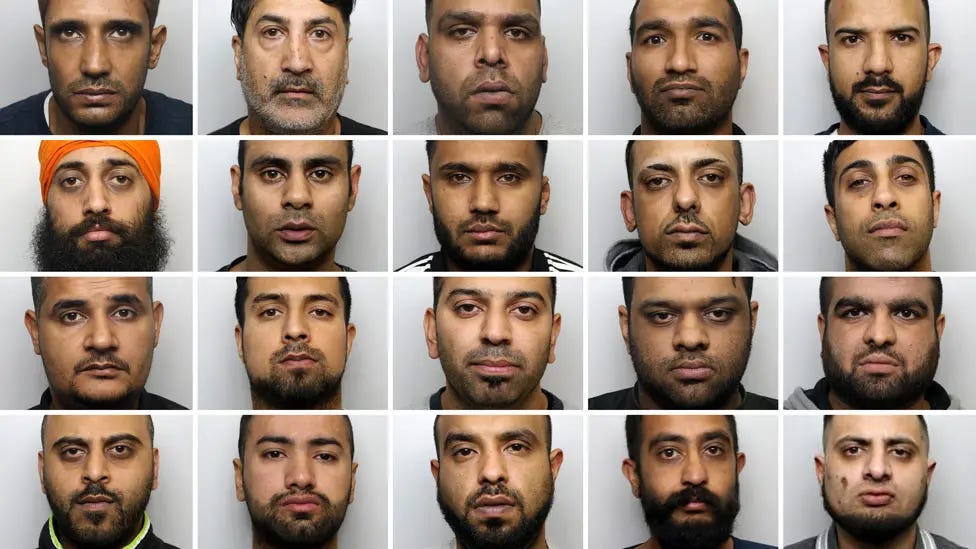
Like professional basketball, those accused of being members of “grooming gangs” tend to be monocultural.
The grooming gang thing has really blown up in the past couple of weeks. I’m not sure wholly why myself but a couple of guesses.
One is that the media really couldn’t report all that much — and for the same reason that Tommy Robinson got jailed one time around. Because there have been multiple ongoing cases and full reporting of one could — and probably would too — prejudice a jury in subsequent cases. So, those ongoing cases mean that the subject is more or less sub judice and can’t, in volume or detail, be talked about.
Thus things like Guardian reporting. Where you get the news that a gang has been tried, found guilty, sent off to jail. And no comment on who they were. Well, except for a list of names all of which are, shall we say, less than Anglo Saxon or even Viking in origin. We all draw our own conclusions at that point.
[…]
The number of abused — which means children raped, recall, arses blown up with pumps so that adult dicks can multiply penetrate to be detailed — starts to be counted up into the thousands. The tens of thousands perhaps.
There’s a point there at which I don’t think that normal societal agreement to allow the authorities to handle things works any more. At some point along that spectrum then significant civil violence breaks out.
Which brings me to the two questions. What is that number which, when known, leads to actual riots? And no, I don’t mean 15 meatheads lobbing half bricks at the police. Actual real and sustained loss of civilian authority control. The second, obviously, is are we going to reach that number?
In short, what is the level of betrayal of these girls that leaves the mob triumphant over law and order?
What really worries me is that I have a horrible — even if still slight at this point — suspicion that there was enough vileness done to enough young girls that we’re going to find out.
On Substack, Francis Turner shares concerns about the mass rapes of children and young women over too many years:
The scandal has been going on for at least 25 years and probably a decade more. That means that every year around 1000 new girls have been gang raped by the gangs.
Every year around 1000 new girls have been gang raped by the gangs
There are roughly 300,000 girls of each year cohort in the UK so that means one in around 300 girls of any age group has been gang-raped. Given that there are large chunks of the UK which are not places where the ~50 identified rape gangs have operated and indeed are places without residents of the relevant ethnicity (primarily Pakistani and Somali in a couple of cases) that means that the number goes way up in those areas. It seems likely that in one those 50 areas the ratio of new victims to their year group is more like 1 in 100 or 1%, especially when you remove the Pakistani girls that probably weren’t targeted even if some of them were in fact abused at home.
In places like Telford if you see a school year group photo for any year in a Comprehensive school in the last 30+ years at least one of the girls in that photo was being gang-raped
If successful steps had been taken in ~2010 to stop the abuse then about 15,000 girls would not have been gang-raped.
The Tory party and civil service disgust of Tommy Robinson has had the result that about 5000 girls were gang raped between when Tommy Robinson started going about the issue in around 2018 and 2023 when Sunak finally set up the national Grooming Gangs Taskforce.
If Substack would let me do a table this would be easier. However here is a summary of girls gang-raped under the prime ministers of this century based on a simple linear model
Starmer: 500 (to date)
Sunak: 1700
Truss: <100
Johnson: 3000+
May: 3000
Cameron: 6000+
Brown: 3000-
Blair: 10,000Probably half of Blair’s 10,000 was before anyone was aware that this was a systemic problem, but it was known to be a potential problem by at least 2004 when
[a] Channel 4 documentary about claims young white girls in Bradford were being groomed for sex by Asian abusers is delayed as police forces warn it could inflame racial tensions. It was finally shown three months later.
If the UK had got serious about stopping grooming gangs back in 2004 then over half of the gang rape victims could have been saved from such a terrible experience.
Take that 35,000 number a different way. There are roughly 35 million women in the UK. So one in a 1000 women in the UK have been gang-raped over the decades.
January 9, 2025
“Starmer is a banshee of a prime minister; he makes a terrible noise but is completely lacking in substance”
The extent of active disinterest to ongoing criminal activity in British towns and cities over a period of several years passes belief. The fear of being accused of racism metastasized to the extent that the authorities may even have colluded with criminals to hide the crimes to preserve politicians’ and senior bureaucrats’ careers. It’s now broken through the conspiracy of silence to being actively discussed in British media and even on the floor of the House of Commons. Even the Prime Minister may have to answer for past actions (or inactions):
It’s very easy to judge the past, particularly when you’re on the “right side of history”. What supreme confidence it must take to assume that all previous generations had got it so wrong, and that humanity was simply waiting for you to turn up and set them straight.
And yet isn’t it curious that so many who like to judge the values and behaviour of people in the past are also rarely willing to turn that critical eye on other cultures that exist today? According to the principle of cultural relativism, all societies and ways of life are equal. So we must not assert that we are morally better to a culture that permits the genital mutilation of children or that denies women an education, but we may assume that we are highly superior to the Ancient Greeks.
This debate has become particularly relevant with the recent explosion of interest in the rape gangs scandal. A report by Professor Alexis Jay in 2022 determined that more than 1,400 young girls were raped and abused in the period between 1997 and 2013 by what became known as the “grooming gangs”, so called because of the manipulative tactics that were employed to gain the victims’ trust. These groups comprised mostly of men of Pakistani heritage, which led many authorities to overlook the severity of the crimes.
Consider this example from a speech delivered by Andrew Norfolk, reporter for the Times. When police discovered a 13-year-old girl, drunk and mostly naked in the company of seven Pakistani men, they arrested her and failed to question any of the adults.
Police have admitted that such failures to investigate were largely down to a desire to avoid allegations of racism. The Jay report noted that several members of local council staff “described their nervousness about identifying the ethnic origins of perpetrators for fear of being thought as racist; others remembered clear direction from their managers not to do so”. Politicians and media commentators were more concerned with maintaining the fantasy that multiculturalism has been a success, rather than taking seriously their obligation to safeguard children. When Julie Bindel — the first journalist to investigate the grooming gangs — tried to publish her findings, she faced resistance ‘because some editors feared an accusation of racism’.
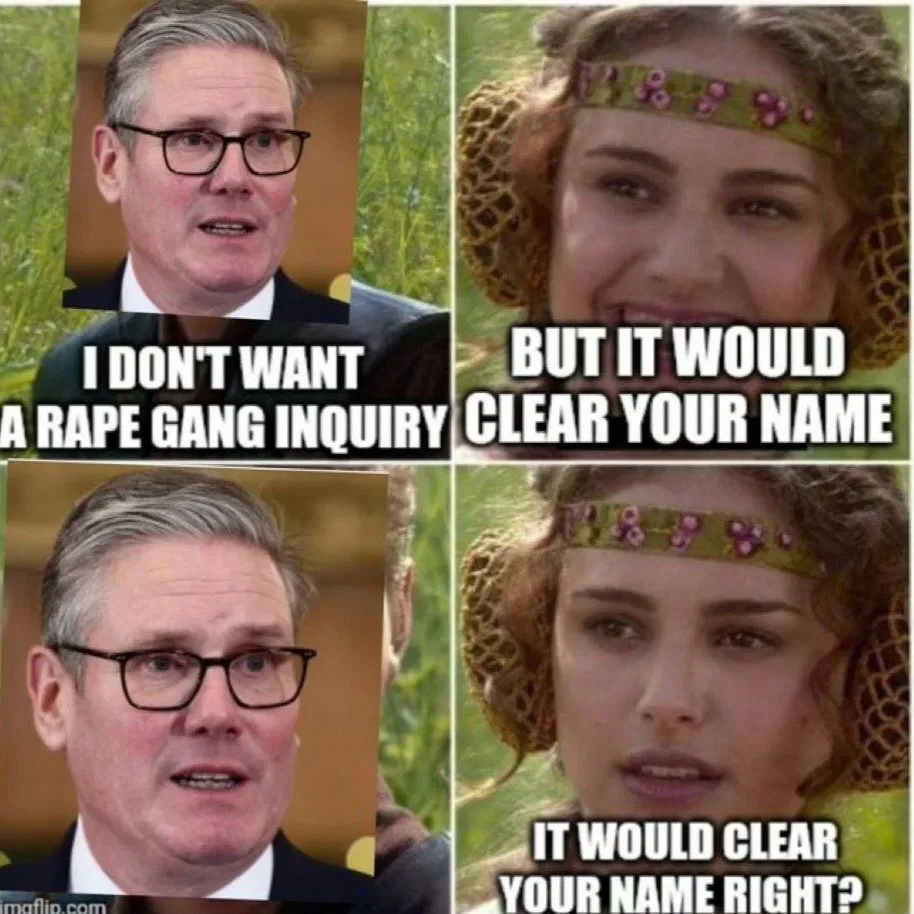
The Labour government has shown itself incapable of making amends. Jess Phillips has rejected a request for a public inquiry into child sexual exploitation in Oldham. And Keir Starmer has stated that anyone interested in a full-scale inquiry into these failings is jumping “on a bandwagon of the far right”.
This acute form of tone-deafness would, in any sound political climate, be cause for immediate resignation. While it is true that racists will be quick to weaponise the criminal behaviour of a minority, there is nothing remotely “far right” in taking an interest in the wellbeing of children and wishing to see those who abuse them held to account. But Starmer is a banshee of a prime minister; he makes a terrible noise but is completely lacking in substance.
Something may change with the release this week of crime league tables according to nationality. Up until now, there has been tremendous political resistance to releasing such statistics, with police in many European countries not recording such details at all in order to preserve the daydream of multiculturalism. And yet those that do keep such records have revealed a clear trend. Data from the Danish government, for instance, has shown that although non-Western immigrants constitute only 9% of the population, they account for 25% of convictions for violent crime. According to the Telegraph, in Sweden immigrants are “three times more likely to be registered as a suspect for assault than the native population – which grows to four times for robbery, and five times for rape”.
By happenstance, I posted this to social media the other day, which seems apposite:
January 6, 2025
The rape gangs in Britain were enabled and protected by “good people” who didn’t want to be accused of racism
Tom at The Last Ditch confesses his early complicity with the official culture of silence that protected and encouraged the exploitation of girls and young women in Britain for decades:

Everyone who ever participated in the leftist orthodoxy of identity-politics is to blame for the near-total impunity of the Muslim rape gangs in Britain. As I reported here, when I was a young solicitor in Nottingham, a police sergeant told me I was “part of the problem.” I had a choice between believing what he told me about “honour killings” in that city or preserving my good standing as an anti-racist liberal. I chose the latter. I feared my career prospects and social standing would be jeopardised (they would have been) if I accepted his honest account. I called a good man a racist (mentally equating him with the likes of Nick Griffin and recoiling in fear from the association) when he was just horrified (as any decent human should be) by young women being murdered.
In that moment, I very much was “part of the problem” and I am profoundly ashamed of that. It is fortunate that – unlike the politicians, local councillors, social-workers and police officers who should have brought the rape gangs or the “honour” killers to justice (or prevented both phenomena altogether) – I had no occasion ever to make any real life choices on the matter. I believe – faced with actual evidence – I would have made better ones, but the way I failed the good sergeant’s test that long-ago day in the early 1980s proves I would have wanted to look the other way, just as they actually did.
I am not still playing the stupid rainbows and unicorns game of cultural moral equivalence (still less the foul Critical Race Theory game of cultural moral hierarchy) when I make the point that the young white working class girls in our cities have not been the only victims of multiculturalism. Those murdered Muslim girls who (so the sergeant told me) had paraffin poured over them and were burned to death were victims too. It was racist to refuse to consider that their Muslim dads, uncles and brothers might murder them because of their primitive religious and cultural notions. It was racist for our authorities to treat Muslim men who gang-raped white girls differently than they would have treated others. It was racist to cover up these horrors in order to protect the myth – shamefully repeated just days ago in his annual Christmas message by His Majesty the King – that multiculturalism has been an overall benefit to Britain.
Some of us have been making these points as best we can for a long time. Many of us had given up, if we’re honest. It was clear that the official narrative that we were racists and that these stories were disinformation – a “moral panic” as Wikipedia puts it – was going to prevail. Until recently the key social media market of ideas – Twitter – was controlled by the Left and attempts to raise the issue were likely to be memory-holed by their private sector woke equivalent of Orwell’s MiniTru.
Miraculously, Elon Musk – a modern Edison, with plenty to occupy him besides our concerns about free speech – bought Twitter and (in one of history’s greatest acts of philanthropy) set it free at his own personal expense. He told advertisers who sought to maintain its old Newspeak regime to “go fuck themselves.” Miraculously he got involved in the issue not just in America (where the Constitution gives him some basis for hope) but in Britain too.
My British Constitution textbook at law school illustrated the supremacy of our Parliament by jokingly saying that it could – in law – make a man into a woman. Little did its authors know that dimwit politicians would later prove the educational point of their joke by making it real. Our constitution – as a result of centuries of struggle with the monarchy, which Parliament decisively won – can be summarised in just three words – “Parliament is supreme”
December 8, 2024
The potential for retribution in a second Trump presidency
Francis Christian meditates on whether or how President-elect Donald Trump will indulge in eye-for-an-eye revenge against the individuals most clearly involved in the lawfare and other attempts to derail his re-election:

It was the English poet Alexander Pope who admonished us in the manner of the New Testament that “to err is human; to forgive, divine” — Errare humanum est, ignoscere divino.
The Old Testament in contrast, has the equally familiar and perhaps far more popular, “eye for an eye“, and in one of the most revolutionary statements ever uttered, Jesus in the Sermon on the Mount talked about us “having heard that it was said, ‘an eye for an eye’ — but I say unto you, love your enemies“.
To wish to take revenge upon one’s enemies is therefore human, but Jesus is asking mankind to rise above this basic instinct and instead, to forgive and love one’s enemies. This was all of course part of His Mission on earth — to change by His Life, His Cross and the Resurrection, the destiny of human beings from being bound to basic instincts and death — to being bound for eternal life, a different destiny and a new creation.
The mavens of Hollywood of course march to a different and more ancient tune (which has been handed down unchanged to them) and generations of movie goers and consumers of media have been brought up on the idea that revenge of the most explosively visceral kind is a good thing, even a noble thing.
My readers will undoubtedly have their own sincerely held beliefs about Jesus’ command to love our enemies and to do good to those who hate us and once again, I do not wish this essay to turn out to be a sermon! What I wish to address instead, is to ask the question: what is the place for retribution, vengeance and revenge in the conduct of statecraft?
In other words, when President elect Trump said in a recently widely publicized interview that he was, “not looking for retribution, grandstanding or to destroy people who treated me very unfairly“, was he declaring a principle of statecraft that makes for a fulfilling and productive Presidency? And is this also a principle of statecraft that will “make American great again?”
In typical, inimitable and endearing Trumpian fashion, the President-elect also added the tongue in cheek comment: “I am always looking to give a second and even third chance, but never willing to give a fourth chance — that is where I hold the line!”
It could be argued from the life of no less a colossal figure than Julius Caesar that decisive and devastating revenge upon one’s enemies makes for a strong and respected ruler and nation. Whilst still a private citizen, Julius Caesar was captured by pirates on the way to the Greek island of Rhodes (to which he was travelling in order to learn oratory from the famous professor Molon). Caesar raised his own ransom — then raised a naval force, captured his pirate captors and had them all crucified.
The later assassination of Caesar and the subsequent civil wars that rocked and roiled Rome is the subject of Shakespeare’s magnificent, Tragedy of Julius Caesar. The subsequent rule of Augustus Caesar was marked by stability, expansion of the empire, the building of roads and bridges (via which the Gospel was to travel), the making of sea and land routes safe for travellers (again, to the advantage of the early Christians taking the Gospel to Asia and Europe) the consolidation of Roman power — and the rule of (Roman) law. It was also during the reign of this austere, learned emperor that Jesus was born in a manger, in the Roman province of Palestine.
H/T to Brian Peckford for the link.


