Quotulatiousness

August 25, 2024

“Does your vote count?” or how to set up an automatic vote-generation scheme

Elizabeth Nickson on recent reporting about voting scams in various US states:

After engineer and data scientist Kim Brooks worked on cleaning the voter rolls in Georgia for a year, she realized she was on a stationary bicycle. She’d clear a name for various reasons, dead, felon, stolen ID, living at a seasonal campground for twenty years, duplicate, moved out of state, 200 years old, etc., and back it would come within a month. At that juncture she realized that a program within the Georgia voter registration database was methodically adding back fake names.

She looked deeper. For new registrants, the culprit was principally Driver’s Services creating new registrations and in this case, the manufacturer was a person, or persons. Within the government office, someone was stealing names and duplicating, even tripling that person’s vote and then forging their signature. Sometimes it was someone who just died, or a teacher who had no voting record. In the case of a nurse who died in 2022 with three registrations, she was registered to vote in two counties, and all three of her voted in the 2022 election and the 2024 primary. Each signature was slightly different, the last three letters spelled, ly, ley, and lley

This operation works under AVR, or automatic voter registration, and is being used to register migrants. They will not vote, but their names have been entered into the Voter Registration database when they apply for a driver’s license and their vote will be voted for them. I imagine that this is repeating something everyone knows, but the borders are open for precisely this reason, so the Democrat/RINO machine can steal their votes. By the way, the process for advancing permanent residency has been cut from 11 months to two.

In 2020, twenty states used operation AVR. Of those, Trump lost 18.

That’s because there are registration fraud rings, as identified in the Arabella doc. and in the work of Omega4America. This worked well in Michigan, where, according to Captain Seth Keshel, who is one of the leads on this fight, believes that Trump likely got 576,443 more votes than were counted and won Michigan by 8.5%.

Every state is host to a dozen or more NGO’s which do nothing but fill out ballots for the faked registrants. Peter Bernegger’s team in Wisconsin has video of NGO functionaries doing just that in Wisconsin in 2020 at 1 am, early morning after Election Day.

    Michigan has two million more registered voters than they should have. 83.5% of the state is registered to vote but only 77.9% is over 18. – Seth Keshel

Seth works with demographic trends and does detailed statistical analysis; travelling almost ceaselessly to teach Americans how to stop the cheat. AVR was launched in Michigan, after Trump’s win in 2016. By 2020 there were 547,460 net new registrants in Michigan. Today, more voters are registered to vote than there are people old enough to vote. Keshel:

Per Keshel’s analysis, the Democrats and RINOs are frantically operating a dying political coalition which began to shift hard after Obama’s performance in his first four years, when not only did nothing change for the working class, it worsened. Democrat registrations in Michigan collapsed to the point where the Dems lost 16,000 as of 2016. Enter AVR and boom, 500+K new registrants.

August 14, 2024

Premier Doug Ford’s weird plan to hold the justice system to account

Filed under: Cancon, Law — Tags: , , , , , — Nicholas @ 03:00

The problem with Premier Ford’s as-yet-unelaborated plan to collect formal statistics on the products of the criminal justice system is that it’s weird. And Canadians don’t like weird things because something something Donald Trump something something Hitler. Despite that, Colby Cosh thinks it’s a good idea:

Superior Court of Justice building on University Avenue in Toronto (formerly the York County Court House).

… the very idea of addressing a social problem by gathering quantitative information is so un-Canadian as to seem radical and startling. It certainly seemed that way to the lawyers and civil libertarians who freaked out at Ford’s mention of “accountability” for judges who fail to protect the public from criminal predators.

Judicial independence is an axiom of our constitution — but to the degree that judges become policymakers, which is perpetually increasing as they discover creative new applications of the Charter, their lack of oversight by elected legislators and by the voting public is also a serious and obvious problem, purely in principle. It is no wonder the legal guild takes fright at the notion of “accountability” if it is interpreted to mean that judges might be subject to enforceable performance measures or firing by a minister.

But, of course, the word “account” is visible in there, and measurement of a social crisis is necessary to establish that one exists, even if almost everybody believes it to exist. Our courts are the first to castigate a government that makes some legislative change affecting individual rights without an attempt at inquiry into its reasonability and urgency. Ford, in proposing to establish the dimensions of preventable re-offending, is doing exactly what a legislator hoping to reduce crime ought to do: gather numbers. Collect and publish information. And let us specify that we mean publish publish, in an open, dependable, accessible way, with maximum detail.

Frankly, Ford’s announcement seems as much as anything like a reaction to being backed into a corner by an unresponsive Liberal government, which controls bail policy and the content of the Criminal Code, and by judges, whose irrational bail and sentencing decisions flood what’s left of our news media. Provincial politicians are bound to be judged by voters on the perceived prevalence of crime, but about all they can actually do about it is to, well, buy more choppers for the coppers and start collecting local data about revolving-door justice.

Update: Fixed broken link.

August 9, 2024

Domicidal maniacs in charge

Lorenzo Warby provides an oh-so-useful word to accurately capture what the diversity-at-all-costs elites running most western countries these days are actually up to:

Domicide is the destruction of home. It comes in the “hard” version — the physical destruction of houses and infrastructure.

Domicide also comes in a “soft” version — flooding localities with new people, separating people from, and otherwise degrading, their heritage. When folk say Britain is becoming “unrecognisable”, it is the domicidal effect of mass migration they are referring to.

The UK is suffering from a domicidal elite, one that uses mass migration to break up working-class communities; asymmetric multiculturalism to elevate incoming cultures over those of native English (the Celtic fringe get minority brownie points); favours non-“white” faces in advertising; asymmetric race-swapping in entertainment against the native English; denigration of British history as racist, white supremacist, imperialist, colonialist, etc.

Much of this is insulting virtue-signalling allied to, or presenting, cartoonish (simplified) and caricature (distorted) history. It all undermines social cohesion. But it is the use of migration policy as a systematic weapon against the resident working class which does the most damage. Though two-tier policing — obviously treating Muslims in particular with a deference not shown to the natives, especially when it comes to policing speech — is also highly corrosive of social cohesion.

Many working-class communities in Britain were already fairly dysfunctional — though the British state is not innocent in those dysfunctions1 — and sections of the British working class are very far from admirable. None of this justifies the use of mass migration to make things worse for such folk, however much it may help to explain the moralised class contempt that underlies so much of modern progressivism and modern managerialism.

To improve such things, to “level up”, requires a strong sense of how to create and maintain social order. Modern progressivism is strongly antipathetic to such understanding. To “level up” also requires a strong sense of custodianship, which managerialism typically lacks: particularly progressivist managerialism.

Indeed, modern feminist, progressivist, managerialism—in its lack of custodianship; lack of social solidarity;2 in its antipathy to taking the problems of social order seriously — is running the British state into the ground. The post-medieval British aristocratic and mercantile elite did a much better job of state management. But those elites had mechanisms — such as duelling, that forced men to defend their reputation at the risk of their life, and grand country houses, that turned into expensive investments in social isolation if you behaved badly — that selected for character.

Nowadays, the British elite only selects for capacity and even that is being degraded by DEI undermining the signals of competence. It turns out, over the longer term, character matters more than capacity. For capacity without character selects for manipulative, anti-social personalities that degrade institutions over time.


    1. For a particularly brutal depiction in fiction of the dysfunctional British welfare state — especially its school system — see Christopher Nuttall’s Mystic Albion series, especially the first book.

    2. Feminisation of institutions and discourse has tended to degrade social solidarity, see Benenson et al, 2009. The most conspicuous example of this in the UK is how uncouth it is in elite circles to mention the systematic rape and sexual exploitation of underage working class girls by overwhelmingly Muslim gangs.

August 6, 2024

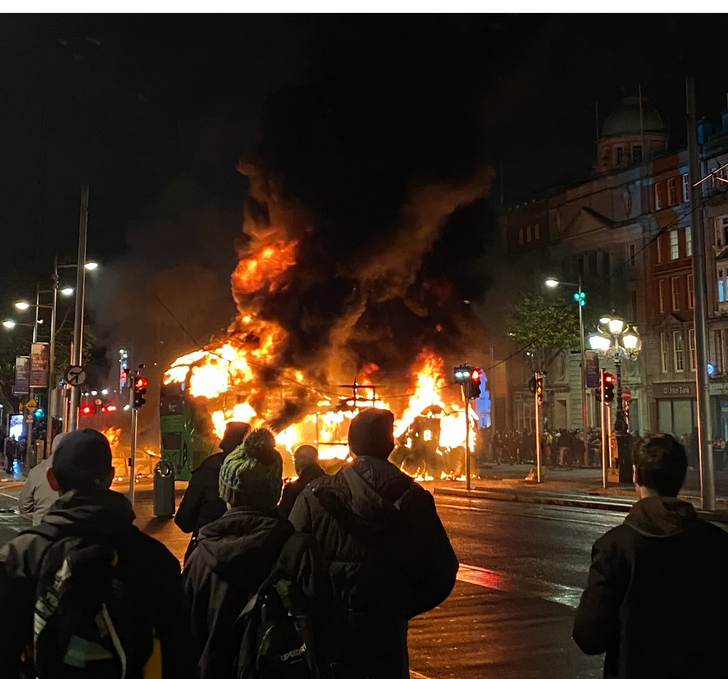
Britain’s immigration debate turns violent

Filed under: Britain, Media, Politics — Tags: , , , , , , , — Nicholas @ 04:00

At The Last Ditch, Tom discusses how the immigration issue has become the issue in modern Britain:

Protest and counter-protest in Middlesbrough over the weekend of August 3-4.

Margaret Thatcher famously quoted Kipling’s Norman and Saxon to President Mitterand of France in an EU meeting;

    The Saxon is not like us Normans. His manners are not so polite.
    But he never means anything serious till he talks about justice and right.
    When he stands like an ox in the furrow – with his sullen set eyes on your own,
    And grumbles, “This isn’t fair dealing”, my son, leave the Saxon alone.

She was trying, perhaps not as delicately as her diplomats would have wished, to explain how the apparently calm British will react – eventually – to being wronged.

I spent twenty years in three other countries and worked closely in business with people from many more. I have often smiled to myself since returning when I hear British people speak of our unique sense of fair play. It’s not unique at all. Everyone has it. We do not own fairness. We do not own tolerance.

We do, however, traditionally pride ourselves on both and the way we see ourselves has shaped our reactions over the last twenty-five years as we welcomed more immigrants than in the previous two millennia. A few years ago I listened quietly to a Bangladeshi friend – a would-be human rights lawyer – talk about racism in our country. I asked her where in the world was a better place to live as a member of an ethnic minority. On reflection, she agreed with me that there is nowhere.

I am not saying we couldn’t treat each other better. Of course we could and should try. But let’s take a moment, as our streets burn and our elites condemn us as far-right racists, to be proud of how we’ve behaved in general towards so many new arrivals in such a short time.

[…]

One day history may reveal which politician in the capital of an old European empire realised there was a ready supply of workers in the former colonies. People who spoke our languages and were familiar with our systems of government – because both had been forced on their ancestors. It was a perilous idea that may yet prove to be the end of European civilisation but he must have looked like a genius to his peers.

The doors were opened and cheap labour flooded in. From the lofty heights where the elites survey us, it looked like a perfect solution. On the ground, not always so much. Mostly we’ve been welcoming, accepting and tolerant. We’ve sometimes even gone beyond tolerance and flattered our new arrivals that they’ve enhanced our magnificent old culture with their jerk chicken and curries.

Yet already when I was a youngster practising criminal law problems had begun to emerge. A custody sergeant with whom I used to chat when waiting to see clients in the cells told me suicide rates among Muslim girls in our Midlands city were disturbingly high. Asked why that was, he said they were not suicides, but honour killings – the first time I’d heard that phrase. No-one, he said, commits suicide by pouring paraffin over themselves and setting themselves alight. It’s just too painful. Muslim men were killing their daughters and sisters. Asked why there were no prosecutions, he said senior police officers made it clear to their subordinates that it was “racist” to suggest the dead girls’ families’ stories of suicide were untrue.

Fresh out of my university law faculty, I sneered that his bosses were right and he was a racist. I will never forget the last words he said to me;

    Young man, then you’re part of the problem.

And I was. In that moment, I’d turned away from murdered women to preserve my smug world view. Just as, decades later, council staff and police officers in cities all over Britain turned away from young girls groomed and raped by Muslim men, for fear of being called bad names.

Gary Fouse in the New English Review asks whatever happened to Merry Olde England:

If you have been following the news out of England for the past week, you might think that the country has all but fallen into civil war. Riots and various forms of violent protests and counterprotests have broken out in cities all over the country in reaction to a shocking murder that occurred in the town of Southport last week. On July 29, a group of little schoolgirls were attending some sort of Taylor Swift-themed dancing class when a 17-year-old son of Rwandan immigrants (who was born in England) attacked them with a knife. Three of the schoolgirls (ages 6. 7, and 9) have died and eight others went to the hospital with serious knife wounds.

The entire nation has erupted in shock and anger. Obviously, the anger is being directed at immigrants in general — given the country’s out of control migration situation and long-simmering tensions with the largely-radicalized Muslim communities. It seems that now-finally — the people have had enough. At least one migrant shelter has been attacked, and several Muslim young men are showing up to counter-protest and do battle with young white men. Now the cops in several cities are trying to keep the two sides apart.

I should state at this point that I will not condone the violence and destruction that is taking place and the objects being thrown at police who are trying to keep order. While I do not condone the violence, I think I can understand why it is taking place. I recall back in the 1960s when there were many riots in inner city areas of the US during the Civil Rights era and in response to the murders of black civil rights leaders like Martin Luther King and Medgar Evers. Many responsible black leaders condemned the violence but also added that they could understand the reasons for it. It was a different era then in America, and in the South, segregation had the force of local laws behind it. Many blacks felt that the government was not responding to their grievances.

[…]

The fact is that far too many nations in the West, including ours, have suffered from bad political leadership. We see it in our cities, we see it in our state capitals, and we see it in Washington DC. Bad political leadership results in bad cities, bad states, and a bad country. The fish rots from the head, and what we need to do-in England-in France, in America, etc is elect responsible people who recognize that their government’s number one duty is to protect the citizens. When a government fails to do so, eventually what happens is what we see in England today.

July 22, 2024

QotD: Post-apartheid South Africa

There were two things that finally caused the dam to break and muted criticism of the South African regime to start appearing in the international press: the first was the situation in Zimbabwe. Like South Africa, Zimbabwe had recently ended decades of white minority rule, but in Zimbabwe things went way more wrong, way more quickly. Robert Mugabe, the incumbent president of Zimbabwe, was running in a contested election, and decided to ensure his victory with a campaign of mass murder and torture which in turn triggered a famine and a refugee crisis.

All of this brought tons of international condemnation onto the Zimbabwean regime, and a lot of countries looking for ways to pressure it to stop the atrocities. The glaring exception was Mbeki’s South Africa, which staunchly defended Zimbabwe for years as the killing and the starvation just kept ratcheting up. It’s unclear why they did this, beyond the ANC and ZANU-PF (the Zimbabwean ruling party) having a certain ideological and familial kinship, both being post-colonialist revolutionary parties that had overthrown white minority rule. But whatever the reason, this was the straw that finally caused Western politicians and celebrities to wake up a little bit and realize that South Africa was now ruled by thugs.

The second, even more catastrophic event that caused the South African government to lose the sheen of respectability was the AIDS epidemic and their response to it. The story of how Mbeki buried his head in the sand, embraced quack theories on the causes of AIDS, and condemned hundreds of thousands of people to avoidable deaths is well known at this point, but Johnson’s book is full of grimly hysterical details that turn the whole story into the darkest comedy you’ve ever seen.

For example: I had no idea that Mbeki was so ahead of his time in outsourcing his opinions to schizopoasters on the internet. According to his confidantes, at the height of the crisis the president was frequently staying up all night interacting pseudonymously with other cranks on conspiracy-minded forums (an important cautionary tale for all those … umm … friends of mine who enjoy dabbling in a conspiracy forum or two). These views were then laundered through a succession of bumbling and imbecilic health ministers such as Nkosazana Dlamini-Zuma or Mantombazana Tshabalala-Msimang who gave surreal press conferences extolling the healing powers of “Africanist” remedies such as potions made from garlic, beetroot, and potato.

Actually, the potions were a step up in some respects, the original recommendation from the South African government was that AIDS patients should consume “Virodene”, a toxic industrial solvent marketed by a husband-wife con-artist duo named Olga and Siegfried Visser. Later documents came to light revealing large and inexplicable money transfers between the Vissers and Tshabalala-Msiming. The Vissers then established a secret lab in Tanzania where they experimented on unsuspecting human subjects, engaged in bizarre sexual antics, and performed cryonics experiments on corpses. Despite this busy schedule, they also produced a constant stream of confidential memos on AIDS policy that were avidly consumed by Mbeki.

The horror of it all is that by this point there were very good drugs that could massively cut the risk of mother-child HIV transmission and somewhat reduced the odds of contracting the virus after a traumatic sexual encounter. There were a lot of traumatic sexual encounters. A contemporaneous survey found that around 60 percent of South Africans believed that forcing sex on somebody was not necessarily violence, and a common “Africanist” belief was that sex with a virgin could cure AIDS, all of which led to extreme levels of child rape. The government then did everything in its power to prevent the victims of these rapes from accessing drugs that could stave off a deadly disease. At first the excuse was that they were too expensive, then when the drug companies called that bluff and offered the drugs for free, it became that they caused “mutations”.

John Psmith, “REVIEW: South Africa’s Brave New World, by R.W. Johnson”, Mr. and Mrs. Psmith’s Bookshelf, 2023-03-20.

July 20, 2024

QotD: Comparing gun crime in Canada and the United States

Filed under: Cancon, Law, Quotations, USA, Weapons — Tags: , , , , , — Nicholas @ 01:00

That may explain the extraordinary amount of sucking up to Canada in this movie [Bowling for Columbine], which, while gratifying to insecure Canucks and self-loathing Americans, may be of less interest to third parties. Moore’s thesis, such as it is, is that America’s murder rate is the consequence not just of the country’s love of guns but of deeper currents of paranoia and fear in the American psyche. To that end, he crosses the Michigan border into Ontario, where one Canadian after another tells him that they don’t lock their doors. The level of guns per capita in Canada is similar to America but the murder rate is much, much lower. Ergo, it must be because Americans are living in fear while Canadians are much more socially progressive.

Whatever, dude. Unlike Moore, I have homes on both sides of the border and it’s the Quebec one I keep locked. By the time you read this, I’ll be in New York, but my home in New Hampshire will be unlocked, and so will my car at the airport, the key in the ignition, so I’ll know where to find it. By contrast, in Quebec it’s illegal to leave your car unlocked, even if you stop for a pee on an ice floe up by Hudson’s Bay. Pace Moore, Canada has vastly lower rates of handgun ownership. Long-gun ownership is much closer, but, statistically, Canadians are slightly more murderous than Americans in this sphere: in the US, there are 1.7 homicides per 100,000 long guns; in Canada, it’s 1.9. So European visitors to North America should be aware they’re more likely to be killed by a homicidal Canadian rifleman than an American one.

On the overall murder rate, if Moore’s interested in “cultural differences”, it seems odd that he should avoid the most obvious one. Alberta Report‘s Colby Cosh, a braver man than I, points out that black Americans are 13 per cent of the US population but commit over half the murders. Once you factor those out, non-black Americans murder at about the same rate as Canadians.

Mark Steyn, “Bowling for Columbine”, Steyn Online, 2002-11-30.

July 13, 2024

“Canada has disclosure issues”

Filed under: Cancon, Media, Politics — Tags: , , , , — Nicholas @ 05:00

The recent revelations about Nobel Prize winner Alice Munro’s family have certainly roiled the turgid waters of Canada’s tiny literati community, but was the scandal actually all that well hidden beforehand?

Alice Munro accepting the 2006 Edward MacDowell Medal, 13 August 2006.
Screenshot from a video of the event via Wikimedia Commons.

The Toronto Star ran two articles last weekend revealing that Andrea Skinner, third and youngest daughter of Nobel-prize-winning author Alice Munro, was sexually assaulted as a nine-year-old by her stepfather, Gerald Fremlin, Alice’s second husband.

The assaults occurred in the 1970s. Alice learned of them in 1992 when Andrea, then twenty-five, wrote her a letter detailing the abuse. After briefly leaving Fremlin, Alice returned to him. Andrea, feeling her mother had chosen her abuser over her, eventually cut ties with Alice and went to the police. Fremlin was convicted of indecent assault in 2005.

I’m not going to dwell on the abuse. It’s all here, and it’s distressing to read. One can only hope that recognition of what she suffered as a child and the pain she’s carried throughout her life brings some solace to Andrea.

I wish that had been my first reaction to the stories, but I was too long a journalist. My first thought was sordid. Good on the Star for getting the scoop.

My second thought was, how was this not reported earlier? It’s obviously a big story, and it all played out in open court. It’s surprising that it didn’t make headlines.

In yesterday’s Star, the always interesting Stephen Marche put the blame on “a specifically Canadian conspiracy of silence” amounting to “a national pathology”. He recalls that CBC radio star Peter Gzowski’s dirty laundry wasn’t aired until he’d passed; that CBC radio star Jian Ghomeshi’s outrageous behavior was not immediately called out; that author Joseph Boyden and singer Buffy Sainte-Marie both passed as Indigenous for a long time (Boyden does, in fact, have Indigenous blood). “Everybody knew but nobody knew,” Marche writes of each of these cases, adding that the Canadian arts and entertainment community “has been a breeding ground for monsters”.

I think Stephen has a low bar for monstrosity, but I am susceptible to his broader argument. Part of the reason I was happy that the Star got the scoop (and sincere congratulations to editor Deborah Dundas and reporter Betsy Powell on landing it) was that we sometimes first read of our biggest scandals in the international press. Toronto mayor Rob Ford’s crack scandal was revealed by Gawker, Justin Trudeau’s blackface habit by Time. Canada has disclosure issues.

The more I think about those issues, however, the less it seems we’re alone with them. How long did it take Harvey Weinstein’s crimes to make headlines? Bill Cosby’s? The US has had its share of long-running identity hoaxes: Elizabeth Warren, Hilaria Baldwin, Rachel Dolezal, and Jessica Krug. We didn’t learn that Kerouac was a thug and Salinger a creep until after they were gone. And it’s especially hard to sustain Marche’s argument that Canada is an outlier when the White House has been playing Weekend at Bernie’s for the last couple of years.

Certain stories are just slow to break. People keep secrets. Others abet them. Not many journalists frequent courtrooms way out there in Goderich, Ontario, and Fremlin’s name on the docket would not have sent off flares. Most people I’ve spoken to this week couldn’t have named Mr. Alice Munro last week.

There was no conspiracy, or at least not a broad one. I’m confident that any newsroom I was a part of would have run with the Munro story had we caught a whiff of Fremlin’s conviction. It’s not impossible to imagine other newsrooms making different editorial choices, perhaps arguing that Fremlin’s assaults didn’t merit coverage: he was a nobody apart from his association with Alice Munro; the offence was minor in a criminal sense (he served no time); Alice was not a party to the assaults; publishing the story would only serve to smear her by association. But I’ve not seen any evidence that any news outlet had a whiff of this story.

Only a small circle of people knew of Fremlin’s crime, most of them in the Munro family, and they weren’t talking. I contacted a few of the best Canadian literary gossips I know and they had heard nothing until last weekend. It’s not true that “everybody knew”.

Two who did know were Alice’s publisher, Douglas Gibson, and her biographer, Robert Thacker.

Did you blink and miss Gender Empathy Gap Day?

Filed under: Germany, Health, Media, Politics — Tags: , , , , — Nicholas @ 03:00

Don’t worry, unlike so, so many other formal days (or months, or seasons …) in the calendar devoted to this or that or the other real and imagined causes, celebrations, or acknowledgements, Gender Empathy Gap Day isn’t observed anywhere:

Remember these examples of virtue signalling? Can you imagine them doing the same for boys or young men?
Image from The Fiamengo File.

Few people have heard of Gender Empathy Gap Day, a day inaugurated in Germany in 2018 to raise awareness about our societies’ remarkable indifference to the suffering of men and boys. Not surprisingly, it has no official status in any country.

Most people, if asked, will insist that it is women and girls who suffer. We expect men and boys to apologize for their advantages and educate themselves about issues affecting women and girls. Animus against men is socially acceptable, even approved. “I bathe in male tears” is a popular feminist slogan, and university professors write mainstream opinion pieces with unironic titles like “Why Can’t We Hate Men?

The Gender Empathy Gap Day doesn’t advocate a contest over which sex has it worse. It does advocate recognition of our collective inability or unwillingness to see the full humanity of men.

Academic researchers Alice Eagly and Antonio Mladinic have compiled data showing that both females and males tend to have more positive associations with women than with men. Researchers have also confirmed a much higher in-group bias amongst women, meaning that women feel more empathy towards other women than towards men, while men also feel more empathy for women.

Whether it’s homelessness (61% male), homicide (78% male victims), suicide (79% male), workplace fatalities (93% male), prison incarceration (93% male), or a host of other issues, men and boys do suffer. Yet according to the research of Dr. Tania Reynolds, we tend to associate agency with maleness and the capacity for victimhood with femaleness, seeing men and boys as active doers rather than as sufferers deserving concern.

As a result, we are tolerant of harsh punishments for male criminal offenders, but not for women. In 2012, Sonja Starr, a professor of Law, published the results of her study of discrepancies in criminal sentencing that showed a very large gender gap in the punishment of women for the same crimes committed by men. Starr’s extensive study found an average 63% sentencing gap that harshly disadvantaged men. She also discovered that “Female arrestees are […] significantly likelier to avoid charges and convictions entirely, and twice as likely to avoid incarceration if convicted”.

The gap in punishment results because we all — including prosecutors, judges, and juries — incline to the belief that women who commit crimes were led into their law-breaking by others, usually men, and had limited choices because of poverty, childhood abuse, mental illness, or addiction. We hesitate to deprive young children of the care of their mothers, while we are content to see fathers behind bars. As Starr points out, however, male offenders have also “suffered serious hardships, have mental health or addiction issues, have minor children, and/or have ‘followed’ others onto a criminal path”.

Author Glen Poole has noted that such indifference to male difficulties is built right into the stories our society tells about itself. He points out that when a large number of men are killed — whether in war, accident, or natural disaster — mainstream news sources report on people killed, making the sex of the victims invisible. It is not news when men and boys die.

When women or girls are killed or harmed, they are rarely if ever referred to as people. Their suffering is news.

July 12, 2024

The British prison system is over-capacity, and Starmer’s new government has a plan

Filed under: Britain, Government, Law, Politics — Tags: , , , — Nicholas @ 10:05

As Ed West points out, the new Labour government’s plan is to move in a different direction than most Britons were hoping:

“Main gate to the HM Prison Wormwood Scrubs in spring 2013” by Chmee2 is licensed under CC BY-SA 3.0 .

Britain’s prisons are desperately overcrowded and morale among staff at an all-time low, following years of underfunding by the Conservative government and the inability of the state to build new jails against local opposition.

Now the incoming prime minister says that we have too many prisoners, while new prison minister James Timpson believes the British justice system is “addicted to punishment”, stating that only a third of inmates should be in jail.

The justice secretary, meanwhile, is considering “lowering the automatic release point for prisoners to less than 50 per cent through their sentence”. While currently prisoners serve half their sentences, or two-thirds for some sexual, violent or terror-related offences, the government plans to push the automatic release point to 40 per cent of their terms for those serving less than 4 years, benefitting 40,000 inmates — but not necessarily benefitting the rest of us.

This would be a very unwise move. The majority of prisoners are inside for sexual or other violent crimes, and even restricting early releases to those serving under four years would set free some very dangerous individuals, while previous amnesties of this type have led to huge increases in crime.

The idea that Britain “is addicted to punishment” jars with the sentences regularly handed out even for the most horrendous crimes, and the way that incorrigible criminals are allowed to offend again. This is the subject of a Twitter thread which I began six years ago, in order to highlight how the common belief in the punitive state was mistaken.

As an illustration, and bear in mind that their “sentences” are often twice what they actually served, here are a few cases:

A man who killed his wife in 1981, who was released after a few years and went on to strangle a girlfriend 12 years later, was subsequently freed — and ended up killing a third woman.

There was serial rapist Milton Brown, who was sentenced to 21 years for raping three women – one of whom took her own life – and was released early, only to rape again.

Or Joshua Carney, 28, freed on licence from prison and who just five days later brutally raped a mother and her 14-year-old daughter. He was allowed out despite 47 previous convictions, and now having been convicted of “13 charges including rape, attempted rape, actual bodily harm and theft” he is still eligible for parole in 10 years. Doesn’t sound like a country addicted to punishment.

There was John Harding, who treated a woman “like a rag-doll” when he beat and threatened to kill her after she told him she didn’t want a relationship. Despite terrorising his victim, including wrapping a sheet around her neck, and being in breach of a 30-month community order for a number of offences, including assault and threatening to kill another woman, and having other convictions for theft and criminal damage, he received a sentence of 21 months. As a result, in 2023, Harding was free to rape two women. Now convicted of rape, actual bodily harm, false imprisonment, strangulation and threats to kill, his sentence of 15 years means he could be out in 10.

If you believe that criminals only behave that way because of “systemic racism” or “poverty” or some other form of impersonal forces, you’ll likely also believe that punishment therefore serves no useful purpose and be in favour of all sorts of alternatives. At least until you or someone close to you is a victim of violent crime …

July 10, 2024

The four horsemen of cultural collapse

Filed under: Law, Liberty, Media, Politics, USA — Tags: , , , , — Nicholas @ 05:00

Chris Bray provides yet more examples of cultural decay and the collapse of law and order in America’s Trudeaupia, California under the loving care of Justin Trudeau’s spiritual twin, Gavin Newsom:

Today tells you about next year.

In a long history of murder in America, the historian Randolph Roth argued that violence follows other losses of trust and order. The murder rate surges in the face of “four distinct phenomena: political instability; a loss of government legitimacy; a loss of fellow-feeling among members of society caused by racial, religious, or political antagonism; and a loss of faith in the social hierarchy”.

Read that list carefully, because it should sound familiar.

Similarly, the originators of the theory of “broken windows policing” argued that peace and order grow from peace and order; neighborhoods are more likely to be calm when they’re “places where people are confident they can regulate public behavior by informal controls”. Crime follows crime; vandalism, for example, “can occur anywhere once communal barriers — the sense of mutual regard and the obligations of civility — are lowered by actions that seem to signal that ‘no one cares'”. The police commissioner William Bratton famously reduced all categories of crime in New York City subways by assigning officers to arrest turnstile jumpers who entered the system without paying. He sent a signal at the front gates.

“Broken windows” is a much-criticized theory: “He contended that the very notion of ‘disorder’ is subjective and racially fraught”. But the criticisms tend to reduce the complexity of the theory in order to “debunk” it.

Decay communicates. Disorder is a message.

July 5, 2024

QotD: South Africa after Apartheid

Filed under: Africa, History, Quotations — Tags: , , , , — Nicholas @ 01:00

Now, what has replaced this abhorrent socio-political system [apartheid] is not good, at all; indeed, what has since happened in South Africa is typical of most African countries: massive corruption, bureaucratic inertia, inefficiency and incompetence, and a level of violence which makes Chicago’s South Side akin to a holiday resort. (For those who wish to know the attribution for much of the above, I recommend reading the chapter entitled “Caliban’s Kingdoms” in Paul Johnson’s Modern Times.) Where South Africa differs from other African countries is twofold: where in the rest of Africa the preponderance of violence and oppression was Black on Black — and therefore ignored by the West — apartheid was a system of White on Black oppression (and therefore more noticeable to Western eyes). The second difference is that apartheid exacerbated the virulence of the “grievance” culture which demands reparations (financial and otherwise) for the iniquities of apartheid. This continues to unfold, to where the homicide rate for White farmers — part of the taking of farmland from Whites — is one of the highest in the world, and the capture and conviction rates for the Black murderers among the lowest — a simple inversion of the apartheid era.

Speaking with hindsight, however, it would be charitable to suggest […] that apartheid was “simply a logical adaptation to the presence of a population that simply cannot support or sustain a First World standard of living, done by people who very much valued the First World society they had created”. While that statement is undoubtedly true, up to a point, and it could be argued that apartheid was a pragmatic solution to the chaos evident throughout the rest of Africa, it cannot be used as an excuse. Indeed, such a labeling would give, and has given rise to the notion that First World systems are inherently unjust, and a different label “colonialism” — which would include apartheid — can be applied to the entirety of Western Civilization.

The fact of the matter is that when it comes to Africa, there is no good way. First World — i.e. Western European — principles only work in a socio-political milieu in which principles such as the rule of law, free trade, non-violent transfer of political power and the Enlightenment are both understood and respected. They aren’t, anywhere in Africa, except where such adherence can be worked to temporary local advantage. Remember, in the African mindset there is no long-term thinking or consideration of consequence — which is why, for example, since White government (not just South African) has disappeared in Africa, the infrastructure continues to crumble and fail because of a systemic and one might say almost genetic indifference to its maintenance. When a government is faced with a population of which 90% is living in dire poverty and in imminent danger of starvation, that government must try to address that first, or face the prospect of violent revolution. It’s not an excusable policy, but it is understandable.

That said, there is no gain in rethinking apartheid’s malevolence […] because apartheid was never going to last anyway, and its malevolence was bound to engender a similar counter-malevolence once it disappeared. Which is the main point to my thinking on Africa: nothing works. Africa is simply a train-smash continent, where good intentions come to nought, where successful systems and ideas fail eventually, and where unsuccessful systems (e.g. Marxism) also fail, just fail more quickly.

Kim du Toit, “Tough Question, Simple Answer”, Splendid Isolation, 2019-12-05.

June 25, 2024

QotD: Progress and decline

The past has always interested me more than the future. This backward-looking tendency has only been reinforced by reaching, somewhat unexpectedly, the age of 70. I can’t say that I don’t feel my age because I don’t know what feeling any particular age is like — but one repeatedly hears that 60 is the new 40, 70 is the new 50, and so on; certainly, the human aging process has slowed since I was born. When I look at photos of people who were 50 in the year of my birth, 1949, they look much older and more worn-out than do 50-year-olds now; and if I had lived only to my life expectancy at birth, I would be dead these last four years.

So progress must have occurred in the intervening time, despite the pessimism that infects those who, like me, are of retrospective temperament and hypersensitive to deterioration. It is not hard to enumerate many things that have improved. They relate principally, but not only, to material conditions. My best friend when I was very young was one of the last children in Britain to suffer from polio, which paralyzed him from the waist down. The quickest form of written communication was then the telegram, and anything other than local telephone calls had to go through an operator. To call across the Atlantic required a reservation and was ferociously expensive; the resultant conversation always seemed to take place during a violent storm. In England, the food was generally disgusting, and meals were to be endured as a regrettable necessity instead of enjoyed (it puzzles me still how people could have cooked so badly). Cars broke down frequently, and every November, pollution produced fogs so thick that you couldn’t see the hand in front of your face (I loved them). Rationing continued for eight years after the war, and disused bomb shelters, present in every park, were where illicit sexual fumbles and smoking took place. Incidentally, for an adult male not to smoke was unusual (75 percent did so); we must have lived in a perpetual fog of foul-smelling tobacco, to judge by the distaste caused by even a single lit cigarette in these virtuous times. Poverty, as raw necessity, still existed. Murderers were sometimes hanged — as well as, more rarely, the innocent. Overt racial prejudice was, if not quite the norm, certainly prevalent.

Yet not everything has improved, though the deterioration has been less tangible than the progress. To give one example: by age 11, I was free to roam London, or at least its better areas, by myself or with a friend of the same age. The sight of an 11-year-old child wandering the city on his own did not suggest to anyone that he was neglected or abused. I remember, too, the evening papers piled up at newsstands; people would throw coins on top of the pile and take their copy. It never occurred to anyone that the money might get stolen; nowadays, it would never occur to anyone that the money would not be stolen. The crime statistics bear out this sea change in national character.

Theodore Dalrymple, “What Seventy Years Have Wrought”, New English Review, 2019-10-26.

June 24, 2024

Justin Trudeau’s Ominous Online Harms Act: Minority Report Comes to Canada: Conor Friedersdorf

Quillette
Published Jun 19, 2024

Jonathan Kay talks to Atlantic Magazine staff writer Conor Friedersdorf about a censorious government bill that would allow officials to investigate Canadians for things they haven’t done yet.

https://quillette.com/2024/06/19/just…

——

Quillette is an Australian-based online magazine that focuses on long-form analysis and cultural commentary. It is politically non-partisan, but relies on reason, science, and humanism as its guiding values.

Quillette was founded in 2015 by Australian writer Claire Lehmann. It is a platform for free thought and a space for open discussion and debate on a wide range of topics, including politics, culture, science, and technology.

Quillette has gained attention for publishing articles and essays that challenge modern heterodoxy on a variety of topics, including gender and sexuality, race and identity politics, and free speech and censorship.
(more…)

June 14, 2024

Britain’s anti-gay hate crime epidemic

Filed under: Britain, Law, Media — Tags: , , , , , , — Nicholas @ 04:00

Andrew Doyle suggests you take the recent reports of burgeoning hate crime in Britain with a fair bit of salt, because the hate crime statistics are far from trustworthy:

When things like this can be reported as “hate crimes”, and the definition depends on the reporter’s assumption of hateful intent, you’re going to see a lot more “hate crimes”.

We all know by now that the Metro is an activist publication masquerading as a newspaper. And so we ought to approach with some caution its article this week claiming that the UK has seen a surge in hate crime against gay people. There’s even a handy rainbow-coloured map which pinpoints the most homophobic locations in the country. Thankfully St Ives isn’t on the list, so I won’t have to cancel my holiday.

What are we to make of the article’s claim that there has been a 462% increase in homophobic hate crime and a 1,426% increase in transphobic hate crime since 2012? The source for these remarkable figures is the House of Commons Hate Crime Statistics report. If true, it would seem to confirm activists’ claims that we are living in an anti-LGBTQIA+ hellhole.

The truth is not so melodramatic. The supposed escalation of hate crimes in the UK can be accounted for by the way in which they are now recorded. Police actively trawl for complaints, inviting citizens to report offensive comments or any action – criminal or otherwise – that the “victim” perceives to have been motivated by prejudice. No evidence of “hate” is required for it to be recorded as such, other than the assumption of the complainant. With such methodology in place, it is inevitable that the statistics will rise.

And perhaps that’s the whole point. The police in the UK are just one of the many major institutions that has been captured by intersectional ideology. Police are regularly seen dancing at Pride parades, driving rainbow-coloured cars, and harassing gender-critical women for wrongthink. In February 2021 in Merseyside – a county that tops the Metro‘s list of homophobic hate spots – police were photographed next to a digital advertisement which read “Being offensive is an offence”. This belief-system can only be sustained by the narrative of widespread hate, and so we should not be surprised to see that police practice has been modified to ensure this outcome.

In fact, the College of Policing had made it clear that a fall in hate crime statistics would not be acceptable. Its operational guidance says that “targets that see success as reducing hate crime are not appropriate”. And by the Home Office’s own admission, “increases in police-recorded hate crime in recent years have been driven by improvements in crime recording and a better identification of what constitutes a hate crime”. In other words, there is no hate crime epidemic at all. It’s simply that the definitions have expanded.

Rather than rely on the Home Office statistics, we would be better turning to a source that hasn’t been corrupted by ideology. The Crime Survey for England and Wales hasn’t adopted the new police methods of recording, and shows that hate crime has been consistently dropping. Between 2008 and 2020, the number of hate crimes fell by 38%, and all the while records of hate crime kept by the police kept on rising. The disparity between the reality and the narrative couldn’t be more stark.

May 28, 2024

QotD: Women’s voting interests

Filed under: Cancon, Media, Politics, Quotations — Tags: , , , — Nicholas @ 01:00

… I was young, then. Imbecilic stupidity is common in the young, who are subject to fashionable excitations. My mother, on the other hand, was older. As a Tory, she of course doubted whether women should vote at all; but as my father was of old Ontario Methodist farmboy stock, his congenital propensity to vote Liberal had to be acknowledged.

“I have to vote Conservative, for his sake,” she reasonably explained.

She had compounded his characteristic error in 1968, however, and felt she owed an explanation to her son. This began by reminding me of her fragile, female sex.

“One thinks of the party leader on the analogy of going for a date.”

And true enough, the Tory leader, Mr Robert Stanfield, was the sort of man you could present to your father. He could be relied on, to get you home safely, and on time.

“But there are times when a woman does not want to get home on time,” mama added.

She, a registered nurse acquainted with the eccentricities of mental patients, called my attention to a phenomenon I had not previously noticed. Whenever a truly monstrous (male) psychopath is strapped away in gaol, the prison receives adoring letters for him, from women. These correspondents have never met him, and know him only from accounts in the yellow press. He may have been found guilty of heinously murdering a succession of wives and lovers. But they promise to be waiting for him on the steps of the penitentiary; and as the police will confirm, they are still there.

My mother had never comprehended how a woman could be so crazy. But when she realized that she had herself just voted for “Pierre” [that’s Trudeau the elder, to clarify], she suddenly understood.

David Warren, “The women’s vote”, Essays in Idleness, 2024-02-22.

« Newer PostsOlder Posts »

Powered by WordPress