
It is the idea of “victimhood”; the idea that a man is not responsible for his acts; that he is instead a victim of the oppression of some abstraction called “society” — because he is black, or on welfare, or whatever. And everyone who isn’t can be held guilty, regardless of how they have actually behaved.
Oppressed by whom?
Oppressed, actually, by the implied permission that is granted in advance, to looters, and rapists, and thugs, and amateur neighbourhood terrorists, by that very satanic idea of victimhood, and its practical corollary, that if you can play the victim, you can manoeuvre yourself into a position to victimize everyone around you.
David Warren, “Bad Gumbo”, DavidWarrenOnline, 2005-09-03.
September 30, 2025
QotD: The modern cult of “victimhood”
Comments Off on QotD: The modern cult of “victimhood”
September 24, 2025
It won’t work – the minister responsible knows it, but they’re going ahead with it anyway
The “it” in the headline is the federal government’s gun confiscation program, which they claim will reduce crime but they already know it won’t do any such thing. What it will do is take away from literally the most law-abiding, responsible citizens their legally purchased property and leave illegal guns in the hands of criminals … at an ever-increasing estimated cost to the taxpayer. In The Line, Matt Gurney covers the details:
The federal gun confiscation program […] is illogical. It won’t save lives or make the public safer. The federal government doesn’t really even expect it to work, and is only going ahead with it because they’ve been stuck with a dumb proposal the Trudeau government made almost five years ago. If they could do it all over again, they wouldn’t, but they feel like they’ve blocked themselves in and have no choice but to proceed so that they don’t anger part of their electoral coalition, mainly voters in Quebec.
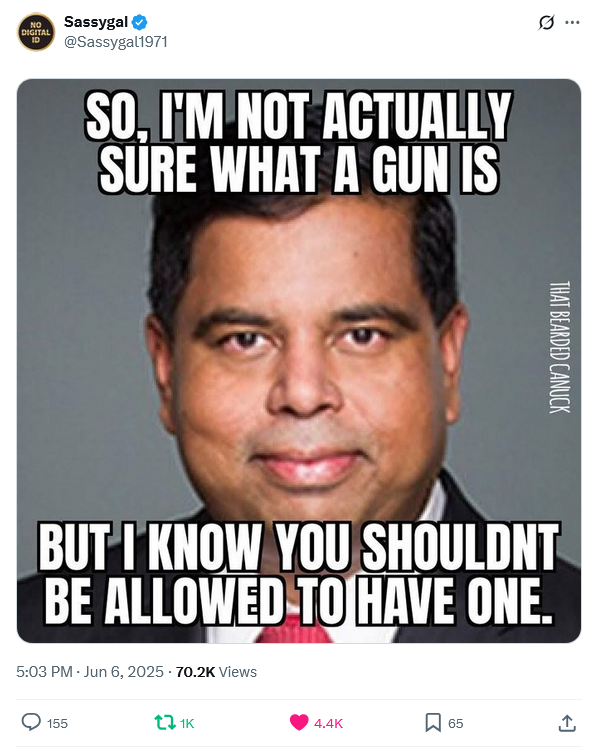
That might sound like a blistering criticism of the program, the kind of thing you’ve read in any number of my columns before. It’s actually what the public safety minister thinks about it. He just didn’t know he was being tape recorded when he said so. In a 20-minute conversation Gary Anandasangaree had with a firearms owner he rents a home to, which was recorded and then leaked, the minister says all of the above things. (He has also confirmed the recording is legitimate.)
Awkward for the minister, clearly, but I actually give him credit. The minister’s comments on tape are a confession, and an admission of defeat. They’re also, hands down, the most honest thing a Liberal government official has said on the gun control file in five years. Given that the minister responsible is freely telling people the program is a bad idea he’s stuck with and that won’t work, a sensible government would probably take this opportunity to walk away from the program.
Unfortunately, that’s not what this PM has chosen. It’s full speed ahead with an idea so bad Anandasangaree wishes he’d never been saddled with it.
Let’s talk about what this program is for a second. And forgive me, there’s quite a bit of history here. During Justin Trudeau’s first term, his only majority, his government had proposed a series of fairly moderate changes to the gun control laws they had inherited from Stephen Harper. As I’ve written often since, the proposals were a mixed bag. Some were okay. Some were bad. But they more or less left the well-functioning Canadian gun control system intact. They nibbled around the edges enough so that they could tell their voters that they had gotten tougher. But they generally didn’t try to fix what wasn’t broken.
But then politics got in the way, as it always does. Trudeau lost his majority in 2019 and became ever-more dependent on voter efficiency and wedge issues. And then in 2020, there was a horrible massacre in Nova Scotia. That catastrophe had nothing to do with our gun control laws; the weapons used were brought in illegally from the United States, as is typical of guns used in gun crime. But the Trudeau government seized on the opportunity — never waste a crisis, right? — to announce that they were “banning” “assault rifles”.
A lot of quotes above. So let me explain. First of all, there really wasn’t much of a ban. Anyone who owned one of the newly banned rifles was allowed to keep them. And as for assault rifles, actual assault rifles — rifle-calibre weapons that use high-capacity detachable magazines and can fire in fully automatic mode — have been banned in Canada for decades. This isn’t a problem that we actually had. And the government tacitly admitted as much when they began fudging the words they used to describe them. In acknowledgement that there were no actual assault weapons to ban, they started talking about assault-style weapons.
“Style” is a tell. You wouldn’t take medicine-style pills, or munch on a food-style snack. Because you’d know better. Trudeau et al knew better. It didn’t stop them. They needed something to announce, and by God, they were going to announce it!
And as we’ve noted several times, the Trudeau government got addicted to the media high of making big showy announcements. So they started doing repeat announcements over a period of time, and thanks to the spinelessness of Canadian legacy media even before Trudeau started directly subsidizing them, the media sugar high got repeated as well. It didn’t take long for the lesson to be learned that making an announcement was cheaper than doing the thing that was announced, and we quickly transitioned to a world where it was the announcement that mattered, not the thing.
At Junk Economics, Bryan Moir sums up the stupidity:
You want blunt? Fine. Here it is:
Listen: politics is kabuki theater and promises are props. Here we have a government rolling out a nationwide confiscation-style buyback and calling it “voluntary” — which is like calling income tax “optional” if you want to be arrested. The minister tells citizens, in public, “it’s voluntary”, then admits in private he’ll criminalize non-compliance, will “bail you out” if it goes that far, and says the whole exercise exists because the party must keep the promise and because the Quebec caucus wants to show muscle. That’s not statesmanship. That’s PR with a warrant.
They lecture you about being “tough on guns” while refusing to be tough on the people who actually bring violence into our streets. The minister himself says if he could do it over he’d target illegal guns and put criminals in jail — not law-abiding owners. Translation: the policy is ideologically driven and politically performative, not strategically intelligent. You don’t cure gang violence — which the cops tell you comes from illegal trafficking and cross-border smuggling — by borrowing billions to buy back legally purchased rifles. That’s like throwing sandbags into a burning house and patting yourself on the back for “doing something”.
And then there’s the logistics and the cost — the ugly part they don’t want on camera. The federal pot is capped at about $742 million and the program is rolled out in fits and starts. Major police forces are already saying “no thanks”, which means the feds must either stand down, contract a patchwork of municipal services, or try to outsource enforcement. Any of those choices blows up the promise in different ways: it becomes toothless, it becomes wildly more expensive, or it becomes a federal-provincial fight that will make the Notwithstanding clause dust-ups look like backyard squabbles. Pick your disaster.
Remember the math: a capped pool of cash plus a growing list of banned models (hundreds, then thousands) equals many owners getting nothing while the bureaucracy eats up the rest on administration, contracts, security, staffing, and political “bribes” (a nicer word for handouts to get agencies to play ball). If the fund runs out — and the minister openly says “it’s capped; when it’s gone, it’s gone” — you’ll have a bunch of people stripped of legal property, out of pocket, and the state triumphant only in optics. That’s confiscation without fair market compensation; it reads like policy designed by accountants and sold by televangelists.
Worst of all: while Ottawa gamely auctions off the idea of virtue, or was that “Canadian values”, real problems pile up. Fire seasons rage, hospitals are full, kids wait for surgeries, food banks are overwhelmed and the cost of living keeps rising— and Mark and Gary are borrowing money to offer coupons for now-illegal guns. If you wanted a textbook case of political misallocation, this is it: symbolic policy delivered with symbolic money so the party can say it kept a promise, while the public pays the bill and crime networks keep smuggling.
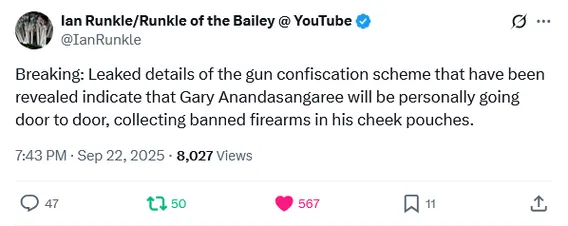
On the gun confiscation program in particular, thank goodness you can always depend on social media to find the funny side of any issue:
Comments Off on It won’t work – the minister responsible knows it, but they’re going ahead with it anyway
September 20, 2025
“[V]iolent crime [in Canada] had increased by 30% over the last decade”
A lot of Canadians are noticing how much social peace has deteriorated in and near major cities, but police and local media increasingly are not sharing full information about suspects — often to avoid accusations of racism. It’s gotten bad but as James Pew points out … it’s just getting worse and worse:
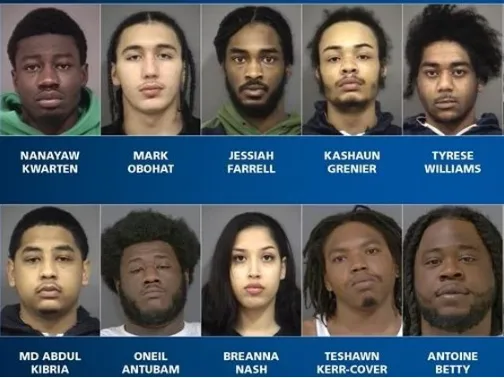
Some of the 18 people charged with violent home invasions and carjackings in the Peel Region, July 2025.
Almost every day we hear new stories of violent crime in Canada. Many of us are shocked into speechlessness. Violent youth offences, home invasions, arsons and assaults are on the rise. The rate of car jackings in the York Region increased by 523% between the years 2019 and 2024. Home invasions in Canada are now a regular occurrence. Last year, Kiernan Green did some number crunching for The Hub. He found that violent crime had increased by 30% over the last decade. And Livio Di Matteo, of the Fraser Institute found that “while Canadian homicide rates remain lower than in the U.S., the Canadian rate has increased at a higher rate since 2014”. In the blink of an eye Canada went from a safe high trust society to a dangerous low trust society. Everything is upside down.
The swarming attack and murder of 59-year old homeless man Kenneth Lee of Toronto in December of 2022 was a somewhat early indication that something was dreadfully off. Eight girls, ranging in age from 13 to 16 attacked Lee, stabbing him with knives and small scissors multiple times. He later died in hospital. Initially charged with second degree murder, ultimately all eight girls had their charges reduced and were sentenced to probation only. The Mayor at the time, John Tory, referred to the judgment as “deeply disturbing.”
So far this year there have been thirteen cases in which youth offenders were charged with homicide in the Greater Toronto Area. The most recent involves a 12-year old who has been charged with murdering a 62-year old homeless man. He had been on a release order at the time of the murder. He was also accompanied by a 20-year-old man named Isaiah Byers. The two went on a spree of unprovoked violent attacks in downtown Toronto, targeting vulnerable individuals. Five in total were attacked with a hammer.
Frustrated with the city’s catch-and-release protocol, the Toronto Police Association recently took to X and asked, “Where are the judges who make these decisions?” And further, in a written statement the TPS pointed out, “Our members are held accountable for the decisions they make and the actions they take. Why isn’t anyone else?”
The Youth Criminal Justice Act (YCJA) is currently protecting the identities of youth offenders involved in shocking levels of violence across the GTA. On July 17th, a 14-year old boy, described as a black youth, was charged with fatally stabbing a 71-year-old woman, Shahnaz Pestonji, while attempting to rob her in a grocery store parking lot. The youth admitted later on a social media livestream that he “didn’t mean to kill the old lady” and was just trying to steal her car.
On August 16th, 8-year old Jahvai Roy was shot and killed by a stray bullet while at home sleeping in his mothers bed. Many bullets were shot that night by thugs outside the Roy home in North York, but tragically one of them passed through a window of Holly Roy’s bedroom and struck Jahvai. She wrote on Facebook, “My baby was preparing for one of his best friend’s birthday celebration. He was so excited he couldn’t sleep!” A 16-year old boy has been arrested, and two others are still being sought by police on Canada-wide warrants: 17-year old Ibrahim Ibrahim of Toronto, and 18-year old Amarii Lindner of Toronto.
On August 23rd a 16-year-old girl was charged with aggravated assault and assault with a weapon after stabbing a woman in her 80s in Scarborough, Ontario. Due to the YCJA, the name of the woman, who is suffering in hospital with life-threatening injuries, was not disclosed by the media. It was reported that the teen and the victim lived in the same residence. The story seems to have vanished. After August 23rd, there are no more media reports.
Comments Off on “[V]iolent crime [in Canada] had increased by 30% over the last decade”
September 12, 2025
A primer on patterns in past political assassinations
On the social media site formerly known as Twitter, ESR shares his observations on common patterns in political assassinations which may be relevant to the investigation of the assassination of Charlie Kirk:

The Salt Lake City FBI office released these photos of a “person of interest” in the Charlie Kirk assassination.
I don’t know anything other than public information about the assassination of Charlie Kirk.
However, a primer follows about patterns in past political assassinations. I will sketch what scenarios an intelligence analyst would come up with looking at this one.
The first and most important rule in this kind of investigation is: when you hear hoofbeats, think horses not zebras.
In political assassinations, as an ordinary murders, the correct suspect is usually the most obvious suspect. Airport-thriller-style convoluted plots and false-flag ops pulled off by unlikely people or organizations are rare in the real world.
Accordingly, when you’re trying to solve a political assassination, the right question to ask is “Who said they wanted him dead?”
Then, you infiltrate those organizations, or arrest a bunch of members, and do contact tracing. Usually you do in fact find your killer that way. It’s not very different from ordinary police work except for the stakes.
There are broadly speaking three different kinds of assassin: the nutter, the zealot, and the pro. They are not difficult to distinguish once you got your hands on them.
Nutters don’t have a coherent political ideology, though they may spout semi-random slogans that political actors can seize on to pretend that they do. They generally have quite an obvious history of mental illness
Before capture, given the kind of public evidence we have now in Charlie Kirk’s assassination, it’s difficult to tell the zealots from the pros by their MO. It used to be easier, but as I noted in a previous post sniper doctrine and technique have been leaking into popular culture for decades.
It’s easier to spot the nutters; they tend to have poor forward-planning capacity. A very obvious way this manifests is a weak or non-existent plan for exfiltrating after the hit. Thus, the nutter is very likely to get caught quite soon after the assassination, often at the site.
This also produces a false-prominence effect – people think political assassins are more likely to be nutters than is actually the case.
Pros – professional assassins working for intelligence agencies or militaries – are also rare. They do occasionally strike – as when, for example the Bulgarian secret service whacked Pope John Paul – but high-profile public assassinations carry a risk of diplomatic and political blowback the most nations are unwilling to assume.
Also, trained assassins are a scarce resource and exfiltrating in the hue and cry following a very public assassination is chancy. Usually you’re going to send them against more obscure targets like exiled dissidents that you think might still be dangerous, hoping not to trigger a full law-enforcement and counterintelligence response.
There’s been talk in some of the wackier corners of the Right that the Mossad did this one. No analyst would take this seriously; the blowback risk to the Israelis is far too high to justify any gain. Same goes for the Russians, though they have a higher risk tolerance than the Israelis and had a much higher tolerance in Soviet times.
In the case of Charlie Kirk it’s pretty high odds we’re looking at a zealot. That’s usually the way to bet, and in this case, the quality of his exfiltration plan and the fact that he has successfully disappeared raises the odds.
Given all these factors, LEOs are going to be looking for zealots associated with domestic organizations that said they wanted Charlie Kirk dead.
Yes, this seems boring and obvious. The main point I’m trying to drive home here is that the boring and obvious theory about a political assassination is usually the correct one.
Accordingly, the first place investigators of the assassination of Charlie Kirk are going to be looking is gun clubs associated with Antifa and the hard left, like the John Brown Gun Club and Redneck Revolt.
It’s not certain that Kirk’s assassin is a member of one of those groups, but if you had to place a bet that would be where to put it.
Update: while I was composing my analysis there was a leak from inside the ATF. They found a .30-06 with engravings expressing “anti-fascist” and transgender ideology.
As I said: When you hear hoofbeats, think horses not zebras. The obvious suspect is usually the correct one.
And later, on the particulars of this particular assassin’s work:
PSA for those speculating about the sniper who killed Charlie Kirk:
No, the shot he made was not a difficult one, and does not constitute evidence that he was a professionally-trained sniper.
His choice of hide and the quality of his exfiltration plan was impressive. That could indicate pro-level training. Or, it could just mean he played the right videogames.
Information about sniper practice has been leaking into popular culture for decades. It used to be that good practice could enable you to make deductions about the background of the sniper, but that time is past.
Nothing has yet been released about what ammunition or weapon he used. It is highly likely that the bullet has been recovered and identified.
About the most we’re likely to be able to extract from the caliber is whether the sniper used an American traditional caliber like .30-06, NATO-standard 7.62, or Russian 7.62. The latter two cases may not be distinguishable if the bullet is deformed.
Knowing this won’t really tell us anything, as rifles in all plausible calibers are generally available in the United States. Furthermore, if this were a pro-level hit, misdirecting investigators by choosing an adversary or third party weapon is part of normal covert operations doctrine.
All in all, it is not possible to deduce anything of significance about the sniper from the publicly available information. Mistrust anyone who claims otherwise.
Comments Off on A primer on patterns in past political assassinations
September 8, 2025
Ancient Historian Reviews Monty Python’s Life of Brian | Deep Dives
History Hit
Published 1 May 2025In this new video, classicist Honor Cargill-Martin delves into the iconic Monty Python’s Life of Brian. Is it historically accurate or is it a very naughty film?
00:00 Intro
00:53 Judea A.D. 33
01:55 Colosseum?
06:56 People’s Front of Judea
10:28 “What have the Romans done for us?”
16:05 Roman Grafitti
19:44 Hypocaust
23:30 Biggus Dickus
28:42 “Crucifixion?”
30:37 “… release a wrong doer from our prison”
32:09 “I’m Brian!”
(more…)
Comments Off on Ancient Historian Reviews Monty Python’s Life of Brian | Deep Dives
August 29, 2025
Memories of Bournemouth
It’s nearly sixty years since my family emigrated, but I still have golden memories of the family trips to the seaside, although my family went to Scarborough, Whitby, and Redcar rather than the Bournemouth of Pimlico Journal‘s childhood:
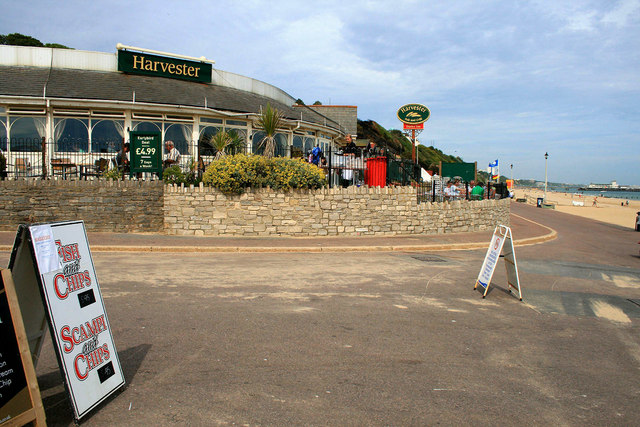
“Harvester at Durley Chine” by David Lally is licensed under CC BY-SA 2.0 

 .
.
At every possible opportunity in the summer weekends of my childhood, my father would take our family down to the coast. Our route to the sea was normally through the medieval city of Salisbury, across the chalk downs of Hardy’s Wessex, and into the piney moors of the New Forest. The destination would nearly always be Bournemouth, the prim, stately model of the British seaside town, perched magisterially on Dorset’s sandstone cliffs, above a long golden strand lapped by the warm waves of the Channel.
Our favourite beach was at Durley Chine, where we could park (for free, greatly appealing to my father) among obscured mansions in the shade of thick-smelling conifers, and make our descent to the shore, where the chine gives way to the rows of huts that line the promenade, and a reassuringly lower-middle class Harvester restaurant. We would while away the hours on the sand until the sky was orange, my mother reading, my father swimming, and my brother and I playing whatever games we could devise, mostly involving the throwing of sand. The day would end with fish and chips under the pines, watching the sun sink over the jurassic cliffs past Poole harbour, the gateway to King Alfred’s stronghold at Wareham.
These were among the most precious times of my early life, and the sights and sounds and smells of that part of the world and the accompanying hazy, worriless bliss are cherished sensations. Though the beach is public, it was one of those places that felt special and individual to my family, as if we had somehow carved out our own summer fief on the crowded shore.
It was on Durley Chine beach, on 24 May 2024, that two innocent women, Amie Grey and Leanne Miles, were attacked by Nasen Saadi, a criminology student from Croydon of Iraqi and Thai heritage. Saadi murdered Grey and left Miles in critical condition, and was sentenced this year to thirty-nine years in prison for his crimes. The incident was part of an escalating pattern of violence, particularly sexual violence, in the Bournemouth area over the past few years, with the beach as the focal point, a pattern which had begun in July 2021 with the brutal rape of a 15-year-old girl by Gabriel Marinoaica, a young man from Walsall who dragged his victim into the sea to commit his attack. Another notable incident occurred eight months later. Afghan asylum seeker and convicted killer Lawangeen Abdulrahimzai (he had shot two fellow Afghans while living illegally in Serbia in 2018, before fleeing to Norway, where his asylum claim was rejected, then travelling to Britain and successfully claiming asylum by pretending to be an unaccompanied fourteen-year-old, despite being an adult) stabbed Thomas Roberts (a local man and qualified precision engineer who had recently applied to join the Royal Marines) to death outside a Subway in the city centre, in a dispute over an e-scooter.
The news stories become relentless from that point. Among many depravities are the sexual assault of a 17-year-old boy by a group of Asian males on 17 June 2023, accompanied the same day by an attempted assault on a 16-year-old girl outside the fish and chip shop on the seafront. A week later, two girls, aged just 10 and 11, who would have been in primary school at the time, were sexually assaulted while swimming in the sea. As far as I can tell, none of these crimes have yet been prosecuted.
Two months after the murder of Amie Grey, on 19 July 2024, a day of delirious warmth culminated in violent clashes between youths, many coming in from London, on the seafront — clashes which were filmed and circulated on social media. In the chaos, a teenage girl was sexually assaulted. Jessica Toale, the freshly-elected Labour MP for Bournemouth West, a seat which had been Tory since its creation in 1950, said after the events of 19 July that crime and anti-social behaviour had become a ‘huge issue’ in contrast to the safe Bournemouth she remembered as a girl, stating that ‘… parents had told [her] that they are concerned about letting their daughters go to the town’. These are almost reactionary words from a Labour MP, and reflective of the mood of anxiety and decline that seems to have enveloped the city, a mood founded on the series of despair-inducing events plaguing residents and visitors. On 30 June, disorder similar to that witnessed in July last year returned to the seafront, with police making arrests across the country in the aftermath.
A week later, on 6 July, a young woman was raped in a public toilet adjoining the beach. The police have charged Mohammed Abdullah, a Syrian asylum seeker living in West London, with the crime.
Comments Off on Memories of Bournemouth
August 28, 2025
A civil society can’t allow young Scottish hellions to brandish weapons at immigrants harassing them
At least, the headline expresses how the sky people probably frame the situation where a young girl felt she needed to scare off a threat to herself and her friend. This is from an X post which claims to be describing what actually happened rather than what the media has been reporting:
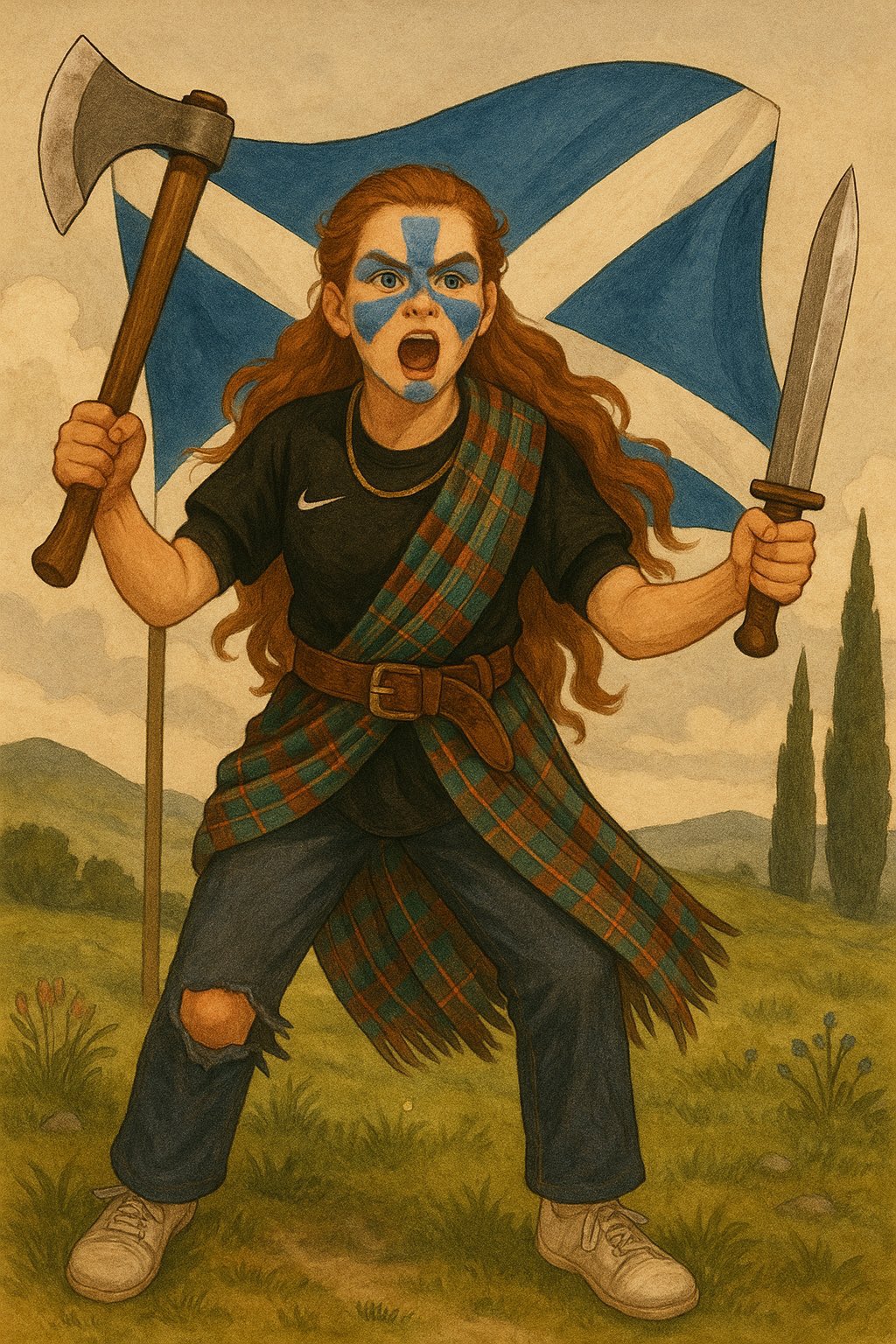
One of many, many images posted to X on this incident.
I spoke with the mom of one of the girls (Mayah) and got the entire story that the media is covering up and lying about.
So first of all, the reporting got the names of the girls mixed up. There were 3 girls who were there who were accosted and attacked by the migrants.
Lola – Lola is the hero from the video. She’s the one with the axe defending her sister from the migrant attackers
Ruby – Lola’s older sister who was attacked and hospitalized
Mayah – Ruby’s best friend who was with them and went to call the police after Ruby was attacked by the migrants
Here’s the summary of what happened from Mayah’s mother:
“Yes. So what happened was the girls where out just walking and the man in the picture made comments to lola(the younger girl) calling her sexy and other sexual remarks then the girls started to tell this man to leave them alone and stop following them and making sexual remarks to them. After that the man’s sister (also in the picture) came around the corner and physically attacked ruby(the older sister) she grabbed her hair dragged her to the floor started to punch her then both the man and woman where kicking her in head while she was on the floor. At this point my daughter (mayah) called the police so my daughters account after that is all abit blurry. But that is when lola had the weapons she pulled them out to protect ruby. After that the man came back at lola recording her making sure she showed the weapons to the camera and antagonising her. Ruby was hospitalised after the attack with a severe concussion a tennis ball sized lump to the back of her head aswell as lots of bruises.”
John Carter reacts to the original image, also on X:
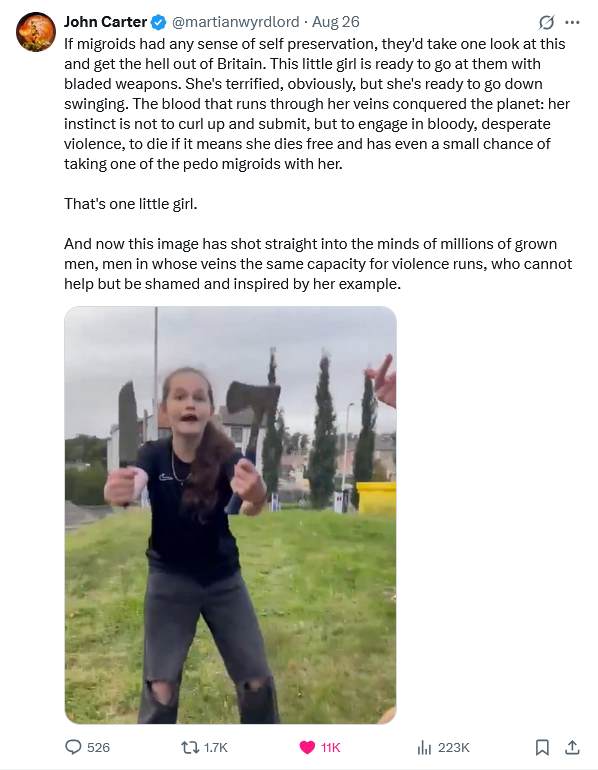
This should be a turning point, but god knows how many such the British elites have ignored so far. Another graphic from X expresses what may happen if this is also ignored:
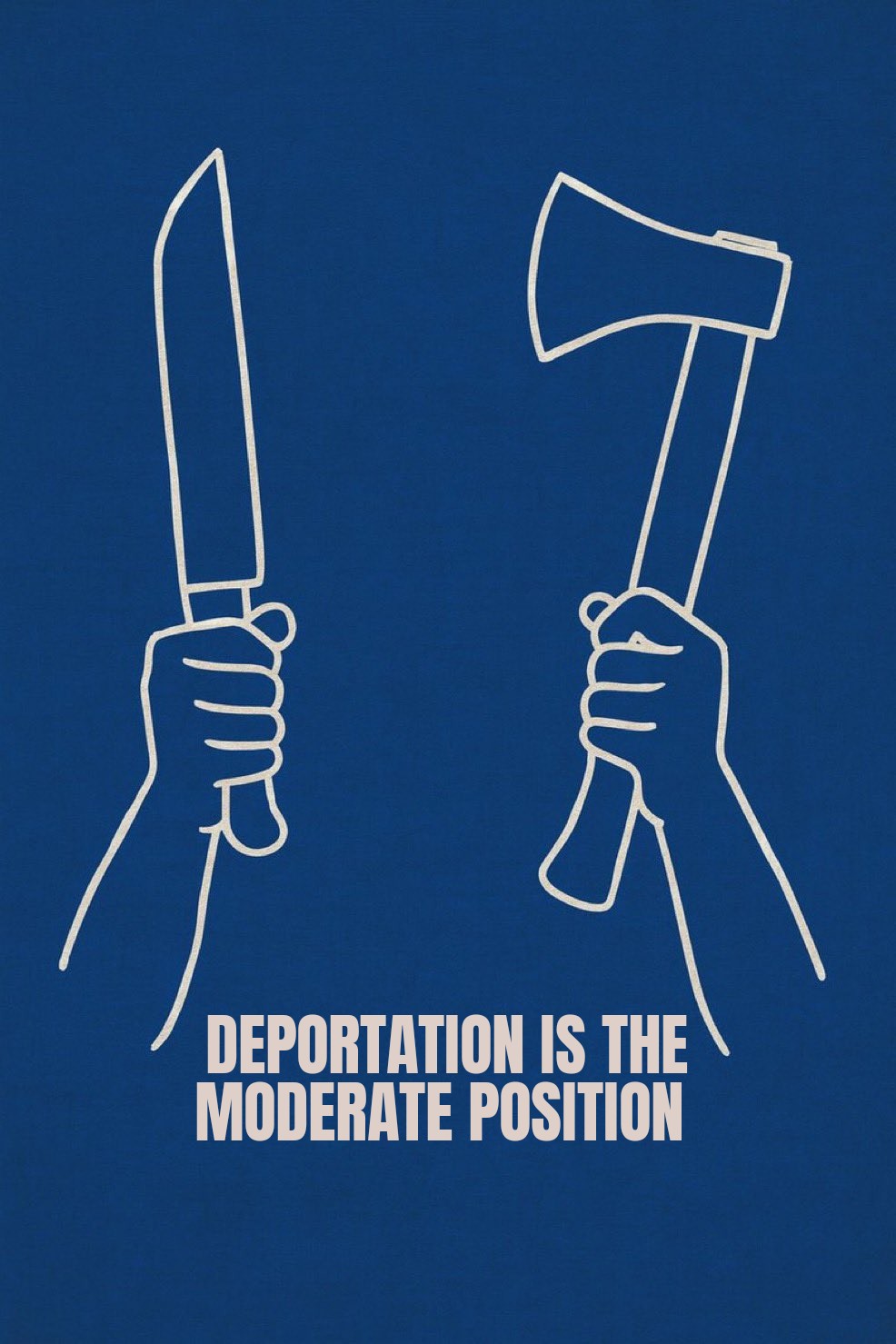
Even the Brits can be pushed too far and we can’t be very far from that point now. And the way the British media is handling this and pretty much every other confrontation is not helping:
You can’t have missed her, if you’re on social media at all, the dual-wielding 14-year-old Scottish lass raising two blades in defiance of the “migrant” seemingly intent on assaulting her and her 12-year-old friend.
The name of this hero won’t be released due to her age, and police were right on the scene to arrest the violent attacker.
That’s right: the little girl is in jail, charged with possession of a bladed weapon. Two weapons, actually — what appear to be a large santoku-style blade and a small hatchet.
In the widely-circulated clip, her would-be attacker (with the non-British accent) can be heard taunting her to show the blades on camera. Why? The answer is obvious: he’s well aware that self-defense is illegal in Britain, and he also knows she’ll be the one the cops take away.
And he was correct on both counts.
[…]
Culturally, things are so crazy that the BBC didn’t just blur out our heroine’s face, they even blurred out her blades. And now you understand the screencap at the top of this column. Mustn’t ruffle any feathers, you see.
How about pepper spray and the like? Sorry, mate, but pepper spray was banned as a “prohibited weapon” (!!!) in 1968.
In Britain, the only legal defense against rape is a whistle — which is to say, no defense at all.
That 14-year-old girl found it necessary to possibly defend herself and her friend against two possible assailants: would-be rapists and the British criminal justice system. The day came, and she proved herself a hero.
She warded off the former, but God only knows what indignities she’ll suffer at the hands of the latter.
What’s the next little British girl’s defense against that?

Comments Off on A civil society can’t allow young Scottish hellions to brandish weapons at immigrants harassing them
August 25, 2025
Defending your life against an intruder can get you charged in Canada
Terry Burton‘s satire-that-is-too-close-to-being-true:
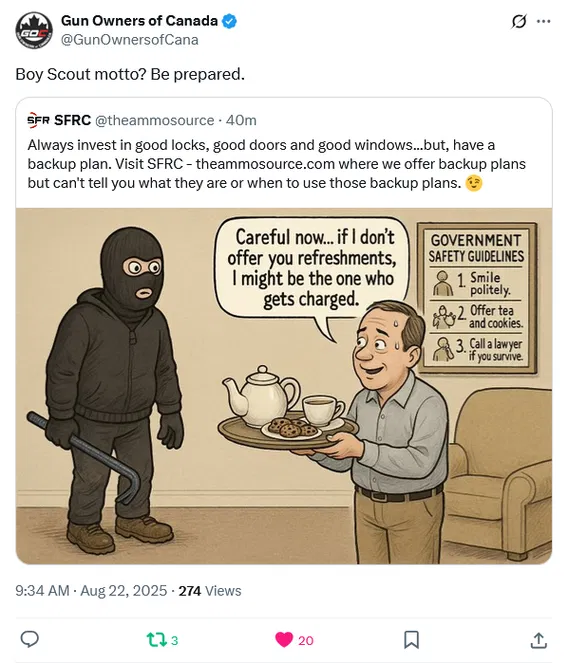
A Recent Case in Ontario
An Ontario man recently had the unthinkable happen: he defended his home. Unfortunately for him, this occurred in Canada, where the laws surrounding self-defence have taken a dive off the deep end of “wokeness”. The police, after deep reflection (and a healthy dose of Diversity, Equity, and Inclusion training), chose to charge the homeowner and not the intruder. Why?
Let’s break down the madness.
How a Home Invasion Might Go in 2025 Canada:
Homeowner (middle-class taxpayer, not currently oppressed):
“Hello, sir. You appear to have broken into my home and possess a 7-inch knife. May I inquire about your intentions?”Intruder (career criminal with a social media following):
“I’m just here to grab some electronics, steal your monies, and stab someone if they resist my incursion. It depends on my mood. Don’t profile me.”Homeowner:
“Of course. My apologies. Would you like a latte while you loot my home? Oat milk? Almond? I don’t want to assume.”Intruder:
“You’re a colonialist bigot for offering me food.”Homeowner:
“Understood. Legally, I’m only allowed to resist you in proportion to your level of violence — yet to be ascertained, as determined by a tribunal of academics who’ve never been in a fist fight. That means if you punch me, I can … maybe glare at you. Anything more, and I’m the criminal.”But what if the homeowner fights back?
In this case, the homeowner managed to grab a knife and defend himself. The intruder was injured — tragically — during this altercation. So naturally, the police arrived and did what any reasonable, DEI officer was instructed s/he must do:
They charged the homeowner.
The intruder? Off to the hospital, flowers sent courtesy of the Canadian taxpayer, and full support from victim services (taxpayer funded). (Yes, really.)
Reasons Police and Prosecutors Declined to Charge the Intruder (some say over-the-top satirical conjecture by the author):
- Mental illness – A catch-all excuse for immunity.
- Homelessness – Makes all actions justifiable, including assault.
- Drug addiction – A disease, not a crime, apparently.
- Identifies as female – We must respect self-identification, even during felonies.
- Arrested 55 times, 20 for B&Es – Systemic failure, so we shouldn’t blame him again.
- Member of a marginalized group – Intersectionality shields all.
- Single-parent upbringing – Automatically voids criminal responsibility.
- Not yet a citizen – A conviction could hinder his application; we, the state machinery that is, must protect him.
- Linked to child porn – But not convicted, so hands off.
- Terrorist affiliations – Political beliefs are personal.
- Anti-Semitic – But it’s culturally complex, they say.
- Illegally entered Canada – A paperwork issue, not a crime.
- Gun and drug trafficking – He’s an entrepreneur, really.
- Anti-Christian – Expressing a valid worldview.
- Anti–Rule of Law – Which now appears to be mainstream.
The Verdict?
The homeowner is:
- Charged with attempted murder.
- Convicted of using “excessive force”.
- Sued in civil court by the intruder.
- Ordered to surrender his house and retirement savings.
The intruder is:
- Awarded the home he broke into.
- Given legal permission to rent the house back to the homeowner’s family.
- Allowed to visit the property at will.
- Celebrated in local media for “surviving trauma”.
What Happened to Common Sense?
It died somewhere between Bill C-18, Bill C-63, and the idea that your lived experience matters more than actual law. In a country where, in some jurisdictions, whistling at night is outlawed, but breaking into homes is a misunderstood cry for help, we’ve lost the thread entirely.
When defending your family is labelled aggression, and violating someone’s home is rebranded asocial protest, Canada ceases to be a democracy and becomes a farce.
Comments Off on Defending your life against an intruder can get you charged in Canada
August 20, 2025
“All politics is local” … except when it isn’t
Lorenzo Warby on a recent study of the vast chasm between what European voters want in areas like crime and immigration and what their elected representatives want:
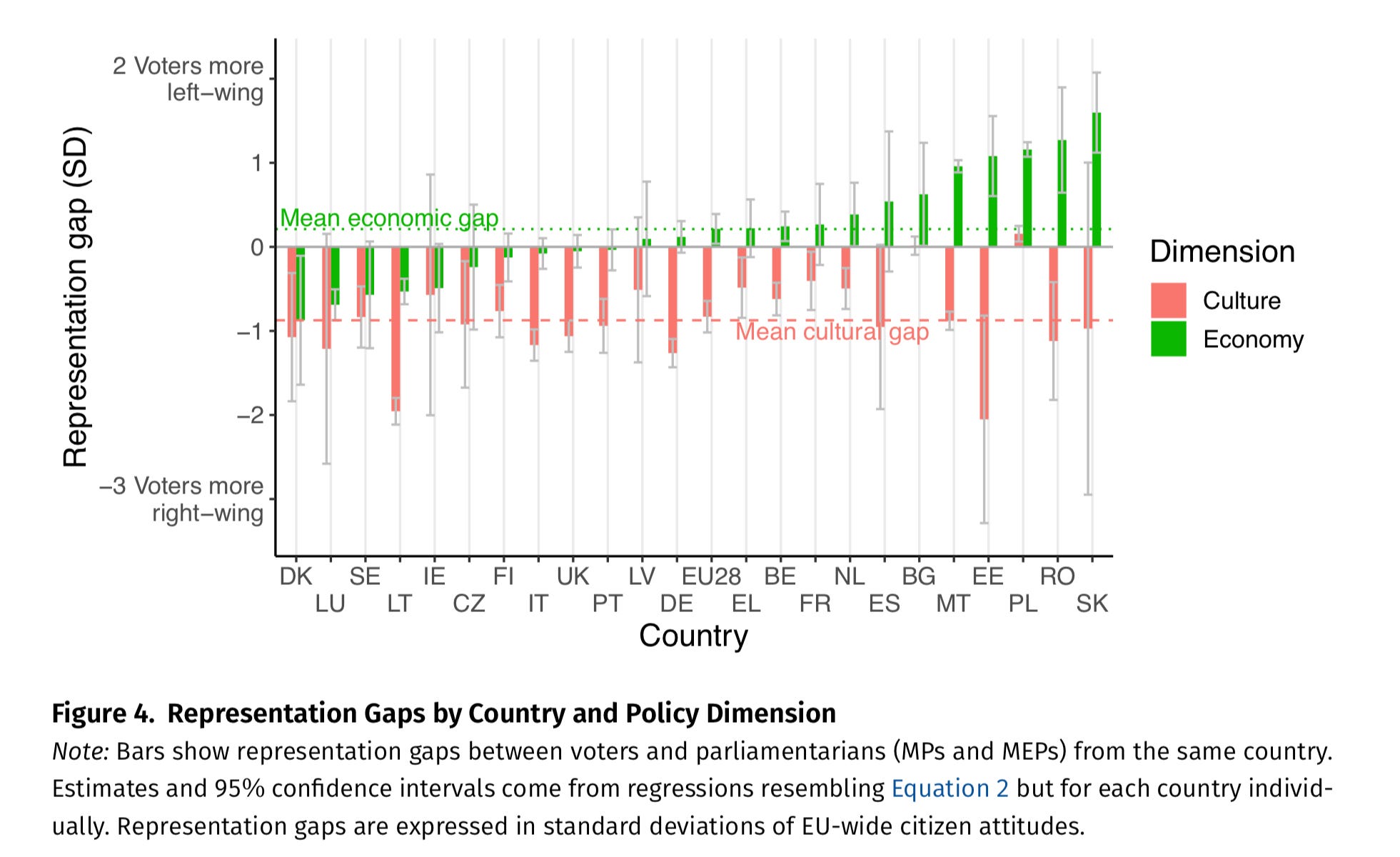
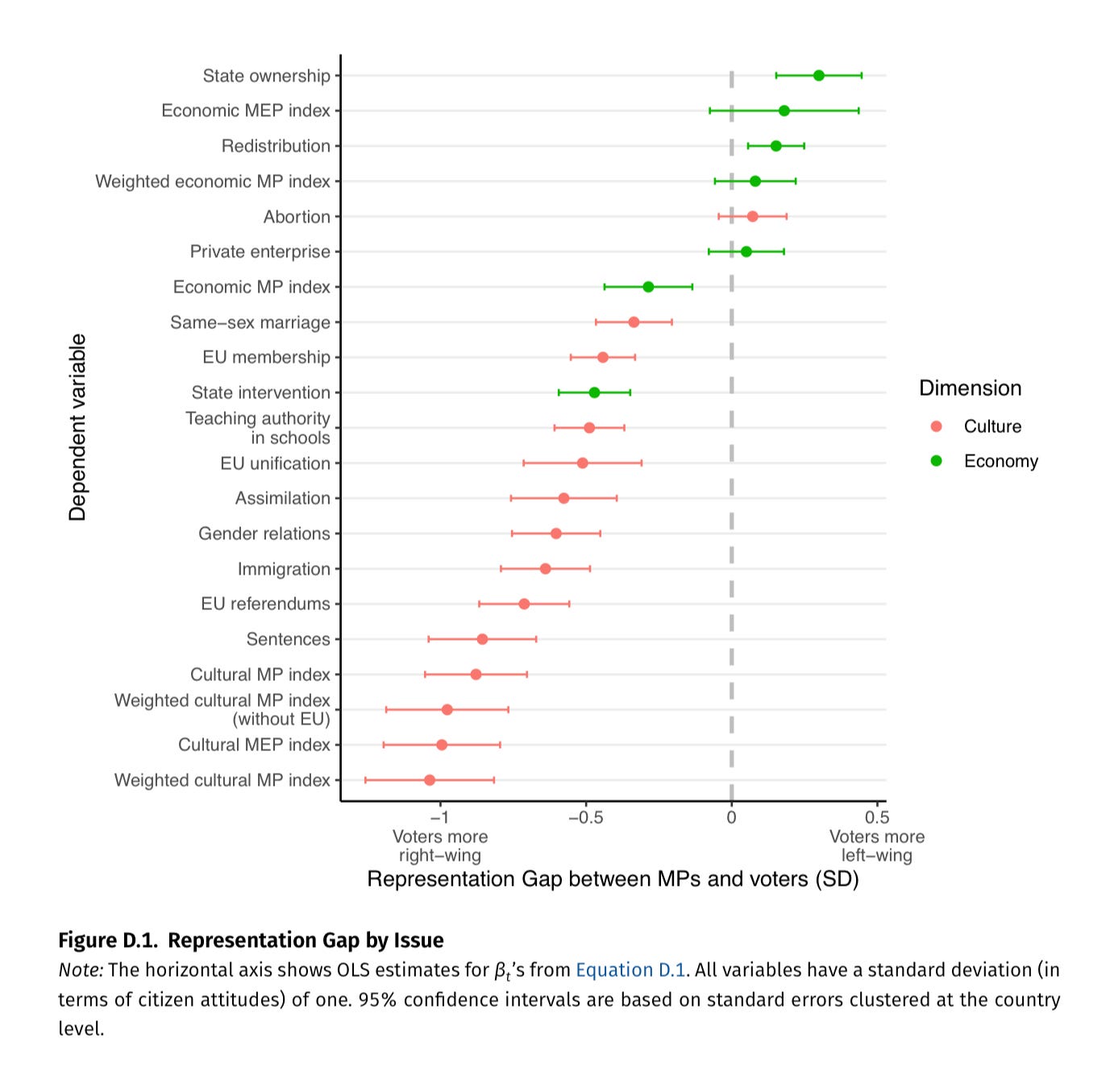
Economist Laurenz Guenther has performed the very useful exercise of quantifying how unrepresentative the views of European politicians are of their voters on cultural issues, such as crime and immigration. This is not true of economic issues, where the views of politicians tend to be quite representative of their voters.
In the case of economic issues, in some countries the politicians are more pro-market (“right”) then their voters, in others they are more dirigiste (“left”) than their voters, in others still they are very similar to their voters. There is simply no consistent pattern, and the average gap between voters and politicians across European countries on economic issues is fairly small.
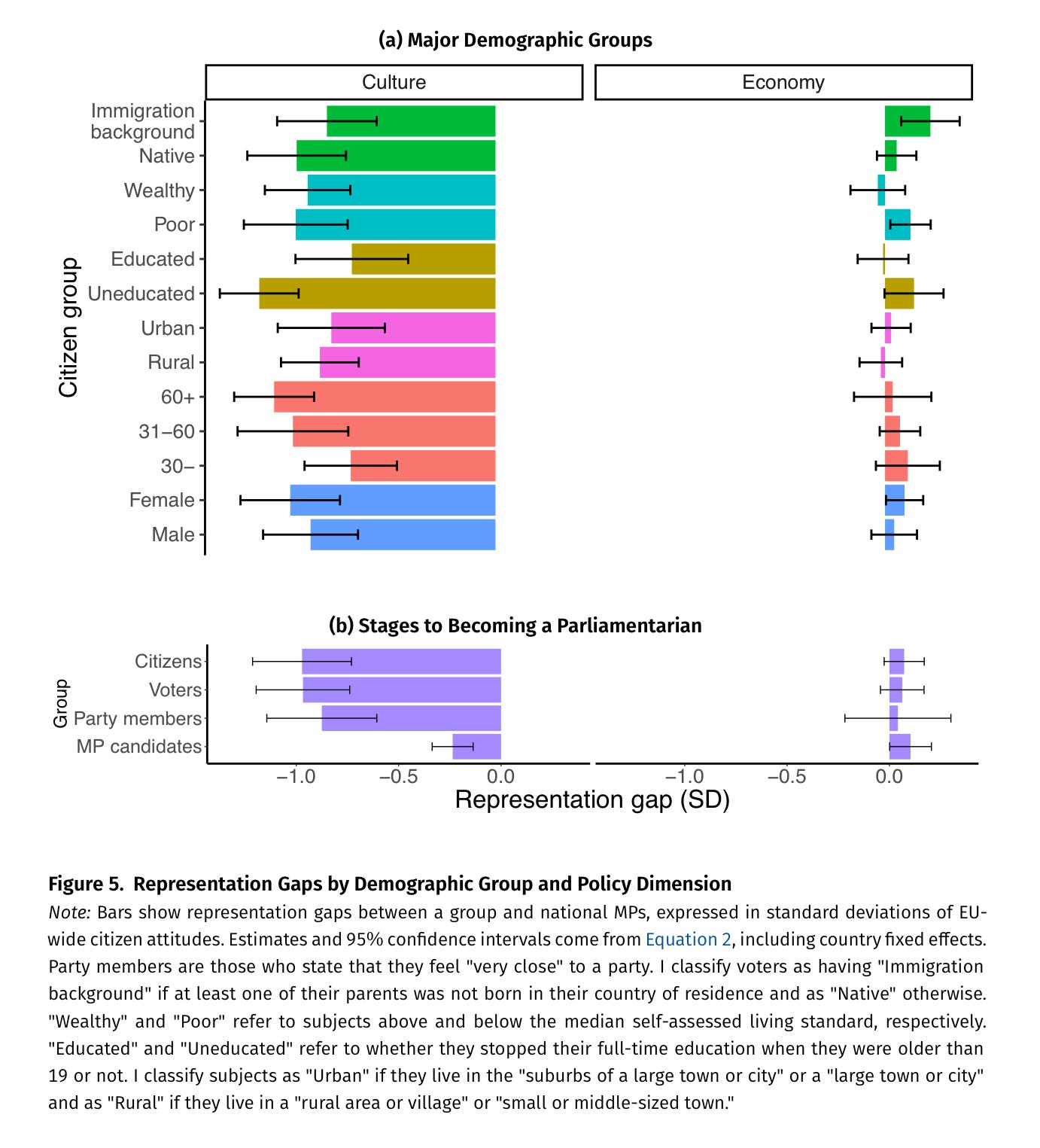
With cultural issues, such as crime and immigration, we get a very different pattern. There, politicians are consistently more socially liberal (“left”) than their voters and by a considerable margin. While education levels explain some of this difference, they do not explain very much, as politicians are significantly more socially liberal than even university-educated voters.
Moreover, politicians are unrepresentative even of their own Party members/base on cultural issues and, again, in being much more liberal than their core supporters. There is some factor or factors specific to being a contemporary politician that systematically separates them out from voters on cultural issues yet does not operate with economic issues.
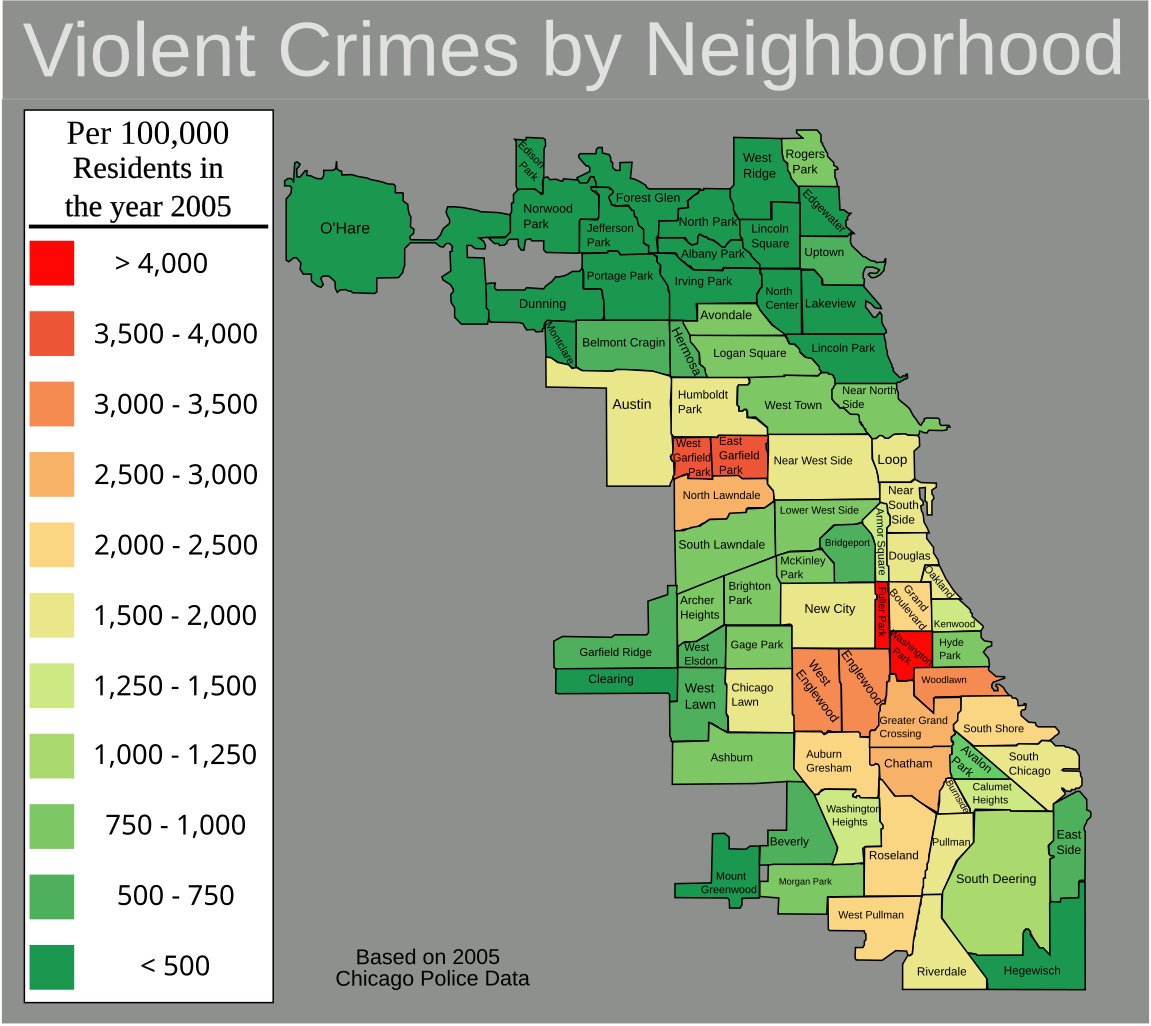
Veteran politician Tip O’Neill famously said that all politics is local. This is particularly true of cultural issues such as crime and immigration, where the effects vary wildly by location. This is much less true of economic issues, which are much more economy-wide in their operation.
There are various features we can identify here. First, executive function(s) — including such features as patience (aka time horizon) — varies between people and is highly heritable. Localities that have lots of people with poor executive function operate very differently from those where it is very much normal for people to have strong executive function.
As the combination of physical robustness and weak executive function predicts criminal behaviour, this has a great deal to do with why crime varies so dramatically by locality. This is especially as crime is very much a power law phenomenon, where a small minority of (overwhelmingly) men commit the vast majority of violent crimes.
Source – Wikimedia Commons.
It also means that people who have spent their lives in social milieus full of people with high executive function can have little or no sense of what happens when one has to deal with weak executive function folk. This is the people unlike me problem that so bedevils contemporary politics and commentary.
Comments Off on “All politics is local” … except when it isn’t
August 3, 2025
“Even when accused men win, they lose”
Janice Fiamengo on the recent court decision that acquitted five former junior hockey players of sexual assault charges in a London, Ontario court:
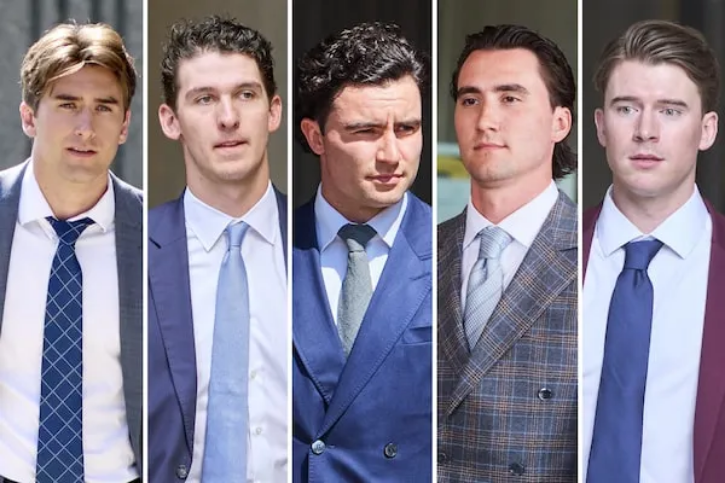
The acquittal, last week, by Justice Maria Carroccia of five former members of the Canadian World Junior Hockey Team charged with sexual assault has provoked the usual exaggerations and question-begging from feminist advocates.
A common theme has been the alleged negative impact of the verdict on “survivors”. Canada’s state broadcaster, the CBC, titled an article “Hockey Canada trial outcome a ‘crushing day’ for sexual assault survivors, says prof“. The Globe and Mail had the same focus: “After the Hockey Canada verdict, advocates fear survivors will fall silent“. For CTV News, also, “Advocates worry about message to survivors following Hockey Canada sex assault trial“. It seems that any not-guilty finding — no matter the accuser’s proven lies and venality — is said to constitute an assault on rape victims everywhere.
Our era’s motto: Better 100 innocent men go to prison than one potential accuser hesitate to come forward.
Many commentators also gushed about the courage of the woman, still identified only as E.M., who took the witness stand to proclaim her truth. E.M.’s lawyer, Karen Bellehumeur, called her “a remarkable person and truly a hero“. Professor Daphne Gilbert credited E.M. with provoking important public conversations at enormous personal cost. Supporters on the courthouse steps carried signs saying “We believe E.M.”
It’s hard to fathom that those declaring their anguish at the verdict and their admiration for E.M. have actually read Judge Carroccia’s 90-page judgement.
That judgement, far from revealing the judge’s failure to understand E.M.’s fear, as one feminist organization alleged, should cause any unbiased observer to question how the case was ever allowed to go to trial in the first place.
It had been found to be a loser when police first looked into it back in 2018. The story was that E.M. had met a hockey player, Michael McLeod, at Jake’s Bar in London, Ontario; McLeod was in town with his team to celebrate their World Junior Championship victory at a ring ceremony and gala dinner. E.M. agreed to go back to McLeod’s hotel room, but once there, he invited many other players to the room, where they took turns sexually assaulting her. She went home crying, and when her mother asked her what had happened, she told her. Her mother called the police.
The problem was that the complainant’s story was full of holes. Questioned by investigators in the days following, she couldn’t say she hadn’t consented, confessed that she may have enjoyed the sexual attention of the players, admitted she could have left the hotel room at any time, and never mentioned fear or intimidation as factors in her actions. London police closed the case in early 2019 without laying any charges. Over time, it seems, E.M. constructed a more compelling story to explain herself in a way that would be acceptable to her mother and to E.M.’s boyfriend.
In 2022, a police investigation was reopened after it was reported that Hockey Canada, the sport’s national governing body, had paid out millions in settlement money to women like E.M. who had alleged sexual misconduct on the part of players. E.M. herself received an undisclosed settlement amount in 2022 after suing for 3.5 million dollars.
Charges were ultimately laid, in early 2024, against five men, all of whom had by then launched careers in the National Hockey League: Dillon Dubé, Alex Formenton, Carter Hart, Callan Foote and Michael McLeod. Their NHL careers are now in tatters while their accuser has enriched herself with a false accusation.
Comments Off on “Even when accused men win, they lose”
QotD: Undermining cultural taboos
One side of the debate argues that the only way to break a taboo is to break a taboo, so the only way forward to is to talk frankly about these things. In the case of crime, for example, the dissident must always interject the demographic facts about crime into the debate, even if it makes the beautiful people shriek. Since most people know the facts, the shrieking by the beautiful people actually advances the cause. This line of reasoning is extended to all taboo subjects universally.
The other side of the debate points out that the taboo breakers always end up in exile or condemned to some ghetto. In fact, their deliberate breaking of taboos ends up reinforcing the taboo, as no one wants to end up like the heretics. Instead, this camp argues the dissident must come up with clever language that subtly mocks the taboos, but narrowly adheres to the rules. The recent use of the word “jogger” is an example of complying with the taboo, while undermining it.
The taboo breakers counter that this just results in an endless search for approved language to hint at unapproved things. It is just a form of self-deception, where the clever think they are in revolt when in reality they are just asking permission. The optics guys counter this by pointing out the obvious. The taboo breakers are removed from the process, so in reality their tactic is just quitting the game. Rather than take on the system in a meaningful way, they mutter epithets in their ghetto.
The Z Man, “Strategy, Tactics & Discipline”, The Z Blog, 2020-05-19.
Comments Off on QotD: Undermining cultural taboos
July 29, 2025
Crimes less serious than “Mischief” according to Canadian courts
In the National Post, Tristin Hopper notes that the sentences being sought for Freedom Convoy 2022 organizers Tamara Lich and Chris Barber are more severe than prosecutors have asked for what appear to be far more serious crimes:

Chris Barber and Tamara Lich
Last week, Crown prosecutors announced they were seeking jail sentences of up to eight years for Tamara Lich and Chris Barber, two organizers of the Freedom Convoy protest.
Both were convicted of mischief, but the Crown is seeking a minimum sentence of seven years in jail for Lich, and eight for Barber, who was also found guilty of counselling others to disobey a court order.
The Crown has argued that the disruptiveness of the Freedom Convoy blockades warrants the harsh sentence, but in a statement this week, Conservative Leader Pierre Poilievre said courts are throwing the book at Barber and Lich while simultaneously giving free reign to “rampant violent offenders” and “antisemitic rioters”.
It’s certainly the case that you can do an awful lot of heinous things in Canada before a prosecutor would ever think of asking for seven years. Below, a not-at-all comprehensive list of things you can do in Canada, and have the Crown seek a lighter sentence than the one they’re seeking for the organizers of the Freedom Convoy.
- Sexually assaulting a baby [5 to 6 years]
- Using a car filled with guns to ram into Justin Trudeau’s house [6 years]
- Killing multiple innocent people via drunk driving [5 years]
- Stabbing a man to death because he told you to stop abusing your girlfriend [5 years]
- Being a police officer who stalks and sexually harasses crime victims [6 months]
- Amassing enough child pornography to fill a video store [3 and a half years]
- Torturing a toddler to death [7 to 8 years]
- Intentionally ramming a car loaded with children and pregnant women [8 years]
- Beating a fellow homeless shelter resident to death [5 and a half years]
- Raping a minor and bragging about it online [4 to 5 years]
July 25, 2025
QotD: Evolved threat display mechanisms
Animals, especially predators, are all pretty good at risk assessment. I’m absolutely certain, as an enthusiastic student of evolution, that dinosaurs had different kinds of threat display mechanisms, too. Maybe even trilobites. They do their thing and they stay alive.
On the other hand, just suppose you’re walking down a badly-lit sidewalk in any town or city in this or practically any other country, when you’re suddenly approached by half a dozen tough-looking young punks. They could be a murderous gang of thugs out to “make their bones” or just the local hockey team. But if you pull out your 6 1/2 inch nickel-plated Smith & Wesson Model 29 .44 Magnum, and simply hold it down beside your leg, you could be arrested for “brandishing” and your attractive, shiny, valuable weapon stolen from you by sticky-fingered cops.
When it comes to threat display — which could save your life as well as the lives of those who make you feel uneasy — you don’t have the rights of a lowly blow-fish. The insanity of ignorant government pencil-necks forbidding four billion year old violence-reducing behavior cannot be overstated.
L. Neil Smith, “Maybe Even Trilobites”, Libertarian Enterprise, 2018-10-14.
Comments Off on QotD: Evolved threat display mechanisms
July 17, 2025
Afghan refugees and the British government
On Substack, Fergus Mason explains why the British government got deep into a secretive program to bring thousands of former Afghan soldiers and their families to Britain:
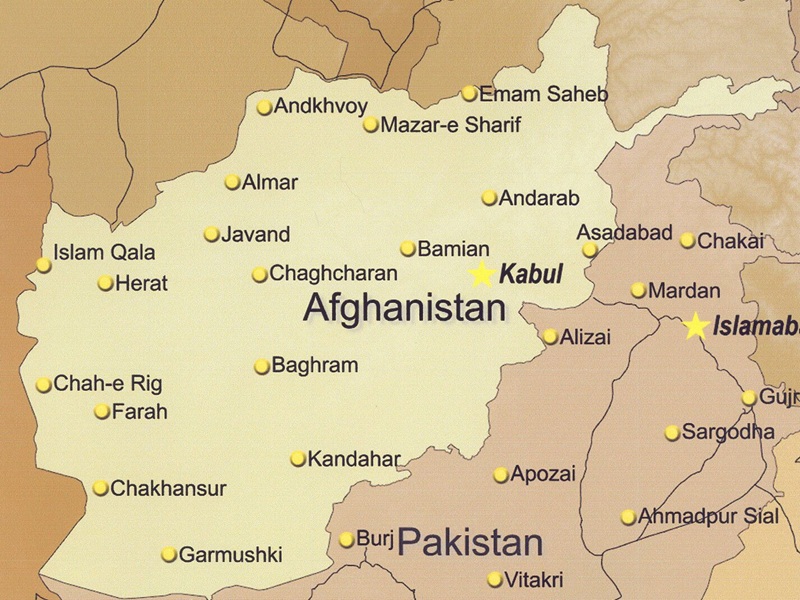
So here’s what we know so far. In February 2022 a Royal Marine officer, working for the Director of Special Forces, sent an email to several Afghans in Britain. These people were involved in the effort to rescue former interpreters and Afghan National Army special forces soldiers who were at risk of reprisals from the Taliban regime, and the Marine wanted to know whether some Afghans who claimed to be ex-special forces really were. The officer intended to attach a filtered list of around a hundred names from an Excel spreadsheet, but inadvertently attached the whole file — which contained around 25,000 names. One of the Afghans he sent the list to immediately passed it on to someone else – this time in Afghanistan. MoD sources are stressing that these were all trusted Afghans, but … well, we’ll get to that shortly.
And then nothing much happened for 18 months. The Taliban didn’t round up and shoot everyone on the list, even though they now claim to have had it since early 2022. But then, in August 2023, an Afghan man — a former soldier who had applied for asylum in Britain, but been rejected — popped up on Facebook. He promptly released part of the spreadsheet, then threatened to post all of it. At this point the government swung into action. First, it pressured Meta, which owns Facebook, to shut down the group the data was posted in and remove the user. Then the Ministry of Defence, under former defence secretary Ben Wallace, applied for a super-injunction to prevent the media from reporting anything about the leak, what the government planned to do about it, or what it was going to cost. It even banned anyone from revealing the existence of the injunction itself. That injunction was granted to Wallace’s successor, Grant Shapps, and the entire story was killed before it became public. The government was already drawing up a plan to bring tens of thousands more Afghans to Britain; the media and Parliament weren’t allowed to mention it; the British people, of course, were not to be allowed to know a thing. The degree of secrecy imposed was truly extraordinary.
And, over the last 18 months or so, the government has quietly been running a huge and very expensive operation to bring those identified as being at risk to Britain. From those listed on the spreadsheet, 23,900 former Afghan soldiers, policemen and intelligence officers were deemed to be in danger because of the leak. So, of course, were their families. How many people does the government plan to bring in under this scheme, in total? Nobody knows. Early estimates, according to court documents, were that 43,000 Afghans would be given asylum in Britain. Yesterday, officials insisted the real total was 6,900; even that dramatically lower number is a big addition to the 24,000 Afghans the government has admitted to bringing in under other, declared schemes. However, horrifyingly, last June three judges — Sir Geoffrey Vos, Lord Justice Singh and Lord Justice Warby — issued a written (but, of course, secret) ruling that up to a hundred thousand people could be at risk if the Taliban got their hands on the list.
Embarrassment for the British government, certainly, both for the initial cock-up and the ridiculous follow-up. It’s going to be expensive to resettle all those refugees and their often quite large families (guesstimates range from £850 million up to £6 billion), but not really a big deal, right? Well, about that …
I’ve already mentioned Afghan culture’s horrific misogyny. This leads to some truly dire attitudes towards women who don’t comply with Afghan society’s draconian rules of female behaviour (which boil down to having no rights and not being allowed to leave the house without a burqa and a male relative). One of the consequences of this is that Afghan men have unleashed a tidal wave of sexual assaults across Europe. At least one migration expert has noted that as well as their frequency, assaults by Afghans are remarkable for their brutality, audacity and often downright stupidity. Austrian political scientist Cheryl Benard wrote:
Can these men possibly expect that their attempts will be successful? Do they actually think they will be able to rape a woman on the main street of a town in the middle of the day? On a train filled with other passengers? In a frequented public park in the early afternoon? Are they incapable of logical thought — or is that not even their aim? Do they merely want to cause momentary female hysteria and touch some forbidden places of a stranger’s body? Is that so gratifying that it’s worth jeopardizing their future and being hauled off to jail by scornful and disgusted Europeans? What is going on here? And why, why, why the Afghans? According to Austrian police statistics, Syrian refugees cause fewer than 10 percent of sexual assault cases. Afghans, whose numbers are comparable, are responsible for a stunning half of all cases.
Type two words into Google — Afghane and Vergewaltigung — and a cornucopia of appalling incidents unfolds before you.
Incidentally, to all you lefties who’re undoubtedly sputtering with fury as you read this, don’t even think of writing Benard off as an anti-Afghan racist. Her husband is former US ambassador Zalmay Khalilzad, who is Afghan.
But surely, the “trusted” former Afghani soldiers, police and intelligence officers being brought in are bound to be much better able to adapt to British culture, right? Uh, well …
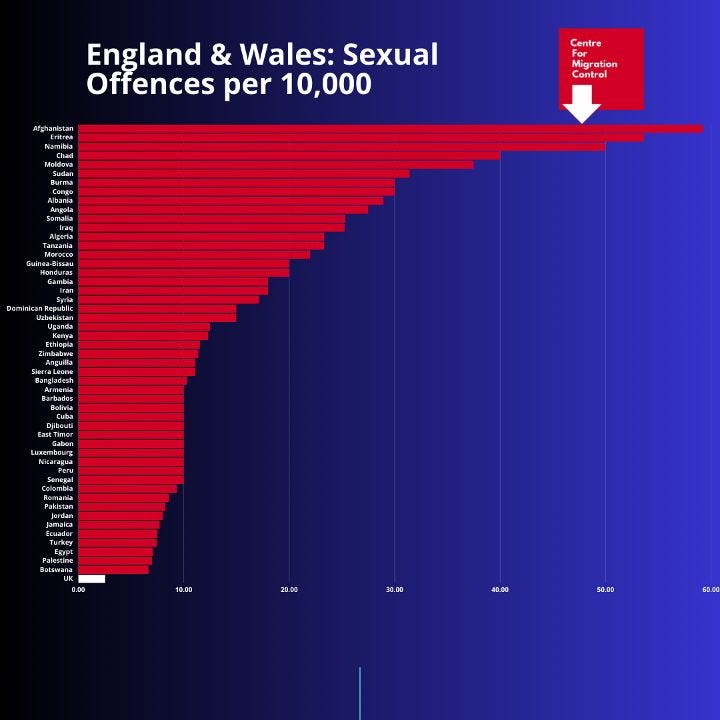
The government has been very reluctant to release — or even admit it possesses — statistics on the link between nationality and crime, but under pressure from independent MP Rupert Lowe it finally did so in March. This showed that among Afghans in Britain, 59 per 10,000 have been convicted of a sexual offence — 22.18 times higher than British men, at 2.66 per 10,000:
By the way, yes, I know the graph is from the Centre for Migration Control — but the data is from the Ministry of Justice and was obtained by a Freedom of Information request. I’ve checked the graph against the data, and it’s accurate.
[…]
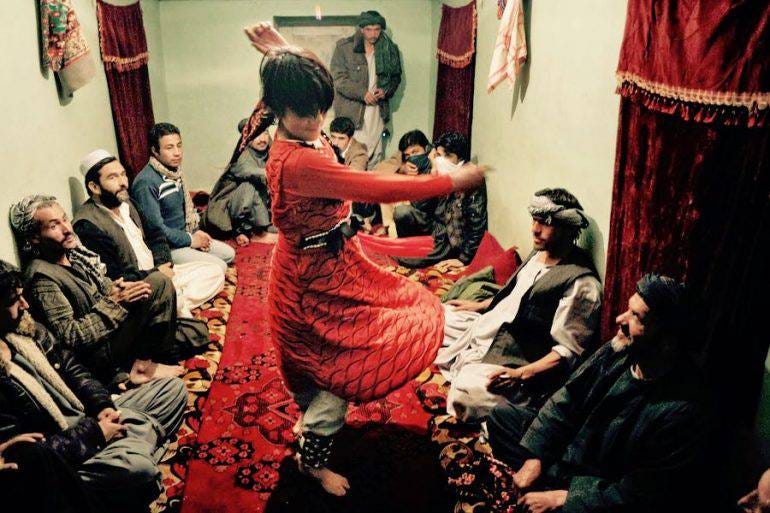
Does this photo of Afghan men watching a young boy dance give you the creeps? It should.
It’s not only women at risk, by the way. Afghan men aren’t averse to raping young boys, either. One of the most revolting aspects of Afghan culture — and that’s saying something — is the tradition of bacha bazi (Dari for “boy play”). Prepubescent boys are forced to dress up as girls then dance for, and “entertain”, men. This strain of paedophilia was common among anti-Taliban warlords and the Afghan security forces, particularly the police. The Taliban claim to be against the practice; their founder, the late Mullah Omar, actually was violently opposed to it. However, many prominent Taliban commanders also enjoy a spot of recreational pederasty.
Of course the obvious answer to this is “But most Afghan men aren’t rapists!” I agree; most of them aren’t. But an alarmingly high percentage of them are, and our governments clearly can’t keep the rapey ones out. The graph and its underlying statistics prove that beyond any possible doubt. And while it’s easy to downplay the statistics by saying it’s still “only” 77 sexual offences committed by Afghans over a two-year period, bear in mind that a) that’s 77 offences that wouldn’t have happened if we hadn’t let any Afghans in and b) this number is only convictions. In Britain just 3.1% of sexual offences reported to the police (around a third of which are rapes) lead to a conviction, which brings the potential number of Afghan suspects up to 2,484. The police estimate that only 10-15% of sexual offences are even reported; that could mean Afghans committed between 16,500 and 25,000 sexual offences across that same two-year period. Afghans would have to be bringing stupendous benefits to this country to make 25,000 sexual offences a worthwhile price to pay; indeed, many (emphatically including me) would argue that it wouldn’t be an acceptable price under any circumstances.
In Spiked, Tim Black on the government’s decision to hide everything for as long as they possibly could … for reasons:
Yet as catastrophic an error as this data leak was, the state has somehow managed to compound it with a series of decisions that made a terrible situation even worse. Successive Conservative and Labour governments effectively mounted a cover-up of both the data breach itself and the response. They slowly undertook a secret evacuation and relocation programme for the Afghans without telling even the Afghans affected about the data breach and the fact their lives were at risk. At the same time, they sought to hide all this from the British public, too, even while thousands of Afghan refugees were quietly being deposited in hotels and in military accommodation across the country. All with no explanation.
It is this de facto cover-up, this attempt on the part of ministers and senior officials to hide state errors and actions from public view, which is the most disturbing aspect of this whole sorry affair. They set about shielding a data breach followed by a costly, large-scale asylum scheme from any form of accountability, criticism or debate. And they did so by exploiting a legal tool that has never been used before by a British government – namely, the superinjunction.
This effective cover-up did not happen immediately. In fact, it wasn’t until early August 2023, a whole 18 months after the data breach took place, that the leak was finally brought to the attention of officials. A support worker responsible for settling Afghans in the UK emailed Luke Pollard, Labour MP for Plymouth, and James Heappey, the then Conservative defence minister, warning them that he’d seen the database circulating online. Days later, journalists also became aware of the leak. It was this that finally prompted the Ministry of Defence and the government to launch a covert mission, codenamed Operation Rubific, to shut down the leak and help Afghans put at risk get to the UK (after being vetted in Pakistan).
It was at this point that the authorities took the unprecedented step of applying for a superinjunction. This legal tool doesn’t only prevent journalists from reporting on the subject of the injunction. It also prevents anyone from acknowledging that the injunction even exists. Ministers argued that this extreme free-speech-defying measure was necessary to prevent the Taliban from becoming aware of the datasheet’s existence. Granted in September 2023, the superinjunction acted like a form of legal dark magic, rendering the data breach and the government response to it invisible. It insulated both from even the possibility of scrutiny.
Members of parliament could have still used their parliamentary privilege to speak up. But since all reporting had been prohibited, MPs found themselves in the same place as the wider public – in the dark. For nearly two years, then, we have all borne blind witness to the state’s conspiracy of silence. Until this week, that is, when defence secretary John Healey decided the superinjunction was no longer necessary.
It wasn’t just the British having issues with Afghan forces, as @InfantryDort recounts on the social media site formerly known as Twitter:
Among the Wildflowers @deaflibertarian
Did the high ranks really tell American soldiers to stand down and not interfere when children were being sexually assaulted in the Middle East region?TLDR, but you need to read it to get what I’m saying. I know it may be hard to understand how American Soldiers could witness horrors in Afghanistan and feel powerless to stop them. But let me try to explain. Fellow veterans, feel free to add on or correct me, because this rot ran deep.
1. We were forged to kill, then reprogrammed to hesitate. The warrior was replaced with a social worker in a helmet. Instead of rehearsing “react to contact,” we sat through PowerPoints on cultural sensitivity. Our edge dulled by doctrine that taught us empathy for the enemy and suspicion of ourselves.
2. We were ordered to practice “courageous restraint”. Sounds noble. It wasn’t. It meant ignoring your instincts. It meant second-guessing every shot, every step. The Army trained us to fight, then punished us for following that training. We were told killing the enemy might make things worse, as if leaving them alive made anything better.
3. Every success was credited to the Afghan army. Every failure pinned on us. We propped up a Potemkin military, full of cowards and thieves, and were ordered to salute the illusion. We whispered truths in smoke pits while speaking lies in briefings.
4. Under certain generals, aggressiveness was punished harshly. They’d clip the wings of the hawks and reward the peacocks. It’s like blaming a wolf for baring its teeth when surrounded by jackals.
5. “Green on Blue” attacks poisoned every partnership. The Taliban infiltrated Afghan ranks so deeply we stopped sleeping. Trust vanished. No one dared provoke them. Not over child rape, not over beatings, not over anything. Every Blue 1 report was a career landmine, so the truth stayed buried.This was the cocktail we drank every day:
• Restraint over reaction
• Illusion over integrity
• Shame over strengthWe were taught to see women as property, not to intervene. To accept children as sexual currency for Afghans, not to interfere. That the blame for every failure lay with us, not the corrupt warlords we empowered.
And was it non-consensual sexual currency? Because the culture was so backwards, we were told villagers would give their kids to powerful Afghans as tribute. And that the kids themselves understood the assignment. How f****d is that? How evil? How diametrically opposed to everything we believe?
And once you’re complicit in enough sin, it gets easier to stay silent. When you’ve spent years maintaining a lie, the truth becomes radioactive. Ripping off the bandage would mean admitting the whole war was infected.
We stood “shonna ba shonna” or shoulder to shoulder with some of the worst people humanity ever produced. And we called it partnership.
That’s how this happened.
A culture of confusion.
A doctrine of deceit.
A war that killed our ability to fight the very evil we were sent to destroy.There is a silver lining here. History has proven that our suspicions were right. And luckily, many of us are still in uniform or in charge of the DoD apparatus. We will NEVER let this happen again. And I will shout this from the rooftops to make sure that’s the case.
Infantry Dort, X.com, 2025-07-16.
July 15, 2025
What the CBC calls a “360-degree view of a story”
On the social media site formerly known as Twitter, Harrison Lowman provides a detailed example of how the CBC prefers to present stories to Canadians — which signally fail to present a “360-degree view” because the CBC actively avoids including actual disagreement on any given topic:

THREAD: When you make complaints about patterns of bias or skewed reporting on the CBC, you are often met by CBC supporters who proceed to demand a list of examples.
When they don’t receive it immediately from you, they proceed to tell you you’re the biased one …. that “it’s in your head”. It feels like a bit of gaslighting to be honest.
So let me, as someone who has worked at the CBC, provide you a prime example of CBC coverage I think is glaringly biased and you can tell me what you think:
/1Earlier this summer, the CBC published this radio/TV story. The webpage version is headlined “Supervised drug site at Kingston prison has only had one visitor despite being open since 2023”
The story details a trial project where prisoners at a Kingston-area prison have been given the ability to inject, snort, or swallow the drugs they’ve smuggled into their cells under the supervision of a nurse.
The news hook is that only ONE inmate has visited the site since its inception more than a YEAR ago.
https://cbc.ca/player/play/video/9.6802851
/2The CBC journalist then proceeds to interview three people: 1. someone running the program, 2. a retired academic expert sympathetic to the program wanting it expanded, and 3. a former inmate who was not in jail when the program started. All sources appear generally in approval of the pilot program.
In the story:
– At no time does the journalist speak to someone who sees this pilot program as the wrong approach. Keep in mind a recent Abacus poll shows a mere 19% of Canadians support expanding safe injection sites. (You’re literally ignoring the vast majority of the population here.)– At no time does the journalist reveal the cost of said program: a whopping $517,000 taxpayer dollars so that a SINGLE inmate could get high.
– Nor do they speak to someone who says (as many in the public would rightly ask) if given the cost and almost non-existent use, whether it’s worth continuing the program, or whether there’s a better way to spend this money within the corrections system- rehabilitation etc.
/3
Instead the CBC journalist exclusively focusses on the “barriers” to using the jail drug program, implying this all that can change- ie. look at making it easier for the inmates to use drugs.
The coverage, highlighting barriers:
– implies that they should operate at night, because it’s current hours “don’t line up with when inmates want to get high.”;
-In the written version of the article: source: “They’d prefer to take drugs during their free time after supper.”– That prisoners need to be allowed to smoke crystal meth as part of the program.
– That prisons need to make it so using the program won’t mean users getting unwanted attention from fellow inmates, officers…etc.
/4Last week, CBC News’ general manager and editor in chief Brodie Fenlon said:
“The job of a CBC News journalist is to report facts, to proportionately surface the variety of viewpoints that exist about those facts, to provide context and counter narratives where they exist, and to ensure credible analysis is in the mix. The goal is to give you a 360-degree view of a story so you can draw your own conclusions.”
“… We don’t shy away from contrarian views or perspectives that challenge orthodoxy.” “The best journalism often involves facts and viewpoints that challenge our own worldview.”
In what world is this a 360 degree view of this story? In what world is this a story that challenges orthodoxy?
Instead, this coverage appears to tell viewers the CBC approves of safe injection sites … for criminals, and doesn’t prioritize taxpayer $ waste in its coverage.
With this story, CBC is just clearly not meeting their own journalistic standards, and are failing to adequately inform the public.
There’s your example. Tell me I’m wrong.
The CBC must do better.
I plan to launch a complaint with the CBC ombudsman. It won’t be my first.
https://cbc.ca/news/editorsblog/cbc-news-platforming-1.7580219
Among the responses was this one from Andrew Kirsch:
I wrote the 1st ever memoir about being a Canadian spy. It was a National bestseller but largely positive about the org. I desperately tried to get on CBC (and TVO) to promote it. They weren’t interested. A while later my ex-colleague wrote a memoir about her career with a focus on institutional racism at CSIS. She was interviewed and her book was featured all over the website. I don’t want to take anything away from the other book. I just felt like mine was also a Canadian story worth telling.
Comments Off on What the CBC calls a “360-degree view of a story”


