
We should start by charting the broad outlines of the place of the medieval church in Western Europe. I should start off by noting that this is a huge topic – as will swiftly become clear, there was almost no part of society in which the Church did not play a significant role – and I will only be offering a broad-strokes overview here, sufficient to provide a basis of comparison for [Game of Thrones]. Most of this discussion will principally concern the Latin Church (what today is the Catholic Church) in the West. Since this discussion is – importantly! – about the state of affairs before the reformation, I will tend to refer to the Latin Church simply as “the Church” for brevity’s sake.
The very first thing to note is that the Church (in this case, both the Latin West and the Greek East) pre-dated the Middle Ages themselves. The Church arrived in the Middle Ages as relic of the Roman Imperial past. It inherited Roman Imperial organization – the diocese, for instance, derived from the boundaries of Roman super-provinces called dioceses (Greek: διοίκησις). Unlike the new medieval aristocracy, which tended to rule from fortified estates in the countryside, the Church remained centered in towns and cities, many of which had been major centers under the Romans. As the Roman provincial administration collapsed, it largely fell to the Church – as one of the few surviving literate institutions – to replace some of the core functions, like record keeping and the preservation of literature and learning. This was less true [in] Scandinavia and Eastern Europe, places where the Church was a relative late-comer, but for most of Western Europe, the Church was not some new institution grafted on to a pre-existing society (as it had been under the Romans), but rather part of the bedrock cultural foundation upon which that new society was constructed (fellow pedants! – please note carefully the phrase part of in the previous sentence; I am aware there were other things).
That said, the institutional power of the Church (and here we really do mean what would be the Roman Catholic Church) begins to change dramatically in the 11th century, right as we enter the High Middle Ages, and continues for the next several centuries (keeping in mind that Game of Thrones and A Song of Ice and Fire really evoke the High and Late Middle Ages, rather than the Early period). In short, the institutional heft of the Church grows dramatically. Quite a few things begin happening which are linked together: the Popes begin trying to wrest control over the Church’s hierarchy (specifically, the investiture of bishops) from secular rulers. Clerical celibacy was more stringently enforced. The Church intruded into warfare (as we’ve discussed with the Peace of God / Truce of God movements). It began to more directly attempt to regulate marriage, especially among the powerful (marriage was a made a sacrament in 1184). By the 1300s, this included keeping detailed records in many parts of France about births, deaths and marriages, in part to ensure no one married a close relative.
(And, of course, for those of you thinking, “wait, isn’t this also the period of the Crusades – military expeditions called by and at least nominally (but not in practice) under the auspices of the Pope?” Yes, it is, and that’s not an accident either).
In my experience teaching this, it is the next step that baffles my students the most. This vast increase in the institutional power of the Church was made possible, not by armies or shrewd real-politic (though both were involved), but by belief. The primary weapon wielded by Popes in this effort was the threat of excommunication, which (under Catholic doctrine) cut off the excommunicated individual or community from salvation, potentially damning them for all eternity. But of course that threat is only real if you believe the Pope has that power. And therein is the key point: most of Europe did believe. As I tell my students, it is safe to assume, as a general matter, that people in the past believed their own religion. Of course there are exceptions, but the general rule remains.
In the conflicts that arose – because, as you might imagine, secular rulers were unwilling to give up their prerogatives – it did not actually much matter if the king or emperor believed in the power of excommunication, because no one rules alone. Thus when the Holy Roman Emperor Henry IV was excommunicated by Pope Gregory VII in 1076, the audience for this act wasn’t Henry himself (who had already declared Gregory illegitimate anyway). It was directed at all of Henry’s vassals and supporters, releasing them from their oaths of allegiance and essentially saying, “stick with this guy, and he’ll take you to hell with him”. It worked, sparking a major rebellion and forcing Henry to humiliatingly apologize the following year.
(History note: this would be “round 1” in a multi-round fight that wasn’t settled until 1122 with the Concordat of Worms; in the end the Papacy mostly won, sharply limiting the Holy Roman Emperors’ power over their bishops).
Bret Devereaux, “New Acquisitions: How It Wasn’t: Game of Thrones and the Middle Ages, Part II”, A Collection of Unmitigated Pedantry, 2019-06-04.
May 11, 2026
QotD: The cultural importance of the church in early Medieval Europe
April 7, 2026
“The Eight Hundred Years of Oppression”
On Substack, Upper Canadian Cavalier examines “The Irish Question”:
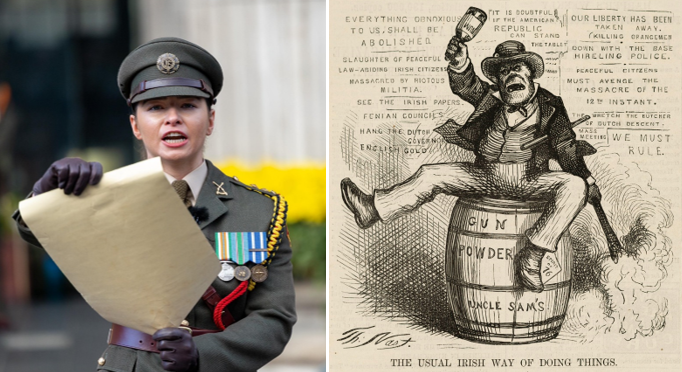
Every confidence scheme requires three things. A mark who is sympathetic. A grievance real enough to be credible. And an operator whose entire livelihood depends on ensuring the grievance is never actually resolved. Resolution ends the game. The operator does not want justice. He wants the next fundraising dinner.
Irish nationalism, in its mature institutional form, is one of the longest-running confidence schemes in the history of democratic politics. This is not to say the underlying grievances were invented. English rule in Ireland produced genuine catastrophes, and anyone who tells you otherwise has not read much history. The point is not that the wounds were fake. The point is that a very specific class of people discovered, sometime in the nineteenth century, that a bleeding wound is worth considerably more than a healed one, and they have been salting it professionally ever since.
The operators of this scheme are not a conspiracy in any tidy sense. They do not meet in a room. They are, rather, an ecosystem: the Sinn Féin political class, the Irish-American fundraising establishment, the Gaelic cultural bureaucracy with its language boards and arts councils and grant committees, and undergirding all of it for most of its history, the Catholic Church, which managed the remarkable trick of positioning itself as the spiritual soul of Irish resistance while simultaneously running the country’s schools, hospitals, orphanages, and laundries with the administrative efficiency of a medium-sized colonial power. They share no common mailing list. They share something considerably more durable: a common interest in a people who define themselves entirely by what was done to them, because such a people will always need someone to explain what it means.
That someone, naturally, has a salary. Sometimes several.
Part One: The Invoice That Never Clears
The foundational text of Irish identity is not a poem or a legal document or a philosophical treatise. It is an invoice. The Eight Hundred Years of Oppression, presented at every available occasion, never stamped paid, accruing interest at a rate that defies actuarial calculation. It is invoked at pub tables and university seminars and Boston fundraisers and Sinn Féin press conferences with the solemn regularity of a liturgical response, which is appropriate, since it has become one.
Eight hundred years. Let us sit with that number for a moment, because it deserves scrutiny rather than reverence.
The Poles were partitioned entirely out of existence for a hundred and twenty-three years, absorbed simultaneously by three empires, had their language banned, their nobility liquidated, their clergy persecuted, and their country removed from the map of Europe with a finality that the Irish situation never approached. They rebuilt it. They were then invaded again from both sides at once within living memory, occupied by The Nazis and Soviets losing somewhere between five and six million citizens in six years. They do not, as a general rule, organize their entire national identity around the experience. They built things instead.
The Armenians experienced something so total it required the coinage of an entirely new word to describe it. The Acadians were physically deported. The Welsh had their language suppressed for centuries by a state apparatus that regarded Welsh-speaking children as candidates for corrective intervention, which is considerably more systematic than anything the Penal Laws produced. The Greeks spent nearly four centuries under actual Ottoman administration, not the notional suzerainty that characterized much of the Anglo-Irish relationship, and emerged and got on with being Greeks.
None of them made Eight Hundred Years into a brand.
What distinguishes the Irish accounting of oppression is not the severity of the oppression, which was real but not historically singular, but the extraordinary care with which it has been packaged, maintained, and exported. The Famine, which ended in the 1850s, is still discussed in certain Irish-American circles as a recent bereavement requiring ongoing condolences and, more usefully, ongoing donations. The emotional statute of limitations has never been permitted to run. Each generation receives the invoice freshly printed, as though the debt were personally owed to them and personally owed by someone who can still be made to feel bad about it.
April 5, 2026
“Easter remains one of the major annual high holy days of confectionery derangement”
At The Freeman, Nicole James remembers her early chocolate obsessions:

Roald Dahl’s chocolate river was the economic policy of my childhood. Dripping with glossy abundance, and available to any enterprising glutton with a low sense of self-preservation. I never looked at Augustus Gloop and thought, “There goes a cautionary tale about excess”. I thought, “There goes a boy with initiative”. I wanted the river. I wanted the factory. I wanted an Oompa Loompa or two, ideally unionized and living in a tasteful outbuilding, making me truffles on demand. I wanted a world in which everything was edible and slightly mad. While everyone else was apparently learning moral lessons, I was busy fantasizing about a life in which I could plunge both arms into a molten tributary of cacao and come up glistening, like some sort of deranged dessert otter.
Easter seemed to offer the nearest thing to this ideal. It was the one annual moment when adults, in a dramatic collapse of judgment, agreed that children should be handed industrial quantities of wrapped chocolate and told to go hard. Easter had tiny eggs hidden in pot plants and larger ones with enough packaging to survive atmospheric re-entry. It was capitalism in a bunny suit.
Then adulthood arrived, lugging excellent literary references. Along came Like Water for Chocolate, with its sexy sorrow and culinary melodrama, and suddenly chocolate was not just a childhood frenzy but a vehicle for yearning and seduction. It could communicate things one would never dream of saying aloud at a suburban dinner party. Chocolate had range.
And this is why the present state of it feels so personally offensive because what is happening to chocolate is a slow-motion mugging. Cocoa is being shaved out. Bars are shrinking. Prices are soaring. Palm oil and vegetable fats are barging into flavor. Chocolate flavor. Not real chocolate, but a cheap mockery of the original deity.
And yet Easter remains one of the major annual high holy days of confectionery derangement. According to Cargill, in the United States, people are expected to plough through around 73 million pounds of chocolate over the Easter season. Around 90 million chocolate bunnies are produced, with — fun fact — 78% being devoured from the ears first.
Easter spending in the US has in recent years hovered around the $23 billion mark, with candy doing much of the heavy lifting. Chocolate, marshmallow Peeps, baskets, flowers, brunches, the whole pastel circus. Christianity may supply the headline act, but the event itself has clearly been workshopped by a mall.
But beneath the cellophane gaiety lies an increasingly grubby truth. Cocoa prices have surged, largely because harvests in West Africa have been hammered. Ghana and Côte d’Ivoire, which together produce the bulk of the world’s cocoa, have been clobbered by poor weather, crop disease, supply chain fragility, deforestation, and the sort of labor abuses that make any cheerful Easter ad feel criminal. The global appetite for chocolate remains immense, but the cacao tree itself is having a nervous collapse.
Update, 19 April: To the surprise of many who’ve latched on to the “woe, woe, mankind bad” chorus, there are now reports of a bumper crop of cocoa and the market prices are dropping:
It all seemed to kick off in March 2024 with the BBC’s chief climate headbanger Justin Rowlatt noting that “climate change” was one of the reasons for chocolate Easter eggs getting more expensive. Experts are said to have claimed that “human-induced” climate change had made extreme heat “10 times more likely” in the main cocoa bean-growing areas of West Africa. The story has had excellent fearmongering legs with a couple of years of bad weather-related harvests sending the world price of cocoa soaring. As late as October last year, the New York Times was stating that higher cocoa prices pushed up by climate change had led to companies changing their chocolate confectionary concoctions. Alas, sadly missing in recent chocolate climate claptrap is that an improved recent harvest (no weather-adjusting humans thought to be involved) has led to a massive 75% slump in global cocoa prices from the peak reached in January last year.
Like coral, polar bears and Arctic ice, any narrative-disturbing news is ignored. The media barkers promoting the Net Zero fantasy simply move onto the next promising climate porn project that can be ramped up to Armageddon level. The Great Choccy Catastrophe is a classic of its kind, but it is just the latest in a long and increasingly tedious line of crying wolf climate tantrums.
[…]
They get a lot of weather in the tropics, particularly in countries like Ivory Coast which accounts for up to 45% of world cocoa bean production. Dry periods alternate with wetter conditions, and there is some short-term variability in decadal temperatures. But according to World Bank climate figures, the average temperature since 1900 has risen just 1°C, while rainfall totals have remained remarkably stable. The average annual total since 1900 is around 1,354 mm. This is nearly identical to the 1,283 mm recorded in 2023, and similar to the 1,239 mm that fell in the supposedly drought conditions in 2024. Neighbouring Ghana is the world’s second largest cocoa producer and its 125 year precipitation average is 1,236 mm. This is a little higher than the 2024 ‘drought’ total of 1,181 mm, and a tad lower than the 1,278 mm in 2023.
The tropics have provided good pickings for climate and Net Zero agitators. Temperatures and rainfall can vary widely over individual years and decades. For instance, Ghana had record low rainfall in 1983 of 851 mm compared with a record high of 1,775 mm in 1968. As we have repeatedly seen over the last few years, any departure from the norm becomes the basis for a politicised junk science prediction that the climate is in crisis.
How to Make Marbled Eggs for Easter – The Victorian Way
English Heritage
Published 23 Mar 2018If you’d like to try this recipe at home, make sure to be very careful when handling/blowing the eggs. In some countries chickens are not vaccinated against salmonella so we suggest giving the eggs a good wash in boiling water and take care not to get any raw egg in your mouth.
This recipe for Marbled Eggs would have been served as a sweet “entremets” — small dishes served before dessert. This particular version uses a sweetened cream filling with chocolate and vanilla, but you could use any flavour you like or experiment with different colour jellies.
(more…)
April 3, 2026
Hot Cross Buns – Mother Goose Would Love These
Food Wishes
Published 12 Apr 2017Pretty much all I know about hot cross buns, I learned from the nursery rhyme, but thanks to a recipe I found on Anson Mills, I was still able to make a fairly decent batch. Including real crosses, not to be confused with dinner rolls on which an icing cross has been piped.
In addition to its eye-catching appearance, the dough-based “cross” provides an interesting textual contrast, as it gets sort of chewy, and crispy edged.
Like I said in the video, any sweet dough will work with this easy technique, especially rich, and fragrant examples, like our Italian Easter Bread dough. Times may vary, but regardless of the dough, simply wait for the dough to double in size, and proceed.
If you want to get all your buns the same size, weigh your dough in grams before dividing, and then divide by 16. Then, weight each of your dough balls to that exact amount, and boom, your tray of buns will look like the ones you saw on that magazine cover. Or, just eyeball it and take your chances. Either way, I really hope you give this a try soon. Enjoy!
March 3, 2026
QotD: The rise of archives-based history in the late Middle Ages
All of this, I suggest, is because people increasingly thought factual accuracy was important. And that only comes with the increasing sense of linear time. The chronicles of the first two or three Crusades, for instance, are filled with wild exaggerations and impossible claims … but they’re not lies. They just serve a different purpose. They’re called “histories”, but that’s a misleading translation (of the word historia, I’ll admit). What they really are is much closer to exempla — saints’ lives, that kind of thing. Their point isn’t “This and that actually happened”; it’s more like “Let us all praise God, for the wondrous things he allowed us to do!”
Gesta Francorum means “deeds of the French”, but in the sense of “The wonders done in God’s name,” not “a list of battles and their outcomes”.
Severian, “The Ghosts (II)”, Founding Questions, 2022-05-18.
February 25, 2026
QotD: The notion of “history”
We are closer in time to them than they were to the men who built the Pyramids — by a long shot — and think about that for a second. That’s the vast scope of merely literate human history. Human settlement itself goes back at least another 6,000 years before that, and probably a lot longer.
So far as we can tell, well into historical time men had no real conception of “the past”. Even those men who had recently died weren’t really gone, and again I find Jaynes useful here, but he’s not necessary; it’s obvious by funeral customs alone. They had a basic notion of change, but it was by definition cyclical — the sun rises and sets, the moon goes through its phases, the stars move, the seasons change, but always in an ordered procession. What once was will always return; what is will pass away, but always to return again.
Linear time — the sense of time as a stream, rather than a cycle; the idea that the “past” forecloses possibilities that will never return — only shows up comparatively late in literate history. Hesiod wrote somewhere between 750 and 650 BC; his was the first work to describe a Golden Age as something that might’ve actually existed (as opposed to the Flood narratives of the ancient Middle East).
Note that this is not yet History — that would have to wait another 300 years or so. Whereas a Thucydides could say, with every freshman that has ever taken a history class, that “We study the past so that we don’t make the same mistakes”, that would’ve been meaningless to Hesiod — we can’t imitate the men of the Golden Age, because they were a different species of man.
Note also that Thucydides could say “Don’t make the mistakes of the past” because “the past” he was describing was “the past” of currently living men — he was himself a participant in the events he was describing “historically”.
The notion that the Golden Age could return, or a new era begin, within the lifetime of a living man is newer still. That’s the eschaton proper, and for our purposes it’s explicitly Christian — that is, it’s at most 2000 years old. Christ explicitly promised that some of the men in the crowd at his execution would live to see the end of the world (hence the fun medieval tradition of the Wandering Jew). And since that didn’t happen, you get the old-school, capital-G Gnostics, who interpreted that failure to mean that it was up to us to bring about our own salvation via secret knowledge …
… or, in Europe starting about 1000 AD, you get the notion that it’s up to us to somehow force Jesus to return by killing off all the sinners. I can’t recommend enough Norman Cohn’s classic study The Pursuit of the Millennium if you want the gory details. Cohn served with the American forces denazifying Europe, so he has some interesting speculations along Vogelin’s lines, but for our purposes it doesn’t matter. All we need to do is note that this was in many ways The Last Idea.
Severian, “The Ghosts”, Founding Questions, 2022-05-17.
February 19, 2026
QotD: The Donation of Constantine
I love it because it’s clearly a watershed moment in human thought. I don’t mean the rediscovery of the classical past; I mean the shift between a more cyclical orientation towards life, versus an orientation around linear time. Time as the regular procession of the seasons, vs. time as a stream or river.
Some examples will help. The 15th century saw not just the creation of archives-based history, but the techniques in various fields that make archival work possible. For instance, the Donation of Constantine was definitively proved to be a forgery in the 15th century, on the basis of philological evidence. Before that point, the people using the Donation – both ways — wouldn’t have cared too much if they knew it was a fake. Not because they were opportunists (although they were), but because “factual accuracy”, to use one of my favorite of the Media’s many Freudian slips, just didn’t matter much back then.
When they said “the Donation of Constantine” they meant “hallowed by tradition”, and if you’d proved to them that the Donation was fake, they’d just keep on keepin’ on — ok, then, “hallowed by tradition” it is, everyone update your style books accordingly.
Severian, “The Ghosts (II)”, Founding Questions, 2022-05-18.
February 15, 2026
How to Make The Economy Look Better Than It Is – Death of Democracy 03 – Q3 1933
World War Two
Published 14 Feb 2026Death of Democracy returns to Nazi Germany in Q3 1933. See Hitler enforce one‑party rule, sign the Reichskonkordat, tighten propaganda and press control, and expand work programs that feed rearmament. From July to September, follow the legal and cultural Gleichschaltung that normalizes terror and reshapes Europe’s future in this episode.
(more…)
February 11, 2026
QotD: Delusional takes – “There are no white people in the Bible”
Oh boy, I get to post more Damned Facts that will offend people who richly deserve to be offended.
There were lots of white people in the Bible. And you don’t need to get into any definitional questions about the genetics of ancient Judea, either.
Greeks and Romans were white — that is, pale-skinned Caucasians. We know this from art, from sequenced genomes, and from contemporary descriptions of what they looked like. Herodotus described the Pontic Greeks as being blonde and blue-eyed.
Here’s the really Damned Fact: brownness in Mediterranean European populations was a late development. Post-Classical. Caused by …
… the Islamic invasions, post 722 CE. Resulted in Europeans of the Mediterranean coast becoming admixed (to put it very, very diplomatically) with Arabs and Africans. That’s why there’s a really noticeable gradient in Italy between lighter-skinned Northerners and darker-skinned Southerners; it’s all about how long various regions were under Islamic domination.
The question that usually comes up is, was Jesus himself “white”?
It’s possible. We can’t go by the artistic evidence, because Byzantine art deliberately confused Jesus with stylized depictions of the Emperor in his glory (there’s a really famous example of this in the Hagia Sophia in Constantinople). And those Greek emperors may well have been depicted as a bit blonder and more blue-eyed than they actually were, because that was considered beautiful. Dashboard Jesus is a late polyp of this tradition.
But until we find actual genetic material we’re not going to know. Imperial-run Palestine was a swirling cauldron of different ethnic groups, and the genetic boundaries didn’t necessarily match up neatly with the religious ones. Knowing that his parents were part of the Jewish people doesn’t necessarily help much.
The two most likely cases are that Jesus looked like a current-day city Arab, or he looked like a Philistine — that is, Greek with some local admixture; a lot of coastal Lebanese still look like that today. But full-bore pasty-skinned Euro can’t be ruled out.
ESR, The social media site formerly known as Twitter, 2025-11-10.
February 4, 2026
QotD: The impact of quasi-official monotheism on the Roman Empire
That is part of the context where we should understand Constantine (r. 306-337). Constantine is famous for declaring the toleration of Christianity in the empire and being the first emperor to convert to Christianity (only on on his death-bed). What is less well known is that, having selected Christianity as his favored religion, Constantine – seeking unity again – promptly set out to unify his new favored religion, by force if necessary. A schism had arose as a consequence of Diocletian’s persecution and – now that Christianity was in the good graces of the emperor – both sides sought Constantine’s aid in suppressing the other in what became known as the Donatism controversy, as the side which was eventually branded heretical supported a Christian bishop named Donatus. Constantine, after failing to get the two groups to agree settled on persecuting one of them (the Donatists) out of existence (which didn’t work either).
It is in that context that later Christian emperors’ efforts to unify the empire behind Christianity (leading to the Edict of Thessalonica in 380) ought to be understood – as the culmination of, by that point, more than a century of on-again, off-again efforts by emperors to try to strengthen the empire by enforcing religious unity. By the end of the fourth century, the Christian empire was persecuting pagans and Jews, not even a full century after it had been persecuting Christians.
These efforts to violently enforce unity through homogeneity had the exact opposite effect. Efforts to persecute Arian Christians (who rejected the Nicene Creed) created further divisions in the empire; they also made it even more difficult to incorporate the newly arriving Germanic peoples, who had mostly converted to the “wrong” (Arian) Christianity. Meanwhile, in the fifth century, the church in the East splintered further, leading to the “Nestorian” (the term is contested) churches of Syria and the Coptic Church in Egypt on the “outs” with the official (Eastern) Roman Church and thus also facing persecution after the Council of Ephesus in 431. The resentment created by the policy of persecution in the East seems to have played a fairly significant role in limiting the amount of local popular resistance faced by the Muslim armies of the Rashidun Caliphate during the conquests of Syria, the Levant and Egypt in the 630s, since in many cases Christian communities viewed as “heretical” by Constantinople could actually expect potentially better treatment under Muslim rule. Needless to say, this both made the Muslim conquests of those regions easier but also go some distance to explaining why Roman/Byzantine reconquest was such a non-starter. Efforts to enforce unity in the empire had, perhaps paradoxically, made it more fragile rather than more resilient.
Bret Devereaux, “Collections: The Queen’s Latin or Who Were the Romans, Part V: Saving and Losing and Empire”, A Collection of Unmitigated Pedantry, 2021-07-30.
February 1, 2026
QotD: Don’t bother accusing progressives of hypocrisy … that’s a “category error”
Donatists argued that Christian clergy must be faultless for their ministry to be effective and their prayers and sacraments to be valid.
DonatistsDemocrats are the real racists, amirite? In Clown World, hypocrisy is a category error:
Hypocrisy is the practice of engaging in the same behavior or activity for which one criticizes another or the practice of claiming to have moral standards or beliefs to which one’s own behavior does not conform. In moral psychology, it is the failure to follow one’s own expressed moral rules and principles. According to British political philosopher David Runciman, “Other kinds of hypocritical deception include claims to knowledge that one lacks, claims to a consistency that one cannot sustain, claims to a loyalty that one does not possess, claims to an identity that one does not hold”. American political journalist Michael Gerson says that political hypocrisy is “the conscious use of a mask to fool the public and gain political benefit”.
The underlying assumption here is that there exists a standard outside of oneself. What SJW believes that? If you want a learned citation for it, get our main man Marcus Aurelius back up in here: Of each particular thing ask, what is it in itself? What is its nature?1
SJWs are nihilists. Hypocrisy requires an external standard, and they don’t have one. All they have is their self — which they hate, and long to extinguish, along with everything else that reminds them of their hated, hateful self. Their every thought, word, and deed aims only at that — extinction — whether they recognize it or not.
In practice, then, SJW “hypocrisy” is a tool, a tactic — a really valuable one. They want to kick down some pillar of ambient civilization. And they’ve got all the time in the world to do it, because while they’re just getting on with it, their putative “opponents” are shrieking about hypocrisy! Often with some blather about “Chesterton’s Fence” or similar for good measure.
That’s Donatism, PoMo version. “If you’re going to tear down the fence, first you must explain how it got there, and what it was supposed to do, and then what you’ll be replacing it with.” No. Category error. They don’t care. They have never cared. The fence isn’t the point. Neither is the fence’s replacement, or whatever might be behind the fence, or anything else. They’ve never given any of that a second’s thought, because destruction is the point.
It’s the only point. Always. They have no other.
Thus we must reject Donatism. It doesn’t matter how flawed your “priest” is. The work is bigger than the man. The work transcends the man.
Severian, “The Way, Chapter 2: Guidance”, Founding Questions, 2022-05-01.
- A PoMo in joke. That’s not Aurelius, it’s Hannibal Lecter. But it’s an accurate paraphrase of Aurelius. Can you believe there was once a time when a bestselling thriller could make an allusion to Marcus Aurelius a small but important plot point? That time was 1988, for the record.
January 1, 2026
QotD: Niccolao Manucci’s improbable early career
That sounded pretty good to the teenager, so he disembarked with Bellomont at Smyrna, made the hazardous journey across Ottoman Anatolia, thence through Armenia, and finally to the Safavid Empire, where Bellomont declared himself an ambassador from the rightful king of England and sought Persian intervention in the English Civil War (!). The Shah was horrified by the regicide and amazed that the other Christian kings of Europe had not come to the aid of Charles I,1 but gently rebuffed Bellomont’s request by pointing out that it would be quite impractical to send a large army from Persia to England.
Frustrated, Bellomont set off once again with his young charge, this time to the Mughal Empire. He got as far as the port of Surat, where he suddenly died, leaving the teenage Manucci completely on his own, thousands of miles from his home, in the middle of a civil war.
I sometimes wonder how often this sort of thing happens without us ever finding out. Perhaps history is full of ridiculous people having ridiculous adventures, it’s just that most of them aren’t Zhu Yuanzhang, or they don’t write detailed memoirs, or those memoirs are lost or destroyed before they reach us. Something like this very nearly happened to Manucci. The Venetian teenager left all alone in India not only survived, but flourished socially and financially, lived to a ripe old age, and wrote thousands of pages of penetrating social observations. His account is both the most entertaining and the most reliable history of the Mughal Empire at its zenith. Manucci had the singular talent of moving through every social circle, from the royal court to the lowest of peasants. He interacted with generals and statesmen, harem attendants, Islamic jurists, Hindu sages, elephant drivers,2 Portuguese mercenaries, eunuchs, merchants, prostitutes, common soldiers, missionaries, beggars, and even the emperor himself. There are very few cases where we get to see a premodern society laid out in all its intimate detail and from every angle, and we only missed losing this one by the barest of lucky strokes.
The story of Manucci’s manuscript is a twisting one. The original copies of his tale fell into the hands of a French Jesuit who mutilated the text — excising all the fun parts, all the personal observations, the adventure stories, and of course anything remotely critical of the Catholic Church. The resulting “edition” found its way back to India and into Manucci’s hands before his death. Naturally, he freaked out and tried to reproduce his original text from memory, sending it along with a letter of protest by sealed courier directly to the Venetian Senate. But this second copy is the work of a much older man, much farther from the stories and events described, and has numerous omissions and differences from the original.3 In 1763, the Jesuit order was expelled from France and their Paris library, including Manucci’s first manuscript, was seized by the state. It was then lost during the Revolution and believed destroyed, before turning up in damaged and partial form at an auction-house in Berlin a century later.
Countless European intellectuals have tried their hand at stitching the mishmash of fragments we have back into a cohesive whole, including a “J. Bernoulli” (yes, one of those Bernoullis, but I can’t figure out which brother it was). But everybody agrees the most successful of these efforts was that by William Irvine, a British colonial administrator and fellow of both the Royal Asiatic Society and the Asiatic Society of Bengal, who also helpfully translated the whole thing into English. Irvine’s edition has been republished many times, most recently by the wonderful people at Forgotten Books, which is how it found its way into my hands.4
Irvine is not the sort of editor who confines his remarks to a preface and some footnotes. Instead, he directly injects his own commentary inline, into the body of the text. These asides range from bracketed remarks like “[here I have deleted a coarse and obscene description]” all the way up to essays dozens of pages long containing his reflections and opinions on the text. And this is layered on top of the various modifications and emendations made by French Jesuits and Venetian scribes. All of this gives the book a meta-textual, almost postmodern feeling. It’s a bit like House of Leaves. Sometimes you’re reading Manucci, and sometimes you’re reading three nested layers of people commenting on people commenting on people commenting on Manucci. And the effect is heightened when you suddenly realize that Manucci, like the protagonist of a Gene Wolfe story, is not telling you all that he knows.
John Psmith, “REVIEW: Storia do Mogor, by Niccolao Manucci”, Mr. and Mrs. Psmith’s Bookshelf, 2025-09-08.
- Bellomont’s only real success in his mission was to completely poison the well for all future European travelers in Persia. Manucci reports that the next Englishman to visit the court of the Shah was thrown into a dungeon for disloyalty to his liege lord (a story independently corroborated by the French adventurer Jean-Baptiste Tavernier). “[The shah’s] object was to give a lesson to his own nobles as to the manner in which they should serve their king and the fidelity they ought to display, when the occasion arose, in defence of their monarch.”
- The book contains extensive discussion of how all elephants and horses that the Mughal princes might want to ride are pre-ridden by an attendant, to “loosen its stomach” and eliminate any flatulence.
- This is actually a huge simplification — there are four distinct Venetian codices, all with major differences from each other.
- I started with the Forgotten Books paperback, but halfway through the first volume I was hooked, and seeing that I had a thousand pages left to go, picked up a handsome leatherbound set from a used book seller for a song. I would normally never dream of buying a second copy of a book I already own just because it feels nicer in my hands, but you, dear subscribers, have spoiled me.
December 30, 2025
QotD: Modern weddings
Chris Taylor, “Long Day’s Journey into Matrimony”, Taylor & Company, 2005-09-01.
December 24, 2025
The Pagan Roots of Christmas
History With Hilbert
Published 23 Dec 2017It’s Christmastime everyone, as you can tell from the name, it has a lot to do with Christ and Christianity, after all, Jesus was born on the 25th of December, right? Well, not quite. Most of what we do at Christmas time has little or nothing to do with Christianity and is rather rooted in the ancient pagan pasts of both Europe and other places. In this video I’m going to explore the aspects of Christmas that come form the traditions and beliefs of the Northern Europe Germanic or Nordic Pagans as this is what I know the most about and what interests me the most. This isn’t to say there are more explanations for where certain traditions come from or that there were other groups who contributed aspects of our modern Christmas celebrations. Things like Carol Singing, Christmas Trees, Christmas Lights, Yule Logs, Christmas Dinner, Santa Claus, the Elves, New Year’s Resolutions and Kissing under the Mistletoe can all be traced back to the pagan times of our forefathers and to various characters of Norse Myth and Legend like Odin, Freyja, Baldr and Thor.
(more…)


