
seangabb
Published 4 Aug 2021In 400 AD, the Roman Empire covered roughly the same area as it had in 100 AD. By 500 AD, all the Western Provinces of the Empire had been overrun by barbarians. Between April and July 2021, Sean Gabb explored this transformation with his students. Here is one of his lectures. All student contributions have been removed.
(more…)
August 8, 2022
Barbarian Europe: Part 6 – The Birth of England
Comments Off on Barbarian Europe: Part 6 – The Birth of England
August 5, 2022
Don Camillo blesses the river Po
Perhaps the first foreign author I encountered as a child was Giovanni Guareschi — in English translation, of course, I’m not a natural linguist — and I’d read most of his stories by the time I was twelve. They didn’t always make a lot of sense to me as far as the political aspects were concerned, but the human stories always hit home. Clearly, Sarah Hoyt (who is a natural linguist … she read them in the original Italian, although I’d expect they would work very well for Portuguese readers) feels much the same way about the Don Camillo stories:
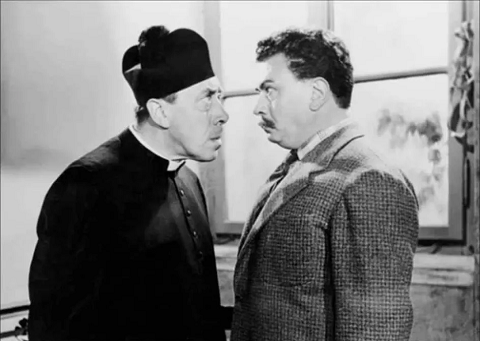
A still from one of the 1952-1965 film adaptations of the Don Camillo stories, with Fernandel as Don Camillo and Gino Cervi as Mayor Peppone.
There is a poignant scene in one of the Giovanni Guareschi Don Camillo books, (set in mid-century Italy, where communism and Catholicism are fighting it back and forth. They’re humorous, profoundly human, and easy reads. The stories are like 200 words each.) in which, during a period of high strife, the priest goes out to bless the river. Btw, if you need examples of how to be a flea on the side of the commies, that character is terribly subversive in little ways (as well as liking to hit them on the head. I might have taken him for a model when I was a pre-teen. Sigh. And Comrade Don Camillo is the best book for how to turn things on their heads if you’re in deep hiding in a lefty stronghold, either professional or geographic.)
Anyway, in the little village on the Po river where the priest and the communist mayor fight it out, the river is an ever present danger, and people cope with it the way they have coped with such things throughout history: every year the priest goes to the river and blesses it, in the hopes that it will become (I am remembering in Italian, the English translation is probably different) “A well behaved citizen and stay within its bounds”.
Now, this is not magic, of course, and the priest explains that. Blessing the river does not guarantee that the river won’t burst out of its bed and flood the village (later on in the book there are accounts of a flood, and if you think that a book can’t paint a picture, be sure it can. For the rest of my life, I’ll carry the image of the priest saying mass in the deserted and flooded village, while across the river, on the safe bank, his flock who fled the flood kneel on the muddy soil at the tolling of the consecration bell. BTW Guareschi is the writer I’d like to be when I grow up. Trained as a journalist, he uses minimal words, but the images stay with you.) It’s just that blessing it gives people hope it won’t, and allows them to live in a precarious place, at a precarious time without losing their minds. (It is important to remember that whatever else humans are, they’re creatures of ritual and habit, and sometimes those are the only panaceas for difficult situations.)
Well, the communists have their dander up, so they tell the priest they want to march in the procession to bless the river with their flags and paraphernalia and the priest says no, they say anyone in the procession will get beaten. They demand the priest cancel it, and people lose their minds. So, the priest says he’ll go alone, if needed. Needless to say, the communists follow, in what is an intimidation maneuver (they have no new moves, really.)
So, Don Camillo, without looking back, gets to the river and prays that the Lord will keep the river within its bounds. And of course, because he knows the audience at his back, he says “If the houses of decent people could float, I’d ask you for a flood like Noah’s. But since the houses of decent people are made of the same stone and brick and sink like the houses of scoundrels, I beg you to make the river behave.”
In case you’re wondering what went wrong in America, and why we are where we are: we forgot our houses can’t flood.
Comments Off on Don Camillo blesses the river Po
July 24, 2022
Still no actual evidence of unmarked graves for Residential School children
In Quillette, Jonathan Kay updates the year-old sensational stories about First Nations children being buried in unmarked (in more unhinged reporting it might have been “mass”) graves on the grounds of former Residential Schools in Canada:
Canada’s unmarked-graves story broke on May 27th, 2021, when the Tk’emlúps te Secwépemc First Nation reported the existence of ground-penetrating radar (GPR) data that indicated regularly spaced subterranean soil disturbances on the grounds of a former Indigenous Residential School that had operated in Kamloops, BC between 1893 and 1978. In addition, the First Nation’s leaders asserted their belief that these soil disturbances corresponded to unmarked graves of Indigenous children who’d died while attending the school.
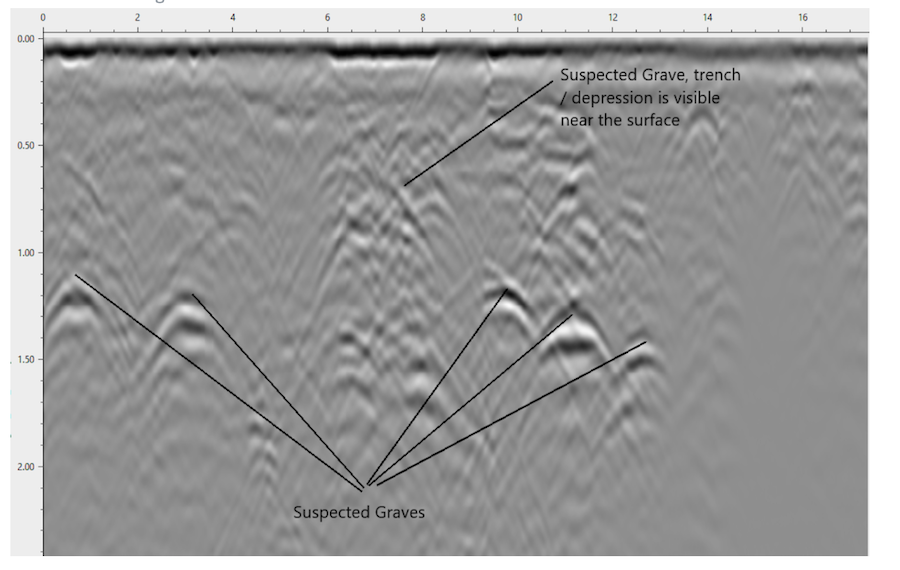
The story became an immediate sensation in the Canadian media; and remained so for months, even after the GPR expert on whom the First Nation relied, Sarah Beaulieu, carefully noted that the radar survey results didn’t necessarily indicate the presence of graves — let alone graves that had been unmarked, graves of Indigenous people, or graves of children. Contrary to what many Canadians came to believe during that heady period, GPR survey data doesn’t yield X-ray-style images that show bodies or coffins. What it typically shows are disruptions in soil and sediment. Investigators then need to dig up the ground to determine what actually lies underneath.
An explanatory image posted by GeoScan, a Canadian Ground-Penetrating-Radar service provider, showing how mapped GPR data can indicate the possible presence of graves.
Image via Quillette.But those details were swept aside during what, in retrospect, appears to have been a true nation-wide social panic. As other Indigenous groups announced that they’d be conducting their own GPR surveys, media figures confidently asserted that the original Canadian Residential-School student death-toll estimate of 3,201 would soon double or even triple. One op-ed writer went so far as to declare that “the discovery of the graves of the children in Kamloops may be Canada’s Holocaust moment.” Dramatic, tear-drenched acts of public atonement unfolded everywhere, with many July 1st Canada Day celebrations being either cancelled or transformed into opportunities for morose self-laceration.
I was one of many Canadians who initially got swept up with all of this — in large part because it seemed as if everyone in the media was speaking with one voice, including journalists I’d known and respected for many years. Looking back on the coverage, I note that headline writers mostly skipped over the technical bits about soil dislocations and such, and went straight to “bodies” and “graves”. And the stories often were interspersed with credulous recitations of dubious tales featuring live babies being thrown into furnaces or buried alive.
The whole mission of Canada’s church-run Residential School system was to assimilate Indigenous people into white Canadian society, usually against their will, while forcing children to leave their families and communities for months or even years at a time. No one disputes that many students were subject to cruel (and sometimes even predatory) treatment and substandard medical care. Certainly, the death rate for Indigenous children attending these schools was much higher than that for children in the general population. No, I never bought into the idea that there was any kind of mass-murder plot going on at these schools. But it hardly seemed far-fetched that some victims of mistreatment and neglect had been buried in unmarked graves — “off the books”, so to speak—by malevolent white teachers, school administrators, and priests seeking to evade responsibility for their actions.
The other important aspect to mention is that — like most other Canadians, I’m guessing — I believed we were only a few days or weeks from seeing real physical evidence plucked from the earth. So it didn’t much matter to me that early commentators were temporarily playing fast and loose with the distinction between GPR data and actual corpses.
Canadians were being told that the old orchard in Kamloops where the GPR data had been collected was a crime scene — a site of mass murder, and the final resting place of 215 child homicide victims. As I’ve reasoned elsewhere: If you told Canadians that, say, 215 murdered white children were buried somewhere in Toronto, or Ottawa, or Vancouver, there’d be investigators and police crawling all over the place, looking for remains that could be tested and identified. And so I naturally assumed the same thing soon would be happening in Kamloops.
But … no. Not at all, in fact.
As I wrote over a year ago, the way the story swept the media was as if the whole Residential School history was somehow new and previously unknown:
Despite being Canadian, my interest in Canadian history centres mostly on economic, naval, and military aspects, but I was certainly aware that the residential school system was a black mark on Canada’s historical dealings with First Nations and that the general outline of events — if not the gruesome details — had been known for many years. The first time I found out about it was in middle school, through what we’d now call a “Young Adult” novel about a young First Nations boy escaping from the residential school he’d been sent to and his attempts to travel hundreds of miles to get home. I read it in the early 70s and it may have been published up to a decade before then (I no longer remember the author’s name or the title of the book, unfortunately).
If I, as a schoolchild, knew something of this fifty years ago, why have people younger than me been shocked and appalled to be hearing about this widespread tragedy for the first time now?
Comments Off on Still no actual evidence of unmarked graves for Residential School children
July 23, 2022
Barbarian Europe: Part 3 – Barbarism and Christianity
seangabb
Published 1 May 2021In 400 AD, the Roman Empire covered roughly the same area as it had in 100 AD. By 500 AD, all the Western Provinces of the Empire had been overrun by barbarians. Between April and July 2021, Sean Gabb explored this transformation with his students. Here is one of his lectures. All student contributions have been removed.
(more…)
Comments Off on Barbarian Europe: Part 3 – Barbarism and Christianity
July 22, 2022
Winemaking in the Middle Ages | The Process, Taste, Storage and Use
Kobean History
Published 31 Aug 2020
(more…)
Comments Off on Winemaking in the Middle Ages | The Process, Taste, Storage and Use
July 19, 2022
Barbarian Europe: Part 2 – The Fall of Rome
seangabb
Published 22 Apr 2021In 400 AD, the Roman Empire covered roughly the same area as it had in 100 AD. By 500 AD, all the Western Provinces of the Empire had been overrun by barbarians. Between April and July 2021, Sean Gabb explored this transformation with his students. Here is one of his lectures. All student contributions have been removed.
(more…)
Comments Off on Barbarian Europe: Part 2 – The Fall of Rome
July 15, 2022
Forget George Washington, Woodrow Wilson, and FDR – studying the presidency of Jimmy Carter is suddenly more relevant
One of the readers of Scott Alexander’s Astral Codex Ten has contributed a review of The Outlier: The Unfinished Presidency of Jimmy Carter by Kai Bird. This is one of perhaps a dozen or so anonymous reviews that Scott publishes every year with the readers voting for the best review and the names of the contributors withheld until after the voting is finished:
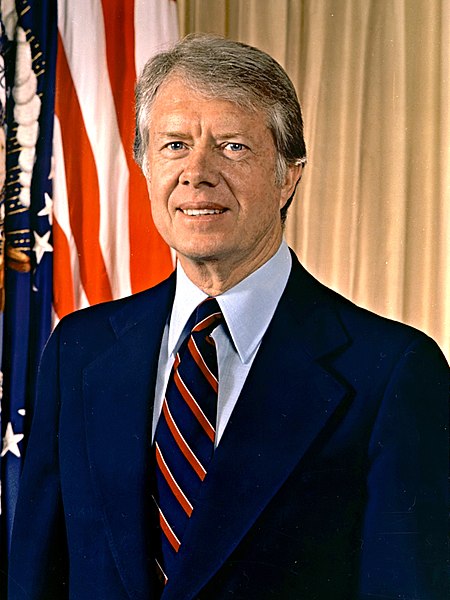
President James Earl “Jimmy” Carter.
Official portrait via Wikimedia Commons.
Like most people under 70, I was more aware of Carter’s post-presidency role as America’s kindly old grandfather, pottering around holding his wife’s hand and building Houses for Humanity. I mostly knew that he liked to wear sweaters, that he owned a peanut farm, and that he lost to Ronald Reagan.
But I wondered what, if any, hidden depths lay within the peanut farmer. Also, I wanted to enter this contest, and I didn’t want to pick a book that I thought a bunch of other people might also review. So I turned to The Outlier: The Unfinished Presidency of Jimmy Carter, by Kai Bird. Like Carter, this book seems to have been largely forgotten. It won a Pulitzer, but I had never heard of it until I googled “best book about Jimmy Carter”. It seems to have gotten a lot less attention than similar recent biographies about Grant, Roosevelt, and Truman, and it’s hard to imagine it ever becoming a TV show or a musical.
Carter was born in 1924 in Plains, Georgia, which, as you can tell from the name “Plains”, is very dull. His father was a successful farmer, which made his family wealthy by local standards. Almost every other Plains resident during Carter’s childhood was an impoverished African-American, many of whom worked on the Carter farm, a fact that is often cited as the answer to the central mystery of Carter’s childhood: how he grew up white in the Depression-era South without becoming a huge racist. It probably doesn’t tell the whole story, though, as his siblings came out just about as racist as you’d expect.
Carter attends the Naval Academy and eventually becomes a lieutenant on a nuclear submarine. At one point, he participates in a cleanup mission in which he is lowered directly into the core of an active nuclear reactor, thus causing him to develop superpowers that he will later use to win the presidency. Perhaps because of this experience — but, more likely, because he realizes that his deep-seated religious beliefs make him a poor fit for a career in an organization designed to wage war — he quits the Navy at 29 and returns home to Plains. “God did not intend for me to kill”, he says, which would have been an awesome catchphrase had those superpowers actually been real.
Searching for a new career, Carter runs for State Senate, loses due to voter fraud, then challenges the results and wins by 15 votes in a new election. A few years later, he runs for governor, and loses for real this time, to avowed segregationist (and man with a truly awesome name) Lester Maddox. Having never experienced failure in any way before, Carter is plunged into a profound spiritual crisis by this loss. Today, we would probably just say he was depressed. But as a religious Christian in the Deep South in 1966, you don’t “get depressed”, you have a spiritual crisis.
In 1970 Carter runs for governor again. This time, however, he decides to do whatever it takes to win. He runs a sleazy campaign that flies in the face of his modern-day reputation as kindly and honest. His campaign strategy has two core planks: 1) pretend to be a racist to appeal to the masses, and 2) avoid taking a stand on any other issue. Carter describes himself nonsensically as a “conservative progressive” and avoids commenting on the Vietnam War or the civil rights movement. He’s so good at pretending to be racist that the white supremacist White Citizens Council endorses him. He even wins the endorsement of his old opponent, outgoing Governor Maddox, who’s term-limited from running again. As far as anyone can tell, Carter never expresses any second thoughts about his disingenuous behavior during the campaign. Having passed through his spiritual crisis, he’s now guided by an unshakeable faith in his own goodness — a faith that justifies a victory by any means necessary.
The “fake racist” strategy works. Carter trounces his opponent, a wealthy businessman named Carl Sanders who he caricatures as “Cuff Links Carl” — when he’s not busy falsely accusing him of corruption, or hypocritically bashing him for his support of Martin Luther King. In January 1971, Carter is sworn in as the 76th Governor of Georgia.
Just a few minutes into his inaugural speech, Carter drops the pretenses of his campaign and executes on one of the most dramatic about-faces in modern-day political history when he declares that “the era of racial discrimination in Georgia is over”. The crowd gasps audibly, and outgoing Governor Maddox denounces Carter as a liar before the inauguration is even over. But Carter doesn’t care. He’s governor now, and he’s going to do what he wants.
Comments Off on Forget George Washington, Woodrow Wilson, and FDR – studying the presidency of Jimmy Carter is suddenly more relevant
July 7, 2022
QotD: Predestination
Credo quia absurdum est has a long and shameful pedigree. See, for example, the notion of Predestination. Technically, “double predestination” is the absurd part — the idea that God must’ve decided who was going to Hell long before He even created the world. It’s all but impossible to teach this idea to students, because modern people — to their credit, and for once I’m not being sarcastic when crediting modern people with anything — realize how ball-scratchingly stupid that is. Hell, maybe it’s true, but no sane person can possibly live with it.
Modern people see that as carte blanche to do whatever we want, because hey, if we do it, God made us do it … which, if you think about it for half a second, means God Himself is responsible for “sin” (quotation marks necessary, because it can’t be evil if I have no possible choice in the matter). Calvin, Knox, et al thought of that too, of course — they were crazy, not stupid — and they even had an answer: Shut up, that’s why. Not the most theologically sophisticated reasoning, but when you’re being burned at the stake for Arminianism it’s remarkably persuasive. Meanwhile, you’d best live like the holiest Puritan that ever lived … even though it’s exquisitely pointless, because you’re almost surely damned.
Severian, “Public Piety”, Rotten Chestnuts, 2019-01-29.
Comments Off on QotD: Predestination
July 1, 2022
Trying to reconcile the highly mediagenic “Residential School mass graves” stories with facts-on-the-ground
Prime Minister Justin Trudeau — never one to miss opportunities to preen before the camera and shed a performative tear or two — quickly ordered Canadian flags to half-staff when the stories about unmarked graves on the grounds of former residential schools spread across the world. Claims and accusations flew, based on ground-penetrating radar scans that didn’t actually prove that the surveyed land contained lost graves. Once the narrative was established, it provided many opportunities for First Nations organizations, activists, and Canadian and foreign politicians to moralize, condemn, and demand investigations, restitution, and apologies from the Catholic church (which ran over 40% of the residential schools), and the provincial and federal governments.
So, more than a year later … what has been investigated? Not much, it turns out:
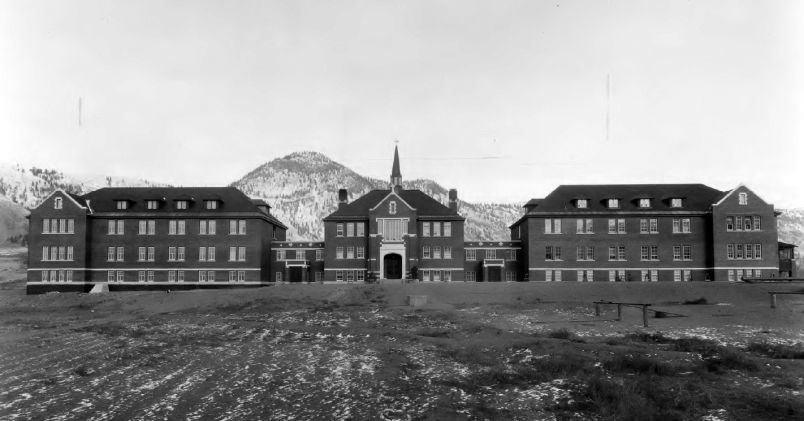
Kamloops Indian Residential School, 1930.
Photo from Archives Deschâtelets-NDC, Richelieu via Wikimedia Commons.
Sixty-eight Christian churches, mostly Roman Catholic, were vandalised or even burned to the ground. Many of these were historical church buildings still used and revered by native people. The pretext for arson and vandalism was that the Kamloops Indian Residential School had been run by a Catholic religious order, as had 43% of all residential schools. Imagine the outrage if 68 synagogues or mosques had been vandalised and burned. Yet the attacks on 68 Catholic churches passed with only mild criticism.
An article in the New York Times was typical of media commentary about the unmarked graves. It was first published under the headline “Horrible History: Mass Grave of Indigenous Children Reported in Canada” on 28 May and updated on 5 October under the same title. It asserted that: “For decades, most Indigenous children in Canada were taken from their families and forced into boarding schools. A large number never returned home, their families given only vague explanations, or none at all.”
Because the corporate press take their cue from the New York Times, its perspective echoed widely. The discovery of the so-called unmarked graves was chosen by Canadian newspaper editors as the “news story of the year”. And the World Press Photo of the Year award went to “a haunting image of red dresses hung on crosses along a roadside, with a rainbow in the background, commemorating children who died at a residential school created to assimilate Indigenous children in Canada”.
But the award this news report should have won is for fake news of the year. All the major elements of the story are either false or highly exaggerated.
First, no unmarked graves have been discovered at Kamloops or elsewhere. GPR has located hundreds of soil disturbances, but none of these has been excavated, so it is not known whether they are burial sites, let alone children’s graves. At her original press conference, the Chief of the Kamloops Indian Band called these findings unmarked graves, and the media, politicians, and even Pope Francis ran with the story without waiting for proof.
Similar claims from the chiefs of other Indian reserves ran into grave difficulty (no pun intended) because the GPR research was conducted in whole or in part on community cemeteries located near the sites of residential schools. It would hardly be surprising to find burial sites in a cemetery! But again, since no excavations have been conducted, it is not known whether these unmarked graves contain the bodies of children.
North American Indians did not conduct burials; they usually exposed the bodies of the dead to be worn away by predators and the elements. Christian missionaries introduced the practice of burial. But Indian graves were usually marked by simple wooden crosses that could not long withstand the rigours of Canadian weather. Thus Indian reserves today contain probably tens of thousands of forgotten unmarked graves of both adults and children. To “discover” these with ground-penetrating radar proves nothing without excavation.
Second, there are no “missing children”. This concept was invented by the Truth and Reconciliation Commission (TRC), whose members spoke at various times of 2,800 or 4,200 Indian children who were sent to residential schools but never returned to their parents. Indeed, some children died at residential schools of diseases such as tuberculosis, just as they did in their home communities. But the legend of missing students arose from a failure of TRC researchers to cross-reference the vast number of historical documents about residential schools and the children who attended them.
Comments Off on Trying to reconcile the highly mediagenic “Residential School mass graves” stories with facts-on-the-ground
The Early Emperors – Part 6: The Birth of Christianity
seangabb
Published 27 Dec 2021The Roman Empire was the last and the greatest of the ancient empires. It is the origin from which springs the history of Western Europe and those nations that descend from the Western Roman Empire. It is the political entity within which the Christian faith was born, and the growth of the Church within the Empire, and its eventual establishment as the sole faith of the Empire, have left an indelible impression on all modern denominations. Its history, together with that of the ancient Greeks and the Jews, is our history. To understand how the Empire emerged from a great though finally dysfunctional republic, and how it was consolidated by its early rulers, is partly how we understand ourselves.
Here is a series of lectures given by Sean Gabb in late 2021, in which he discusses and tries to explain the achievement of the early Emperors. For reasons of politeness and data protection, all student contributions have been removed.
More by Sean Gabb on the Ancient World: https://www.classicstuition.co.uk/
Learn Latin or Greek or both with him: https://www.udemy.com/user/sean-gabb/
His historical novels (under the pen name “Richard Blake”): https://www.amazon.co.uk/Richard-Blak…

Comments Off on The Early Emperors – Part 6: The Birth of Christianity
June 24, 2022
“… most of the ‘mental health crisis’ is just loneliness”
Ed West believes we’re suffering so many social ailments because we’re social creatures, evolutionarily speaking, and modern society has reduced or eliminated so many traditional community social gatherings — made far, far worse by arbitrary lockdown rules and harsh enforcement during the Wuhan Coronavirus panicdemic. He’s talking specifically about Britain and Europe, but the same definitely applies here in North America:
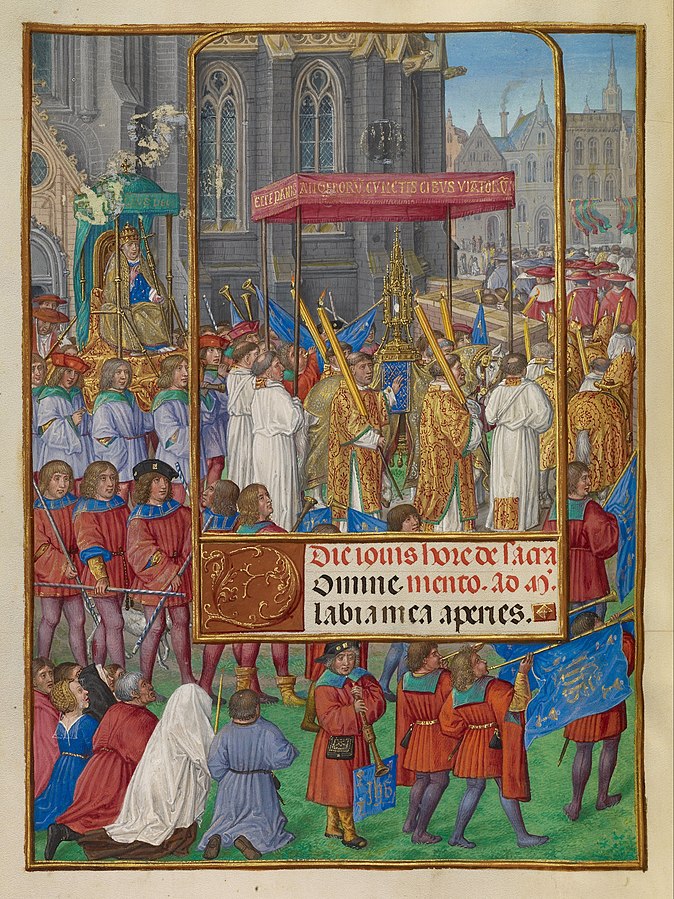
“Procession for Corpus Christi” attributed to Master of James IV of Scotland (Flemish, before 1465 – about 1541), illuminator.
Original illumination in the Getty Center Collection via Wikimedia Commons.
Last week, for example, most of continental Europe got a holiday to mark Corpus Christi, once a huge event in England but killed off by the Reformation. Why can’t we have a holiday too? It was 27 degrees in London last Thursday — it would have been great.
We’re all aware, on some subconscious level, that there is a need for communal feasts and holidays, and in some ways the idea of a June procession to celebrate the official religion has made a comeback with Pride. The feast-shaped hole in our lives is why, from time to time, the great and the good come up with very boring ideas for substitutes feasts, the latest being “Celebration Day”. The idea is for “one day in the year when we can all take a pause in our busy lives to reflect, remember and celebrate the lives of people no longer here”. You mean, like the feast of All Saints’ and All Souls’, which again was a huge part of our calendar once and is still marked in Catholic countries? Like that one?
[…]
Contrary to the fashionable Noughties takes about the evils of supernatural belief, religion has huge psychological benefits. There is a vast array of evidence showing that attending religious ceremonies increases dopamine responses in the brain. Overcoming our fear of death is not even the key part; it is meeting other people and taking part in a common ritual, which has huge benefits, including reduced risk of suicide or addiction. Religious attendance is “associated with lower psychological distress” and “related to higher well-being”.
Modernity, diet and substance abuse may have slightly increased rates of extreme mental illness such as schizophrenia, while social media has allowed people with personality disorders to become prevalent, especially in politics. But most of the “mental health crisis” is just loneliness. People attend fewer communal events because of the decline of religion, they see other people less regularly and they have fewer friends — of course they’re unhappy! Humans are not just social mammals, we are ultra-social by the standards of other species; that’s why we need common rituals and why we’re chasing that religious feeling everywhere and can’t find it. It is why, as Madeline Grant wrote in the Telegraph this week, that as well as progressive institutions adopting religious-type feasts, even exercise classes increasingly resemble Mass.
Lockdown, traumatic though it was, was merely an extreme version of the trend towards solitude already underway (with working from home, online shopping and various other lockdown activities on the rise before 2020). Most traditional societies would consider our everyday lives in non-Covid times to be a form of lockdown, with historically very unusual levels of isolation. That is why the extreme loneliness of lockdown gave rise to ersatz rituals such as Clap for Carers.
Yet you just can’t beat the real thing. As Parker wrote at the time, ritual decline was a real sadness in our lives: “From the Middle Ages until the first half of the 20th century, Whitsun and the week that followed was the chief summer holiday of the year in Britain. It was a time for all kinds of communal merry-making, varying over the centuries but consistent in spirit: the season for feasts and fairs, dancing and drinking, school and church processions, and generally having a good time.”
Comments Off on “… most of the ‘mental health crisis’ is just loneliness”
June 22, 2022
The Day the Viking Age Began
Tasting History with Max Miller
Published 21 Jun 2022For 15% off your first order with Porter Road, click the link https://porterroad.com/MAXMILLER
VIKING BLOD MEAD: https://bit.ly/meadandmore
Support the Channel with PATREON ► https://www.patreon.com/tastinghistory
Merch ► https://crowdmade.com/collections/tas…
Instagram ► https://www.instagram.com/tastinghist…
Twitter ► https://twitter.com/TastingHistory1
Tiktok ► TastingHistory
Reddit ► https://www.reddit.com/r/TastingHistory/
Discord ► https://discord.gg/d7nbEpy
Amazon Wish List ► https://amzn.to/3i0mwGtSend mail to:
Tasting History
22647 Ventura Blvd, Suite 323
Los Angeles, CA 91364LINKS TO SOURCES**
An Early Meal by Daniel Serra & Hanna Tunberg: https://amzn.to/3MOJSNb
Anglo Saxon Chronicle: https://amzn.to/3tBBoCx
The Oxford History of the Vikings by Peter Sawyer: https://amzn.to/3zElwmlRECIPE
1 pound (½ kg) pork meat
Salt for seasoning
2 tablespoons (25g) Lard or another oil for cooking
1 ½ cups (125g) chopped spring onion, or leek
2 teaspoons brown mustard seeds, roughly crushed
1 teaspoon chopped mint
1 pound (½ kg) fresh berries
½ cup (120ml) water
½ cup (120ml) mead1. Season the meat, then heat the lard/oil in a pot on the stove. Sear the meat for 5-7 minutes until well browned. Then remove it and set aside.
2. Add the onion to the pot and cook for 2-3 minutes, then add the water and mead and bring to a simmer. Add the mustard seed and mint and return the pork to the pot. Return to a simmer then cover the pot and place it in an oven at 325°F/160°C for 15-25 minutes or until the pork reaches 145°F. Then remove the pot from the oven and remove the pork to let it rest.
3. Add the berries into the pot with the braising liquid and cook on the stove for 7-10 minutes or until very soft. Mash the berries, then pour everything through a strainer. Return the liquid to the pot and simmer for several minutes or until the sauce reduces down. The sauce will not become too thick without the addition of starch (optional).
4. Slice the pork and serve with the sauce, extra berries, and mint.
**Some of the links and other products that appear on this video are from companies which Tasting History will earn an affiliate commission or referral bonus. Each purchase made from these links will help to support this channel with no additional cost to you. The content in this video is accurate as of the posting date. Some of the offers mentioned may no longer be available.
Subtitles: Jose Mendoza | IG @worldagainstjose
PHOTO
Lindisfarne Priory: Mstanyauk, CC BY-SA 3.0 https://creativecommons.org/licenses/…, via Wikimedia Commons
Disneyland: Sean MacEntee via Flickr, CC BY-SA 3.0 https://creativecommons.org/licenses/…, via Wikimedia Commons
France Relics: Dennis Jarvis via Flickr, CC BY-SA 3.0 https://creativecommons.org/licenses/…, via Wikimedia Commons
Holy Island Sunrise (again): By Chris Combe from York, UK – CC BY 2.0, https://commons.wikimedia.org/w/index…
Viking Age Map: By en:User:Bogdangiusca – Earth map by NASA; Data based on w:File:Viking Age.png (now: File:Vikingen tijd.png), which is in turn based on http://home.online.no/~anlun/tipi/vro… and other maps., CC BY-SA 3.0, https://creativecommons.org/licenses/…” rel=”noopener” target=”_blank”>https://commons.wikimedia.org/w/index…
Lindisfarne Priory Ruins: Nilfanion, CC BY-SA 3.0 https://creativecommons.org/licenses/…, via Wikimedia Commons
Statue of Rollo: By Delusion23 – Own work, CC BY-SA 4.0, https://commons.wikimedia.org/w/index…MUSIC
Battle of the Creek by Alexander Nakarada (www.serpentsoundstudios.com)
Licensed under Creative Commons BY Attribution 4.0 License
http://creativecommons.org/licenses/b…#tastinghistory #viking
Comments Off on The Day the Viking Age Began
June 21, 2022
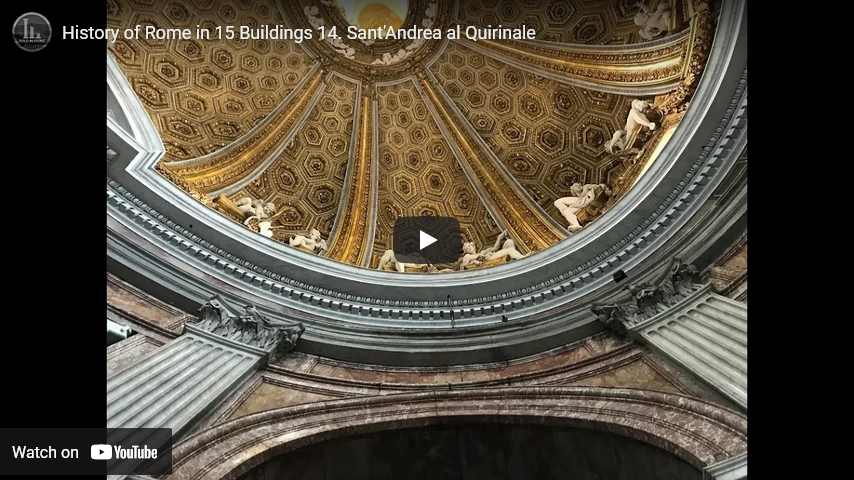
History of Rome in 15 Buildings 14. Sant’Andrea al Quirinale
toldinstone
Published 2 Oct 2018Coke vs. Pepsi. Kramer vs. Kramer. Alien vs. Predator. Everyone loves a rivalry – and so, discussions of art and architecture in Baroque Rome never fail to mention the antagonism between the ebullient Gianlorenzo Bernini and grim Francesco Borromini. This fourteenth episode in our History of Rome follows suit.
To see the story and photo essay associated with this video, go to:
https://toldinstone.com/santandrea-al…
Comments Off on History of Rome in 15 Buildings 14. Sant’Andrea al Quirinale
June 20, 2022
Criminal justice reform
At Time Well Spent, an interview with Charles Fain Lehman that considers the divergence between “what everyone knows” (based on how or if the media reports on an issue) and reality in the criminal justice system:
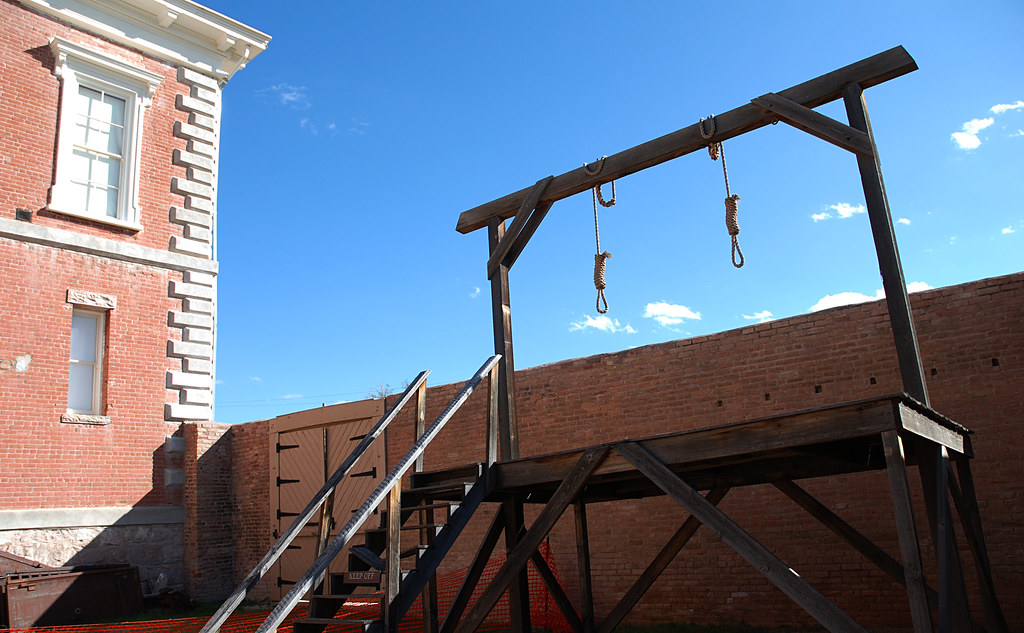
“Tombstone Courthouse State Historic Park” by August Rode is licensed under CC BY-NC-SA 2.0


I want to really dive into your work at City Journal and elsewhere because you’ve produced some of the most informative and sensible material on crime and crime policy I’ve found online, but before that I’m wondering: where does your interest in crime reporting come from, and what inspires you to keep going in the wake of what seems like a pro-crime movement capturing our newsrooms, elite colleges, and preeminent government institutions? You were the first person to support my interest in converting to Judaism as a black dude (as I mentioned in our dms), and so I have to ask also if Jewish culture centralizes the importance of issues of public safety in some way? Let’s get into it.
In some senses, my interest in crime is just a product of my natural contrarianism — I am rarely satisfied with the popular explanation. When I first started out as a reporter (at the Washington Free Beacon), I focused on domestic policy broadly, which I still do to some extent. I have a fluency with numbers, and so my first intuition was to dig into publicly available data. What I regularly found was that data about the criminal justice system simply did not align with the account of reality pushed by the criminal justice reform movement. Books like The New Jim Crow and documentaries like Thirteen give the impression that most people are in prison for marijuana possession on trumped up mandatory minima, all at the behest of the private prison-industrial complex. In reality, the majority of offenders are in prison for murder, marijuana possession is barely an asterisk in prison populations, mandatory minima explain little of the growth in prison populations, and few prisoners are held in private prisons at all. So I began to develop the sense that perhaps the story popular with people, even conservatives, my age was not precisely up to snuff.
The other issue that I think started me down the road to my “tough on crime” stances today was learning about death penalty abolitionism. I wrote a long essay (unfortunately never published) about the death of Clayton Lockett, who was executed in Oklahoma with a drug called midazolam, which lead to a fairly horrible death. What became apparent to me in researching the piece is that Oklahoma only used midazolam because anti-death-penalty activists had lobbied pharmaceutical firms to stop selling more reliable drugs, namely pentobarbital and thiopental, to states, forcing them to switch to less reliable methods. This sort of unintended consequence is actually a common theme across abolitionist activism. For example, in 2019 the Supreme Court blocked the execution of Vernon Madison, a 68-year-old man whose lawyers argued that dementia rendered him incompetent for execution. But of course, Madison only developed dementia because he’d been awaiting execution for literal decades, since he murdered a police officer in 1985.
These may seem like fairly specific issues, but I think they can allow us to identify a common theme with the progressive current in criminal justice reform, namely a belief that “justice” is primarily a concern of the accused — protecting his rights, defending him against the state, etc. Values like due process are, of course, important. But our discourse obfuscates entirely the basic fact that most criminals have committed heinous acts, and that the first responsibility of justice is to redress those harms through punishment. I am motivated, in other words, by a basic belief that justice matters, and that many reformers, in their zeal for fairness or equity or whatever, actively undermine the pursuit thereof.
I don’t think this is consciously a Jewish attitude, which is to say I don’t think I came to this sentiment because I was taught at some point that this is what Jews believed. That said, I tend to think the view that one of the ways that Judaism is distinguished from Christianity is the primacy of justice in the former, compared to the primacy of mercy in the latter. To the Christian, everyone is a sinner, and so the differences between me and the death row prisoner are ontologically trivial. (A view like this I think motivates someone like the Atlantic‘s Liz Bruenig, whom I credit as one of the few honest death penalty opponents, even as I disagree with her.) Judaism, by contrast, is fundamentally a religion of law: God says that these things ought to be done, and to live well is to do them. Of course, Judaism thinks a great deal about the balance of justice and mercy — the Talmud blunts the Torah‘s death penalties, for example. But Judaism always proceeds from the view that there are laws which should be respected, and that violating those laws requires consequences. So in that regard, I suspect that my views are inflected by Judaism. And indeed, coming around to those views I think helped me to think more about Judaism, too.
Comments Off on Criminal justice reform
June 16, 2022
Mussolini’s Pope? – The Geopolitics of the Vatican
World War Two
Published 14 Jun 2022Pope Pius XI is the first Pope to guide the Catholic Church through the age of fascism. How has his Vatican responded to Fascists Italy and Nazi Germany, and what is the geopolitical position of the Papacy on the eve of war of World War Two?
(more…)
Comments Off on Mussolini’s Pope? – The Geopolitics of the Vatican


