
England, some time in the first half of the last century. Night.
In a boarding school near the Kentish coast, a ruffian sneaks along the corridor, hunting for the rare stamp that will make him rich. In a Home Counties village, a tousled-haired schoolboy lies awake, putting the finishing touches to his scheme that will win the war for the Allies. Many miles to the north, a boat pulls away from Wildcat Island, bound for fortune and glory. And far across the oceans, a group of schoolboys tremble in terror, as their South Sea captors prepare to sacrifice them to their idol …
Such is the world of the classic British children’s story: the world of Billy Bunter and his Greyfriars chums, William Brown and his fellow Outlaws, Titty, Roger and the rest of the Swallows and Amazons, Jennings, Molesworth and the Secret Seven. For more than half a century, such stories dominated the imagination of millions of readers. You can still buy second-hand editions of Richmal Crompton’s Guillermo el Detective, and wonder what on earth readers in General Franco’s Spain made of them.
When I was growing up, the books of Frank Richards, Arthur Ransome and Richmal Crompton were still everywhere, just about. Our local library groaned with stories in which middle-class British children spent their weekends in the barn across the fields and their weeknights sneaking out of the dormitory for some stolen tuck. Raised on the virtues of teamwork and courage, the boys grew up to become hunters, naval commanders and Spitfire pilots. I never found out what happened to the girls. For a boy in the early Eighties, to have been caught reading Mallory Towers would have been social suicide.
Dominic Sandbrook, “Children don’t need woke stories”, UnHerd, 2021-05-17.
September 13, 2021
QotD: Those classic British children’s stories
September 10, 2021
Why even highly gifted young quarterbacks rarely succeed as they move toward the NFL
Severian at Rotten Chestnuts looks at the early career life-cycle of football quarterbacks:
At all levels of American football below pro, the “option” is a major facet of the game. This is an offensive play where the quarterback can either run the ball himself, pitch it to another player, or throw it downfield, as he thinks best. It certainly helps if the quarterback is a strong-armed, accurate passer, but the key criterion here is speed. If you get defenders cheating up in order to stop the run, you don’t have to be as strong or accurate with your throws. What matters is that the QB can pass — meaning, he can throw it X yards downfield, within a few yards’ radius of a given spot — not how often he does so. The closer he can get it to the spot, and the further downfield that spot is, the better, but so long as he’s in the vicinity the option system works well.
This starts very, very early in a player’s career. The lower down the skill ladder you go, the more prominent the “option” offense. In “Pop Warner” leagues — kids below age 12, basically — the option pretty much IS the offense, since few kids can throw the ball very far, much less with accuracy. Throwing a football with both velocity and accuracy is extremely difficult, and it doesn’t help that sound throwing mechanics feel brutally unnatural — you know you’re doing it right when it feels like your shoulder is going to pop out of its socket at the very instant your elbow ligaments snap and hit you in the face … which, unfortunately, is exactly what it feels like when you’re doing it wrong, and your shoulder IS about to pop out at the same moment your elbow ligaments snap.
What happens, then, is that kids generally learn how to throw with very poor form … but coaches generally aren’t going to correct them, either because they don’t know the proper mechanics themselves, or because they are focused exclusively on winning games. Who cares if little Kayden, Brayden, or Jayden is going to blow his arm out hucking it like that when he hits high school? That’s Coach Smith’s problem. All that matters now is that he can get it to X spot with radius Y.
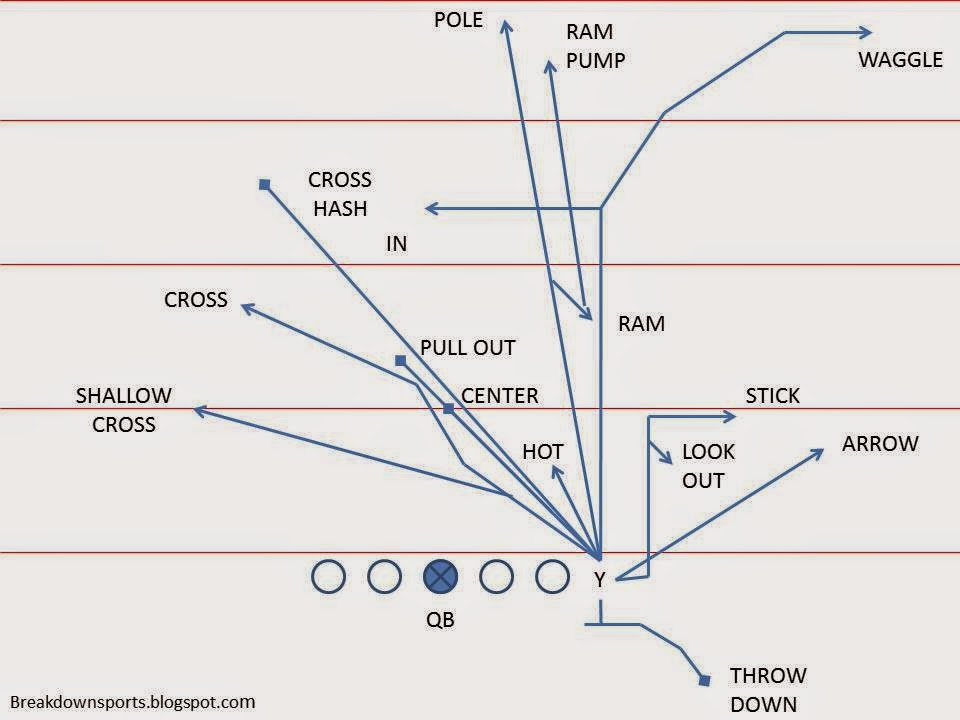
Thus the possible career path of any kid who can throw a football reasonably well quickly diverges. If he’s too slow to run the option effectively, his coaches will try to turn him into an “air raid” style quarterback, which means he throws on every play, mechanics be damned, because we need to win now, and what the hell, he can get it there, can’t he? But even the “air raid” style of play is enormously more difficult to coach, because that means you need to be able to coach a whole corps of wide receivers to run a whole bunch of increasingly complex routes. Here, look:
That’s what’s known as a “route tree”, and all of your receivers — five guys, usually, on every play, plus their backups — need to know how to run every one of them, every time. Which means your playbook is going to be huge, because you (theoretically, anyway) need a play for each one of those routes, for each receiver on the field. And obviously your quarterback has to have something going on upstairs, because he needs to memorize five different guys’ routes for every single play, plus audibles and checkdowns (changing any given player’s route, or even the entire play, on the fly), and so on.
I’m sure y’all see where I’m going with this, but it’s important to note that the key selection — whether a given kid shall be an “option” quarterback, or an “air raid” quarterback — has been made by someone else, much lower on the skill ladder. It would be great if one and the same kid could do both to a high degree of skill, but since human neurons apparently don’t work like that, it’s natural for everyone involved to take the path of least resistance.
And again, I’m not blaming coaches for this. Forget things like “getting fired for losing too many games”, and just consider the sheer amount of work. Stipulating for the sake of argument that you’ve got 50 man-hours in a week to get ready for a game, how do you best allocate them? Getting your QB to throw with proper mechanics alone probably takes a significant chunk of that time, and even though he’ll have to do a lot of it on his own — throwing passes at a tire in the backyard until his arm feels ready to fall off — you’re still spending a LOT of time on something that will make no appreciable difference to the game’s outcome this Friday night. And then throw in the other stuff — how much time does it take just to “install” (as the term d’art is) a game plan that has all those routes in it, much less coaching all the receivers up to where they can run them all?
Nah, brah. Just hand Jonquarious the ball and let him run it, and if he has to huck it downfield every now and again, let him do it his way. Again, this will make no difference at all to the outcome of this week’s game — he’ll either run it or he won’t; make the throw or not — but it frees up a lot of man hours to do all the other stuff a coach has to do that we haven’t talked about yet, such as defense.
September 4, 2021
QotD: Modern childhood
So much for the roving pack of kids each block boasted during Mintz’s childhood, and my own. “The empty lot has disappeared,” he quips. “And we are so concerned with legal liability that if kids do find one, you’d better be sure you’ll get a call from the police.”
Beth Hawkins, “Safe Child Syndrome: Protecting kids to death”, City Pages, Volume 26 – Issue 1267 (posted to the old blog, 2005-03-31).
August 27, 2021
Updating Rahm Emanuel’s notion about not “wasting” a crisis — don’t let a crisis end
In City Journal, John Tierney considers how political leaders and public health officials across the western world are going Rahm Emanual one better by continuously extending the Wuhan Coronavirus crisis:

Wuhan Institute of Virology.
Wikimedia Commons.
Throughout the pandemic, American political and public-health leaders have been following Rahm Emanuel’s classic dictum for power-seeking officials: “You never want a serious crisis to go to waste.” Now they’ve adopted a corollary: you never want a crisis to end.
So they are prolonging the national misery instead of easing it, which could be done with a few simple strategies. Explain to the public that the virus will never disappear but is no longer a mortal threat to the vast majority of Americans. Encourage the minority still at risk to get vaccinated by honestly discussing who is in jeopardy and what scientists have learned about infections. Promote treatments proven to prevent infection and speed recovery while avoiding unproven treatments and mandates that cause collateral damage and generate mistrust. Above all, make it clear to Americans that we finally have reason to celebrate: what once seemed an unprecedented danger is now just one of many pathogens that we know how to live with.
But the nation’s crisismongers aren’t about to relinquish their hold over the public, so they’ve set new goals that are as unachievable as they are unnecessary and harmful. Making vaccines available to every American adult is no longer sufficient; now the crisis cannot end until the entire population has been vaccinated. Instead of focusing efforts on vaccinating the vulnerable, officials obsess on compelling universal obedience, even if that means squandering vaccines on people who already have acquired natural immunity or are at minimal risk of serious illness.
The same progressives who regularly denounce “systemic racism” and “Western imperialism” are now enforcing policies that disproportionately punish minorities and the poor, both in the United States (the majority of black teenagers and young adults in New York have been banished from much of public life by the city’s new vaccine-passport policy) and in the rest of the world. The hypocrisy was deftly captured in a tweet by Martin Kulldorff, the Harvard epidemiologist: “If you favor university vaccine mandates for low-risk American and European students, when there is not enough vaccine for older high-risk people in Asia, Africa and Latin America, please remove your #BLM tags from your Twitter/Facebook profiles.”
Children are being sentenced to another round of unnecessary mask mandates and probably more school closures based on evidence-free warnings from Anthony Fauci and others that the Delta variant will be more deadly to them than the original virus. While the variant is more infectious, the evidence does not show it to be any more lethal. In fact, the current mortality rate among American children with Covid is lower than it was last year — and last year many more children died of the flu than of Covid. One of the most thorough studies, in England, shows that the survival rate for those under 18 with Covid is 99.995 percent. But instead of emphasizing these reassuring statistics, public-health officials like Jerome Adams, the former surgeon general, keep looking for new ways to scare parents and children.
August 19, 2021
How much formal school time can kids miss before it impacts their long-term prospects?
Many years ago, when my son went to Kindergarten, I discovered that a lot of other parents were concerned that if their child missed much — if any — time in class, it would utterly destroy their chances of whatever hopes and dreams they may cherish for a fruitful and productive life in the working world. And by “concerned” I man “bat-shit insanely worried” that even a day or two would be enough to blight the child’s life forevermore. And remember, these were the parents of Kindergarten or Grade 1-3 children. In the time since then, I doubt very much that parents have become more relaxed in this regard, so the re-assurances from Scott Alexander are well-timed, but may still not reach the people who most need to hear them:
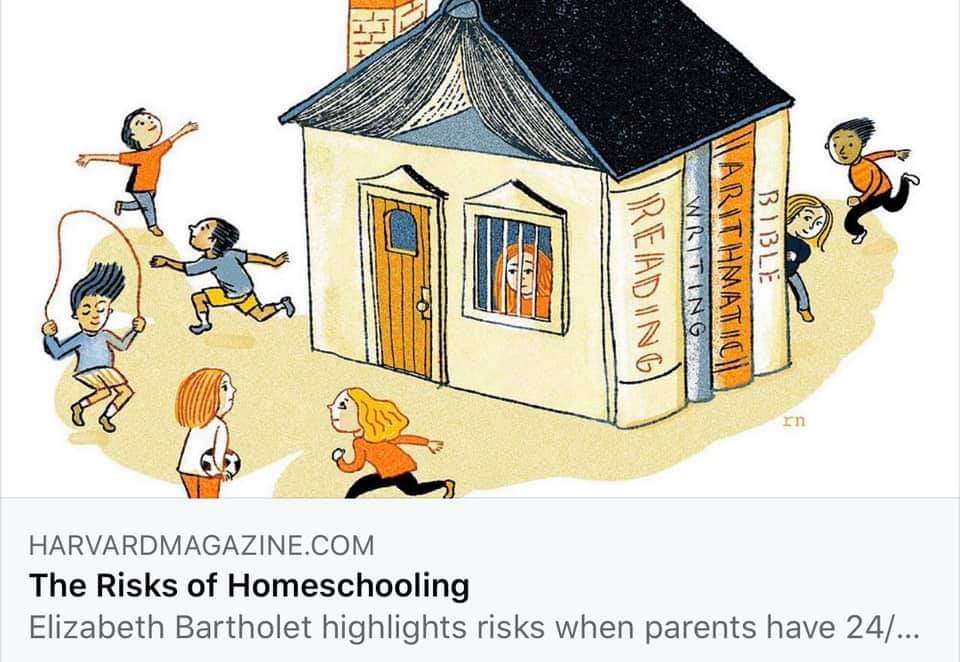
Illustration from Harvard Magazine via Twitter.
Back when the public schools were closed or online, someone I know burned themselves out working overtime to get the money to send their kid to a private school. They figured that all the other parents would do it, their kid would fall hopelessly behind, and then they’d be doomed to whatever sort of horrible fate awaits people who don’t get into the right colleges.
I hear this is happening again now, with more school closures, more frantic parents, and more people asking awful questions like “should I accept the risk of sending my immunocompromised kid to school, or should I accept him falling behind and never amounting to anything?”
(see also this story)
You can probably predict what side I’m on here. Like everyone else, I took a year of Spanish in middle school; like everyone else who did that, the sum total of what I remember is “no hablo Espanol” — and even there I’m pretty sure I forgot a curly thing over at least one of the letters. Like everyone else, I learned advanced math in high school; like everyone else, I can do up to basic algebra, the specific math I need for my job, and nothing else (my entire memory of Algebra II is that there is a thing called “Gaussian Elimination”, and even there, I’m not sure this wasn’t just the name of a video game). Like everyone else, I once knew the names and dates of many important Civil War battles; like everyone else — okay, fine, I remember all of these, but only because the Civil War is objectively fascinating.
And I think that’s the whole point. We learn lots of things in school. Then we forget everything except the things that our interests, jobs, and society give us constant exposure/practice to. If I lived in Spain, I would remember Spanish; if I worked in math, I would remember what Gaussian Elimination was. I think a lot of the stuff you’re exposed to and interested in, a sufficiently curious child would learn anyway; the stuff you’re not goes in one ear and out the other, hopefully spending just enough time in between to let you pass the standardized test.
Even beyond this, school is repetitive. I learned the same Civil War facts in fifth, eighth, and eleventh grade. I think I read The Giver in multiple English classes. And this is just the stuff it’s embarrassing to have repeated. The actually important skills — how to write essays, how to cite sources — get deliberately repeated year after year.
(I still have no idea how to cite a source properly, except a vague memory that something called “MLA Format” was very important, and that there might have been another thing called “Chicago Style” unless I am confusing it with pizza. When I actually need to cite something, I hit the “Cite” button on the top right of PubMed and do whatever it says.)
So my prediction is that an average student could miss a year or two of school without major long-term effects. Their standardized test score would be lower at the end of the two years they missed than some other student who had been in school the whole time. But after a short period they would equalize again. I don’t think you need to burn yourself out working overtime to send your kid to a private school, I don’t think you need to risk your immunocompromised kid’s health to send her to the classroom, I think you can just chill.
Parents who are concerned that the schools are spending too much time indoctrinating rather than teaching their students have a totally different set of concerns, which are outside the scope of this particular discussion.
August 16, 2021
L. Neil Smith – “Take your children out of school!”
In the latest Libertarian Enterprise, L. Neil Smith offers a useful bit of advice to parents concerned about their children being indoctrinated in state-run schools:

“Abandoned Schoolhouse and Wheat Field 3443 B” by jim.choate59 is licensed under CC BY-NC-ND 2.0


For quite a while now, the boob-tube has been filled with coverage of various Board of Education meetings around the country attended by parents murderously angry that their kids are being forcibly indoctrinated with utter claptrap like CRT, which apparently stands for Communist Racist Toxin, a new and poisonous religion where the color of your skin is an Original Sin for which you will be made to suffer no matter what you think, do, or say. My wife Cathy, passing by the TV set half a dozen times a day, invariably shouts, “Take your children out of school!” This essay is admiringly dedicated to her.
I suppose the Public Schools got started out of some sense of specialization. “You chip the flint, Og, Ogla cooks the mammoth, and we’ll teach the kids.” Evolution would have it the other way. The young have been learning from their parents for thousands of generations and it worked out pretty well until sinister figures like Horace Mann and John Dewey, equipped with the limitless power of the State, decided to use it to steal our children from us.
Take your children out of school!
It was perhaps, the stupidest thing that a people have ever done, and I’m pretty sure that Thomas Jefferson would have recognized it as the stupid thing it was, so it had to wait until he and those like him were safely dead. It isn’t brain science. It isn’t rocket surgery. Hand your offspring over to the State, and they will be taught every self-destructive thing the State wants them to be taught — and by now it should be clear, as it surely was to Jefferson, that the State is the enemy of everything decent and productive. Public education was probably responsible for both world wars.
Take your children out of school!
And if it was such a self-evidently good idea, then why did it have to be compulsory? The rows of desks in public schools are populated by conscription — no matter how many pleasant memories we may have of our school days. Public schools are financed by extortion and theft, two of the reasons we fought a revolution in the first place.
Take your children out of school!
It might be cynically observed that public schools are cheaper than paying for baby-sitting, but, given property taxes and the damage it does to the most important people in our lives, is it really? Idiots have whimpered for the last year that having your kids at home is inconvenient.
Public Schools are convenient for the State. They give government two incomes to tax, instead of only one. Take your children out of school!
August 14, 2021
QotD: Modern parenting
But we also fear their independence. We’re up there in the climber because we can’t afford to miss a minute of face time, you see. We believe our physical presence is the linchpin to the children’s emotional well-being and, although we never say so out loud, we want it that way — because it’s central to our well-being. We’re scared the kids will grow up to resent the fact that Mommy works, or — the biggest golem on the list — they just plain won’t like us. And in an age of high divorce rates and transient communities, kids who don’t like us suggest the possibility that we might really end up alone.
Beth Hawkins, “Safe Child Syndrome: Protecting kids to death”, City Pages, Volume 26 – Issue 1267 (posted to the old blog, 2005-04-01).
August 12, 2021
The Canadian Historical Association’s “consensus” on genocide in Canada
In Quillette, Christopher Dummitt reports on last month’s declaration by the Canadian Historical Association that not only were past Canadian governments complicit in deliberate genocide against First Nations, but that such mass extermination efforts are current and ongoing:

Kamloops Indian Residential School, 1930.
Photo from Archives Deschâtelets-NDC, Richelieu via Wikimedia Commons.
Last month, the Canadian Historical Association (CHA) issued a public “Canada Day Statement” — described as having been “unanimously approved” by the group’s governing council — declaring that “existing historical scholarship” makes it “abundantly clear” that Canada’s treatment of Indigenous peoples amounts to “genocide”. The authors also claimed that there is a “broad consensus” among historians on the existence of Canadian “genocidal intent” (also described elsewhere in the statement as “genocidal policies” and “genocidal systems”) — an alleged consensus that is “evidenced by the unanimous vote of our governing Council to make this Canada Day Statement”.
The authors went further by arguing that both federal and provincial governments in Canada “have worked, and arguably still work, towards the elimination of Indigenous peoples as both a distinct culture and physical group” (my emphasis); thereby suggesting that there is “arguably” an ongoing genocide going on, to this day, on Canadian soil.
The idea that Canada is currently waging a campaign of mass extermination against Indigenous people may sound like something emitted by Russian social-media bots or Chinese state media. But no, this is an official statement from the CHA, a body that describes itself as “the only organization representing the interests of all historians in Canada” — presumably including me.
In fact, there is no “broad consensus” for the proposition that Canadian authorities committed genocide, let alone for the completely bizarre idea that a genocide is unfolding on Canadian soil even as you read these words. And while many of us have become used to such plainly dilatory claims being circulated by individual Canadian academics in recent years, the CHA’s use of its institutional stature in this way was so shocking that it caused dozens of historians to affix their names to a letter of protest.
Notwithstanding what this (or any other) official body claims, the question of whether Canada committed genocide is not a settled issue among scholars. Canada is a relatively small country, home to only a small number of professional historians. And so even this modest-seeming collection of names suffices to disprove the CHA’s claim that it speaks for the entire profession. Moreover, many of those who have signed the letter are senior scholars giving voice to younger colleagues who (rightly) fear that speaking out publicly will hurt their careers.
I am not writing here to defend the actions of Canadian governments toward Indigenous populations. As most Canadians have known for decades, the policy of forcing Indigenous children to attend residential schools led to horrendous cases of sexual and physical abuse. There was also a long history in many schools of refusing to let children speak their native languages or continue their cultural traditions. These were assimilatory, underfunded institutions created and run by people who typically believed that they were doing Indigenous people a favour by “civilizing” them.
What I am addressing, rather, is (a) the question of whether these actions are correctly described with the word “genocide”, and (b) the CHA’s false claim that there is “broad consensus” on the answer to that question. As the letter of protest states:
The recent discovery of graves near former Indigenous residential schools is tragic evidence of what the Truth and Reconciliation Commission (TRC) documented in Volume 4 of its final report — a report that we encourage all Canadians to read. We also encourage further research into gravesites across Canada and support the completion of a register of children who died at these schools. Our commitment to interrogate the historical and ongoing legacies of residential schools and other forms of attempted assimilation is unshaken. However, the CHA exists to represent professional historians and, as such, has a duty to represent the ethics and values of historical scholarship. In making an announcement in support of a particular interpretation of history, and in insisting that there is only one valid interpretation, the CHA’s current leadership has fundamentally broken the norms and expectations of professional scholarship. With this coercive tactic, the CHA Council is acting as an activist organization and not as a professional body of scholars. This turn is unacceptable to us.
Historians are taught to approach their study of the past with humility, on the understanding that the emergence of new documents and perspectives may require us to revise our assessments. Moreover, even if an individual scholar might have strong opinions about a particular historical subject — having become certain that his or her interpretation represents the truth — the community of historians exists in a state of debate and disagreement. We are always aware that two historians sifting through the same archival box of documents can develop very different theories about what those documents mean.
It is true that there are some areas of history that might be fairly labelled as definitively “settled”. But these are few. And even in these cases, consensus typically arises organically, through the accumulated weight of scholarship — not, as in the case of the CHA’s Canada Day stunt, through ideologically charged public statements that seek to intimidate dissenting academics into silence.
July 14, 2021
QotD: The unlikely hermaphrodites in The Left Hand of Darkness
Let me start by saying that I LIKED the book. Loved it even. Mostly because it was different and it made me think. (Like other books of the time, it didn’t age well, mostly on language, but also structure, which I guess was innovative and daring at the time, but strikes me as “too early seventies” for words. Now this might be JUST ME but there’s a whole batch of books — one Heinlein — I can’t stand to re-read. I came of age in the seventies and eventually grew to loathe that false-craft feel of art at that time. No one else is forced to agree with me.)
But part of what made me think — because my relaxing reads are books on evolution and animals and their biology and behavior (guys, I read Konrad Lorenz for fun) is that the left (and at the time anyone with even vague intellectual pretensions was at the very least soft left, because the zeitgeist was) was very funny about humans.
They often opened their books on humans by gesticulating broadly at imaginary religious fanatics and rubbing said fanatics’ noses in the fact that “we are animals. No, we’re really animals.” And then proceeded to go a little bananas, sometimes in supposed non-fiction, like Desmond Morris in The Naked Ape, which assured us only humans killed their own species, or something equally ridiculous (I read it at around 14 or 15, I just remember his thesis that humans were uniquely vile made me snort-giggle at the time. Because, you know, you can sustain that if you’re religious, and say humans should aspire to the divine image, but if we’re really just animals, there is NO vile. We do what instinct and nature tell us, no judgement, right?)
But mostly this dysfunction showed in science fiction, particularly at the time. “We’re just animals. If we just changed/removed/tweaked x y z we’d be communitarian, sharing, no war animals.”
The way hermaphrodites behave in TLHOD made me snort/giggle too for various reasons, the first being that hermaphrodite species on Earth (granted mostly very small) have some of the most violent mating behaviors in the world. Makes sense since at least in live-bearing, or for that matter those who care for eggs, species, the cost falls on the one who carries young or sits on eggs. The other one just goes off, whistling his merry way and lives to mate another day. So in a species where either of the couple can bear, there would be a “war” (There are several books on war of the sexes in various species, which has led to things like praying mantises and duck penises.) to determine who bears. And yes, she did get right that in an intelligent species, value would have to be put on children-of-the-body or no one would want to do it. (Or most children would be conceived by rape. Which to be fair, is most hermaphrodite species on Earth.)
What she got wrong, related to that, is then having the kids raised in some sort of hippie dippie commune.
In fact, the whole setup makes perfect sense as a professional woman’s fantasy. “I want to have kids, but someone else raises them, and it will be the perfect communitarian family and no one will think it’s bad if I’m not there, or take no more interest in them than in any of the family kids.”
In point of fact, from evolutionary POV, an hermaphrodite species would have a hell of an attachment to their own biological “of the body” kids, for the simple reason that otherwise, being intelligent and able to circumvent instinct, no one would have kids “of the body” and those born of rape would be abandoned to die. World’s shortest species/race/breed.
Yes, I’m sure that some human (and these were supposed to be modified humans) tribes have done the communitarian child raising, but it’s not the norm, it’s not usually as communitarian as it looks and … oh, heck, even extended family raising the kids, which it sort of is, is nowhere nearly what US leftists think it is. There’s squabbles, politics, and the mothers very much care and “pull” for their own kid.
Anyway, it amused me because it was nowhere near the only. There was this trend back then for hermaphrodite modified humans that somehow made them more cooperative/better at not warring, etc, which I found absolutely mind bogglingly bizarre and made me wonder why people thought injecting the fierce young-protecting instinct of the female into a species at large would make it more sharing and caring, not the other way around. (And lord, study any society with multiple concubines and wives. Women protect THEIR children, there is no sisterhood or love all babies, when yours is in the mix. Some of the most horrific tales of mankind are the vengeance wrought by a woman on rival women AND THEIR BABIES.)
Sarah A. Hoyt, “Remaking People”, According to Hoyt, 2018-11-19.
June 21, 2021
“… the GOP needs an inflammatory issue to rile their racist base, and so this entire foofaraw is really just an astro-turfed, ginned-up partisan gambit about nothing”
An excerpt from Andrew Sullivan’s most recent Weekly Dish looks at the burgeoning fight over the use of Critical Race Theory in public schools:
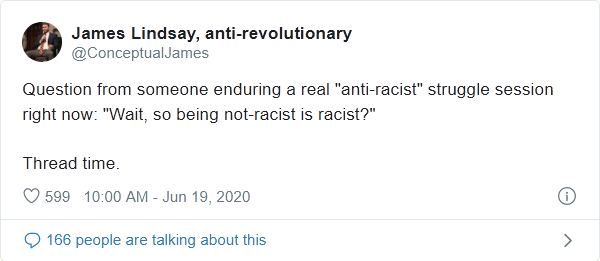
The stories in the mainstream media this past week about the broadening campaign to ban critical race theory in public schools have been fascinating — and particularly in how they describe what CRT is. Here’s the Atlantic‘s benign summary of CRT: “recent reexaminations of the role that slavery and segregation have played in American history and the attempts to redress those historical offenses.” NBC News calls it the “academic study of racism’s pervasive impact.” NPR calls CRT: “teaching about the effects of racism.” The New York Times calls it, with a straight face, “classroom discussion of race, racism” and goes on to describe it as a “framework used to look at how racism is woven into seemingly neutral laws and institutions.”
How on earth could merely teaching students about the history of racism and its pervasiveness in the United States provoke such a fuss? No wonder Charles Blow is mystified. But don’t worry. The MSM have a ready explanation: the GOP needs an inflammatory issue to rile their racist base, and so this entire foofaraw is really just an astro-turfed, ginned-up partisan gambit about nothing. The MSM get particular pleasure in ridiculing parents who use the term “critical race theory” as shorthand for things that just, well, make them uncomfortable — when the parents obviously have no idea what CRT really is.
When pushed to describe it themselves, elite journalists refer to the legal theories Derrick Bell came up with, in the 1970s — obscure, esoteric and nothing really to do with high-school teaching. “If your kid is learning CRT, your kid is in law/grad school,” snarked one. Marc Lamont Hill even tried to pull off some strained references to Gramsci to prove his Marxian intellectual cred, and to condescend to his opponents.
This rubric achieves several things at once. It denies that there is anything really radical or new about CRT; it flatters the half-educated; it blames the controversy entirely on Republican opportunism; and it urges all fair-minded people to defend intellectual freedom and racial sensitivity against these ugly white supremacists.
What could be more convenient? NBC News “reporter”, Brandy Zadrozny, even decried parents’ attempts to discover through FOIA requests just what their children are being taught — and argued this week that, “for longtime ultra conservative activists, CRT is the opportunity of a lifetime.” CRT, she explains, is not a threat at all, and there is no proof that it is even being taught. It’s “just a catch-all term repurposed as a conservative boogeyman.” She goes on: “it harnesses pushback against 2020’s racial justice movement, covid denialism, and depends on a base still energized by Trump and misinformation, looking for political power.”
I’m sure the MSM will continue to push this narrative indefinitely. They are still insisting, after all, that “white supremacy” is behind hateful attacks on Asian-Americans, and that soaring murder rates are purely a function of Covid19. And you can see why: this dismissive take is extremely helpful in avoiding what is actually happening. It diverts attention from the stories and leaks and documents that keep popping up all over the place about extraordinary indoctrination sessions that have become mandatory for children as early as kindergarten.
June 20, 2021
QotD: Cargo cult thinking in education
The problem of course is that college is not the cause of prosperity, but a marker (with prosperity) of other traits — focus on long-term goals, discipline, hard work, and yes knowing 2+2=4. This sort of woke BS just makes it worse, because it attacks the real roots of prosperity. There are real barriers to poor blacks achieving prosperity — eg how do you focus on long-term goals when you don’t know where you are sleeping tonight or when you have no role models who do so — but the purity and objectivity of math is not among these.
This sort of cargo cult thinking can be seen all the time in Progressive economic proscriptions. The government push for home ownership is another — middle class people own homes so if low income people owned homes they would become middle class. Now, this has a bit of accuracy in that, like the stock market, the elite have goosed the housing market to always go up. But leaving that aside for a moment, owning a home vs renting is a terrible decision for many people — it piles on a lot of financial risk but perhaps more importantly it limits geographic mobility which used to be critical to lower-income people improving their lot.
Warren Meyer, “Are the Woke a False Flag Operation of White Supremacists?”, Coyote Blog, 2021-02-16.
June 16, 2021
“One nation, indivisible”?
As a child in England and then in Canada, I was used to the relatively low-key acknowledgements of the Crown and the nation which may be why I was quite befuddled watching American TV portrayal of the in-your-face patriotic displays of the United States, especially the Pledge of Allegiance required of schoolchildren. It seemed oddly statist and even collectivist (although I didn’t know those terms at the time) for a country that constantly seemed to be patting itself on the back as the “home of the free”. I later learned that the Pledge hadn’t even been invented until nearly a century after the nation had been established (and the current version was devised and popularized by a noted utopian socialist, then adopted by Congress in 1942). Tom Mullen explores how the Pledge came about and considers the idea that it is time to drop it:

“American Flag” by JeepersMedia is licensed under CC BY 2.0
An Atlanta, Georgia, charter school announced last week its intention to discontinue the practice of having students stand and recite the Pledge of Allegiance during its schoolwide morning meetings at the beginning of each school day, opting to allow students to recite the pledge in their classrooms instead. Predictably, conservatives were immediately triggered by this “anti-American” decision, prompting the school to reverse its decision shortly after.
The uproar over periodic resistance to reciting the pledge typically originates with Constitution-waving, Tea Party conservatives. Ironically, the pledge itself is not only un-American but antithetical to the most important principle underpinning the Constitution as originally ratified.
[…]
Then, there’s “indivisible”. One would think a federation born by its constituent states seceding from the nation to which they formerly belonged would make the point obvious enough. But the Declaration makes it explicit:
That whenever any Form of Government becomes destructive of these ends, it is the Right of the People to alter or to abolish it, and to institute new Government, laying its foundation on such principles and organizing its powers in such form, as to them shall seem most likely to effect their Safety and Happiness.
It would be impossible to exercise that right — that duty, as the Declaration later calls it — if the republic were indivisible. The strictest constructionists of the time didn’t consider the nation indivisible. Thomas Jefferson didn’t threaten to send troops to New England when some of its states considered seceding upon his election. Quite the opposite. And in an 1804 letter to Joseph Priestly, he deemed a potential split in the union between “Atlantic and Mississippi confederacies” not only possible but “not very important to the happiness of either part.”
The people advocating “one nation, indivisible” in those days were big government Federalists like Hamilton, whose proposals to remake the United States into precisely that were flatly rejected in 1787.
Proponents of absolute, national rule like to quip this question was “settled” by the American Civil War. That’s like saying Polish independence was “settled” by Germany and the Soviet Union in 1939.
In fact, it is precisely the trend towards “one nation” that has caused American politics to become so rancorous, to the point of boiling over into violence, over the course of the last several decades. This continent is inhabited by a multitude of very different cultures, which can coexist peacefully if left to govern themselves. But as the “federal” government increasingly seeks to impose a one-size-fits-all legal framework over people who never agreed to give it that power, the resistance is going to get more and more strident. If there is any chance to achieve peace among America’s warring factions, a return to a more truly federal system is likely the only way.
Getting rid of the un-American pledge to the imaginary nation would be a good, symbolic start.
June 9, 2021
QotD: Failing to account for mere “women’s work”
Elli Quinn quirked an eyebrow. “How odd. On other worlds, people seem to come in floods, and they’re not necessarily impoverished, either.”
Ethan, diverted, said, “Really? I don’t see how that can be. Why, the labor costs alone of bringing a child to maturity are astronomical. There must be something wrong with your accounting.”
Her eyes screwed up in an expression of sudden ironic insight. “Ah, but on other worlds the labor costs aren’t added in. They’re counted as free.”
Ethan stared. “What an absurd bit of double thinking! Athosians would never sit still for such a hidden labor tax! Don’t the primary nurturers even get social duty credits?”
“I believe,” her voice was edged with a peculiar dryness, “they call it women’s work.”
Lois McMaster Bujold, Ethan of Athos, 1986.
June 7, 2021
Why is the belated discovery of (potentially hundreds of) unmarked graves at a former residential school surprising?
The weekly wrap-up post at The Line considers the recent revelation of possibly hundreds of unmarked graves of First Nations children at the site of a former Catholic-run residential school in BC. Despite being Canadian, my interest in Canadian history centres mostly on economic, naval, and military aspects, but I was certainly aware that the residential school system was a black mark on Canada’s historical dealings with First Nations and that the general outline of events — if not the gruesome details — had been known for many years. The first time I found out about it was in middle school, through what we’d now call a “Young Adult” novel about a young First Nations boy escaping from the residential school he’d been sent to and his attempts to travel hundreds of miles to get home. I read it in the early 70s and it may have been published up to a decade before then (I no longer remember the author’s name or the title of the book, unfortunately).
If I, as a schoolchild, knew something of this fifty years ago, why have people younger than me been shocked and appalled to be hearing about this widespread tragedy for the first time now?
Kamloops Indian Residential School, 1930.
Photo from Archives Deschâtelets-NDC, Richelieu via Wikimedia Commons.
We like to start our dispatches with something pithy or casual, but it’s been a heavy week. The discovery of what appears to be a burial site containing the bodies of more than 200 children at the site of a former residential school in B.C. has shaken Canadians. Of course it has. There are two outrages here — the outrageous reality of the generations of combined abuses inflicted on Indigenous Canadians, of which the residential school system was but a part. Also, the outrage that most Canadians are only learning about this now.
Your Line editors are not experts on Indigenous affairs or history, but we dare say we’re better read than most on Canadian history in a general sense. We do not say this in any way with snark or derision, but to our fellow Canadians — this should not be surprising to you. The Catholics who ran most of these schools under the sanction of the state had a long history of trying to save souls at the expense of the bodies in which they inhabited. Religious institutions were slow to recognize and stop the spread of disease in their own institutions. Most disturbingly, their ideology glorified, even sanctified, physical suffering. It still does.
Mass graves have been uncovered in Ireland, at the site of Catholic-run homes once devoted to the care of unwed mothers and children. “Saint” Mother Teresa’s hospitals in India were altars to the needless suffering of impoverished people who could not afford to die in peace and dignity. Her hospitals were dirty, poorly run facilities where children were reportedly tied to beds, and terminal patients were given little more than aspirin.
One of the great lessons of history that we consistently fail to accept is that many of our most evil actions are rooted not in self-evidently evil impulses, but rather in our desire to “save” others. Hubris and paternalism, these are the sins we cannot seem to shake. Residential schools, Catholic or otherwise, were the disastrous result of marrying a poisonous and righteous ideology with the authority and resources of a centralized state.
The Truth and Reconciliation report laid out much of this in detail in its final report in 2015, which also spelled out that graves like the ones we’re now mourning in Kamloops are likely to be far more prevalent and common than we now understand. Everyone here deserves the truth.
Update: I’m delighted to see that David Warren continues to improve from his recent health issues and he has rather a different view on Canada’s residential school system and its place in the lives of the First Nations children who attended the schools:
Ryerson was also a figure in the development of Canada’s “residential schools”, which took Indians from (mostly) dysfunctional homes and gave them an education with priests, nuns, and respectable Protestants. Not all denizens of an orphanage are happy, and by attaching the word “colonialism”, and giving simplified accounts, full of libels, “progressive” Canadian politicians have made this period of Canadian history into a scandal. Those who know better have been silenced.
Some years ago I tried to defend the “residential schools”, more or less alone in the Canadian “meejah”. I received many, many letters from former students of them, who said their memories were happy. They had been inspired by teachers of real Christian faith and conviction, and had been equipped with the rudiments of sound learning. “They saved my life,” was a frequent comment.
I could understand the residential schools because I am familiar with Canadian education before it was taken over by barbaric hordes; and also because I am myself partly a product of “British colonial” private schools in Asia, decades ago. They were brutal towards their boys, sometimes. I was myself beaten, and their teachers were sometimes tyrannical.
As a young man I thought this was the way of the world. Now that I am old, I look back on the teaching I received with great pride. It was vastly better than what I would receive in a Canadian high school; and that was much better than what we get today.
QotD: Toronto in summertime
On the other hand, the raccoon population appears to be dwindling. It would seem that the skunks are driving them away. Perhaps they will turn on the coyotes, next.
The geese and swans along the Lakefront are also acting unionized, having long nursed a powerful dislike for the city’s other inhabitants. They are large, and forceful in expressing their opinions. Ditto, the trolley drivers. And the schoolchildren are about to be released from their cages, in time for what is now called “Canada Day.” Monstrous little creatures in the main, especially after they have shot up their drugs. (The older-looking ones are their teachers.)
David Warren, “Sumer is icumen in”, Essays in Idleness, 2018-06-16.


