
What about, instead of going through the trench lines, we went over them?
There are two directions to take airpower here: tactical and strategic. One wasn’t ready then (but would be by WWII), the other still hasn’t managed to accomplish its stated objectives yet, but continues to over-promise and under-deliver results.
Let’s deal with tactical airpower first. The first function aircraft were put to in WWI was reconnaissance. In 1914, that might mean locating the enemy in a fast-moving battlefield, but as soon as the trench stalemate set in, reconnaissance mostly meant identifying enemy buildups along the line and – still more importantly – serving as spotters for artillery. It wasn’t a huge cognitive leap to go from having aircraft which identified targets for the artillery to thinking that the aircraft could be the artillery. But as with tanks, the technical limitations of the platforms in use meant that actually meaningful close air support was still two decades away when the war ended. The rapid development of aircraft in these early days means that there is a truly bewildering array of aircraft designs in use during the war, but the Farman F.50 is a good sample for what the most advanced bombers in common use looked like towards the war’s end. It carried a maximum of eight 44kg bombs (352kg) under the wings, which were dropped unguided. With a maximum speed of less than 100mph and a service ceiling under 5000m, it was also an extremely vulnerable platform: fragile, slow and with a relatively low flight ceiling. The French mainly used bombers at night for this reason.
But how much airpower does it take to really move a division out of position? In 1944, at the start of Operation Cobra as part of the Normandy breakout, it was necessary for US forces to move the powerful armored division Panzer Lehr out of its prepared positions outside of St. Lo. Over the course of an hour and a half, the U.S. Eighth Air Force hit Panzer Lehr with approximately three thousand aircraft, including 1,800 heavy bombers (each of which might have had bomb-loads of c. 2-3,500kg; the attack would have been the equivalent of about 13,000 Farman F.50s (of which only a hundred or so were built!)). By this point, even medium bombers carried bomb loads in the thousands of pounds, like the B-25 Mitchell medium bomber, with a bomb load of 3000lbs (1360kg). This was followed by a hurricane artillery barrage! Despite this almost absurdly awesome amount of firepower (which, to be clear, inflicted tremendous damage; by the end of Operation Cobra, Panzer Lehr – the heaviest and most powerful Panzer division in the west – had effectively ceased to exist), Panzer Lehr, badly weakened was still very capable of resisting and had to be pushed out of position by ground attack over the next three days.
Needless to say, nothing on offer in 1918 or for a decade or more after, was prepared to offer that kind of offensive potential from the air. That kind of assault would have required many thousands of aircraft with capabilities far exceeding what even the best late-war WWI bombers could do. Once again, while close air support doctrine was developed with one eye on the trench stalemate and the role airpower could play in facilitating a breakthrough and restoring maneuver (either by blasting the breakthrough or – as in Soviet Deep Battle doctrine – engaging enemy rear echelon units to bog down reinforcements). But the technology wasn’t anywhere near the decisive point by 1918. Instead, the most important thing aircraft could do was spot for the artillery, which is mostly what aircraft continued to do, even in late 1918.
But that’s tactical bombing against military targets. What about strategic bombing against civilian targets?
The first efforts at strategic bombing were made in WWI, though once again the technology wasn’t ready. The range for fixed-wing aircraft was still very limited; the aforementioned Farman F.50 had a range of only 420km, nowhere near enough to really bring entire countries under the threat of bombing. Dirigibles – zeppelins – could manage much longer ranges and the Germans did attempt to bomb British cities with them starting in 1915. The problem was that once aircraft powerful enough to climb to the zeppelin’s altitude were developed, the slow and fragile zeppelins were sitting ducks: lighter than air airships could hardly be armored, after all. Moreover, the bomb loads of zeppelins had always been far too low to make effective strategic bombing possible beyond the initial shock of it.
What no one could have known in WWI was not merely that the technology for effective conventional strategic bombing wasn’t ready, but that it would probably never be ready. Interwar air-power theorists, seeing the potential of strategic airpower to bypass the trench stalemate by flying over it began to try to work out how this would be done. Giulio Douhet (1869-1930) argued that future wars would be fought and won in the air, with fleets of bombers using high explosives and chemical weapons to massacre enemy civilian centers, until civilians forced their governments to surrender. Douhet was not alone; his vision of airpower was shared, for instance, by the “father of the RAF”, Hugh Trenchard (1873-1956).
This concept, “morale bombing” as it is sometimes called, probably deserves its own post discussing its failures. But in brief, the concept was tested, with far larger amounts of bombs than Douhet or any other interwar theorist could have ever dreamed of, during WWII. The argument by air theorists that high altitude bombers could not be stopped was proved false when the British did exactly this, stopping German bombers over Britain in 1940. Moreover, terror bombing against civilian targets in Britain didn’t lead to surrender, but hardened resolve. Likewise, “morale” bombing against German targets by the allies didn’t lead to surrender, but hardened resolve. Later efforts to demoralize the North Vietnamese through a American bombing campaign in the Vietnam War didn’t lead to surrender, but hardened resolve. More recent efforts to demoralize or destroy terrorists and the Taliban through the use of airpower hasn’t lead to surrender, but rather hardened resolve. Likewise, efforts by the Syrian Regime to defeat various opposition groups in Syria through the use of chemical weapon-based terror bombing didn’t lead to surrender (siege-and-starve tactics did), but hardened resolve.
It turns out the fundamental premise of the entire idea of morale bombing – that being bombed will make people want to stop fighting – was flawed. Morale bombing has been, depending on how hard you squint at the US air campaign over Japan in WWII (including the use of nuclear weapons) successful either once (out of many attempts) or never. In most cases, the sustained bombing of civilian centers has been shown to increase a population’s willingness to resist, making the strategy worse than useless.
The case for strategic bombing against industrial targets is marginally better, but only marginally. While airpower advocates, particularly in the United States promised throughout WWII that bombing campaigns against German industry could lead to the collapse of the German war machine, in the end many historians posit that the real achievement of the campaign was to lure the Luftwaffe into the air where it could be destroyed, thus denying the German army of air cover and close air support, particularly on the Eastern Front. Some diminution of German industrial capabilities was accomplished (though it is not clear that this ever approached the vast resources poured into producing the large numbers of extremely expensive bombers used to do it, though the allies had such an industrial advantage over Germany, forcing the Germans to fight in expensive ways in the sky was a winning trade anyway), but the collapse of German industry never happened. As Richard Overy notes, German industrial output continued to rise during strategic bombing and only began to fall as a result of the loss of territory on the ground. Needless to say, “strategic bombing can sucker the enemy into wasting their close air support” was not the result that airpower advocates had promised, nor could it have broken the stalemate.
I don’t want to oversimplify the continued debate over the efficacy of strategic airpower here too much so let’s just say that the jury is still very much out as to if strategic airpower works even with modern technology; it certainly wouldn’t have worked with WWI era technology.
Bret Devereaux, “Collections: No Man’s Land, Part II: Breaking the Stalemate”, A Collection of Unmitigated Pedantry, 2021-09-24.
July 11, 2026
QotD: Could airpower have broken the trench stalemate on the western front in WW1?
July 5, 2026
QotD: Battlefield communication in the pre-modern world
The first option, of course, is shouting. The problem here is obvious: how is the commander’s command to be heard? Interestingly, there has been a fair bit of research by ancient historians looking at the question of how many people can possibly hear a short address unaided by modern loudspeakers and the like; figures vary but generally a few thousand if they are reasonably compact and quiet. That might work for a general’s pre-battle speech, delivered before the army advances, but it will not do for an army that is already in motion, much less once the chaos of battle has begun. Thousands of men marching (let alone fighting!) are noisy!
The modern solution to this problem is radio, but of course that’s hardly available to our pre-modern commander. Instead, to judge by films, the mind quickly jumps to signal flags. I am reminded of Braveheart (1995)’s rendition of the Battle of Falkirk, where Edward I uses signal flags to order his archers forward. HBO’s Rome also does this in its version of the Battle of Philippi, with flags being jostled and then pointed forward to signal the advance. Unfortunately, signal flags – as distinct from unit flags (which we’ll come back to in a moment) – have a few key problems, the most notable of which is that no one will be looking at them: after all the army is advancing, the soldiers are looking forward but signal flags (again, as opposed to unit flags) are going to be behind them, not placed out in the middle of No Man’s Land between the armies. As a result, signal flags are useful for sending information long distances (in a chain of stations or operators), for instance from one commander at distance to another, but not in battle; operational, rather than tactical tools. In practice, the use of signal flags like this is confined to the modern era; the first successful “optical telegraphs” (as iterations on things like smoke signals and fire relays) date to the late 18th century.
Unit flags – a banner or other big, obvious symbol (like a statue of an eagle on a stick) – are more useful. These can be positioned at the front of a unit, typically at its center. If it advances, then the soldiers in the unit also know to advance, following the standard they can see (because it is elevated, large and visible) even if they cannot hear the orders. There are two complications here though: first, the unit banner or flag is a relatively late innovation in antiquity, really only coming into its own with the Romans. The Achaemenids may have used some kinds of ensigns or standards, but the Greeks do not seem to have done. Instead our first really good documentation of something like a battle flag comes from the Romans: each legion had a signa (eventually standardized to the legionary eagle, the aquila), which was a shiny metal statue mounted on a pole so it could be easily seen. Units of the legion broken off to do other things might instead follow a less impressive cloth banner, a vexillum, by which such detachments became known as vexillationes. But the broader problem is that of course your general may not be particularly close to your flags (or other standards) which are generally at the front-center of each component unit of your army. The flags may allow a subordinate officer to “drive” the unit over the battlefield – and that’s good – but it doesn’t let the general tell that officer what to do.
A better option is music, but once again development seems to come fairly late in antiquity. Greek hoplites seem to have advanced to the music of the aulos, a double-reeded flute-like instrument; given the limitations of the instrument it is generally assumed it was used to keep time (so everyone marched in step) not transmit orders. Once again, a more complex system of musical signalling seems to come with the Romans, at least as detailed by Vegetius. Vegetius (2.22) notes three different kinds of horn instruments used by a legion: the tubicen was used to sound charge and retreat, the cornicen regulated the movement of the signa (so “advance” or “halt”), while the buccina was used mostly for camp signals: sounding watches or assemblies. It’s a system that is akin to later bugle calls, but note that the orders it can give are limited to a relative handful of prearranged signals: advance, halt, charge, retreat, assemble, change shift and so on.
The attentive reader here may have already noticed how developed Roman command and control is and may suspect that ties in with the Romans having a more “command” oriented culture of generalship; if so you are ahead of the game!
Of course if those instruments are sounding on a per-unit basis (and they are) that means you still have the problem of getting the order from the general to the instruments for the unit in question. And fundamentally here, the technology is – as I tell my students – man-on-horse. The particular fellow on the horse may be a dedicated messenger (if your military organization has those) or a subordinate officer or it may be the general himself.
But it is important to note now the limitations of this sort of system and we can use what we know of the Roman command and control system (as noted, one of the more developed of such systems prior to gunpowder) to get a sense of them. Let’s say the general realizes there is a problem on his flank and he needs a unit (probably here we’re talking a cohort or a maniple, not a legion) to change what it is doing. First off, the order needs to get within shouting range of the unit’s commander (in this case a senior centurion). The general can either go themselves or send a messenger; both options have their downsides. If the general goes himself he is essentially removing himself from observing or commanding the rest of the battle, but a common problem with sending a junior subordinate is that the unit commander may not respect or feel the need to obey that subordinate (written orders can help with this, but now we’re bringing in questions of literacy). Of course both a messenger or a general in transit may also well be killed, which will prevent the order from being received!
In either case, the message is going to move at galloping speed, which is around 40km/h, meaning that it may take several minutes for the general or messenger to navigate to the spot. That doesn’t sound so bad, but battles with contact weapons do not typically go for hours and hours; Pydna (168) was, as noted last week, decided in about an hour total! Of course a battle might be longer (or shorter!) than this, though much of that extra time is likely pre-battle skirmishing – the actual direct press of infantry formations in shock rarely lasts long because of the terror of it (and to a lesser extent its lethality; we’ll return to the balance of terror and lethality next time). Imagine if you were playing a Total War game and your input delay was, say, five minutes long in a battle that might only last an hour or two.
But of course galloping time isn’t the end of it. The message now has to be conveyed to the unit. In the Roman system, that means the messenger needs to find the appropriate centurion, explain the order to him and then ideally that fellow will then signal the instruments and signa to act accordingly – but even then, those instruments and signa only have a handful of prearranged signals available. Anything more complicated will need to be shouted down the line the old fashioned way (as we know, for instance, the Spartans did for lack of almost any of the rest of this apparatus of command, Xen. Lac. 13.9). Needless to say that means that giving any complex order to a unit already engaged or about to be engaged is going to mean starting by signalling retreat and then attempting to regroup the unit; regrouping an already retreating unit is one of the most difficult tasks on a battlefield and is rarely performed successfully in an unplanned fashion (even in a planned fashion it goes wrong as often as it goes right).
(This is, by the by, why reserves are so important. An unengaged unit hanging behind the lines can be given new orders far, far easier than a unit that is already engaged or about to be. And indeed, those familiar with the Roman system of fighting with its three lines of heavy infantry will note that it is a system heavy on reserves. Indeed, the manipular legion essentially assumes it will be necessary to retreat and regroup the first line of heavy infantry (the hastati) behind the second (the principes) and plans and drills for that. Note how the Roman command culture, the Roman fighting method and the actual apparatus of messengers, signa, instruments and junior officers all align here – that’s common because these sort of institutions tend to co-evolve.
By contrast we may compare a Greek hoplite army in the Classical Period. It has no battle flags or ensigns and the general is expected to fight on foot. In the past I’ve described the resulting phalanx as an “unguided missile” and this is a big reason why. That’s not to say hoplite generals never exerted command on the battlefield – better generals might keep a reserve to be rushed to important points (as Pagondas does at the Battle of Delium in 424 BC). But for the most part, once a hoplite general formed up the army and hit “go”, they had very little control over the army.
Bret Devereaux, “Collections: Total Generalship: Commanding Pre-Modern Armies, Part II: Commands”, A Collection of Unmitigated Pedantry, 2022-06-03.
June 28, 2026
QotD: Getting cloth to market in the ancient and medieval world
It should thus be of little surprise that regions involved in major textile production for export were often concentrated either on coasts or on rivers that were navigable to the sea (one may map the regions Pliny lists as major wool and linen exporters to find that they are all accessible by sea). While the sheep themselves may be grazed part of the year up in the uplands far from the coast, one of the great advantages of transhumance is that the sheep may transport themselves under the care of their shepherds to villages and lower pastures not too far from coastal towns which may serve as centers of textile production and major points of sale.
Now those transport costs become less and less significant the more valuable the goods being transported are. For a bulk good like grain (or common wool), transport may represent a majority of the costs. But if one is shipping something extremely valuable (particularly valuable per unit weight), the cost of acquisition at the source (and the profits of final sale) are much larger relative to the transport costs and less efficient methods of transportation become useful, thus the viability of silk and other expensive luxury goods being transported overland across Eurasia on the famous Silk Road.
Very high value fabrics didn’t need to come from so far afield though. In the Roman world, the province of Asia (corresponding roughly to western Turkey today) had several notable centers of production for particularly high valued textiles (on this, see I. Benda-Weber, “Textile Production Centers, Products and Merchants in the Roman Province of Asia” in Gleba and Pásztókai-Szeöke, op. cit.). Thyateira’s guild of purple-dyers (the πορφυροβάφοι) seem to have had trade contacts for their wares – wool dyed Tyrian purple via the murex snail – all over the province as well as in Macedonia and Italy. Weavers in the region were also known for producing fabrics with complex woven patterns and Miletus, one of the major ports in the region, had as noted the reputation for producing the best dyed wool in the Mediterranean. Such fabrics were highly valued and we find evidence that such fabrics were bought not merely by the Roman elite, but also made overland as far as Persia where such wares were valued at the Achaemenid (550-330 BC) court.
Neverthless, not all fabrics moving through trade in antiquity or the middle ages were rare or high value fabrics. As Jinyu Liu notes in a study of inscriptions relating to the textile trade, “coarse wool and wool of medium quality, and products made of these non-luxury wools dominated the market” in the Roman Empire, often being “pulled” through trade towards both large population centers in the interior of the empire and towards the Roman armies in the frontier provinces, both of which must have outstripped local production in their demand for textiles (Liu, “Trade, Traders and Guilds (?) in Textiles” in Gleba and Pásztókai-Szeöke, op. cit.). This trade included not just fabrics but also ready-made products like garments or blankets which must have been aimed at fairly modest people, neither the very poor (who couldn’t afford them) nor the wealthy (who wouldn’t have been caught dead in “ready-made” one-size-fits-no-one clothing), but rather the middling urban workers and common soldiers (and perhaps small farmers, though we might assume their households would produce most of their own textiles in the countryside where wool and flax, being agricultural and pastoral products, might be more available).
In Medieval Europe, just as in the ancient world, the centers of textile trading tended to follow the water as it made transport easier. England was a major wool-producing center in the high and later Middle Ages (and into the Early Modern period), with J.S. Lee (op. cit., 9) estimating production per capita exploding from around 1.3 pounds per person in the early 1300s to 7 pounds by the 1550s as the textile production system in England reoriented towards export. Wool products, produced in towns mostly in towns that were nearly coastal or had river-access flowed down by coastal trade and up the Thames to London to either be sold and used there or to be further exported to the dyers and fabric markets of the Low Countries (where fabrics could use the Rhine to travel further into the continent) or to be bought by the merchants of the Hanseatic League and so head into the Baltic.
Bret Devereaux, “Collections: Clothing, How Did They Make It? Part IVb: Cloth Money”, A Collection of Unmitigated Pedantry, 2021-04-09.
June 22, 2026
QotD: When the US switched to the All-Volunteer Force in 1973
This was a huge change. For such a major change, I find that it draws surprisingly little attention. The 50th anniversary of the AVF passed with relatively little fanfare in 2023. I’ve mentioned For the Common Defense (1984, 1994, 2012) as the dominant textbook for introductory American military history: the shift to the All-Volunteer Force is dealt with in a single page (page 568, for the curious). The textbook I’ve seen most recently used for US Naval history (and which I used), J.C. Bradford and J. F. Bradford, America, Sea Power and the World (2016, 2023), doesn’t even give it that much: the shift is discussed in a single paragraph on page 351 (308 in the 2016 edition).1
The likely impacts of the shift to an AVF were studied prior to implementation in the Gates Commission, a report that had a preordained conclusion – it was convened to provide Nixon the cover to do the thing (end the draft) he had promised to do already in his campaign – and which honestly I find disappointing in its approach, which is mostly “happy talk” designed to justify what Nixon had already decided to do. It is striking to me, for instance, that the Gates Commission did not include a single historian to perhaps discuss how the shift towards fully professional militaries had gone for republics in the past. Instead, the focus is on the economics of the shift, with fairly blithe assertions that the civil-military relationship would remain unchanged despite the fairly obvious implausibility of that given the shift from “everyone serves” to “only a small portion of society serves”.2
As I’ve noted elsewhere, the Romans also seem to have thought that they could professionalize their army without reducing its ability to scale up in an emergency or altering the civil-military relationship and for quite a few decades that more or less worked, while the old norms held. But as those old norms decayed, the institution increasingly became what you’d expect from its institutional structure: a permanent political faction, advocating for its own interests, often with violence, to the point that the emperor Septimius Severus’ advice to his sons as he lay dying in 211 was, “Be harmonious, enrich the soldiers, and scorn all other men”,3 a fairly open admission that the soldiery was not just a political constituency, but the most important one. It took time for those norms to shift, but when one is building or rebuilding institutions, the long-term is the term that matters.
I do not think necessarily that this is the direction the All-Volunteer Force must go. It has two and a half centuries of strong norms pushing it away from this direction. But careful maintenance of the civ-mil bargain is made all the more necessary when the military is effectively fully professional. For my own part, all cards on the table, while I greatly value the service of the United States’ military personnel (there’s that third part of the bargain!) and think they serve honorably, I am quite skeptical of the long-term implications of the All-Volunteer Force. Its creators assumed that fully professionalizing the military would not impact the civil-military relationship and that it would always be possible to shift back to a mass-conscript army in the event of a major war, but historical examples suggest it is not so easy.
But the All-Volunteer Force is not the direction from which I see now the principal threat to the civ-mil bargain.
Bret Devereaux, “Collections: The American Civil-Military Relationship”, A Collection of Unmitigated Pedantry, 2025-07-04.
- In that book’s defense, the Navy has a really big set of reforms associated broadly with CNO Elmo Zumwalt that happen at basically the same time and are connected and it opts to focus on those. I will note that the position of the paragraph has changed because the updated 2023 version of the book has opted to grapple more extensively and more successfully with this period as one of increasing diversity in the navy, with a chapter by Kristy N. Kamarck on that specific topic. It is a marked improvement over the first edition, though I think both FtCD and the Bradford and Bradford remain too hagiographic, too willing to sweep the military’s problems under the rug and only comment on military diversity when they can tell the story as a happy tale of progress.
- Especially as that small portion tends to be concentrated, a thing the Commission essentially refuses to consider as a first principle of their analysis; they assume cheerfully that the AVF will naturally continue to reflect a cross-section of the United States. In some ways that is true, but in other ways it is very much not – there certainly are “military families”, where service tends to “run in the family” in the United States now – and the emergence of those patterns would have been a pretty obvious thing to expect, given that the same trend is extremely visible in the Roman army of the early empire.
- Dio 77.16
June 16, 2026
QotD: Nitpicking the field fortifications in Gladiator (2000)
What we are shown is pretty clearly a prepared defense on a hillside, with a series of raised terraces, with a mix of abatis (sharpened wood obstacles, often crudely cut wood stakes set in an X pattern) and mantlets, with gaps in those defenses to allow units to move and a whole bunch of catapults positioned up on the hill. The terraces make for a layered, multi-stage fighting position at each level. On the one hand, the Romans were hardly averse to field fortifications and one wonders again if this set was a product of someone with an active imagination looking at the Column of Trajan [Wiki], which features a lot of scenes of Roman soldiers cutting trees and building bridges, roads and forts.
The problem isn’t that there are field fortifications, it is everything else about them: the style of field fortification, their position, layout and use. As we’ve noted before, Roman armies on campaign built fortified marching camps nightly, so we would expect Maximus’ army to have such a camp, but as we’ve discussed even more so, one of the classic, famous features of Roman armies is that they build the same layout of camp wherever they go, the famous Roman “playing card” forts, generally built on flat, open ground (rather than hillsides). That defense would not look like this, instead consisting of a ditch (the fossa) behind which would have been a earthwork rampart (the agger) topped with a wooden palisade (the vallum); thus rather than successive layers, you’d have a single clear fighting position (the vallum) on a mount with the ditch directly in front of it. And that would be a continuous line, with just four gates (at the center of each side), rather than this kind of checkerboard pattern of fortifications, because of course the purpose of this defense was to prohibit entry. Moreover, the line of field fortifications we see are not part of, nor connected to, a marching camp: it is simply a line of fortifications on the side of the hill with nothing on the flanks, rather than the distinctive “playing card shape”. We don’t see the camp sitting behind it either.
But the really immediate problem is that Maximus’ army has formed up within his troops strung through the field fortifications, with legionary soldiers mostly in front of them (but some are behind them) and the archers in between the stakes and mantlets. This may seem like a sensible way to form up a defense, but it is not the Roman way. Maximus is very intentionally “offering battle”, – inviting his opponent into an open field engagement. The way a Roman army did this was invariably forming up on the flat, open, unfortified ground in front of the camp, toward the enemy, signalling that they would fight in the open, outside of their walls (as Maximus does indeed intend to do).
So what we ought to see is Maximus’ army formed up outside in the open field, with the camp likely visible some distance behind them. That camp would be protected by very different fortifications: you’d be able to make out its “playing-card” shape, with watch-towers on the corners and the raised vallum running the exterior and the relatively neat grid of tents in the interior.
Finally, before we get to the battle plan, I want to note one more oddity here, which is the battlefield itself. The battlefield is a muddy field, which it looks to have been recently clear-cut, otherwise surrounded by dense forest. Of course part of the reason is that this is Bourne Wood, a coniferous tree plantation (and frequent filming location) in Surrey, England (which is why the trees are all the same species, so neatly spaced out) rather than the edge of an old-growth forest somewhere in southern Germany.
But the thing is, the Marcomanni, Quadi and other Germanic-language speaking peoples were an agrarian society, same as the Romans: their villages were surrounded by farm and pastureland. Of course a lot of the forest – old-growth forest, rather than tree-farms as here – remained, but if a Roman army wanted a flat, open space to offer battle in, they needn’t have cleared it themselves (and indeed probably couldn’t, at least not in the time frame they’d have to prepare for a pitched battle), but could simply march to the nearest village with its patches of farmland. Getting a Roman army to fight in dense, old-growth forest, after all, famously required clever ambushes, as a Teutoberg Forest (modern Kalkriese) in 9 AD. And if the enemy didn’t want to fight in the open, Roman armies were perfectly happy to burn villages and pillage crops as the standard way of attempting to force an enemy to accept an offer to battle or else vacate the area.
Bret Devereaux, “Collections: Nitpicking Gladiator’s Iconic Opening Battle, Part I”, A Collection of Unmitigated Pedantry, 2025-06-06.
June 10, 2026
QotD: Tiberius Gracchus, Tribune of the Plebs
And here it is worth noting that kind of government the Romans had to understand the response. The Roman Republic had written laws but no written constitution – instead, the rules for office holding, for conducting the business of the Senate, for running the assemblies and so on were all customary: the Romans governed themselves in accordance with what they called the mos maiorum, “the custom of the ancestors”. In a sense then, certain practices, if practiced long enough, became a sort of law-of-tradition to themselves and of course one of those customs – practiced at this point for, at minimum around 150 years – was the continual leasing of large amounts of ager publicus to the point that the leases were treated as a form of ownership: people used that land as security for loans, they built houses on it, they buried their parents on it and so on. Because the leases were presumptively renewable and had been for decades if not centuries, under the mos maiorum, the holders of ager publicus had long considered the land theirs. And of course the upset parties are rich and powerful, so their opposition was significant and meaningful, politically.
In brief, the way this plays out is that while Tiberius Gracchus does have significant popular support for his motion (Plut. Ti. Gracch. 9.1), much of the elite are opposed. He draws up a quite conciliatory version of the law, which proposes to compensate the holders of large amounts of ager publicus for their lost leasing rights and to then give them the remainder of their leased land (so they needn’t fear a second lex agraria and a third and a fourth and so on), but according to Plutarch in the face of continued elite opposition, shifts back to a less conciliatory version of the law (Plut. Ti. Gracch. 10.3). The resistance to his law centers on another tribune, Marcus Octavius, himself a large holder of public lands, who plans to veto the law and uses his own powers as a tribune to disrupt the process (along with some fairly clear shenanigans by some of the wealthy, like trying to hide the voting urns to prevent a vote on the law and so on).
Now there are a few things to note at this juncture in the story. First, there being ten tribunes, it must never have been very hard to find a tribute willing to gum up the passage of a given law, but that, traditionally, this was a tactic of delay, rather than a hard-stop the way Octavius is using it. At the same time, with real public momentum to make this law happen, one could easily imagine simply waiting Octavius out – he only has one year in office. Except. Except that, remember, Tiberius Gracchus needs a big victory in his tribunate to get his political career [back] on track, a consideration that was clearly significant (thus the reason we’re informed of his quaestorship; we usually don’t know much about even very significant figures’ time in junior offices!). That consideration, I think, serves as important context for Tiberius’ decision to escalate every time he encounters resistance: he cannot afford to simply be the prelude to someone else passing this law: he needs to pass it himself.
The normal method for “deconflicting” two magistrates with opposing vetoes like this was to go to the Senate, which Tiberius Gracchus, hoping his influential supporters would carry the day, did. Instead, according to Plutarch (Ti. Gracch. 11.2) the Senate was merely no help, whereas Appian (BCiv 1.12) describes the Senate as openly upbraiding Tiberius, a strong negative response. Now under the mos maiorum, that would be the end of it: the authority of the Senate (the auctoritas senatus) ought to be so intense that when the Senate speaks in one voice and says, “not right now” then you desist. Remember that in the Roman conception, the Republic is a partnership of sorts between the Senate and the People (the S and the P in SPQR), rather than a situation in which the Senate is purely subordinate to the popular will: if the Senate is strongly opposed, that is supposed to be a veto point that is respected.
But remember: Tiberius Gracchus cannot, politically, desist. He must push through because his political career requires a victory this year. Note that the cause does not require a victory in 133; there is nothing to stop another tribune in 132 from trying to advance the same bill or a more limited or different version of it. But Tiberius Gracchus’ career absolutely requires success in 133. So instead of desisting, he escalates.
He now breaks clearly with the mos maiorum and plans to take his law directly to the people against the advice of the Senate. Octavius is obviously a problem – he’ll veto anything Tiberius Gracchus tries to do – so Tiberius Gracchus introduces a law to depose Octavius from office. The Roman Republic doesn’t have anything like impeachment, there is no framework to remove someone from office. Instead, the way the Republic works is that all of the offices are held for short duration (one year) and while tribunes and office holders with imperium are immune from prosecution while in office, they can be prosecuted the moment they leave office for any crimes they committed. There is no framework for booting out a tribune like this; the remedy in the customary Roman system is to make sure the next year you elect tribunes who support the idea and try to pass it then. But that remedy doesn’t work for Tiberius Gracchus.
So Tiberius Gracchus passes the law deposing Octavius and then has him dragged from the speaker’s platform (the rostra) and now we have a problem. Because of course Octavius’ supporters are going to view this law itself as illegal and invalid: tribunes are, you will recall sacrosanct, so it’s not clear they can be deposed and it is very clear they cannot be assaulted or dragged. Violating the sacrosanctity of a tribune is, at least notionally, a capital offense and a severe violation of religion and if you think that Tiberius Gracchus’ legal basis for all of this is rubbish, you think he just did it twice. Of course, Tiberius is also a tribune, so you can’t attack him now, but once his year is done, you are probably planning to haul him in to court and let a jury decide if what he did was legal or not.2
In any case, with Octavius removed, Tiberius passes his land reform bill. The law provided for a three-man commission to handle the assessment of what public land was held in excess and then to hand it out. Tiberius Gracchus names as those commissioners himself, his brother and his father-in-law (Appius Claudius Pulcher (cos. 143)). Needless to say, that is a set of commissioners which does not inspire a lot of confidence that the commission will be uncorrupted by politics, a point we’ll get back to in just a moment.
In the meantime, the Senate looked to exert its traditional prerogative over state funds (as it advised the quaestors who superintended the treasury) to hamstring the new commission, but Tiberius Gracchus took advantage of the recent death of Attalus III, King of Pergamum. Attalus had notionally willed his kingdom “to the Roman people” – he had no clear heirs and so perhaps thought by this act to get the Romans to pick one of his relatives to run the kingdom, thus avoiding a damaging civil war – but instead Tiberius, getting the news early, rushed to pass a law annexing the kingdom and using the windfall to fund his commission. The law passes, but this is a breach both of the Senate’s traditional power over state finances, but also its very important role managing Roman foreign policy.
What I want to note in this sequence which is important for understanding what comes next is that Tiberius Gracchus has just demonstrated that, so long as he remained popular, he could use the powers of the tribunate to essentially run the Roman state from the tribune’s chair. Tiberius has now forced not merely a domestic land issue, but also a finance issue and a foreign policy issue over the objection of the Senate and another elected tribune, essentially running roughshod over all of the customary limits intended to keep any one Roman politician from coming to dominate the Roman political system.
Of course if you were an opponent of Tiberius Gracchus, you could at least tell yourself that this is all bad, but at the very least, Tiberius Gracchus will be out of office next year, as it was contrary to custom to run for any office immediately after holding it. Indeed, it was unusual to hold basically any office more than once, save for the consulship (and even then, only for very successful consuls and never multiple years in a row). Those limits are customary but everything about the Roman Republic is customary; if you discounted the mos maiorum, there wouldn’t be any republic left. You’d instead expect that Tiberius would go back to being a senator for a few years while planning his shot at the praetorship – during which he’ll have to survive a series of court battles over the legality of his actions.
So even if he is doing potentially outrageous, dangerous things, at least he’ll be gone in a year, right?
Bret Devereaux, “Collections: On the Gracchi, Part I: Tiberius Gracchus”, A Collection of Unmitigated Pedantry, 2025-01-17.
- Which, again, noting the complications above, probably means applying that limit for the first time to at least some classifications of land it had not applied to before and also applying it against the socii.
- The Roman court system leaves questions of law – which in most modern courts would be decided by a judge – to the jury itself.
June 4, 2026
QotD: Demographic decline in the late western Roman Empire
It’s a plausible theory and the only problem with it is that it doesn’t appear to have actually happened.
Here the key archaeological method is what is called “field survey“. While readers are probably more familiar with the intensive excavation work done at famous sites like Pompeii or Vindolanda, one tool archaeologists have to study the past is to survey large areas, sometimes by air, sometimes by on foot, sometimes with ground penetrating radar, in an effort to map out larger scale settlement patterns in the past than would be possible by labor-intensive single-site excavation work. Dateable remains (pottery most often) allow for archaeologists to get a rough sense of the dates in which sites were inhabited and in some cases building remains and the like can give some sense of what kind of settlement was present. The “error-bars” on some of this data can of course be large, but they offer a tool for tracking long-term changes in land use patterns. On the flip side, these sorts of studies really become valuable only when you have a lot of them to create a robust data-set over a fairly large area that lets you adjust for purely local patterns and distortions. Fortunately in much of the former Western Roman Empire and especially in Roman Italy (where these studies are very important for the study of Roman demography and agriculture) we’ve hit the tipping point where there is enough archaeological data to begin reaching for conclusions.
Now there is an immediate difficulty with using this kind of evidence, which is that for reasons we’ll get to in a moment (though they are reasons that tend to also be bad for the “change and continuity” argument), we have a major confounding variable here: site visibility. Our ability to see a site, archaeologically, is heavily dependent on factors like building material and the quantity of imperishable goods (especially pottery) that people are using. For reasons we’ll get to, compared to, say, second century AD communities, sixth century AD communities tended to build their buildings in far more perishable (and thus less visible) materials (like wood) and also tended to use a lot less imperishable household goods. Consequently, it is substantially harder to see a sixth century village than it is to see a second century villa.
Nevertheless, the decline is so marked and so consistent as to strongly suggest there is something real here. R.P. Duncan Jones (in “Economic Change and the Transition to Late Antiquity” in Swain and Edwards (eds) Approaching Late Antiquity (2006)) assembles some of the site data from around the empire; there is unsurprisingly a lot of regional variation (with some regions, like Syria, actually moving against trend), but in the western Empire (except N. Africa; decline there comes later) the trend is fairly clear, with site numbers declining (often drastically by half or more) beginning in the late third or fourth centuries. Bryan Ward-Perkins in The Fall of Rome notes a field study outside of Rome in which the number of sites declines by three quarters. Site data accumulated like this isn’t often very chronologically precise, so we’re dealing with centuries, not decades, but the clear trend suggests rural population decline, not an urban population ruralizing. To be visible to us in this way, the decline must have been quite severe.
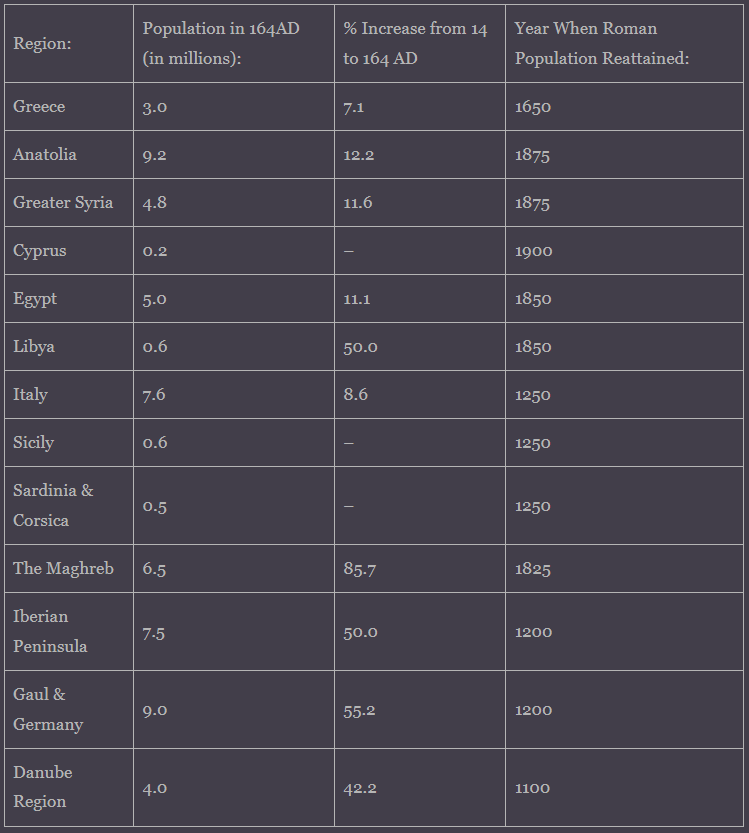
To give a sense of the scale of the decline, here is an abbreviated version of a chart from Bruce Friar’s “Demography” chapter in the second edition of the Cambridge Ancient History, which breaks down the estimated population of the Roman Empire by region and adds the dates when each of those regions got back to their Roman-era population:
Chart from Frier, “Demography” CAH2 XI (2000), 814. Some of these figures would likely see some revision today, mostly downward revisions of growth combined with upward revisions in population reflecting a somewhat (but generally not massively) higher estimated pre-Roman population.
Note that the decline in the East was, as noted last time, both later and generally slower. The reason for the later times to reattain Roman population here in many cases is that the major medieval Islamic population centers were further East (e.g. Baghdad under the Abbasids) placing them outside the traditional bounds of the Roman Empire, but also that the Roman East was much more urbanized and densely populated compared to its land area than the Roman West in the second century (or at any time during the Roman Period) so the “population to attain” bar on the East was much higher. After all, the cities of places like Syria or Egypt were in many cases centuries or even millennia old when the Romans showed up.Now the long times there to regain the Roman population can be a bit deceiving (and are very approximate). For reasons we’ll get into shortly, population growth from 600 to 900 or so in Europe was very low, so the issue here isn’t that the decline was so steep that it took many centuries to recover from, but rather that the decline was from a high population equilibrium to a low population equilibrium, both of which were, under their own conditions, stable (if that is confusing, don’t worry, we’ll delve more into it in a moment). Second, the apparent gap between places that “caught up” before 1300 and those that “caught up” after it is smaller than it looks, because of course the mid-1300s represent a massive population discontinuity over the entire broader Mediterranean world due to the Black Death such that a lot of those places “catching up” in the 1200s probably fell behind again due to the plague and then caught up again in the 1400s or early 1500s.
But this now raises two related questions: first, why did population decline so sharply and second, what was the impact on quality of life that resulted? The old answer to the first question was of course “the barbarians killed everyone” but as we’ve seen, while the fifth century was a violent time, the violent discontinuities were not that extreme. Surely the violence of the period has something to do with some of this declining population, but as noted, the underlying population (with their language and religion) didn’t much change (and the raw number of “barbarians” coming over the frontier was, in demographic terms, fairly small). Most of those Roman cities decayed, rather than being burned. But if the “barbarians” didn’t kill everyone, what did and why did that somehow have a negative impact on the survivors? The answers to these two questions are actually linked in that they depend on the same evidence, so that is where we will go next.
Bret Devereaux, “Collections: Rome: Decline and Fall? Part III: Things”, A Collection of Unmitigated Pedantry, 2022-02-11.
May 29, 2026
QotD: What is volley fire and what is it for?
Volley fire can cover for the slow reload rate of guns or crossbows in two ways. The first are volley fire drills designed to ensure a continuous curtain of fire; the most famous of these is the “counter-march”, a drill where arquebuses or muskets are deployed several ranks deep (as many as six). The front rank fires a volley (that is, they all fire together) and then rush to the back of their file to begin reloading, allowing the next rank to fire, and so on. By the time the last rank has fired, the whole formation has moved backwards slightly (thus “counter” march) and the first rank has finished reloading and is ready to fire. The problem this is solving is the danger of an enemy, especially cavalry, crossing the entire effective range of the weapon in the long gap between shots. This, by the by, was the volley fire tactic that was being used in China with crossbows before gunpowder; I don’t know that anyone ever did volley-and-charge with crossbows, which lack the lethality of muskets.
The other classic use is volley-and-charge. Because firearms are very lethal but slow to reload, it could be very effective to march in close order right up to an enemy, dump a single volley by the entire unit into them to cause mass casualties and confusion and then immediately charge with pikes or bayonets to try to capitalize on the enemy being demoralized and confused. You can see variations on this tactic in things like the 17th century Highland Charge or the contemporary Swedish Gå–På (“go on”). By charging rather than waiting to reload, the attacker could take advantage of the high lethality of firearms without suffering the drawback of long reload times.
Crucially, note that volley-and-charge works because it compresses a lot of lethality into a very short time, which I suspect is why we don’t see it with bows or crossbows (but do see it with javelins, which may have shorter range and far fewer projectiles, but seem to have had higher lethality per projectile). As we’re going to see in a moment, the lethality of bows or crossbows against armored, shielded infantry – even in close order – was pretty low at any given moment and needed to add up over an extended period of shooting. By contrast, muskets were powerful enough to defeat most armor and thus to disable or kill basically anyone they hit, limited of course by reload time: with a reload time of as much as 30 seconds for earlier matchlocks, a line of musketeers might only be able to fire a few times at an advancing infantry unit (which might take two or three minutes to walk through effective range) and given the limited accuracy of smoothbore muskets, only the last shots would hit at a high level. By contrast, a unit doing volley-and-charge is compressing probably close to 50% of the lethality of sustained shooting, devastating moment and then immediately charging.
Putting that much lethality into a singular instant was valuable from a morale perspective and of course it enabled a unit to quick march through the enemy’s effective range, stopping only briefly to fire and charge, limiting losses from steady enemy fire. But as we’re going to see, the lethality of bows (and, to a significant extent, crossbows) was much lower and so couldn’t be effectively compressed into that single, devastating, confusing moment.2
Bret Devereaux, “Collections: Why Archers Didn’t Volley Fire”, A Collection of Unmitigated Pedantry, 2005-05-02.
- On drill and in particular, counter-march volley fire with crossbows, see Andrade, The Gunpowder Age (2016), 149-160.
- It also didn’t generate a smokescreen to help with the final rushing charge, whereas a musket-and-bayonet unit might benefit significantly from firing and then charging through and out of its own obscuring smoke into a terrified and confused enemy.
May 23, 2026
QotD: Egypt within the Roman Empire
A lot of that comes from how Tacitus represents the structure of Roman rule in Egypt: he describes Augustus as having “kept in the [imperial] house” (retinere domi) the governance of Egypt, assigning it to an equestrian prefect. Egypt was a relatively late addition to Rome’s growing Empire; the Ptolemaic dynasty had ruled it since the death of Alexander the Great in 323. From the 160s that Ptolemaic kingdom had become effectively a client of Rome, its independence maintained by the threat of Roman arms (demonstrated vividly in 168 when Rome turned back a Seleucid invasion of Egypt with nothing more than a consultum of the Senate), but had remained independent until Cleopatra‘s disastrous decision to back Marcus Antonius (Mark Antony) in the last phase of Rome’s civil war. After their defeat, Octavian (soon to be Augustus) had in 30 BC after the suicide of Cleopatra, annexed the kingdom, creating the province of Roman Egypt.
Tacitus’ description of Augustus keeping the rule of Egypt “in the house” led early scholars to assume that Egypt was taken essentially as the private property of the emperors. This is less crazy than it initially sounds; later emperors administered massive estates through a parallel state treasury called the fiscus (distinct from the main treasury of the Roman state, the aerarium Saturni; the fiscus was the private accounts and property of the emperor) administered in some cases by equestrian officials, so the idea of running an entire province effectively out of the fiscus, with the whole of Egypt effectively the private property of the emperor administered by an equestrian official wouldn’t have seemed impossible and it certainly seems to be what Tacitus is describing.
But as our evidence for the activity of these prefects has improved, what we see are officials who act quite a lot like other provincial governors, despite their non-senatorial origins. Praefecti Aegpyti typically served around three years (fairly typical), where generally not from the province they oversaw (also typical), and wouldn’t be reassigned to a post back in that province (also typical). Unlike with the earlier Ptolemaic government, there was no royal court in Egypt, the prefect’s entourage more nearly resembling that of a Roman governor, nor was the emperor personally present. Residents of Egypt who wished to petition the emperor had to do it through the same channels as any other resident of the Roman Empire. The military enforcement forces in the province, too, were typically Roman, drawn (as was normal) from provinces other than where they served. Consequently, as Dominic Rathbone (op. cit.) notes, local elites looking to operate with this new form of government found that they had to adjust themselves to a system of rule, quintessentially Roman, rather than the more personalistic Ptolemaic regime where favor might be curried with important local figures or the royal court itself.
That said, while we’ve increasingly found that the Praefectus Aegypti was more of a normal governor than we thought, vision into the lower levels of the Roman administration in Egypt reveal a complex and in some cases peculiar system. In most of the Roman Empire, Roman governors oversaw largely self-governing communities, run by local elites, which handled most local affairs. Those communities generally delegated governing functions to elected or appointed magistrates who were amateur part-timers drawn from the elite (the curiales, we’ve mentioned these fellows before).
In Egypt, by contrast, while the Romans disassembled the royal Ptolemaic court, they initially seem to have left much of its administrative apparatus of salaries administrators in place. The division of Egypt into administrative districts – called nomes – was kept and the seat of government in the province was firmly entrenched in Alexandria (whereas at least in the first two centuries, most Roman provinces had no clearly established “capital”). Each of the nomes was governed by a strategos (while the word means “general” these were purely civilian officials), typically drawn from the Alexandrian upper-class (rather than being truly local elites), assisted by a salaried basilikos grammateus, “royal scribe”. Villages also generally had a komogrammateus, village scribe, who reported to the strategos; these fellows also seem to have initially been salaried officials. Some of these positions gradually became truly liturgic in nature, mirroring more closely systems of local governance in much of the rest of the Roman world, but perhaps only in the late second century.
Similarly, it was often assumed early on that land ownership and tenure would look very different with the emperor maintaining a lot of direct control and nearly all of the land in Egypt being effectively public land. That perspective was potentially reinforced by the evidence out of the Arsinoite nome (again, modern el-Fayyum) because most of the land there under the Ptolemies belonged to military settlers and thus had special obligations placed on it and was thus not truly private land. But what we see under the Romans is that first this military settler (cleruchic or katoikic; the distinctions here are a post for another day) land is fully privatized and taxed like it would be anywhere else. Meanwhile, the evidence from the other nomes on the Nile itself suggest that private land was more common there even under the Ptolemies. That said, the expansion of private land holdings seems to have been a process taking place mostly under Roman rule, which in turn meant that in many cases land tenure might look quite different in Egypt (where much land was either public or held by temples) than in the rest of the empire where most land was in private hands (although public and temple lands were also common), though it tended to look more and more like the rest of the empire over time, with the process supposed to be substantially complete by the end of the second century. Scholars broadly seem to still be very much divided on the degree to which late Ptolemaic and early Roman Egyptian landholding was exceptional, but it certainly had its substantial quirks.
Meanwhile the Romans did another odd thing in that they didn’t change: the currency system. While the Roman Empire minted its currency in a series of regional mints (not centrally), the Romans almost always brought new areas under their control into the existing Roman currency system (based principally around the gold aureus, the silver denarius and the copper-alloy sestertius). That was both a tool of Roman imperialism, a way to make physical Rome’s notional dominion over conquered lands, but it also served (probably unintentionally) to lower transaction costs and encourage economic interaction between provinces. But Egypt was not brought into the Roman currency system, instead maintaining the Ptolemaic currency system based on the silver tetradrachma (Egypt was already a very monetized economy under the Ptolemies). That barrier between the economy in Egypt and outside of it can make it tricky to know how representative prices within Roman Egypt were for the rest of the empire. Egypt is only brought into the broader Roman currency system with the currency “reforms” of Diocletian (r. 284-305).
At the same time, Egypt was hardly “cut off” from the broader Roman economy. We have good evidence of quite a lot of trade out of Egypt, particularly in agricultural staples. But here again, Egypt is strange: Egyptian grain was the foundation for the imperial era annona civilis, the distribution of free grain to select citizens in the city of Rome itself. That meant a massive, continuous state-organized transfer of grain, specifically wheat grain, from Egypt to Rome. Some of that grain was taxed in kind, but much of it seems to have been purchased in Egypt; in either case transport was essentially subcontracted by the state. Egypt was hardly the only source of grain for the annona (the province of Africa, modern Tunisia, was another major source), but few provinces likely saw the scale of state-organized goods transfer that Egypt did. And it’s striking that attested Egyptian agriculture is quite heavily dominated by wheat farming, rather more than we might normally expect, which both speak to the high yields the Nile could offer but also Egypt’s role as the breadbasket of the Roman Empire.
Bret Devereaux, “Collections: Why Roman Egypt Was Such a Strange Province”, A Collection of Unmitigated Pedantry, 2022-12-02.
May 17, 2026
QotD: Battlefield morale and cohesion in movies/games versus real history
Actual armies have far more than two states of morale and behaved in far more dynamic, unpredictable and interesting ways!
The first problem with this “binary model” of morale is that it assumes just a single factor (“leadership” or “morale”) but in practice we ought to be thinking about at least two different ingredients here: morale and cohesion.
Morale is the commitment the combatants have to their leadership and their cause. To simplify a bit, we might say that soldiers with good morale believe three things: that their cause is a worthy one, that they are on the road to success and that their leaders have a good (enough) plan to achieve final victory. Poor morale can result from a breakdown in any of those three elements: troops might for instance believe both in their goal and its eventual possibility but not in their leaders to produce it (this seems to have been the case, for instance, in the French Mutiny of 1917). On the other hand, regardless of the charisma of leaders, few people come to a war intending to die in it; if the cause appears impossible, morale will sink regardless. And armies that do not believe in the cause at all are extremely difficult to motivate by other means.
On the other hand cohesion is the force that holds a specific unit together through the power of the bonds holding the individual combatants to each other and/or to their (generally junior or non-commissioned) officers. There are a lot of ways to build that cohesion: people are generally unwilling to abandon neighbors, close friends and relatives, for one. They are also reluctant to expose themselves to shame at home for having done so; shame is one of the few things people fear as much, if not more than, death. For armies that can’t rely on that sort of organic cohesion, it can be built by reconstructing the soldier’s unit as his primary social group. Drill can do this: it creates an experience of shared suffering and achievement which bonds the soldiers together creating strong “artificial” cohesion.
These two ingredients have different roots, but they also function differently. The formulation that has always stuck with me is one from James McPherson’s For Cause and Comrades: Why Men Fought in the Civil War (1998): morale (McPherson discusses it under the heading of “the Cause”) will get men into uniform, it will sustain them on large marches and cold nights and it will get them to the battle, but it will not get them through the battle. Instead, cohesion (the “comrades” of the title) gets men through the terror of actual combat, when fear has driven “the cause” far from mind. But of course cohesion isn’t enough on its own either, since it provides no reason to advance or attack or really to do anything at all except stick together.
Adding further complication to this, morale and cohesion are not, as they often exist in games, inherent properties of a unit, but rather emergent properties of the interactions of a whole bunch of individuals. In a strategy game, units exist primarily as extension of the player’s will; in film units typically exist as extensions of their commander’s or the main character’s will (note how common it is that right as the hero begins winning his duel with the villain, so too his army begins winning the battle). But of course actual armies are composed of lots of humans, each with their own individual will and agency.
Those humans are continually making calculations about risks, goals and survival. It’s not hard here to see why, by the by, morale won’t carry troops through high risk conditions: if your only goal is to survive to experience the end-state of the war, then it is always in your interest to let someone else do the dying; it doesn’t serve your end to stay in a high risk position. By contrast, if you are held there by the fear of shame if your close comrades see you run, that still applies. Thus these calculations get progressively more “primal” as the sense of danger rises (fear makes a mess of those higher brain functions), but they do not stop.
Bret Devereaux, “Collections: Total Generalship: Commanding Pre-Modern Armies, Part IIIC: Morale and Cohesion”, A Collection of Unmitigated Pedantry, 2022-07-01.
May 11, 2026
QotD: The cultural importance of the church in early Medieval Europe
The very first thing to note is that the Church (in this case, both the Latin West and the Greek East) pre-dated the Middle Ages themselves. The Church arrived in the Middle Ages as relic of the Roman Imperial past. It inherited Roman Imperial organization – the diocese, for instance, derived from the boundaries of Roman super-provinces called dioceses (Greek: διοίκησις). Unlike the new medieval aristocracy, which tended to rule from fortified estates in the countryside, the Church remained centered in towns and cities, many of which had been major centers under the Romans. As the Roman provincial administration collapsed, it largely fell to the Church – as one of the few surviving literate institutions – to replace some of the core functions, like record keeping and the preservation of literature and learning. This was less true [in] Scandinavia and Eastern Europe, places where the Church was a relative late-comer, but for most of Western Europe, the Church was not some new institution grafted on to a pre-existing society (as it had been under the Romans), but rather part of the bedrock cultural foundation upon which that new society was constructed (fellow pedants! – please note carefully the phrase part of in the previous sentence; I am aware there were other things).
That said, the institutional power of the Church (and here we really do mean what would be the Roman Catholic Church) begins to change dramatically in the 11th century, right as we enter the High Middle Ages, and continues for the next several centuries (keeping in mind that Game of Thrones and A Song of Ice and Fire really evoke the High and Late Middle Ages, rather than the Early period). In short, the institutional heft of the Church grows dramatically. Quite a few things begin happening which are linked together: the Popes begin trying to wrest control over the Church’s hierarchy (specifically, the investiture of bishops) from secular rulers. Clerical celibacy was more stringently enforced. The Church intruded into warfare (as we’ve discussed with the Peace of God / Truce of God movements). It began to more directly attempt to regulate marriage, especially among the powerful (marriage was a made a sacrament in 1184). By the 1300s, this included keeping detailed records in many parts of France about births, deaths and marriages, in part to ensure no one married a close relative.
(And, of course, for those of you thinking, “wait, isn’t this also the period of the Crusades – military expeditions called by and at least nominally (but not in practice) under the auspices of the Pope?” Yes, it is, and that’s not an accident either).
In my experience teaching this, it is the next step that baffles my students the most. This vast increase in the institutional power of the Church was made possible, not by armies or shrewd real-politic (though both were involved), but by belief. The primary weapon wielded by Popes in this effort was the threat of excommunication, which (under Catholic doctrine) cut off the excommunicated individual or community from salvation, potentially damning them for all eternity. But of course that threat is only real if you believe the Pope has that power. And therein is the key point: most of Europe did believe. As I tell my students, it is safe to assume, as a general matter, that people in the past believed their own religion. Of course there are exceptions, but the general rule remains.
In the conflicts that arose – because, as you might imagine, secular rulers were unwilling to give up their prerogatives – it did not actually much matter if the king or emperor believed in the power of excommunication, because no one rules alone. Thus when the Holy Roman Emperor Henry IV was excommunicated by Pope Gregory VII in 1076, the audience for this act wasn’t Henry himself (who had already declared Gregory illegitimate anyway). It was directed at all of Henry’s vassals and supporters, releasing them from their oaths of allegiance and essentially saying, “stick with this guy, and he’ll take you to hell with him”. It worked, sparking a major rebellion and forcing Henry to humiliatingly apologize the following year.
(History note: this would be “round 1” in a multi-round fight that wasn’t settled until 1122 with the Concordat of Worms; in the end the Papacy mostly won, sharply limiting the Holy Roman Emperors’ power over their bishops).
Bret Devereaux, “New Acquisitions: How It Wasn’t: Game of Thrones and the Middle Ages, Part II”, A Collection of Unmitigated Pedantry, 2019-06-04.
May 5, 2026
QotD: Why China never adopted war elephants
Trautmann (2015) finds the solution in land-use patterns: China had simply converted so much of its pasture and forest to crop-land, in a densely settled city-and-agriculture land-use pattern that incorporating large numbers of elephants was not just prohibitive, but also culturally foreign. And there’s something to this, though I don’t buy it completely. Absolutely, Chinese land-use patterns would make elephants a lot more expensive to maintain than in India or even Rome. Highly productive farmland would likely have to be turned over to elephant pasture. That said, Chinese rulers had embraced the chariot and cavalry, so such things could be done, if the military or political calculus made them worth doing. But they weren’t done.
Instead, I tend to think that the same basic calculus that applied for Rome applies neatly for China – elephants fare poorly in societies with access to large numbers of disciplined infantrymen who can be trained in anti-elephant tactics. And this was certainly true of China, which had disciplined infantry to spare. Also, Han armies seem to have relied on close integration of missile weapons and polearms, meaning that they had the same sort of integrated light infantry support that the legion of the Roman Republic did. Later Chinese armies, as Trautmann briefly notes, had no problem defeating elephants in battle.
As with Rome, in China, elephants seem to have been a military solution looking for a problem to solve – and never found it. For one Chinese dynasty after another, the major military threats were either peer competitors (during periods of political fragmentation) whose disciplined infantry armies were no more vulnerable to elephants than Rome’s, or else steppe nomads. Given the tremendous logistical difficulties of operating even small armies out on the open steppe, attempting to take war elephants there would have been the height of stupidity. Elephants weren’t going to stop the Mongols – to be fair, not much stopped the Mongols (we’ll get into India, Mughals and elephants next time).
Bret Devereaux, “Collections: War Elephants, Part II: Elephants against Wolves”, A Collection of Unmitigated Pedantry, 2019-08-02.
April 29, 2026
QotD: The battlefield role of the general in pre-modern battles
So instead of assessing a battle plan – which they cannot observe – soldiers tend to assess battle commanders. And they are going to assess commanders not against abstract first principles (nor can they just check their character sheet to see how many “stars” they have next to “command”), but against their idea of what a “good general” looks like. And that idea is – as we’re about to demonstrate – going to be pretty dependent on their culture because different cultures import very different assumptions about war. As I noted back in the Helm’s Deep series, “an American general who slaughtered a goat in front of his army before battle would not reassure his men; a Greek general who failed to do so might well panic them.” An extreme example to be sure, but not an absurd one. In essence then, a general who does the things his culture expects from him is effectively performing leadership as we’ve defined it above.
But the inverse of this expectation held by the soldiers is that generals are not generally free to command however they’d like, even if they wanted to (though of course most generals are going to have the same culturally embedded sense of what good generalship is as their soldiers). Precisely because a general knows his soldiers are watching him for signs that he is their idea of a “good general”, the general is under pressure to perform generalship, whatever that may look like in this cultural context. That is going to be particularly true because almost all of the common models of generalship demand that the general be conspicuous, be available to be seen and observed by his soldiers. As a result, cultural ideals are going to heavily constrain what the general can do on the battlefield, especially if they demand that the general engage personally in combat.
Different sorts of generals
We can actually get a sense of a good part of the range simply by detailing the different expectations for generalship in ancient Greek, Macedonian and Roman societies and how they evolved (which has the added benefit of sticking within my area of expertise!).
On one end, we have what we might call the “warrior-hero general”. This is, for instance, the style of leadership that shows up in Homer (particularly in the Iliad), but this model is common more broadly. For Homer, the leaders were among the promachoi – “fore-fighters”, who fought in the front ranks or even beyond them, skirmishing with the enemy in the space between their formations (which makes more sense, spatially, if you imagine Homeric armies mostly engaging in longer range missile exchanges in pitched battle like many “first system” armies).
The idea here is not (as with the heroes of Homer) that the warrior-hero general simply defeats the army on his own, but rather that he is motivating his soldiers by his own conspicuous bravery, “leading by example”. This kind of leadership, of course, isn’t limited to just Homer; you may recall Bertran de Born praising it as well:
And I am as well pleased by a lord
when he is first in the attack,
armed, upon his horse, unafraid,
so he makes his men take heart
by his own brave lordliness.On the opposite end of the spectrum, there is the pure “general as commander” ideal, where the commanding general (who may have subordinates, of course, who may even in later armies have “general” in the name of their rank) is expected to stay well clear of the actual fighting and instead be a coordinating figure. This style […] is fairly rare in the pre-gunpowder era, but becomes common afterwards. Because in this model the general’s role is seen primarily in terms of coordinating various independently maneuvering elements of an army; a general that is “stuck in” personally cannot do this effectively. And it may seem strange, but violating these norms with excessive bravery can provoke a negative response in the army; confederate general Robert E. Lee attempted to advance with an attack by the Texas Brigade at the Battle of the Wilderness (May 6, 1864) only to have his own soldiers refuse to advance until he retired to a more protected position. Of course this sort of pure coordination model is common in tactical video games which only infrequently put the player-as-general on the battlefield (or even if the “general” of the army is represented on the battlefield, the survival of that figure is in no way connected to the player’s ability to coordinate the army).
In practice, pre-modern (which is to say, pre-gunpowder) generals almost never adopt this pure coordination model of generalship. The issue here is that effective control of a gunpowder army both demands and allows for a lot more coordination. Because units are not in melee contact, engagements are less decisive (units advance, receive fire, break, fall back and then often reform to advance again; by contrast a formation defeated in a shock engagement tends not to reform because it is chased by the troops that defeated it), giving more space for units to maneuver in substantially longer battles. Moreover, units under fire can maneuver, whereas units in shock generally cannot, which is to say that a formation receiving musket or artillery fire can still be controlled and moved about the field, but a unit receiving sword strikes is largely beyond effective command except for “retreat!”
In between these two extremes sits variations on what Wheeler terms a “battle manager”, which is a bit more complex and we’ll return to it in a moment.
What I want to note here is that these expectations are going to impact where the general is on the battlefield and thus what he can do to exert command. A general in a culture which expects its leaders to be at the front leading the army has the advantage of being seen by at least some of his soldiers (indeed that is the point – they need to see him performing heroic leadership), but once engaged, he cannot go anywhere or command anyone. This is also true, by the by, in cultures where the general is expected to be on foot to show that they share in the difficulties and dangers of the infantry; this is fairly rare but for much of the Archaic and Classical periods, this was expected of Greek generals. Even if a general on foot isn’t in combat directly, their ability to see or move about the battlefield is going to be extremely limited.
On the flipside, a general who is following the “commander” ideal is likely to be in the rear, perhaps in an elevated position for observation. The obvious limitation here is that such a commander is going to struggle to display leadership because no one can see them (everyone is facing towards the enemy, after all). But that also impacts their ability to command – no one is looking at them so if they want to change their plans on the fly they need to send word somehow to subordinate officers who are with or in front of the battle line who can then use their visibility to communicate those orders to the troops.
Bret Devereaux, “Collections: Total Generalship: Commanding Pre-Modern Armies, Part II: Commands”, A Collection of Unmitigated Pedantry, 2022-06-03.
April 23, 2026
QotD: The problems of a “no first use” nuclear weapons policy
For the United States during the Cold War, the problem with declaring a “no first use” policy was the worry that it would essentially serve as a “green light” for conventional Soviet military action in Europe. Recall, after all, that the Soviet military was stronger in conventional forces in Europe during the Cold War and that episodes like the Berlin Blockade (and resultant Berlin Airlift) seemed to confirm Soviet interest in expanding their control over central Europe. At the same time, the Soviet use of military force to crush the Hungarian Revolution (1956) and the Prague Spring (1968) continued to reaffirm that the USSR had no intention of letting Central or Eastern Europe choose their own fates – this was an empire that ruled by domination and intended to expand if it could.
The solution to blocking that expansion was NATO, the North Atlantic Treaty Organization. Not because NATO collectively could defeat the USSR in a conventional war – the general assumption was that they probably couldn’t – but because NATO’s article 5 clause pledging mutual defense essentially meant that the nuclear powers of NATO (Britain, the United States, and France) pledged to defend the territory of all NATO members with nuclear weapons. But just like deterrence, mutual defense alliances are based on the perception that all members will defend each other. Declaring that the United States wouldn’t use nuclear weapons first would essentially be telling the Germans, “we’ll fight for you, but we won’t use our most powerful weapons for you” in the event of a conventional war; it would be creating a giant unacceptable asterisk next to that mutual defense clause.
So the United States had to be committed to at least the possibility that it would respond to a conventional military assault on West Germany with nuclear retaliation (often envisaged as a “tactical” use of nuclear weapons – that is, using smaller nuclear weapons against enemy military formations. That said, even in the 1950s, Bernard Brodie was already warning that restraining the escalation to general use of nuclear weapons once a tactical nuclear weapon was used would be practically impossible).
Bret Devereaux, “Collections: Nuclear Deterrence 101”, A Collection of Unmitigated Pedantry, 2022-03-11.
April 17, 2026
QotD: The decline of cities in the late western Roman Empire
This was the world the Romans knew and the world they were most comfortable governing. Consequently, while the Romans were utterly uninterested in “civilizing” anyone, when they conquered areas which weren’t urbanized, they tended to found cities or encourage local urbanization in order to create the administrative structures through which the Romans could extract revenue most efficiently.
As mentioned above, the Romans generally wanted these cities to be mostly self-governing. While at conquest, the Romans found themselves managing a bewildering array of different styles of local urban government, over time a mix of Roman administrative preference and cultural diffusion tended to produce a fairly similar set of civic institutions. City governments, which also administered their rural countryside, were run by a town council which consisted of the wealthiest notables of the town – the curiales – in much the same way that the Roman upper-class had dominated the running of the city during the Republic. Roman authority generally protected the curiales and their wealth from the sorts of popular uprisings that tempered many Greek oligarchies in the classical period and in return the curiales managed the population and the collection of taxes for the Romans.
The curiales both managed the town affairs and were also expected to use their own wealth to fund public activity and works: maintain temples and baths, fund religious rituals and festivals, and so on. Through the first and second century, that process was mostly responsible for providing the cities of the Roman Empire with the impressive collection of often still-visible public works they boasted: baths, theaters, amphitheaters, aqueducts, temples, courthouses, public spaces and so on. While some of these structures were little more than the public posturing of the elites, many of them were open to the general public and will have represented, in as much as anything before the industrial revolution could, meaningful improvements in the lives of regular people.
While most of the wealth of any of these cities was derived from the rents and taxes extracted from their agricultural hinterlands, these cities also substantially lived off of trade and markets. Because the local city typically housed the local market, they were the obvious point for local products to enter the stream of provincial-wide or empire-wide trade or for distant imports to reach their final customers. We’ll come back to this next time when we discuss trade and the economy, but for now I want to note that this trade provided a fair bit of the economic vitality of these cities but also that it did in fact reach down beyond mere luxury goods into the basic staples that even the relatively poor might buy.
The decline and fall of these Roman cities is most extensively described in J.H.W.G. Liebeschuetz’ aptly titled, Decline and Fall of the Roman City (2001). Given his title, as you might imagine, Liebeschuetz is in the “decline and fall” camp, arguing that the classical city which defined the Roman world largely did not survive it. Regional patterns differ, with Liebescheutz identifying three “patterns”: I) Western and Central Anatolia, II) Syria, Palestine and Arabia, III) the west, including North Africa).
We’ll deal with the situation in the east in just a moment, so let’s focus here on the cities of the west, which were at the start generally smaller, less wealthy and generally far younger than those of the east (with some exceptions in Italy). Decline sets in fastest and is most severe in Britain, with the final collapse of the cities coming as early as the 360s, whereas in North Africa, the classical city doesn’t seem to tip into decline until after 400.
While each individual region and indeed each city will have been subject to its own unique conditions, a few basic causes seem to have been active everywhere to some degree. First, the crisis of the third century seems to have fundamentally disrupted empire-wide Roman trade, which then stabilized at a lower level for the fourth century, before declining precipitously in the fifth. That first decline seems to have been somewhat offset by the increased demands of imperial administration and in particular the centralized taxation in-kind and movement of goods which had to move through cities. Peter Brown describes the late Roman state as, “the crude but vigorous pump which had ensured the circulation of goods in an otherwise primitive economy” (The Rise of Western Christendom, 2nd ed., 13). We’ll return to this when we discuss the shape of the economy next time, but for now it works as a crude, but vigorous description of that facet of the late Roman economy.
At the same time, as Liebescheutz describes, the role of the curiales steadily atrophies in the fourth century. On the one hand, much of the authority and power of being on the council was steadily eroded as those functions were pulled upwards into the imperial bureaucracy. At the same time, members of the curial class who sought imperial office could get immunities from the progressively more severe taxation which otherwise often fell on the curiales and so the imperial elite often crowded out the curiales when it came to wealth and prestige in the community. As they lost both control and responsibility for their cities, the curiales‘ investment in public works and monumental architecture also ceased (though local elites do invest in church-building and monastic foundations), leading to the decay of the physical urban centers.
Finally, the warfare of the fifth century had its impact, though as Liebescheutz notes, it cannot be presented as a sole cause simply because many urban areas were already clearly in decline when conflict hit. In the case of Britain, the cities were gone by 420, decades before the arrival of any invaders. Nevertheless, political instability and violence in the fifth century seems to have delivered death-blows to ailing communities, especially in the Balkans and along the Rhine.
The end result was that in the West, urbanism declined severely between the fourth and sixth centuries. Rome, once a city of a million people, collapsed down to a population of just 80,000. Arles, which had been a thriving Roman city with an amphitheater, an aqueduct, a chariot-racing track, a theater and full city walls shrunk so severely that the remains of the city moved inside its amphitheater, repurposing it as a new set of city walls, with the town square in the middle and houses built in the stands. While many towns survived in their new, shrunken and impoverished form, urbanism in Europe outside of the Eastern Roman Empire would largely have to be reinvented during the High Middle Ages, (though with some key institutional survivals from the Roman era and often rising out of the diminished remains of Roman cities). Instead, the society of the early Middle Ages was overwhelmingly rural in both population and focus. If on politics we have a bit of a mix between decline and continuity, when it comes to the cities that made up the old political system, the “decline and fall” knight strikes a clear blow: the system of social organization that characterized the ancient world practically vanished and would have to be redeveloped centuries later. The institutions that had maintained it (like the curiales) largely vanished, replaced in some cases by local “notables” and in other cases by ruralization.
Bret Devereaux, “Collections: Rome: Decline and Fall? Part II: Institutions”, A Collection of Unmitigated Pedantry, 2022-01-28.


