
When asked about Machiavelli’s reputation, people use terms like “amoral”, “cynical”, “unethical”, or “unprincipled”. But this is incorrect. Machiavelli did believe in moral virtues, just not Christian or Humanistic ones.
What did he actually believe?
In 1953, the British philosopher Isaiah Berlin delivered a lecture titled “The Originality of Machiavelli”.
Berlin began by posing a simple question: Why has Machiavelli unsettled so many people over the years?
Machiavelli believed that the Italy of his day was both materially and morally weak. He saw vice, corruption, weakness, and, as Berlin says, “lives unworthy of human beings”. It’s worth noting here that around the time that Machiavelli died in 1527, the Age of Exploration was just kicking off, and adventurers from Italy and elsewhere in Europe were in the process of transforming the world. Even the shrewdest individuals aren’t always the best judges of their own time.
So what did Machiavelli want? He wanted a strong and glorious society. Something akin to Athens at its height, or Sparta, or the kingdoms of David and Solomon. But really, Machiavelli’s ideal was the Roman Republic.
To build a good state, a well-governed state, men require “inner moral strength, magnanimity, vigour, vitality, generosity, loyalty, above all public spirit, civic sense, dedication to security, power, glory”.
According to Machiavelli, these are the Roman virtues.
In contrast, the ideals of Christianity are “charity, mercy, sacrifice, love of God, forgiveness of enemies, contempt for the goods of this world, faith in the hereafter”.
Machiavelli wrote that one must choose between Roman and Christian virtues. If you choose Christianity, you are selecting a moral framework that is not favorable to building and preserving a strong state.
Machiavelli does not say that humility, compassion, and kindness are bad or unimportant. He actually agrees that they are, in fact, good and righteous virtues. He simply says that if you adhere to them, then you will be overrun by more unscrupulous men.
In some instances, Machiavelli would say, rulers may have to commit war crimes in order to ensure the survival of their state. As one Machiavelli translator has put it: “Men cannot afford justice in any sense that transcends their own preservation”.
From Berlin’s lecture:
If you object to the political methods recommended because they seem to you morally detestable … Machiavelli has no answer, no argument … But you must not make yourself responsible for the lives of others or expect good fortune; you must expect to be ignored or destroyed.
In a famous passage, Machiavelli writes that Christianity has made men “weak”, easy prey to “wicked men”, since they “think more about enduring their injuries than about avenging them”. He compares Christianity (or Humanism) unfavorably with Paganism, which made men more “ferocious”.
“One can save one’s soul,” writes Berlin, “or one can found or maintain or service a great and glorious state; but not always both at once.”
Again, Machiavelli’s tone is descriptive. He is not making claims about how things should be, but rather how things are. Although it is clear what his preference is.
He writes that Christian virtues are “praiseworthy”. And that it is right to praise them. But he says they are dead ends when it comes to statecraft.
Machiavelli wrote:
Any man who under all conditions insists on making it his business to be good, will surely be destroyed among so many who are not good. Hence a prince … must acquire the power to be not good, and understand when to use it and when not to use it, in accord with necessity.
To create a strong state, one cannot hold delusions about human nature:
Everything that occurs in the world, in every epoch, has something that corresponds to it in the ancient times. The reason is that these things were done by men, who have and have always had the same passions.
Rob Henderson, “The Machiavellian Maze”, Rob Henderson’s Newsletter, 2023-12-09.
March 12, 2024
QotD: Isaiah Berlin on Niccolò Machiavelli
February 24, 2024
Feeding Napoleon – Chicken Marengo
Tasting History with Max Miller
Published Nov 21, 2023
(more…)
February 19, 2024
QotD: Cleopatra VII Philopator
Cleopatra, of course, has all of that reception layered on too. In antiquity and indeed until the modern era, she was one of the great villains of history, the licentious, wicked foreign queen of Octavian’s propaganda. More recently there has been an effort to reinvent her as an icon of modern values, perhaps most visible lately in Netflix’ recent (quite poorly received) documentary series. A lot of both efforts rely on reading into gaps in the source material. What I want to do here instead is to try to strip some of that away, to de-mystify Cleopatra and set out some of what we know and what we don’t know about her, with particular reference to the question I find most interesting: was Cleopatra actually a good or capable ruler?
Now a lot of the debate sparked by that Netflix series focused on what I find the rather uninteresting (but quite complicated) question of Cleopatra’s heritage or parentage or – heaven help us – her “race”. But I want to address this problem too, not because I care about the result but because I am deeply bothered by how confidently the result gets asserted by all sides and how swiftly those confident assertions are mobilized into categories that just aren’t very meaningful for understanding Cleopatra. To be frank, Cleopatra’s heritage should be a niche question debated in the pages of the Journal of Juristic Papyrology by scholars squinting at inscriptions and papyri, looking to make minor alterations in the prosopography of the Ptolemaic dynasty, both because it is highly technical and uncertain, but also because it isn’t an issue of central importance. So we’ll get that out of the way first in this essay and then get to my main point, which is this:
Cleopatra was, I’d argue, at best a mediocre ruler, whose ambitious and self-interested gambles mostly failed, to the ruin of herself and her kingdom. This is not to say Cleopatra was a weak or ineffective person; she was very obviously highly intelligent, learned, a virtuoso linguist, and a famously effective speaker. But one can be all of those things and not be a wise or skillful ruler, and I tend to view Cleopatra in that light.
Now I want to note the spirit in which I offer this essay. This is not a take-down of the Netflix Queen Cleopatra documentary (though it well deserves one and has received several; it is quite bad) nor a take-down of other scholars’ work on Cleopatra. This is simply my “take” on her reign. There’s enough we don’t know or barely know that another scholar, viewing from another angle, might well come away with a different conclusion, viewing Cleopatra in a more positive light. This is, to a degree, a response to some of the more recent public hagiography on Cleopatra, which I think air-brushes her failures and sometimes tries a bit too hard to read virtues into gaps in the evidence. But they are generally gaps in the evidence and in a situation where we are all to a degree making informed guesses, I am hardly going to trash someone who makes a perfectly plausible but somewhat differently informed guess. In history there are often situations where there is no right answer – meaning no answer we know to be true – but many wrong answers – answers we know to be false. I don’t claim to have the right answer, but I am frustrated by seeing so many very certain wrong answers floating around the public.
Before we dive in briefly to the boring question of Cleopatra’s parentage before the much more interesting question of her conduct as a ruler, we need to be clear about the difficult nature of the sources for Cleopatra and her reign. Fundamentally we may divide these sources into two groups: there are inscriptions, coins and papyrus records from Egypt which mention Cleopatra (and one she wrote on!) but, as such evidence is wont to be, [they] are often incomplete or provided only limited information. And then there are the literary sources, which are uniformly without exception hostile to Cleopatra. And I mean extremely hostile to Cleopatra, filled with wrath and invective. At no point, anywhere in the literary sources does Cleopatra get within a country mile of a fair shake and I am saying that as someone who thinks she wasn’t very good at her job.
The problem here is that Cleopatra was the target of Octavian’s PR campaign, as it were, in the run up to his war with Marcus Antonius (Marc Antony; I’m going to call him Marcus Antonius here), because as a foreign queen – an intersecting triad of concepts (foreignness, monarchy and women in power) which all offended Roman sensibilities – she was effectively the perfect target for a campaign aimed at winning over the populace of Italy, which was, it turns out, the most valuable military resource in the Mediterranean.3 That picture – the foreign queen corrupting the morals of good Romans with her decadence – rightly or wrongly ends up coloring all of the subsequent accounts. Of course that in turn effects the reliability of all of our literary sources and thus we must tread carefully.
Bret Devereaux, “Collections: On the Reign of Cleopatra”, A Collection of Unmitigated Pedantry, 2023-05-26.
1. Or even just the seventh!
2. This is not to diminish the value of reception studies that trace the meaning a figure – or the memory of a figure – had over time. That’s a valuable but different lens of study.
3. It’s not all Octavian, mind. Cicero’s impression of Cleopatra was also sharply negative, for many of the same reasons: Cicero was hardly likely to be affable to a foreign queen who was an ally of Julius Caesar.
February 2, 2024
The Sad Story of Churchill’s Iceman, Geoffrey Pyke
World War Two
Published Jan 31, 2024Geoffrey Pyke is remembered as an eccentric scientist who spewed out ideas like giant aircraft carriers made of icy Pykerete. But there was much more to him than that. He was a spy, a special operations mastermind, and his novel ideas contributed to the success of D-Day.
(more…)
J.M. Browning Harmonica Rifle
Forgotten Weapons
Published Sep 6, 2015Have you heard of Jonathan Browning, gunsmith and inventor? Among his other accomplishments, he is credited with designing the harmonica rifle in the US — and we have an example of one of his hand-made guns here to look at today (made in 1853). Browning was a Mormon, and spent several years slowly moving west periodically setting up gunsmithing shops before he reached his final destination of Ogden, Utah. There he settled down for good, and had 22 children with his 3 wives. One of those children also showed an aptitude for gunsmithing, and formally apprenticed to his father. You might recognize his name …
January 27, 2024
QotD: McCarthy was right
Yet McCarthy was right – not just in a general sense of clearly understanding that communism is not merely an alternative path to a brighter future but an evil and inhuman ideology at war with the liberal, democratic and Christian West, but also in focusing on the federal bureaucracy’s strangely ineffectual response to the presence in its ranks of many people, often in very senior and influential positions, suspected of working for the communist cause.
Contrary to the official version, it was never McCarthy’s role to unmask Red agents; a job more appropriately done by investigative agencies. In his legislative role overseeing federal bureaucracies, he made it his mission to inquire why so many individuals, whose loyalty has already been put under the question mark by numerous internal and external investigations, had no problems staying in sensitive jobs for years and moving unhindered from one agency to another. Those named by McCarthy (on the Democrat insistence) were not simply some random individuals with vaguely progressive sympathies; already at the time many of them have been identified as Soviet agents and security risks in the testimony of communist renegades (like Whitaker Chambers and Elizabeth Bentley) or through secret FBI surveillance. Others were suspects on the account of their associations with Eastern European or local communists and causes.
Over the following decades, most have been further incriminated from a variety of sources, including Soviet defectors and the deciphered Venona transcripts of secret Soviet intelligence cables, which mention some 400 individuals in the 1940s and 50s United States as active agents and contacts or abettors and helpers. The problem was not Reds under the beds, but Reds quite literally in positions of access to highly valued classified information or positions of influence over the shape of US policy, from the White House, through the State Department, to a host of other departments and agencies. All this is now beyond any dispute, but these weren’t mere idle speculations at the time either. Lauchlin Currie, Owen Lattimore, Harry Dexter White, Nathan Silvermaster, T.A. Bisson and dozens and dozens of others did conspire in small groups and networks to pass on classified information to the Soviets or steer the American foreign policy into the direction favourable to the communists (particularly in China during and after the war). And yet, despite all having serious question marks over them, they were allowed to work in government for years undisturbed. It was not because of some giant communist conspiracy at the highest levels of government but because of the bureaucratic inertia, old boys’ networks and the organisational reluctance to admit problems – but also because communist agents within protected and promoted each other. Time and time again mistakes got buried instead of rectified. McCarthy dared to shed the public spotlight on the continuing outrage and ask why. It was like a poor country cousin being invited to a formal dinner by his big city relatives and dropping a loud fart between the entree and the main.
But the story of McCarthy goes beyond these well-established historical facts to the campaign of character assassination and falsification of the record that succeeded beyond anyone’s wildest dreams. There is truly nothing new under the sun when the entrenched liberal establishment wants to protect its turf and fend off its enemies and as you read what McCarthy has been subjected to in relatively short period of 1950-54 you will no doubt experience a sense of deja vu from recent history: indiscriminate mud throwing in a hope that something sticks; blatant lies, misrepresentations and misinterpretations of evidence; politicians working hand in hand with public servants to coordinate the attacks; destroying and withholding of information and evidence (for example, the security information about the suspected individuals being physically transferred from the State Department to the Truman White House so that it could not be subpoenaed or otherwise accessed; a practice condemned by the Republicans and then continued by the Eisenhower White House); blackmailing witnesses or preventing them from testifying; biased media running the narrative (fake news is nothing new); whitewashing the accused and discrediting the accusers; incessant lawfare; trumped up charges and defamation. Coincidentally, McCarthy too was compared to Hitler while at the same time being accused of helping Russians. McCarthyism is not what McCarthy has done to his supposed victims; it’s what the left has done to him. It’s what it keeps doing to people who get in the way and threaten to disturb the business as usual.
Arthur Chrenkoff, “Before there was Trump, there was Joe McCarthy”, Daily Chrenk, 2019-09-30.
January 24, 2024
The father of the “Green Revolution”
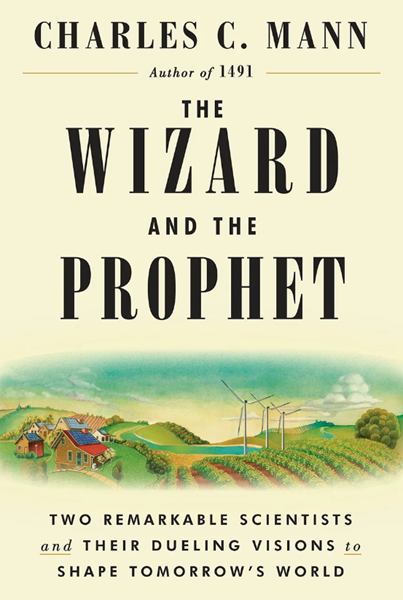
In the latest review at Mr. and Mrs. Psmith’s Bookshelf, Jane Psmith reviews The Wizard and the Prophet by Charles C. Mann:
Norman Borlaug is generally estimated to have saved the lives of about a billion people who would otherwise have starved to death.
Yet despite all this — and Borlaug’s is a great story, which Charles Mann tells better and in far more detail than I do above — his book isn’t really a biography of Borlaug or of its other framing figure, early environmentalist William Vogt.1 Rather, it’s a compellingly-written and frankly fascinating overview of various environmental issues facing humanity, and of two different sorts of approaches one can take to addressing them. Mann opens by introducing the two men, but as soon as he’s done that they function mostly as symbols, examples and stand-ins, for these two schools of thought about the world and its problems.
Borlaug is the Wizard of the title, the avatar of techno-optimism: with hard work and clever application of scientific knowledge, we can innovate our way out of our problems. Vogt is the Prophet, the advocate of caution: he points to our limitations, all the things we don’t know and the complex systems we shouldn’t disturb, warning that our constraints are inescapable — but also, quietly, that they are in some sense good.
It’s not hard to identify the Wizards all around us. Inventors and innovators, transhumanists and e/acc, self-driving cars and self-healing concrete … every new device or technique for solving some human problem — insulin pumps! heck, synthetic insulin at all! — is a Wizardly project.
It’s a little more difficult to pin down what exactly the Prophets believe, in part because they spend so much time criticizing Wizardly schemes as dangerous or impractical that it’s easy to take them for small-souled enemies of human achievement.2 That isn’t fair, though — there’s a there there, a holistic vision of the world as an integral organic unity that we disturb at our peril, because the constraints are inextricably linked to the good stuff.
If that seems too abstract, here’s an example. Imagine for a moment (or maybe you don’t have to imagine) that you have a friend who subsists entirely on Soylent. It’s faster and easier than cooking, he says, and cheaper than eating out. He’s getting all his caloric needs met. And he’s freed up so much time for everything else! Now, anyone might express concern for his physical health: does Soylent actually have the right balance of macronutrients to nourish him? Is he missing some important vitamins or other micronutrients that a normal diet might provide? Is the lack of chewing going to make his jaw muscles atrophy? And those are all reasonable concerns about your friend’s plan, but they all have possible Wizardly solutions. (A multivitamin and some gum would be a start.)
If you’re a Prophet sort, on the other hand, you’re probably going to start talking about everything else your friend is missing out on. There’s the taste of food, for one, but also the pleasures of color and texture and scent, the connection to the natural world, the role of community and tradition in shared meals, the way cooking focuses thought and attention on incarnate reality. You might throw around words like “lame” and “artificial” and “sterile” and “inhuman”. Your friend’s Soylent-only plan assumes that the whole point of food is to consume an appropriate number of calories as quickly and easily as possible, hopefully in a way that doesn’t meaningfully degrade his health, but a Prophet rejects his premise entirely. Instead, a Prophet argues that your friend’s food “problem” is actually part of the richly textured beauty of Creation. Yes, feeding yourself and your loved ones delicious, healthful, and economical meals takes time and effort, but that’s simply part of being human.5 You should consider that a challenge to be met rather than a threat to be avoided.
Unfortunately, Mann does the Prophets a disservice by choosing William Vogt as their exemplar. Yes, he was an important figure in the history of the modern environmental movement. Yes, he wrote a very influential book.4 And yes, his careful attention to the integrity of the ecosystems he studied was quintessentially Prophet. But he saw human beings mostly as disruptions to the integrity of those ecosystems, and pretty much every one of his specific predictions — not to mention the predictions of his many followers, most famously Paul Erlich in The Population Bomb5 — have simply failed to come true. Compared to Borlaug’s obvious successes, Vogt’s dire warnings that humanity will soon exhaust the Earth’s capacity and doom ourselves to extinction (unless we abort and contracept our way there first; his second act was as director of Planned Parenthood) seem laughable. Reading about his life can leave you with the impression that Prophets are just people who are more worried about a spotted owl than a starving child, and frankly who cares what those people think?
1. They were roughly contemporaries, but this is emphatically not the story of a pair of rivals; they encountered each other in person only once, in passing, after which Vogt wrote an angry letter to the Rockefeller Foundation demanding they cease Borlaug’s Mexican project at once.
2. And, to be fair, a lot of the language and arguments pioneered by Prophets does get employed by a sclerotic managerial class opposed to anything they can’t fit neatly into their systems and processes and domain-agnostic expertise. But more on that later.
3. Incidentally, this is more or less the argument between the Wizards and the Prophets when it comes to soil. Wizards are delighted with the Haber-Bosch process and artificial fertilizers; Prophets decry the “NPK mentality” that sees the soil as a passive reservoir of chemicals and instead laud composting, manure, and other techniques that encourage the complex interactions between soil organisms, plant roots, and the physical characteristics of humus. This is the origin of the fad for “organic”, a label that doesn’t mean much when applied to industrial-scale food production and is often more trouble than it’s worth for small-time farmers and ranchers. Still, Mann’s story of the movement’s birth is interesting.
4. You’ve probably never heard of it, but it was influential!
5. Apparently out of print! Good.
January 21, 2024
The Duke of Wellington, perhaps best known as the inventor of the Wellington boot …
Weaver Sheridan expresses some surprise that His Grace’s main source of fame is the credit for the invention of the Wellington, rather than his other, uninteresting achievements:
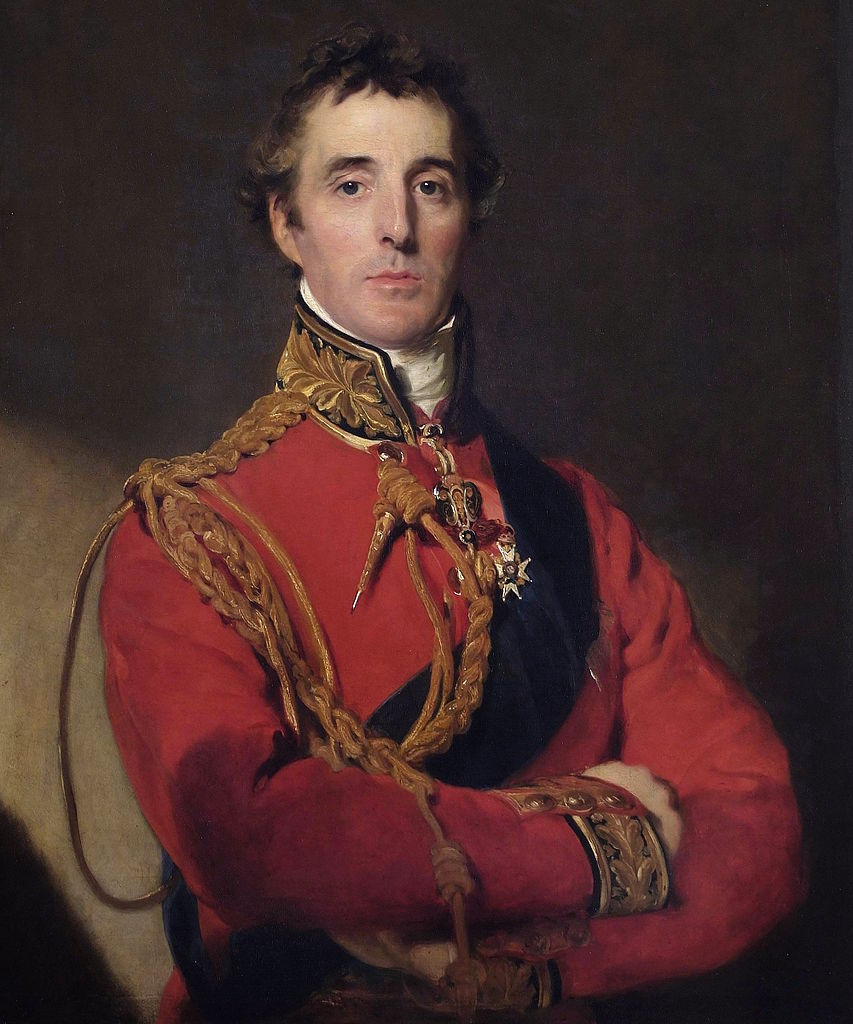
Arthur Wellesley, 1st Duke of Wellington (1769–1852) by Thomas Lawrence, circa 1815-1816.
Wikimedia Commons.
I know nothing should surprise us these days about dumbed-down Britain. But an article on the moronic Mail Online website the other day had me choking on my cornflakes.
It read: “In 2020, Mandy Lieu, 38, bought 935-acre Ewhurst Park in Hampshire, once owned by the inventor of the wellington boot, the Duke of Wellington, and vowed to turn it into a world-class organic farm and nature reserve.”
The inventor of the wellington boot!
Good grief, I know teaching of British history is nowadays outrageously skewed and bowdlerised, but I didn’t realise things had got this bad.
The article’s author obviously thinks the Iron Duke’s main claim to fame was the welly. Does she know nothing about him being a soldier and statesman, victor of the Peninsular War, victor of Waterloo, nemesis of Napoleon, twice Prime Minister? Or is the wellington boot reference made simply to get equally thick readers to relate to the story? Who cares about fusty old battles and boring politics? It is all so yesterday, isn’t it? But everyone knows what wellies are, don’t they?
To anyone with a modicum of interest in this country’s past, such ignorance is deeply depressing, to say the least. But I suppose it could be worse. Think what would happen if some Mail Online know-nothing hack was able to interview other historical figures …
“Sir Winston Churchill, tell us how you came up with the idea of a nodding bulldog to promote your insurance company.”
“Napoleon, having invented a popular type of brandy, was it perhaps rather egotistical to name it after yourself?”
“Pablo Picasso, as a car designer you must be thrilled to see your Citroën Grand C4 Picasso being crowned “Best Used MPV” in the Auto Express Used Car Awards 2023.”
January 10, 2024
The problem of engaging with “the great classical works”
The first book review for 2024 at Mr. and Mrs. Psmith’s Bookshelf is a look at Xenophon’s Education of Cyrus by John Psmith:
It is easier, given his nature, for a human being to rule all the other kinds of animals than to rule human beings. But when we reflected that there was Cyrus, a Persian, who acquired very many people, very many cities, and very many nations, all obedient to himself, we were thus compelled to change our mind to the view that ruling human beings does not belong among those tasks that are impossible … We know that Cyrus, at any rate, was willingly obeyed by some, even though they were distant from him by a journey of many days; by others, distant by a journey even of months; by others, who had never yet seen him; and by others, who knew quite well that they would never see him. Nevertheless, they were willing to submit to him.
I am not well-read in the classics. My excuse ultimately boils down to the same argument that all the classicists give for why you should be well-read in the classics: reading a book that has been widely admired for a very long time isn’t just reading a book, it’s entering into a “great conversation” taking place across the aeons. I feel awkward reading a book like that without knowing something about the commentaries on the book, all the people it has influenced, all the people who influenced it, the commentaries on the commentaries, and so on. It’s exhausting and overwhelming, and when I ignore all that and plunge ahead, I often don’t enjoy the book and then I feel dumb. A “great conversation” sounds nice, but only if you’re one of the participants and you actually get the inside jokes and references. Otherwise it’s as alienating and isolating as showing up to a party where you don’t know anybody, and where everybody else has already been chatting for a few thousand years.
I don’t remember who recommended Xenophon’s Cyropaedia to me or how it wound up on my reading list, but when it finally made its way to the top of my stack, I saw it and shuddered. How could I possibly appreciate this semi-fictionalized biography of the founder of the Persian Empire without first being familiar with Xenophon’s work as a mercenary for one of Cyrus the Great’s distant descendants? Or with all the ways he was riffing on and responding to the political philosophy of his frenemy Socrates? Or with the complicated politics of the Peloponnesian War, and the way that Xenophon, an Athenian exile and the original Sparta-boo, was actually writing PR for King Agesilaus II, but concealing it within a story about the exotic Persians?1 Or with how this book led to the creation of an entire major genre of books in the Middle Ages? Or with the most famous and subversive instance of that genre, Machiavelli’s The Prince, and with all the hundreds of subsequent works reacting and responding to that one?
You see the problem? One could very easily conclude that it would be impossible for me to appreciate this book. Fortunately, I ignored all that and read it anyway. No doubt I missed all kinds of subtle layers of meaning and nuance, but even read on a totally superficial level by an ignoramus, this book rocks.
The title has the word “education” in it, but the book covers Cyrus’s entire life and reign, and only the first section concerns his education in the literal sense. That first section is very important to what comes next, though, so I’m going to dwell on it a bit. Cyrus, along with the other Persian boys of his social class, is being trained to lead. And so their education is centered around having lots of opportunities to judge, instruct, and coerce others; but also opportunities to serve and obey. If you’re old enough, you might remember when the education of the American leadership class worked this way too, but even those of you who are younger have seen vestiges of it in the bizarrely disproportionate weight given to extracurriculars in US college admissions.
1. If you’re an American, then you’re already familiar with this trick. Most of our debates about the virtues and vices of other nations are just thinly-veiled attempts to “own” domestic political opponents.
January 7, 2024
Evelyn Waugh’s horrible family
In the latest SHuSH newsletter, Ken Whyte explains why Evelyn Waugh drank:
Happy New Year! How were your holidays? Were you as festive as undergraduate Evelyn Waugh kicking off his Christmas break in 1924?
Then I went to Oxford. Drove to 31 St Aldates where I found an enormous orgy in progress. Billy and I unearthed a strap and whipped Tony. Everyone was hideously drunk except, strangely enough, myself. After a quiet day in cinemas, I had a dinner party of Claude, Elmley, Terence, Roger Hollis and a poor drunk called MacGregor. I arrived quite blind after a great number of cocktails at the George with Claude. Eventually the dinner broke up and Claude, Rogers Hollis and I went off for a pub crawl which after sundry indecorous adventures ended up at the Hypocrites where another blind was going on. Poor Mr McGregor turned up after having lain with a woman but almost immediately fell backwards downstairs. I think he was killed. Next day I drank all morning from pub to pub and invited to lunch with me at the New Reform John Sutro, Roger Hollis, Claude and Alfred Duggan. I ate no lunch but drank solidly and was soon in the middle of a bitter quarrel with the President — a preposterous person called Cotts — who expelled me from the club. Alfred and I then drank double brandies until I could not walk. He carried me to Worcester where I fell out of the window then relapsed into unconsciousness punctuated with severe but well directed vomitings. On Wednesday I lunched with Robert Byran at the New Reform and the man Cotts tried to throw me out again. Next day I lunched with Hugh and drank with him all the afternoon and sallied out with him fighting drunk at tea time when we drank at the New Reform till dinner… Next day, feeling deathly ill, I returned to London having spent two months’ wages. I had to dine with Alex, Richard Greene, Julia Strachey … and then back to Richard’s home for a drink. …
[…]
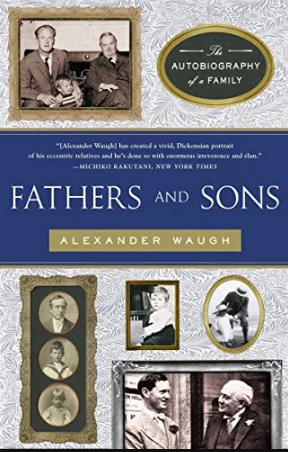
I picked up Alexander Waugh’s Fathers and Sons: The Autobiography of a Family (2004), several weeks ago. I’ve been enjoying it so much that I’m rationing it, reading about ten pages at a time to make it last.
Alexander Waugh is a music writer and biographer, former opera critic at the Evening Standard, son of novelist and Private Eye diarist Auberon Waugh, grandson of the aforementioned Evelyn, the titan of English letters whose brother, Alec, and father, Arthur, were also reasonably famous writers. The book is about the interpersonal relations of these three generations of men who produced about 180 books among them. And it’s wild. These are hugely and incorrigibly flawed people. Often horrible to one another (also to outsiders but they save their best for kin). They are in equal parts perverse and hilarious, and often brilliant, especially Evelyn. I can’t believe people ever behaved this way.
Undergraduates have never required reasons to binge drink, but you can’t read the opening chapters of Fathers and Sons without thinking Evelyn had special motivation. He was the second son of Arthur. His older brother, Alec, was “the firstling”, the “future head of the family”, their parents’ “darling lamb”, and mom and pop didn’t care who knew it, least of all Evelyn.
Arthur and his missus, Kate, had an “unbounded fascination for Alec”, who won all his school honours and was star of the cricket team. Arthur considered the boy a literal gift from God and believed that they could communicate telepathically. He would write him notes like: “I simply go about thinking of your love for me all the time”. Their relationship, writes Alexander, was “hot, clammy and compulsive”, and to the “objective eye their behavior might have resembled a pair of star-crossed teenage lovers”. Indeed, it was romantic in all but the physical sense — Arthur saved his sexual depredations for girls of tender age with whom he played “tickling games” (he also had a fetish involving young women and bicycles).
In addition to being second born, Evelyn made the mistake of being male. His parents had wanted a daughter; they consoled themselves by giving him an effeminate name and dressing him in bonnets and frills long beyond the standard of the day. He was said to be a “warm, bright. sweet-natured and affectionate child”, at least until an awareness of the family dynamic dawned. In Edwardian terms, he was treated as a bastard child by his legitimate parents. His possessions were hand-me-downs. He attended the less expensive school. When eleven-year-old Evelyn asked for a bicycle, his parents bought a bigger and better one for Alec. When Alec asked for a billiard table, space was found for it in Evelyn’s room. Despite winning prizes and becoming head of his house in school, and president of the debating society, and editor of the school magazine, Evelyn remained an afterthought and something of a nuisance in the minds of his Alec-obsessed parents.
Evelyn responded to his circumstances in a clever and self-protective fashion, defining himself against his brother and father. By adolescence, he had an inkling that he was smarter and funnier than both. They could keep their mawkish outpourings of emotion toward one another; he would be hard of head and sharp of tongue. By his early teen years, he was confiding to his diary that Arthur was a fat and “ineffably silly” Victorian sentimentalist. He considered both Alec and Arthur philistines. “Terrible man, my father”, Evelyn said to a schoolmaster. “He likes Kipling.”
To the extent that his parents thought about Evelyn, they were disturbed by his dark moods and lassitude, and intimidated by his cynical wit. Both Alec and Arthur were threatened by Evelyn as a potential literary rival. When Evelyn, in what was becoming a typical act of rebellion, ran up an expensive restaurant tab and had it sent to an outraged Arthur, Alec said: “You know father, if Evelyn turns out to be a genius, you and I might be made to look very foolish by making a fuss over ten pounds, seventeen and ninepence.”
So you can perhaps see how young Evelyn Waugh developed an enthusiasm for drink remarkable even in an undergrad, and why the rare characters killed in gruesome fashion in his fiction tended to be fathers.
January 1, 2024
Michael Palin’s Great-Uncle Harry
In The Critic, Peter Caddick-Adams reviews Michael Palin’s Great-Uncle Harry:
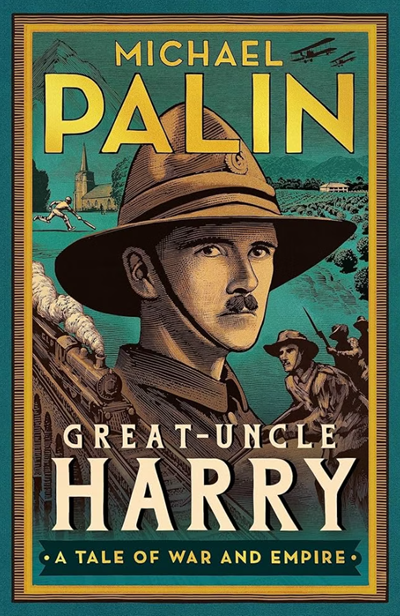
The first of last week’s volumes nestling on my desk, with its immediately identifiable Ripping Yarns cover illustration, was Sir Michael Palin’s story of his forebear, Great Uncle Harry, who travelled the world but disappeared on the Somme. Here, I felt an immediate connection, not least because Michael, I and his Great Uncle Harry Palin had hauled ourselves through the same academy of learning, Shrewsbury School, though at different times. There are plenty of 1914-18 memoirs and tributes around, but this is one of the best. The further the Great War (as it used to be called) recedes, the more we seem to need to torture ourselves with the staggering sacrifices it involved. I read my copy over Remembrance weekend, which made it doubly poignant.
In Great Uncle Harry, Palin’s gift is to give us the hinterland of his ancestor. Many First World War authors, here I could mention the great Lyn Macdonald, Richard Holmes and Martin Middlebrook, all of whom I place on pedestals, provide us with erudite studies, laced with gripping eyewitness accounts. I find myself doing the same with 1939-45, but of necessity there is no room to give the brave and the damned a back story. They are parachuted into the text. They fight and live or die and exit stage left. It is refreshing, therefore, to hold the hand of a first war warrior from birth unto death. Palin was lucky his Great Uncle Harry kept a series of notebooks and diaries of his time in khaki, and was able to research his globe-trotting years before battle. Our man was brought up in Herefordshire, and after school drifted out to British India. He had two stints, first working as a railway manager and latterly as overseer on tea plantations. The reader is fortunate that Palin the documentary-maker filmed in both environments and is able to look over his forebear’s shoulder and summon up the Edwardian social standards of the day, with its solar topees and chota pegs (sunset whiskeys), its heat and its dust. Palin the younger’s many diaries and written travelogues, of which I find New Europe (2007) the best, are equally good.
But Great Uncle Harry Palin was restless. The youngest and most headstrong of seven, he flounced out of each of his two jobs serving the Raj, and ended up trying his hand at farming in New Zealand. There he seemed more settled, but not quite. The Palin under the microscope, notes his great nephew, was one of the first to volunteer for war service with the 12th (Nelson) Regiment, a South Island infantry outfit, in August 1914 and sailed with them overseas, initially to Egypt. There they were absorbed into the Canterbury Battalion, and deployed to Gallipoli, from which Great Uncle Harry emerged without a scratch.
Gallipoli is a conjurer’s name. Now known by the Turks as their Gelibolu Peninsula, overlooking the ancient Hellespont (today’s Dardanelles Strait), its southern tip lies 200 miles from what was then Turkey’s capital, Constantinople, officially Istanbul after 1930. Only since the 1990s has this strategically significant sliver of land, across the Dardanelles from ancient Troy, and guarding entry to the Bosphorus and Black Sea, been opened up for tourists. The 1915 operation was dreamt up by Winston Churchill to break the stalemate of the Western Front. He advocated a naval advance on Constantinople, as a way of knocking the Austro-German alliance out of the war. Such a stratagem would then have offered Paris and London the ability to supply the troops of Tsar Nicholas the Last with modern arms and munitions to prevail against the Central Powers.
Instead of breaking the Western Front, Gallipoli broke Churchill. It was a campaign endlessly refought in the inter-war years, which generally concluded that amphibious warfare had no future, though Lieutenant Colonel George S. Patton in his 1936 General Staff study, The Defense of Gallipoli, found it fascinating. It was one reason why the allies had no maritime landing capability in 1939-40, to Britain’s detriment at Dunkirk, and later Germany’s disadvantage when planning a seaborne assault against southern England. Valuable lessons of what to do, and not to do, had to be relearned before D-Day in 1944 could be a success. My own assessment is right idea, wrong commanders. Gallipoli might have offered the success Churchill desired, but was executed poorly.
The original plan had been to overwhelm Constantinople with battleships, and there is evidence that the Turks were preparing to surrender. However, the Franco-British war fleet encountered German-supplied Krupp cannon along both shores of the Dardanelles and a minefield in the middle, and suffered catastrophic losses. A land campaign was then initiated to clear the Turkish land-based defences. This should have been foreseen and a simultaneous, rather than sequential, maritime-land attack might well have delivered the goods.
Instead, the few Turkish defenders on Gallipoli could see a landing was imminent, called in reinforcements and dug trenches ferociously. On the peninsula, amidst scrub, trench and memorials lie scattered British, Commonwealth, Ottoman and French (yes, they were there too) cemeteries, hinting at stirring tales of derring-do. Last time I was there, I encountered not only rifle cartridges, pieces of pottery rum jars, and shell cases, but human bones. My guide observed, “Probably wild pigs dislodging the topsoil. It happens all the time.” An indication of the 300,000 Allied and 255,000 Turkish killed, wounded and missing in a campaign where illness often took as many as combat wounds. Along the western coast, amidst shards of amphorae from pre-history, lie many wrecks associated with the 1915 campaign in crystal-clear water. It remains high on my recommended battlefields to visit.
December 31, 2023
Justinian I
In The Critic, George Woudhuysen reviews Justinian: Emperor, Soldier, Saint, by Peter Sarris:
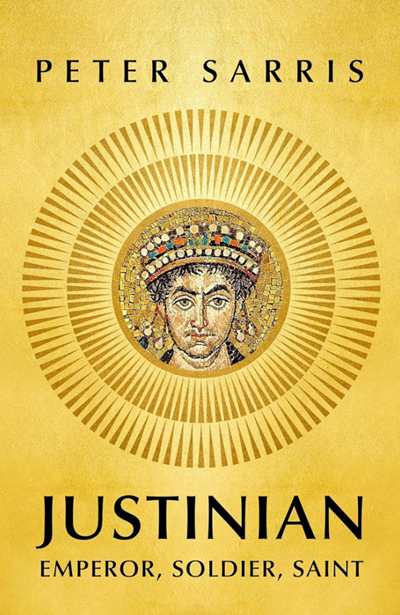
The emperor Justinian did not sleep. So concerned was he for the welfare of his empire, so unremitting was the tide of business, so deep was his need for control that there simply was not time for rest. All this he explained to his subjects in the laws that poured forth constantly from his government — as many as five in a single day; long, complex and involved texts in which the emperor took a close personal interest.
The pace of work for those who served Justinian must have been punishing, and it is perhaps unsurprising that he found few admirers amongst his civil servants. They traded dark hints about the hidden wellsprings of the emperor’s energy. One who had been with him late at night swore that as the emperor paced up and down, his head had seemed to vanish from his body. Another was convinced that Justinian’s face had become a mass of shapeless flesh, devoid of features. That was no human emperor in the palace on the banks of the Bosphorus, but a demon in purple and gold.
There is something uncanny about the story of Justinian, ruler of the eastern Roman Empire from 527 to 565. Born into rural poverty in the Balkans in the late 5th century, he came to prominence through the influence of his uncle Justin. A country boy made good as a guards officer, he became emperor almost by accident in 518. Justinian soon became the mainstay of the new regime and, when Justin died in 527, he was his obvious and preordained successor. The new emperor immediately showed his characteristically frenetic pace of activity, working in consort with his wife Theodora, a former actress of controversial reputation but real ability.
A flurry of diplomatic and military action put the empire’s neighbours on notice, whilst at home there was a barrage of reforming legislation. More ambitious than this, the emperor set out to codify not only the vast mass of Roman law, but also the hitherto utterly untamed opinions of Roman jurists — endeavours completed in implausibly little time that still undergird the legal systems of much of the world.
All the while, Justinian worked ceaselessly to bring unity to a Church fissured by deep theological divisions. After getting the best of Persia — Rome’s great rival — in a limited war on the eastern frontier, Justinian shrewdly signed an “endless peace” with the Sasanian emperor Khusro II in 532. The price — gold, in quantity — was steep, but worthwhile because it freed up resources and attention for more profitable ventures elsewhere.
In that same year, what was either a bout of serious urban disorder that became an attempted coup, or an attempted coup that led to rioting, came within an ace of overthrowing Justinian and levelled much of Constantinople. Other emperors might have been somewhat put off their stride, but not Justinian. The reform programme was intensified, with a severe crackdown on corruption and a wholesale attempt to rewire the machinery of government.
Constantinople was rebuilt on a grander scale, the church of Hagia Sophia being the most spectacular addition, a building that seems still to almost defy the laws of physics. At the same time, Justinian dispatched armies to recover regions lost to barbarian rulers as the western Roman Empire collapsed in the course of the 5th century. In brilliant and daring campaigns, the great general Belisarius conquered first the Vandal kingdom in North Africa (533–34) and then the much more formidable Ostrogothic realm in Italy (535–40), with armies that must have seemed almost insultingly small to the defeated.
If Justinian had had the good fortune to die in 540, he would have been remembered as the greatest of all Rome’s many emperors. Unfortunately for him, he lived. The 540s was a low, depressing decade for the Roman Empire. Khusro broke the endless peace, and a Persian army sacked the city of Antioch. The swift victories in the west collapsed into difficult wars of pacification, which at points the Romans seemed destined to lose.
December 27, 2023
The never-settled “Pétain question”
Theodore Dalrymple reviews a new book on the trial of Marshal Pétain after the liberation of France in WW2:
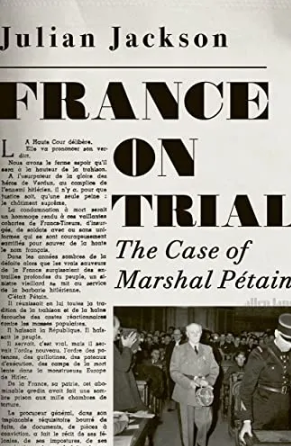
François Mauriac, the left-leaning, Nobel Prize–winning, Catholic novelist, said of the trial of Marshal Pétain that it would never be over: a sentiment more or less echoed by General de Gaulle. And certainly, the figure of Pétain continues to divide opinion in France, at least among those with opinions on such matters. Was he a traitor to France, or its savior, or perhaps something in between the two?
Professor Julian Jackson has written a superb book about Pétain’s trial, its circumstances, and its aftermath. I would like to say that I read it in one sitting, but it was too long for that; but I looked forward impatiently to picking it up again, all else being but a regrettable interruption.
The continued salience of what might be called the “Pétain question” is illustrated by the fact that one of the candidates in the last French presidential election, Éric Zemmour, claimed that Pétain was the savior of the French Jews. This was all the more startling because Zemmour himself is Jewish (his parents emigrated from Algeria to France not long before independence), and because, if Pétain is exonerated in the matter of the deportation of seventy-five thousand Jews during the war to Germany, there to be murdered, his reputation is all but saved: for it is in this matter that his record is most excoriated.
As Jackson reminds us, this was not always so. In the immediate post-war period, and during his trial for treason, the fate of the Jews of France was not much emphasized. According to Éric Conan and Henry Rousso, in their book Vichy, un passé qui ne passe pas (Vichy, a past that does not pass), the Jews of France themselves were not anxious that their treatment by Vichy should be emphasized, for they had had more than enough of being treated as a population apart. They wanted their suffering to be subsumed under that of the nation as a whole, and it was only later, by the subsequent generation, that the deportation assumed its great historiographical importance. It is not that nothing about the deportation was known before, it was merely that less emphasis was placed on it. There is an analogy with the historiography of the Soviet Union. Solzhenitsyn revealed nothing that was not, or could not have been, known before, with all its human and moral significance; the difference was that the world was now ready or willing to believe it.
But what of Zemmour’s claim, which is precisely that which Pétain’s defenders, when they are not outright anti-Semites, make on the Marshal’s behalf? It is certainly true that a far higher percentage of French Jews survived than, say, of Belgian or Dutch Jews (the figures are seventy-five, fifty, and twenty-five percent, respectively). But how much of the difference was attributable to the alleged relative decency, and cunning, of Vichy and its marshal?
Allow me a personal anecdote. Above my mother-in-law’s flat in Paris lived an old Jewish lady whose brother had been deported on the last convoy of Jews from Paris before the end of the occupation. She, however, had been saved by having been sent out of Paris to the care of nuns, who disguised her identity. Hence, she survived.
One day my mother-in-law was traveling on a bus and started to talk to an old lady next to her, who asked her where she lived. She gave the street, then the number, then the number of the flat, whereupon the lady next to her, who was Jewish, burst into tears. This was the very flat in which she had been hidden by family friends during the four years of the occupation, being careful never to appear at the window because opposite was the German Kommandantur, formerly and afterwards a police station. Four years of claustrophobic terror during adolescence: it was like something from a novel by Patrick Modiano.
The survival of these two old ladies owed nothing to Vichy or Marshal Pétain, but this does not settle the historical question. What percentage of the survivors owed their survival to the bravery of individuals, and what to policy decisions? We shall probably never know with any certainty. If one compares the survival rates of France and the Netherlands, what part did the relative geographies of the two countries play? France is much larger and less densely populated, and has many landscapes more conducive to concealment than the Netherlands.
Again, what of the pétainiste claim, repeated by Zemmour, that Vichy sacrificed Jews of non-French origin in order to save those of French origin? The former, however, were more conspicuous, with much smaller networks of potential defenders, than the latter. This might explain the large difference in the survival rates between the French-born and foreign-born Jews, an explanation which would hardly redound to the regime’s credit.
December 25, 2023
QotD: Washington Irving and American Christmas traditions
An even larger number may be unaware of how much they’re honoring Mr Irving in their Christmas jubilations. He it was who, in the 1812 edition of his History of New York, threw in a whimsical vignette in which St Nicholas flies over the treetops in a wagon while puffing on his pipe. No reindeer, but all the other elements of the American Santa are there.
Washington Irving loved the great village revelries of the old English Christmas, which the Puritans had left far behind them when they landed at Plimouth Plantation. The parlor games and community feasting and the notion of the Saviour’s birth as a cause of merriment all appealed to him. In his famous and bestselling Sketch Book of 1819-1820 five chapters are devoted to lovingly detailed scenes from an English family Christmas as observed by a young visitor, and they proved so popular that half-a-century later (by which time almost all the elements had been imported into American life) they were published as a stand-alone book.
Mark Steyn, “Dangling Hares and Rosy-Cheeked Schoolboys”, SteynOnline, 2021-12-20.
December 20, 2023
Eat Like a Medieval Nun – Hildegard of Bingen’s Cookies of Joy
Tasting History with Max Miller
Published 5 Sept 2023
(more…)


