It is hard to say to what degree Sparta ever really pursued this goal. Several Spartan leaders – kings like Cleomenes I, the regent Pausanias, Agesilaus II, along with men like Lysander – once on campaign outside Sparta seemed to have envisaged a much wider sphere of Spartan control over Greece and worked to achieve it. At the same time, the ever cautious Gerousia (along with the Ephors) almost always worked to restrain and eventually destroy such men. This should remind us that no state – not even Sparta – is really a unitary entity with one set of goals held by everyone; within the state there is a complex set of competing interests. For the Spartan kings and influential commanders, success outside of Sparta was an alluring way to potentially build power outside of the systems which restricted them within Sparta; for the Gerousia and the Ephors – who were that system – success abroad was a threat to stability at home.
Given Sparta’s inherent resources, the goal was not unrealistic: Sparta was by land area, if not by population, the largest polis in Greece. But Spartan hegemony lasted less than a decade, primarily because of the ineptness of Spartan diplomacy. While victory over Athens in 404 BC made Sparta the preeminent Greek state, the mistakes started almost immediately: the occupation/collaboration government (the “Thirty Tyrants”) in Athens was so cruel and unpopular that Sparta was forced to acquiesce to its removal after just eight months. Meanwhile, Spartan imperiousness – including a refusal to share the spoils of victory, as well as military activity against little Elis and big Persia unsanctioned by the Peloponnesian League – turned Sparta’s allies against them. Sparta’s efforts to restore their alliance militarily led to the Corinthian War in 395, which would prove that while Sparta was still strong, it was not strong enough to enforce its alliances by force of arms. If any of the Spartans ever aimed for hegemony or preeminence among the Greeks, it is safe to say they failed.
Bret Devereaux, “Collections: This. Isn’t. Sparta. Part VII: Spartan Ends”, A Collection of Unmitigated Pedantry, 2019-09-27.
November 16, 2022
QotD: Did Sparta actually aspire to supremacy in Greece?
November 1, 2022
QotD: Spartan strategy during the Persian wars
The hammer Sparta has, of course, is hoplite battle. Sparta seeks to solve almost all of its issues by applying a hoplite phalanx to the problem, regardless of if the problem can be solved by a hoplite phalanx. Spartan strategic thinking is thus marred by both a failure to consider military solutions that did not consist of traditional hoplite battles, as well as an inability to consider or execute non-military solutions at all.
We can see the former weakness in Spartan planning in the Persian Wars. Spartan planning is both direct and unrealistic: find a choke-point, fortify it and hold it indefinately with a hoplite army. Attempted at Thermopylae this plan fails; the Battle of Thermopylae is often represented in popular culture as an intentional delaying action, but it was nothing of the sort – Herodotus is clear that this was supposed to be the decisive land engagement (Hdt. 7.175; Cf. Diodorus 11.4.1-5). The Spartans then attempt to recreate this plan at the Isthmus of Corinth and have to be rescued from their strategic stupidity by the Athenians, who threaten to leave the alliance if the plan isn’t abandoned (Hdt. 8.49-62). A blockade at the Isthmus would be easy for the Persian army to bypass – assuming it didn’t simply defeat it with generally superior Persian siegecraft – and worse yet was a diplomatic disaster given that it meant essentially writing Athens off as a loss, when the Athenian navy provided the bulk of the ships protecting the Isthmus.
Bret Devereaux, “Collections: This. Isn’t. Sparta. Part VII: Spartan Ends”, A Collection of Unmitigated Pedantry, 2019-09-27.
October 15, 2022
QotD: Spartan strategic and diplomatic blunders during and after the Peloponnesian War
It takes Sparta years of fighting Athens to finally recognize this – an effort in 413/2 to support revolts from Athens is pathetically slow and under-funded (Thuc. 8, basically all of it) and it isn’t until Sparta not only allies with Persia but entrusts its fleet to the mothax Lysander that they seriously set about a strategy of cutting Athens’ naval supply lines. This isn’t a one-time affair: Sparta’s inability to coordinate ends and means shows up again in the Corinthian war (e.g. in Argos, Xen. Hell. 4.7), where they are pulled into a debilitating defensive stalemate because the Corinthians won’t come out and fight and the Spartans have no other answers.
This is compounded by the fact that the Spartans are awful at diplomacy. Sparta could be the lynch-pin of a decent alliance of cities when the outside threat was obvious and severe – as in the case of the Persian wars, or the expansion of Athenian hegemony. But otherwise, Sparta consistently and repeatedly alienates allies to its own peril. Spartan leadership at the end of the Persian wars had been so arrogant and hamfisted that leadership of the anti-Persian alliance passed to Athens (creating what would become the Athenian Empire, so Spartan diplomatic incompetence led directly to the titanic conflict of the late fifth century). And to be clear, Athenian diplomacy does not score high marks either, but it is still a far sight better than the Spartans (Greek diplomacy, in general was awful – rude, arrogant and focused on compulsion rather than suasion – so it is telling that the Spartans are very bad at it, even by Greek standards).
In 461, Spartan arrogance towards an Athenian military expedition sent to help Sparta against a helot revolt utterly discredited the pro-Sparta political voices at Athens and in turn set the two states on a collision course. Sparta had ejected the friendly army so roughly that it had created an outrage in Athens.
During the Peloponnesian War, Spartan diplomatic miscalculations repeatedly hurt their cause, as with the destruction of Plataea – the symbol of Greek resistence to Persia. Later on in the war, terrible Spartan diplomacy repeatedly derails efforts to work with the Persian satrap Tissaphernes, who has the money and resources Sparta needs to defeat Athens; it is the decidedly un-Spartan actions first of Alcibiades (then being a traitor to Athens) and later Lysander who rescue the alliance. After the end of the Peloponnesian War, Sparta promptly alienated its key allies, ending up at war first with Corinth (the Corinthian War (394-386) and then with Thebes (378-371), both of which had been stalwarts of Sparta’s anti-Athenian efforts (Corinth was itself a member of the Peloponnesian League). This led directly to the loss of Messenia and the breaking of Spartan power.
In short, whenever Sparta was confronted with a problem – superior enemy forces, maritime enemies, fortified enemy positions, the need to keep alliances together, financial demands – any problem which could not be solved by frontal attack with hoplites, the traditional Spartan leadership alienated friends and flailed uselessly. Often the Spartans attempted – as with Corinth and later Thebes – to compel friendship with hoplite armies, which worked exactly as poorly as you might imagine.
It is hard not to see both the strategic inflexibility of Sparta and the arrogant diplomatic incompetence of the spartiates as a direct consequence of the agoge‘s rigid system of indoctrination. Young Spartiates, after all, were taught that anyone with a craft was to be despised and that anyone who had to work was lesser than they – is it any surprise that they disdained the sort of warfare and statecraft that depended on such men? The agoge – as we are told – enforced its rules with copious violence and was designed to create and encourage strict, violent hierarchies to encourage obedience. It can be no surprise that men indoctrinated in such a system – and thus liable to attempt to use its methods abroad – made poor diplomats and strategic thinkers abroad.
Bret Devereaux, “Collections: This. Isn’t. Sparta. Part VII: Spartan Ends”, A Collection of Unmitigated Pedantry, 2019-09-27.
September 25, 2022
QotD: Sparta’s military reputation as “the best warriors in all of Greece”
That reputation could be a real military advantage. Greek hoplite armies arranged themselves right-to-left according to the status of each polis‘ army (poleis almost always fight in alliances). Since Sparta was always the leader of its alliance, the Spartan king and his force always took the right – opposite the weakest part of the enemy army. You may easily imagine the men facing the Spartans – they know the Spartan reputation for skill (and do not have the advantage of me telling them it is mostly hogwash) and by virtue of where they are standing know that they do not have the same reputation. Frequently, such match-ups resulted in the other side running away before the Spartans even got into spear’s reach (e.g. Thuc 5.72.4).
There’s a story in Xenophon, embedded in the larger Battle of Lechaeum, which I think illustrates the point well. Early on, the Argives (the men of Argos, always the enemy of Sparta) meet and rout a group of Sicyonians (who are allies of Sparta). A passing Spartan cavalry company under a Pasimachus sees this and rushes in; getting off their horses, they grab the Sicyon shields (marked with the city’s sigma) and advance against the Argives. But whereas later in the battle the arrival of the Spartans will trigger panic and retreat, here the Argives do not know they are fighting Spartans (because of the shields) – and so they advance with confidence; Pausimachus with his small force is crushed. As he attacks Pausimachus declared (according to Xenophon), “By the two gods, Argives, these Sigmas will deceive you” (Xen. Hell. 4.4.10; the “two gods” or “twin gods” here are Castor and Pollux).
I rather think that Pausimachus was deceived by the lambda his own shield may have carried (there is debate about if Spartan shields always had the lambda device, I tend to think they did not). Pausimachus expected to surprise the Argives with his Spartan skill. Instead, he found out – fatally – that the magic was never in the Spartan, it was in the image of Sparta that lived in the mind of his opponent.
Bret Devereaux, “Collections: This. Isn’t. Sparta. Part VI: Spartan Battle”, A Collection of Unmitigated Pedantry, 2019-09-20.
August 21, 2022
History Summarized: The Acropolis
Overly Sarcastic Productions
Published 29 Apr 2022They say of the Acropolis, where the Parthenon is …
(more…)
August 11, 2022
QotD: Logistical limits to Spartan military action against Athens
During the first phase of the Peloponnesian War, called the Archidamean war, after the Spartan king who conducted it, Sparta invaded Attica functionally every year in an effort to inflict enough agricultural devastation that the Athenians would be forced to come out and fight […] The core problem is that it just isn’t possible to do a meaningful amount of damage in the short campaigning season before the army has to go home.
And I want to be clear just how long they bang their head against this rock. The Spartans invade in 431, besiege a minor town, accomplish nothing and leave (Thuc. 2.18-20), and in 430 (Thuc. 2.47), in 429, because of a plague in Athens, they instead besiege tiny Plataea (Thuc. 2.71ff) and then leave, but in 428 they’re back at it in Attica (Thuc. 3.1), and in 427 (Thuc. 3.26), and in 426 but turn back early due to earthquakes (Thuc. 3.89). But they’re back again in 425 (Thuc. 4.2), leaving each time when supplies run out. Sparta mounts no attack in 424 because Athenian naval raiding forces them to keep the army at home (Thuc. 4.57); in 423 they have a year-long truce with Athens (Thuc. 4.117). They only finally suggest the creation of a permanent base in Attica in 422/1 (Thuc. 5.17) but the war ends first (they’ll actually fortify a small outpost, Decelea, only when the war renews in 413).
Thucydides is in several cases (e.g. Thuc. 3.1.3) explicit that what causes these armies to fail and disperse back home is that they run out of supplies. They are two days – on foot! – from a major friendly trade port (Corinth), and they run out of supplies. Their last invasion was six years after their first and they still had not resolved the logistics problem of long-term operations in what is effectively their own backyard.
Bret Devereaux, “Collections: This. Isn’t. Sparta. Part VII: Spartan Ends”, A Collection of Unmitigated Pedantry, 2019-09-27.
August 3, 2022
QotD: Relative wealth among the Spartiates
It is important to begin by noting that the sheer quantity of food the spartiates were to receive from their kleros would make almost any spartiate wealthy by the standards of most Greek poleis – spartiates, after all, lived a live of leisure (Plut. Lyc. 24.2) supported by the labor of slaves (Plut. Lyc. 24.3), where the closest they got to actual productive work was essentially sport hunting (Xen. Lac. 4.7). If the diet of the syssition was not necessarily extravagant, it was also hardly … well, Spartan – every meal seems to have included meat or at least meat-broth (Plut. Lyc. 12.2; Xen. Lac. 5.3), which would have been a fine luxury for most poorer Greeks. So when we are talking about disparities among the spartiates, we really mean disparities between the super-rich and the merely affluent. As we’ll see, even among the spartiates, these distinctions were made to matter sharply and with systematic callousness.
Now, our sources do insist that the Spartan system offered the Spartiates little opportunity for the accumulation or spending of wealth, except […] they also say this about a system they admit no longer functions … and then subsequently describe the behavior of wealthy Spartans in their own day. We’ve already noted Herodotus reporting long-standing wealthy elite spartiates as early as 480 (Hdt. 7.134), so it’s no use arguing they didn’t exist. Which raises the question: what does a rich Spartiate spend their wealth on?
In some ways, much the same as other Greek aristocrats. They might spend it on food: Xenophon notes that rich spartiates in his own day embellished the meals of their syssitia by substituting nice wheat bread in place of the more common (and less tasty) barley bread, as well as contributing more meat and such from hunting (Xen. Lac. 5.3). While the syssitia ought to even this effect out, in practice it seems like rich spartiates sought out the company of other rich spartiates (that certainly seems to be the marriage pattern, note Plut. Lys. 30.5, Agis. 5.1-4). Some spartiates, Xenophon notes, hoarded gold and silver (Xen Lac. 14.3; cf. Plut. Lyc. 30.1 where this is supposedly illegal – perhaps only for the insufficiently politically connected?). Rich spartiates might also travel and even live abroad in luxury (Xen. Lac. 14.4; Cf. Plut. Lyc. 27.3).
Wealthy spartiates also seemed to love their horses (Xen. Ages. 9.6). They competed frequently in the Olympic games, especially in chariot-racing. I should note just how expensive such an effort was. Competing in the Olympics at all was the preserve of the wealthy in Greece, because building up physical fitness required a lot of calories and a lot of protein in a society where meat was quite expensive. But to then add raising horses to the list – that is very expensive indeed (note also spartiate cavalry, Plut. Lyc. 23.1-2). Sparta’s most distinguished Olympic sport was also by far the most expensive one: the four-horse chariot race.
In other ways, however, the spartiates were quite unlike other Greek aristocrats. They do not seem to have patronized artists and craftsmen. The various craft-arts – decorative metalworking, sculpture, etc – largely fade away in Sparta starting around 550 B.C. – it may be that this transition is the correct date for the true beginning of not only “Spartan austerity” but also the Spartan system as we know it. There are a few exceptions – Cartledge (1979) notes black-painted Laconian finewares persist into the fifth century. Nevertheless, the late date for the archaeological indicators of Spartan austerity is striking, as it suggests that the society the spartiates of the early 300s believed to have dated back to Lycurgus in the 820s may well only have dated back to the 550s.
The other thing we see far less of in Sparta is euergitism – the patronage of the polis itself by wealthy families as a way of burnishing their standing in society. While there are notable exceptions (note Pritchard, Public Spending and Democracy in Classical Athens (2015) on the interaction and scale of tribute, taxes and euergitism at Athens), most of the grand buildings and public artwork in Greek cities was either built or maintained by private citizens, either as voluntary acts of public beneficence (euergitism – literally “doing good”) or as obligations set on the wealthy (called liturgies). Sparta had almost none of this public building in the Classical period – Thucydides’ observation that an observer looking only at the foundation of Sparta’s temples and public buildings would be hard-pressed to say the place was anything special is quite accurate (Thuc. 1.10.2). There are a handful of exceptions – the Persian stoa, a few statue groups, some hero reliefs, but far, far less than other Greek cities. In short, while other Greek elites felt the need – or were compelled – to contribute some of their wealth back to the community, the spartiates did not.
Passing judgment on those priorities, to a degree, comes down to taste. It is easy to cast the public building and patronage of the arts that most Greek elites engaged in as crass self-aggrandizement, wasting their money on burnishing their own image, rather than actually helping anyone except by accident. And there is truth to that idea – the Greek imagination has little space for what we today would call a philanthropist. On the other hand – as we’ll see – a handful of spartiates will come to possess a far greater proportion of the wealth and productive capacity of their society. Those wealthy spartiates will do even less to improve the lives of anyone – even their fellow spartiates. Moreover, following the beginning of Spartan austerity in the 550s, Sparta will produce no great artwork, no advances in architecture, no great works of literature – nothing to push the bounds of human achievement, to raise the human spirit.
Bret Devereaux, “Collections: This. Isn’t. Sparta. Part IV: Spartan Wealth”, A Collection of Unmitigated Pedantry, 2019-08-29.
June 30, 2022
QotD: Sparta had Lycurgus, while Athens had Solon … who at least actually existed
Once upon a time … there was a Spartan named Lycurgus, and he was the very best Spartan …
Lycurgus had been the younger brother of one of Sparta’s two kings, but had left Sparta to travel when his brother died, so that he would be no threat to his young nephew.
After a time, the Spartans begged Lycurgus to come back and reorganize society, and Lycurgus – with the blessing of the Oracle at Delphi – radically remade Spartan society into the form it would have for the next 400 years. He did not merely change the government, but legislated every facet of life, from child-rearing to marriage, to the structure of households, the economic structure, everything. Once he had accomplished that, Lycurgus went back to Delphi, but before he left he made all the Spartans promise not to change his laws until he returned. Once the Oracle told him his laws were good, he committed suicide, so that he would never return to Sparta, thus preventing his laws from ever being overturned. So the Spartans never changed Lycurgus’ laws, which had been declared perfect by Apollo himself. Subsequently, the Spartans accorded Lycurgus divine honors, and within Sparta he was worshiped as a god.
And that’s how Lycurgus remade Sparta. The End.
The role Lycurgus serves in the sources is as the perfect, infallible founder figure. No less than the Oracle at Delphi – the divine word of Apollo – declared Lycurgus a god (Hdt. 1.65.3). For later sources who, we must stress – believe their own religion (as people everywhere are wont to do) – that means, essentially a priori that Lycurgus’ “constitution” must be practically flawless and all flaws must stem from its imperfect implementation.
But – wait a second – what is our evidence for the actual person of Lycurgus or the character of the state he set up?
Remember how I said Lycurgus is dated to the late 9th century – specifically the 820s B.C. or so. That’s a huge problem. The earliest Greek literature comes from around (very roughly – there is deep scholarly debate here that I’m glossing over) the mid-8th century (c. 750 or so) and is entirely mythological in nature. The first actual history is Herodotus, writing in the mid-400s. The earliest historical event we have evidence for is the Lelantine War (c. 700ish), at least a century after the life of Lycurgus. None of our sources have anything to go on about Lycurgus – save for what the Spartans – who already worship this figure as a god – tell them. Crucially, Tyrtaeus, writing in the 650s B.C., while he does mention the rhetra (an oracle the Spartans received concerning the arrangement of their government) does not mention Lycurgus (although Plutarch is quick to connect the two, Plut. Lyc. 6.5), meaning that the earliest source for Lycurgus’ existence is Herodotus.
Wait, it gets even better – the one thing we do know about Lycurgus’ laws is that they were not written down (Plut. Lyc. 13.1). Also, Lycurgus supposedly took steps to prevent his remains from returning to Sparta (Plut. Lyc. 29.5-6, but cf. 31.4) and no continued family line, which seems like exactly the sort of explanation you put at the end of a good campfire story for why there was absolutely no trace of such an important man save his legend. So not only the details of Lycrugus’ life, but also the society he created will have lived as oral tradition – potentially changing from one telling to the next, being embellished or expanded – for generations before being committed to the permanent, unchanging memory of written history.
In short, our only evidence for Lycurgus are the campfire stories told about him by people who worshiped him as a god, as related to individuals centuries later. Which is to say that, by historical standards, there is no reliable evidence at all that Lycurgus existed.
[…]
Lycurgus is often set against Solon – the early 6th century Athenian reformer. It is true that Athenians also tend to attribute things to Solon that were later developments, but we need to note the key differences: Solon comes two centuries after Lycurgus (thus, unlike Lycurgus, in the historical period), didn’t receive divine honors and most importantly writes to us (he wrote poetry, some of which survives), so that we can know he was an actual real person. Asking students – as I have seen done – to compare a real, flawed reformer with an idealized, semi-mythical demi-god without any kind of guidance as to the nature of these two figures is, quite frankly, educational malpractice.
Bret Devereaux, “Collections: This. Isn’t. Sparta. Part III: Spartan Women”, A Collection of Unmitigated Pedantry, 2019-08-29.
June 10, 2022
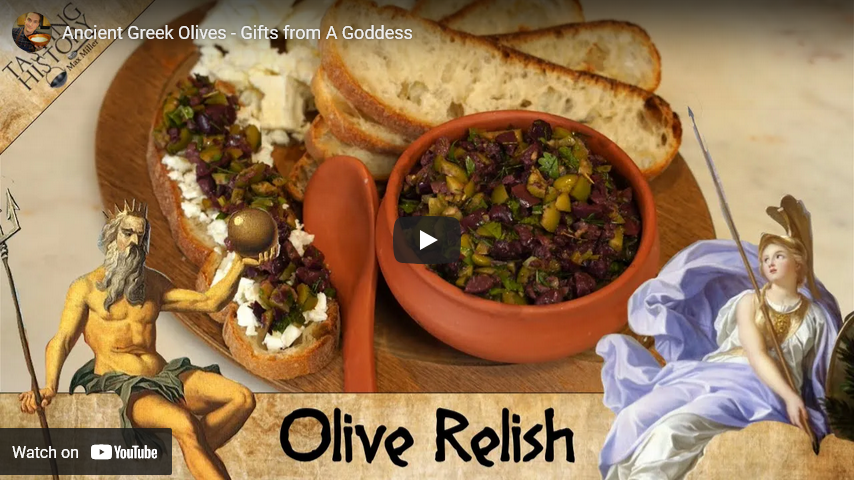
Ancient Greek Olives – Gifts from A Goddess
Tasting History with Max Miller
Published 1 Jun 2021Help Support the Channel with Patreon: https://www.patreon.com/tastinghistory
Tasting History Merchandise: crowdmade.com/collections/tastinghistoryFollow Tasting History here:
Instagram: https://www.instagram.com/tastinghist…
Twitter: https://twitter.com/TastingHistory1
Tiktok: TastingHistory
Reddit: r/TastingHistory
Discord: https://discord.gg/d7nbEpyTasting History’s Amazon Wish List: https://amzn.to/3i0mwGt
LINKS TO INGREDIENTS & EQUIPMENT**
Sony Alpha 7C Camera: https://amzn.to/2MQbNTK
Sigma 24-70mm f/2.8 Lens: https://amzn.to/35tjyoW
Dried Rue: https://amzn.to/3yErUqH
Terracotta Bowls with Spoons: https://amzn.to/3wLkEIbLINKS TO SOURCES**
De Agricultura by Cato the Elder: https://amzn.to/3bP20H6
De Re Rustica by Columella: https://amzn.to/3fkN99z
“Defense in the Matter of the Olive Stump” by Lysias
Varro the Agronomist: https://amzn.to/3fkhG7l
Aristotle’s Politics: https://amzn.to/3vkHMNj**Some of the links and other products that appear on this video are from companies which Tasting History will earn an affiliate commission or referral bonus. Each purchase made from these links will help to support this channel with no additional cost to you. The content in this video is accurate as of the posting date. Some of the offers mentioned may no longer be available.
Subtitles: Jose Mendoza
PHOTO CREDITS
Trapitum: Carole Raddato from FRANKFURT, Germany, CC BY-SA 2.0 https://creativecommons.org/licenses/…, via Wikimedia Commons
Akhenaten, Nefertiti and their children: By Neoclassicism Enthusiast – Own work, CC BY-SA 4.0, https://commons.wikimedia.org/w/index…
Amphora with Palm Trees: By Sharon Mollerus – Amphora with Palm Trees, Mycenaean, 15th century BC., CC BY 2.0, https://commons.wikimedia.org/w/index…
Procession fresco from Knossos: By ArchaiOptix – Own work, CC BY-SA 4.0, https://commons.wikimedia.org/w/index…
The Olive tree of Vouves: By Eric Nagle – https://www.reddit.com/r/europe/comme…, CC BY-SA 4.0, https://commons.wikimedia.org/w/index…
Reconstruction of the palace at Knossos: By Mmoyaq – Own work, CC BY-SA 3.0, https://commons.wikimedia.org/w/index…
The soldiers of Xerxes I: By A.Davey – This file has been extracted from another file: Xerxes detail ethnicities.jpg, CC BY 2.0, https://commons.wikimedia.org/w/index…
Lysias: By Coyau / Wikimedia Commons, CC BY-SA 3.0, https://commons.wikimedia.org/w/index…
Bouleuterion: By Zigomar – Own work, CC BY-SA 3.0, https://commons.wikimedia.org/w/index…#tastinghistory #olives #ancientgreece
March 25, 2022
QotD: Herodotus as Spartan propagandist
Herodotus seems to be at the start of it, at least in our sources – he relates a story where, after an embarrassing failure in an effort to reduce tiny Tegea to helotage (the Tegeans kicked the Spartans’ asses) in the mid-sixth century, the Spartans supposedly stole the bones of the hero Orestes. Consequently, Herodotus notes, the Spartans were from that point on able to always beat Tegea and subdued the Peloponnese (Hdt. 1.68), resulting in the creation of the Spartan-led Peloponnesian League. The unbeatable Spartans thus appear. It’s possible the Spartan reputation predated this, but – as we’ll see – Herodotus will be the one who codifies that reputation and cements it.
Except, hold on a minute – how hard was it to subdue the Peloponnese? It seems to have been done with a fairly adept mix of diplomacy and military force (champion one side in a local dispute, beat the other, force both into your alliance, repeat, see Kennell (2010), 51-3 for details). But it is little surprise that Sparta would be dominant in the Peloponnese. Messenia and Laconia together was around 2,600 square miles or so. This is – if you’ll pardon the expression – flippin’ massive by the standards of Greek poleis. More than twice as large as the next largest polis in all of Greece (Athens). Sparta is fully one-third of the Peloponnese (the peninsula Sparta is located on). The remaining two-thirds is home to many other poleis – Corinth, Argos, Elis, Tegea, Mantinea, Troezen, Sicyon, Lepreum, Aigeira and on and on. Needless to say, Sparta was several times larger than all of them – only Corinth and Argos came even remotely close in size. The population differences seem to have roughly followed land area. Sparta was just much, MUCH larger and more powerful than any nearby state by the start of the fifth century.
Sparta thus spends the back half of the 500s as the teenager beating up all of the little kids in the sandbox and making himself leader. When you are upwards of three times larger (and in some cases, upwards of ten times larger) than your rivals, a reputation for victory should not be hard to achieve. And, in the event, it turns out it wasn’t.
Which brings us back to Herodotus […] because he isn’t just observing the Spartan reputation, Herodotus is manufacturing the Spartan reputation. Herodotus is our main source for early Greek history (read: pre-480) and for the two Persian invasions of Greece. Herodotus’ Histories cover a range of places and topics – Persia, Greece, Scythia, Egypt – and contain a mixture of history, ethnography, mythology and straight up falsehoods. But – as François Hartog famously pointed out in his The Mirror of Herodotus (originally in French as Le Miroir d’Hérodote), Herodotus is writing about Greece, even when he is writing about Persia – those other cultures and places exist to provide contrasts to the things that Herodotus thinks bind all of the fractious and fiercely independent Greek poleis. And he is perfectly willing to manufacture the past to make it fit that vision.
Sparta has a role to play in that narrative: the well-governed polis, a bastion of freedom, ever opposed to tyranny, be it Greek or Persian. We’ll come back to Sparta’s … let’s say relationship … with Persian “tyranny” next week. But for Herodotus, Sparta is the expression of an ideal form of “Greekness” and in Herodotus’ logic, being well-governed (eunomia is the Greek term) results primarily in military excellence. For the story Herodotus is telling to work, Sparta – as one of the leading states resisting Persia – must be well governed and it must be militarily excellent. That’s what will make a good story – and Herodotus never lets the facts get in the way of a good story.
(Sidenote: Athens – at least post-Cleisthenic Athens – gets this treatment too. Athens ends up embodying a different set of “Greek” virtues and where Sparta shows its prowess on land, the Athenians do so at sea.)
And so, Herodotus – the myth-maker – talks up the Spartiates at Thermopylae (you know, the brave 300) and quietly leaves out the other Laconians (who, if you scrutinize his numbers, he knows must be there, to the tune of c. 900 men), downplaying the other Greeks. Spartan leadership is lionized, even when it makes stupid mistakes (Thermopylae, to be clear, was a military disaster and Spartan intransigence nearly loses the battle of Plataea, but Herodotus represents this as boldness in the face of the enemy; even more fantastically inept was the initial Spartan plan to hold on the Isthmus of Corinth as if no one had ever seen a boat before).
Bret Devereaux, “Collections: This. Isn’t. Sparta. Part VI: Spartan Battle”, A Collection of Unmitigated Pedantry, 2019-09-20.
February 11, 2022
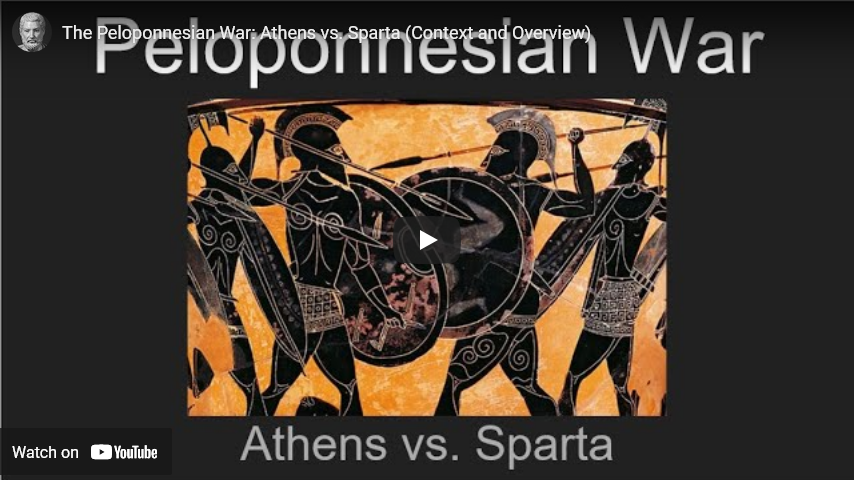
The Peloponnesian War: Athens vs. Sparta (Context and Overview)
Thersites the Historian
Published 28 Oct 2021In this lecture, I cover Greek history from 478-404 BCE with an emphasis on the Peloponnesian War. This is intended as a primer on the topic and I devote more time to establishing the context and causes of the war than I do going through the details of conflict itself.
Patreon link: https://www.patreon.com/thersites
PayPal link: paypal.me/thersites
Discord: https://discord.gg/QCaXXFr
Brave Browser: https://brave.com/noa557
Twitter link: https://twitter.com/ThersitesAthens
Minds.com link: https://www.minds.com/ThersitestheHis…
Steemit/dtube link: https://steemit.com/@thersites/feed
BitChute: https://www.bitchute.com/channel/jbyg…
November 30, 2021
The Elgin Marbles
In The Critic, Zachary Hardman outlines the history of the Elgin Marbles and why the Greek government is re-opening the campaign to retrieve them from the British Museum:
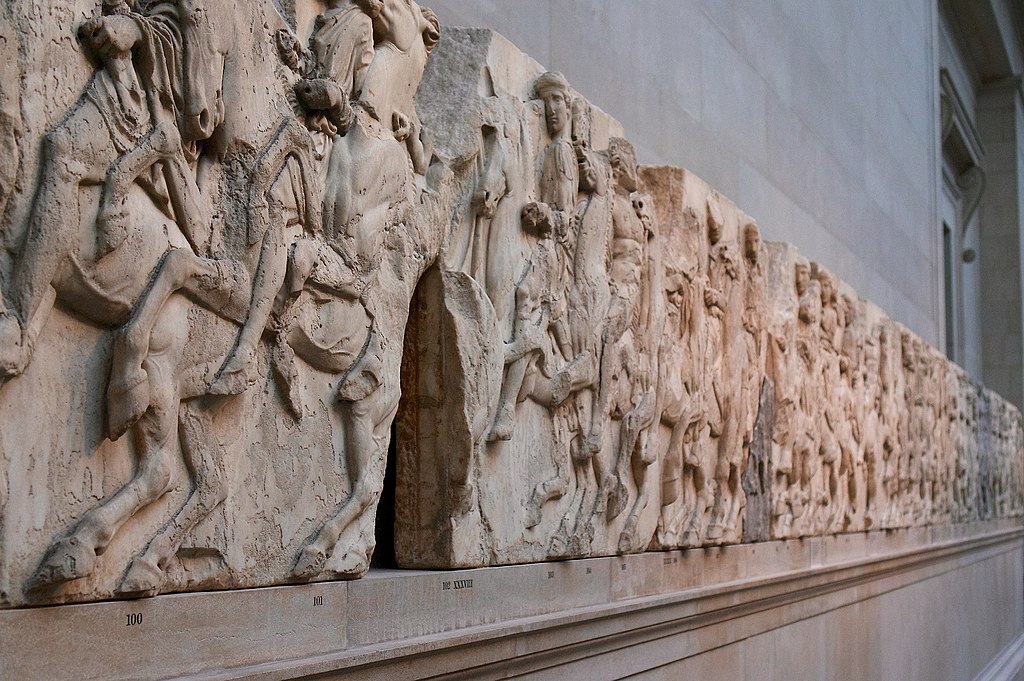
Some of the sculptures in the Elgin Marbles collection on display in the Duveen Gallery of the British Museum.
Photo by Paul Hudson via Wikimedia Commons.
Last week, the Greek Prime Minister, Kyriakos Mitsotakis was in London, with only one thing on his mind: the return of the so-called “Elgin Marbles” to Athens. 2021 is the two-hundredth anniversary of Greek independence, when the country liberated itself from the yoke of the Ottoman Empire and, for Athens, there would be no better birthday present than the restitution of the lost marbles.
The dispute about their rightful ownership is as old as the modern Greek state. In the early 19th century, the British Ambassador Lord Elgin was granted permission by Athens’ Ottoman rulers to remove half the remaining marble sculptures from a frieze on the Parthenon, the ruined ancient temple, which still adorns the Acropolis, the rocky outcrop overlooking the city.
Elgin had the marbles shipped to Britain. The journey, though, proved difficult. They were transported via Malta where, following a shipwreck, they spent a brief sojourn at the bottom of the Mediterranean Sea. The rescue mission was ruinously expensive. Elgin intended to furnish his ancestral Scottish home with the marbles. On second thoughts, though, he cut his losses and sold them to the British Museum.
Public opinion was divided. Lord Byron wrote two poems denouncing Elgin. His supporters, meanwhile, claimed the marbles were saved from further damage at the hands of warring Greeks and Turks, who didn’t appreciate them anyway. The Greeks, understandably, took a dim view of this. Since the 1980s they have waged a sustained PR offensive for the return of the marbles. An impasse, though, remains.
To break it, Mitsotakis would do well to consider the insights of the ancient rhetoricians. Athens, of course, was the birthplace of not only democracy, but rhetoric: the art of persuasion. The philosopher Aristotle, who wrote the original guidebook on the subject, said it was about identifying “the means of persuasion in any given case”. It is the task of modern Athens to work out who it must persuade and what of.
The fresh campaign began with the Government. In Downing Street, after all, lives a man Mitsotakis regards a “true philhellene”. The return of the marbles, the Greek Prime Minister said, after a meeting with Johnson, would be a “coup” for “global Britannia”. Flattery, however, has its limits. The British Government is unwavering in its support for the Museum. Mitsotakis, however, was undeterred.
October 26, 2021
The Constitution of Athens
Historia Civilis
Published 15 Dec 2017Patreon | http://historiacivilis.com/patreon
Donate | http://historiacivilis.com/donate
Merch | http://historiacivilis.com/merch
Mailing List | http://historiacivilis.com/mailinglist
Twitter | http://historiacivilis.com/twitter
Website | http://historiacivilis.comSources:
The Athenian Constitution by Aristotle: http://amzn.to/2C1mHLv
Politics by Aristotle: http://amzn.to/2AB6KPV
Parallel Lives: The Life of Solon by Plutarch: http://amzn.to/2AT5Viv
The Constitution of the Athenians by Pseudo-Xenophon: http://amzn.to/2z9rE6l
The Rise of Athens by Anthony Everitt: http://amzn.to/2C2ryMu
The Athenian Democracy in the Age of Demosthenes by Mogens Herman Hansen: http://amzn.to/2AEAtYj
Persian Fire by Tom Holland: http://amzn.to/2AjLB8WMusic:
“Direct to Video,” by Chris Zabriskie
“It’s Always Too Late to Start Over,” by Chris Zabriskie
“Mario Bava Sleeps In a Little Later Than He Expected To,” by Chris Zabriskie
“Hallon,” by Christian BjoerklundWe are a participant in the Amazon Services LLC Associates Program, an affiliate advertising program designed to provide a means for us to earn fees by linking to Amazon.com and affiliated sites.
October 11, 2021
City Minutes: The Athenian Empire
Overly Sarcastic Productions
Published 25 Jun 2021Deja Vu? Only slightly! I’m re-imaging City Minutes, and this time the plan is to *Actually Make It Good*! With MULTIPLE CITIES per episode, and HORIZONTAL VIDEO!
I heard your feedback on the first run of the shorts loud and clear — City Minutes Good, Shorts Bad — so this will be the format going forward: networks of cities, with each getting a minute of spotlight.
We’re starting where I always start, in ancient Athens (I wanted to give you the proper version of the pilot), but we’ve got tons of other City Minutes planned!
SOURCES & Further Reading: Thucydides History of the Peloponnesian War, World History Encyclopedia (https://www.worldhistory.org/Athens): “Athens”, “Piraeus”, “Sounion”, “Delos”, “Corcyra”, “The Delian League” parts 3 & 4, and my degree in Classical Studies
Cities by timestamp:
00:00 — Athens
1:00 — Piraeus
2:01 — Sounion
3:03 — Delos
4:05 — Mytilene
5:03 — Korkyra
6:03 — ConclusionOur content is intended for teenage audiences and up.
PATREON: https://www.Patreon.com/OSP
PODCAST: https://overlysarcasticpodcast.transi…
DISCORD: https://discord.gg/osp
MERCH LINKS: http://rdbl.co/osp
OUR WEBSITE: https://www.OverlySarcasticProductions.com
Find us on Twitter https://www.Twitter.com/OSPYouTube
Find us on Reddit https://www.Reddit.com/r/OSP/
From the comments:
Overly Sarcastic Productions
43 minutes ago
Fun linguistic shenanigans: The island of Korkyra (commonly spelled Corcyra when referring to the ancient city) is known today as both Kerkyra and Corfu. The name Corfu comes from an Italianized version of the Byzantine name Korufo.I use the pronunciation of “Korkyra” with an O because it reflects the more common version of the name as listed in ancient accounts — adherence to the original ancient version is also why I’m using Ks in place of any Latinized Cs.
Essentially: I’m spelling everything the ancient way, but using modern Greek phonetics to sound out those words. It’s an uncommon way to go about, but it feels like the right balance of ancient authenticity and modern linguistic continuity.
-B

October 7, 2021
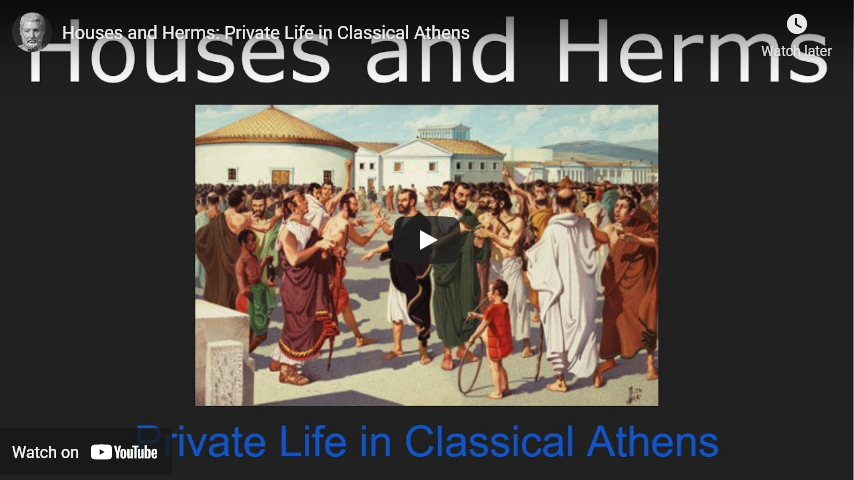
Houses and Herms: Private Life in Classical Athens
Thersites the Historian
Published 6 Oct 2021In this video, I look private life in classical Athens with a focus on material culture.
Patreon link: https://www.patreon.com/thersites
PayPal link: paypal.me/thersites
Discord: https://discord.gg/QCaXXFr
Brave Browser: https://brave.com/noa557
Twitter link: https://twitter.com/ThersitesAthens
Minds.com link: https://www.minds.com/ThersitestheHis…
Steemit/dtube link: https://steemit.com/@thersites/feed
BitChute: https://www.bitchute.com/channel/jbyg…