
World War Two
Published 25 Oct 2025Tripoli hums as staff and both battalions of Panzer-Regiment 5 bolster Rommel; Ariete is formally pulled under his hand to guard the rear while he eyes Marada. Malta’s Wellingtons and Sunderlands withdraw under X. Fliegerkorps pressure, a British war council prioritizes Greece, and HMS Greyhound bags Anfitrite as both sides struggle to hit each other’s convoys.
(more…)
October 26, 2025
North Africa Ep. 5: Desert Fox Prepares to Pounce
Comments Off on North Africa Ep. 5: Desert Fox Prepares to Pounce
October 23, 2025
A39 Tortoise: The Forgotten Super Heavy
The Tank Museum
Published 13 Jun 2025The A39 Tortoise. The last complete survivor of a World War Two project that arrived just a little too late. Some have called it “The British Jagdtiger” – but is that actually a fair comparison?
Tortoise was a part of the strategy the Allies would need to defeat Germany during the Second World War. It was recognised that total victory could only occur on German soil – and that meant smashing through the imposing defences of the Siegfried Line. The Allies would need a Heavy Assault tank. Many designs were put forward for this role, including the Valiant, the A33 and the T14 Assault tank.
The A39 is extremely well-armoured. Its casemate construction could withstand a hit from an 88mm gun at close ranges. But at 78-tons, this lumbering beast was both slow and heavy – and is one of the largest and heaviest vehicles in the museum’s collection. In terms of firepower, the impressive 32pdr gun was extremely effective against both concrete and enemy armour. It even has room inside for 7 crew!
In the end, the Tortoise arrived too late to see any action on the battlefield. It was intended to form a part of the 79th Armoured Division – making it one of Hobart’s Funnies. Whether Tortoise would have become the stuff of legend, or a bit of a joke – well, we’ll leave that question up to you.
00:00 | Introduction
00:39 | What is a Heavy Assault Tank?
03:45 | Why a Heavy Assault Tank?
09:24 | The A39: As Good as it Gets?
17:55 | A Solution Without a Problem
(more…)
Comments Off on A39 Tortoise: The Forgotten Super Heavy
October 18, 2025
The Battle of Sedan: The Anatomy of Failure
World War Two
Published 17 Oct 2025In May 1940, a period of ten days flipped the world order on its head. France, the titan of the Great War, was carved apart by the armored fist of the Wehrmacht: Panzergruppe Kleist. Now, in this new feature-length production, we explore why it happened, whether this was ever avoidable, and whether France’s flaws stemmed from incompetence, or something far more sinister.
(more…)
Comments Off on The Battle of Sedan: The Anatomy of Failure
September 7, 2025
The BEF and the German Sichelschnitt of May, 1940
Dr. Robert Lyman rebuts the common-since-the-1950s adulation of the Wehrmacht‘s attacks of May-June, 1940 through the Low Countries that drove the British Expeditionary Force off the continent and destroyed the flower of the French army prior to the surrender of France in June:
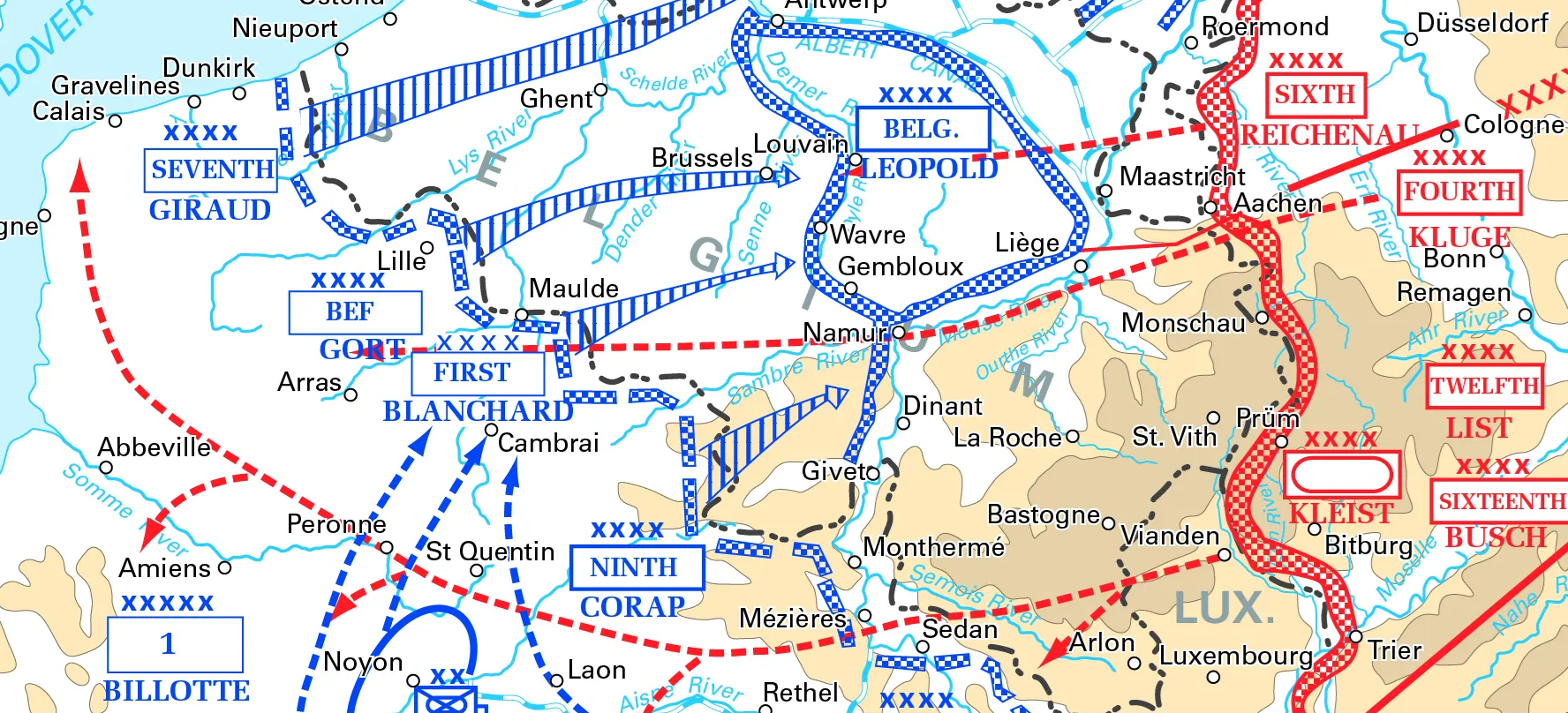
Detail from the West Point Military Atlas map of the “Campaign in the West, Disposition and Opposing Forces, 1940”
Full map.
The world has largely remembered Sichelschnitt as a brilliant German operation of war, but it was one that was fundamentally enabled by Allied ineptitude. Indeed, Blitzkrieg wasn’t particularly new, innovative or even a warfighting doctrine. It is best described, in the context of France 1940, as an event. It was simply the way that the Wehrmacht exerted its tactical and operational superiority over its more pedestrian enemies in 1940. In fact, it was the 1940 extension of what the German Army had first demonstrated in Flanders in March 1918, this time with tanks and Stukas. It was the Panzerwaffe (“tank force”) – combined with a tactical air force – which in 1940 would create the breakthrough that Ludendorff had been unable to achieve in 1918. Where it was applied, by Army Group A, it concentrated fast-moving armoured vanguards co-ordinated with tactical air power, such as 400 Ju 87 Stuka dive-bombers, to so overwhelm the enemy in both time and space that they were unable to respond quickly enough to the changing and challenging battlefield. In 1940 the panzer came into its own, the sound of clattering tracks on French cobblestones a new feature in the sound of battle and a key element in how France remembers its defeat in 1940.
It wasn’t the type of tank in the German inventory which mattered, but the way in which these tanks were employed. Only about 10 per cent of the army comprised tanks, the remainder relying on horse and wagons and the raw, painful feet of the marching infantry. Of the 2,539 tanks the Wehrmacht deployed in 1940, only 916, or 36 per cent were battleworthy, the remainder being clattering tin cans with machine guns (the obsolete Panzer Mark Is and Mark IIs). The only modern tanks were 683 Panzer Mark IIIs and Czech T38 tanks armed with a 37mm gun, and 278 of the larger Mark IVs with a short 75mm gun. But it was enough. The German operational strategy was to use this mass of armour not to fight a large confrontational tank battle, but to achieve breakthrough and breakout, bursting through the enemy’s linear defences. It was surprise and shock action that so discomforted the Allies, who had lazily and, given what we know of British failure to understand 1918, ignorantly assumed that the war would progress against a 1914 rather than a 1918 pattern. The armoured vanguard would surge through the outer skin of the enemy defences, concentrating heavy effort in one place, before driving hard into the heart of enemy territory. With an enemy intent on fighting a linear battle, the rear areas, behind this outer crust, would be weakly defended and full of rear-echelon, administrative and supply troops managing the lines of communication up to the front, not expecting to have to fight. It was by driving hard and fast behind the enemy front line, breaking the cycle of Allied battlefield decision-making, that Blitzkrieg was to achieve its psychological effect.
In contrast the Allies remained concerned about retaining the integrity of their defensive lines. The diaries of Major General Henry Pownall, for instance, are replete with concerns as the days spun past about the widening frontages on one defensive line or another. British concern was misplaced. It was to spread the ever-decreasing butter of the British infantry across ever-widening stretches of French and Belgian bread, without realising that the Germans were concerned not with rolling up a front line, but with driving hard to the rear. By so doing they would take risks with their flanks, but the discombobulatory effect on the enemy was considered to far outweigh any worry about the risk of counter- attack from an increasingly battered and disorganised enemy. Of course this operational concept was risky, but the risks taken were carefully calculated given what the German General Staff knew about British and French tactical doctrine, or the lack of it.
These German tactics were psychologically disconcerting for those not trained to expect them. As was demonstrated on the Meuse, artillery would batter a position in co-ordination with armoured columns bypassing fixed defences and attacking those it needed to clear from the flanks and the rear. The infantry accompanying the advancing armour – Panzergrenadiers (mechanised infantry) – arrived in tandem with the Stukas, which could drop their bombs from a screaming dive. Each Stuka seemed to those at the receiving end to be diving directly at them, personally. For untrained troops it was a terrifying experience. The panzers would sweep on while the truck-borne infantry would turn up to deal with survivors of this storm of fire and movement. By this time, of course, the disorientated French and British would now consider themselves cut off, behind their front line, with no prospect of being relieved. Surrender or a disorganised escape to the rear would seem to be a more sensible option than the forlorn hope of continued resistance when the surrounding fields were dotted with the grey-green uniforms and coal-scuttle helmets of their enemy. The psychological effect of Blitzkrieg was considerable. This wasn’t how their fathers had told them war was fought. How did the Germans manage to discomfort them on the battlefield so comprehensively? Were they inadequate soldiers, unable to meet the standards of campaigning set by the previous generation? Or was it that their tactics were simply not able to cope with the shock of a comprehensive assault by German infantry, armour and air power all descending on them at once? This was the battlefield that the British had entirely dominated, by virtue of their tactical innovations, in 1918. It was now Germany’s turn, a direct result of the failure of the British Army to develop its doctrine and approaches to warfighting at the end of the Great War. Brave men in 1940 did their duty, but against a battle-winning concept of their enemy, they were out-thought rather than out-fought. And critically, when an army thinks it is beaten, it is indeed beaten.
Comments Off on The BEF and the German Sichelschnitt of May, 1940
September 4, 2025
QotD: The development of the “halftrack” during the interwar period
The period between WWI and WWII – the “interwar” period – was a period of broad experimentation with tank design and so by the time we get to WWII there are a number of sub-groupings of tanks. Tanks could be defined by weight or by function. The main issue in both cases was the essential tradeoff between speed, firepower and armor: the heavier you made the armor and the gun the heavier and thus slower the tank was. The British thus divided their tank designs between “cruiser tanks” which were faster but lighter and intended to replace cavalry while the “infantry tanks” were intended to do the role that WWI tanks largely had in supporting infantry advances. Other armies divided their tanks between “light”, “medium”, and “heavy” tanks (along with the often designed but rarely deployed “super heavy” tanks).
What drove the differences in tank development between countries were differences between how each of those countries imagined using their tanks, that is differences in tank doctrine. Now we should be clear here that there were some fundamental commonalities between the major schools of tank thinking: in just about all cases tanks were supposed to support infantry in the offensive by providing armor and direct fire support, including knocking out enemy tanks. Where doctrine differed is exactly how that would be accomplished: France’s doctrine of “Methodical Battle” generally envisaged tanks moving at the speed of mostly foot infantry and being distributed fairly evenly throughout primarily infantry formations. That led to tanks that were fairly slow with limited range but heavily armored, often with just a one-man turret (which was a terrible idea, but the doctrine reasoned you wouldn’t need more in a slow-moving combat environment). Of course this worked poorly in the event.
More successful maneuver warfare doctrines recognized that the tank needed infantry to perform its intended function (it has to have infantry to support) but that tanks could now move fast enough and coordinate well enough (with radios) that any supporting arms like infantry or artillery needed to move a lot faster than walking speed to keep up. Both German “maneuver warfare” (Bewegungskrieg) and Soviet “Deep Operations” (or “Deep Battle”) doctrine saw the value in concentrating their tanks into powerful striking formations that could punch hard and move fast. But tanks alone are very vulnerable and in any event to attack effectively they need things like artillery support or anti-air protection. So it was necessary to find ways to allow those arms to keep up with the tanks (and indeed, a “Panzer divsion” is not only or even mostly made up of tanks!).
At the most basic level, one could simply put the infantry on trucks or other converted unarmored civilian vehicles, making “motorized” infantry, but […] part of the design of tanks is to allow them to go places that conventional civilian vehicles designed for roads cannot and in any event an unarmored truck is a large, vulnerable tempting target on the battlefield.
The result is the steady emergence of what are sometimes jokingly called “battle taxis” – specialized armored vehicles designed to allow the infantry to keep up with the tanks so that they can continue to be mutually supporting, while being more off-road capable and less vulnerable than a truck. In WWII, these sorts of vehicles were often “half-tracks” – semi-armored, open-topped vehicles with tires on the front wheels and tracks for the back wheels, though the British “Universal Carrier” was fully tracked. Crucially, while these half-tracks might mount a heavy machine gun for defense, providing fire support was not their job; being open-topped made them particularly vulnerable to air-bursting shells and while they were less vulnerable to fire than a truck, they weren’t invulnerable by any means. The intended use was to deposit infantry at the edge of the combat area, which they’d then move through on foot, not to drive straight through the fight.
The particular vulnerability of the open-top design led to the emergence of fully-enclosed armored personnel carriers almost immediately after WWII in the form of vehicles like the M75 Armored Infantry Vehicle (though the later M113 APC was eventually to be far more common) and the Soviet BTRs (“Bronetransporter” or “armored transport”), beginning with the BTR-40; Soviet BTRs tended to be wheeled whereas American APCs tend to be tracked, something that also goes for their IFVs (discussed below). These vehicles often look to a journalist or the lay observer like a tank, but they do not function like tanks. The M113 APC, for instance, has just about 1.7 inches of aluminum-alloy armor, compared to the almost four inches of much heavier steel armor on the contemporary M60 “Patton” tank. So while these vehicles are armored, they are not intended to stick in the fight and are vulnerable to much lighter munitions than contemporary tank would be.
At the same time, it wasn’t just the infantry that needed to be able to keep up: these powerful striking units (German Panzer divisions, Soviet mechanized corps or US armored divisions, etc.) needed to be able to also bring their heavy weaponry with them. At the start of WWII, artillery, anti-tank guns and anti-air artillery remained almost entirely “towed” artillery – that is, it was pulled into position by a truck (or frequently in this period still by horses) and emplaced (“unlimbered”) to be fired. Such systems couldn’t really keep up with the tanks they needed to support and so we see those weapons also get mechanized into self-propelled artillery and anti-air (and for some armies, tank destroyers, although the tank eventually usurps this role entirely).
Self-propelled platforms proved to have another advantage that became a lot more important over time: they could fire and then immediately reposition. Whereas a conventional howitzer has to be towed into position, unlimbered, set up, loaded, fired, then limbered again before it can move, something like the M7 Priest can drive itself into position, fire almost immediately and then immediately move. This maneuver, called “shoot-and-scoot” (or, more boringly, “fire-and-displace”) enables artillery to avoid counter-battery fire (when an army tries to shut down enemy artillery by returning fire with its own artillery). As artillery got more accurate and especially with the advent of anti-artillery radars, being able to shoot-and-scoot became essential.
Now while self-propelled platforms were tracked (indeed, often using the same chassis as the tanks they supported), they’re not tanks. They’re designed primarily for indirect fire (there is, of course, a sidebar to be written here on German “assault guns” – Sturmgeschütz – and their awkward place in this typology, but let’s keep it simple), that is firing at a high arc from long range where the shell practically falls on the target and thus are expected to be operating well behind the lines. Consequently, their armor is generally much thinner because they’re not designed to be tanks, but to play the same role that towed artillery (or anti-air, or rocket artillery, etc.) would have, only with more mobility.
So by the end of WWII, we have both tanks of various weight-classes, along with a number of tank-like objects (APCs, self-propelled artillery and anti-air) which are not tanks but are instead meant to allow their various arms to keep up with the tanks as part of a combined arms package.
Bret Devereaux, “Collections: When is a ‘Tank’ Not a Tank?”, A Collection of Unmitigated Pedantry, 2022-05-06.
Comments Off on QotD: The development of the “halftrack” during the interwar period
August 26, 2025
When Jagdpanther Fought Churchill
The Tank Museum
Published 18 Apr 2025Jagdpanther vs Churchill. Tank destroyer vs tank. New technology vs proven veteran. Who will emerge victorious?
It’s 6pm on 30th July 1944. Outnumbered 6 to 1, a platoon of 3 German Jagdpanthers is about to go into action for the first time. Facing them will be a squadron of 18 British Churchill tanks. Within 5 minutes, 11 tanks will be knocked out.
The Jagdpanther is the latest German armoured vehicle to arrive in Normandy. With a devastating gun, and a heavily armoured superstructure, this tank hunter is quick, reliable and deadly.
The Churchill has been fighting with Allied armies in North Africa, Italy and on the Eastern Front. The early marks struggled with a range of issues, but by 1944 it is an essential part of the British and Canadian tank force.
It’s during Operation Bluecoat where these two machines would come face-to-face for the very first time. The Churchills of S Squadron, 3rd Battalion, Scots Guards, have captured Hill 226 – a strategically important area to the south of Caumont. They are preparing for a German counterattack, but their infantry is yet to arrive – leaving their left flank dangerously exposed. And a platoon of Jagdpanthers is ready to take full advantage of their vulnerable state …
00:00 | Introduction
00:35 | The Jagdpanther
02:38 | The Churchill
05:43 | Operation Bluecoat
07:46 | A Turkey Shoot?
12:25 | Aftermath
17:40 | Roll of Honour
(more…)
Comments Off on When Jagdpanther Fought Churchill
August 23, 2025
T-55: 70 Years Old. Still in Service
The Tank Museum
Published 22 Aug 2025No tank in history has been produced in the quantities that the T-55 and its relatives have. Some sources suggest as many as 100,000 have been built since 1946, this tank is still seeing service across the globe. So how come this 80-year-old tank is still in service in 2025?
When looking at its predecessor, the T-34, the move to the T-55 looks like a massive leap in design. But there is a clear evolutionary progression – there is just a missing link. The T-44 laid the groundwork for future Soviet tank design – pioneering torsion bar suspension and a transverse engine.
It was soon decided that the T-44 would require a new 100mm gun to replace the 85mm. This new model would be called the T-54. While NATO classes both the T-54 and 55 as the same vehicle, the T-55 is a substantially better tank. A comprehensive series of upgrades made this an effective force on the battlefield.The T-55 would prove popular with forces around the world. It would even go head-to-head against itself in the Iran-Iraq War of the 1980s. Eventually the T-55 would become outdated as NATO technology became more and more advanced. But it is still in service in the conflict in Ukraine – why?
The Russian army, despite the stereotype of having unending stockpiles of weaponry, have been struggling to keep up with the astounding loss rate the Ukrainians have been able to inflict on them. This has resulted in older and older vehicles being dragged out of those large storage depots across Russia, mainly being used as mobile, protected artillery.
The T-55 has endured partly due to its sheer numbers, availability and upgradability. Its performance on the battlefield has varied, but its basic but effective design has proven itself again and again throughout the decades. It is worth reiterating how remarkable it that a vehicle conceived at the end of the Second World War is still even a consideration for armies 80 years on.
In this video, historian James Donaldson explores the history of the most-produced tank in history – the T-55. This Soviet design has its roots in the iconic T-34, evolving through the years to become an effective fighting machine that was sold around the world. Despite manufacturing ending in the 1980s, this tank is still a feature on the battlefield, with both sides making use of T-55s in the current conflict in Ukraine. It may not be engaging in tank-on-tank combat as initially intended, but the T-55 is still providing a useful, effective and relatively cheap addition to the arsenal of many armies in the 21st Century.
00:00 | Introduction
00:43 | The Missing Link
02:31 | Making the T-55
05:24 | Upgrades
08:34 | A Numbers Game
12:51 | In Action
16:41 | T-55 Today
(more…)
Comments Off on T-55: 70 Years Old. Still in Service
August 21, 2025
Six Reasons Operation Market Garden FAILED
The Tank Museum
Published 3 April 2025Operation Market Garden failed because the tanks of XXX Corps did not reach the Paras in Arnhem in time. Many historians have argued that the British armoured column “let the side down”. But is this actually true?
We reckon there are six reasons why the operation was a total disaster. It was a poor plan from the get-go, relying on a rate of advance that would outmatch the German invasion of France in 1940. Bad weather prevented the deployment of badly-needed reinforcements, and the terrain Guards Armoured were expected to traverse – a single road with impassable conditions on either side – significantly hampered the efforts of the tank crews.
Poor intelligence also meant that the British column was not prepared for resistance from a retreating and desperate German Army. It was a combination of all these factors that caused Market Garden to unravel completely.
Despite the complications, many acts of valour were carried out by both the airborne and armoured divisions, including the legendary assault across the Waal by the US 82nd Airborne.
So, join us as we explore these six reasons why Operation Market Garden failed and decide for yourself whether XXX Corps could have done anymore.
00:00 | Introduction
02:23 | #1 – A Bad Plan
06:22 | #2 – Poor Intelligence
07:51 | #3 – Difficult Terrain
11:27 | #4 – Determined Resistance
13:45 | #5 – Bad Weather
14:38 | #6 – Loss of Surprise
19:45 | What Went Wrong?
(more…)
Comments Off on Six Reasons Operation Market Garden FAILED
August 11, 2025
Speed vs Armour: The Unexpected History of Fast Tanks
The Tank Museum
Published 21 Mar 2025Would you rather go to war in a tank that was quick but lightly armoured – or heavily armoured but slow?
The concept of fast tanks has existed since the First World War, but making a tank fast is easier said than done. You can increase the speed, but only by compromising the other two sides of The Iron Triangle.
Whilst a good power to weigh ratio is key to making a tank go fast, there are other factors that need to be considered. J Walter Christie pioneered the innovative helicoil spring suspension system – an invention that allowed tanks to cope with travelling at high speeds across country. Although not picked up by the US Army, the brilliance of Christie’s suspension was recognised by the Soviets and soon made an appearance on the BT-Series of tanks – and most effectively on the T-34.
Back in the UK, the newly mechanised cavalry was making use of some brand-new Cruiser tanks. Whilst these were fast vehicles, this was coming at the cost of effective protection. Some military thinkers advocated for the concept of “speed as armour” but results were mixed – with the Crusader and Cromwell both proving to be capable tanks.
After the war, the British Army finally moved on from “speed as armour” and settled on sacrificing a bit of speed for the sake of better protection. This was incorporated first into the concept of Universal Tanks and remains a fixture in the modern Main Battle Tank.
So, we’ll ask again. Would you rather go to war in a tank that was quick but lightly armoured – or heavily armoured but slow?
00:00 | Introduction
00:51 | What Makes it a Fast Tank?
02:39 | What is a Fast Tank For?
04:39 | Suspension of Disbelief
06:34 | Speedy Soviets
08:29 | Cruisers Replace Cavalry
11:20 | The Second Wave
13:19 | Cruising in Europe
19:08 | One Tank to Do It All
(more…)
Comments Off on Speed vs Armour: The Unexpected History of Fast Tanks
August 10, 2025
QotD: The “generations” of warfare
First Generation Warfare, abbreviated 1GW, was war as it was waged from the dawn of civilization up through roughly the Civil War. This style of conflict involved massed line infantry, equipped with spears, pikes, swords, or line-of-sight ranged weapons such as longbows, crossbows, or muskets. The basic tactic was to draw up two large groups of armed men, bring them into close contact, and have them hack at one another until one side grew demoralized by the slaughter, at which point their line would break and the real slaughter could begin.
Industrial or Second Generation Warfare (2GW) brought rifled firearms, machine-guns, and indirect artillery. Men could now be killed at a great distance, without ever seeing the enemy. Camouflage, concealment, and cover became the keys to victory. Its heyday was roughly from the Civil War to the Great War.
Mechanized warfare or 3GW arrived with the internal combustion engine and powered flight. Tactics now depended on speed and manoeuvrability. It dawned with the Second World War and reached its apogee with the invasion of Iraq.
Mechanized warfare created an overwhelming advantage for large industrial states. Small states and non-state actors responded with 4GW, which can be thought of as televisual warfare – combat via propaganda. This is war as fought with cameras and media distribution networks. It is guerrilla warfare via weaponized morality: using the enemy’s own military actions against it by showing the consequences of war for one’s civilian population to the enemy civilian population. Bait the enemy into killing babies, then ask them how many more babies they’re willing to murder. Think Vietnam, Afghanistan, Iraq.
The response to 4GW is 5GW – warfare by psyop, utilizing misinformation and sentiment engineering. Its characteristic weapons platform is the social network. Where 4GW seeks to use the enemy’s own morality against it, 5GW seeks to change that morality, to transform the enemy’s inner nature, getting the enemy to attack themselves for you, to surrender with open arms and smiles on their faces … ideally, without the enemy even realizing that they’re under attack.
John Carter, “Political Conflict in the Age of Psychic Warfare”, Postcards From Barsoom, 2024-03-01.
Comments Off on QotD: The “generations” of warfare
August 4, 2025
Day Ten – German Victory in the Battle of France – Ten Days in Sedan
World War Two
Published 3 Aug 2025May 19, 1940. Ten days into Fall Gelb, Guderian’s panzers thunder toward the Channel, poised to slam a steel ring around nearly half a million Allied troops. In Paris, Paul Reynaud ousts Daladier and Gamelin, calling back Marshal Pétain and General Weygand as France’s last throw of the dice. The pocket is almost shut, yet the story is far from over. Is there time for one more twist? Keep watching as we follow the fight to its end and discuss the aftermath of this campaign.
(more…)
Comments Off on Day Ten – German Victory in the Battle of France – Ten Days in Sedan
July 27, 2025
Day Nine – Hitler’s Halt Order and Tragedy at La Ferté – Ten Days in Sedan
World War Two
Published 26 Jul 2025May 18, 1940. Our coverage of the German blitzkrieg in France continues. Today, we take a break from the panzers for a spot of old-fashioned siege warfare. At Ouvrage La Ferté, a small garrison of French troops makes a doomed last stand against overwhelming German firepower. We follow their final hours, the decisions that sealed their fate, and what their sacrifice meant for the collapsing French front.
(more…)
Comments Off on Day Nine – Hitler’s Halt Order and Tragedy at La Ferté – Ten Days in Sedan
July 20, 2025
Day Eight – Can Charles de Gaulle Save France? – Ten Days in Sedan
World War Two
Published 19 Jul 2025Ten Days in Sedan continues as our WW2 Blitzkrieg documentary follows the first serious counterblow against the German spearhead. Colonel Charles de Gaulle leads the 4th Armoured Division in an attack against the German flank. De Gaulle’s units are understrength and his assault is improvised but he catches Heinz Guderian by complete surprise. Is this just a fleeting gesture of defiance, or a new kind of French resistance?
(more…)
Comments Off on Day Eight – Can Charles de Gaulle Save France? – Ten Days in Sedan
July 14, 2025
Day Seven – Ghost Division! – Ten Days in Sedan
World War Two
Published 13 Jul 2025May 16 1940: Our WW2 Blitzkrieg documentary, Ten Days in Sedan, continues as Winston Churchill arrives in Paris. The Prime Minister still has hope but he’s shocked to see the French burning documents and preparing to evacuate. Meanwhile French and German tanks slug it out in Stonne, Guderian reaches Montcornet, and Rommel leads his Ghost Division far behind French lines.
Chapters
00:00 Intro
00:58 Recap
01:38 Stonne
03:05 Panzers Drive West
07:02 New French Plan
12:23 Rundstedt’s Halt Order
16:06 Ghost Division
21:53 Churchill in Paris
(more…)
Comments Off on Day Seven – Ghost Division! – Ten Days in Sedan
July 13, 2025
Tiger II: What was the point?
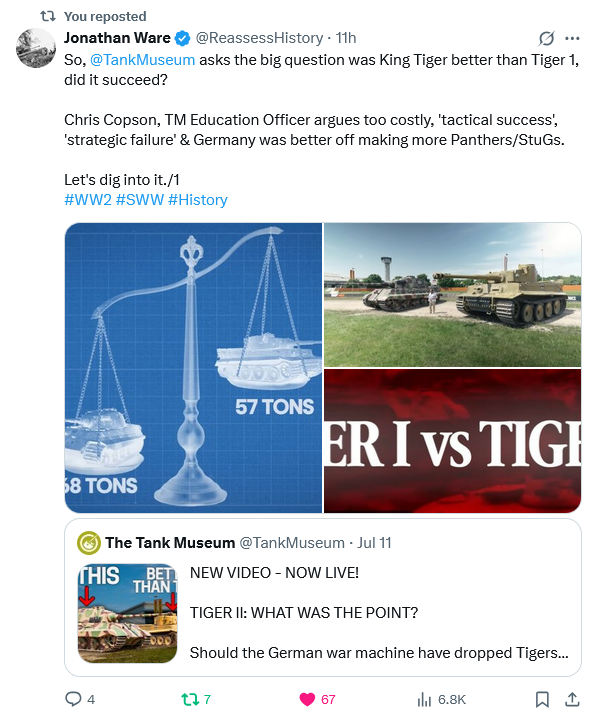
The folks at the Tank Museum at Bovington put together a video comparing the Tiger II to the earlier Tiger I and the typical allied tanks they faced on the battlefield. On the social media site formerly known as Twitter, historian Jonathan Ware posted a long thread about both the topics the Tank Museum’s video raised and where he feels they should have added more context:
And here’s the Tank Museum’s video itself:
FEATURING FOOTAGE OF TIGER I AND TIGER II RUNNING TOGETHER AT TANKFEST 2025 – with thanks to Musée des Blindés and World of Tanks.
It’s absurdly large, heavy, expensive, and difficult to build. So, you have to ask; what is the point of Tiger II when you already have the biggest, toughest and meanest beast on the block – Tiger I.
Whilst the Tiger I has maintained a legendary status since its appearance on the battlefield, there were many aspects of this tank’s design that were pretty much dead ends. The turret couldn’t be resized to fit a more powerful gun. And adding extra weight in the form of armour would put a huge amount of strain on the internal mechanics. So, a new tank was needed to ensure the German’s could maintain their edge against Allied armour.
Enter the Tiger II, otherwise known as the King Tiger. Heavily armed, the Tiger II could take on any Allied tanks that it faced, with its KwK 43 able to penetrate the frontal armour of a Sherman at 1,800m. Its thick sloped armour was incredibly dependable, and no Allied tank commander would willingly engage a Tiger II in a head-to-head fight.
The Tiger II’s battlefield presence came at a significant cost. A single Tiger II could take up to 400,000 hours to build at a price of RM 321,500 – up to 100,000 more hours than a Tiger I, and over twice the cost of a Panther. A while the Allies were churning out tanks that were “good enough”, the Germans were committed to quality and ensuring their tanks would always have the edge against enemy armour.
The Tiger II has often been described as a tactical success for its battlefield prowess, but a strategic failure for being so resource-hungry, expensive and relatively low in number. Given their cost, it forces us to question whether the German war machine should have dropped Tigers altogether in favour producing tanks that were cheaper and easier to build
00:00 | Introduction
00:55 | Durchbruchswagen
06:15 | Tiger I vs Tiger II
12:52 | The Numbers Game
17:34 | Was Tiger II a Success?This video features archive footage courtesy of British Pathé.
In this film, Chris Copson breaks down the differences between two legendary tanks – the Tiger I and Tiger II. Whilst Tiger I was an impressive tank, certain areas of its design were an evolutionary dead-end. Its boxy turret couldn’t be enlarged to fit a bigger gun, and the hull couldn’t be up armoured without adding stress to the drive train. So, Tiger II ordered in 1943, including even thicker, sloped armour and a much more destructive gun. With mixed success on the battlefield, difficulties in maintaining its complex mechanics and reliance on dwindling supply lines, the Tiger II ended up being a tactic success, but a strategic failure.
Want to learn more about the Tiger I and Tiger II? Here are some of the sources we used to make this film:
Panzer Tracts No.23 – Panzer Production from 1933 to 1945 by Thomas Jentz and Hilary Doyle, 2011
Germany’s Tiger Tanks, DW to Tiger I: Design, Production and Modifications by Thomas Jentz and Hilary Doyle, 2000
Germany’s Tiger Tanks, VK45.02 to Tiger II: Design, Production and Modifications by Thomas Jentz and Hilary Doyle, 1997
Encyclopedia of German Tanks of World War Two, Revised Edition by Peter Chamberlain and Hilary Doyle, 1993
Tigerfibel. English translation by The Tank Museum, 2022
Panther and its Variants by Walter Spielberger, 1978
Armored Champion: The Top Tanks of World War II by Steven Zaloga, 2015
www.tankarchives.com
www.forum.axishistory.com
www.achtungpanzer.com
www.feldgrau.net
Comments Off on Tiger II: What was the point?


