Quotulatiousness

February 5, 2021

The 369th Infantry Regiment in WW1 – the “Harlem Hellfighters”

Filed under: France, Germany, History, Military, USA, WW1 — Tags: , , , , — Nicholas @ 03:00

Lawrence W. Reed remembers the US regiment that spent the most days in combat during WW1 and was awarded the French Croix de Guerre for the unit’s incredible fighting efforts:
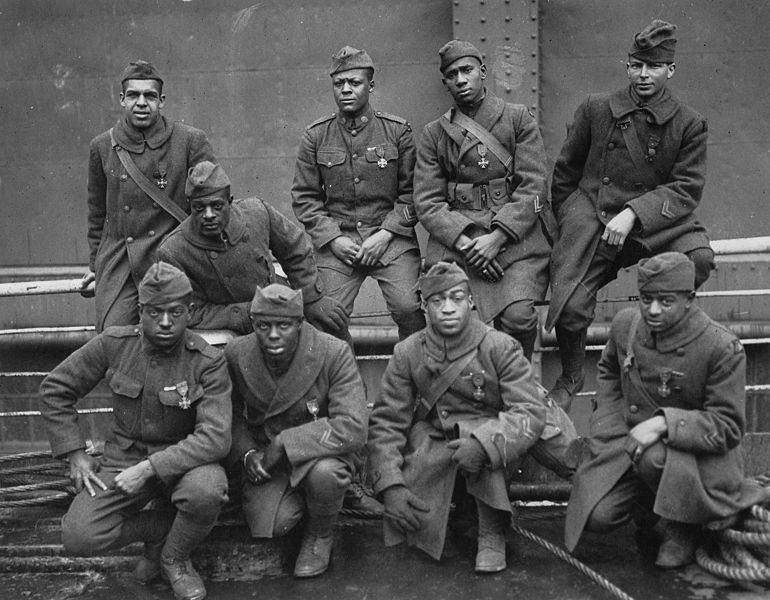
“Some of the colored men of the 369th (15th N.Y.) who won the Croix de Guerre for gallantry in action.” Left to right. Front row: Pvt. Ed Williams, Herbert Taylor, Pvt. Leon Fraitor, Pvt. Ralph Hawkins. Back Row: Sgt. H. D. Prinas, Sgt. Dan Strorms, Pvt. Joe Williams, Pvt. Alfred Hanley, and Cpl. T. W. Taylor.
Records of the War Department General and Special Staffs via Wikimedia Commons.

Formed from a New York National Guard unit, the men of the 369th learned basic military practices at Camp Whitman, New York, before being sent to Camp Wadsworth in Spartanburg, South Carolina, for combat training. They were not welcomed by many of the locals there, and some were subjected to discrimination and vile epithets for no more reason than their color. In December 1917, they were shipped to France where they expected to see action on the front lines.

Their high spirits were quickly dashed when it became apparent the Army did not want to deploy them for anything other than manual labor, far from the fighting. Even the rifles they brought with them were confiscated by US Army officials.

The commander of the American Expeditionary Force, General John J. Pershing, was reluctant to commit any US troops to the front until he felt he had assembled them in sufficient numbers to ensure victory. The French, meanwhile, were desperate for manpower. Finally bowing to French pressure, Pershing gave them the 369th. While some regarded black troops as expendable, they ultimately proved themselves indispensable.

Consider this amazing record of the Harlem Hellfighters: No American unit experienced more time in combat than they did — no less than 191 days under fire. They never lost an inch of ground. The enemy never captured a single of their number. They suffered the highest casualty rate of any US regiment. None deserted. The grateful French bestowed their highest military honor, the Croix de Guerre, upon the entire regiment. Many individuals of the regiment received the US Army’s second-highest award, the Distinguished Service Cross. Posthumously, Henry Johnson received America’s Medal of Honor in 2015. The 369th ended up as the most decorated US regiment of the war.

Another distinguishing feature of the Harlem Hellfighters was their band, the largest and best-known of any regiment. Its leader was James Reese Europe, whose enlistment in 1917 proved to be a boon for recruitment. He was one of America’s best-known black musicians and others like Noble Sissle, who became Europe’s lieutenant and lead vocalist, were eager to serve with him.

Europe’s band was extremely popular with the French, even when Europe introduced his own arrangement of La Marseillaise, France’s national anthem. The Hellfighters’ band brought both jazz and ragtime music to France, where nobody had heard either before.


Tank Chats #93 Humber Hornet | The Tank Museum

Filed under: Australia, Britain, History, Military, Weapons — Tags: , , — Nicholas @ 02:00

The Tank Museum
Published 24 Jan 2020

Here David Fletcher takes a look at the Humber Hornet, a specialised air-deployable Armoured Fighting Vehicle. It was designed to carry the Malkara, an anti-tank guided missile developed by Australia and the United Kingdom.

Support the work of The Tank Museum on Patreon: ► https://www.patreon.com/tankmuseum

Visit The Tank Museum SHOP: ►tankmuseumshop.org

Twitter: ► https://twitter.com/TankMuseum
Instagram: ► https://www.instagram.com/tankmuseum/
Tiger Tank Blog: ► http://blog.tiger-tank.com/
Tank 100 First World War Centenary Blog: ► http://tank100.com/

QotD: Misunderstanding the threat/promise of robotics and AI

So, start with the very basics. Human desires and needs are unlimited – that’s an assumption but a reasonable one. There’re some number of people on the planet. This provides us with a lot of human labour but not an unlimited amount. Thus labour is a scarce or economic resource – and we’ve not enough of it to sate all human desires and wants.

OK, so, now we use machines to do some jobs that were previously done by humans. Imagine that this new technology actually required more human labour – that it created new jobs in greater volume than those it destroys. Say, the tractor and combine harvester industry needs more people in it than we used to use to cut the crops by hand. We’ve just made ourselves poorer. We used to have some amount of grain through the labour of some number of people. We’ve now got that grain but by using the labour of more people. We’ve used more of our scarce resource and we’re now poorer by the loss of what they used to make when not hand cutting grain but now no longer are by making tractors.

What makes us richer is if the tractor industry has record production statistics while using less labour than the hammer and sickle. That means that some human labour is now free to go off and try to sate a human desire or want for something other than grain. Ballet dancing for example. We’re now richer – tractors and combine harvesters have made us richer – by whatever value we put on more ballet dancing.

The entire point of any form of automation is to destroy jobs so as to free up that labour to do something else. The new technology doesn’t create jobs, it allows other jobs to be done.

The only point at which this fails is if human needs and desires aren’t unlimited. Which means that we might be able to provide everything that everyone wants without us all working. Which doesn’t really sound like much of a problem really.

Tim Worstall, “As Usual, World Economic Forum Gets Robots And AI Wrong Over Jobs”, Continental Telegraph, 2018-09-18.

February 4, 2021

The LEGENDARY Six-Board Chest

Filed under: Tools, Woodworking — Tags: , , , — Nicholas @ 06:00

Rex Krueger
Published 3 Feb 2021

Bring this project to life with nailed joinery and affordable wood.
More video and exclusive content: http://www.patreon.com/rexkrueger​
Get the plans!: https://www.rexkrueger.com/store/plan…​
(more…)

The New World: A Beautiful Mess

Filed under: Americas, Britain, History, Media — Tags: , , , , , — Nicholas @ 04:00

Atun-Shei Films
Published 3 Feb 2021

A review of the Terrence Malick film The New World, a lavish and beautifully shot historical epic that nonetheless falls short in a few important ways.

Support Atun-Shei Films on Patreon ► https://www.patreon.com/atunsheifilms​

Leave a Tip via Paypal ► https://www.paypal.me/atunsheifilms

Buy Merch ► teespring.com/stores/atun-shei-films​

#TerrenceMalick​ #Jamestown​ #Pocahontas​

Original Music by Dillon DeRosa ► http://dillonderosa.com/​
Reddit ► https://www.reddit.com/r/atunsheifilms​
Twitter ► https://twitter.com/atun_shei

Ace reads the upper middle class out of the conservative movement

Filed under: Politics, USA — Tags: , , , , , , , — Nicholas @ 03:00

At Ace of Spades H.Q., Ace himself explains why he doesn’t consider anyone who evinces loyalty to “the mores of the upper middle class” to be in any way, shape, or form “conservative”:

Never once do these bougie “cons” notice that the class whose class markers they are so eagerly collecting like Cub Scout merit badges are entirely created by progressives.

I’m going to say this more straightforwardly than I’ve ever said it. I’ve hinted around it, I’ve never said it straight up.

But here goes:

People loyal to the mores of the upper middle class are left-liberal. Period.

They should have no place in the leadership and “thought” leadership of any “conservative” movement. They are not conservative.

They are all pro-gay marriage.

They are all pro-abortion.

They are all in favor of shipping out every single working-class job to China, and, for those few remaining jobs which must be performed in America, shipping in workers from the third world to displace Americans.

They are all supporters of a soft version of the SJW progressive stack. They all believe in “White Privilege,” for an obvious reason — as the rich children of the prosperous upper-middle class, they’re actually the ones born to privilege, but they wish to obscure that fact. So they buy into the left’s claims about the “White Privilege” of 63% of the country, instead of focusing on the wealth privilege of 10%.

Jake Tapper will entertain he shares a kind of privilege with two thirds of the country but he will never acknowledge his real privilege, one shared by only 10% of the country.

And the social-climbing “conservative” media class is almost entirely born from the same prosperous class. They too do not want to talk about real privilege.

I always want to ask these guys, so desperate to peonize the working class: How far back in time do you have to go to find an ancestor who had a job which caused callouses to form on his hands?

Was it two generations ago? Three? It’s obvious the “conservative” media class has never had to work a shovel in their lives. The toughest job they’ve ever held was working in their dad’s law office, or valet parking Beemers at the country club.

And yes, they support the leftwing SJW claims about race. Bullshit like “minorities can’t be racist,” or at least not racist in a way that should be held against them.

That’s why they all rushed to defend notorious, swaggering racist Sarah Jeong, and refuse to even acknowledge the eyebrow-singing anti-white racism seen every single day in the media.

To acknowledge there’s such a thing as “anti-white racism,” and that it ought to be condemned, is, they’ve decided, an “alt-right” idea, and the alt-right is a lower class phenomenon, and, as I’ve noted, they really, really really need you to know they are not lower class.

The only way in which they are arguably “conservative” is that … they are in favor of oligarchical fascism directed by the billionaires signing their paychecks.

Which is of course not “conservative” at all. But that’s the one category in which they can make an arguable case for their “conservatism” — in always championing the Ruling Class’ right to rule over the downscale Dirties.

Is that the “conservatism” we want? A gonzo left-liberalism which is also thoroughly anti-republican, anti-egalitarian?

Also at Ace of Spades H.Q., OregonMuse quoted this rather timely Barry Goldwater statement:

I have little interest in streamlining government or in making it more efficient, for I mean to reduce its size. I do not undertake to promote welfare, for I propose to extend freedom. My aim is not to pass laws, but to repeal them. It is not to inaugurate new programs, but to cancel old ones that do violence to the Constitution or that have failed their purpose, or that impose on the people an unwarranted financial burden. I will not attempt to discover whether legislation is “needed” before I have first determined whether it is constitutionally permissible. And if I should later be attacked for neglecting my constituents’ “interests”, I shall reply that I was informed that their main interest is liberty and that in that cause I am doing the very best I can.

How to Sharpen a Gouge | Paul Sellers

Filed under: Tools, Woodworking — Tags: , , — Nicholas @ 02:00

Paul Sellers
Published 13 Mar 2017

Paul shows how to sharpen a gouge using his standard method, rocking the gouge side to side. He uses flat stones, in this case diamond stones in coarse (250), fine (600) and super fine (1200) grit, followed by a strop charged with buffing compound. Then you’re ready for carving.

For a beginner friendly guide on sharpening a gouge, see our sister site: https://commonwoodworking.com/sharpen…

For more information on these topics, see https://paulsellers.com or https://woodworkingmasterclasses.com

QotD: The (as-yet-unfulfilled) promise of “personalized medicine”

Filed under: Health, Quotations, Science — Tags: , , , — Nicholas @ 01:00

A more useful lesson might be skepticism about personalized medicine. Personalized medicine – the idea that I can read your genome and your blood test results and whatever and tell you what antidepressant (or supplement, or form of therapy) is right for you has been a big idea over the past decade. And so far it’s mostly failed. A massively polycausal model would explain why. The average personalized medicine company gives you recommendations based on at most a few things – zinc levels, gut flora balance, etc. If there are dozens or hundreds of things, then you need the full massively polycausal model – which as mentioned before is computationally intractable at least without a lot more work.

(You can still have some personalized medicine. We don’t have to know the causes of depression to treat it. You might be depressed because your grandfather died, but Prozac can still make you feel better. So it’s possible that there’s a simple personalized monocausal way to check who eg responds better to Prozac vs. Lexapro, though the latest evidence isn’t really bullish about this. But this seems different from a true personalized medicine where we determine the root cause of your depression and fix it in a principled way.)

Even if we can’t get much out of this, I think it can be helpful just to ask which factors and sciences are oligocausal vs. massively polycausal. For example, what percent of variability in firm success are economists able to determine? Does most of the variability come from a few big things, like talented CEOs? Or does most of it come from a million tiny unmeasurable causes, like “how often does Lisa in Marketing get her reports in on time”?

Maybe this is really stupid – I’m neither a geneticist or a statistician – but I imagine an alien society where science is centered around polycausal scores. Instead of publishing a paper claiming that lead causes crime, they publish a paper giving the latest polycausal score for predicting crime, and demonstrating that they can make it much more accurate by including lead as a variable. I don’t think you can do this in real life – you would need bigger Big Data than anybody wants to deal with. But like falsifiability and compressability, I think it’s a useful thought experiment to keep in mind when imagining what science should be like.

Scott Alexander, “The Omnigenic Model As Metaphor For Life”, Slate Star Codex, 2018-09-13.

February 3, 2021

Just Following Orders? – Death Camp Commandants – WW2 Gallery

Filed under: Europe, Germany, History, Military, WW2 — Tags: , , , — Nicholas @ 04:00

World War Two
Published 2 Feb 2021

All Nazi transit, concentration, labour and extermination camps were led by Nazi officers. In this episode, we’re taking a look at some of them to see what kind of people rose to those positions and what impact they made.

The video Spartacus mentions about how Eicke created the Concentration Camp model is here: https://youtu.be/SjLFdw5u26s​

Join us on Patreon: https://www.patreon.com/TimeGhostHistory
Or join The TimeGhost Army directly at: https://timeghost.tv

Follow WW2 day by day on Instagram @ww2_day_by_day – https://www.instagram.com/ww2_day_by_day
Between 2 Wars: https://www.youtube.com/playlist?list…
Source list: http://bit.ly/WW2sources

Hosted by: Spartacus Olsson
Written by: Joram Appel and Spartacus Olsson
Director: Astrid Deinhard
Producers: Astrid Deinhard and Spartacus Olsson
Executive Producers: Astrid Deinhard, Indy Neidell, Spartacus Olsson, Bodo Rittenauer
Creative Producer: Maria Kyhle
Post-Production Director: Wieke Kapteijns
Research by: Joram Appel
Edited by: Iryna Dulka
Sound design: Marek Kamiński
Map animations: Eastory (https://www.youtube.com/c/eastory​)

Colorizations by:
– Mikołaj Uchman
– Norman Stewart – https://oldtimesincolor.blogspot.com/​

Sources:
– United States Holocaust Memorial Museum
– Bundesarchiv: 152-01-14, 152-01-26, 152-01-024, 119-0052-01, 152-01-16, 183-W0402-503, 152-23-10A, 152-26-27, 183-78612-0004, 146-2007-0068, 152-23-21A
– Yad Vashem: 202_65, 202_71, 4613_666, 202_169, 202_167, 202_133, 192-093, 11CO3, 192-006, 11FO7, 1137_208
– Watchtower by Eliricon from the Noun Project

Soundtracks from the Epidemic Sound:
– Gunnar Johnsen – “Not Safe Yet”
– Cobby Costa – “From the Past”
– Brightarm Orchestra – “On the Edge of Change”
– Phoenix Tail – “Last Minute Reaction”
– Christian Andersen – “Barrel”
– Farrell Wooten – “Rainy Landscapes”
– Flouw – “Endlessness”
– Wendel Scherer – “Defeated STEMS INSTRUMENTS”
– Craft Case – “Secret Cargo”

Archive by Screenocean/Reuters https://www.screenocean.com​.

A TimeGhost chronological documentary produced by OnLion Entertainment GmbH.

From the comments:

World War Two
5 hours ago (edited)
This is our first official “Gallery” episode. There are too many significant, impactful and interesting individuals to give them all their own Biography episodes. So we decided to bundle some of them together in categories in which they played a significant role, like the people who served as camp commandants in this episode. We will still do Biography specials when one individual story deserves to be told, but with the addition of this new format we will be able to cover a lot more and provide the broadest context to this immense war.

Fatah demands that Britain return Big Ben to its original Jerusalem home

Filed under: Britain, History, Middle East — Tags: , , , , , , — Nicholas @ 03:00

Daniel Greenfield unravels the historical misconceptions that informed the demand:

“Big Ben” by kev_zilla is licensed under CC BY-NC-ND 2.0

“The Jerusalem Clock is hidden in London today,” Fatah, the political movement behind the PLO and the Palestinian Authority, asserts in a post titled, “Jerusalem Stolen Clock”.

It goes on to claim that the British military ordered the clock tower dismantled. Then the “British moved the clock first to a new tower across from the municipality of Jerusalem, and transferred it to the British Museum in London, to become the famous British icon, ‘Big Ben’.”

How did Big Ben, which was built in 1859, become a Muslim clock tower from the 20th century?

There are some other slight differences between London’s Big Ben and the “stolen clock” such as the fact that Big Ben is 316 feet tall while the “Palestinian” clock tower was only 42 feet.

But the story of the “Palestinian clock” is also the story of the entire myth of “Palestine”.

When you believe that the Jerusalem of King David and King Solomon was originally yours, you can just as easily believe that London’s Big Ben was originally the property of “Palestine”.

The “Palestinian clock” is as real as “Palestine”. The myth of a “Palestinian” people propounded by Fatah which has spent decades killing over it is also the story of the “Palestinian clock”.

There’s no more of a “Palestinian” people who were dispossessed by the Jews than Big Ben is a “Palestinian” clock stolen and passed off as London’s Big Ben. Both are fake history built out of resentments and garbled stories whose context has been lost, but whose hatreds remain real.

There were never any Palestinians. When the clock was built the region had been part of the Ottoman Empire, the last Caliphate until ISIS. The caliphates had settled it with Arab Muslim clans who dominated Christian refugees fleeing Muslim persecution, along with groups of other minorities from escaped slaves to gypsies, along with the indigenous Jewish population.

The Ottomans had become obsessed with clock towers as a symbol of their empire. But the Ottomans hadn’t invented them, they had adopted them from Europe, and planted them in major cities of the empire to create a common sense of time and belonging for their subjects.

Sultan Abdul Hamid II, the last real sultan of the empire, obsessively erected clock towers to show off how modern the Ottoman Empire was. But by then the Empire was anything but modern and Hamid’s clock tower craze was powered by his German allies. Kaiser Wilhelm II gave Hamid a batch of clocks at the turn of the century which the Turks put into clock towers.

The Ottoman Empire erected some of its clock towers in Israel. These clock towers utilized the talents and funds of the indigenous Jewish and the Arab Muslim settler population. The clock tower projects in Israel began in 1901 which is also the date when Wilhelm sent Hamid a whole bunch of clocks. One of these clock towers was stuck on Jerusalem’s Jaffa Gate which Hamid had previously cut a hole in so that the Kaiser could enter Jerusalem in his tall plumed helmet.

H/T to Kate at SDA for the link.

Germany’s WW1 “Kurz” Model Tankgewehr

Filed under: Germany, History, Military, Weapons, WW1 — Tags: , , , — Nicholas @ 02:00

Forgotten Weapons
Published 29 Oct 2020

http://www.patreon.com/ForgottenWeapons

https://www.floatplane.com/channel/Fo…

Cool Forgotten Weapons merch! http://shop.bbtv.com/collections/forg…

When the German Tankgewehr was introduced in May 1918, the first 300 or so guns were of a different pattern than the standard production that would follow (and of which about 16,000 would be made). The Kurz model had a barrel about 4 inches shorter than the standard, and was about 2 pounds heavier, because that barrel (although shorter) was much larger in diameter than the standard pattern.

Contact:
Forgotten Weapons
6281 N. Oracle #36270
Tucson, AZ 85740

QotD: The “Parkerization” of wine

Filed under: Business, Economics, Quotations, Wine — Tags: , , , , — Nicholas @ 01:00

… mega-star wine critic Robert Parker Jr., a man who has more influence on the taste and price of wine than anyone else has, or ever had had. Now in his seventies, Parker is retired. But back in 1975, the former lawyer, taking his lead from former presidential candidate, Ralph Nader — a consumer rights advocate — began to publish The Wine Advocate, a kind of consumer guide to fancy wine.

The world of wine had never seen anything like it. Parker was on a mission to demythologise all the snobby and obscure terminology under which fine wine was clouded and developed a simple 100 point scale on which wines could be judged.

As his influence grew, a Parker wine score in the 90s would pretty much guarantee considerable financial success to a vineyard. Inevitably, so the argument goes, those who made wine started to adjust the taste of their product so that it would suit the arbiter’s palate.

Parker generally likes big, dark, gutsy, jammy, tannic wines that can, his critics say, be engineered to taste that way in post-production, often by use of imported yeasts or through the use of young oak barrels. It’s more about clever chemistry than the particular charisma of the local terroir. Parker’s taste favours the muscular Californian Cabernet wines and the great Château wines of Bordeaux, yet has little appreciation for the lighter, less tannic, more subtle Pinot Noirs from Burgundy or Gamays from the Loire Valley. “Bad critics look at Pinot through Cabernet-tinted spectacles and so criticise it for being something it never set out to be,” writes Clive Coates, in a not so subtle dig at Parker, in his encyclopaedic The Wines of Burgundy.

Those who bewail Parker’s phenomenal influence speak of “parkerisation” as the wine equivalent of globalisation. The New York Times wine critic Alice Feiring writes that this is how “Rioja loses its Spanish accent”: parkerisation leads to an increasingly homogenised style of wine in which the diversity of grapes and wine tastes come to be submerged under the over powerful influence of Parker’s very particular palate. Those, like her, who prefer subtlety in their wine speak dismissively of Parker’s love for “jam bombs”.

Those who defend Parker, argue that his 100 point scale works as a kind of bullshit detector. It’s cutting through all the fancy talk and obscure (often) French classifications, to focus on the taste and the taste alone.

Giles Fraser, “Is wine starting to taste the same?”, UnHerd, 2020-10-14.

February 2, 2021

When the self-defined elites achieved class consciousness

At Rotten Chestnuts Severian adds to his ongoing series of posts identifying areas where Marx was right:

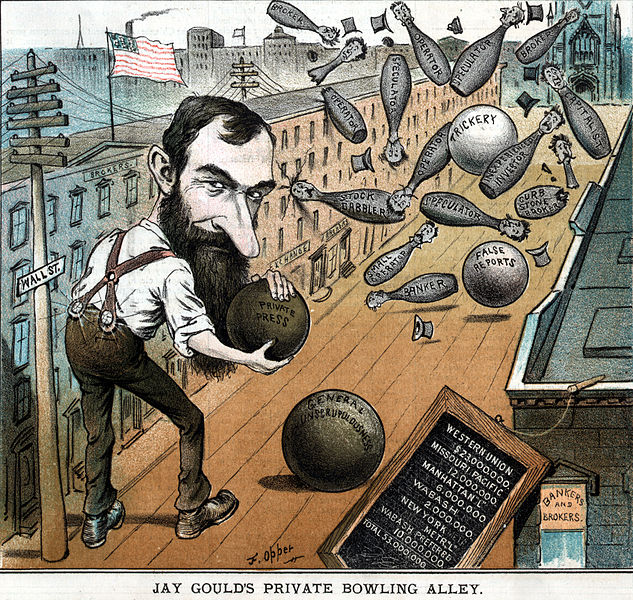
“Jay Gould’s Private Bowling Alley.” Financier and stock speculator Jay Gould is depicted on Wall Street, using bowling balls titled “trickery,” “false reports,” “private press” and “general unscrupulousness” to knock down bowling pins labeled as “operator,” “broker,” “banker,” “inexperienced investor,” etc. A slate shows Gould’s controlling holdings in various corporations, including Western Union, Missouri Pacific Railroad, and the Wabash Railroad.
From the cover of Puck magazine Vol. XI, No 264 via Wikimedia Commons.

… I liken Karl Marx to one of those bird-masked medieval Plague doctors — he sees the pathology clearly, indeed far faster and better than anyone else, but his proposed “cure” is far likelier to kill you than the actual disease. Worse, what makes Marx’s cure especially lethal is what ends up making his diagnosis essentially right: It’s a self-fulfilling prophecy.

The proletariat is achieving class consciousness, all right — look no further than the GameStop “short squeeze” for proof. But the only reason the proles are achieving class consciousness is because the “capitalists” forced them to, just like Marx said they would. The Elite and the Bureaucracy (usually, but not always, a distinction without a difference) finally achieved class consciousness through the combination of NAFTA and the Louvre Accords. Starting around 1990, then, the Elite self-consciously embraced their role as rootless, stateless, jet-setting parasites (with the wannabe-Elites in the Media, academia, and the bureaucracies signing up for tours of duty as fart-catchers, both to bask in reflected glory and in hopes of being promoted).
In short, our “Capitalists” — really, “financial-ists” or “spreadsheet gangsters,” since they don’t actually make anything, they just bust out existing firms via debt manipulation — behave exactly as Marx described factory owners behaving all the way back in the First Industrial Revolution.

In my naivete, I used to think Marx’s ranting was hyperbole. I cited the example of Andrew Carnegie — a real bastard in his youth, who went on to be one of the world’s great philanthropists. That’s human behavior, I said, as opposed to the bloodthirsty caricature of Marx’s fantasies … but I was wrong, comrades. Carnegie happily would’ve sold his fellow Americans down the river, just as Bezos, Gates, and the rest of the pirates-in-neckties are happily selling us down the river now. Only two things prevented it back then: one structural, one cultural.

The structural one is simply technology, and therefore uninteresting. Britain’s “free traders” — you know, the Jardine-Matheson types who started the Opium Wars for fun and profit — would’ve happily outsourced Britain’s entire industrial base to China if they hadn’t been hampered by wind speed. By the time this was technically feasible — which is about 1860, if you’re keeping score — simple inertia had taken over. They didn’t retool until they had to, at which point instant communications and modern ships … well, you know the rest. Like I said, it’s vital, but boring.

The cultural one is much more interesting. You might be tempted to say, as I did, that Jardine and Matheson were always on the lookout for #1, of course, but were sincere British patriots for all that, just as Carnegie for all his faults was an authentic American. I doubt it, comrades. I sincerely doubt it. What kept these guys in check wasn’t patriotism, or even culture. Rather, it was fear.

The History of Hollywood

Filed under: Business, History, Media, USA — Tags: , , , , , , , — Nicholas @ 04:00

The Cynical Historian
Published 3 Sep 2020

This episode is about the history of Hollywood, and it’s quite a long one. This is part 9 in a long running series about California history.

————————————————————

references:
Bernard F. Dick, Engulfed: The Death of Paramount Pictures and the Birth of Corporate Hollywood (Lexington: The University Press of Kentucky, 2001). https://amzn.to/3f2Yb0S​

Hollywood’s America: United States History Through its Films, eds. Mintz, Steven and Randy Roberts (St. James, N.York: Brandywine Press, 1993). https://amzn.to/2tZIoJT

Richard Slotkin, Gunfighter Nation: The Myth of the Frontier in Twentieth-Century America (New York: Atheneum Books, 1992). https://amzn.to/2KX0jI2

Kevin Starr, Inventing the Dream: California through the Progressive Era, (Oxford, U.K.: Oxford University Press, 1985). https://amzn.to/2VPTbVX​

————————————————————

Support the channel through PATREON: https://www.patreon.com/CynicalHistorian​
or by purchasing MERCH: teespring.com/stores/the-cynical-hist…​

LET’S CONNECT:
Twitch: https://www.twitch.tv/cynicalhistorian​
Discord: https://discord.gg/Ukthk4U​
Twitter: https://twitter.com/Cynical_History​
Subreddit: https://www.reddit.com/r/CynicalHistory/​

————————————————————

Wiki: By 1912, major motion-picture companies had set up production near or in Los Angeles. In the early 1900s, most motion picture patents were held by Thomas Edison’s Motion Picture Patents Company in New Jersey, and filmmakers were often sued to stop their productions. To escape this, filmmakers began moving out west to Los Angeles, where attempts to enforce Edison’s patents were easier to evade. Also, the weather was ideal and there was quick access to various settings. Los Angeles became the capital of the film industry in the United States. The mountains, plains and low land prices made Hollywood a good place to establish film studios.

Director D. W. Griffith was the first to make a motion picture in Hollywood. His 17-minute short film In Old California (1910) was filmed for the Biograph Company. Although Hollywood banned movie theaters — of which it had none — before annexation that year, Los Angeles had no such restriction. The first film by a Hollywood studio, Nestor Motion Picture Company, was shot on October 26, 1911. The H. J. Whitley home was used as its set, and the unnamed movie was filmed in the middle of their groves at the corner of Whitley Avenue and Hollywood Boulevard.

The first studio in Hollywood, the Nestor Company, was established by the New Jersey–based Centaur Company in a roadhouse at 6121 Sunset Boulevard (the corner of Gower), in October 1911. Four major film companies – Paramount, Warner Bros., RKO, and Columbia – had studios in Hollywood, as did several minor companies and rental studios. In the 1920s, Hollywood was the fifth-largest industry in the nation. By the 1930s, Hollywood studios became fully vertically integrated, as production, distribution and exhibition was controlled by these companies, enabling Hollywood to produce 600 films per year.

Hollywood became known as Tinseltown and the “dream factory” because of the glittering image of the movie industry. Hollywood has since become a major center for film study in the United States.
————————————————————
Hashtags: #history​ #Hollywood​ #California

Well, it is a very, very cunning plan …

Filed under: Government, History, Media, Politics, USA — Tags: , , , , , , — Nicholas @ 03:00

In the latest Libertarian Enterprise, Sarah Hoyt explains why the progressives’ cunningest of cunning plans may not be cunning enough:

The left has a plan so cunning that if it were a person, it would be teaching cunningology at Oxford. And the ones who get the reference will also know that their plan is about to go pear shaped in all sorts of interesting ways, and at the end of it there might very well be a turnip or two involved, but not as the only item available in the shelves of the grocery store.

Look, someone pointed out in the comments the left are trying to follow the “plan” for other communist revolutions round the world.

He’s right. They’re trying to follow it to the letter. Partly because it’s worked before, and partly, because to be fair, they’re a cult, and cults don’t know the reason for the ritual, they just follow it.

… but it’s already going wrong. And it’s only going to get worse.

You see, part of the problem is that the cult of communism and the procedures for “the revolution” were set in the early twentieth century. And it’s designed for the early twentieth century. To the extent they worked in places like Venezuela, it is because the underlying structures of the society were still very much “early twentieth century.”

The US? Well, not so much. In fact we never were much like the early twentieth century in Europe, which is why they’ve had a hell of a time getting a foothold here.

The communist revolution is designed to work in a country that is mostly urban, with a vast urban underclass that can’t rise above for reasons both internal and external despite working unreasonable hours. It’s designed for a country with a firm aristocracy of the hereditary sort (even if that aristocracy is often from trade), it is designed for a country with a conscript army where the plum assignments go to the “good families” as a matter of course, it is designed to work — most of all and very importantly — in a country where they ABSOLUTELY control all the means of mass communication and do so without the vast majority of the people being aware of it.

The last time they could have pulled that off in the US was in the mid seventies. And my guess, honestly, is that they tried. I don’t know for sure, since the news of the time were all reported by biased sources, and besides I’m too lazy and too busy […] to spend my day chasing down hints. I bet they did try, though. I bet they gave it a sporting try. And I bet part of the issue back then — as now, btw — is that they were pinning their hopes on a race war, having both not realized how much of a minority people of African descent are in the US (last estimate is what? 14%? Sizeable, sure, but not a large minority and certainly not a majority. Also, and seriously, a lot of that minority is middle class and whatever they voice from the mouth-out as uninterested as the rest of us in having the apple cart overturned. Apples are tasty. Genocide not so much.) Mostly because that sh*t was so successful in Africa, and again the left doesn’t think. It ritualistically applies “what worked” without being able to account for changed conditions.

Anyway, that was the last time they could have MAYBE credibly have followed their little red map to revolution and have it work. And even then Americans were just too darn contrarian. Why everyone and their parents were telling us that Republicans were so dangerous, that they were going to start the nuclear war, that — And we went and voted Reagan in. (Well, not me. I only worked towards it. I didn’t vote. I wasn’t a citizen and I’m not a democrat.)

In fact, America could have engraved on its door lintel “authorities can go f*ck themselves.” The left keeps forgetting that. And sometimes justifiably. Take their Covid-psy-ops. It worked. And it was all run on the “experts” and how important it was.

Uh uh. So, they think their control is back! They’re golden again, baby!

« Newer PostsOlder Posts »

Powered by WordPress