Quotulatiousness

August 4, 2021

QotD: The Bell Curve of the benefits of (modern) education

Filed under: Education, Humour, Quotations, USA — Tags: , , — Nicholas @ 01:00

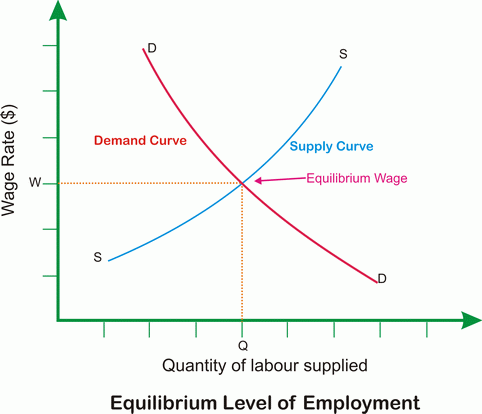
It’s become clear over the last two or three decades that the benefits of education follow a bell curve (see the image at the top of this item).

On the far left of the curve is a newborn — who has learned literally nothing, knows nothing, and has received no benefit from education.

As we learn from our parents at home and our teachers at school, we progress along the curve with benefits accumulating along the way.

But something happens somewhere between sophomore year Vivisecting the Deconstructed Patriarchy 201 at Bleeding Heart College and achieving the dream of earning that Ph.D. from the University of Charging More Than a Mortgage for your dissertation on Imposing Ruthless Meaninglessness on Others.

Somewhere just on the right side of the bell curve, we devolve along the curve with detriments accumulating along the way.

By the time you’re as well educated as Dr. Swannie Jett, you’re so untethered from reality that you’re basically impervious to knowledge.

Stephen Green, “Insanity Wrap #198: Looted & Burned Target Store Puts Up Mural Celebrating Arson”, PJ Media, 2021-05-03.

August 3, 2021

1848 – The Year of (Failed) Revolutions I GLORY & DEFEAT

Filed under: Europe, France, Germany, Government, History — Tags: , , , , — Nicholas @ 04:00

realtimehistory
Published 7 Jul 2021

Support Glory & Defeat: https://realtimehistory.net/gloryandd…

The year 1848 was pivotal in European history. All across the continent revolutionary movements erupted and demanded a new order. This would be no different in France and in the German states.

» OUR PODCAST
https://realtimehistory.net/podcast – interviews with historians and background info for the show.

» LITERATURE
Engehausen, Frank: Die Revolution von 1848/49. Paderborn, München 2007

Gall, Lothar (Hrsg.): 1848 – Aufbruch zur Freiheit: Ausstellungskatalog zum 150-jährigen Jubiläum der Revolution von 1848/49. Berlin 1998

Gouttman, Alain. La grande défaite de 1870-1871. Paris 2015

Siemann, Wolfram: Die deutsche Revolution von 1848/49. Suhrkamp, Frankfurt am Main 1985

Wollstein, Günter: “Scheitern eines Traumes”. In: Informationen zur politischen Bildung, Heft 265 (2010) o.S.

» SOURCES
Carrey, Émile: Recueil complet des actes du Gouvernement provisoire. Première partie n° 281. Paris 1884

Haupt, Hermann (Hrsg.): Quellen und Darstellungen zur Geschichte der Burschenschaft und der deutschen Einheitsbewegung, Band 1, Heidelberg 1910

N.N.: Die Staats-Verträge des Königsreichs Bayern von 1806 – 1858. Regensburg 1860

» OUR STORE
Website: https://realtimehistory.net

»CREDITS
Presented by: Jesse Alexander
Written by: Cathérine Pfauth, Prof. Dr. Tobias Arand, Jesse Alexander
Director: Toni Steller & Florian Wittig
Director of Photography: Toni Steller
Sound: Above Zero
Editing: Toni Steller
Motion Design: Philipp Appelt
Mixing, Mastering & Sound Design: http://above-zero.com
Maps: Battlefield Design https://www.battlefield-design.co.uk/
Research by: Cathérine Pfauth, Prof. Dr. Tobias Arand
Fact checking: Cathérine Pfauth, Prof. Dr. Tobias Arand

Channel Design: Battlefield Design

Contains licensed material by getty images
All rights reserved – Real Time History GmbH 2021

History Summarized: Abrahamic Religious Philosophy

Overly Sarcastic Productions
Published 12 Jun 2017

Alrighty, here goes nothing. With three religions’ individual histories in the bag, and one campaign each by the Muslims and Christians covered on this channel, let’s see if we can find a way to all get along.

RELEVANT LINKS:
History Summarized: Islam: https://youtu.be/Uvq59FPgx88?
History Summarized: Christianity: https://youtu.be/A86fIELxFds?
History Summarized: Judaism: https://youtu.be/aKB6WduDwNE?
History Summarized: Christianity, Judaism, and the Muslim Conquest https://wp.me/p2hpV6-gQv
History Summarized: The Crusades: https://youtu.be/wZhyDIIkeLo​

PATREON: www.patreon.com/user?u=4664797

MERCH LINKS:
Shirts – https://overlysarcasticproducts.threa…?
All the other stuff – http://www.cafepress.com/OverlySarcas…?

Find us on Twitter @OSPYouTube!

QotD: Robert Heinlein predicted the 2020s amazingly well in 1959

Filed under: Books, Quotations, USA — Tags: , , , , , , — Nicholas @ 01:00

[High school Moral Philosophy teacher and retired Mobile Infantry Colonel Jean DuBois lecturing his class on juvenile delinquents and the permissive society that helped create them:]

“[These] unfortunate juvenile criminals were born with none, even as you and I, and they had no chance to acquire any; their experiences did not permit it. What is ‘moral sense’? It is an elaboration of the human instinct to survive. The instinct to survive is human nature itself, and every aspect of our personalities derives from it. Anything that conflicts with the survival instinct acts sooner or later to eliminate the individual and thereby fails to show up in future generations.

“But the instinct to survive can be cultivated into motivations more subtle and much more complex than the blind, brute urge of the individual to stay alive. [What one] miscalled ‘moral instinct’ was the instilling in you by your elders of the truth that survival can have stronger imperatives than that of your own personal survival. Survival of your family, for example. Of your children … of your nation. And so on up.

“[These] juvenile criminals hit a low level. Born with only the instinct for survival, the highest morality they achieved was a shaky loyalty to a peer group, a street gang. But the do-gooders attempted to ‘appeal to their better natures’, to ‘reach them’, to ‘spark their moral sense’. They had no ‘better natures’; experience taught them that what they were doing was the way to survive. The puppy never got his spanking; therefore what he did with pleasure and success must be ‘moral’.

“The basis of all morality is duty, a concept with the same relation to group that self-interest has to individual. Nobody preached duty to these kids in a way they could understand — that is, with a spanking. But the society they were in told them endlessly about their ‘rights.'”

Robert A. Heinlein, Starship Troopers, 1959, quoted by Dave Huber in “Libertarian sci-fi author predicted current progressive-induced cultural failures over 60 years ago”, The College Fix, 2021-04-03.

August 2, 2021

The World of the Franco-Prussian War – The 19th Century up to 1870 I GLORY & DEFEAT

realtimehistory
Published 30 Jun 2021

Support Glory & Defeat: https://realtimehistory.net/gloryandd…

Welcome to the first primer episode for Glory & Defeat. In this first primer episode we will take a broad look at the industrial revolution and the emerging new ideologies of the 19th century: Communism and Nationalism.

» OUR PODCAST
https://realtimehistory.net/podcast – interviews with historians and background info for the show.

» LITERATURE
Hobsbawm, Eric: The long nineteenth century. 3 Bände. London 1962-1987

Kugler, Martin: “Fehleinschätzungen der Menschheit”, in: Die Presse v. 28.2.2010. o.S

Osterhammel, Jürgen: Die Verwandlung der Welt. Eine Geschichte des 19. Jahrhunderts. München 2009

Bruckmüller, Ernst et. al. (ed.): Putzger. Historischer Weltatlas. Berlin 2001

Staas, Christian: “Im Schatten der Schlote”, in: Geo Epoche Nr. 30. Die industrielle Revolution. 2008. S. 72-85

Bischoff, Jürgen: “Vorwärts durch Raum und Zeit”, in: Geo Epoche Nr. 30. Die industrielle Revolution. 2008. S. 56-71

» SOURCES
Engels, Friedrich: Die Lage der arbeitenden Klasse in England. Leipzig 1845

» OUR STORE
Website: https://realtimehistory.net

»CREDITS
Presented by: Jesse Alexander
Written by: Cathérine Pfauth, Prof. Dr. Tobias Arand, Jesse Alexander
Director: Toni Steller & Florian Wittig
Director of Photography: Toni Steller
Sound: Above Zero
Editing: Toni Steller
Motion Design: Philipp Appelt
Mixing, Mastering & Sound Design: http://above-zero.com
Maps: Battlefield Design https://www.battlefield-design.co.uk/
Research by: Cathérine Pfauth, Prof. Dr. Tobias Arand
Fact checking: Cathérine Pfauth, Prof. Dr. Tobias Arand

Channel Design: Battlefield Design

Contains licensed material by getty images
All rights reserved – Real Time History GmbH 2021

Who is Colt? A History of the Colt Patent Firearms Manufacturing Company

Filed under: Business, History, USA, Weapons — Tags: , , , , , , — Nicholas @ 02:00

Forgotten Weapons
Published 23 Feb 2017

Today we will take a look at the history of the Colt company, from Sam Colt’s first efforts in Paterson (and before) to the West Hartford remnants that survive today. If you enjoy this type of history, please let me know in the comments!

http://www.patreon.com/ForgottenWeapons

Cool Forgotten Weapons merch! http://shop.bbtv.com/collections/forg…​

If you enjoy Forgotten Weapons, check out its sister channel, InRangeTV! http://www.youtube.com/InRangeTVShow

Gun display racking provided by Matrix Armory: http://www.matrixarmory.com

QotD: Western military superiority

Filed under: History, Military, Quotations — Tags: , , — Nicholas @ 01:00

Many scholars have been reluctant to discuss the question of European military superiority because either they confuse it with larger issues of intelligence or morality or they focus on occasional European setbacks as if they are typical and so negate the general rule of Western dominance. In fact, the European ability to conquer non-Europeans — usually far from Europe, despite enormous problems in logistics, with relatively few numbers of combatants, and in often unfamiliar and hostile terrain and climate — has nothing to do with questions of intelligence, innate morality or religious superiority, but again illustrates the continuum of a particular cultural tradition, beginning with the Greeks, that brought unusual dividends to Western armies on the battlefield.

Victor Davis Hanson, Carnage and Culture, 2001.

August 1, 2021

Not a Step Back! – Wehrmacht Closes in on Stalingrad – WW2 – 153 – July 31, 1942

World War Two
Published 31 Jul 2021

Operation Edelweiss opens with a blast, and as the Wehrmacht closes in on Stalingrad, Stalin issues that famous order. There aren’t just big actions in the East, the Japanese have landed in New Guinea, the Allies try one more offensive at El Alamein, and the Americans have locked in on Guadalcanal.
(more…)

Christopher Hitchens on George Orwell

DailyHitchens
Published 22 Jan 2010

Aug 7, 2009. Christopher Hitchens talks with EconTalk host Russ Roberts about George Orwell. Drawing on his book Why Orwell Matters, Hitchens talks about Orwell’s opposition to imperialism, fascism, and Stalinism, his moral courage, and his devotion to language. Along the way, Hitchens makes the case for why Orwell matters. For more videos, updates and info on Christopher Hitchens, please visit http://www.dailyhitchens.com

Gresham’s Law, as applied to photography

Filed under: Books, Media, Technology — Tags: , , — Nicholas @ 03:00

In economics, Gresham’s Law states that “bad money drives out good”, that may need to be reformulated as it applies to modern standards of photography in a formulation something like: “bad photos drive out good photos“:

“Art is like a joke, either you get it or you don’t.” So it was explained to me in the late 1970s by photographer Randy Eriksen, whose cheeky observation about the importance of context to one’s appreciation of either comedy or art could have been a parenthetical second subtitle for author and educator Kim Beil’s Good Pictures: A History of Popular Photography (Stanford University Press, 2020).

Beil’s episodic and highly readable book identifies 50 photographic trends — illustrated by hundreds of vintage and contemporary photographs — that have guided the aesthetics of photography since 1851, when a group of American daguerreotypes made a splash at the Crystal Palace Exhibition in London. Back in 1851, context mostly equaled 1851, as the latest photo technology of the day played a major role in how Victorians decided that one picture was good and another was not.

[…]

Beil’s own context began in Albany, New York, where she grew up. “My mom was into photography,” Beil tells me over the phone. “She was the one who took the pictures in my family. When my parents got me my first camera, a Nikon FE, they made me attend a class offered by the camera store. I remember it was held in this dark ballroom at an Albany hotel. It was me and a bunch of middle-aged men. That’s where I learned about 35mm cameras, f-stops, and shutter speeds.”

“How To Make Good Pictures” (Rochester, NY: Eastman Kodak Co., 1943).
Source: Collection of the Prelinger Library, via Collectors Weekly.

Beil also learned from various “How to Make Good Pictures” manuals published by Kodak, which also hailed from upstate New York. “I’m pretty sure I internalized the advice I read in ‘How to Make Good Pictures’,” Beil says of her early aesthetic indoctrination, “things like avoiding centering your subject in the frame, the rule of thirds, shooting during ‘golden hour’, all that conventional wisdom.”

[…]

“Intention is central to the way I think about art, and maybe even how we define it,” Beil agrees. “Take lens flare: I think the power of lens flare comes from its initial unintentional use by people who were just taking casual pictures without any premeditation, without much intention.” In these sorts of photographs, Beil says, lens flare was an amateur mistake that conferred “a kind of authenticity to an image.” That’s why advertisers find lens flare so appealing. “Because we still associate it with authenticity,” Beil says, “it makes an advertising photo seem more real, maybe even spontaneous.”

Today, lens flare is so widely used, so intentional, that billions of smartphone cameras offer multiple variations of this former failing in the form of filters, which can be activated with a click or a swipe. “Everything can be achieved and there are no more accidents,” Beil says of photography in the 2020s, “so photographers look to things that happened before to reinsert some kind of authenticity into their pictures.” Thanks to technology, photographers can now pretend to take pictures as if they lacked the tools to make their pictures, well, good.

The problem, of course, is that technology is intrusive, inserting itself into aesthetics and even cultural paradigms without being invited to do so. “We have a situation today,” Beil says, “in which our smartphone cameras are producing pictures according to the criteria of software designers, who have made a lot of egregious assumptions about the tonality of skin color.” According the Beil, because the sample sets used by software designers have historically included more pictures of light skin tones than dark skin tones, the colors captured by our smartphone cameras do a better job of reproducing the lighter skin tones. “People with darker skin aren’t represented in the way that they want to be,” she says, “or even in the way that’s accurate. Google has promised that the Pixel 6 camera coming out in October 2021 is going to deal with that problem,” she adds, but Beil doesn’t sound like she’s expecting much more than an incremental improvement.

Crown Colony class – Guide 144

Filed under: Britain, History, Military, Weapons, WW2 — Tags: , , , — Nicholas @ 02:00

Drachinifel
Published 28 Sep 2019

The Crown Colony class cruisers of the Royal Navy, and many others, are today’s subject.

Want to support the channel? – https://www.patreon.com/Drachinifel​

Want a shirt/mug/hoodie – https://shop.spreadshirt.com/drachini…​

Want a medal? – https://www.etsy.com/uk/shop/Drachinifel​

Want to talk about ships? https://discord.gg/TYu88mt

Want to get some books? www.amazon.co.uk/shop/drachinifel

Drydock Episodes in podcast format – https://soundcloud.com/user-21912004

QotD: Rudolf Gaida’s convoluted military career

Filed under: Europe, History, Military, Quotations, Russia, WW1, WW2 — Tags: , , , , , — Nicholas @ 01:00

Rudolf Gaida, 1882-1948. Born in Montenegro (then a part of Austria-Hungary). Trained as a pharmacist in Bohemia. Conscripted into the army medical corps, July 1914. Deserted to a Montenegrin regiment, pretending to be an officer, 1915. Captured by the Russians, 1917. In May 1918, with the rank of Captain, he served in the Czechoslovak Corps, and favoured fighting the Bolsheviks. Colonel commanding the Czech forces in Central Siberia, July-October 1918. Supported Admiral Kolchak’s seizure of power at Omsk, November 1918. Promoted Major-General by Kolchak, November 1918. Commanded Kolchak’s Northern Army, June-July 1919, with the rank of Lieutenant-General. Dismissed by Kolchak, July 1919. Attempted unsuccessfully to seize power at Vladivostok, November 1919. Returned to Czechoslovakia, 1920. Chief of the Czech General Staff, 1926. Cashiered for trying to take part in a fascist putsch. Imprisoned for “Banditry”, 1931. Headed the Czech Fascist organization, 1939-45. Arrested as a collaborator, 1945, and subsequently shot.

Footnote in Martin Gilbert’s World in Torment: Winston S. Churchill 1917-1922, 1975.

July 31, 2021

Rowan Atkinson Live – With friends like these AKA the wedding from hell

Filed under: Britain, Humour — Tags: , — Nicholas @ 04:00

Rowan Atkinson Live
Published 24 Sep 2010

Also know as the wedding from hell, Rowan plays 3 very different but horribly hilarious characters including a priest who talks about fellatio …

English sea-borne trade in the early 17th century

Filed under: Africa, Americas, Asia, Books, Britain, Europe, History — Tags: , , , , , , — Nicholas @ 03:00

In the latest Age of Invention newsletter, Anton Howes reviews a book on English trade … a very old book:

I’ve become engrossed this week by a book written in 1638 by the merchant Lewes Roberts — The Marchant’s Mappe of Commerce. It is, in effect, a guide to how to be a merchant, and an extremely comprehensive one too. For every trading centre he could gather information about, Roberts noted the coins that were current, their exchange rates, and the precise weights and measures in use. He set down the various customs duties, down even to the precise bribes you’d be expected to pay to various officials. In Smyrna, for example, Roberts recommended you offer the local qadi some cloth and coney-skins for a vest, the qadi‘s servant some English-made cloth, and their janissary guard a few gold coins.

Unusually for so many books of the period, Roberts was also careful to be accurate. He often noted whether his information came from personal experience, giving the dates of his time in a place, or whether it came second-hand. When he was unsure of details, he recommended consulting with better experts. And myths — like the rumour he heard that the Prophet Muhammad’s remains at Mecca were in an iron casket suspended from the ceiling by a gigantic diamond-like magnet called an adamant — were thoroughly busted. Given his accuracy and care, it’s no wonder that the book, in various revised editions, was in print for almost sixty years after his death. (He died just three years after publication.)

What’s most interesting about it to me, however, is Roberts’s single-minded view of English commerce. The entire world is viewed through the lens of opportunities for trade, taking note of the commodities and manufactures of every region, as well as their principal ports and emporia. A place’s antiquarian or religious tourist sites, which generally make up the bulk of so many other geographical works, are given (mercifully) short shrift. Indeed, because the book was not written with an international audience in mind, it also passes over many trades with which the English were not involved, or from which they were even excluded. It thus provides a remarkably detailed snapshot of what exactly English merchants were interested in and up to on the eve of civil war; and right at the tail end of a century of unprecedented growth in London’s population, itself seemingly led by its expansion of English commerce.

So, what did English merchants consider important? It’s especially illuminating about England’s trade in the Atlantic — or rather, the lack thereof.

Roberts spends remarkably little time on the Americas, which he refers to as the continents of Mexicana (North America) and Peruana (South America). Most of his mentions of English involvement are about which privateers had once raided which Spanish-owned colonies, and he gives especial attention to the seasonal fishing for cod off the coast of Newfoundland — a major export trade to the Mediterranean, and a source of employment to many English West Country farmers, who he refers to as being like otters for spending half their lives on land and the other half on sea.

But as for the recently-established English colonies on the mainland, which Roberts refers to collectively as Virginia, he writes barely a few sentences. Although he reproduces some of the propaganda about what is to be found there — no mention yet of tobacco by the way, with the list consisting largely of foodstuffs, forest products, tar, pitch, and a few ores — the entirety of New England is summarised only as a place “said to be” resorted to by religious dissenters. The island colonies on Barbados and Bermuda were also either too small or too recently established to merit much attention. To the worldly London merchant then, the New World was still peripheral — barely an afterthought, with the two continents meriting a mere 11 pages, versus Africa’s 45, Asia’s 108, and Europe’s 262.

The reason for this was that the English were excluded from trading directly with the New World by the Spanish. It was, as Roberts jealously put it, “shut up from the eyes of all strangers”. The Spanish were not only profiting from the continent’s mines of gold and silver, but he also complained of their monopoly over the export of European manufactures to its colonies there. It’s a striking foreshadowing of what was, in the eighteenth century, to become one of the most important features of the Atlantic economy — the market that the growing colonies would one day provide for British goods. Indeed, Roberts’s most common condemnation of the Spanish was for having killed so many natives, thereby extinguishing the major market that had already been there: “had not the sword of these bloodsuckers ended so many millions of lives in so short a time, trade might have seen a larger harvest”. The genocide had, in Roberts’s view, not only been horrific, but impoverished Europe too (he was similarly upset that the Spanish had slaughtered so many of the natives of the Bahamas, known for the “matchless beauty of their women”).

Can You Swordfight in a Wedding Dress?

Filed under: Humour, Weapons — Tags: , , — Nicholas @ 02:00

Jill Bearup
Published 17 May 2021

If you’re anticipating sword-wielding baddies at your wedding, you may well need these handy tips on the best way to sword fight in your wedding dress, or other big-skirted ballgown.

Live your best dark royaltycore life, who am I to tell you not to.

Contains very little actual fighting, because … who am I even going to fight?

Still, maybe people will be available for more fight shenanigans soon.

Music from epidemicsound.com
“Oceanic Adventure” – Bonnie Grace
“Rendezvous in D Minor” – Trevor Kowalski
“Faith Arise” – Edgar Hopp

« Newer PostsOlder Posts »

Powered by WordPress