Quotulatiousness

August 29, 2021

Justin Trudeau discovers for himself the truth of Harold Macmillan’s dictum on the most difficult thing about being Prime Minister

Filed under: Asia, Cancon, Politics — Tags: , , , , — Nicholas @ 05:00

Former British Prime Minister Harold Macmillan was asked what was the most difficult thing about his job and is reported to have said, “Events, my dear boy, events.” Justin Trudeau had everything he wanted in the Canadian political situation in early August so he put his early election plans into action … and along came those unpredictable events:

“2019 Canadian federal election – VOTE” by Indrid__Cold is licensed under CC BY-SA 2.0

What would have happened in the election of 2021 if Afghanistan hadn’t fallen? If the writ had been drawn up just a few weeks before, or a few weeks after August 15, the day Kabul fell to the Taliban?

This is the sort of question political science nerds will debate over weak beer for decades to come. It’s no great mystery why the Liberals went forward with the election even as armed fighters began to stream into the capital city of a country in which Canadians have sacrificed so much time, blood and treasure.

But I can picture the scene in the war room now and the logic is inescapable. The meeting with the governor general had been set, the news leaked, the campaign messaging laid out, the suits pressed and the planes booked. Besides, as we all know: “nobody cares about foreign affairs.” That old cant, repeated, like a charm.

Most of the time, it’s true.

Canadians hadn’t thought about Afghanistan for a decade. We’d all stopped paying any mind to some poor nation on the dark side of the world, that disputed chunk of mountain and desert besieged by misery and war since the time of Alexander the Great.

Nobody cares about such things. Until they do.

And what’s the difference between a foreign affair that we care about, and one that we do not? The answer is not flattering. We are selfish and solipsistic creatures. We care about current events abroad when what’s happening has some connection to ourselves or our interests — or when the news reflects something about ourselves.

I would not be the first pundit to point out the parallel between the fall of Kabul and the death of Alan Kurdi, the three-year old Syrian refugee boy whose body washed ashore after drowning in the Mediterranean Sea in September of 2015, in the midst of the federal election that brought Justin Trudeau to power. That child’s doll-like body, face-down on a beach, destroyed us, and the tragedy was made more pointed with the discovery that his family had been trying to reach Canada. And that his asylum application had been rejected by officials in Stephen Harper’s government.

In our own bureaucratic nightmare, and Harper’s dispassionate response, we saw reflected our own lack of compassion.

What we are confronting now in Kabul is our lack of competence.

Yamamoto: Midway Round Two? – World War Two – 157 – August 28, 1942

World War Two
Published 28 Aug 2021

The Battle of the Eastern Solomons takes place this week — another carrier battle. As for the Germans, they’re advancing on Stalingrad, slowing down in the Caucasus, and Erwin Rommel is preparing to launch another assault in North Africa.
(more…)

The competing English and Dutch East India companies

In his latest Age of Invention newsletter, Anton Howes considers the odd fact that although the Dutch were the last major seafaring power to extend to the East Indies, they quickly became the most powerful European traders and colonialists in the region:

By the mid-seventeenth century, although the trans-Atlantic trades were still almost entirely in the hands of the Spanish, the European trade to the Indian Ocean had come to be dominated by the Dutch — which is quite surprising, as they had arrived so late. The high-value exports of the Indian Ocean — particularly pepper — had anciently arrived via the Red Sea, the Persian Gulf, or overland, and then been bought up in Egypt or Syria by the Venetians and Genoese, who then sold them on to the rest of Europe. It was then the Portuguese who had supplanted that trade in the late fifteenth century by discovering the direct route to the Indian Ocean around the Cape of Good Hope. The Portuguese monopolised the new sea route around Africa for a century, almost totally undisturbed by other Europeans, entrenching their position by building forts — occasionally with the permission of local rulers, but often without.

The Portuguese seem to have spread the rumour in Europe that they had effectively conquered the entire region, presumably to dissuade others from even trying to break their monopoly. Even as late as the 1630s, when other nations were already regularly trading there, foreign writers took the time to mock such assertions. As the Welsh-born merchant Lewes Roberts put it, the Portuguese “brag of the conquest of the whole country, which they are in no more possibility entirely to conquer and possess, than the French were to subdue Spain when they possessed of the fort of Perpignan, or the English to be masters of France when they were only sovereigns of Calais.” Quite.

[…]

But for all their tardiness, the Dutch arrival in the Indian Ocean was dramatic. The English may have been the first to threaten the Portuguese monopoly, but in the whole of the 1590s they sent a mere two expeditions out east, and in 1600-10 sent only a further eight (seven by the newly-chartered East India Company (EIC), with a monopoly over English trade with the region, and another voyage licensed to break that monopoly in 1604 by the king, which unhelpfully spoiled the company’s relations with local rulers by turning pirate and plundering Indian and Chinese ships). What the English sent out over the course of twenty years, the Dutch exceeded in just five. Between just 1598 and 1603, after the successful return of de Houtman’s first voyage, they sent out a whopping thirteen fleets — and this despite their merchants not even pooling their efforts like the English had until the very end of that period, when in 1602 the various small and city-based Dutch companies were merged to form a single, national joint-stock monopoly, the Verenigde Oost-Indische Compagnie (VOC). The founding of the VOC accelerated the divergence. Between 1613 and 1622 the EIC sent out a paltry 82 ships compared to the VOC’s 201.

The sheer quantity of Dutch ships heading for the Indian Ocean meant that they were soon dominant amongst the European merchants there, capturing forts from the Portuguese, founding further bases of their own, and able to forcibly keep the English out — sometimes by attacking the English directly, other times by simply threatening any of their would-be trading partners. The steady stream of Dutch ships also allowed them to resupply and maintain their factors — the key infrastructure of long-distance commerce, as I explained in last week’s post for subscribers. They were able to have a presence, and project force, in a way that the English could not. By 1638, Lewes Roberts, despite often lauding England’s commercial achievements, and being an EIC official himself, had to concede that in the Indian Ocean “the English nation are the last and least”.

That English weakness was reflected in how EIC merchants had to comport themselves in the region so as to have any share in the trade at all. Despite the EIC’s later reputation for bloodthirsty rapaciousness, in the early seventeenth century they were highly reliant on good relations with the locals. Whereas the Dutch could often afford to use force and bear the repercussions, the English more or less only held on in the early days by ingratiating themselves with local rulers — often by finding common cause against the aggressive and domineering Dutch. The infrequently-supplied English factors were often heavily indebted to local merchants too, including the Indo-Portuguese — a group that they often married into, for access to social networks and support. As the historian David Veevers argues in a new overview of the early EIC (a relatively pricey academic book, but compellingly argued and juicy with detail), the English often went further than just friendliness or integration, subordinating themselves to local rulers too. Of the few early forts that the English managed to establish, for example, that at Madras in 1640 was only built because the local ruler encouraged it, treating the English there as his vassals.

MP-28: Hugo Schmeisser Improves the MP18

Filed under: Germany, History, Military, Weapons — Tags: , , , — Nicholas @ 02:00

Forgotten Weapons
Published 22 Aug 2017

The MP28,II was Hugo Schmeisser’s improved take on the original World War One MP18,I design. It used a simple box magazine in place of the Luger drum magazines, and this magazine would form the basis for a long series of military SMG magazines. It was a double-stack, single feed design because Schmeisser thought this would prevent some malfunctions that were possible with double-feed magazines (and because Mauser probably had a patent on the double feed box magazine at the time). This magazine would be used in conversions of MP18 guns, and would also be the model for the MP-38/40 and subsequent British Sten gun magazines.

The MP28 also introduced a semiautomatic selector switch, where the MP18 had been a fully automatic-only design. It is the presence of this selector button over the trigger, along with a tangent sight instead of a simple flip-up notch that can be used to distinguish between an updated MP18 and an MP28.

While the MP28 was not formally adopted by the German military, it was used by police and SS units, as well as being adopted or copied by a wide selection of other nations, including Portugal, Spain, China, Japan, and Ethiopia.

http://www.patreon.com/ForgottenWeapons​

Cool Forgotten Weapons merch! http://shop.bbtv.com/collections/forg…​

If you enjoy Forgotten Weapons, check out its sister channel, InRangeTV! http://www.youtube.com/InRangeTVShow

QotD: “LEEEERRRROOOYYYY JEEEEENNNNKIIIIINS!”

Filed under: Gaming, Humour, Quotations — Tags: , — Nicholas @ 01:00

Would it be confessing too much to admit that one of my generation’s formative moments happened in the massively multiplayer online role-playing game World of Warcraft?

The year was 2005, and a diverse collection of mages and warriors were about to storm a mythical castle swarming with flying dragon-like creatures, particularly deadly to their guild. Like true and proper nerds, they met beforehand to discuss their strategy, and with all the detached analysis of a corporate board discussing the latest results of a focus group convened to discuss a brand refresh.

“Christ. OK. Well what we’ll do I’ll run in first, gather up all the eggs,” the leader begins. “I will use Intimidating Shout to kind of scatter them so they don’t have to fight a whole bunch of them at once. When my shout is done, I’ll need Anthony to come in and drop his shout too so we can keep them scattered.

“We’re going to need Divine Intervention on our mages … it is a pretty good plan. We should be able to pull it off this time. What do you think, Abdul? Can you do a number crunch real quick?”

The resident numbers guy responds: “Uh, yeah, give me a second. I’m coming up 32.33 — repeating, of course — percentage of survival.”

“Ah, that’s a lot better than what we usually do …”

Then one of the guild’s resident numbnuts breaks into this dull planning.

“Thumbs up. Let’s do this.

LEEEERRRROOOYYYY JEEEEENNNNKIIIIINS.”

“Oh my God, he just ran in.”

His team dutifully follows … and proceeds to get slaughtered by the dragon things.

“Goddamnit, Leeroy. You moron.”

Whether or not the scene was staged is irrelevant. The guild, “Pals for Life”, may have died in that fight, but glory lives forever. Or, at least, meme glory does. It was a perfect encapsulation of what happens when the best-laid plans come to nothing, when life goes pear shaped, when the odds are bad so, fuck it, you storm the castle anyways.

Jen Gerson, “Alberta goes Leeroy Jenkins on Summer”, The Line, 2021-05-28.

August 28, 2021

Flagging enthusiasm

Filed under: Cancon, Media, Politics — Tags: , , , , — Nicholas @ 05:00

In Friday’s NP Platformed newsletter, Colby Cosh considers the suddenly politically relevant position of the Canadian flag:

The other day, Conservative Leader Erin O’Toole made mention of the fact that the Canadian flag atop the Peace tower in Ottawa has been flying at half-staff for almost three months and that as prime minister he would put it back up — countermanding the specific order Justin Trudeau gave on May 30. O’Toole’s remark was a brief one dropped in at the end of a longer statement, but he did say we should be proud of our flag, which some people still think of as a Liberal contrivance, and he made the point that being proud of Canada goes hand in hand with wishing to improve it.

I saw this the other day and commented on social media that “I expect the Canadian dying media to be All. Over. This. — Conservative leader Erin O’Toole just called for the Canadian flag to be raised (they’ve been at half-staff officially since the end of May). If the media have their way, this will guarantee a huge majority government for their crush, Justin Trudeau.”

I admit, this was a bit glib, and not all the Canadian media are in the tank for Justin, but (as the old joke about lawyers had it) the 90% give the other 10% a bad name.

First of all, if sticking up for the proper display of the flag counts as wrapping oneself in it, doesn’t using it for gestures of regret (or the dreaded “virtue signalling”) really qualify as the mirror image of this? Trudeau made a point of making sure we knew the lowering of the flag was his own initiative. Liberals have spent a couple of generations working their asses off to constantly remind us that it’s a Liberal flag, which is precisely why conservatives in Ontario towns starting with “B” love the Red Ensign. It is natural to wonder whether, given the apparent Liberal sensitivity about our blood-soaked banner, we won’t get a third national flag before everyone’s finished adapting to the second one. […]

Canada is a place where literal Conservatives can’t “wrap themselves” too tightly in the literal flag: this isn’t the United States, where the positioning and context of the flag in ads or on stage will let you know instantly whether you’re at a Republican or a Democratic event. (The presence of an eagle is always a good clue.) Yet our Liberals have manoeuvred themselves into a position, somehow, in which it is awkward to fly the flag too high.

Can Trudeau now set a date for the raising of the flag to its position of respect and dignity, having plumb forgotten to do so in the first place? And if he is the renewed choice of the Canadian people as prime minister, will he be able to hoist the thing back up? Will this happen the day after the election? The first week? After prolonged consultations with First Nations, perhaps involving a royal commission?

You see, there is an aspect to this that goes beyond politicians battering at one another with flagpoles and other national paraphernalia. O’Toole’s comment didn’t just remind us that we’re Canadians and we should like our flag. It reminded us that we have a government that often seems to have a big problem thinking 30 seconds ahead, let alone six months.

An Entire French Army Trapped in Metz During the Franco-Prussian War

Filed under: France, Germany, History, Military — Tags: , , — Nicholas @ 04:00

realtimehistory
Published 26 Aug 2021

Sign up for Curiosity Stream and get Nebula bundled in and SAVE 26%: https://curiositystream.com/realtimeh…

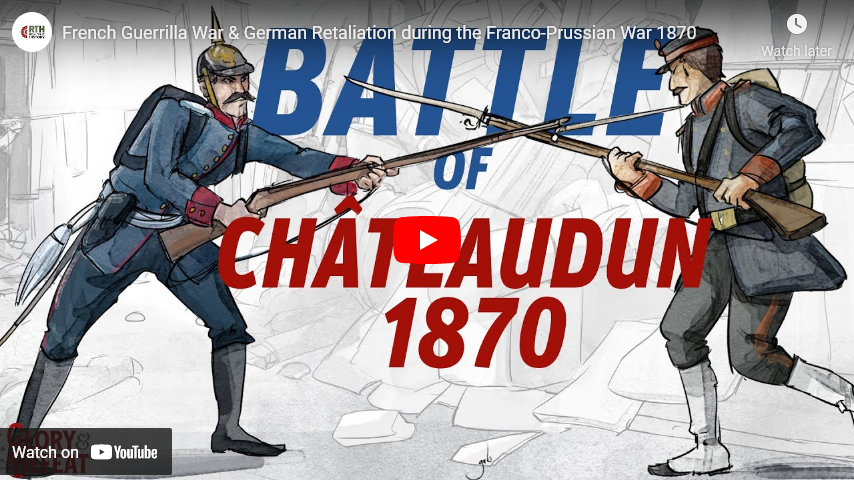
The French Army of the Rhine under Marshal Bazaine is trapped inside Metz — along with civilians and wounded over 250,000 people will need to be fed from the city’s dwindling supplies. Surrounding the city is a German Army that cannot force the Metz fortifications and opts for starving it into submission instead.

» THANK YOU TO OUR CO-PRODUCERS
John Ozment
James Darcangelo
Jacob Carter Landt
Thomas Brendan

» OUR PODCAST
https://realtimehistory.net/podcast – interviews with historians and background info for the show.

» LITERATURE
Arand, Tobias: 1870/71. Der Deutsch-Französische Krieg erzählt in Einzelschicksalen. Hamburg 2018

Bourguinat, Nicolas/Vogt, Gilles: La guerre franco-allemande de 1870. Une histoire globale. Paris 2020

Gouttman, Alain: La grande défaite de 1870-1871. Paris 2015

Herre, Franz: Eugénie. Kaiserin der Franzosen. Stuttgart, München 2000

Milza, Pierre: L’année terrible. Paris 2009

Schikorsky, Isa (Hrsg.): “Wenn doch dies Elend ein Ende hätte”. Ein Briefwechsel aus dem Deutsch-Französischen Krieg 1870/71. Köln, Weimar, Wien 1999

» SOURCES
Bazaine, François-Achille: Episoden aus dem Kriege von 1870 und der Belagerung von Paris. Berlin 1884

Bazaine, François-Achille: Feldzug des Rhein-Heeres vom 12. August bis 28. Oktober 1870. Leipzig 1872

Großer Generalstab (Hrsg.): Der Deutsch-Französische Krieg, 1870–71. Bd. 1–3. Berlin 1874 ff.

Historischer Verein der Höhen von Spicheren des 67. Kaiserlichen Linienregiments der Infaterie (Hrsg.): Das Kriegstagebuch von Clovis Hardy. Soldat im 63. Linienregiment. Deutsch-Französischer Krieg 1870/71. Vom Lager in Châlons bis nach Ansbach in Bayern. O.O. [Esvres] O.J. [2011]

Sternegg, Johann Khoss von: Schlachtenatlas des XIX. Jahrhunderts. Leipzig 1886

» OUR STORE
Website: https://realtimehistory.net

»CREDITS
Presented by: Jesse Alexander
Written by: Cathérine Pfauth, Prof. Dr. Tobias Arand, Jesse Alexander
Director: Toni Steller & Florian Wittig
Director of Photography: Toni Steller
Sound: Above Zero
Editing: Toni Steller
Motion Design: Philipp Appelt
Mixing, Mastering & Sound Design: http://above-zero.com
Maps: Battlefield Design
Research by: Cathérine Pfauth, Prof. Dr. Tobias Arand
Fact checking: Cathérine Pfauth, Prof. Dr. Tobias Arand

Channel Design: Battlefield Design

Contains licensed material by getty images
All rights reserved – Real Time History GmbH 2021

The name “Afghanistan” is becoming a badge of shame for western politicians, and deservedly so

Filed under: Asia, Britain, Cancon, Military, USA — Tags: , , , , , , — Nicholas @ 03:00

In The Line, Matt Gurney points out that while it was probably beyond the capabilities of the Canadian government to evacuate all Afghanis who had assisted Canadian efforts in that country, the actual efforts fell very far short of even “adequate”:

On the second day of the Taliban’s rule in Kabul, the front of Hamid Karzai International Airport was crowded with people trying to travel abroad, but were stopped by Taliban militants, 17 August, 2021.
Public domain image from VOA via Wikimedia Commons.

We have to cut through the fanatics on both sides and be very clear about this: the evacuation was always going to be messy. We were never going to get everyone out. But it is obvious that we did not get out as many people as we should have. It’s clear that we made major errors, including failing to work with veterans and aid groups on the ground; we did not lift bureaucratic hurdles quickly enough. We lost time dithering. That is our shameful failure.

It is not the Canadian government’s fault that our American allies decided to pull out of the conflict. Frankly, I still can’t entirely blame either the Trump or Biden administrations for that decision, although the execution of that decision has been catastrophic.

This was not a decision made in Ottawa, but in Washington, and for entirely American reasons. Further, the Liberals are not to blame for the U.S. government’s massive intelligence failure. We were caught totally flatfooted by the rapid and total collapse of the former Afghan government — what had been expected to take months took days. Canada, a member of both NATO and the Five Eyes, relies heavily on the intelligence gathered by our larger, more powerful ally. I do not fault Liberal party leader Justin Trudeau or his government for being caught unprepared.

So let’s dispense with that nonsense right away. In the big picture, there is not a whole hell of a lot Canadian governments could have done to avoid this crisis.

But we could’ve managed the crisis much better.

Over the last 10 days, we’ve had repeated reports of bottlenecks caused by over-restrictive paperwork requirements. We’ve seen other allies flying helicopters into Kabul to allow them to retrieve their people from sites around the city; Canada has helicopters and the ability to deploy them, but we didn’t follow suit.

Reports indicate that there was a gap of several days in any meaningful Canadian Armed Forces presence on the ground — and that gap set us back in terms of intelligence and planning. Canadian officials reportedly worried about the number of seatbelts on our transport planes even as other allies were loading their aircraft up with as many people as they could (we eventually began cramming evacuees into ours, as well). In several recent pieces here at The Line, Kevin Newman has described the struggle faced by those those trying to escape — people to whom we had had promised safe haven as their lives were now in peril due time they spent helping us during our missions in Afghanistan. There are numerous reports of our government telling these people to show up at gas stations and hotels — only to ghost them.

Facts beyond our control limited how effective we were ever going to be at getting people out, but we did not max out our effectiveness within those constraints. As a result, people will die who did not have to. The gap between the best-possible Canadian response and the actual Canadian response is a gap measured in lives.

I’m always happy to point the finger at Prime Minister Trudeau for his mistakes, but as Matt Gurney writes above, there was little that Trudeau could have done to avert the humanitarian disaster still unfolding around Kabul. The blame for deciding to pull out without adequate (or any) notice to allies or competent logistical and administrative planning lies with Joe Biden, as Conrad Black explains [this was written before the bomb attacks outside the airport in Kabul]:

Biden, in his address last Monday, in his midweek interview with George Stephanopoulos, and in his address on Friday, uttered a series of egregious falsehoods that were quickly exposed. He said there was no expression of discontent from America’s allies. For the first time in history, references to an American president in the British Parliament were met with shouts of “shame”. When Thomas Tugendhat, the chairman of the House of Commons Foreign Relations Committee and a retired colonel who served with distinction in Afghanistan and was decorated by the U.S. 82nd Airborne Division for combat bravery, said that it was shameful for a commander-in-chief who has not served under his own colors to mock the sacrifice of men who have, all parties in the British House agreed. No American president has been so severely or — unfortunately — deservedly insulted.

No American, consuming only mainstream media narratives, would realize that there were three times as many allied forces from assorted NATO countries in Afghanistan as there were Americans, or that they were not consulted before the Americans abruptly departed and brought the roof down on all of them. The Western alliance, as former President Trump emphasized, has its problems. Most of the members were not pulling their weight. Germany, the strongest NATO country after the United States, has almost disarmed and has effectively made itself a Russian energy satellite through the Nord Stream 2 natural gas pipeline. But they did not deserve this.

After this horrifying fiasco, where the Americans scuttled and turned tail and left their European allies and Canada to fend for themselves, the NATO members have already indicated that they are in no mood to follow this administration anywhere. No one can blame them. Biden said on Friday that the United States was not sending armored vehicles to collect its citizens and bring them to Kabul airport as the British and French were doing because, he explained, Americans were not being stopped by Taliban checkpoints. Half an hour later, the inarticulate Pentagon spokesman John Kirby squarely contradicted his commander-in-chief, and the official explanation was changed to advise Americans not to try to reach the airport because of the danger.

Biden said the Afghans wouldn’t fight so they weren’t worth the risk of American lives; but 50,000 Afghan soldiers and scores of thousands of civilians have died in this war. No Americans ha[d] died in Afghanistan in 18 months (in stark contrast to the soaring crime rates in almost all American cities). As Tugendhat told the House of Commons, it is not for the commander-in-chief of this cowardly, shameful, and disastrous flight from American national responsibilities, who has never served in his own armed forces, to disparage those who have died in allied forces for a cause that he has abandoned and doomed.

The one potentially positive aspect of this horrible debacle has been the unarguable revelation that the president is not up to his job.

Russo-Japanese War 1904-1905 – Battle of Tsushima

Filed under: China, History, Japan, Military, Pacific, Russia — Tags: , — Nicholas @ 02:00

Kings and Generals
Published 16 Dec 2018

In our new historical animated documentary, we will cover the Russo-Japanese War of 1904-1905 with a focus on the naval engagements at Tsushima, the Yellow Sea, and Port Arthur. This conflict between Russia and Japan was unique due to the heavy usage of the battleships and its results influenced the First and Second World Wars.

Support us on Patreon: http://www.patreon.com/KingsandGenerals or Paypal: http://paypal.me/kingsandgenerals

Check out our Merch Store: teespring.com/stores/kingsandgenerals

We are grateful to our patrons and youtube members, who made this video possible: https://drive.google.com/open?id=1Tff…

This video was narrated by Officially Devin (https://www.youtube.com/user/OfficiallyDevin)

✔ Merch store ► teespring.com/stores/kingsandgenerals
✔ Podcast ► Google Play: http://bit.ly/2QDF7y0 iTunes: https://apple.co/2QTuMNG
✔ Twitter ► https://twitter.com/KingsGenerals
✔ Instagram ► http://www.instagram.com/Kings_Generals

Sources:
Robert Forczyk – Russian Battleship vs Japanese Battleship
William Koenig – Epic Sea Battles
Левицкий – Русско-японская война 1904—1905
Сорокин – Оборона Порт-Артура. Русско-японская война 1904—1905

Production Music courtesy of Epidemic Sound: http://www.epidemicsound.com

#Documentary #RussoJapaneseWar #KingsAndGenerals

QotD: Social media capitalizes on “the biggest Faculty Lounge Fallacy of them all”

Filed under: Education, Media, Quotations, USA — Tags: , , , , , , — Nicholas @ 01:00

… Twitter (etc.) are specifically set up in such a way as to discourage any real-world action. Basically it’s the faculty lounge writ large. If you’ve been to college in the last half-century, you surely noticed that the faculty are Very Very Concerned about all kinds of stuff … but that the stuff they’re Very Very Concerned about is always happening to some obscure group thousands of miles away.

Even when they’re pretending to Care Very Much about, say, “systemic racism” in “America”, it would never occur to them to go down to the ghetto that, in many notorious cases, is literally right next door to do anything about it. They could find out everything they ever wanted to know — and then some!! — about “the Black Experience” by driving down MLK Blvd. at three in the morning, but somehow they never do. The way you win at victim bingo in the ivory tower is you find the most obscure group, the furthest away, to chastise your peers for not caring enough about. If what you say could possibly have any real-world application in the lives of anyone anybody you know had even the possibility of ever meeting, you lose.

Such is Social Media, so it’s no surprise that the Twitterati all fall victim to the biggest Faculty Lounge Fallacy of them all: That saying something is the same as doing something. Or, in other words, and not to put too fine a point about it, they act like passive-aggressive little bitches, like cat ladies around the company water cooler. You could get Johnny from Accounting to stop leaving his half-eaten sandwich in the lunch room fridge by simply asking him to stop … or you can have daily hen parties about it for weeks, months, years, squawking about how some people need to get some common courtesy … and meanwhile Johnny from Accounting goes on doing it, oblivious.

The genius of Facebook, Twitter, etc. — and it IS genius; sick, evil, twisted genius — is that they figured out how to monetize this.

Severian, “Internet Tough Guys”, Rotten Chestnuts, 2021-05-10.

August 27, 2021

On Which Side is Brazil? – WW2 Special

World War Two
Published 26 Aug 2021

Brazilian President, Getúlio Vargas, has led his country as dictator since the 1930s. He has embraced European fascist ideas and fostered close ties with Germany and Italy. Yet, he also maintains a close relationship with the United States. After skilfully playing both sides, he must now choose Axis or Allies.
(more…)

Updating Rahm Emanuel’s notion about not “wasting” a crisis — don’t let a crisis end

Filed under: Government, Health, Liberty, Media — Tags: , , , , , — Nicholas @ 03:00

In City Journal, John Tierney considers how political leaders and public health officials across the western world are going Rahm Emanual one better by continuously extending the Wuhan Coronavirus crisis:

Wuhan Institute of Virology.
Wikimedia Commons.

Throughout the pandemic, American political and public-health leaders have been following Rahm Emanuel’s classic dictum for power-seeking officials: “You never want a serious crisis to go to waste.” Now they’ve adopted a corollary: you never want a crisis to end.

So they are prolonging the national misery instead of easing it, which could be done with a few simple strategies. Explain to the public that the virus will never disappear but is no longer a mortal threat to the vast majority of Americans. Encourage the minority still at risk to get vaccinated by honestly discussing who is in jeopardy and what scientists have learned about infections. Promote treatments proven to prevent infection and speed recovery while avoiding unproven treatments and mandates that cause collateral damage and generate mistrust. Above all, make it clear to Americans that we finally have reason to celebrate: what once seemed an unprecedented danger is now just one of many pathogens that we know how to live with.

But the nation’s crisismongers aren’t about to relinquish their hold over the public, so they’ve set new goals that are as unachievable as they are unnecessary and harmful. Making vaccines available to every American adult is no longer sufficient; now the crisis cannot end until the entire population has been vaccinated. Instead of focusing efforts on vaccinating the vulnerable, officials obsess on compelling universal obedience, even if that means squandering vaccines on people who already have acquired natural immunity or are at minimal risk of serious illness.

The same progressives who regularly denounce “systemic racism” and “Western imperialism” are now enforcing policies that disproportionately punish minorities and the poor, both in the United States (the majority of black teenagers and young adults in New York have been banished from much of public life by the city’s new vaccine-passport policy) and in the rest of the world. The hypocrisy was deftly captured in a tweet by Martin Kulldorff, the Harvard epidemiologist: “If you favor university vaccine mandates for low-risk American and European students, when there is not enough vaccine for older high-risk people in Asia, Africa and Latin America, please remove your #BLM tags from your Twitter/Facebook profiles.”

Children are being sentenced to another round of unnecessary mask mandates and probably more school closures based on evidence-free warnings from Anthony Fauci and others that the Delta variant will be more deadly to them than the original virus. While the variant is more infectious, the evidence does not show it to be any more lethal. In fact, the current mortality rate among American children with Covid is lower than it was last year — and last year many more children died of the flu than of Covid. One of the most thorough studies, in England, shows that the survival rate for those under 18 with Covid is 99.995 percent. But instead of emphasizing these reassuring statistics, public-health officials like Jerome Adams, the former surgeon general, keep looking for new ways to scare parents and children.

The Raid on the Medway – Grand Theft Warship

Filed under: Britain, Europe, History, Military — Tags: , , , , — Nicholas @ 02:00

Drachinifel
Published 24 Apr 2019

Today we look at the Dutch raid on the Medway in the 2nd Anglo-Dutch War and its after-effects.

Want to support the channel? – https://www.patreon.com/Drachinifel

Want to talk about ships? https://discord.gg/TYu88mt

Music – https://www.youtube.com/watch?v=jRQWZ…

Want to get some books? – www.amazon.co.uk/shop/drachinifel

Drydock Episodes in podcast format – https://soundcloud.com/user-21912004

From the comments:

lordmuntague
2 years ago
“On 14 December 1941 a Dutch minelayer named after Jan van Brakel, which was serving as a convoy escort on the UK eastern coast, accidentally hit the anchor buoy of one of the gate vessels which were protecting the entrance to the Medway during World War II. The commander reported this incident to the port authorities, signalling: “Van Brakel damaged boom defence Medway”. The instant reply was: “What, again?”

From the RNSA Website.

QotD: Music corporations, musicians, and hypocrisy

Filed under: Business, Media, Politics, Quotations — Tags: , , , , — Nicholas @ 01:00

“A good song should make you wanna tap your feet and get with your girl. A great song should destroy cops and set fire to the suburbs. I’m only interested in writing great songs.”

So says Tom Morello, guitarist for the Los Angeles-based band Rage Against the Machine. He and his bandmates are not simply against cops and the suburbs, of course. They also stand for the Zapatistas and the Shining Path, for freeing Mumia Abu-Jamal and Leonard Peltier, for giving California back to Mexico, and for destroying stores where rich people like themselves shop.

That’s pretty strong stuff coming from work-for-hire employees of one of the great cogs in the global capitalist machine, the megaconglomerate Sony, which wholly owns and distributes Rage’s music and even is a co-owner of the group’s publishing. Since 1992, Rage has sold nearly 7 million records, and it’s safe to say that nobody has benefitted more from that commerce than the band’s unabashedly capitalist paymaster.

Brian Doherty, “Rage On: The strange politics of millionaire rock stars”, Reason, 2000-10.

August 26, 2021

A New World Order? – The World Power Conference | B2W: ZEITGEIST! I E.24 Summer 1924

TimeGhost History
Published 25 Aug 2021

The League of Nations is just one manifestation of a broader ideal in the interwar years. Within a palace in the heart of the British Empire, a new conference is underway. It is attended by everyone from H.G. Wells to the Prince of Wales.
(more…)

« Newer PostsOlder Posts »

Powered by WordPress