Quotulatiousness

November 21, 2021

British Columbia’s annus horribilis

Filed under: Cancon, Environment, Government — Tags: , , , , — Nicholas @ 03:00

In The Line, Jen Gerson does a distressingly good imitation of Cassandra’s warnings … and just like Cassandra, her words are probably going to be ignored until things get much worse:

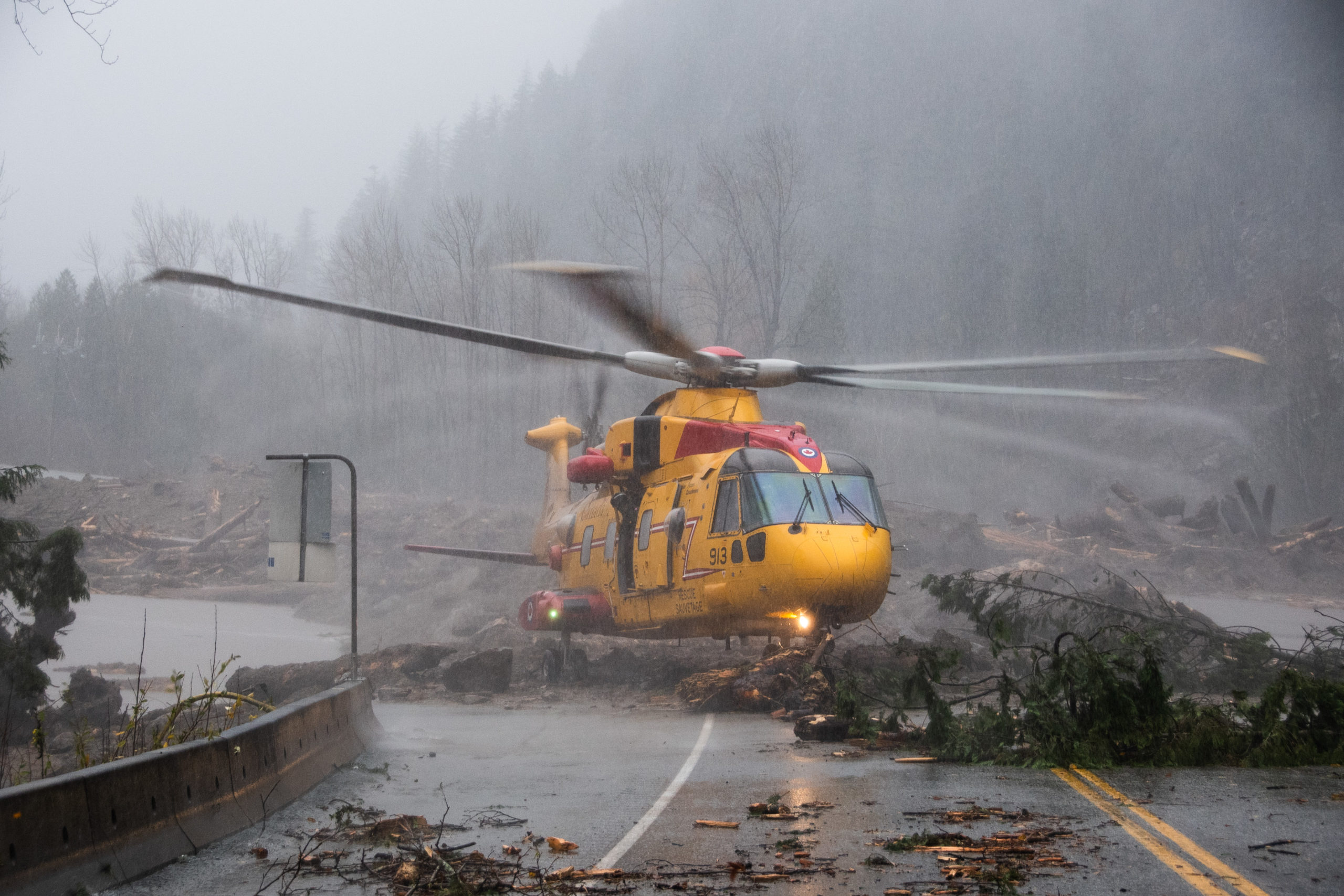
“A job well done by @RCAF_ARC’s 442 Transport & Rescue Squadron. Using 3 CH149 helicopters and supported by a CC115 Buffalo, the Sqn evacuated 311 people, 26 Dogs and a Cat to safety in Agassiz after being trapped by landslides on roads in BC.
RCAF Operations, Nov 16, 2021 (https://twitter.com/RCAFOperations/status/1460664604648947721)”

So now here it is. We have flooding so acute that we are airlifting food supplies to small towns in British Columbia cut off by destroyed transport routes that it may take weeks to repair. The damage has cut off rail and road links from the city of Vancouver to the rest of Canada. Not only does this trap all the rail and truck resources now stranded in the isolated areas, it also cuts off one of the largest ports in North America in the midst of a global supply chain crisis.

On top of that, many of those economists who told us inflation was not going to happen are now hedging their bets. Oh, and we are still dealing with a pandemic, and its lingering health and economic damage.

Once again we have proven ourselves utterly dependent on the military to manage a domestic crisis — a military that is so profoundly underfunded and under equipped that it has reached a state of generational decline. (For more on that, read Matt Gurney’s piece in The Line from yesterday [linked here].)

Meanwhile, we’ve been writing here at The Line about the utter collapse of our institutional capacity; the unavoidable fact that our governments seem totally unable to anticipate obvious, immediate, and pressing disasters. A recent example of that came from the federal government’s failure to sound the alarm on COVID-19 back in 2020. However, the residents of British Columbia sure didn’t get the same kind of notice of imminent danger that their American counterparts surely did.

God help us if a really bad winter storm hits somewhere in this country over the next six to eight weeks. Another severe ice storm, or a real blizzard; I genuinely fear we would have people starving to death in their homes for lack of resources to spare to dig them out.

I am a 37-year-old woman who had never seen an empty shelf in a grocery store until COVID-19. Now I’m seeing scenes out of Kamloops supermarkets that look like something out of The Walking Dead. No serious shortages in 35 years — and now I’ve seen two episodes of panic buying clearing out the shelves in the past two.

We keep on acting as if this disaster is the peak. This is the worst year ever, and we’re going to get back to normal any minute now.

Maybe.

But what if we don’t?

SA80 History: XL60 Series in 4.85mm

Filed under: Britain, History, Military, Weapons — Tags: , , , , , , — Nicholas @ 02:00

Forgotten Weapons
Published 10 May 2017

Armament Research Services (ARES) is a specialist technical intelligence consultancy, offering expertise and analysis to a range of government and non-government entities in the arms and munitions field. For detailed photos of the guns in this video, don’t miss the ARES companion blog post:

http://armamentresearch.com/british-e…

Once the basic configuration of the new British rifle was determined, the next step was to build a series of prototypes. The design that took form was basically a bullpup copy of the Armalite AR-18. The design team at Enfield were mostly senior draftsmen, with virtually no firearms experience among them. To make things worse, most of the design team was regularly rotated onto other projects, preventing them from developing any project experience on the rifle.

Several prototype batches were made (typically of a dozen guns each, both IWs and LSWs), all in the unique British 4.85x49mm cartridge, with a variety of different feature sets. Through the different patterns, configurations would change on the safety (push button vs lever) fire selector (push button vs lever), and magazine catch (straight-in side lever vs rock-in side lever vs rock-in rear paddle). At this time, plans still existed to make both left- and right-handed versions of the final gun, so prototypes of both were manufactured.

Because cost-cutting measures had not yet been forced on the project, these XL-60 series guns were generally reliable, at least in normal conditions. They are quite comfortable to fire, with a cartridge very similar to the 5.56mm NATO in practical terms. There is nothing particularly wrong with that cartridge, but it would be dropped when it lost NATO trials to the Belgian SS109 … but we will address that in the next episode of the SA80 history.

http://www.patreon.com/ForgottenWeapons

Cool Forgotten Weapons merch! http://shop.bbtv.com/collections/forg…

If you enjoy Forgotten Weapons, check out its sister channel, InRangeTV! http://www.youtube.com/InRangeTVShow

QotD: Britain’s middle class after WW1

One of the most important developments in England during the past twenty years has been the upward and downward extension of the middle class. It has happened on such a scale as to make the old classification of society into capitalists, proletarians and petit bourgeois (small property-owners) almost obsolete.

England is a country in which property and financial power are concentrated in very few hands. Few people in modern England own anything at all, except clothes, furniture and possibly a house. The peasantry have long since disappeared, the independent shopkeeper is being destroyed, the small business-man is diminishing in numbers. But at the same time modern industry is so complicated that it cannot get along without great numbers of managers, salesmen, engineers, chemists and technicians of all kinds, drawing fairly large salaries. And these in turn call into being a professional class of doctors, lawyers, teachers, artists, etc., etc. The tendency of advanced capitalism has therefore been to enlarge the middle class and not to wipe it out as it once seemed likely to do.

But much more important than this is the spread of middle-class ideas and habits among the working class. The British working class are now better off in almost all ways than they were thirty years ago. This is partly due to the efforts of the Trade Unions, but partly to the mere advance of physical science. It is not always realized that within rather narrow limits the standard of life of a country can rise without a corresponding rise in real-wages. Up to a point, civilization can lift itself up by its boot-tags. However unjustly society is organized, certain technical advances are bound to benefit the whole community, because certain kinds of goods are necessarily held in common. A millionaire cannot, for example, light the streets for himself while darkening them for other people. Nearly all citizens of civilized countries now enjoy the use of good roads, germ-free water, police protection, free libraries and probably free education of a kind. Public education in England has been meanly starved of money, but it has nevertheless improved, largely owing to the devoted efforts of the teachers, and the habit of reading has become enormously more widespread. To an increasing extent the rich and the poor read the same books, and they also see the same films and listen to the same radio programmes. And the differences in their way of life have been diminished by the mass-production of cheap clothes and improvements in housing. So far as outward appearance goes, the clothes of rich and poor, especially in the case of women, differ far less than they did thirty or even fifteen years ago. As to housing, England still has slums which are a blot on civilization, but much building has been done during the past ten years, largely by the local authorities. The modern council house, with its bathroom and electric light, is smaller than the stockbroker’s villa, but it is recognizably the same kind of house, which the farm labourer’s cottage is not. A person who has grown up in a council housing estate is likely to be – indeed, visibly is – more middle class in outlook than a person who has grown up in a slum.

George Orwell, “The Lion And The Unicorn: Socialism and the English Genius”, 1941-02-19.

November 20, 2021

Modern navigation aids compared

Filed under: Britain, Humour — Tags: , , , — Nicholas @ 05:00

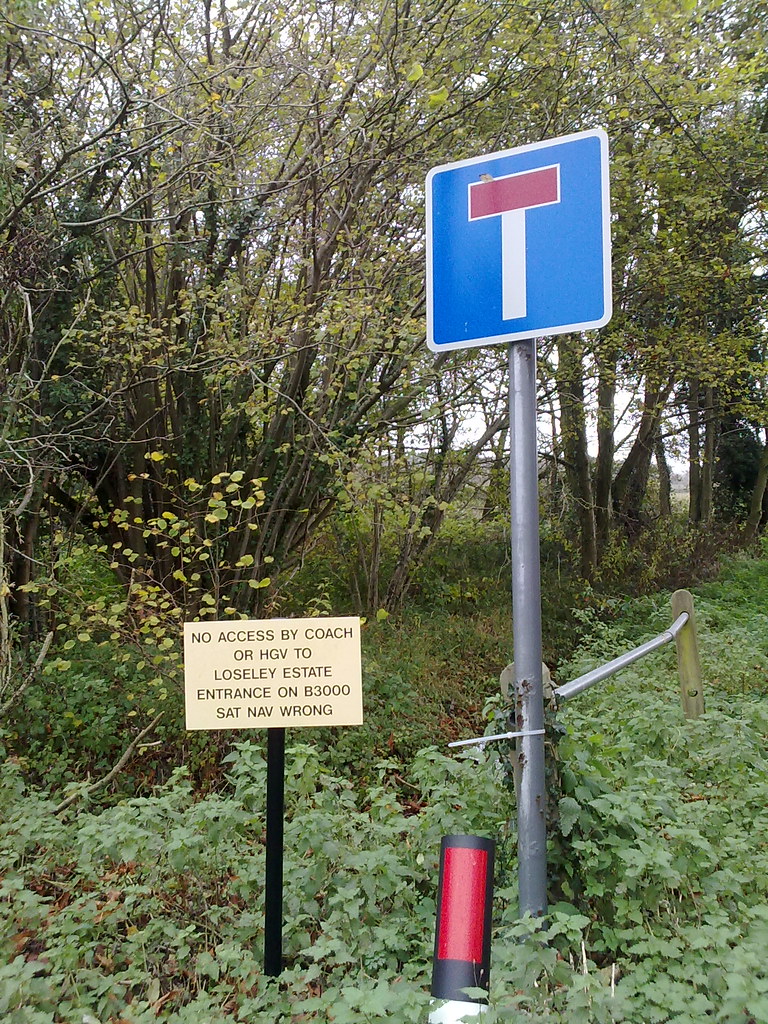
In common with most people in this age of pandemic, I don’t travel very much these days. Back when I did manage to get out and about on the roads, I had an early Garmin GPS device in my vehicle and when I eventually updated the sound system in my truck to a new device, it included a built-in GPS (that constantly “loses” satellite fixes and loudly informs me, even when I’m not using the mapping function). I’ve had both good and bad experiences with these devices, but Alistair Dabbs is much more entertaining with his story:

“Sat Nav FAIL” by J-o-n-o is licensed under CC BY-SA 2.0

Turn left. Turn right. At the roundabout, take the fourth exit.

Nobody enjoys being told what to do all the time but in the case of Google Maps I will make an exception. What I like about it best is that I can ignore her directions – should dissent take my fancy – and she doesn’t get cross.

This is in sharp contrast with all the classic sat-navs I have ever used, including the one embedded permanently into my current vehicle. Not only does it have a penchant for taking me on pointlessly circuitous routes, the wrong way up one-way streets, and along shortcuts too narrow for a bicycle, it grows angrier by the second when I refuse its orders.

“Turn right, turn right, turn right, turn left,” it would yell at increasing volume, trying to browbeat me into making a U-turn. Well no, I don’t want to drive through that building site or weave between those ambulances and fire engines dealing with that overturned lorry. Can’t you take me on an alternative route?

“Recalculating …” it would bark like a sulking dalek, but never accomplishing such. “Recalculating … Recalculating …”

Clearly I am not the only reluctant motorist to have given up on traditional sat-navs: not a single ad for one of these has turned up in my Black Friday spam deluge this year. And good riddance. Of the £3m per minute spent by Brits on their Black Friday shopping, roughly £0 will be spent on in-car nags.

Google Maps is more chilled. It’s as if she has resigned herself to my penchant for taking the wrong exits and missing turns. This is a habit I acquired by trying too hard not to drive like my father, who would obey every instruction from his sat-nav with military immediacy. As soon as he heard the words “Turn left”, he’d turn hard on the steering wheel straight away and we’d find ourselves heading up someone’s front drive, into an underground office car park or across a pedestrianised shopping walkway.

Me, I prefer to wait a bit – maybe a bit too long. Google Maps doesn’t mind and gives me no grief. Perhaps she also recognises her own faults in occasionally trying to direct me to drive through bricked-up entrances and children’s playgrounds. “Pff, whatever,” she probably thinks. “He’s too thick to follow the normal route. Let’s try a longer one.”

The odd thing is that she talks to Mme D in a very different way. On her smartphone, Google Maps is, well, chatty.

While all I get is a functional “Turn left/right” or “In 300 metres take the slip-road,” Mme D is treated to a tirade of verbosity. “Move into the filter lane and turn left at the next traffic lights heading north-northwest into B3496 Lower High Street but keep to the right to avoid the turnoff, mind the pedestrian crossing and wave hello to the butcher on the corner …” it spews, one directive tumbling into the next in a single continuous description of the journey and all its finest details.

DicKtionary – M is for Mathematics – Newton and Hooke

Filed under: Britain, History, Science — Tags: , , , , — Nicholas @ 04:00

TimeGhost History
Published 19 Nov 2021

Today we turn away from killers and sociopathic rulers and look at two men from the world of science. Isaac Newton and Robert Hooke were certainly very intelligent and creative, but were they dicks as well?
(more…)

Twenty years of TSA bullying

Filed under: Bureaucracy, Government, USA — Tags: , , , — Nicholas @ 03:00

In Friday’s Reason Roundup newsletter, Robby Soave calls for the end of the Transportation Security Administration after twenty long years of futility on making travel safer but brilliant success in making the travel experience so much worse for passengers:

Exactly 20 years ago today, President George W. Bush signed the Aviation and Transportation Security Act into law and created the Transportation Security Administration, better known as the TSA. A response to the 9/11 attacks, the TSA was thought to be a necessary tool for confronting the new reality of terror in the skies.

Two decades later, the TSA has more than 54,000 employees, a budget of $8 billion dollars, and a long track record of harassing passengers for no good reason. Far from contributing to actual safety, the TSA is a stunning example of government failure: Its absurd travel restrictions make air travel no safer, deprive passengers of their civil liberties, and make the process of flying much more costly, time-consuming, inconvenient, and unenjoyable. The agency should never have been created, and its 20th birthday is as good a time as any to abolish it.

For starters, the TSA routinely fails at its main purpose: preventing passengers from carrying deadly weapons onto airplanes. TSA agents constantly miss weapons, drugs, and other illicit items when government agents try to smuggle them in as part of testing.

“TSA screeners failed to detect weapons, drugs, and explosives almost 80 percent of the time,” noted the Heritage Foundation in 2017. “While the exact failure rate is classified, multiple sources indicate it is greater than 70 percent.” During one test, at the Minneapolis–Saint Paul International Airport, the TSA’s failure rate was 95 percent.

The 9/11 terror attacks, in which a small number of men were able to use crude, simple weapons to hijack airplanes and crash them into important buildings, were a scarring moment for the nation. The U.S. government vowed to be more vigilant. But the truth of the matter is that preventing hijackings is now trivially easy: Pilots can lock the cockpit doors, which are almost impossible for intruders to breach. Prior to 9/11 most airplane hijackings involved detours to different locations; hijackers did not intend to crash the planes, and thus neither crews nor passengers had much reason to fight back. This calculus is forever changed: Would-be plane hijackers will face insurmountable difficulties, whether or not they’ve received aggressive pat-downs from the TSA.

Meanwhile, the TSA’s security theater has made air travel a much more grueling process. It’s not just the ritualistic humiliation of having to remove belts and shoes, empty out backpacks and suitcases, and submit to full-body scanners. TSA agents are also frequently caught stealing from passengers, groping them, and delaying them for no reason. Again, there is no point to any of this. It does not make people safer. If anything, it makes us less safe: It is likely that some people choose to drive to their destination, rather than deal with the hassle. Car travel, though, is far more dangerous than air travel — many more people die in car crashes than in plane crashes each year. And not even COVID-19 could tip the scales in airplanes’ favor, according to The Washington Post.

Enough is enough. There is not a single good reason that Americans should have to endure such misery at the hands of this utterly pointless bureaucracy. The best time to abolish the TSA was right after it was created. The second-best time is now.

Remy made a parody video on the TSA that’s definitely worth a watch. Back in 2010, Iowahawk created some helpful new slogans for the TSA, free of charge.

Meet The Last Artisans Making Traditional Bagpipes By Hand In Scotland’s Capital | Still Standing

Filed under: Britain, History, Media, Woodworking — Tags: , , , — Nicholas @ 02:00

Business Insider
Published 2 Jul 2021

Bagpipes have been a symbol of Scottish heritage for centuries, but traditional artisans have faced stiff competition with the rise of mass manufacturing. Kilberry Bagpipes is now the last workshop in the capital city of Edinburgh where they still make them by hand.

For more information, visit:
https://kilberrybagpipes.com/

——————————————————

#Bagpipes #Scotland #BusinessInsider

Business Insider tells you all you need to know about business, finance, tech, retail, and more.

Visit us at: https://www.businessinsider.com
BI on Instagram: https://read.bi/2Q2D29T
BI on Twitter: https://read.bi/2xCnzGF
BI on Amazon Prime: http://read.bi/PrimeVideo

Meet The Last Artisans Making Traditional Bagpipes By Hand In Scotland’s Capital | Still Standing

From the comments:

Kilberry Bagpipes
1 month ago
It was a pleasure having you guys in to film with us! Thank you for putting together such a fantastic video illustrating what we do and why we do it! If anyone has any further questions or is keen to learn to play then please feel free to email us where we will be happy to help!

All the best,
Dave and Ruari
The Kilberry Team

QotD: Cheating with both hands

Filed under: Media, Politics, Quotations, USA — Tags: , , , , — Nicholas @ 01:00

The linked analysis of these four events is very easy to read [here] – or so say I, but for five years my work was researching aspects of statistical anomalies, so here is my summary for anyone who feels differently.

Batches of counted votes can be very unbalanced towards either candidate or they can be large, but there is a strong inverse relationship between the two. The paper analyses a lot of data to show the improbability of both very unbalanced and very large. This is a good test because it tends to get past fraudsters, who are focussed on the raw margin of votes more than the ratio or the batch size.

A secondary tell – and this one is already well-known in fraud detection in third-world countries – is improbable ratios of the losing candidate to minor candidates, e.g. Trump getting little more than twice as many votes as the minor candidates in the second Michigan anomaly when the state’s average (calculated including that data point) was 31 to 1. The paper finds this combination of grossly-violated size-margin ratio and grossly-violated Trump-to-third-party ratio particularly suspicious (as do I). It also computes what happens if you pull these four data points in towards merely the 99th percentile of the size-margin relationship – leaving them still anomalous but not so wildly implausible. (Biden loses his alleged lead in all three states.) It also notes some related statistical oddities.

My guess is that the idea of the US waking up to what I’d woken up to – Trump the heavy odds-on favourite – terrified his enemies. Their pre-election narrative was that Trump would at first “appear” to win, after which “days and weeks of counting” (Zuckerberg) would show he had lost. But while Zuckerberg promised to “educate” America to believe in that, I think someone in the early hours of the 4th panicked that if the US electorate woke up to a bookies-call-it-for-Trump breakfast on Wednesday morning, that would never be erasable from the US mind, no matter how many votes they then “found”. So they made sure that didn’t happen. (You never know: it might yet be that what they did to prevent that becomes equally hard to remove from America’s consciousness. You don’t have to be a statistician to think a sudden step function in a smooth graph looks odd.)

So the good news is that my memory for numbers is working fine. The bad news is that I may lose a night’s sleep next election. The very first of the four anomalous points went into the Georgia vote totals soon after 6:30 AM my time – half-an-hour after the normal rising time of Donald Trump and Margaret Thatcher, I am told. (I guess the reason I’m not PM or president is that I’m usually asleep then.) When I first glanced at the results, I thought Georgia was surprisingly close given e.g. the Florida result, but if I’d missed the other three oddities as completely as Georgia’s, I’d have been far less cautious in reviewing the outcome.

Niall Kilmartin, “Good News! I can believe my eyes”, Samizdata, 2020-12-01.

November 19, 2021

Bismarck Gets Closer To German Unification – A New Spanish King I GLORY & DEFEAT

Real Time History
Published 18 Nov 2021

Sign up for Curiosity Stream and get Nebula bundled in and SAVE 26%: https://curiositystream.com/realtimeh…

While the Franco-Prussian War is continuing its messy guerilla phase, the German leaders are negotiating towards a united Germany. Hesse and Baden join the promptly renamed German Confederation — but Württemberg and Bavaria still want more concessions. Meanwhile the question of Spanish succession that started the war is solved in Madrid.

» THANK YOU TO OUR CO-PRODUCERS
John Ozment
James Darcangelo
Jacob Carter Landt
Thomas Brendan
James Giliberto
Kurt Gillies
Albert B. Knapp MD
Tobias Wildenblanck
Richard L Benkin
Scott Deederly
John Belland
Adam Smith
Taylor Allen
Jim F Barlow
Rustem Sharipov

» OUR PODCAST
https://realtimehistory.net/podcast – interviews with historians and background info for the show.

» LITERATURE
Arand, Tobias: 1870/71. Der Deutsch-Französische Krieg erzählt in Einzelschicksalen. Hamburg 2018

Gouttman, Alain: La grande défaite. 1870-1871. Paris 2015

Koch, Roland : “Les canons à balles dans l’armée du Rhin en 1870” in Revue historique des armées, 255 (2009), p. 95-107.

» SOURCES
Braun, Lily (Hrsg): Kriegsbriefe aus den Jahren 1870/71 von Hans von Kretschman weiland General der Infanterie. Berlin 1911

Carr, Raymond: Spain 1808–1939. Oxford: At the Clarendon Press, 1975

Deuerlein, Ernst: Die Gründung des Deutschen Reichs 1870/71 in Augenzeugenberichten. Düsseldorf 1970

Goncourt, Edmond de: Journal des Goncourts. II.1. 1870-1871. Paris 1890

Kühnhauser, Florian: Kriegs-Erinnerungen eines Soldaten des königlich bayerischen Infanterie Leibregiments. Partenkirchen 1898

Lowndes, Emma: Récits de femmes pendant la guerre franco-prussienne (1870-1871). Paris, 2013.

Meisner, Heinrich Otto (Hrsg.): Kaiser Friedrich III. Das Kriegstagebuch von 1870/71. Berlin, Leipzig 1926

N.N: + Amadeus von Savoyen in: Neue Presse v. 19. Januar 1890. S. 2

N. N. (Hrsg.): Bismarcks Briefe an seine Gattin aus dem Kriege 1870/71. Stuttgart, Berlin 1903

Schikorsky, Isa (Hrsg.). “Wenn doch dies Elend ein Ende hätte”. Ein Briefwechsel aus dem Deutsch-Französischen Krieg 1870/71. Köln, Weimar, Wien 1999

» OUR STORE
Website: https://realtimehistory.net

»CREDITS
Presented by: Jesse Alexander
Written by: Cathérine Pfauth, Prof. Dr. Tobias Arand, Jesse Alexander
Director: Toni Steller & Florian Wittig
Director of Photography: Toni Steller
Sound: Above Zero
Editing: Toni Steller
Motion Design: Philipp Appelt
Mixing, Mastering & Sound Design: http://above-zero.com
Maps: Battlefield Design
Research by: Cathérine Pfauth, Prof. Dr. Tobias Arand
Fact checking: Cathérine Pfauth, Prof. Dr. Tobias Arand

Channel Design: Battlefield Design

Contains licensed material by getty images
All rights reserved – Real Time History GmbH 2021

Viewing-with-alarm … from afar

Filed under: Britain, Media, Politics, USA — Tags: , , , , , — Nicholas @ 05:00

In Spiked, Simon Evans explains why he finds British commentary on US hot-button issues like guns and race to be frequently uninformed but remarkably certain of itself:

What many Brits believe every American carries in their pickup trucks or on their persons, probably.

As a Brit, there are few things less edifying, nor more unintentionally hilarious, than an American newspaper reporting on any very English scandal. A breach of some obscure royal protocol, perhaps, or an aspect of parliamentary procedure, often involving Black Rod, which despite the capital B, the Washington Post will have to explain, is not a racial epithet, or an ill-advised tribute act.

A personal favourite is when a provincial dietary preference has caught the New York Times‘ eye, having unexpectedly “caught on” nationwide. It is an innocent enough pleasure, watching Americans trying to distinguish black pudding from haggis, or indeed gravy from “chippy sauce”. Like watching the Dutch discuss the morality of bullfighting, or Korea debate a proposed rule change in top flight Buzkashi.

Yet put the sneaker on the other foot and watch British commentators angrily contend the moral and legal thrust of a case in which an American is on trial for using lethal force with a firearm, and we suffer something very like Gell-Mann Amnesia by proxy. We forget how important a little local knowledge might be, and our seasoned, tolerant, bemused respect for tradition and culture and specialist knowledge are gone within moments. Watching the Kyle Rittenhouse case approach a verdict, British commentators are a-froth with indignation at the palpable miscarriages of justice seemingly running unchecked only five short hours away across the globe. My God, he had a gun ! What more is there to say? And – do I have this right? – he crossed state lines ! The man’s a monster.

Not since the proroguing of parliament two years ago have so many people become acquainted so quickly with something so arcane as the crossing of state lines with intent to do mischief. Putting aside the fact that the weapon itself did not cross this fabled demarcation, what is striking is the evident lack of enthusiasm for certain other state lines, such as the one somewhat further to America’s south, or indeed the one etched around the British Isles, that currently seem to get crossed on a pretty frequent basis, with who knows what intent? Drawing attention to those lines is clearly racist.

It was GB Shaw who first made the observation that GB’s shores were separated from the US’s by an ocean of incomprehension, concealed by our sharing a common language.

Rather like urban Canadians, most British readers and viewers tend to agree with the opinions expressed in US mainstream media based largely in urban coastal areas:

So, we don’t get the full spectrum argument. Instead, we gratefully share the apparent horror and shame of the coastal elite, with their tertiary education and their teeth that meet in the middle, when confronted with their inland, inbred in-laws. We deplore the multi-decade epidemic of what seems, if you read the Washington Post and the NYT, to be the largely white, Wild West assassination culture that 2A concedes. Bullets sprayed around schools. Shopping malls, synagogues and mosques running with blood. A death toll out of all control. Murder, cold-blooded and cruel – and largely in the service of a bigotry, as often as not a racial bigotry, as old as the Appalachians hills.

This is, to put it as mildly as one can without choking, not quite the whole story. Do your own due diligence, it isn’t hard. The editors of the NYT can’t stop you acquainting yourself with the FBI crime statistics, and they put some of the more notorious outbreaks of flying lead into useful perspective.

But generally, we instead swallow like sugary cough syrup (believing it good for us, no matter how delicious it also is) the narrative that guns are largely in the hands and lovingly tended racks of homicidal white supremacists, paranoid death-spiral redneck survivalists, and a police force that is barely superior in discipline, racial enlightenment or legitimacy to a rounded-up posse of ad hoc lynch-happy vigilantes.

The Allied 1942 Plan to Invade Europe – WW2 Special

Filed under: Africa, Britain, History, Military, USA, WW2 — Tags: , , , , — Nicholas @ 04:00

World War Two
Published 18 Nov 2021

The second front has been opened, and Allied forces are invading Vichy French Northwest Africa. But did you know that it could very well have been an invasion of Europe taking place right now instead? Let’s examine how this idea came about, and why it never worked out.
(more…)

“We don’t even fund our search-and-rescue units properly. That’s the least controversial thing the military does.”

Filed under: Cancon, Environment, Military — Tags: , , , , — Nicholas @ 03:00

In The Line, Matt Gurney discusses the situation of the Canadian Armed Forces as domestic demands escalate (especially in the Vancouver area this week), and the already under-staffed units strain to meet Canadians’ needs:

“A job well done by @RCAF_ARC’s 442 Transport & Rescue Squadron. Using 3 CH149 helicopters and supported by a CC115 Buffalo, the Sqn evacuated 311 people, 26 Dogs and a Cat to safety in Agassiz after being trapped by landslides on roads in BC.
RCAF Operations, Nov 16, 2021 (https://twitter.com/RCAFOperations/status/1460664604648947721)”

If you’ve heard of General Wayne Eyre, Canadian Army, it’s probably because he’s currently the acting chief of the defence staff — that’s the top officer in the Canadian Armed Forces, in command of the army, navy and air force. He got the job after the last CDS got entangled in the sexual misconduct scandal now roiling the military. Gen. Erye stands a pretty good chance of being the next CDS on a full-time basis, assuming the government ever gets around to making a decision on that front. Given the attention the Liberals usually give the military, this is not a guarantee.

If you’d heard of Gen. Eyre before all the weirdness alluded to above, there’s a decent chance it’s because of a pretty stark warning he sounded not long ago. Interviewed by the Canadian Press, the general, then head of the army, warned that the military was simply too small to do all that was being asked of it. Specifically, he warned that increasingly frequent domestic deployments were interfering with the military’s ability to conduct large-scale, multi-unit exercises. In typical Canadian fashion, the general reached for a hockey metaphor to describe why such large exercises are essential, and told the CP, “It’s like a hockey team that would never train, never play on the ice together, and then all of a sudden being thrown into an NHL game and be expected to win.”

There are other concerns with increasing domestic deployments, which the CP noted were becoming larger as well as more frequent in line with worsening natural disasters. They exhaust personnel and wear out equipment. But the point was made — the general was telling Canadians that our world was changing, and our military was struggling to keep up. Military guys usually aren’t verbose or particularly expressive. The fact that Gen. Eyre gave this interview at all was notable on its own.

The interview was published on Jan. 20, 2020, by the way, on a day when hundreds of troops were helping Newfoundlanders dig out after a nasty winter storm. Anyone recall what else was getting underway back in early 2020?

As I write this column, I’m watching a press conference from British Columbia government officials, addressing the massive damage done by recent floods and landslides. It’s an unusually emotional press conference. That’s not a criticism, but simply an observation from a journalist who’s watched more of these than he can remember over the years. The ministers are clearly possessed by the enormity of this problem; the minister of transportation aptly described the province’s transportation network as “crippled.” Major highways and railways are either underwater or blocked by debris. Some others seem to have been partially destroyed, the ground beneath them simply gone. Many communities in B.C. are now entirely cut off from the outside world or have, at best, extremely limited access; helicopters are hauling supplies in and stranded people out. The city of Vancouver, Canada’s third largest, is essentially detached from the rest of the country unless one wants to take a huge detour through the United States, which only reopened its land border to Canadians a few days ago.

The economic toll of cutting off the Port of Vancouver from the rest of the country, at a time when supply chain disruptions are already biting hard, is going to be gigantic. Economist Trevor Tombe did some quick math and estimated it at over $2 billion a week in trade between B.C. and the rest of the country that’s just been wiped off the national GDP, not to mention the direct costs of actually fixing the damaged infrastructure, of repairing property damaged or destroyed by the tragedy and, sadly, and the massive losses to farmers in property and livestock, much of which has drowned. This is a big, big economic hit to Canada.

I Wore 18th-Century Clothing *Every Day for 5 YEARS & This Is What I Learned (Corsets Aren’t Bad!)

Filed under: History — Tags: , , , , — Nicholas @ 02:00

Abby Cox
Published 10 May 2020

I wore 18th-century women’s clothing, all day, 5 days a week, for 5 years of my life. Over those 5 years, I learned *a lot* about my body, fashion in the 1700s — the good and the not so good, and how we can take these lessons and improve modern fashion.

***Trigger Warning: I do talk about body image in this video (as a reflection of my own, long, long journey with my own body & how wearing historical clothing has given me a different perspective on body image) which may or may not be upsetting for some. ***

*Ok, so not “every day” but you get the idea…😉

💌Business Inquiries *ONLY* abbycox@semaphorebrands.com
(This email goes directly to my management and not to me.)

More Videos:

🎉🎉 Answering YOUR FAQs from THIS Video: https://youtu.be/SN3agbKZVP0
“Becoming an 18th-Century MEME LORD” https://youtu.be/a0pRE3uXWu8
“Historical Costumers and Their Hogwarts Houses” https://youtu.be/vxmRsc9Qj8M
Rachel Maksy – “Born in the Wrong Era” – https://www.youtube.com/watch?v=r5GAJ…

A lot of these photos of me were taken by the lovely Fred Blystone. You can see more of his photography here: https://www.facebook.com/groups/13664…

Also, @Edwardian Tailor (https://www.youtube.com/channel/UCBSf…)

We like to assume that the people in the past are “stupid” (it’s normal human behavior), and one of the ways that we, as a modern society, do this is by judging the past for their fashion trends and practices. We’ve been taught to demonize corsetry (or in this case, stays) for being restrictive and a tool of oppression towards women, and take pride in our culture of diet and exercise, without considering the issues that can be found in our body-obsessed culture. We praise jeans and a t-shirt, as being “comfortable” but the insecurities that so many of us have about our bodies are put on display in our 21st-century uniforms. We take for granted our modern homes, and how that has made us lazy in dressing for the seasons, resulting (in part) the loss of various types of textiles and weaving technology. I learned a lot over those 5 years, including how to indulge in an Indian Buffet while wearing my 18th-century stays, and I’m excited to share my insights with you. Also, can we just discuss how stupid modern underwear is?? 😉

Images Used:

*Summer Dresses, 1783, Object Number – J,5.139, Asset Number – 79588001 © The Trustees of the British Museum. https://www.britishmuseum.org/collect…

*Sheer Cottton Mull Italian Gown, 1780s, The Metropolitan Museum of Art, 17.107.6a, b, https://www.metmuseum.org/art/collect…

*Kofta, 1760s-90s, Nordiska Museet, NM.0186311, https://digitaltmuseum.se/01102369100…

*Women 1790-1799, Plate 052, Fashion Plate from August 1796, The Metropolitan Museum of Art Library Costume Institute Fashion Plate Collection, https://libmma.contentdm.oclc.org/dig…

*Robe a l’anglais c. 1780, The Metropolitan Museum of Art, 1982.291a, b, https://www.metmuseum.org/art/collect…

*Attributed to Isaac Cruikshank, Cestina Warehouse or Belly Piece Shop
April 16, 1793, The Metropolitan Museum of Art, 59.533.475 https://www.metmuseum.org/art/collect…

*Stays, The Metropolitan Museum of Art,
2009.300.3330a–d
https://www.metmuseum.org/art/collect…

*The Bum Shop, Attributed to R. Rushworth (British, active 1785–86), July 11 1785, The Metropolitan Museum of Art, 1970.541.12, https://www.metmuseum.org/art/collect…

*Chemise, 1780-1800s, The Metropolitan Museum of Art, 2005.368 https://www.metmuseum.org/art/collect…

*Corset, 1880s, The Metropolitan Museum of Art, 2009.300.3497a–c
https://www.metmuseum.org/art/collect…

——-

Music from Epidemic Sound:

“Gold Among the Sand”- Trevor Kowalski
“To Clarity” – Airae
“The Path to Innovation” – Airae
“Caffeinated and Motivated” – Airae
“Alice is on her Way” – Airae
“Cafe Laurent” – Medite
“In a Jiffy” – Moins Le Quartet
“Moonlight Night” – Gabriel Lucas

———

Instagrams: https://www.instagram.com/abbyelyn

From the comments:

Abby Cox
1 year ago (edited)

Hey Everyone! 👋🏻

Thank you all so much for taking the time to watch this video about my experience! I’ve noticed a lot of the same questions in the comments, so I want to take a minute to answer them here –
🎉UPDATE (Sept 27, 2020) – I’ve answered your questions about menstruation here: https://www.youtube.com/watch?v=iV2TgwjjhOE
🎉UPDATE (June 7, 2020) – I’ve taken the most commonly asked questions from the comments and have done a video to answer them! You can watch it here: https://youtu.be/SN3agbKZVP0

– My stays (18th-century term for a corset) are from https://redthreaded.com/ – they’re a fantastic historical corset company that I adore. (and for the couple of you trying to call me out – my 100% hand-sewn, me-made, reproduction stays are so worn out that they’re in retirement, and just because I can make stays by hand doesn’t mean I have the time. I’d also rather support a small business that I believe in.❤️Finally, the gown I’m wearing in this video was cut to go over those stays, but if you’d like to see my hand-sewn reproduction stays in action you can buy the book I co-wrote here: https://www.american-duchess.com/book/american-duchess-guide) ☺️

– While I haven’t gone down the menstruation research rabbit hole (cause it is its own subject of study) I am going to do my best with limited access to primary source documentation (which is what I really need to be able to answer this question) to produce a video about what 18th-century women would do. I don’t know when this will be, but I will do my absolute best to answer this question, and if I can do some experimental archeology in the process, I will. 😎 (ravenclaws gotta ravenclaw…)

– Thigh chafing – so I think that varies from person to person. I never really had a lot of issues with it (and my narrow hips mean that I will never have a thigh gap) because my linen shift would always kind of end up between my leg and absorb the sweat. However, I know a lot of costumers who will wear split-crotched drawers because they find it more comfortable, even though drawers weren’t a thing in the 18th-century.

Ok! I hope this helps answer some of your questions! Thank you all so much for watching and engaging in this video. I really can’t tell you all how much I appreciate it! ❤️

QotD: People who are interested in history versus “academic” historians

Filed under: Education, History, Politics, Quotations, USA — Tags: , , , , , — Nicholas @ 01:00

One of many reasons I never went anywhere in my career as an academic historian is that I actually like history. I find it interesting. That’s because I find people interesting, and history is, above all, the study of people and how they be.

Your average academic historian lives entirely in xzheyr own head. They hate and fear people. They have no interest in how people actually are, only in how they should be. Thus, academic history quickly devolves into the worst kind of Social Justice Mad Lib, a never-ending, ever more frantic search for ever more obscure terms to complete the equation: “Despite [barbarities], the [micro-group] were actually only doing it because they were oppressed by the Pale Penis People, because [reasons].”

For example:

This is one of those things that’s true even if it’s not true, because Clown World, but I actually looked this guy up and yeah, he’s real — he’s a “Professor of Practice in Media and Activism at Harvard University”, which is exactly what it sounds like: basically, a tenured pest, who makes very nice bank making students protest shit for class credit. The “new book” referenced in the screenshot isn’t on Amazon yet, so maybe that’s not real, but again, Clown World — even if it’s not real, it’s real, because that’s exactly the kind of thing academic historians do. You probably remember it well from your own college days, if you were in college at any time between about 1985 through 1995, the heyday of “everyone you’ve ever heard of was secretly gay!” pseudo-scholarship.

Severian, “On Boredom”, Rotten Chestnuts, 2021-08-17.

November 18, 2021

Make a Vintage-Style Wooden Hinge with Hand Tools

Filed under: Tools, Woodworking — Tags: , , — Nicholas @ 04:00

Rex Krueger
Published 17 Nov 2021

This wooden hinge will put your tools to the test & make an unexpected addition to your skill set.

All plans 50% off until Christmas! https://www.rexkrueger.com/store
Get the plans from this video! (Scroll down)
(more…)

« Newer PostsOlder Posts »

Powered by WordPress