
There are quite a lot of ores of iron, but not all of them could be usefully processed with ancient or medieval technology. The most commonly used iron ore was hematite (Fe2O3), with goethite (HFeO2) and limonite (FeO(OH)·nH2O) close behind. Rarer, but still used was magnetite (Fe3O4) and siderite (FeCO3). All of these can occur in big rock deposits, but may also occur as “bog iron” where oxidation occurs in acidic environments (in swamps and bogs) leading to the formation of small clumps of iron-rich material. Many of these ores can be spotted visually by someone who knows what they are doing; hematite can be blackish to reddish-brown but leaves tell-tale red streaks (of rust); goethite’s black-brown color is also fairly recognizable, as is limonite with its burnt yellow-orange hue. We’ll come back to these ores a few times both this week and next, because while they can all yield iron, some of them yield that iron easier than others.
One distinction here is between bog iron and iron in ore deposits. Bog iron is formed when ground-water picks up iron from iron-ore deposits, where that iron is then oxidized under acidic conditions to form chunks of iron minerals (goethite, magnetite, hematite, etc.), typically in smallish chunks. Bog iron is much easier to smelt because it contains fewer impurities than iron ore in rock deposits, but the quantity of iron available from bog iron is relatively low (although actually renewable, unlike mines; a bog can be harvested for iron again after a few decades as the processes which produce the bog iron continue). Because of its low output, bog iron tends to be an important part of the iron supply only when production is relatively low, such as during the Pre-Roman Iron Age in Europe, or the early medieval period.
But what I want to stress here at the outset is that while the local variety of iron may vary based on conditions, iron ores are sufficiently common that prior to the industrial revolution, it wasn’t generally necessary to trade or transport them over long distances because most areas have deposits. There are some exceptions (Japan is notoriously mineral poor – my limited geological understanding is that this is common in volcanic land formations – and while it does have some iron deposits, they are few and relatively small), but for the most part, getting iron ore was not hard. As we’ll see, timber availability was actually often a more pressing limitation on iron exploitation than the ore itself […]
Bret Devereaux, “Iron, How Did They Make It? Part I, Mining”, A Collection of Unmitigated Pedantry, 2020-09-18.
April 19, 2022
April 18, 2022
Once upon a time, the American military wanted to know precisely nothing about the sex lives of servicemen
Yet another trip into a far distant past, this time in the US armed forces, long before the Current Year:
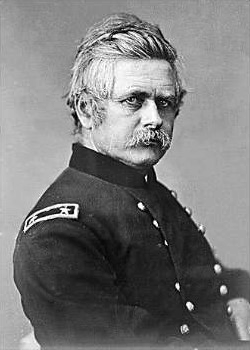
General Edward Ord (1818-1883), the designer of Fort Sam Houston, saw action in the Seminole War, the Indian Wars, and the American Civil War.
Undated photo from before 1883 via Wikimedia Commons.
For much of its history, the American military has had an aversion to hearing in any official way about the sexual conduct of servicemembers. In one of the US Army’s most notorious 19th-century legal conflicts, Captain Andrew Geddes reported from a remote post in Texas that Lieutenant Louis Orleman had been forcing his teenaged daughter to have sex; in a written statement to his commanding officer, Geddes wrote that Orleman “had been having sexual intercourse with her for the past five years, or since she was thirteen years of age, and that he had placed a loaded revolver to her head, threatening that he would blow out her brains if she did not consent to his horrible desires.” Thus informed, then-Brigadier General Edward Ord convened a court-martial — to conduct a trial of Captain Geddes, for putting such an appalling thing in writing.
As Louise Barnett concludes in her book about the trial, “acknowledging the possibility of incest by bringing charges against Orleman would have officially validated and magnified a scandal that would have haunted the Army, and the Department of Texas, for years to come. Fortunately for Orleman, this course of action was unthinkable because incest itself was unthinkable in America in 1879.”
Similarly, a rich and colorful history of the early American navy attempts to count recorded acts of sodomy at sea, and finds them buried in euphemism within official reports of sailor misconduct: “improper conduct too base to mention”, or “filthy conduct”, or “improper conduct on the berth deck”. As the historian James Valle has written, naval courts-martial finding themselves hearing testimony about shipboard sodomy tended to adjourn quickly, or to end testimony and immediately vote to acquit — after which the accused tended to vanish from a ship’s rolls, without explanation, the very next time the ship made port. “Consequently,” Valle concludes, in the early republic “not one navy man was ever convicted of homosexuality by a formal court-martial.” Herman Melville mentioned the unmentionable by writing, in White Jacket, of complaints regarding shipboard acts “from which the deck officer would turn away with loathing.” They didn’t want it to happen, but if it happened, they didn’t want to know about it.
The exceptions are, you know, interesting. In the early years of the Cold War, the sudden arrival of the threat posed by nuclear weapons and the emerging political power of the Eastern Bloc produced a moral panic in which security officials in the federal government hunted communists by looking for homosexuality; the “lavender scare” ran alongside the red scare. And so, as Elizabeth Lutes-Hillman has written, the Cold War military justice system became endlessly obsessed with sexual difference, throwing aside the usual disinclination to take notice of sexual behavior in the ranks: “Courts-martial instead became a performance of military values for the culture at large, setting the boundaries of deviant behavior for the armed forces, and so, to a certain extent, for the American body politic.” To drag that language about the performance of values down to the plane of action, Lutes-Hillman reports the example of the shore patrol in Norfolk, Virginia, which proudly reported in the late-1950s that it had caught 231 sailors in acts of sodomy by drilling holes in the wall of the local YMCA.
Putting all of that together, the American military has mostly preferred to avert its eyes from the sexual behavior of servicemembers, except in moments of transition and political crisis. If the armed forces are really interested in the question of which bed you spent the weekend in, Private Snuffy, something different is happening. For something more than 200 years, the default message from a company commander on Friday afternoon has generally been, “Handle your business, don’t interrupt my weekend with a phone call from a police department, and you’d best be in formation when the flag goes up on Monday morning.” Normal is the view that servicemembers are grown-ups whose intimate matters aren’t military business. Historically, if the armed forces officially have sex on the brain, something has been disrupted; anxiety and disorder outside the military have seeped into the ranks.
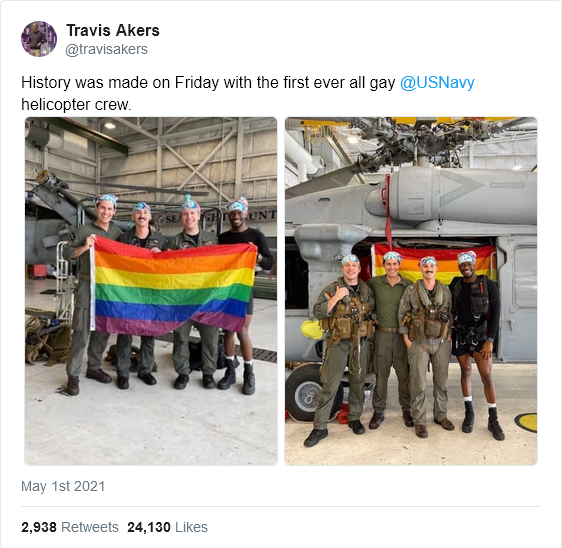
Now. To go back to an example from last year, this:
… suggests a number of obvious questions, starting with how did the United States Navy know this? Is this liberation, or is it intrusion? (BREAKING: The Department of the Navy proudly announces which helicopter pilots are into dudes, and stand by for detailed information on which surface warfare officers are bi-curious. We’re still asking around on that one, so.) It’s like the shore patrol is drilling holes in the wall at the YMCA again, but this time it’s so they can bus in a cheering section. The chain of command is right outside your door, you guys, and we hear what you’re doing in there, and OH MY GOD WE’RE SO PROUD OF YOU DO YOU NEED SOME CONDOMS? The Department of Defense isn’t a regular mom, it’s a cool mom.
Republic to Empire: The Augustan Settlement
seangabb
Published 23 Mar 2021Here is the tenth lecture, which covers the Augustan Settlement and the ending of the Roman Republic. Discussion includes: the Constitutional Settlements, graphical representations of the old and new Roman Constitutions; opinions in Rome and the provinces of the new order; the legitimisation propaganda; the general success of the reign of Augustus.
(more…)
Jen Gerson raises the banner of revolution against the Boomergeoisie
In the free-to-read portion of last week’s weekend post from The Line, Jen Gerson channels the anger and frustration of the Millennial sans-culottes (or should that be the sans-maisons?) who are being systematically locked out of the housing market in Canada to protect the paper investments of the Boomer generation:

“Green suburbs” by Pierre Metivier is licensed under CC BY-NC 2.0


It’s come to the attention of several of the editors at The Line that some of you Boomers are mad at us. Or, more specifically, you’re mad at co-founder Jen Gerson who popped up a particularly scathing screed about the housing market earlier this week.
To wit:
Our Boomer got his and that’s what matters. We have an entire government apparatus set up to protect that guy. The guy with the money and the guy who votes. The rich-on-paper people are happy, and as long as everybody gets a seat somewhere on this pyramid, then everybody else should be happy too.
We will admit that Gerson didn’t intend this column to come across as an anti-Boomer harangue. She intended it as an anti-government-housing-policy-that-favours-boomers-over-young-people rant, but we can understand why some of our more mature readers took umbrage. We would say we were sorry but … we’re mostly not. A few points:
Firstly, when we talk about macroeconomics and intergenerational equity issues, we are emphatically not talking about individuals. Nobody born between the years 1946 and 1964 is personally, individually morally culpable for the state of the housing market, or the economy, or climate change or any other tragedy of the commons.
[Otherwise, we’d be adopting the tactics of the CRT movement and talking about “Boomer Fragility” and other similar kafkatraps where denial is proof of guilt.]
If you bought a $40,000 house in the ’80s, you couldn’t possibly have known that that purchase would eventually lead to a six-figure real estate portfolio by 2020: you took a risk on the economy as it existed at the time, even struggling through a rough patch of high interest rates, and that risk paid off. No Millennial would have done any differently had we been in your position.
But, let’s be honest, if you are a Canadian Boomer, you were probably born in a country that hadn’t been bombed to the ground just before an historic economic boom so grand that it allowed unprecedented investment in your health, education, development and well being.
That doesn’t mean you didn’t also work hard, and suffer setbacks, as all humans must do over the course of a lifetime. Some of you made bad decisions, and some of you were unlucky, certainly. The bell curve tolls for us all. But you did get to play the game of life during a particularly fortuitous period of history. That period is now ending and the currents of history aren’t going to be as kind to your kids as they were to you (although let’s not kid ourselves. Canadian Millennials and Zers don’t have it so bad in the greater scheme of things, either.) Recognizing this — let’s call it Boomer privilege — doesn’t cost you anything. It doesn’t hurt you. It’s not a personal attack.
What we do find fascinating is the Boomers among our readership who take discussions about intergenerational equity and demographic advantage very, very personally. Forgive us for playing pop psychologist, but it almost feels like some of you park so much of your worth as human beings into your ability to earn wealth that to have someone point out that this wealth accumulation was helped by macroeconomic factors over which you had no control — luck, essentially — seems to be read as an attack on your sense of self, purpose, and identity. (Is this why so many of you struggle to retire? Is there a frisson of guilty conscience at play?)
That is … your issue. Being lucky isn’t an indictment of your character. We assume all of our Line subscribers are genuinely good people who knit little paw mittens for orphaned cats, okay? Otherwise, why else would you be here?
7.62mm Rifle L8: The Last Gasp of the Service Lee Enfield
Forgotten Weapons
Published 13 Dec 2021http://www.patreon.com/ForgottenWeapons
https://www.floatplane.com/channel/Fo…
Cool Forgotten Weapons merch! http://shop.forgottenweapons.com
After the British adopted the FAL as the L1A1 rifle, there was still an interest in converting stocks of existing No4 Enfield rifles to the new 7.62x51mm cartridge for reserve and training use. A conversion system was developed using a new barrel, bolt, and magazine — although the Sterling company was doing much the same thing at the same time and intellectual property lawsuits would close the project for nearly 10 years. By the time the lawsuits cleared up, it had become clear that the rifles were neither particularly successful nor particularly necessary anymore. The problem the British has was one of accuracy — the 7.62mm version just wasn’t sufficiently accurate. A thousand were sold to Sierra Leone, and a few more used in New Zealand and by cadet organizations in the UK, but the project was basically a failure.
Contact:
Forgotten Weapons
6281 N. Oracle 36270
Tucson, AZ 85740

QotD: Colonialism in the British Raj
There I met a man of very advanced age, whose name I cannot remember (to my shame) who had been a civil servant in India during the final days of the Raj. He told me something I have pondered ever since. “We were just a handful of people providing guidance and administration”, he said, “with overwhelming consent in a gigantic country. We even slept in the streets during summer on khatias and had no fear of being killed.”
Whatever politics was happening was between the British and Indian political elites, and plainly did not affect most normal Britishers or Indians.
Consider, that in 1901 Indians numbered nearly 300 million while the British-born population of India was around 150,000. Colonialism was indeed by the consent of the governed, and the independence fight was primarily an intra-elite affair, where the mostly western-educated native would-be boss class fought with the foreign overlords who taught them, for political control.
In the sub-continent, the civil service, lower (and some higher) judiciary, magistrates, police officers, intelligentsia, landed gentry and local businesses were primarily Indian, a lot of them pro-imperial to the end of their time. What happened to those voices? In current post-colonial discourse, one cannot read any pro-imperial literature, which is either lost or considered too reactionary to be taught at universities, an injustice to a clear understanding of history.
Sumantra Maitra, “Pro-imperial truths of the old world”, The Critic, 2021-11-09.
April 17, 2022
Operation Mincemeat, 1943
Once an obscure bit of espionage and military disinformation, the events of Operation Mincemeat are being brought to the big screen (boy, does that term seem dated) in a feature film starring Colin Firth. Michael Curtis provides a look at the actual deception mission that inspired the film:
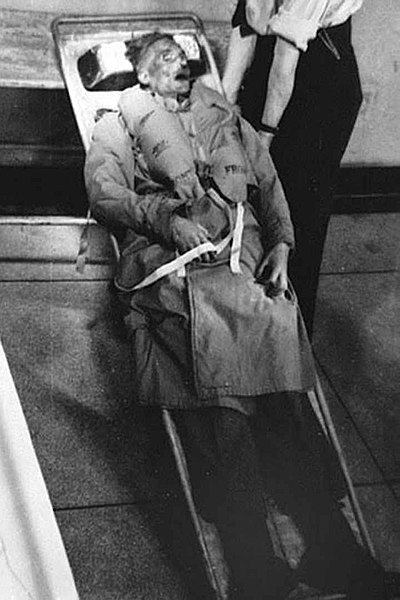
The corpse of Glyndwr Michael, dressed in a Royal Marine uniform with false documents and a fake ID, used in Operation Mincemeat, 1943.
Public domain image from The National Archives.
The story of the British deception, a fascinating story of Allied subterfuge, is now told in the film Operation Mincemeat. It is a remarkable and seemingly highly improbable story of a plan of Allied intelligence to deceive Hitler and misdirect German intelligence. Indeed, it is one of the best examples in history of military deception.
The concept of a plan starts with the Trout Memo, officially written in 1939 by Admiral John Godfrey, director of Naval Intelligence, but almost certainly written by his subordinate Lieutenant Commander Ian Fleming, not yet dreaming of 007, about the deception of an army in war time by fly fishing. Many ideas were suggested, including sending out tins of explosives disguised as food so that hungry sailors would pick them up. One idea, number 28 on the list, almost certainly the thought of Fleming who thought of elaborate deception options, was to use a dead body dressed as an airman dropped from a parachute that had failed and carrying false papers, and drop it where the Germans would find it and be deceived by it.
The deception was planned by a group, the Twenty Committee, XX, headed by Lieutenant Commander RNVR, Ewen Montagu, Cambridge, Harvard, a naval intelligence officer and prominent Jewish lawyer, who later became a judge, together with an RAF officer Squadron Leader Charles Cholmondeley. Montagu later wrote an account of the affair in a book, The Man who Never Was, 1953. The memory of the event is also simply commemorated in a mortuary in Hackney in East London where the body that was used in the plot is buried. In a rather unkind but truthful remark Montagu said of the man who was used, “The only worthwhile thing he ever did, he did after his death.”
The main deception in the plot was a personal letter purported to be from General Sir Archibald Nye to General Sir Harold Alexander, starting, “My dear Alex.” Nye’s letter contained details of sensitive topics, and of a new commander of the Guards brigade, and U.S. service medal awards. He also referred to Operation Husky, an imminent Allied invasion of Greece, that the Germans had been reinforcing and strengthening their defenses in Greece and Crete, and therefore the chief of the Imperial General Staff felt that the Allied troops planned for the assault were insufficient. Thus, it was agreed by the chiefs of staff that the 5th division should be reinforced by one brigade group for the assault on the beach south of Cape Araxos and that similar reinforcement should be made for the 56th division at Kalamata. The letter was a clever double bluff. Nye wrote that “we stand a very good chance of making the Germans think we will go for Sicily, it is an obvious objective and one about which they must be nervous.” To confuse Hitler, he therefore suggested the Allies would invade Sicily.
It is interesting but not surprising that a key figure in the deception appears to have been Ian Fleming, Mr. James Bond, who had written of methods to confuse the enemy, and was crucial to the Trout Memo.
The plot developed. After some difficulty a suitable body was found by a London coroner and kept on ice for few months. It was Glyndwr Michael, 34, homeless Welsh laborer, penniless, with mental health problems, who had died after ingesting rat poison in a London warehouse. He was transformed into Major William Martin, of the Royal Marines whose body contained love letters from a non-existent fiancé named Pam, a jewelry bill for an engagement ring, ticket stubs, religious medal, a copy of a letter marked “personal and most secret”, and above all the false Nye letter. The body had to look as if it had died in an air crash, but floated ashore and he had died at sea. Major Martin, his body wrapped in a life jacket, and with a black attaché case chained to his wrist, was found on April 30, 1943, by a Spanish fisherman off the coast of Huelva.
Even more unlikely than the plan itself was the impact the “secret” document had on Axis planning, summarized in the Wikipedia article:
On 14 May 1943 Grand Admiral Karl Dönitz met Hitler to discuss Dönitz’s recent visit to Italy, his meeting with the Italian leader Benito Mussolini and the progress of the war. The Admiral, referring to the Mincemeat documents as the “Anglo-Saxon order”, recorded
The Führer does not agree with … [Mussolini] that the most likely invasion point is Sicily. Furthermore, he believes that the discovered Anglo-Saxon order confirms the assumption that the planned attacks will be directed mainly against Sardinia and the Peloponnesus.
Hitler informed Mussolini that Greece, Sardinia and Corsica must be defended “at all costs”, and that German troops would be best placed to do the job. He ordered that the experienced 1st Panzer Division be transferred from France to Salonika, Greece. The order was intercepted by GC&CS on 21 May. By the end of June, German troop strength on Sardinia had been doubled to 10,000, with fighter aircraft also based there as support. German torpedo boats were moved from Sicily to the Greek islands in preparation. Seven German divisions transferred to Greece, raising the number present to eight, and ten were posted to the Balkans, raising the number present to 18.
On 9 July the Allies invaded Sicily in Operation Husky. German signals intercepted by GC&CS showed that even four hours after the invasion of Sicily began, twenty-one aircraft left Sicily to reinforce Sardinia. For a considerable time after the initial invasion, Hitler was still convinced that an attack on the Balkans was imminent, and in late July he sent General Erwin Rommel to Salonika to prepare the defence of the region. By the time the German high command realised the mistake, it was too late to make a difference.
Kursk – The Next Great Battle? – WW2 – 190 – April 16, 1943
World War Two
Published 16 Apr 2022The Allies have one chance left to catch the Axis forces in Tunisia before they can reach the Tunis defences; in the USSR both the Axis and Soviets are making plans for a fight near Kursk; and in the skies, in the South Pacific a Japanese aerial offensive ends and Yamamoto himself flies off to congratulate his pilots.
(more…)
The end of the (pandemic-induced) book boom
In the latest SHuSH newsletter, Ken Whyte metaphorically collects his winnings from predicting nearly a year back that the boom in book sales during 2020/2021 would not last once the pandemic lockdowns began to ease off:
I noted last June in SHuSH 103, “Big Guys Lose Their Minds”, that book sales, especially for the leading firms — Penguin Random House, HarperCollins, Hachette, Simon & Schuster — were ramping up during the pandemic, reaching 10% to 20% above 2019 levels. I also noted that the numbers were making some of these publishers giddy.
HarperCollins CEO Brian Murray, for instance, gave an interview in which he proclaimed that humanity had entered a new era of permanently higher book sales and added that he was ratcheting up his spending to meet the increased demand.
“We are being aggressive in terms of buying books. We’ve seen the book pie grow, maybe 15 percent,” says Murray, “and so our response, which is part opportunistic and part defensive, is to be aggressive in buying right now. Because if that pie remains large, we want to make sure that we get a nice share of the larger pie … we want to make sure that we have a lot of new, exciting books in the future that will maintain our revenues at the current levels.” Yikes.
In that June newsletter, I anticipated the world returning to normal and book sales falling back to earth as vaccinations took hold and the coronavirus waned (we also promised to check back in a year — so here we are, a few months early).
It did not feel dangerous, that prediction. While it can sometimes be difficult to distinguish between a temporary spike (or drop) in sales due to extraordinary circumstances and the beginning of a long-term trend, it’s always safest to pick extraordinary-and-temporary amid an unprecedented pandemic with people locked up and not behaving normally. Also, my buddy Jack David at ECW Press agreed with me and he’s been doing this forever. And it wasn’t like Brian Murray had any evidence to back his claim that an era of permanently higher book sales had dawned.
[…]
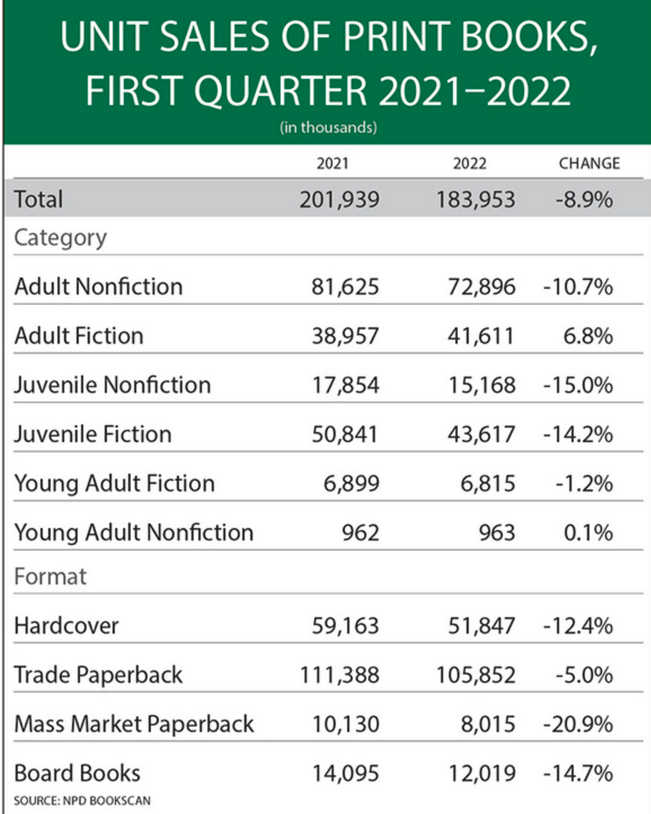
The share prices of big publishing companies don’t tell the same sort of story because they tend not to be pure-play book publishers: Simon & Schuster, for instance, is owned by multimedia giant Viacom; HarperCollins by the omnipresent Rupert Murdoch; Penguin Random House is less than a quarter of Bertelsmann’s business. But first-quarter 2022 revenue figures for those firms are available and they show that the great give-back is underway in the book world, too.
The headline in Publisher’s Weekly reads “The Book Sales Boom is over”. Here’s the US data:
And that’s just the beginning. Sales will continue to slide throughout 2022 and into 2023 as the world normalizes, people concentrate on doing all the things they’ve not been able to do the past two years, run through the extra cash they accumulated in the pandemic, and resume their former library borrowing habits.
What happens at the big publishing companies? If, as Murray’s comments would lead you to suspect, they’ve budgeted and spent for the good times to continue, unhappy times await.
Queen Victoria’s Easter Cake
Tasting History with Max Miller
Published 23 Mar 2021Help Support the Channel with Patreon: https://www.patreon.com/tastinghistory
Tasting History Merchandise: crowdmade.com/collections/tastinghistoryFollow Tasting History here:
Instagram: https://www.instagram.com/tastinghist…
Twitter: https://twitter.com/TastingHistory1
Tiktok: TastingHistory
Reddit: r/TastingHistory
Discord: https://discord.gg/d7nbEpyLINKS TO INGREDIENTS & EQUIPMENT**
Sony Alpha 7C Camera: https://amzn.to/2MQbNTK
Sigma 24-70mm f/2.8 Lens: https://amzn.to/35tjyoW
Self Rising Flour: https://amzn.to/3cKxIoy
Almond Flour: https://amzn.to/3cGN9Ox
Mixed Peel: https://amzn.to/3lp6MP2
Currants: https://amzn.to/3bWEXe4
Castor Sugar: https://amzn.to/3vJMjJR
8 Inch Cake Pan: https://amzn.to/3f3fL7JLINKS TO SOURCES**
Pot Luck: British Home Cookery Book by May Byron: https://amzn.to/3r1qQIp
The Chronicle of Battle Abbey: https://amzn.to/3ePfrco
Cake: A Slice of History by Alysa Levene: https://amzn.to/2Q7JOAs**Some of the links and other products that appear on this video are from companies which Tasting History will earn an affiliate commission or referral bonus. Each purchase made from these links will help to support this channel with no additional cost to you. The content in this video is accurate as of the posting date. Some of the offers mentioned may no longer be available.
Subtitles: Jose Mendoza
#tastinghistory #easter #simnelcake

QotD: How jobs differ from school
When John Smith finishes school he is expected to get a job. And what getting a job seems to mean is joining another institution. Superficially it’s a lot like college. You pick the companies you want to work for and apply to join them. If one likes you, you become a member of this new group. You get up in the morning and go to a new set of buildings, and do things that you do not, ordinarily, enjoy doing. There are a few differences: life is not as much fun, and you get paid, instead of paying, as you did in college. But the similarities feel greater than the differences. John Smith is now John Smith, 22, a software developer at such and such corporation.
In fact John Smith’s life has changed more than he realizes. Socially, a company looks much like college, but the deeper you go into the underlying reality, the more different it gets.
What a company does, and has to do if it wants to continue to exist, is earn money. And the way most companies make money is by creating wealth. Companies can be so specialized that this similarity is concealed, but it is not only manufacturing companies that create wealth. A big component of wealth is location. […] If wealth means what people want, companies that move things also create wealth. Ditto for many other kinds of companies that don’t make anything physical. Nearly all companies exist to do something people want.
And that’s what you do, as well, when you go to work for a company. But here there is another layer that tends to obscure the underlying reality. In a company, the work you do is averaged together with a lot of other people’s. You may not even be aware you’re doing something people want. Your contribution may be indirect. But the company as a whole must be giving people something they want, or they won’t make any money. And if they are paying you x dollars a year, then on average you must be contributing at least x dollars a year worth of work, or the company will be spending more than it makes, and will go out of business.
Someone graduating from college thinks, and is told, that he needs to get a job, as if the important thing were becoming a member of an institution. A more direct way to put it would be: you need to start doing something people want. You don’t need to join a company to do that. All a company is is a group of people working together to do something people want. It’s doing something people want that matters, not joining the group.*
For most people the best plan probably is to go to work for some existing company. But it is a good idea to understand what’s happening when you do this. A job means doing something people want, averaged together with everyone else in that company.
* Many people feel confused and depressed in their early twenties. Life seemed so much more fun in college. Well, of course it was. Don’t be fooled by the surface similarities. You’ve gone from guest to servant. It’s possible to have fun in this new world. Among other things, you now get to go behind the doors that say “authorized personnel only.” But the change is a shock at first, and all the worse if you’re not consciously aware of it.
Paul Graham, “How to Make Wealth”, Paul Graham, 2004-04.
April 16, 2022
Remember all the angst about untold numbers of unmarked graves at former residential schools?
Oh, c’mon man! You must remember the performative grief and anger as even the Prime Minister got into the act by declaring Canada a nation that had committed genocide against as-yet-uncounted First Nations children (oh, and upping the ante, he also implied that this genocide was still ongoing). Do you remember the number of times these graves — often described as “mass graves” rather than merely “unmarked graves” — were investigated in the wake of all this media attention and the fate of at least some of the victims confirmed? No? Well, there’s a good reason for that:
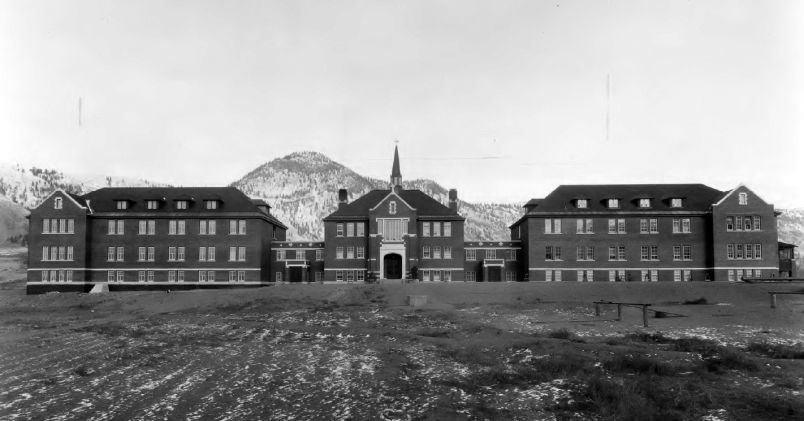
Kamloops Indian Residential School, 1930.
Photo from Archives Deschâtelets-NDC, Richelieu via Wikimedia Commons.
Rosanne Casimir, the chief of the local Tk’emlúps te Secwépemc First Nation, said that “knowledge keepers” within the community had guided investigators to the area to be searched — which had once been an apple orchard on the residential school’s premises. The chief also said that knowledge keepers had already told her that what lay below the surface were graves of children whose deaths had previously been undocumented.
Following that announcement, several other First Nations announced their own discoveries. And in December, the Canadian Press called the discovery of unmarked graves, the “news story of the year”.
If you aren’t from Canada, it’s hard to understand the scale of the national reaction to this story. It’s been known for decades that thousands of Indigenous children died during their time in the residential-school system, many of them from tuberculosis. But this new discovery set the country off emotionally. Justin Trudeau, the prime minister, lowered the Canadian flag on public buildings, and didn’t raise it for another five months. And journalists became unrestrained in the language they used. In one Canadian newspaper, a headline ran, “Is this Canada’s Holocaust moment?”
Canadians were assured that these weren’t just graves, they were the graves of children; and furthermore, it was suggested, these children hadn’t just died from malnutrition or untreated disease — which is obviously bad enough. Some suggested these children were flat out murdered and dumped in shallow graves in the middle of the night. These claims were even aired by the national broadcaster, CBC, on an investigative show called Fifth Estate.
In the Kamloops press, meanwhile, Dr. Sarah Beaulieu, the ground-penetrating-radar expert who’d helped with the discovery, described — as a newspaper put it — “recollections of children as young as six years old being woken up in the middle of the night to dig holes for burials in the apple orchard.”
But there was one odd aspect to the story — and it got odder as the weeks and months marched on: No one seemed to be in any kind of hurry to see what was actually beneath the surface. All we had were ground-penetrating-radar images. And those images don’t show bodies, or caskets, or anything like that. What this technology shows are soil dislocations, which, depending on their depth and spacing, can sometimes indicate the possible presence of grave sites. Why weren’t police, or indigenous authorities, or forensic teams searching for the remains of these poor children?
It’s important to remember that Canadians were being told that this was a crime scene — indeed, not just any crime, but mass murder. If you told Canadians that, say, 215 murdered white children were buried in a field in Toronto, or Ottawa, or Vancouver, there’d be investigators and police all over the place — to see if they could find remains that could be tested and identified. Maybe evidence could be collected showing the manner of death.
And remember that many of the abuses identified at the Kamloops residential school and others like it date to the middle of the 20th century. This means that some of the perpetrators of these claimed child homicides — that is, the teachers, administrators, priests, and ministers who worked at these schools — some of them could still be alive. Shouldn’t we be getting evidence and building a case against them?
How to Make a Royal Marines Officer: Part 2 (1989)
Royal Marines
Published 13 Sep 2012First transmitted in 1989, this is the second part of a programme that follows the progress of 29 men who want to be Royal Marine officers. The remainder of those hoping to be Royal Marine officers face their toughest test.
From the comments:
Nick B
5 years ago (edited)
Richard Van der Horst (honour sword winner) rose to become a Lt Col and commanding officer of the SBS. He was widely expected to be fast tracked to General and command of all UK special forces. Tragically he died in a diving training accident in Norway in 2005.

How much of teenagers identifying as transgender is “social contagion and the development of a new youth subculture”?
The sheer number of children and teens who are deciding that they are “trans” is far in excess of previous generations. How much of this phenomena may be accounted for by social contagion?

My teenage daughter has decided that she is “trans”. So have all her friends. Not some of them. Not most of them. Every. Single. One.
She had never heard of trans, and had no signs of gender dysphoria, until she was moved to a new, cool trans-friendly school by her unsuspecting, politically liberal parents. There she met a group of geeky (or dare I say nerdy?), smart, slightly (but not very) gender nonconforming, artsy kids. As I understand it, they all discovered “trans” together. The old “cis” friends were swiftly discarded in favour of this exciting new peer group.
Exploring “trans stuff” online with friends is a source of great interest and excitement — a real social event. What’s not to love about 245 gender identities, complete with their own unique flags? Then there are those cool neo-pronouns. Forcing your out-of-touch old parents to refer to you as “ze” or “ey” (how do you pronounce that again??) in the name of “inclusivity” is just too delicious to resist. The manga, the cute avatars in computer games, the blue or pink hair — all part of the fun as well. Mocking the outgroup (in this case so-called “cis” people in general and the dreaded TERFs in particular) is also good for a laugh — especially if they happen to be your parents as well.
There is even a special vocabulary with lots of new terms — deadnaming, misgendering, sex assigned at birth, and much more. If these concepts need to be explained to your uncool parents (accompanied by eye rolls of course), so much the better.
Bonding with friends, searching for their identity and place in life, working out their sexuality, separating from family — these are all normal developmental tasks for teens. For many, youth subcultures can be a natural part of that. Some are harmless. Some, like drug use and extreme dieting, not so much. But in the case of the latter, sensible adults usually intervene to help steer the young people in the right direction. Not in the case of trans. Here we have adults steering kids down a dangerous path, which involves permanent, life altering drugs and surgeries for which there is no good evidence base.
For many of these kids, LGBTQ+ is a youth subculture. It really is as simple as that. Recent surveys have been identifying skyrocketing rates of “trans” or “queer” identification in young people. One found that an astonishing 39% of young adults in the US aged between 18-24 identified with the label LGBT — the figure for teens <18 may well be even higher. Of course this figure includes gay and lesbian people as well as those identifying as trans. Another poll, which looked only at gender, found that nearly 10% of US high schoolers identified as “gender diverse”. Yet another survey gives a lower figure of 1.8%. Whichever figure is correct, this is a huge explosion in numbers over a very short period of time. As endocrinologist Dr Will Malone asks; “How do we reconcile these numbers with 2013 data reporting the prevalence of adult gender dysphoria to be a rare 2-14 in 100,000?”
Social contagion and the development of a new youth subculture, that’s how.
H/T to Blazing Cat Fur for the link.
Tank Chats #143 | Hetzer | The Tank Museum
The Tank Museum
Published 31 Dec 2021Our Patreons have already enjoyed Early Access and AD free viewing of our weekly YouTube video! Consider becoming a Patreon Supporter today: https://www.patreon.com/tankmuseum
The Munich Agreement averted the outbreak of war but for Czechoslovakia, it meant giving way to German occupation. Join David Willey to discover how Germany was able to use the country’s existing military outputs to build the tank destroyer, Hetzer.
00:00 – Intro
00:28 – The history of the tank destroyers name
14:55 – Wartime production
(more…)


