
Forgotten Weapons
Published 30 Aug 2023Brno’s ZB-26 was one of the best light machine guns of the 1920s, and it was widely adopted by countries that did not have domestic arms design and production capacity (and it would eventually become the British Bren gun as well). It was designed for the 8mm Mauser cartridge, and had a simple fixed gas system that ran very well — until countries began following the German lead in moving to standard use of s.S. (schweres Spitzgeschoß; heavy ball) ammunition. This put undue strain on the ZB-26 mechanism, and so an improvement was made to include an adjustable gas system that could be set to accommodate a variety of loadings. This experimental model was the ZB-27, and it was tested by Romania in the late 1920s.
Romania liked the design, and adopted it in 1930, purchasing guns from Brno and also buying a license to produce them at the Cugir factory complex in Romania. Today we are taking a look at two examples of Romanian ZB-30s, one Czech-made and one Romanian-made. They both incorporate a number of improvements over the ZB-26 (improved barrel latch security, rear monopod socket, bipod locking lever, etc) but also have a few minor differences from each other.
Thanks to the Southern Iceland Shooting Association for helping me film these and other cool guns in Iceland!
(more…)
December 9, 2023
Romanian ZB-30 LMG: Improving the Already-Excellent ZB-26
QotD: A secret of effective writing
I’m in the process of editing a document for a technical project that is intended to be an introduction for newbies to certain fairly complex issues. While requesting feedback on the project mailing list, I realized that I had accidentally revealed a major secret of really top-grade writing, exactly the sort of thing that put The Cathedral and the Bazaar on the New York Times best-seller list.
I see no reason not to share it with my readers. So here is the relevant part of my request for feedback:
Please fix typos and outright grammatical errors. If you think you have spotted a higher-level usage problem or awkwardness, check with me before changing it. What you think is technically erroneous may be expressive voice.
Explanation: Style is the contrast between expectation and surprise. Poets writing metric poetry learn to introduce small breaks in scansion in order to induce tension-and-release cycles at a higher level that will hold the reader’s interest. The corresponding prose trick is to bend usage rules or change the register of the writing slightly away from what the reader unconsciously expects. If you try to “fix” these you will probably be stepping on an intended effect. So check first.
(I will also observe that unless you are already an unusually skilled writer, you should not try to replicate this technique; the risk of sounding affected or just teeth-jarringly bad is high. As Penn & Teller puts it, “These stunts are being performed by trained, professional idiots.”)
Eric S. Raymond, “A major secret of effective writing”, Armed and Dangerous, 2011-02-05.
December 8, 2023
“An error of this magnitude makes one wonder how robust such calculations are”
Christopher Snowden notes the proliferation of media and public advocacy groups warning us about “junk food”:

On Monday, the front page of The Times led with a speech from Henry Dimbleby and a cost-of-obesity estimate from the Tony Blair Institute for Global Change — the perfect start to the week for any Times reader. According to Sir Tony’s think tank, “the effect on national productivity from excess weight is nine times bigger than previously thought”. An error of this magnitude makes one wonder how robust such calculations are (the previous estimate only came out last year), but Mr Dimbleby saw it as further proof that food should be treated like smoking.
The NHS “will suck all the money out of the other public services” while “at the same time, economic growth and tax revenue will stagnate. We will end up both a sick and impoverished nation,” Dimbleby will warn.
Would it be unfair to point out that the USA has much higher rates of obesity than the UK and also has much higher GDP growth?
As I pointed out on what I shall continue to call Twitter, the estimates as bunkum. They come from Frontier Economics and were first commissioned by the makers of Wegovy, presumably to make their effective but expensive weight loss drug look like a relative bargain.
Their previous estimate of the cost of obesity to “society” was £58bn. This year’s estimate is £98bn, most of which (£57bn) comes from lost quality-adjusted life years. As I tire of pointing out, these are internal costs to the individual which, by definition, are not costs to wider society. I can’t stress enough how absurd it is to include lost productivity due to early death as a cost to the economy. You might as well calculate the lost productivity of people who have never been born and claim that contraception costs the economy billions of pounds.
Since the previous estimate, the costs have been bulked up by including the costs of being overweight, but there is no indication in the wafer-thin webpage of what these are. Being merely overweight doesn’t have many serious health implications. The healthcare costs have doubled, but as in the previous report, the new estimate does not look at how much more healthcare would be consumed if there was no obesity. No savings are included. What we need is the net cost.
The “report” that The Times turned into a front page news story is no more than a glorified blog post. It contains no detail, no methodology and none of the assumptions upon which it is based can be checked. It comes with an eight page slideshow from Frontier Economics which is described as a “full analysis” but which doesn’t contain any useful figures either.
Estimates like this are bound to mislead the casual reader into thinking that they are paying higher taxes because of obesity. There is no other reason to publish them, as they have no academic merit. They are designed to be misunderstood.
Sure enough, the very next day The Times was explicitly claiming that the putative £98 billion — now rounded up to £100 billion — was a direct cost to government …
The findings come after an analysis found this week that Britain’s weight problem is costing the state almost £100 billion a year.
The development of the American suburb
In the latest book review from Mr. and Mrs. Psmith’s Bookshelf, Jane Psmith discusses A Field Guide to American Houses (Revised): The Definitive Guide to Identifying and Understanding America’s Domestic Architecture, by Virginia Savage McAlester. In particular, she looks at McAlester’s coverage of how suburbs developed:
After some brief but interesting discussion of cities,1 most of the page count is devoted to the suburbs. It’s a sensible choice: suburbs have by far the most varied types of house groupings, and more than half of Americans live in one. But what exactly is a “suburb”? It’s a wildly imprecise word, referring to anything that is neither truly rural nor the central urban core, and suburbs vary tremendously in character. As a working definition, though, a suburb is marked by free-standing houses on relatively larger lots. (If you can think of a counter-example that qualifies but is “urban”, I’ll bet you $5 it started out as a suburb before the city ate it.)
This means that building a suburb has a few obvious technological prerequisites, which McAlester lists as follows: First, balloon-frame construction, which enabled not just corners but quick and inexpensive construction generally and removed much of the incentive for the shared walls that were so common in the early cityscape. Second, the proliferation of gas and electric utilities in the late nineteenth century meant that the less energy-efficient free-standing homes could still be heated relatively inexpensively. Third, the spread of telephone service after 1880 meant that it was much easier to stay in touch with friends whose front doors weren’t literally ten feet away from yours.2 But by far the most important technological advances came in the field of transportation, which is obviously necessary if you’re going to live in the country (or a reasonable facsimile thereof) and work in the city.
The first of these transportation advances was the railroad. In fact “railroad suburb” is a bit of a misnomer, because most of the collections of houses that grew up around the new rail stops were fully functional towns that had their own agricultural or manufacturing industries. The most famous railroad suburbs, however, were indeed planned as residential communities serving those wealthy enough to pay the steep daily rail fare into the city. Llewellyn Park near New York City, Riverside near Chicago, and the Main Line near Philadelphia are all examples of railroad suburbs that have maintained their tony atmosphere and high property values.
The next and more dramatic change was the advent of the electric trolley or streetcar, first introduced in 1887 but popular until about 1930. (That’s what all the books say, but come on, it’s probably October 1929, right?) Unlike steam locomotives, which take quite a long time to build up speed or to slow down again, and so usually had their stations placed at least a mile apart, streetcars could start and stop far more easily and feature many more, and more densely-placed, stops. Developers typically built a streetcar line from the city veering off into the thinly-inhabited countryside, ending at an attraction like a park or fairground if possible. If they were smart, they’d bought up the land along the streetcar beforehand and could sell it off for houses,3 but either way the new streetcar line added value to the land and the development of the land made the streetcar more valuable.
You can easily spot railroad towns and streetcar suburbs in any real estate app if you filter by the date of construction (for railroad suburbs try before 1910, for streetcar before 1930) and know what shapes to look for. Railroad towns are typically farther out from the urban center and are built in clusters around their stations, which are a few miles from one another. Streetcar suburbs, by contrast, tend to be continuous but narrow, because the appeal of the location dropped off rapidly with distance from the streetcar line. (Lots are narrow for the same reason — to shorten the pedestrian commute.) They expand from the urban center like the spokes of a wheel.
And then came the automobile and, later, the federal government. The car brought a number of changes — paved streets, longer blocks, wider lots (you weren’t walking home, after all, so it was all right if you had to go a little farther) — but nothing like the way the Federal Housing Authority restructured neighborhoods.
The FHA was created by the National Housing Act of 1934 with the broad mandate to “improve nationwide housing standard, provide employment and stimulate industry, improve conditions with respect to mortgage financing, and realize a greater degree of stability in residential construction”. It was a big job, and the FHA set out to accomplish it in a typical New Deal fashion: providing federal insurance for private construction and mortgage loans, but only for houses and neighborhoods that met its approval. This has entered general consciousness as “redlining”, after the color of the lines drawn around uninsurable areas (typically old, urban housing stock),4 but the green, blue, and yellow lines — in order of declining insurability — were just as influential on the fabric of contemporary America.
A slow economy through the 1930s and a prohibition on nonessential construction during the war meant that FHA didn’t have much to do until 1945, but as soon as the GIs began to come home and take advantage of their new mortgage subsidies, there was a massive construction boom. With the FHA insuring both the builders’ construction loans and the homeowners’ mortgages, nearly all the new neighborhoods were built to the FHA’s exacting specifications.
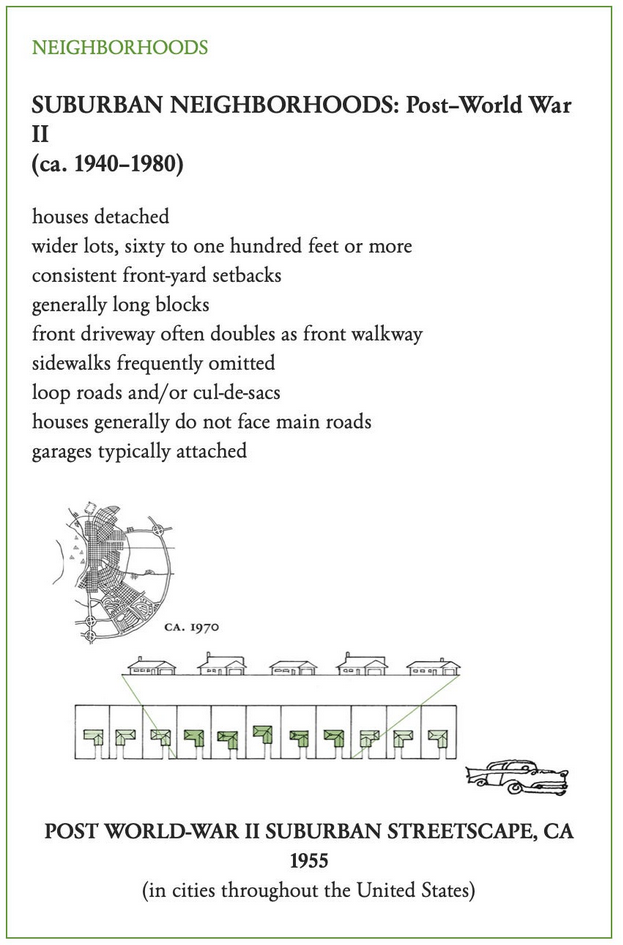
One of the FHA’s major concern was avoiding direct through-traffic in neighborhoods. Many post-World War II developments were built out near the new federally-subsidized highways on the outskirts of the cities, so the FHA was eager to protect new subdivisions from heavy traffic on the interstates and the major arterial roads. Neighborhoods were meant to be near the arterials, but with only a few entrances to the neighborhood and many curved roads and culs-de-sac within it. Unlike the streetcar suburbs or the early automobile suburbs that filled in between the “spokes” of the streetcar lines, where retail had clustered near the streetcar stops, the residents of the post-World War II suburbs found their closest retail establishments outside the neighborhood on the major arterial roads. Lots became wider, blocks longer, and sidewalks less frequent; houses were encouraged to stay small by FHA caps on the size of loans. And although we tend to assume they were purely residential areas, the FHA encouraged the inclusion of schools, churches, parks, libraries, and community centers within the neighborhood.


1. America doesn’t have many urban neighborhoods that predate 1750, and even fewer that persist in their original layout, but if you’ve ever visited one it’s amazing how compact everything feels even in comparison to the rowhouses of the following century.
2. McAlester’s footnote for the paragraph that contains all this reads: “These three essentials were highlighted in an essay the author has read but has not been successful in locating for this footnote.”
3. This is still, I am told, how some of the more sensibly-governed parts of the world run their transit systems: whatever company has the right to build subways buys up the land around a planned (but not announced) subway line through shell corporations, builds the subway, then sells or develops the newly-valuable property. Far more efficient as a funding mechanism than fares!
4. This 2020 NBER working paper points out that redlined areas were 85% white (though they did include many of the black people living in Northern cities) and suggests that race played very little role in where the red lines were drawn; rather, black people were already living in the worst neighborhoods.
“When you see the same signs here that characterised collapse in other polities for the last 5000 years, it means collapse is coming here too – we’re not special snowflakes”
Feeling good? Happy with your culture and comfortable that major disruptions won’t disturb you? Here’s Theophilus Chilton to harsh your mellow:
There are essentially three basic reasons why those on the American Right haven’t shrugged the same way regular folks in Europe are beginning to (see Spain and France as well as Ireland for recent examples). The first of these is because the American Right still holds onto a residual trust in elections and democracy and the whole “We’ll get ‘em next election!” mentality. Having been fed a decades-long diet of reverence for democracy and voting and whatnot acts as a desensitising agent that keeps many Americans anesthetised to the actual uselessness of such attitudes.
But this will continue to erode as we see more obvious election fraud. Eventually, when the norm becomes “go to bed with the right-wing candidate ahead by 10% and wake up with the left-wing candidate winning by 0.5%,” elections will lose what legitimacy they have left. Further, as “democracy” comes to be increasingly defined as “whatever the Regime wants to do“, more and more normies will start to clue in to the fact that democratic forms are not going to save America, but are in fact what are destroying it.
Second, Heritage Americans and those on the normie Right tend to assume that everybody still plays by the old, traditional set of norms, including FedGov. This “seemed” plausible when the Regime employed incrementalism to gradually acculturate normies to its agenda. But as they accelerate their revolutionary overthrow of everything that normies thought would be sacrosanct like they have over the past few years, this sense of “norms” will go away. And when that happens, there will be a whole lot of people suddenly open to the possibility that something else might become a new set of norms.
Third, because America is so BIG – especially in the geographical sense – Heritage Americans have been able to self-mitigate many of the worse aspects of the Regime agenda. They could get away from the slums. Federalism allowed them to find states in which to prosper despite the Regime’s efforts. And so forth. Regular folks in many places could still plausibly think America was a high trust, high social cohesion society because where they were at locally might well have been. But as the Regime accelerates, this also will stop. $oros DAs will continue to release violent criminals while punishing law-abiding citizens for defending themselves and their property. Immigration and inflation will further erode the economic prosperity that still remains, which is something that fleeing to a Red state can’t fix. And of course, it will all be brought home starkly once 20,000 or so Palestinian “refugees” get relocated into their counties.
Let’s remember that this is what we actually saw in Ireland. Even into the Oughts, Ireland was homogenous, relatively high IQ and high trust, was the Celtic Tiger with lots of prosperity. Then globohomo decided that Ireland needed tons of “refugees” just like the rest of Europe and suddenly that prosperity and safety and high trust went away. What was the response? Riots and continued disorder that Regime attempts to clamp down on are only going to make worse.
This is going to wear out eventually, which is something that FedGov knows. That’s why they’ve been ramping up gun control efforts over the past few years despite constant opposition from the courts. They’re merely trying to prepare for the inevitable by disarming the people they know they need to suppress the most. Unlike most Euro and Anglosphere countries, Americans haven’t allowed themselves to be disarmed — and that’s something that really does vex The Powers That Be.
But the problem is that it isn’t the 1950s anymore, or even the 1990s for that matter. Back in the 1950s, FedGov could literally stick bayonets at the backs of high school students and force unwilling southern states to integrate their schools. Even in the 1990s FedGov could send its agents to besiege and murder dozens of men, women, and children and most people even at an official level wouldn’t say a thing. But now its 2023 and we’re quite a bit further along the decentralisation path in our secular collapse phase. What FedGov had the moral legitimacy and competency to pull off back then isn’t guaranteed for them now anymore.
So what happens when the FBI wants to do another Waco? What happens if Texas decides it doesn’t want to allow the FBI to do another Waco? We’re past the point where we can blithely say, “Well, the Feds can just make Texas go along with it!” Our place in our collapse cycle means that’s not going to fly like it could have 30 years ago.
At this point, the goal should not be to calm people down but to get them riled up so that when (not if) the break comes, it will be so widespread and numerous that it will completely overwhelm the ability of FedGov and its agencies to deal with it. In this vein, I think of Solzhenitsin’s quote from Gulag Archipelago,
And how we burned in the camps later, thinking: What would things have been like if every Security operative, when he went out at night to make an arrest, had been uncertain whether he would return alive and had to say good-bye to his family? Or if, during periods of mass arrests, as for example in Leningrad, when they arrested a quarter of the entire city, people had not simply sat there in their lairs, paling with terror at every bang of the downstairs door and at every step on the staircase, but had understood they had nothing left to lose and had boldly set up in the downstairs hall an ambush of half a dozen people with axes, hammers, pokers, or whatever else was at hand? … The Organs would very quickly have suffered a shortage of officers and transport and, notwithstanding all of Stalin’s thirst, the cursed machine would have ground to a halt! If … if … We didn’t love freedom enough. And even more – we had no awareness of the real situation … We purely and simply deserved everything that happened afterward.
So what does this mean practically? It means people need to start organising locally with people they trust, building a network in their town or county, coordinating with friendly local power holders. It means stockpiling the necessary tools for the maintenance of their freedoms. It means training to shoot, learning how to use comms, thinking both strategically and tactically — obtaining the knowledge to use with your organising. Most of all, it means being morally and temperamentally prepared to oppose the enemies of our people, both foreign and domestic.
The Real Betty Crocker’s Pineapple Upside Down Cake
Tasting History with Max Miller
Published 22 Aug 2023
(more…)
QotD: Prices as information
Let’s all take another huge toke and return to our Libertarian paradise, where all conceivable information is both completely accurate and totally free to circulate. And since we’re now all so very, very mellow, let’s give Karl Marx due credit. One of his main gripes with “capitalism” is that it “commodifies” everything. Everything has its price under “capitalism”, Marx said, even stuff that shouldn’t – human life, human dignity. Since this is a college classroom and I’m the prof, I can assign some homework. Go google up “kid killed over sneakers”. You can always find stories like that. Put your natural, in-many-ways-admirable young person’s urge to rationalize aside, and simply consider the information. What were those Air Jordans really worth, based on the stuff we’ve learned today?
See what I mean? Marx had a point. What are those sneakers worth, considered from the standpoint of “demand”? Obviously more than whatever a human life is worth, considered from the same standpoint. Hence Marxism’s enduring appeal to young people whose hearts are in the right place. “Commodificiation”, or “reification” as he sometimes called it, is very real, and very nasty …
Severian, “Velocity of Information (I)”, Founding Questions, 2020-12-26.
December 7, 2023
Canada is great at gesturing on the international stage … far less so in doing anything substantive, especially militarily
In The Line, Harrison Ruess channels his inner Star Trek geekiness to illustrate the Kobayashi Maru situation the Royal Canadian Navy (and the rest of the armed forces) find themselves in:

Canada is, and has been for some time, caught between two irreconcilable positions. We don’t want to spend any money on the military but also continue to prioritize how important and influential we want to be in the world (“Canada is back”, etc).
Friends, either of these things is possible. We just can’t do both at the same time.
So let’s have an honest conversation and decide which road we want to go down, commit to it, and then do the best we can in whichever adventure we choose. Talking, domestically and internationally, about how determined Canada is to make a positive impact in the world, while not investing in the systems to give our words weight, sets both Canadians and our allies up for disappointment. The old adage that it’s best not to over-promise and under-deliver should be remembered. We seem to aspire to the reverse.
If Canadians really don’t want to invest in our military, then we need to be honest about the consequences of those decisions. It means a more inwardly focused Canada, less able to support our allies, with fewer seats at big tables, less able to respond to emergencies or disasters, and likely less able to help our own. Given our unstable world, I would not personally advocate for this road, but there is a case to be made for it. So if you are someone who thinks this is the right path, then make your case honestly. Explain why you think it’s swell that our navy will need to launch under-equipped vessels, or not launch them at all. Defend your ground. But stop trying to sell Canadians a fable that we can have a shell of an armed forces while at the same time having increased global influence and impact.
On the other hand, if we do think Canada has a positive role to play — and even a responsibility — in trying to bring some order to the world, help those who need it, and ultimately protect our own interests, then we need a military, and a military budget, strong enough to meet the demands of the task. This includes procurement budgets, maintenance budgets, budgets to offer competitive wages, and budgets to sustain missions, both training and the real deal.
Proponents of this position need to do a much better job of explaining why this is the best path to both improving the lives of Canadians and stabilizing our destabilized world. Then our governments must pursue and defend this road, even when defence isn’t top of the polling priority list — which it never is.
The current status-quo doesn’t work. It’s dishonest. And most importantly, it hurts Canadians and our awareness of what our country is — or isn’t — capable of doing. Kudos to V.Adm. Topshee for, in not so many words, trying to explain the impact of this reality on the navy.
Having a capable, equipped military costs money — starting with perhaps the NATO-agreed upon two per cent of GDP. That’s the cost of doing business as a serious, mature, supposedly globally oriented country. Are we that? Do we even want to be?
Burying the lede … and the victims
Maxime “Mad Max” Bernier sent out a fundraising letter to PPC supporters that included some disturbing new data from Statistics Canada:

As usual, the biggest news in Canada is being ignored by all of our crooked establishment politicians and the dishonest corporate media.
Last week Statistics Canada released a report on deaths in Canada (causes of death, overall life expectancy, etc), which include the latest data from 2022.
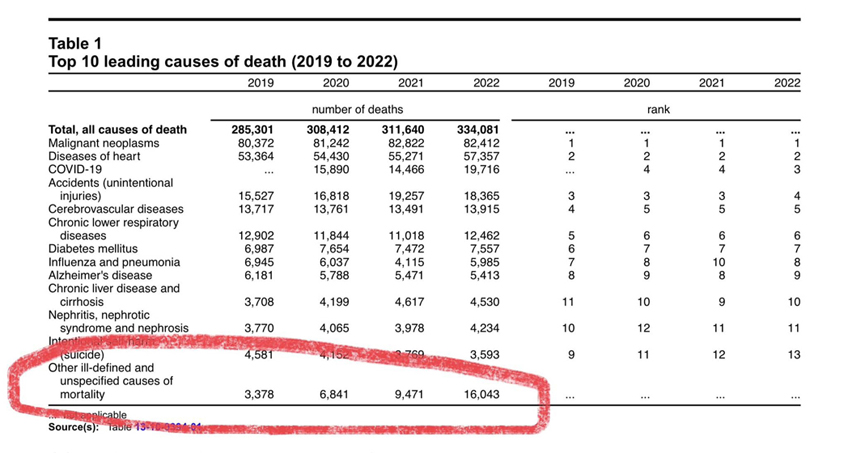
I’m not a doctor, a scientist, or even a statistician, but when I saw the table below, a few things jumped out at me.
First, deaths related to covid-19 (check the fourth line) were at an all-time high in 2022!
Can you believe that? There were more covid deaths in 2022 than the two years before.
And yet that same year saw the end of mask mandates, vaccine passports, and most covid measures.
For two years the elites blasted us with propaganda and warped our society around this mild illness, but when deaths were rising, they were silent. Bizarre!
To be clear, I am not advocating for any of these unnecessary draconian restrictions to return, I am just demanding some honesty and consistency from our morally corrupt politicians, public health officials, and media!
It has never been so obvious that covid restrictions were not scientific, they were just about politics and control.
But the most disturbing part is what I have circled at the bottom of the table. Deaths with “ill-defined or unspecified causes” have been steadily increasing since 2020.
These deaths have almost TRIPLED since 2020 from 6,841 to 16,043 in 2022.
What could be causing this? What happened in 2021 that could have caused this explosion of unexplained deaths over the last 2 years?
An experimental pharmaceutical product was rushed to market and forced on Canadian society, is what happened.
They told us it was “safe and effective” but over the last few years we have learned more and more about how that covid shot was neither.
Now more and more Canadians are dying from causes very likely related to the covid shot.
And where is the accountability?!
There is no admission of any possible error on the part of the government. On the contrary, it’s still encouraging everyone to get boosters!
There are no demands for an inquiry by the opposition parties to investigate the potential risks associated with the covid jab.
There are no investigative journalists trying to get to the bottom of one of the biggest medical scandals in Canadian history.
No! They’re just trying to sweep it under the rug and move on!
We can’t wait for the political establishment to hold itself to account. We saw throughout the covid years that the government, the opposition, and the media will all work together to protect themselves and each other.
And we can’t let them get away with it!
The only kind of conspiracy theories the media is interested in
Chris Selley points out the obvious bias legacy media polls bring to any investigation into the popularity of various conspiracy theories:

Readers, were you aware that polls show conservative Canadians are more prone to believing in conspiracy theories than liberal Canadians? I’m kidding — of course you were. The pollsters haven’t stopped asking about it since the pandemic hit: Insights West in April 2021, Angus Reid in November 2021, Abacus Data in June 2022, Leger Marketing in the spring of 2022, and again this week. And we in the media can’t get enough of it: “Conspiracy theories are popular in Canada, especially among conservatives, poll says”, was The Canadian Press headline for this week’s Leger poll.
The notion that the Conservative Party of Canada and some of its leading lights are inviting violence through unconscionably heated and conspiratorial rhetoric is endemic in the Canadian newsroom. While I’m no fan of unconscionably heated rhetoric, I very much doubt actual extremists, or potentially violent extremists, see anyone worth choosing among Canada’s federal political leaders. But in any event, it apparently needs saying that not all conspiracy theories are created equal. Some aren’t conspiracy theories at all.
To its credit, The Leger poll released this week mostly confines itself to proper conspiracies: 9/11 Trutherism, a faked lunar landing, etc. Somewhere between 36 per cent (the truth about John F. Kennedy’s assassination was covered up) and five per cent (the earth is flat) believe completely or somewhat in these notions.
But by far the most popular statement among those Leger presented to respondents was as follows: “Mainstream media manipulates the information it disseminates”. Fifty-five per cent of respondents overall agreed with that; the JFK coverup was in a distant second at 36 per cent.
What’s “mainstream media”? If it includes, say, Al Jazeera and Fox News, then the statement is obviously true. (What does “manipulate” mean, for that matter? It doesn’t necessarily imply bad faith.) And the belief is certainly not just confined to Conservative voters: 47 per cent of NDP voters and 53 per cent of Green voters agreed, compared to 69 per cent of Conservative supporters.
What the question definitely does, however, is boost the overall numbers and make them more newsworthy. So Leger (and media) can say “79 per cent of Canadians believe in at least one of the conspiracy theories we asked them about”, and “Conservative voters (94 per cent) are more likely to believe in at least one of the theories”.
That’s a quibble, really. Other polls have, in my view, been utterly shameless about this sort of results-padding.
Take this proposition, for example, which Abacus put to its respondents: “52 per cent think government accounts of events can’t be trusted”.
That is a true statement. It applies to every government in the world, ever.
Even to mention Klaus Schwab’s Great Reset in Canadian political conversation is to risk being branded a conspiracy theorist. But it’s a real-deal “world governance” manifesto, it’s absolutely bonkers from start to finish, everyone from Justin Trudeau to the King (in a previous role) has made approving noises about it, and to the very limited extent it should be taken seriously, everyone should oppose it.
Carl Gustaf: Recoilless Rifle | Anti-Tank Chats
The Tank Museum
Published 25 Aug 2023From The Falklands to Ukraine; the Carl Gustaf recoilless rifle was introduced in 1948 and is still used by armies around the world today.
(more…)
QotD: Displacing the “little platoons”
Janice Rogers Brown, “A Whiter Shade of Pale”, a speech to the Federalist Society, 2000-04-11.
December 6, 2023
Halifax Explosion: Minute by Minute
Terra Incognita
Published 5 Dec 2017100 years ago, the Canadian port city of Halifax was struck by one of the largest non-nuclear explosions in history. How did it happen?
(more…)
QotD: What Charles VIII brought back from his Naples vacation
There was still a long “shaking out” period for the new technology: figuring out how to get enough saltpeter for gunpowder (now that’s a story we’ll come back to some day), how to build a large enough and strong enough metal barrel, and how to actually use the weapons (in sieges? against infantry? big guns? little guns?) and so on. By 1453, the Ottomans have a capable siege-train of gunpowder artillery. Mehmed II (r. 1444-1481) pummeled the walls of Constantinople with some 5,000 shots using some 55,000 pounds of gunpowder; at last Theodosius’ engineers had met their match.
And then, in 1494, Charles VIII invaded Italy – in a dispute over the throne of Naples – with the first proper mobile siege train in Christendom (not in Europe, mind you, because Mehmed had beat our boy Chuck here by a solid four decades). A lot of changes had been happening to make these guns more effective: longer barrels allowed for more power and accuracy, wheeled carriages made them more mobile, trunnions made elevation control easier and some limited degree of caliber standardization reduced windage and simplified supply (though standardization at this point remains quite limited).
The various Italian states, exactly none of whom were excited to see Charles attempting to claim the Kingdom of Naples, could have figured that the many castles and fortified cities of northern Italy were likely to slow Charles down, giving them plenty of time to finish up their own holidays before this obnoxious French tourist showed up. On the 19th of October, 1494, Charles showed up to besiege the fortress at Mordano – a fortress which might well have been expected to hold him up for weeks or even months; on October 20th, 1494, Charles sacked Mordano and massacred the inhabitants, after having blasted a breach with his guns. Florence promptly surrendered and Charles marched to Naples, taking it in 1495 (it surrendered too). Francesco Guicciardini phrased it thusly (trans. via Lee, Waging War, 228),
They [Charles’ artillery] were planted against the Walls of a Town with such speed, the Space between the Shots was so little, and the Balls flew so quick, and were impelled with such Force, that as much Execution was done in a few Hours, as formerly, in Italy, in the like Number of Days.
The impacts of the sudden apparent obsolescence of European castles were considerable. The period from 1450 to 1550 sees a remarkable degree of state-consolidation in Europe (broadly construed) castles, and the power they gave the local nobility to resist the crown, had been one of the drivers of European fragmentation, though we should be careful not to overstate the gunpowder impact here: there are other reasons for a burst of state consolidation at this juncture. Of course that creates a run-away effect of its own, as states that consolidate have the resources to employ larger and more effective siege trains.
Now this strong reaction doesn’t happen everywhere or really anywhere outside of Europe. Part of that has to do with the way that castles were built. Because castles were designed to resist escalade, the walls needed to be built as high as possible, since that was the best way to resist attacks by ladders or towers. But of course, given a fixed amount of building resources, building high also means building thin (and European masonry techniques enabled tall-and-thin construction with walls essentially being constructed with a thick layer of fill material sandwiched between courses of stone). But “tall and thin”, while good against ladders, was a huge liability against cannon.
By contrast, city walls in China were often constructed using a rammed earth core. In essence, earth was piled up in courses and packed very tightly, and then sheathed in stone. This was a labor-intensive building style (but large cities and lots of state capacity meant that labor was available), and it meant the walls had to be made thick in order to be made tall since even rammed earth can only be piled up at an angle substantially less than vertical. But against cannon, the result was walls which were already massively thick, impossible to topple over and the earth-fill, unlike European stone-fill, could absorb some of the energy of the impact without cracking or shattering. Even if the stone shell was broken, the earth wouldn’t tumble out (because it was rammed), but would instead self-seal small gaps. And no attacker could hope that a few lucky hits to the base of a wall built like this would cause it to topple over, given how wide it is at the base. Consequently, European castle walls were vulnerable to cannon in a way that contemporary walls in many other places, such as China, were not. Again, path dependence in fortification matters, because of that antagonistic co-evolution.
In the event, in Italy, Charles’ Italian Vacation started to go badly almost immediately after Naples was taken. A united front against him, the League of Venice, formed in 1495 and fought Charles to a bloody draw at Fornovo in July, 1495. In the long-term, French involvement would draw in the Habsburgs, whose involvement would prevent the French from making permanent gains in a series of wars in Italy lasting well into the 1550s.
But more relevant for our topic was the tremendous shock of that first campaign and the sudden failure of defenses which had long been considered strong. The reader can, I’d argue, detect the continued light tremors of that shock as late as Machiavelli’s The Prince (1532, but perhaps written in some form by 1513). Meanwhile, Italian fortress designers were already at work retrofitting old castles and fortifications (and building new ones) to more effectively resist artillery. Their secret weapon? Geometry.
Bret Devereaux, “Collections: Fortification, Part IV: French Guns and Italian Lines”, A Collection of Unmitigated Pedantry, 2021-12-17.
December 5, 2023
Vanity does apparently have a limit (for most of us) – it’s about 25%
Rob Henderson explains why so many people — not down-to-earth sensible folks like my readers, of course — seem to have an inflated view of their own attractiveness:

A few years ago, a study on online dating found that people tend to reach up the hierarchy toward potential partners who are more desirable than themselves. On average, people pursued partners who are 25% more desirable than they themselves are.
This is consistent with what the psychologist Roy Baumeister has described as the “optimal margin of illusion”. Generally, people believe they themselves are 10-20% better than they really are.
Thus, people might not knowingly pursue individuals who are more desirable than themselves. Rather, they genuinely believe those individuals are in their league. They think they’re aiming for someone of equal attractiveness to themselves.
Consistent with this idea, a study looked at how people inflate their perceptions of themselves. The researchers brought people into their lab to have their photos taken. The researchers then digitally modified these images to varying degrees by making them look more similar to an attractive person or a less attractive person.
So imagine they take your photo (assuming you’re male) and change the image to look just a little bit more like Brad Pitt. Or a bit more like someone much uglier than you.
A few weeks later, the researchers invited the participants back into the lab and showed them either modified or unaltered photos of themselves.
People were asked to identify their true, unaltered photo among an array of images. One image was their actual photo. Others were morphed to be more or less attractive.
Participants were most likely to guess that their true photo was the one that was modified to be 10 to 20 percent more attractive.
This probably matches your own experience. Consider how you react to candid photos of other people compared to candid photos of yourself. We hear our friends say, “Ugh, that’s a horrible photo of me” and we think “No, that photo is fine, that’s what you look like.” But then we say the same thing when we see candid photos of ourselves. So unflattering.
In his book The Social Leap, the evolutionary psychologist William von Hippel has written, “That’s why you don’t like candid pictures of yourself: because they capture what you actually look like, not what you think you look like. You prefer the picture of yourself that caught you at just the right angle, on just the right day, and those are the ones you put up on Facebook, Tinder, or in the company directory.”
This pattern of self-enhancement extends beyond just physical attractiveness.
I’ve written before about the “better-than-average effect”. A large body of research has found that people tend to believe they are more intelligent, trustworthy, and have a better sense of humor than others. A recent study found that people believe they use ChatGPT more critically, ethically and efficiently than others. People think they are better drivers than average, students think they are better students than average, professors think they are better professors than average.
People do inflate their opinions of themselves. But this only goes so far. People in the photo study chose images that were slightly more attractive than the true photo, but only slightly.
Most people see themselves as just a bit better than they really are.


