
The underlying principles of Game are sound, because they come from the world of advertising. Heartiste was very good about referring to the marketing background — sociobiology may have provided the theory, but marketing, particularly Robert Cialdini’s seminal Persuasion, provided the practice. Social proof, consistency and commitment, all that jazz, it’s just marketing, and marketing certainly works … as far as it goes. I’m not privy to the numbers (not being a senior exec at a major corporation), but I’m pretty sure that an ad campaign that verifiably produced a 5% increase in sales would be a smashing success. An ad campaign that got 10% would make you Don Draper, a legend in the field who is also complete fiction.
Which forces us to consider a second question: How much of Game’s “success” is just practice? I’d wager very long money that no one, in the history of seduction, has ever said “I hit on fifteen girls a day, but I never seem to get anywhere”. And that of course is the very first thing the Game gurus have you do — just approach girls, dozens of them every day. Practice any skill for an hour a day and you’re bound to get a lot better pretty quickly. If you stink at golf, for instance, go hit a bucket of balls every day after work; in a month you’ll be dramatically better than you were, even if — make that especially if — you were terrible to start with.
Then throw in the marketing-style success rate. A 5% sales increase might not seem that big, but it’s millions of dollars. So, too, “scoring with 5% of your approaches” is a stunning success rate compared to 0%, especially since, you know, it’s sex, which our culture has taught us is the only meaningful standard.
Finally, though I will cheerfully admit to never having been a PUA, or anything close to it, I’ve read a fair amount of their stuff, and it seems to me that what they’re teaching is “how to fake self-confidence”, which is to say, they’re teaching Method acting. The theory is that you “fake it ’til you make it” — that is, by acting self-confident at all times, eventually you’ll really be self-confident. That virtue is as virtue does, and vice versa, goes back at least to Aristotle, so I’m certainly not going to argue with it. I’m simply going to point out that self-confidence, though of course very real, is more than just a set of behaviors, though our culture makes it very difficult to distinguish the two … and, worse, makes both of them very difficult to distinguish from “just being an asshole”.
Severian, “Mental Middlemen II: Sex and the City and Self-Confidence”, Rotten Chestnuts, 2021-05-06.
May 30, 2024
QotD: Is a “Pickup Artist” just an amateur method actor performing “fake it until you make it” drills?
May 29, 2024
“The more they rant, scream and lecture, the more cool singing ‘Ausländer raus‘ and ‘Deutschland den Deutschen‘ will become”
Our deep undercover secret informant in Deutschland, eugyppius, recounts the latest scary outbreak of deadly neofascist singing in the beleaguered country:

The latest threat to German democracy including “one of the men in the video can be seen offering a slack, distinctly metrosexual Roman salute and giving himself a two-fingered Hitler moustache”
“Fascism”, as popularly understood, is both very bad and also very ill-defined, being a negative political vice characterised primarily in opposition to that equally ill-defined political virtue known as “democracy”. This “democracy”, whatever it may be, is distinguished above all by its fuzzy associations with a wide array of other virtues, like diversity, inclusiveness, equity and transsexuality. Fascism is mostly the opposite of all of these things, which sounds bad enough, but it gets much worse: Because democracy is a very fragile virtue, forever requiring vigilant defence and social fertiliser, fascism has become the most ineradicable and indestructible of weeds.
Or perhaps it is better, in our post-pandemic era, to say that fascism is like a virus. It is always spreading, despite (or because of?) our best efforts to kill it off. We vaccinate children against the fascist virus with years of indoctrination about the evils of National Socialism in school, but to judge from the present state of our political discourse, this programme has worked about as well as the mRNA jabs worked against Covid. Never have we preached so stridently against fascism, and never has it been so omnipresent.
Another curious property of fascism, is that it does not merely infect human brains. It can also taint cultural artefacts, like phrases. All of the very best people can use a specific phrase, but that does not matter at all should the fascists get ahold of it. Once they have run the benign words through their evil fascist mouths, anyone who utters them afterwards – whatever his intentions – may well be guilty of fascism. If only democracy were that effective and powerful.
As we’ve learned from the events of the past week, the Germ Theory of Fascism applies also to songs, even vacuous pop music. All of the most democratic people in Germany have worked themselves up into a collective outrage against an unremarkable 1999 Italodance tune called “L’amour toujours” (“Love always”) by Gigi D’Agostino, because some very bad fascists have been caught singing some very naughty lyrics to its indifferent melody. The fascists themselves have been cancelled of course, and the song is on its way to its own separate cancellation as well.
But I’m getting ahead of myself.
[…]
The SPD only deepened their performative self-parody by posting this graphic to Instagram:
The Sylt revellers had chanted “Germany for the Germans”, but in this image the SPD proposed an improvement: “Germany for those Germans who defend our democracy”. Checkmate fascists! Except, “Germany for the Germans” is a slogan most closely identified with Der Heimat (formerly the NPD), an “ultranationalist” and “neo-Nazi” party. Realising that they had unwittingly reproduced the forbidden Nazi incantation, and were therefore guilty of spreading this horror virus, our crack SPD social media team swiftly deleted their post and threw up a hasty apology:
We just published a post condemning in the strongest possible terms what we all saw in a video from Sylt. We did not manage to strike a tone that would resonate with everyone. We would like to sincerely apologise for this. Our aim is to make it clear that we do not want to leave this country to the far right and hate preachers. We want to defend our democracy and our freedom. Let’s continue this fight together in solidarity!
This is one of those missteps that really leaves you scratching your head. After hours of foaming at the mouth about “neo-Nazi slogans”, our virtue-mongering social democrats posted their own version of those very same tainted words to Instagram, in apparent ignorance of their origins and deeper significance. We are left to ask what they imagined they were angry about in the first place.

It’s hard not to agree with eugyppius’ conclusion:
I have my own theory about all of this.
Once upon a time, teenagers sustained a vibrant countercultural leftism, which was all about telling the establishment to go fuck itself, ingesting inadvisable quantities of drugs and engaging in a lot of inadvisable sex. All of that was very transgressive and exciting, directed as it was against a much more conservative and straight-laced German society. They shocked people, and that was the point. In the decades since, all of those hippies have grown old, and the most ideologically committed of them have become that which they used to hate, namely a lot of insufferable shrivelled scolds. As is the way with scolds everywhere, they’ve unwittingly inspired a new countercultural movement on the opposite side of the political spectrum. The more they rant, scream and lecture, the more cool singing “Ausländer raus” and “Deutschland den Deutschen” will become. Maybe, if they don’t like these words, they should try chilling out and finally shutting the fuck up about fascism. God knows there are more important things to screech about.
In the meantime, our new fascist anthem L’amour toujours has hit the top of the German charts.
A visit to failure pier
CDR Salamander has some advice for any US congresscritter with a spine (unfortunately, that probably means none of them):

This old operational planner has one bit of advice to Congress in their role of having oversight of the Executive Branch; subpoena the Decision Brief for the Gaza pier operation.
This was on the lowest of low scale of military operations, Humanitarian Assistance/Disaster Response. There is little to nothing classified about any of this rump of a capability. Call in member of the Joint Staff who were involved in this planning — and I would prefer if you could find a few terminal O5/6 to testify as well. You might actually enjoy some candor.
The Commander’s Intent, the Higher Direction and Guidance, the Planning Assumptions, the Constraints and Restraints, the Critical Vulnerability analysis, etc. It is all there. If not, the Chairman of the Joint Chiefs of Staff and the Secretary of Defense should tell the American people to their face.
This is a larger issue than anything happening in that impossible corner of the globe. Over the weekend, we saw yet more indications of an empire in decline deteriorating from bad to pathetic.
From the time the first load came off the pier, the aid barely made it past 300 meters until it disappeared into Hamasistan.
I’ll go ahead and tap the sign;
[…]
Generally this latest act in this other-end-of-the-Med-from-the-Greeks tragedy that has unfolded in front of everyone. As we saw at the top at Ashkelon Beach, first some ancillary bits floated over to Israel as the Eastern Mediterranean reminded everyone it is at the eastern end of a big sea with weather and waves and stuff.
We then found out that three soldiers were injured in a forklift accident. Just to add insult to injury, as the locals laughed, it appears more of the business end decided to try to make it to Haifa on its own.
[…]
I’m not sure how you scatter Army property all over the Eastern Med without a boot getting dry, but maybe I’m wrong. Gaza is lava, and all.
Empires don’t often die in a blaze of glory, no. More often than not they end in simpering apologies and excuses from poor leaders putting the wrong people in positions they have no place being, and when they fail — there is no accountability.

Ontario’s long and winding (and subsidy-strewn) road to beer in convenience stores
Apparently I’ll have a little bit more to celebrate on my birthday this year as the Ontario government’s glacially slow-to-change alcohol sales rules are being liberalized as of September 5th to allow all the province’s convenience stores to begin selling beer and wine:

“The Beer Store” by Like_the_Grand_Canyon is licensed under CC BY-NC 2.0


Premier Doug Ford promised Ontarians beer in corner stores, supermarkets and big-box stores, and by God he has delivered. As of Sept. 5, all Ontario convenience stores meeting eligibility criteria will be allowed to sell beer, wine, cider and pre-mixed drinks. As of Oct. 31, the privilege will be extended to all grocery and big-box stores. The province says it expects as many as 8,500 new booze-procurement sites to come online under the new regime. By Ontario standards, it’s absolutely revolutionary.
The new regime is also, of course, hilariously complicated. And absurdly, offensively expensive.
It is fair to describe the new regime as somewhat more competitive, and certainly more convenient. In addition to offering potentially thousands of new locations, supermarkets (including the roughly 450 already licensed) will be able to offer volume discounts on beer — i.e., a 24-pack will cost less per bottle than a six-pack. This was a privilege hitherto reserved for The Beer Store, the American-, Belgian- and Japanese-owned conglomerate that dominated beer sales in Ontario from the end of Prohibition until fairly recently.
Private retailers will even be able to set their own prices, which until now has been considered blasphemy.
It is not fair to describe the new regime, as the government does, as an “open” market.
Near as I can tell, Ontario will by 2026 have the following retail environments in place:
- The Beer Store. Smelly, surly, and the best-available value. Only beer — no cider or mixed drinks. It’s in the name.
- LCBO locations. Government-run liquor stores retain their near-absolute monopoly on hard liquor sales, in addition to selling beer (especially craft beer, in which The Beer Store’s owners aren’t so interested), wine and everything else.
- LCBO- and/or The Beer Store-branded “agency stores” in rural areas, which sell everything the LCBO does, but operate inside of convenience stores, small supermarkets and other local businesses, and are staffed by non-government employees.
- The existing supermarkets licensed to sell beer, cider and wine (and in rare cases all three!), plus scores of new outlets — the new 8,500 new locations.
The Beer Store maintains a monopoly (in urban areas) on wholesale for bars and restaurants and on refunding cans and bottles, although its new “master framework agreement” (MFA) doesn’t even oblige it to maintain its current number of locations — which in urban areas have been dwindling rapidly. I’m a 17-minute walk from my nearest Beer Store. The house I grew up in, in the heart of midtown Toronto, is a 45-minute walk. I’m not schlepping a leaky garbage bag full of empty cans either distance.
Why Germany Lost the Battle of the Atlantic
Real Time History
Published Feb 2, 2024In March 1943, German U-boats are on the attack – they sink 108 Allied vessels that month alone. Some Allied officials fear a German victory in the Atlantic is imminent. If the Allies lose the Atlantic, Britain loses its lifeline – and maybe even the war. But by May 1943, it will be the U-boats limping home in defeat. So how, in just two months, did the U-boats go from hunters to hunted?
(more…)
QotD: Wine
Lawrence Osborne, The Accidental Connoisseur, 2004.
May 28, 2024
Rishi Sunak’s big-brained election-winning strategy: bring back the draft
Embattled British Conservative leader Rishi Sunak has had another of his patented brainstorms for a policy that will absolutely win his party huge numbers of “gammon” votes in the July 4th general election:
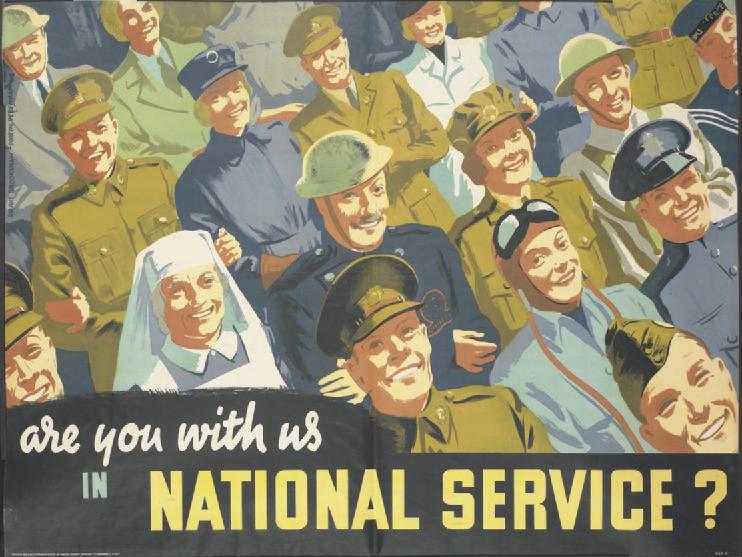
I thought the misty nostalgia for postwar “National Service” had died out long ago …
Here we go: straight off, let’s get the youth to do some indentured servitude, sorry, National Service.
The Sunday Times reports:
Every 18-year-old will be required by law to sign up for a year of National Service under plans unveiled by the Conservatives this weekend.
Rishi Sunak’s first manifesto commitment would see youngsters given the choice between a full-time course (for 12 months) or spending one weekend a month volunteering in their community. There will be sanctions for teenagers who do not take part. Up to 30,000 full-time positions will be created either in the armed forces or in cybersecurity training. The weekend placements could be with the fire or police service, the NHS or charities tackling loneliness and supporting older, isolated people.
The Tories have pledged to set up a royal commission to design the £2.5billion programme and establish details such as how the cybertraining would be delivered. A pilot will start next year and by the end of the parliament legislation will be passed making it mandatory for all 18-year-olds.
[…]
The Prime Minister says: “This new, mandatory National Service will provide life-changing opportunities for our young people, offering them the chance to learn real-world skills, do new things and contribute to their community and our country.” I doubt very much it will do this. The youth could learn real world skills in a weekend job that they’d actually get paid for but under Tory Rule they must become an indentured servant of the State instead.
It was floated that “the weekend placements could be with the fire or police service, the NHS or charities tackling loneliness and supporting older, isolated people”. Really? The fire and police service having to babysit some surly 17-year-old teenager glued to a mobile phone? Is this really what a police officer wants?
No doubt the vast majority of the youth will be dumped in some NHS hospital to do goodness knows what, or indeed a nursing home. And what about all the people who are currently off work and on anti-depressants “because of mental health”. Will they be forced to volunteer, or let off the requirement?
Trudeau is at his very best in tackling imaginary problems
Tristin Hopper calls attention to just how much of the federal government’s attention is focused on problems that don’t actually exist, except in the Prime Minister’s vivid imagination, like the notorious “hidden agenda” of Pierre Poilievre’s Conservatives to turn Canada into the world of The Handmaid’s Tale by banning abortion (and undoubtedly forcing women to wear the distinctive red-dress-and-bonnet uniforms, too):

In Trudeau’s fevered imagination, this is what the Tories want Canadian women to be wearing in future.
The Trudeau government has initiated another round of warning that Canadian abortion access is at risk.
“Women’s rights, reproductive rights, and equality are non-negotiable,” Prime Minister Justin Trudeau declared at a recent speech, as Liberal Party social media accounts broadcast accusations that their opponents endanger a “woman’s right to choose”.
This would all make perfect sense in the United States, which has indeed seen a wave of new state-level laws effectively banning abortion outright.
But the Liberals are talking about Canada, a country that has no abortion laws whatsoever, and no political inclination to create any.
Polls show an incredible 80 per cent of Canadians supporting a “woman’s right to an abortion”. Conservative Prime Minister Stephen Harper didn’t once touch abortion during his nine-year tenure.
As noted, Canada literally has no legal language dealing with the whole abortion issue … and therefore any Conservative government would have to create a new law to even begin to address an issue that a super-majority of Canadians are already against “fixing”. Conservatives can be incredibly dumb at times, but that would be stupidity of a very high order indeed.
Then, there’s Trudeau’s determination to link Poilievre with Diagonal, er, Dialagon, er, Dialysis, I mean “Diagolon”, which is apparently some super-powerful secretive extreme right-wing conspiracy to … do something diagonal-ish? I dunno. I’d never heard of ’em until Trudeau started trying to tie Poilievre to them:
Earlier this month, the Liberal’s main attack against the Conservatives was that they were in thrall to Diagolon, a supposed white supremacist militia with designs on destroying Canada from within.
“What has not been answered by the leader of the Opposition is why he chooses to continue to court extreme right nationalist groups like Diagolon,” said Trudeau in the House of Commons on April 30, one of several times he would slap down a question from the Conservatives by bringing up Dialogon.
Poilievre’s alleged ties to Diagolon are pretty tenuous. At a Nova Scotia fundraiser, among the attendees who queued up to shake Poilievre’s hand was Diagolon founder Jeremy MacKenzie, who claimed he did it just to get Poilievre in trouble. More recently, Poilievre visited an anti-carbon tax encampment where one of the RVs had a small Diagolon logo scrawled on its front door in permanent marker.
What’s more, multiple police investigations have concluded that Diagolon isn’t even a group, much less an organized anti-government militia.
It’s basically three guys on a podcast and their followers — whom they’ve occasionally met for BBQs. According to an RCMP profile of Diagolon put together at the height of Freedom Convoy, it was “exceedingly difficult” to nail down Diagolon as “a distinct group, with common ideology, a political agenda, and the cohesion necessary to advance such an agenda.”
The bought-and-paid-for Canadian media, of course, haven’t done much to point out just how ludicrous these accusations are, because even if they’re not, y’know, true, they are “truthy”. It’s not likely to change, as the legacy media still hate and fear anyone who might threaten their cosy subsidy deal with the Liberals.
And then there’s the Liberals’ fixed belief that Canada is the most racist country to ever have existed and that our entire culture is based on white supremacy and oppressing the “global majority” at all times:
Derived from the U.S. academic dogma of critical race theory, anti-racism holds that Canada’s basic structures — from its police forces to its justice system to its parliaments — are all fundamentally white supremacist. As such, they can only be remedied by “deliberate systems and supports” favouring “equity-seeking groups”, according to official Government of Canada literature.
The Trudeau government has established an Anti-Racism Secretariat, they’ve poured tens of millions of dollars into race-specific grants and they’ve subjected every arm of the federal government to anti-racism mandates and training.
Agencies such as the Canada Research Chairs program now openly screen for candidates based on ethnicity and other immutable characteristics. And perhaps most infamously, it was a federal anti-racism program that paid more than $500,000 to Laith Marouf, a virulent antisemite who has repeatedly referred to his benefactor as “Apartheid KKKanada”.
All of this has proceeded on the core assumption that Canada is — and always has been — a country defined by “systemic racism”. This was stated most plainly in an internal Canadian Armed Forces report which declared “racism in Canada is not a glitch in the system; it is the system”.
There’s a lot of (imported) fretting and huffing and puffing about this “issue”, yet there is almost no evidence for any of it being true in Canada. It would be statistically more likely to be true that much of our government and business organizations are actively over-hiring and over-promoting people on the basis of them not being white or male or heterosexual than the reverse.
Why a Tire Company Gives Out Food’s Most Famous Award
Tasting History with Max Miller
Published Feb 20, 2024Eugénie Brazier, the chef behind today’s recipe, was a culinary force to be reckoned with. She was described as “a formidable woman with a voice like a foghorn, rough language, and strong forearms”. Both of her restaurants won Michelin stars in the early 20th century, making her the first person to have six. No one else would earn six Michelin stars for 64 years.
By modern Michelin standards, this dish is pretty plain, but it’s still really good. The chicken is cooked simply in butter, and the cream sauce is absolutely fantastic. I was afraid the alcohol would overpower it, but it doesn’t. The sauce takes on a kind of floral woodiness instead of each individual alcohol’s flavor, and it’s so good.
(more…)
QotD: Women’s voting interests
“I have to vote Conservative, for his sake,” she reasonably explained.
She had compounded his characteristic error in 1968, however, and felt she owed an explanation to her son. This began by reminding me of her fragile, female sex.
“One thinks of the party leader on the analogy of going for a date.”
And true enough, the Tory leader, Mr Robert Stanfield, was the sort of man you could present to your father. He could be relied on, to get you home safely, and on time.
“But there are times when a woman does not want to get home on time,” mama added.
She, a registered nurse acquainted with the eccentricities of mental patients, called my attention to a phenomenon I had not previously noticed. Whenever a truly monstrous (male) psychopath is strapped away in gaol, the prison receives adoring letters for him, from women. These correspondents have never met him, and know him only from accounts in the yellow press. He may have been found guilty of heinously murdering a succession of wives and lovers. But they promise to be waiting for him on the steps of the penitentiary; and as the police will confirm, they are still there.
My mother had never comprehended how a woman could be so crazy. But when she realized that she had herself just voted for “Pierre” [that’s Trudeau the elder, to clarify], she suddenly understood.
David Warren, “The women’s vote”, Essays in Idleness, 2024-02-22.
May 27, 2024
“Product recommendations broke Google, and ate the Internet in the process”
Ted Gioia says the algorithms are broken and we need a way to get out of the online hellscape our techbro overlords have created for us:

Have you tried to get information on a product or service from Google recently? Good luck with that.
“Product recommendations broke Google,” declares tech journalist John Herrman, “and ate the Internet in the process.”
That sounds like an extreme claim. But it’s painfully true. If you doubt it, just try finding something — anything! — on the dominant search engine.
No matter what you search for, you end up in a polluted swamp of misleading links. The more you scroll, the more garbage you see:
- Bogus product reviews
- Fake articles that are really advertisements
- Consumer guides that are just infomercials in disguise
- Hucksters pretending to be experts
- And every scam you can imagine (and some that never existed before) empowered by deepfakes or AI or some other innovative new tech
The Google algorithm deliberately makes it difficult to find reliable information. That’s because there’s more money made from promoting garbage, and forcing users to scroll through oceans of crap.
So why should Google offer a quick, easy answer to anything?
Everybody is now playing the same dirty game.
Even (previously) respected media outlets have launched their own recommendation programs as a way to monetize captured clients (= you and me). Everybody from Associated Press to Rolling Stone is doing it, and who can blame them?
Silicon Valley sets the dirty rules and everybody else just plays the game.
Welcome to the exciting world of algorithms. They were supposed to serve us, but now they control us—for the benefit of companies who impose them on every sphere of our lives.
And you can’t opt out.
For example, when I listen to music on a streaming platform, the algorithm takes over as soon as I stop intervening—insisting I listen to what it imposes on me. Where’s the switch to turn it off?
I can’t find it.
That option should be required by law. At a minimum, I should be allowed to opt out of the algorithm. Even better, they shouldn’t force the algorithm on me unless I opt in to begin with.
If this tech really aimed to serve me, opting in and opting out would be an obvious part of the system. The fact that I don’t get to choose tells you the real situation: These algorithms are not for our benefit.
Do you expect the coming wave of AI to be any different?
[…]
The shills who want us to lick the (virtual) boots of the algorithms keep using the word progress. That’s another warning sign.
I don’t think that word progress means what they think it means.
If it makes our lives worse, it isn’t progress. If it forces me into servitude, it isn’t progress. If it gets worse over time — much worse! — it isn’t progress.
All the spin and lobbying dollars in the world can’t change that.
So that’s why I became a conscientious objector in the world of algorithms. They give more unwanted advice than any person in history, even your mom.
At least mom has your best interests at heart. Can we say the same for Silicon Valley?
Visual metaphors in the British general election
When British PM Rishi Sunak decided to drop the writ for a general election, he must have thought he was boldly seizing the initiative but his timing was characteristically bad:
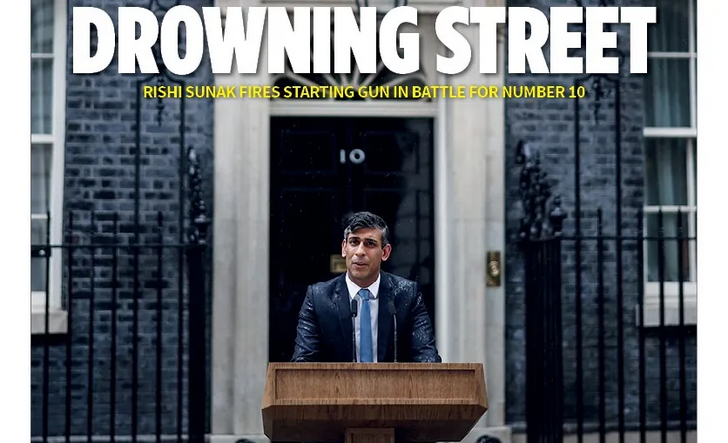
If your pitch to voters is that Britain needs protection in dangerous and uncertain times, it’s probably best to first show the voters that you can protect yourself.
For example, if it’s raining, you might want to consider demonstrating the good sense to wear a raincoat. Or carry an umbrella. Or if, say, you are the prime minister of an entire country, with an events team at your disposal, you might want to consider erecting a tent of some sort, something that can keep you dry without ruining your visuals.
Or you can be Rishi Sunak, the beleaguered British prime minister, and stand out in the pouring rain, unprotected, and get drenched as you state your case for more time to be the country’s leader, evading the storm only when re-entering the house you will surely be vacating after voters have their say on July the 4th.
To be fair to Sunak, it’s not easy to predict the weather in London. Nor can you always control the timing of events. But when it rains all of the time where you live and you do absolutely control the timing of events, as a British prime minister does when calling an election, it’s unforgivable to be unprepared. There’s a reason most Brits keep an umbrella nailed to their hips, and it’s not style.
And if you think this is to make a mountain out of a molehill, you should check out the front pages of the U.K. papers on the morning after the election call. “Drown & out”, blared The Mirror. “Drowning Street”, chortled another broadsheet. “How long will (Sunak) rain over us,” chirped in a key regional title. Each headline was accompanied by a grim looking Sunak soaked to his whippet-like core. The presentational details matter, especially when you’re putting yourself in the shop window.
Then again, to expect anything more from a Conservative movement that is running on fumes after 14 turbulent years in power is to put hope over experience. It’s been a draining (nearly) decade and a half. There was the austerity and economic uncertainty of the coalition years. The referenda — Scottish and EU — that choked off most debate on other issues in the middle part of the last decade. And then came the double act of COVID and Ukraine, a compounding whammy that hammered supply chains and put up energy and other prices, prompting the worst cost-of-living crisis in generations. It would have been enough to test any leader’s mettle, which is probably why the Conservatives have had five prime ministers during their stretch in government, including three in 2022 alone.
The Manda: Croatia’s Minimalist .50 BMG
Forgotten Weapons
Published Feb 21, 2024The Manda is a rifle that was designed for the Croatian Special Police at the beginning of the Homeland War in 1991. At that point, the Special Police (basically the SWAT teams) were basically the only really well-trained fighters in the country with combat experience. They wanted .50 BMG anti-material rifles for the war that was breaking out, and the Croatian Ministry of the Interior developed and produced the Manda for them.
Specifically, the rifle was designed by engineer Petar Vucetic (and named after his sister). Mechanically, it is a very simple rifle, with two large locking lugs, a tubular stock, M70 AK pistol grip, and a barrel made from a turned-down Browning M2 bolt with a large muzzle brake. A total of 84 were made, fitted with Leupold scopes and mounts with integrated BDC cams for use from 300 out to 1000 meters.
(more…)
QotD: The Cursus Honorum in the Roman republic
The second caution is that the cursus honorum was, for most of its history, a customary thing, a part of the mos maiorum, rather than a matter of law. But of course the Romans, especially the Roman aristocracy, take both the formal and informal rules of this “game” very seriously. While unusual or spectacular figures could occasionally bend the rules, for most of the third and second century, political careers followed the rough outlines of the cursus honorum, with occasional efforts to codify parts of the process in law during the second century, beginning with the Lex Villia in 180 BC, but we ought to understand that law and others of the sort as mostly attempting to codify and spell out what were traditional practices, like the generally understood minimum ages for the offices, or the interval between holding the same office twice.
That said, there is a very recognizable pattern that was in some cases written into law and in other cases merely customary (but remember that Roman culture is one where “merely customary” carries a lot of force). Now the cursus formally begins with the first major office, the quaestorship, but there are quite a few things that an aspiring Roman elite needs to do first. The legal requirement is that our fellow – and it must be a fellow, as Roman women cannot hold office (or vote) – needs to have completed ten years of military service (Polyb. 6.19.1-3). But there are better and worse ways to discharge this requirement. The best way is being appointed as junior officers, military tribunes, in the legions. We’ll talk about this office in a bit, but during this period it served both as a good first stepping stone into political prominence as well as something more established Roman politicians did between major office-holding, perhaps as a way of remaining prominent or to curry favor with the more senior politicians they served under or simply because military exigency meant that more experienced hands were wanted to lead the army.
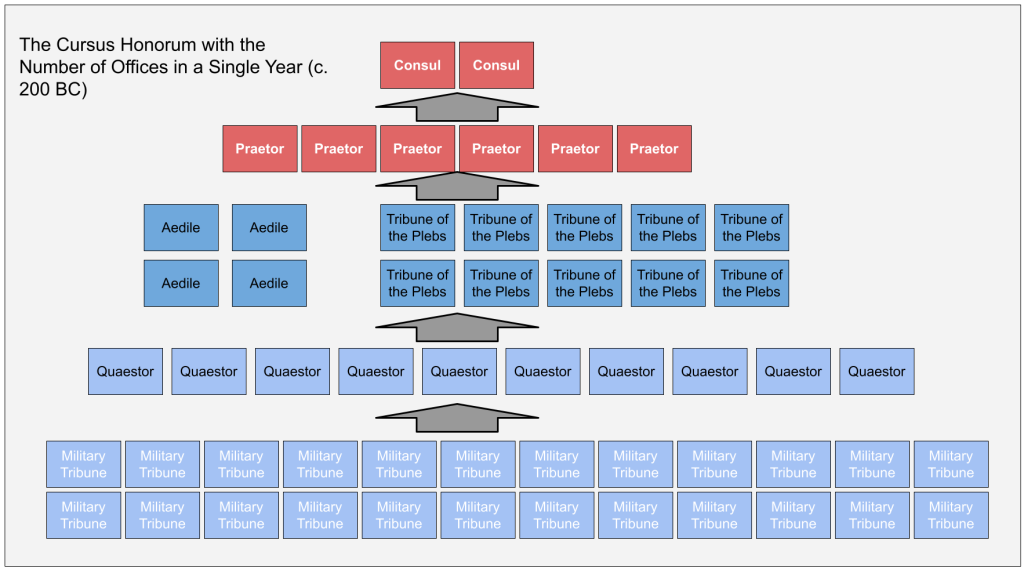
A diagram of the elected offices of the cursus honorum. Note that there were additional appointed military tribunes.
There are a bunch of other minor magistrates that are effectively “pre-cursus” offices too, but we don’t know a lot about them and they don’t seem generally to show up as often in the careers of the sort of Romans making their way up to the consulship, though this may be simply because our sources don’t mention them as much at all and so we simply don’t know who was holding them in basically any year. We’ll talk about them at the end of this set of posts, because they are important (particularly for non-elites).
I should note at the outset: all of these offices are elected annually unless otherwise noted, with a term of service of one year. You never hold the same office twice until you reach the consulship, at which point you can seek re-election, after a respectable delay (which is later codified into law and then ignored), but you may serve as a military tribune several times (this was normal, in fact, as far as we can tell).
The first major office of the cursus was the quaestorship. The number of quaestors elected grows over time. Initially just two, their number is increased to four in 421 (two assigned to Rome, one to each of the consuls) and then to six in the 260s (initially handling the fleet, then later to assist Roman praetors or pro-magistrates in the provinces) and then eight in 227. There may have been two more added to make ten somewhere in the Middle Republic, but recent scholarship has cast doubt on this, so the number may have remained eight until being expanded to twenty under Sulla in 81 BC through the aptly named lex Cornelia de XX quaestoribus (the Cornelian Law on Twenty Quaestors, Sulla being Lucius Cornelius Sulla Felix).2 It’s not clear if there was a legal minimum age for the quaestors and we only know the ages of a few (25, 27, 29 and 30, for the curious) so all we can say is that officeholders tended to hold the office in their twenties, right after finishing their mandatory stint of military service.3 Serving as a quaestor enables entrance into the Senate, though one has to wait for the next census to be added to the Senate rolls by the censors.
After the quaestorship, aspirants for higher office had a few options. One option was the office of aedile; there were after 367 four of these fellows. Two were plebeian aediles and were not open to patricians, while the two more prestigious spots were the “curule” aediles, open to both patricians and plebeians. The other option at this stage for plebeian political hopefuls was to seek election as a tribune of the plebs, of which there were ten annually, we’ll talk about these fellows in a later post because they have wide-ranging, spectacular and quite particular powers.
After this was the praetorship, the first office which came with imperium. Initially there may have just been one praetor; by the 240s there are two (what will become the praetor urbanus and the praetor peregrinus). In 227 the number increases to four, with the two new praetors created to handle administration in Sicily, Sardinia and Corsica. That number then increases to six in 198/7, with the added praetors generally being sent to Spain. Finally Sulla raises the number to eight in 81 BC. The minimum age seems to have been 39 for this office.
Finally comes the consulship, the chief magistrate of the Roman Republic, who also carried imperium but of a superior sort to the praetors. There were always two consuls and their number was never augmented. For our period (pre-Sulla) the consuls led Rome’s primary field armies and were also the movers of major legislation. Achieving the consulship was the goal of every Roman embarking on a political career. This is the only office that gets “repeats”.
Finally there is one office after the cursus honorum and that is the censorship. Two are elected every five years for an 18 month term in which they carry out the census. Election to the censorship generally goes to senior former-consuls and is one way to mark a particularly successful political career. That said, Romans tend to dream about the consulship, not the censorship and if you had a choice between being censor once or holding the consulship two or three times, the latter was more prestigious.
With the offices now laid out, we’ll go through them in rough ascending sequence. Today we’ll look at the military tribunes, the quaestors and the aediles; next week we’ll talk about imperium and the regular offices that carry it (consuls, praetors and pro-magistrates). Then, the week after that, we’ll look at at two offices with odd powers (tribunes of the plebs and censors), along with minor magistrates. Finally, there’s another irregular office, that of dictator, which we have already discussed! So you can go read about it there!
One thing I want to note at the outset is the “elimination contest” structure of the cursus honorum. To take the situation as it stands from 197 to 82, there are dozens and dozens of military tribunes, but just eight quaestors and just six praetors and then just two consuls. At each stage there was thus likely to be increasingly stiff competition to move forward. To achieve an office in the first year of eligibility (in suo anno, “in his own year”) was a major achievement; many aspiring politicians might require multiple attempts to win elections. But of course these are all annual offices, so someone trying again for the second or third time for the consulship is now also competing against multiple years of other failed aspirants plus this new year’s candidates in suo anno. We’ll come back to the implications of this at the end but I wanted to note it at the outset that even given the relatively small(ish) size of Rome’s aristocracy, these offices are fiercely competitive as one gets higher up.
Bret Devereaux, “Collections: How to Roman Republic 101, Part IIIa: Starting Down the Path of Honors”, A Collection of Unmitigated Pedantry, 2023-08-11.
1. See Lintott, op. cit. 104-5, n. 47.
2. These dates and numbers, by the by, follows F.P. Polo and A.D. Fernández, The Quaestorship in the Roman Republic (2019).
3. If you are wondering about how anyone can manage to hold the office before 27, given ten years of military service and 17 being the age when Roman conscription starts, well, we don’t really know either. The best supposition is that some promising young aristocrats seem to have started their military service early, perhaps in the retinues (the cohors amicorum) of their influential relatives. Tiberius Gracchus at 25 is the youngest quaestor we know of, but he’s in the army by at most age 16 with Scipio Aemilianus at Carthage in 146.
May 26, 2024
Will Rishi Sunak be the British Kim Campbell?
The British election is now underway and if the polls are accurate, Rishi Sunak’s Conservatives are in for one heck of a thrashing. If he’s particularly unlucky, he could come close to former Canadian Prime Minister Kim Campbell’s electoral shipwreck in 1993 (losing a Parliamentary majority and being reduced to two seats in the Commons), but perhaps Labour leader Sir Keir Starmer isn’t quite the <sarc>charismatic juggernaut</sarc> that Canada’s Jean Chrétien was:
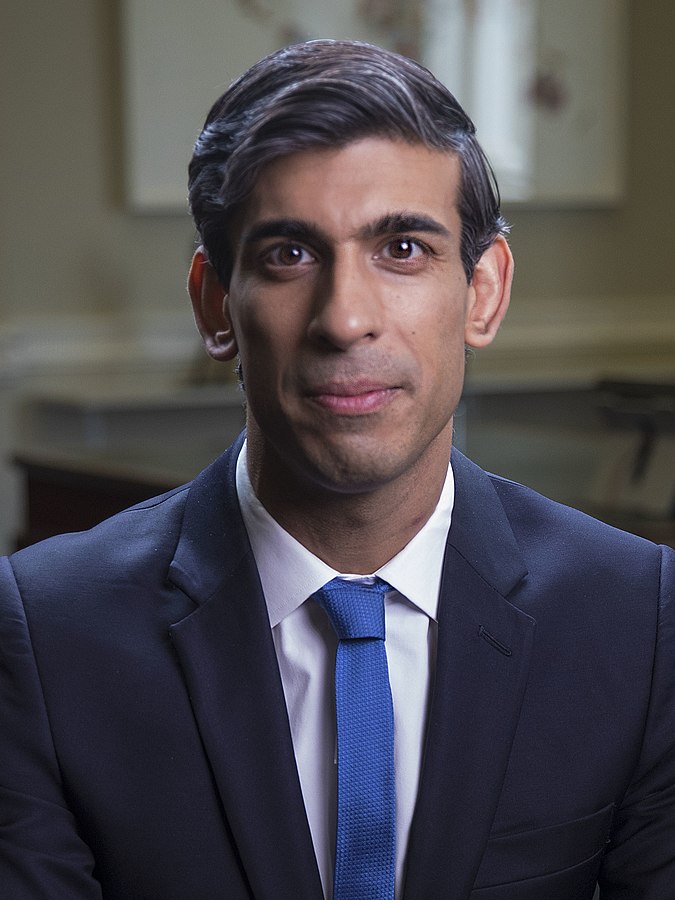
Rishi Sunak shortly after becoming Chancellor of the Exchequer in 2020.
I’m old enough to remember the sense of optimism, hope and promise felt when Tony Blair was elected back in 1997; not by me, obviously, but I could at least appreciate that other people felt that ‘things can only get better’.
Whether you think they did or not, Blair transformed the country in his own image, just as his predecessor Margaret Thatcher had done during her similarly long reign. No one could say the same of the recent fourteen years of Tory-led governments, a period that has been marked by a continual drift away from conservatism both within civil society and in many ways driven by the administration itself.
As I have said one or two times before, you could have woken up from a long coma and had no idea who had been in charge the whole time. It’s an indication of how far the Overton Window has shifted that proposals to limit student-led immigration are considered way out there despite being mainstream only a decade ago – proposals which the Prime Minister backed out of. One of the benefits of being in government should be the ability to shift the terms of debate, but whereas the rest of Europe is mostly turning Right, Britain under the Tories has gone the other way.
In retrospect, and I have definitely said this more than once or twice, the post-Brexit immigration policy was their biggest mistake. It meant the worst of both worlds for the country and for Tory coalition building, alienating both a large section of cautious voters over leaving the EU, and the many cultural conservatives they picked up in 2019 who saw the referendum as a vote on immigration.
In a parallel universe where the government reduced net migration to five figures, there may well have been immediate pain: struggles to fill vacancies, inflationary pressure caused by rising wages, and universities which now cannot survive without using the immigration system as a funding mechanism. But the Tories would have been on 30% rather than 20%; that they aren’t aware enough to understand this is strange, but then they aren’t an ideological party.
Rishi Sunak’s decision to hold the election early is very curious. Perhaps he was worried that enough letters would be handed in triggering a leadership contest; perhaps he feared that Nigel Farage would reappear and make the Reform Party even more of a problem. Perhaps he’s just impetuous and has had enough, but the announcement itself, in pouring rain and drowned out by a New Labour anthem played by a public nuisance, was fitting.
The prime minister is very unpopular, and the Tories are currently polling at catastrophic levels, but there is little enthusiasm for Labour and more people think the country will get worse than better after they are elected.


