
In one way, pre-Roman Italy was quite a lot like Greece: it consisted of a bunch of independent urban communities situated on the decent farming land (that is the lowlands), with a number of less-urban tribal polities stretching over the less-farming-friendly uplands. While pre-Roman urban communities weren’t exactly like the Greek polis, they were fairly similar. Greek colonization beginning in the eighth century added actual Greek poleis to the Italian mix and frankly they fit in just fine. On the flip side, there were the Samnites, a confederation of tribal communities with some smaller towns occupying mostly rough uplands not all that dissimilar to the Greek Aetolians, a confederation of tribal communities and smaller towns occupying mostly rough uplands.
In one very important way, pre-Roman Italy was very much not like Greece: whereas in Greece all of those communities shared a single language, religion and broad cultural context, Roman Italy was a much more culturally complex place. Consequently, as the Romans slowly absorbed pre-Roman Italy into the Roman Italy of the Republic, that meant managing the truly wild variety of different peoples in their alliance system. Let’s quickly go through them all, moving from North to South.
The Romans called the region south of the Alps but north of the Rubicon River Cisalpine Gaul and while we think of it as part of Italy, the Romans did not. That said, Gallic peoples had pushed into Italy before and a branch of the Senones occupied the lands between Ariminum and Ancona. Although Gallic peoples were always a factor in Italy, the Romans don’t seem to have incorporated their communities as socii; indeed the Romans were generally at their most ruthless when it came to interactions with Gallic peoples (despite the tendency to locate the “unassimilable” people on the Eastern edge of Rome’s empire, it was in fact the Gauls that the Romans most often considered in this way, though as we will see, wrongly so). That’s not to say that there was no cultural contact, of course; the Romans ended up adopting almost all of the Gallic military equipment set, for instance. In any event, it wouldn’t be until the late first century BCE that Cisalpine Gaul was merged into Italy proper, so we won’t deal too much with the Gauls just yet. I do want to note that, when we are thinking about the diversity of the place, even to speak of “the Gauls” is to be terribly reductive, as we are really thinking of at least half a dozen different Gallic peoples (Senones, Boii, Inubres, Lingones, etc) along with the Ligures and the Veneti, who may have been blends of Gallic and Italic peoples (though we are more poorly informed about both than we’d like).
Moving south then, we first meet the Etruscans, who we’ve already discussed, their communities – independent cities joined together in defensive confederations before being converted into allies of the Romans – clustered on north-western coast of Italy. They had a language entirely unrelated to Latin – or indeed, any other known language – and their own unique religion and culture. The Romans adopted some portions of that culture (in particular the religious practices) but the Etruscans remained distinct well into the first century. While a number of Etruscan communities backed the Samnites in the Third Samnite War (298-290 BC) culminating in the Battle of Sentinum (295) as a last-ditch effort to prevent Roman hegemony over the peninsula, the Etruscans subsequently remained quite loyal to Rome, holding with the Romans in both the Second Punic and Social Wars. It is important to keep in mind that while we tend to talk about “the Etruscans” (as the Romans sometimes do) they would have thought of themselves first through their civic identity, as Perusines, Clusians, Populinians and so on (much like their Greek contemporaries).
Moving further south, we have the peoples of the Apennines (the mountain range that cuts down the center of Italy). The people of the northern Apennines were the Umbri (that is, Umbrian speakers), though this linguistic classification hides further cultural and political differences. We’ve met the Sabines – one such group, but there were also the Volsci and Marsi (the latter particularly well known for being hard fighters as allies to Rome; Appian reports that the Marsi had a saying prior to the Social War, “No Triumph against the Marsi nor without the Marsi”). Further south along the Apennines were the Oscan speakers, most notably the Samnites (who resisted the Romans most strongly) but also the Lucanians and Paelignians (the latter also get a reputation for being hard fighters, particularly in Livy). The Umbrian and Oscan language families are related (though about as different from each other as Italian from Spanish; they and Latin are not generally mutually intelligible) and there does seem to have been some cultural commonality between these two large groups, but also a lot of differences. Their religion included a number of practices and gods unknown to the Romans, some later adopted (Oscan Flosa adapted as Latin Flora, goddess of flowers) and some not (e.g. the “Sacred Spring” rite, Strabo 5.4.12).
Also Oscan speakers, the Campanians settled in Campania (surprise!) at some early point (perhaps around 1000-900 BC) and by the fifth century were living in urban communities politically more similar to Latium and Etruria (or Greece, which will make sense in a moment) than their fellow Oscan speakers in the hills above, to the point that the Campanians turned to Rome to aid them against the also-Oscan-speaking Samnites. The leading city of the Campanians was Capua, but as Fronda (op. cit.) notes, they were meaningful divisions among them; Capua’s very prominence meant that many of the other Campanians were aligned against it, a division the Romans exploited.
The Oscans struggled for territory in Southern Italy with the Greeks – told you we’d get to them. The Greeks founded colonies along the southern part of Italy, expelling or merging with the local inhabitants beginning in the seventh century. These Greek colonies have distinctive material culture (though the Italic peoples around them often adopted elements of it they found useful), their own language (Greek), and their own religion. I want to stress here that Greek religion is not equivalent to Roman religion, to the point that the Romans are sticklers about which gods are worshipped with Roman rites and which are worshipped with the ritus graecus (“Greek rites”) which, while not a point-for-point reconstruction of Greek rituals, did involve different dress, different interpretations of omens, and so on.
All of these peoples (except the Gauls) ended up in Rome’s alliance system, fighting as socii in Rome’s wars. The point of all of this is that this wasn’t an alliance between, say, the Romans and the “Italians” with the latter being really quite a lot like the Romans except not being from Rome. Rather, Rome had constructed a hegemony (an “alliance” in name only, as I hope we’ve made clear) over (::deep breath::) Latins, Romans, Etruscans, Sabines, Volsci, Marsi, Lucanians, Paelignians, Samnites, Campanians, and Greeks, along with some people we didn’t mention (the Falisci, Picenes – North and South, Opici, Aequi, Hernici, Vestini, etc.). Many of these groups can be further broken down – the Samnites consisted of five different tribes in a confederation, for instance.
In short, Roman Italy under the Republic was preposterously multicultural (in the literal meaning of that word) … and it turns out that’s why they won.
Bret Devereaux, “Collections: The Queen’s Latin or Who Were the Romans, Part II: Citizens and Allies”, A Collection of Unmitigated Pedantry, 2021-06-25.
June 18, 2024
QotD: The peoples incorporated or “allied” to Rome in the Republic’s Italian expansion
June 17, 2024
For want of a security clearance, the (potential) traitors escaped scot-free
In the free-to-cheapskates section of this week’s Dispatch from The Line, we get a summary of the state of brain-freeze in Parliament over the NSICOP (National Security and Intelligence Committee of Parliamentarians) report, that in a functioning state would have triggered much more action than it has in the dysfunctional Dominion:
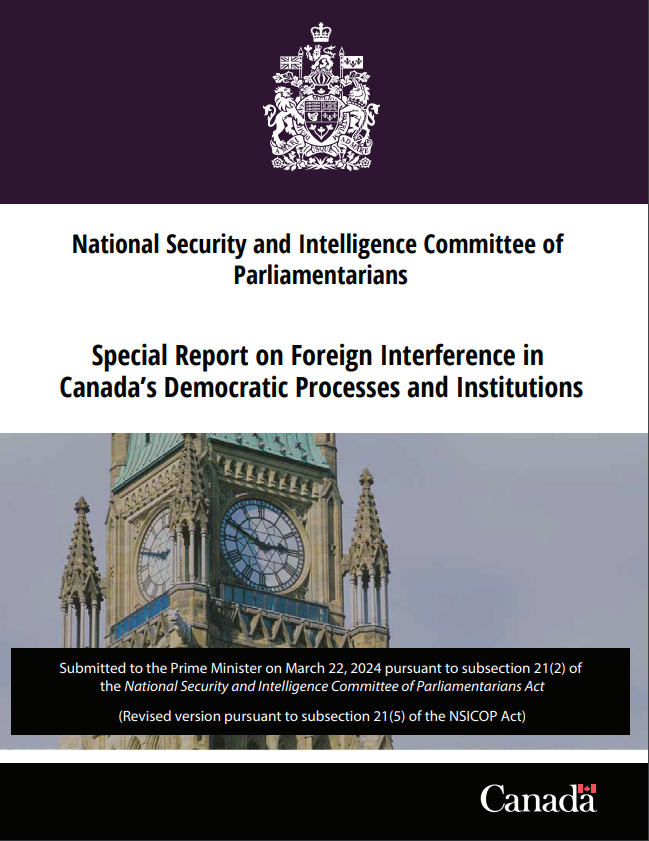
The cover of the NSICOP special report on foreign interference (PDF – https://nsicop-cpsnr.ca/reports/rp-2024-06-03/special-report-foreign-interference.pdf )
The lead story this week, clearly, was the continuing fallout from the NSICOP report last week. Because of this report, even though there is much that we do not know, there are absolutely some things that are clearly established. Let’s run through some of the key points that are uncontested and draw some very modest and safe conclusions from them.
Here are facts.
- There are multiple parliamentarians, meaning members of the House of Commons and the Senate, who have been deemed by eight of their colleagues to be engaged in activities with hostile foreign powers on either a witting or semi-witting basis.
- The prime minister and the PMO have been aware of who these individuals are for at least a month, if not longer. That is when NSICOP filed its unredacted report to them for review, as required.
The above facts are unchallenged. Now let’s draw a few conclusions.
The phrasing of the NSICOP report, as well as both Elizabeth May’s and Jagmeet Singh’s press conferences this week, led us to believe some of these individuals are still sitting in both the House of Commons and the Senate. We acknowledge that Elizabeth May and Jagmeet Singh differ considerably on the severity of what these individuals are alleged to have done, but both seem to agree that the relevant parties, in at least some cases, remain in Parliament.
The prime minister, as the person responsible for the administrative and legal apparatus of government, could call the Clerk of the Privy Council, the Director of CSIS, the minister of public safety and others as necessary into his office today, and inform them that he would be making the names public, and that it would be the responsibility of those individuals to figure out how that could be accomplished while protecting intelligence sources and methods. At this time, there is no indication that he has done so, or has any interest in doing so.
So we got the grotesque theatre that was the House of Commons this week. The government has spent the last week and change challenging various opposition leaders to obtain security clearances so that they could view information that the prime minister has had for at least a month, and perhaps longer, even though both the Security of Information Act and the National Security and Intelligence Committee of Parliamentarians Act (depending on the auspices under which their security clearances were issued) prevents them from disclosing what they read.
And, therefore, doing anything about it. Because to remove a caucus member would be to reveal it, and if a leader has no caucus members that are implicated, there is no urgency to their reading the report.
Protecting the national security of Canada, and the democratic institution of parliament itself, is the prime minister’s job before it is anyone else’s. And the prime minister has had this information for at least a month.
It’s worth repeating that because we want you to envision something. Imagine there are three U.S. Senators accused of aiding and abetting a foreign power, and Joe Biden knew about it for a month.
When do you think impeachment proceedings would start?
Boris Johnson was unceremoniously dumped by his party for lying about throwing a party during COVID lockdowns (and we have no problem with that). Our prime minister has known that there are people currently sitting in parliament that have turned themselves into intelligence assets for hostile foreign powers for a month, and …
… the government would like you to know that it thinks Pierre Poilievre should get a security clearance so that he can read the documents.
We think Poilievre should, too. Because here’s the thing. The Security of Information Act says right there in Section 24 “No prosecution shall be commenced for an offence against this Act without the consent of the Attorney General”.
That reads to us like so: Pierre Poilievre can read those documents, release the names, and then dare Justin Trudeau to prosecute him. Indeed, anyone with the names could.
Your Line editors have raised this before on the podcast, but it bears repeating. Canada’s international reputation has taken a lot of hits lately. So imagine if you would, gentle reader, a situation where Justin Trudeau’s Attorney General signs off on having his political opponent arrested for revealing that hostile foreign powers have coerced sitting MPs into becoming intelligence assets … especially if one or more of those MPs is revealed to be a Liberal.
That’s a front page international news story. We’d look like a banana republic. Our international reputation would take decades to recover.
Spoiler: we already do look like a banana republic and our international reputation is lower than it has ever been. Trudeau isn’t a dummy: he figures that our reputation literally can’t get much worse no matter what he does, so he’s choosing to protect … someone … and what’s Poilievre going to do? He proved during the lockdowns that he’s not willing to get arrested on a matter of principle (unlike Maxime Bernier), so he’s likely to just posture endlessly until something new pops up in the silly season news rotation.
Farm Camp for city slickers
In The Free Press, Larissa Phillips explains the kind of things city children (and their parents) learn when they stay at her family’s small farm for a week or a weekend:
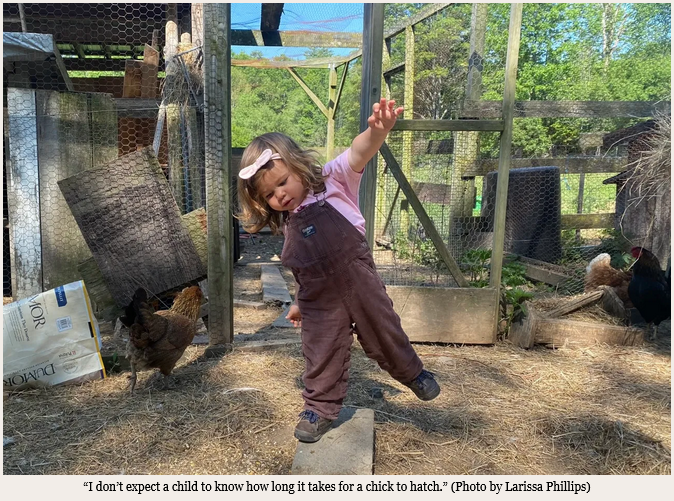
Here are some things I have taught the kids who visit my farm: animals don’t care about your feelings, and sometimes we kill them to eat them. It doesn’t matter how desperately you want to find more eggs, the hens don’t lay on demand. Tomatoes aren’t ripe in June. The stalls aren’t going to clean themselves. Cuts, scrapes, and stings aren’t really a big deal. And there will always be poop.
I’m often struck by what city kids don’t know when they turn up at the education program I run for families on our 15-acre hobby farm — Honey Hollow Farm — in the Upper Hudson Valley. As a longtime urbanite, I get it. I lived in Brooklyn for 15 years before my husband and I moved upstate in 2010 with our two young children and one goal: start a farm. We kept horses and ponies for fun and raised poultry and sheep — and sometimes pigs — for food.
It was hard. Slaughtering animals we’d raised since they were babies was wrenching. Breeding and birthing those babies was dicey, too. But these experiences toughened us up. Working with animals and the land and the seasons was grounding — and the best antidote to anxiety I’d ever found. And most of it was fun.
I wanted to share this outlook with other families, even if it was just for a weekend. So at the start of the pandemic, I opened our guest cottage — and set up an informal curriculum to teach escaping urbanites what I’d learned.
I called it farm camp.
We host one family at a time, all through the year, in a renovated barn apartment overlooking the pony pasture. Most come for a week, some for a weekend. Every morning I’ll take a handful of kids, sometimes as young as three, through a two-hour, hands-on class on animal care, life, death, poop. All of them have to do some real farmwork.
There is a lot to learn. I don’t expect a child to know how long it takes for a chick to hatch, or why the roosters are always jumping on top of the hens. But I am often surprised by some of the straightforward things they don’t know how to do. Like how to pull a wagon around a corner, hold a shovel, climb over a gate, make a braid, or tie a knot.
Don’t get me wrong — I love offering explicit instructions on the most mundane tasks, then standing back and cheering when a kid does it independently. But two generations ago, these skills would have been common knowledge. For most of human history, the proportion of the world’s population living in cities was below 5 percent. It’s at 56 percent now. By the time today’s toddlers reach adulthood, it is expected that 80 percent of humans will live in urban areas.
Overprotected as they are, a lot of city kids are missing out on so many important encounters with material reality: with death or danger or manual labor. These encounters can be unpleasant, even painful. It’s understandable that we want to save our children from them. But they lose something essential when we do.
Most urbanites have a very sanitized — in fact, Disneyfied — view of rural life and especially life on a farm. It can be traumatic to discover that all the animals aren’t like you saw in the cutesy cartoons as a preschooler …
Inside the deputy PM’s thoughts
In the National Post, Tristin Hopper imagines what Deputy Prime Minister Chrystia Freeland might be thinking as she pushes her capital gains tax increase:
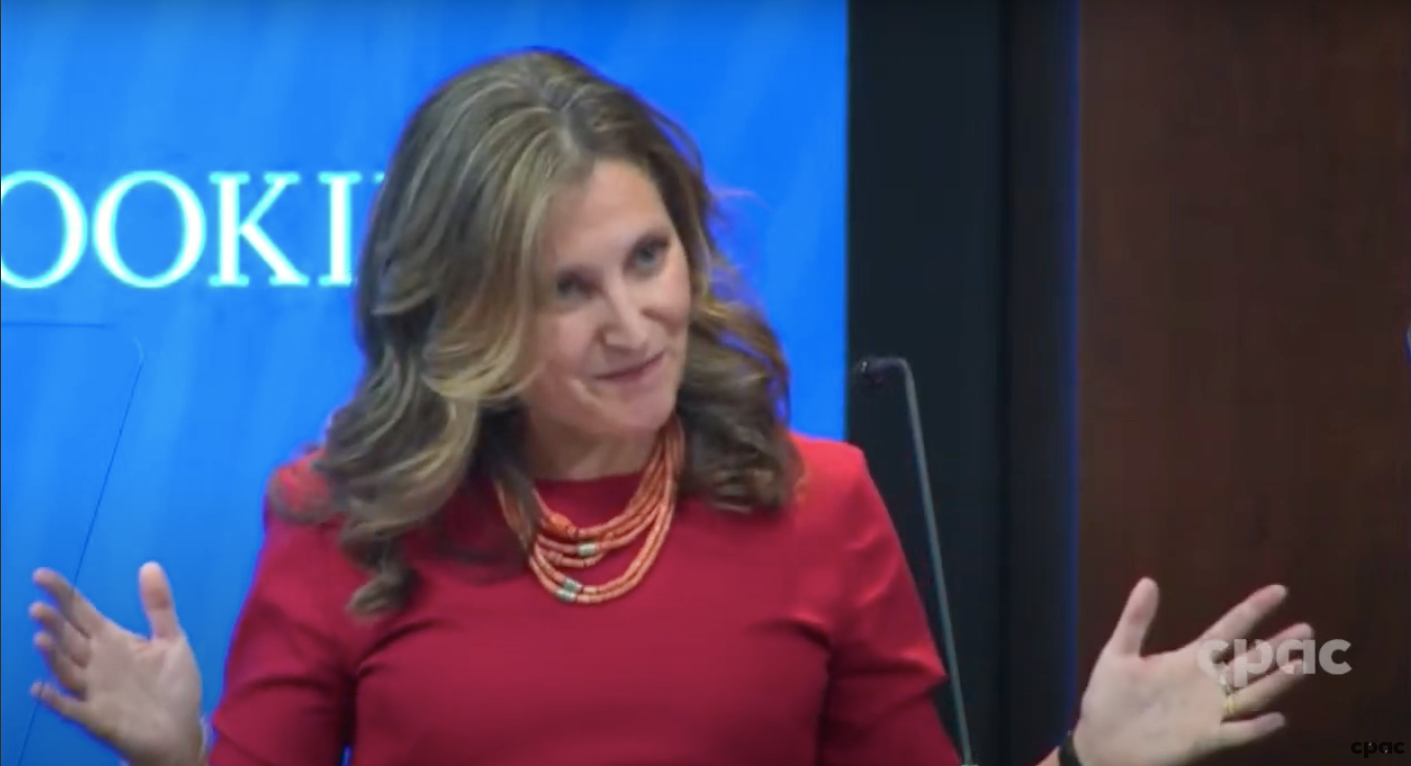
Screencap from a CPAC video of Chrystia Freeland speaking in October, 2022.
On Monday, Deputy Prime Minister Chrystia Freeland defended her government’s raising of the capital gains tax by delivering a weirdly catastrophic lecture speaking of a Canada beset by poverty, division and angry mobs.
“Do you want to be in a country where those at the very top live lives of luxury but must do so in gated communities behind ever higher fences using private health care and airplanes because the public sphere is so degraded and the wrath of the vast majority of their less privileged compatriots burns so hot?” she said.
[…]
Monday
Rivers of blood. Mothers consuming their offspring. Houses of worship employed only as makeshift storehouses for the dead.Abundance will cease. Colour will vanish. The people you now know as loved ones will first become strangers, and then they will become enemies.
These are but some of the fates that realistically lie in store for a Canada that refuses to raise its capital tax inclusion rate from 50 per cent to 67 per cent on gains realized after June 25, 2024. While I am sympathetic to those who have worked hard and wish to retain what they have earned, I would urge them to consider the value of money in a Canada where the only remaining currency is one’s readiness to kill.
Tuesday
As deputy prime minister of Canada, I am fully aware that carbon taxes are an electoral liability for this government. But this is a problem not of policy, but of messaging.If we’re not able to tax carbon-emitting fuels to a rate of $170 per tonne by 2030, the most optimistic scenario I can offer is the complete breakdown of the natural world as we know it.
Agriculture will become a memory. Cities will become unapproachable due to the overwhelming smell of decay. Language will devolve and then disappear. Any surviving art or culture will only inspire fear, because people will not know what it is.
The air may be breathable, but we will wish it was not.
5 Foods that Changed Fast Food Forever (ft. @mythicalkitchen)
Tasting History with Max Miller
Published Mar 8, 2024The Mythical Kitchen Cookbook by Josh Scherer: https://amzn.to/49Se1qZ
QotD: Philosophy
Terry Pratchett, excerpt from “The Life of Wen the Eternally Surprised”, Thief of Time, 2001.
June 16, 2024
Orwell’s Nineteen Eighty-Four at 75
Ed West on the attempts by many different parties to claim the legacy of George Orwell for their own purposes:
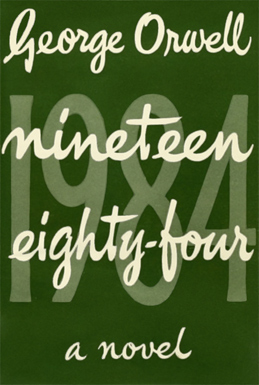
No writer’s legacy and approval is so fought over as George Orwell, whose final — and most celebrated — work Nineteen-Eighty-Four was published seventy five years ago this month.
The most influential piece of political fiction in history, such is the success of the dystopian novel that its themes have been recited to death by columnists, often by people I imagine he would have loathed (including me).
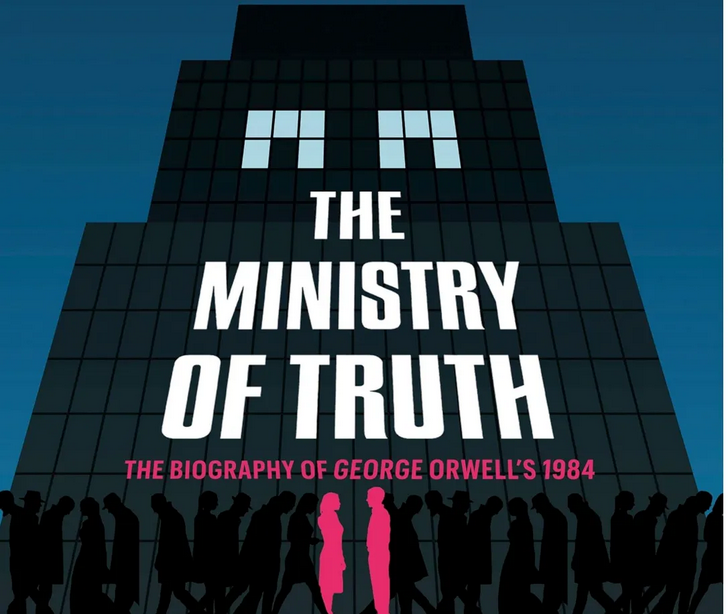
Orwell’s nightmare became a particular focus of conservative commentators from the 1990s with the rise of “political correctness”, which might be seen as both a form of politeness and at the same time a way of policing opinions by changing the language. As Orwell’s Newspeak was described, it was to ensure that dissent cannot be voiced because “the necessary words were not available”. Newspeak, along with thought police and doublethink, has become a part of our political vocabulary, while even the proles have Big Brother to entertain them. No one can doubt that Orwell has won the final victory, and the struggle for the writer’s soul forms part of Dorian Lynskey’s entertaining and informative The Ministry of Truth, a biography of Nineteen-Eighty-Four which was published at the time of the last significant anniversary.
Lynskey, a hugely gifted writer who specialises in the relationship between arts and politics, is very much on the Left and sees the modern parallels with the Trumpian disdain for truth, although the great man himself is now often more cited by the Right. Indeed the anniversary was recently celebrated by the free-market think-tank the Institute of Economic Affairs with a new edition and an introduction by my friend Christopher Snowdon.
Orwell was a paradoxical man, contradictory, sometimes hypocritical (aren’t we all?). In the preface to his book, publisher Victor Gollancz wrote that “The truth is that he is at one and the same time an extreme intellectual and a violent anti-intellectual. Similarly he is a frightful snob – still (he must forgive me for saying this), and a genuine hater of every form of snobbery.”
As Lynskey writes: “Until the end of his life, Orwell acknowledged that microbes of everything he criticised existed in himself. In fact, it was this awareness of his own flaws that inoculated him against utopian delusions of human perfectibility.”
Such awareness is surprisingly rare among intelligent journalists and commentators, especially when ideology takes a grip — and Orwell was introduced to this reality in quite brutal form.
The background to both Nineteen Eighty-Four and Animal Farm was Orwell’s disillusionment during the Spanish Civil War. The conflict between Nationalists and Republican galvanised western intellectuals and marked the turning point when the intelligentsia became firmly wedded to the Left. Over a thousand writers went to fight in Spain, and while few entirely understood the political situation they did grasp, as Malcolm Muggeridge said, that “it seemed certain that in Spain Good and Evil were at last joined in bloody combat”.
In reality it was a conflict in which both sides committed appalling atrocities, although Franco’s forces certainly outdid their enemies in murderous scale. That ruthlessness partly explains their victory, but the Republicans were not helped by the seemingly endless factionalism that saw various squabbling leftist acronyms fight each other, and which makes the war hard to follow. There was the socialist UGT, the Russian-backed PSUC, the anarchist FAI and anarcho-syndicalist CNT, and also the POUM, Workers’ Party of Marxist Unification, which rather belied its name by falling out with both Stalin and Trotsky.
Spain was an education for Orwell. Witnessing in Barcelona a Russian known only as “Charlie Chan”, allegedly an agent of NKVD, he wrote: “I watched him with some interest for it was the first time I had seen a person whose profession was telling lies — unless one counts journalists”.
He recorded how, with the honourable exception of the Manchester Guardian, “One of the dreariest effects of this has been to teach me that the Left-wing press is every bit as spurious and dishonest as that of the Right”. Welcome to the Intellectual Dark Web, George Orwell.
Mao Tightens His Grip – WW2 – Week 303 – June 15th, 1945
World War Two
Published 15 Jun 2024After several weeks of the Congress of the Chinese Communist Party, Mao Zedong’s power has consolidated to the point that it is absolute. All pledge loyalty Mao, and his infallibility shall not be questioned. Meanwhile the war goes on in the field with Australian landings on Brunei, continuing fighting on Okinawa, and the last part of Europe — in the Netherlands — liberated from Axis control.
(more…)
“What the hell is going on in Canada?”
If you’re not Canadian or have any Canadian friends, you may not understand just how badly broken the country is — and the federal government is still desperately pretending that we’re all onboard with the Net Zero/Carbon Tax/”you’ll own nothing” bullshit and piling on the long-term debt:
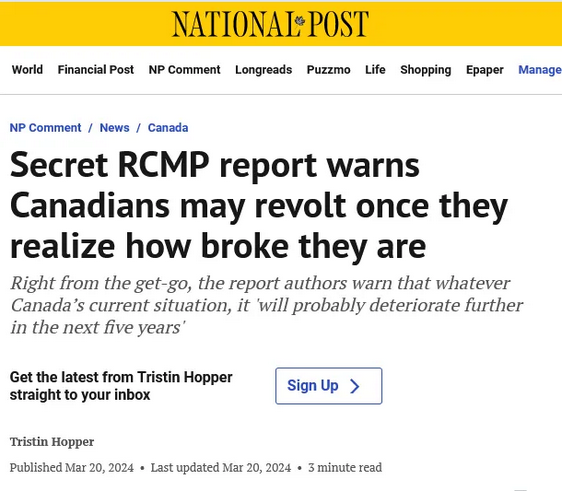
One of Canada’s intelligence agencies, a couple of months ago, sent a memo to the Liberal federal government informing them that, in the near-future years to come, they are worried about revolutionary activity. I believe Canada is a good case study because it seems the country has been a sociological testing ground for the powers that be to see what happens. Canada is a surreal twilight zone where it feels like every psyop known to man is hurled its way. Canada unquestionably has the worst demographic and immigration issues, the worst housing issues, the worst social stability, and upwards mobility issues, all adjusted and proportional to its population and size, of course. For our purposes, I believe Canada serves as the worst-case scenario of how bad the dating market can be, and how bad it will continue to get.
Canada has some of the lowest upward social mobility among developed nations, especially for young people, particularly within the OECD and G8. This means that young people in Canada find it relatively difficult to move up the economic ladder compared to their parents.
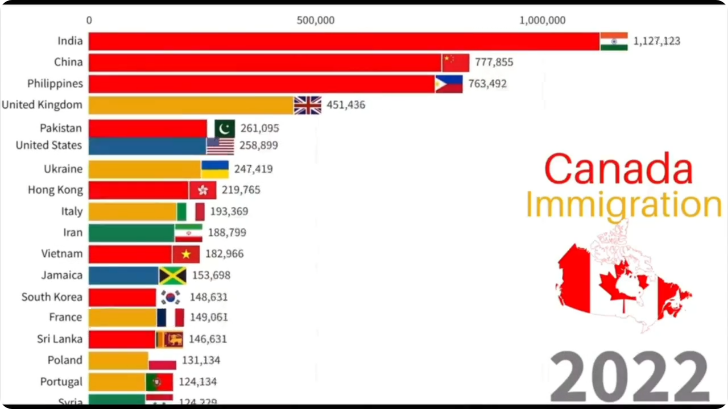
In 2022, Canada’s population growth was significantly driven by immigration. According to Statistics Canada, approximately 95% of the population growth in that year was attributed to immigration. This includes both permanent and temporary residents, with a notable influx of international students, temporary workers, and permanent residents. Only a meagre 5% of Canada’s population growth, including recent immigrants, was from organic growth and childbirth. Below are the national origins of immigrants over the last twenty-four years. The combined total number of people entering Canada per year, including international students, temporary foreign workers, legal immigrants, and refugee claimants, is approximately 1,133,770 individuals officially. In reality, the government over the last four years has lost count.
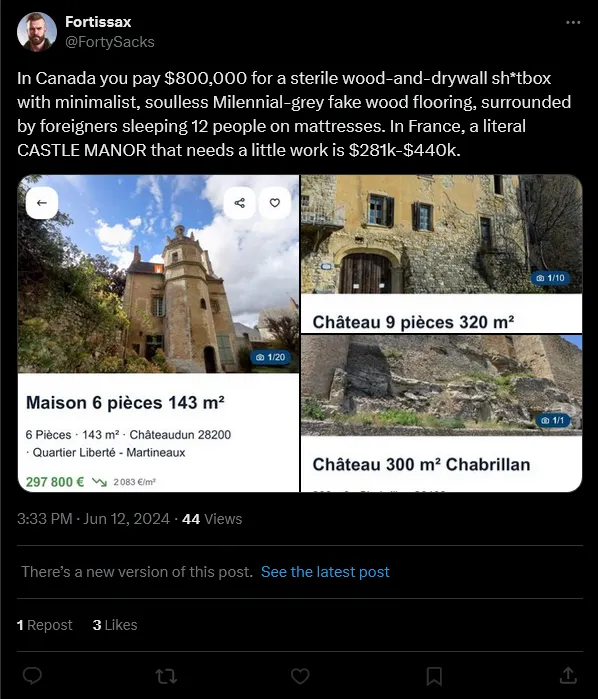
As of April 2024, the average home price in Canada is approximately CAD $703,446. This is €477,121.93 and USD $511,466.93. Would you like to see what $703k CAD can get you in France? Hint: a lot more than in Canada.
This has been noticed so much by Canadians that it is now a meme, with Conservative Party and opposition leader Pierre Poilievre pointing it out in the House of Commons. You can compare the price of homes and the cost of living with Canadian wages. You can also compare how far those meagre wages would go in other first-world countries like France, Germany, or Sweden. The answer is much farther. Much, much farther. There is currently no hope, short of radical action by the government unheard of in Canadian history, for this situation to be rectified. The only other option is best left unsaid.
“Educated” Women Lead
In Canada, among ethnic Canadians, a significant portion of the female population is more educated and makes more money than Canadian men. Canadian men make, on average, CAD $48,500, while women make CAD $42,000. However, only 56% of men have post-secondary education, while 68% of women do. Men have completed higher levels of high school, and women have completed higher levels of college or university. This has led to a massive gap in socioeconomic status between men and women. It gets worse when you include non-ethnic Canadians. Completed levels of post-secondary education for men remain at 56%, while women’s rise to 73%.
We know that in our post-industrial world, resources translate to money. Money and completed levels of education translate to status. Women are 50% more likely to divorce men when they make more money. When women are already the initiators of divorce 70% of the time, it starts looking pretty ugly, fast.
What People Ate on Ellis Island
Tasting History with Max Miller
Published Mar 5, 2024A complete Ellis Island meal: Tapioca Pudding, coffee, Beef and Barley Soup, and white bread.
City/Region: United States of America
Time Period: 1887The food on Ellis Island could be pretty good or pretty terrible depending on when you were there. The quality went up and down a lot, but the food was always free to those who were staying on the island. A menu for the midday meal on Tuesday, January 20, 1920 lists English Beef Soup with Barley, Lamb Stew with Vegetables, Bread and butter substitute, Tapioca Pudding, Coffee. This recipe doesn’t use a lot of meat, but the marrow melts into the broth and there are plenty of vegetables and flavor, making for a hearty soup.
Beef Soup
Select a small shin of beef of moderate size, crack the bone in small pieces, wash and place it in a kettle to boil, with five or six quarts of cold water. Let it boil about two hours, or until it begins to get tender, then season it with tablespoonful of salt, and a teaspoonful of pepper; boil it one hour longer, then add to it one carrot, two turnips, two tablespoonfuls of rice or pearl barley, one head of celery and a teaspoonful of summer savory powdered fine; the vegetables to be minced up in small pieces like dice. After these ingredients have boiled a quarter of an hour, put in two potatoes cut up in small pieces; let it boil half an hour longer, take the meat from the soup, and if intended to be served with it, take out the bones and lay it closely and neatly on a dish, and garnish with sprigs of parsley.
Serve made mustard and catsup with it. It is very nice pressed and eaten cold with mustard and vinegar, or catsup. Four hours are required for making this soup. Should any remain over the first day, it may be heated, with the addition of a little boiling water, and served again. Some fancy a glass of brown sherry added just before being served. Serve very hot.
— The White House Cook Book, 1887.
QotD: Napoleon Bonaparte – the great man?
Remember, the real Napoleon was so impressive he literally caused a crisis in 19th century philosophy! Everybody had carefully worked out their little theories, later exemplified by Tolstoy, about how human agency doesn’t matter in history and everything is just the operation of vast impersonal forces like the grinding of tectonic plates, and then boom this guy shows up and the debate springs to life again. You know it’s real when two guys as different as Nietzsche and Dostoevsky are both grappling with what we can learn from somebody’s existence. And I think Raskolnikov’s unhealthy Napoleon fanboyism was supposed to be a bit of a satire of some very real intellectual currents among the European and Russian intelligentsia.
So what do you think? Does Napoleon vindicate the great man theory of history? I’m still working out my own answer to this, which I briefly allude to in my review of Zhuchkovsky’s book. Basically, I think we can transcend the traditional dichotomy by constructing a political/military analogue of the Schumpeter/Kirzner theory of entrepreneurship. Vast, impersonal forces (such as technological progress or structural economic changes) can create opportunities — in fact they’re pretty much the only thing that can, because the force required to reconfigure society is usually far beyond what any person or group can manage.
But once the opportunity is there, it takes a lot less raw power to act on it, assuming you can recognize it. Imagine a process of continental drift that slowly, slowly raises a mountain-sized boulder out of the ground, and every year it’s inching closer to this precipice, until finally it teeters on the edge. A human being could never have done that, it would be far too heavy, but once it’s up there, there might be a narrow window, a few precious moments, when a solid shove by somebody sufficiently perceptive and motivated can direct and harness this unimaginable force.
So the question is: what made Europe so ripe for Disruption (TM) at that moment? Obviously the French Revolution, and there were some pretty important changes in the nature of warfare too. What else?
Jane: Well, you know what I’m going to say: it’s the Enlightenment, stupid.
I was going to compare Napoleon to, say, Odoacer, but I don’t think the analogy actually holds. The Goths were conquerors from outside; their approach, their whole worldview, was very different from the Romans’.1 But Napoleon is extremely inside. The people he comes from are not actually all that different from the ancien régime — they’re feuding hill clans, but they’re aristocratic feuding hill clans — and yet he’s so thoroughly a creature of Enlightenment modernity that even when he’s engaging in the time-honored feuding hill clan pastime of resisting integration by the metropole he’s doing it by writing pamphlets. He might be a Corsican nationalist but he’s been intellectually colonized by France. Or, more accurately, by the elements of French culture that are in the process of undermining and overthrowing it.
I think you’re right about political entrepreneurship. (So here we see the Psmiths wimp out and answer the great man/impersonal force dichotomy “yes”.) It’s perhaps more neatly summed up by that famous Napoleon quip: “I saw the crown of France lying on the ground, so I picked it up with my sword”. Which: based. But also, if we’re going to continue his metaphor, he didn’t knock the crown onto the ground. Everything was already irredeemably broken before he got there. And this, I think, distinguishes him from the Germanic conquerors, who found something teetering and gave it a final push. Caesar, similarly, came up in the old order but dealt it its death blow.
But back to the Enlightenment: the crown is on the ground because the culture that held it up has fallen apart, and it’s fallen apart because gestating in its innards was an entirely different culture that’s finally burst its skin like a parasitic wasp and emerged into the light of day. A lazy reading of history sees Napoleon with a crown giving people titles and building palaces and goes “ooh, look, he’s just like the ancien régime“, but this is dumb. Napoleon is obsessed with modernizing and streamlining. He wants to wipe away the accumulated cruft of a thousand years of European history and build something smarter and cleaner and more rational. He’s just better at organization and psychology than the revolutionaries were. The French Revolution (and the total failure of the Directory) created the material conditions, but the entire intellectual milieu that made the French Revolution possible also made it possible for people to look at Napoleon and go “whoa, nice”.
Jane and John Psmith, “JOINT REVIEW: Napoleon the Great, by Andrew Roberts”, Mr. and Mrs. Psmith’s Bookshelf, 2023-01-21.
1. There’s some very interesting stuff on this, and about later efforts from both cultures to bridge the gap, in Bryan Ward-Perkins’ The Fall of Rome: And the End of Civilization.
June 15, 2024
In Germany, it can be dangerous to “participat[e] in the wrong discussions before the wrong kind of people and assembl[e] one’s (wholly accurate) data from the wrong sources”
German government control over what people can say online seems like something Justin Trudeau would love to have (and, in fact, is working toward) here in Canada:
Almost two years ago, on 26 July 2022, a German Twitter user known only as MicLiberal posted a thread that culminated in his criminal trial this week. His is but the latest in a long line of such prosecutions – the tactic our rulers increasingly favour to intimidate and harass those who use their freedom of expression in inconvenient ways.
MicLiberal committed his alleged offence as Germany was still awakening from months of hypervaccination insanity. Science authorities and politicians had spent the winter decrying the “tyranny of the unvaccinated“, demanding that “we have to take care of the unvaccinated, and … make vaccination compulsory“, firing people who protested institutional vaccine mandates on social media and denouncing the unvaccinated for ongoing virus restrictions and Covid deaths. Our neighbour, Austria, even went so far as to impose a specific lockdown on those who refused the Covid vaccines. Culturally and politically, those were the darkest months I have ever lived through; they changed my life forever and I will never forget them.
MicLiberal’s thread aimed only to memorialise some of the crazy things the vaccinators had said. It opened with this tweet:
We were complicit!
We marginalised, defamed, discredited, insulted and cancelled people. On behalf of science!
By popular demand, this brief thread with statements that should not be forgotten:
There ensued nothing but a series of citations, most of them wholly typical samples of vintage 2021/22 vaccinator rhetoric, much of it not even that remarkable. For example, MicLiberal included this statement from Andreas Berholz, deputy editor-in-chief of the widely read blog Der Volksverpetzer:
Fact-check: The unvaccinated remain the main drivers of the pandemic.
[…]
You might be wondering what crime MicLiberal can possibly have committed by drawing attention to these already-public statements. The most honest answer is that his thread achieved millions of views in a matter of days, and at a very awkward moment – precisely when everyone was beginning to regret all the illiberal and wildly intemperate things they had said in the depths of the virus craze. He had embarrassed some very vain and powerful people with their own incredibly stupid words, and today many are of the opinion that that ought to be a crime in and of itself.
Alas, things have not yet deteriorated that far. Thus the police and prosecutors were left to scour our dense thicket of laws for a more plausible offence. They decided that their best chance lay with a novel provision of the German Criminal Code (Paragraph 126a). This provision makes it a crime to “disseminate the personal data of another person in a matter that is … intended to expose this person … to the risk of a criminal offence directed against them“. On 28 July, two days after MicLiberal posted his 25 tweets, Cologne police filed a criminal complaint against him, and afterwards the Cologne prosecutor’s office brought charges, arguing that MicLiberal had suggested that the people he cited were “perpetrators” and therefore associated them with “fascism”. The district court declined to approve the charges, but the prosecutors appealed to the regional court, where the judges saw things differently. They believed that a prosecution was warranted because of the “heated social debate” surrounding Covid measures, and because MicLiberal’s audience was composed of “homogeneous” like-minded people, who (in the summary of the Berliner Zeitung) “could either form groups or encourage individual members to commit acts of violence”. MicLiberal had furthermore assembled his citations from a website that the judges deemed guilty of an “anti-government orientation”.
We must take a moment to ponder this truly amazing argumentation, which would seem to criminalise such things as participating in the wrong discussions before the wrong kind of people and assembling one’s (wholly accurate) data from the wrong sources. In each of these cases, of course, it is the prosecutors and the judges eager to apply Paragraph 126a to their political opponents who get to decide what is “wrong”.

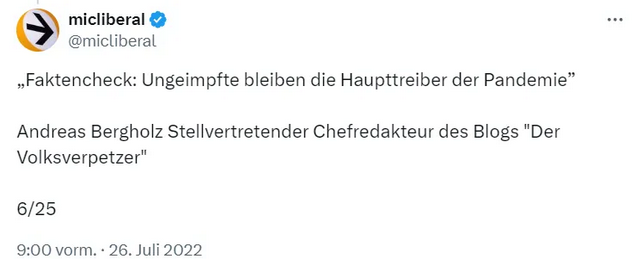
The good news in all of this is that the court acquitted him of these creative charges, but the prosecution has given notice that they intend to appeal.
W.H.O. the hell do they think they are?
Christopher Snowden on what he calls a “new low” for the World Health Organization (WHO) in a report issued earlier this week that sounds like Karl Marx was one of the writers:

The WHO European Region published a new report today, written mostly by British ‘public health’ academics. It is quite revealing. For example …
This requires, at a minimum, that governments recognize that the primary interest of all major corporations is profit and, hence, regardless of the product they sell, their interests do not align with either public health or the broader public interest. Any policy that could impact their sales and profits is therefore a threat, and they should play no role in the development of that policy. Similarly, governments must also recognize the now overwhelming evidence (see also chapters 4, 6 and 7) that HHIs [“health-harming industries”] engage in the same political and scientific practices as tobacco companies and that voluntary or multistakeholder partnership approaches do not work where conflicts of interest exist. Instead, they must regulate other HHIs [“health-harming industries”], their products and practices, as they do tobacco.
That’s just one paragraph, but there’s a lot it in.
Firstly, they are clearly not just opposed to “health-harming industries” but to private industry and the free market in general.
Secondly, they want to exclude all industries from the policy-making process, as already happens with the tobacco industry.
Thirdly, they want to regulate all “health-harming industries” in the same way as they regulate tobacco. These industries include alcohol, food and fossil fuels, but the report also mentions pharmaceuticals, infant formula, gambling, firearms, healthcare (!) and sugary drinks. As the quote above makes clear, they think that all private industry damages health in some way.
This is all there in black and white and there is much more of the same in the report. This is not scaremongering or the slippery slope fallacy. It is in an official WHO document.
When people show you who they are, believe them.
I have written about this for The Critic …
If this sounds to you like Bolshie talk, you might be onto something. It is further confirmation that the modern “public health” movement is an arm of the hard left presented as an arm of medicine. It would be tempting to tell the authors to stay in their lane, but anti-capitalist nanny statism is their lane. For over a decade, such academics, mostly from Britain and Australia, have been pumping out studies about the “commercial determinants of health” and the “corporate political activity” of “unhealthy commodity industries”. The new WHO report is a sort of greatest hits collection. Last year they published a whole series of articles in the Lancet in which they claimed that there is “growing evidence that neoliberalism has been damaging to health” and called for “a normative shift away from harmful consumptogenic systems”.
Half-baked Marxist rhetoric has been rife in the social sciences for decades, but these people have a vaguely coherent point to make and are pursuing a serious, if terrifying, agenda. Since they do not believe in human agency, they assume that people only make “unhealthy choices”, such as eating processed ham, because the system that controls them has been rigged by big corporations. They say in today’s report that “consumers do not have capacity (time or resources) to make the ‘right’ choice”. Fortunately, public health academics know what the right choice is and could impose it on a grateful population if it were not for the pesky free market. Hence their rage against capitalism, which extends to suspicion of intellectual property, international trade, share buybacks, impact assessments (because they allow businesses to engage with policy-makers) and even the EU single market.
Further to what I say in the article, I’d add that it is to the UK’s shame that so many of the authors of this report are British. They include quackademics that I have been making fun of for years, such as Anna Gilmore, Mark Petticrew and May van Schalkwyk. Between them, they constitute a small clique of talentless, fanatics and/or grifting social scientists who have constructed a world of unreality for themselves by publishing endless low quality journal articles which they and their colleagues then reference and self-reference. It is profoundly depressing that they are now dangling the corpse of the WHO — which was once a great institution — on pieces of string.
The Ford Foundation and the far left
N.S. Lyons looks at the vast amount of money the “philanthropic” Ford Foundation donates to organizations pushing far left agendas:
It’s November 2023, and, following the October 7 attacks by Hamas terrorists that killed some 1,400 Israelis and at least 31 Americans, thousands of demonstrators march through New York City, calling for the destruction of the Jewish state. Chants of “from the river to the sea, Palestine will be free” echo through the streets, along with “there is only one solution: intifada revolution”. Among the crowd is the infamous Palestinian American activist Linda Sarsour, who warns through a megaphone that a cabal of wily Jews has conspired to place “their little posters” (of kidnapped Israeli civilians) across the city, seeking to entice people to rip them down. While many onlookers might look like “ordinary people”, she says, the Jews have “their little people all around the city”, surveilling others. Sarsour is there to deliver such rhetoric in part because she’s been paid to be there: her nonprofit, MPower Change, has received $300,000 in grant funding from the Ford Foundation “to build grassroots Muslim power”.
It’s May 2023, and protesters have stormed the Capitol building in Washington, D.C., to demand that lawmakers not accept spending cuts during negotiations to lift the debt ceiling. Many are so disruptive that the police arrest them and drag them out. These are activists of the Center for Popular Democracy, an extreme left-wing organization that has collected $35.2 million from the Ford Foundation since 2012. Four months later, they will be imitated by 150 youth activists from the “climate revolution” group the Sunrise Movement, 18 of whom will be arrested after occupying the Speaker of the House’s office. The Sunrise Movement also receives Ford Foundation money—$650,000 for “training and organizing”.
It’s April 2023, and, a world away, the China Development Research Foundation (CDRF), a think tank set up and directed by the Chinese state, is hosting a conference in Beijing to discuss how to “promote the formation of an internationally accepted ESG system with Chinese characteristics”, including through China’s globe-spanning influence and infrastructure plan, the Belt and Road Initiative. But this effort by America’s top geopolitical adversary isn’t too far afield for the Ford Foundation to fund; it has given CDRF $600,000 to help realize its ambitions.
These examples from just the last year — collected via a semi-random tour of the Ford Foundation’s vast Grants Database — represent a tiny fraction of the nearly $1 billion that the foundation gives away yearly, on average. Almost a century old and sitting on a mountainous $16.4 billion endowment in 2022, the foundation is a “philanthropic” giant — one of the five largest in the U.S. If it were a for-profit firm, its market capitalization would rank it among the Fortune 500. Instead, “guided by a vision of social justice”, as its mission statement puts it, the Ford Foundation’s enormous flood of untaxed money flows annually to an immense ecosystem of overwhelmingly left-wing — and often outright revolutionary — causes.
Yet the foundation’s activities remain largely below the public’s radar, the extent of its malign history mostly unknown. This should change. America today faces a multitude of escalating sociopolitical crises that are rapidly tearing apart the body politic: a rapacious strain of tribal identity politics; spreading legal, cultural, and moral chaos; lawlessness in the streets; and the entrenchment of an oligarchic managerial elite, increasingly willing to cast aside any remaining shred of democratic or national sovereignty in its pursuit of top-down global “progress”. Behind every one of these fractures, one finds the ongoing work of the Ford Foundation.
In 2020, following the death of George Floyd in Minneapolis, a “racial reckoning” swept the United States, kindling fiery riots across the nation, abrupt moves by municipalities to defund police departments, and the near-wholesale capitulation of public institutions — from universities to government agencies to major corporations — to a culturally revolutionary ideology of identitarian grievance and racial separatism. To some, this came as a shock. To the Ford Foundation, it marked the fulfillment of decades of effort.
The foundation has long seen itself as uniquely dedicated to progress and social justice, its stated mission from as early as the 1950s being the “general purpose of advancing human welfare” and to “eradicate the causes of suffering” worldwide. But after current president Darren Walker took the helm in 2013, it began more fully to embrace a public identity as a “social justice foundation” and reoriented its mission to “disrupt the drivers of inequality” in every sphere of life and across the globe.
Dado by Hand
Lost Art Press
Published Mar 6, 2024Megan Fitz demonstrates her dado cutting process by hand for a Dutch tool chest. Will the shelf fit?


