
… Is there, in fact, more lunacy in the Current Year, or is it just louder? He argued that there’s more. I argue that there’s not. Victorians, for instance, were world-class eccentrics. Just to stick with the breakfast cereal theme, consider that Kellogg’s corn flakes were based on some weird theory of digestion that was designed to combat the scourge of masturbation. No, really — the Sylvester Graham referenced in that article is the guy behind graham crackers, which were designed for similar reasons. See also “Fletcherism”, which counted Thomas Edison among its adherents. And that’s just food! Water, electricity, magnetism, you name it, there’s some weird Victorian health fad attached to it. Throw in the peccadilloes, sexual and otherwise, of just the widespread missionary movements, and you’ve got all the crazy you can handle, and then some.
Contrast this to the Current Year, where, much like breakfast food, what seems to be a bewildering variety of lunacy can be boiled down to just a few basic types. “Wokeness” is a madlib with just two variables: ____ is either racist or sexist, pick one. (I suppose you can combine them, but you’ll notice that doesn’t happen nearly as often as you’d predict, because the blacks hate the gays and the feminists hate everyone, so going full retard ends up getting you in a lot of trouble with your coreligionists).
Severian, “Mail Bag / Grab Bag”, Rotten Chestnuts, 2021-06-11.
June 15, 2024
QotD: Is there more craziness these days or is it just the volume turned up to 11?
June 14, 2024
Britain’s anti-gay hate crime epidemic
Andrew Doyle suggests you take the recent reports of burgeoning hate crime in Britain with a fair bit of salt, because the hate crime statistics are far from trustworthy:

When things like this can be reported as “hate crimes”, and the definition depends on the reporter’s assumption of hateful intent, you’re going to see a lot more “hate crimes”.
We all know by now that the Metro is an activist publication masquerading as a newspaper. And so we ought to approach with some caution its article this week claiming that the UK has seen a surge in hate crime against gay people. There’s even a handy rainbow-coloured map which pinpoints the most homophobic locations in the country. Thankfully St Ives isn’t on the list, so I won’t have to cancel my holiday.
What are we to make of the article’s claim that there has been a 462% increase in homophobic hate crime and a 1,426% increase in transphobic hate crime since 2012? The source for these remarkable figures is the House of Commons Hate Crime Statistics report. If true, it would seem to confirm activists’ claims that we are living in an anti-LGBTQIA+ hellhole.
The truth is not so melodramatic. The supposed escalation of hate crimes in the UK can be accounted for by the way in which they are now recorded. Police actively trawl for complaints, inviting citizens to report offensive comments or any action – criminal or otherwise – that the “victim” perceives to have been motivated by prejudice. No evidence of “hate” is required for it to be recorded as such, other than the assumption of the complainant. With such methodology in place, it is inevitable that the statistics will rise.
And perhaps that’s the whole point. The police in the UK are just one of the many major institutions that has been captured by intersectional ideology. Police are regularly seen dancing at Pride parades, driving rainbow-coloured cars, and harassing gender-critical women for wrongthink. In February 2021 in Merseyside – a county that tops the Metro‘s list of homophobic hate spots – police were photographed next to a digital advertisement which read “Being offensive is an offence”. This belief-system can only be sustained by the narrative of widespread hate, and so we should not be surprised to see that police practice has been modified to ensure this outcome.
In fact, the College of Policing had made it clear that a fall in hate crime statistics would not be acceptable. Its operational guidance says that “targets that see success as reducing hate crime are not appropriate”. And by the Home Office’s own admission, “increases in police-recorded hate crime in recent years have been driven by improvements in crime recording and a better identification of what constitutes a hate crime”. In other words, there is no hate crime epidemic at all. It’s simply that the definitions have expanded.
Rather than rely on the Home Office statistics, we would be better turning to a source that hasn’t been corrupted by ideology. The Crime Survey for England and Wales hasn’t adopted the new police methods of recording, and shows that hate crime has been consistently dropping. Between 2008 and 2020, the number of hate crimes fell by 38%, and all the while records of hate crime kept by the police kept on rising. The disparity between the reality and the narrative couldn’t be more stark.
When propaganda wins over historical facts, Ontario public schools edition
To someone of my generation (late boomer/early GenX), the history of the Residential School system was taught, at least superficially, in middle school. Along with the early settlement of what is now Canada by the French and later the English (with a very brief nod to the Vikings, of course), we got a cursory introduction to the relationships among the European settlers and explorers and the various First Nations groups they encountered. It wasn’t in great depth — what is taught in great depth in middle school? — but we got a rough outline. In my case, details about the Residential School system came more from a “young adult” novel about a young First Nations student running away from his school and trying to find his way back to his home and family. My best friend in school had First Nations ancestry, so I felt a strong desire to understand the book and the system and culture portrayed in it.
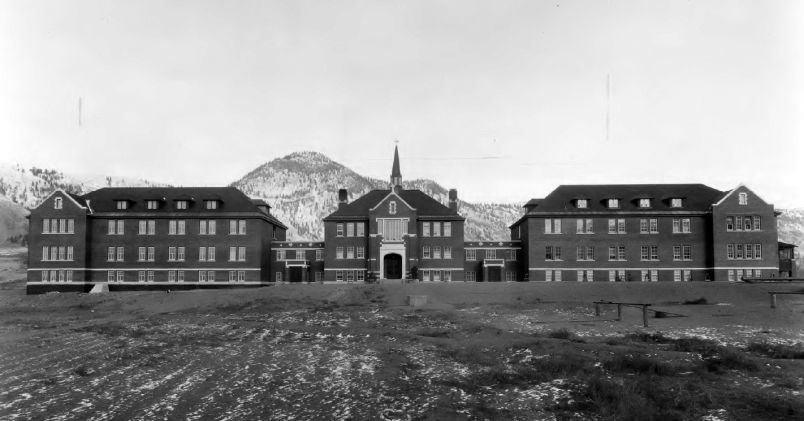
Kamloops Indian Residential School, 1930.
Photo from Archives Deschâtelets-NDC, Richelieu via Wikimedia Commons.
If, in the early 1970s, the Ontario school system taught at least a bit about the history of the First Nations peoples, how is it possible that they stopped doing so and my son’s generation were utterly blindsided by the sensationalist treatment of the students at a particular Residential School in British Columbia? And as a result, were far more credulous and willing to believe the worst that the “anticolonialist” propagandists could come up with.
“Igor Stravinsky” is a teacher in the Ontario school system who writes under a pseudonym for fairly obvious reasons, as he’s not a believer in the modern narrative about the history of First Nations children in the Residential School system:
This will be my last instalment of this series. I have attempted to shed light on the poor quality of information students are receiving in Ontario schools with regard to Indigenous history and current issues. It is important to note that this is being done intentionally. It is to the advantage of the leaders of the Indigenous Grievance Industry to characterise Canada and the pre-Canadian colonies of this land as genocidal oppressors, and our politicians have exploited this situation for crass political gain. This was perhaps epitomised by Prime Minister Justin Trudeau’s photo op of himself holding a teddy bear in the proximity of a soil disturbance in a field at the site of a former residential school in Cowessess First Nation, Saskatchewan on Tuesday, July 6, 2021:
Prime Minister Justin Trudeau holding a teddy bear in Cowessess First Nation, Saskatchewan.
July 6, 2021.Are there actually human remains there? If so, of whom? Is this evidence of any kind of foul play? These are questions he was not about to bother to ask. Why would he, when such a golden opportunity to score political points presented itself?
We now know all this murdered Indigenous children stuff was a big hoax but don’t hold your breath waiting for Trudeau to issue an apology for staining the international reputation of Canada and triggering a knee-jerk vote by our Parliament declaring Canada a genocidal state and adopting the The United Nations Declaration on the Rights of Indigenous People (more on that below). Undoing all this damage will be a herculean task.
Just as students are fed simplistic, misleading, and false information about the past with regard to Indigenous people (the focus being the Indian Residential Schools) they are being presented with the point of view that human rights violations against the Indigenous people are ongoing, and are the reason for the poor quality of life in which such a disproportionate number of Indigenous people find themselves.
The claim of generational trauma
On Apr. 27, 2010, speaking as chair of the Truth and Reconciliation Commission and for the people of Canada, Sinclair told the Ninth Session of the United Nations Permanent Forum on Indigenous Issues: “For roughly seven generations nearly every Indigenous child in Canada was sent to a residential school. They were taken from their families, tribes and communities, and forced to live in those institutions of assimilation.”
This lie is promoted in the schools. It is the foundation of the generational trauma claim but in fact, during the IRS era, perhaps 30% of Status Indians (you can cut that figure in half if you include all people who identify as Indigenous) ever attended, and for an average of 4.5 years.
Even if it were true that most Indigenous people who attended the IRS suffered trauma, there is no evidence or logical reason to believe that trauma could be transferred down the generations. If generational trauma is a thing, why have the descendants of the victims of the holocaust been doing so well?
If there is generational trauma, the culprit is alcohol. Alcohol abuse has been a major problem in Indigenous communities since first contact but rarely comes up these days, certainly not in schools. Fetal Alcohol Syndrome (FAS), which occurs when a mother consumes alcohol during pregnancy, is also a major problem and the children born with it suffer from mental and emotional challenges throughout their lives. It impacts their social life, education and work. Girls who suffer from the condition all too often end up drinking during pregnancy themselves and the cycle continues.

Chef John’s Cream of Mushroom Soup – Pure Liquid Moon-Soaked Earth
Food Wishes
Published Dec 30, 2009[NR: I kid you not, this is the best cream of mushroom soup I’ve ever tasted. And I made it!]
I can’t believe I haven’t posted a video recipe for cream of mushroom soup! It’s such a classic cool weather staple, and quite simple to make – as long as you have a few hours to spare. The secret to this deep rich potage is a long slow caramelization, the key to unlocking the mushroom’s magic. Oh, and by the way, I mean that literally. Mushrooms are by far the most mysterious and magical things we eat.
Scientists still don’t really understand how and why they grow like they do. While every other food you eat gets its energy from the sun, Agaricus bisporus, the common button mushroom, does not. Some believe mushrooms are powered by the moon, which I find fascinating to contemplate.
This is a very minimalist formula, and meant to transform the browned bits of fungus into pure earthy essence of mushroom. You can use whatever exotic mushrooms you can get a hold of, but it works quite well with the ubiquitous white button mushroom. Enjoy!
(more…)
QotD: European “megacorporations” in the east
And the structure of these massive trading companies mirrors some of the elements of a megacorp. While both companies were, in theory, shipping companies, in practice they were massive vertically integrated conglomerates. Conquering the production areas (particularly India for the EIC and Java for the VOC), they essentially controlled the production chain from start to finish. That complete vertical integration meant that the companies also had to supply employees and colonial subjects, which in turn meant controlling trade and production in everything from food and clothes to weapons. Both companies had their own armies and fleets (the EIC boasted more than 25,000 company soldiers at its height, the VOC more than 10,000) and controlled and administered territory.
In short, they were the colonial Dutch and British governments for many millions of colonial subjects. For the people living in territory dominated by these companies, they really would have resembled the megacorps of speculative fiction, operating with effectively impunity and using their vast profits to field armies and navies capable of defeating local states and compelling them to follow the interests of the company (which remained profit-oriented).
(I feel the need to stop and note that “company rule” in India and even more so in the Dutch East Indies was brutally exploitative, living up to – and in many cases quite surpassing – the normal dystopian billing of science fiction megacorporations. At the same time, it seems equally worth noting that the shift to direct colonial rule by the state was not always much better.)
So in one sense, the speculative fiction megacorp has already existed, but in the other, the limits of these historical entities are informative too. First, it seems relevant that none of these companies were creatures of the markets, rather, they were created by state action – they were chartered companies, state monopolies, or both. These massive imperial trading companies (of which the EIC and VOC were the most successful, but not the only ones) were all created by their respective governments, armed with substantial privileges and typically given exclusive rights to certain trade – they were state-sanctioned monopolies (echoes of this also in the Japanese Zaibatsu state-sanctioned vertical monopolies; note that the Roman publicani [tax-farming “companies” of the middle and late Republic] were also state-sanctioned monopolies) whose monopolies were backed by state power to the point that their states (that is, Britain, the Dutch Republic, France and so on) would and did go to war to protect the trading rights of their monopoly trading companies.
Second, these megacorporations, far from being in a position to usurp the states that formed them (as fictional megacorporations often do), turn out to be extremely vulnerable to those states. The EIC was effectively nationalized by an act of parliament in 1858 (after the Indian Mutiny of 1857 discredited company rule in the eyes of the British government) and disbanded in 1874. The VOC was likewise nationalized by its parent government in 1796 and then dissolved in 1799. No effort was made by either company to resist being disbanded with any sort of force; it would have been a pointless gesture in any case. While the resources of the EIC were vast, the military capabilities of the British Empire were far greater. Moreover, the companies simply didn’t have the legitimacy to operate absent their state backing.
This is of course also true for the not-quite-megacorporations, like the great trusts of America’s gilded age (Standard Oil, U.S. Steel, etc.), or the Japanese zaibatsu or even modern super-sized corporate entities. Of the 10 largest companies in the world, four are straight up state-owned enterprises. Even for the private modern massive company, by and large when they try to fight their “home” state, they lose, or at least are badly damaged without seriously inconveniencing the far greater power of the state (just ask AT&T or Microsoft).
Bret Devereaux, “Fireside Friday: January 1, 2021”, A Collection of Unmitigated Pedantry, 2021-01-01.
June 13, 2024
Fun new family game – Who’s the Parliamentary Traitor?
In the National Post, Tristin Hopper presents the rulebook for an exciting new family game literally “ripped from the headlines” – Who’s the Parliamentary Traitor?
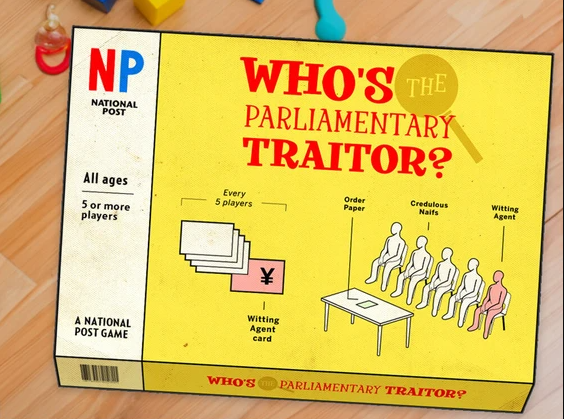
“To simulate what it’s like to go to work in a national parliament secretly housing foreign agents, the National Post presents a tongue-in-cheek instruction manual to play this group game: Who’s the Parliamentary Traitor?
Photo by Brice Hall”
WHAT YOU NEED TO PLAY:
- One large writing surface, such as a chalkboard, whiteboard or flip chart (THE ORDER PAPER)
- 20-70 note cards
- A timer
SETTING UP PLAY:
Gather at least five of your closest friends and have them sit in a line facing the ORDER PAPER. They will be divided into two categories: The WITTING AGENTS and the CREDULOUS NAIFS.To choose who among them will be the WITTING AGENTS, prepare a stack of IDENTITY CARDS equal to the number of players. On every fifth card, mark the symbol for the Chinese yuan (¥). In the case of five players, mark a single card, for 10 players, mark two, etc.
Shuffle the IDENTITY CARDS and distribute them among the players. Anyone receiving a “¥” is now a WITTING AGENT.
Set aside another stack of note cards to serve as MANDATE LETTERS. The text for each card is below. Shuffle the MANDATE LETTERS and place them face down.
RULES OF THE GAME:
Each round begins with a CANADA IS NOT BROKEN phase in which all players close their eyes, put their thumbs in their ears and bury their face for two minutes (the elapsed time to be marked with a timer). During this phase, the WITTING AGENTS open their eyes, stride over to the ORDER PAPER and write down a piece of binding public policy that damages Canada to the advantage of a hostile government (suggestions below).Once this act of treachery is done, the WITTING AGENTS return to their seats will pretend to wake up alongside them as if nothing happened.
Now begins the CONCERNED FOLLOW-UP phase. First, players must pull a MANDATE LETTER card that will determine conditions of discussion. Now, the parliamentarians must decide who among them is the foreign cat’s paw who has defaced their ORDER PAPER with disloyal policy. Uncomfortable questions are asked, accusations are made, and at the end of the round the players vote on who among them will be ejected as a traitor.
Only after the accused traitor is exiled will they show their IDENTITY CARD, revealing whether the accusations have been true, or whether they have been unjustly maligned.
Ejected players are then exiled to THE SENATE, a separated area of chairs where they are served port, ginger ale and black liquorice. They continue to participate in the CANADA IS NOT BROKEN and the CONCERNED FOLLOW-UP phases, but they no longer have a vote.
Build a Traditional Tool Tote for Father’s Day
Rex Krueger
Published Jun 12, 2024This Father’s Day, go for a project that stays in the family.
Free Plans! https://www.rexkrueger.com/store/p/fr…
(more…)
Debunking the “miraculous” Marshall Plan
If you’ve read anything about the state of Europe in the aftermath of the Second World War, you’ll undoubtedly have heard of the way the Marshall Plan did wonders to get (western) Germany and the other battle-devastated nations back on their feet economically. At FEE, Christian Monson suggest that you’ve been provided with a very rosy scenario that doesn’t actually accord with the facts:
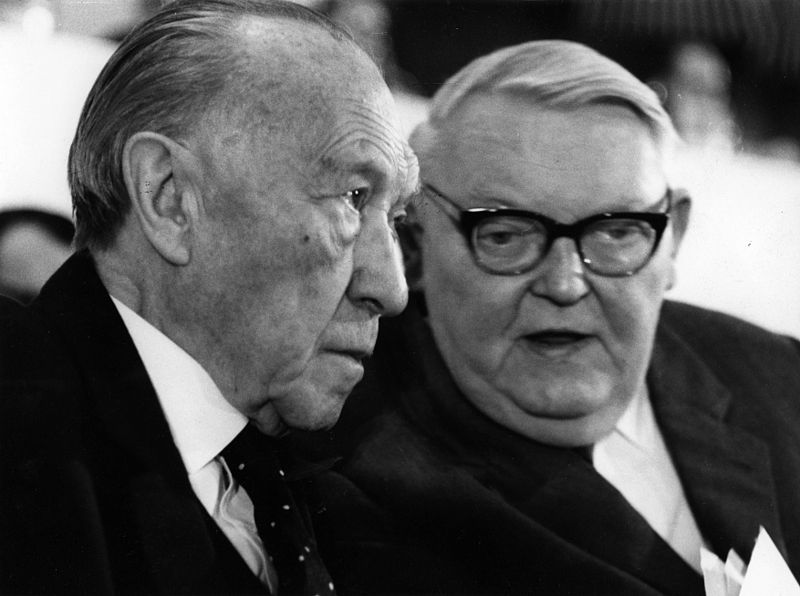
Konrad Adenauer in conversation with Ludwig Erhard.
KAS-ACDP/Peter Bouserath, CC-BY-SA 3.0 DE via Wikimedia Commons.
Unfortunately, the ubiquity of the myth that the Marshall Plan rebuilt Germany is proof that state-controlled education favors propaganda over economic literacy. Despite the fact that most modern historians don’t give the Marshall Plan much credit at all for rebuilding Germany and attribute to it less than 5 percent of Germany’s national income during its implementation, standard history textbooks still place it at the forefront of the discussion about post-war reconstruction.
Consider this section from McDougal Littell’s World History (p. 968), the textbook I was given in high school:
This assistance program, called the Marshall Plan, would provide food, machinery, and other materials to rebuild Western Europe. As Congress debated the $12.5 billion program in 1948, the Communists seized power in Czechoslovakia. Congress immediately voted approval. The plan was a spectacular success.
Of course, the textbook makes no mention of the actual cause of the Wirtschaftwunder: sound economic policy. That’s because, for the state, the Marshall Plan makes great statist mythology.
Not only is it frequently brought up to justify the United States getting involved in foreign conflicts, but it simply gives support for central planning. Just look at the economic miracle the government was able to create with easy credit, they say.
And of course, admitting that the billions of dollars pumped into Germany after WWII accomplished next to nothing, especially when compared to something as simple as sound money, would be tantamount to admitting that the government spends most of its time making itself needed when it isn’t and thereby doing little besides getting in the way.
The Inconvenient Truth of Currency Reform
You are unlikely to find the real cause of the Wirtschaftwunder mentioned in any high school history textbook, but here is what it was. In 1948, the economist and future Chancellor of West Germany Ludwig Erhard was chosen by the occupational Bizonal Economic Council as their Director of Economics. He went on to liberalize the West German economy with a number of good policies, the most important being currency reform.
The currency in Germany immediately after WWII was still the Reichsmark, and both the Nazis and then the occupying Soviet authorities had increased the amount in circulation significantly. As a result, by 1948 the Reichsmark was so worthless that people had turned to using cigarettes and coffee as money.
To give people a true store of value so that they could calculate economic costs accurately, assess risk and invest in the future, Erhard created the Deutsche Mark, West Germany’s new currency. Like ripping off a bandaid, he decreased the money supply by 93 percent overnight.
It’s also worth noting that while Erhard, following his school of Ordoliberalism, did form a central bank, it was at least designed independent from the government and followed a hard-money policy (preserving a stable amount of money) through the length of the Wirtschaftswunder. In fact, the original Bank Deutsche Länder was rather limited in scope until it was reorganized as the considerably more centralized Bundesbank in 1957, incidentally when Germany’s economic miracle began to lose steam.
Other notable liberal policies instituted by Erhard included removing all price controls and lowering taxes from the Nazis’ absurd 85 percent to 18 percent. The American occupational authorities opposed these reforms, but Erhard went through with them anyway. This liberalization had an immediate effect. The black market disappeared almost overnight, and in one year, industrial output almost doubled.
Perhaps most poignantly, unemployment dropped from more than 10 percent to around 1 percent by the end of the 1950s. Normally the government tries to justify currency manipulation as a means to eliminate unemployment, but the Wirtschaftwunder is evidence that sound money does the job far better.
The Best Allied Tank Of WW2
WW2 Pod: We Have Ways of Making You Talk
Published Mar 7, 2024Comedian Al Murray and historian James Holland look at a picture of a Cromwell tank jumping over a ramp in 1944. Was this the best Allied tank of WW2?
QotD: Gun safety is for always
The entire point of Rule One is that when you are handling a firearm, you need to be mindful. You need to be constantly aware of the fact that what you have in your hand is not a banana or a can of soup but an object that can, under the right circumstances, discharge a projectile with lethal consequences.
Chuck Haggard says that one shouldn’t have separate habits of handling for “loaded” and “unloaded” guns because when one is tired or distracted, one can inadvertently default to the wrong one. (“How do you dry-fire, Tam?” As though I’m expecting a loud noise at any moment. And I sure don’t have that gun pointed at anything I’m not prepared to pay for if I’m wrong about the gun’s status.)
[…]
What you see there with the chief in the video and with the guy in the picture above is bad gun-handling habits at work. This is why, whether I’m handling an actual firearm or a SIRT or a blue gun or an airsoft or whatever, I am very conscious of where the muzzle is pointing and do not point or wave it around casually. I want the default, habitual behavior for when there is a gun-shaped object in my hand to be caution and awareness. I always want the action of aiming a gun at something to be a conscious and deliberate choice.
And I don’t ever want to have to utter the words “Oh my God, I’m sorry! I thought it was unloaded!”
Tamara Keel, “Safety Is For Always”, View From The Porch, 2016-06-06.
June 12, 2024
“Treason never prospers” … except in Canadian politics, apparently
Justin Trudeau and his unindicted co-conspirators in Canada’s federal parliament don’t think the names of Members of Parliament who have been acting as enablers or actual agents of foreign powers — that is, possible traitors — should be made public. The National Security and Intelligence Committee of Parliamentarians (NSICOP) Even the least cynical may be forgiven for thinking that this isn’t what a mature country would do in similar circumstances:

The cover of the NSICOP special report on foreign interference (PDF here)
… MPs have an obligation to protect the institution that is the House of Commons. Every MP is required as a condition of taking their seats, to swear the following oath: “I, [name], do swear that I will be faithful and bear true allegiance to His Majesty King Charles the Third, King of Canada, his heirs and successors. So help me God.”
The violation of that oath, or the suspected violation of that oath, is absolutely arguably contempt against the House of Commons. We don’t have a ton of precedent for that, because MPs who have been alleged to have collaborated, even unwittingly, with a foreign power in the past usually have the good sense to resign. But MPs should absolutely be allowed to pass judgment on the actions of their colleagues, with the express intent of expelling from the House any members who have transgressed against their oath to King and Country. This isn’t just their duty, it is a duty that they are uniquely positioned and obligated to perform. Until we know exactly which parliamentarians we’re talking about, a spectre hangs over all 400-plus of them. That very much compromises the public’s opinion of Parliament and has a demonstrable impact on their ability to do their jobs as parliamentarians.
Once upon a time, children, ministers of the Crown would offer their resignations for mistakes made by members of the civil service in the ministry for which he or she held responsibility, never mind mistakes of their own. In modern times, of course, it’s rare to find a minister resigning voluntarily until the RCMP is literally knocking on the door, and sometimes not even then.
Second, we are a large and multicultural country. MPs are expected to represent members of any diaspora community which may exist in their constituency. If you’re a Tibetan or Uyghur activist, how can you be represented by an MP who’s demonstrated a willingness to collaborate with the government of the People’s Republic of China? If you’re an Iranian democracy and reform activist, how can you be represented by an MP who has close ties to Iran’s diplomatic and intelligence operation?
The answer, of course, is that you can’t be. The government has a greater responsibility to the democratic rights of those Canadians than it does to protecting the identity of any single unscrupulous or otherwise compromised parliamentarian. With every day that passes, Ottawa looks more like it has an interest in partisan butt-covering than it does in maintaining the long-term faith that democracy requires for our institutions to survive.
A good Member of Parliament recognizes the responsibility to the constituents — whether they voted for that particular MP or not — and would keep that responsibility as faithfully as possible. On that reckoning, we have fewer good MPs than we should have … and if the intelligence turns out to be fully supported upon full investigation, there should be a lot of open seats to run by-elections for (even if no formal charges of treason are ever laid).
Finally, I accept that intelligence is not evidence. I also accept, as noted in the Globe by Philippe Lagassé and Stephanie Carvin, that we must be cautious to not compromise intelligence sources and methods, or compromise ongoing investigations. Parliamentarians should not replace the criminal justice system or undercut our defence, but they what they are capable of doing, and indeed are required to do because no one else can do it for them, is broadly defining what the acceptable behaviour for parliamentarians should be. If an MP or a senator has engaged with a foreign power’s diplomatic or security services and they do not believe they have crossed the line for what we deem to be acceptable behaviour, they will be more than welcome to go on Power and Politics, or take to social media, or show up at what I’m sure will be many committee hearings, and make their case.
It is not a hardship to ask them do so. They are not being hard done by. The question here is not whether what they’ve done is criminal. It wasn’t criminal when Bev Oda billed the taxpayers for her juice. It wasn’t criminal when Bill Morneau forgot to leave a cabinet meeting where a decision was made that was a perceived conflict of interest. But both of those parliamentarians were forced to accept that their behaviour had failed the people they were sworn to represent. They resigned.
And the idea that orange juice crosses the line, but aiding a foreign intelligence service — even “semi-wittingly” — does not, will fail to pass the smell test with a very large number of Canadians. And that is entirely correct. The public is well ahead of the politicians on understanding this.
Public trust in politicians has been ebbing for quite some time and was fading even before the pandemic exposed so many of them as would-be dictators, poltroons, and idiots. There is no deep reservoir of respect for politicians that can be drawn on at this point. Swift action is the only thing that Parliament can do and by “swift”, I don’t mean setting up a Royal Commission with a multi-year remit to bury the issue until after the next federal election.
“Consumption inequality” really has fallen significantly since Orwell’s day
Tim Worstall on some of the points raised by Christopher Snowdon’s new introduction to Orwell’s Nineteen Eighty-Four:
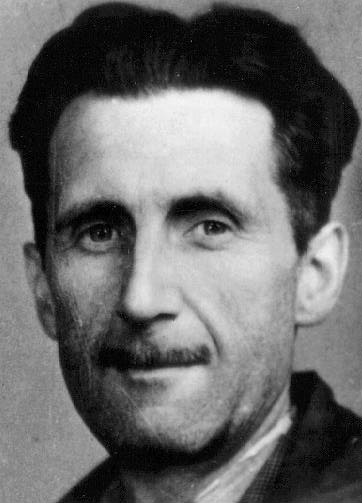
Eric (“George Orwell”) Blair’s press card portrait, 1943
Eric Blair, the useful one, once pointed out that:
In a world in which everyone worked short hours, had enough to eat, lived in a house with a bathroom and a refrigerator, and possessed a motor-car or even an aeroplane, the most obvious and perhaps the most important form of inequality would already have disappeared. If it once became general, wealth would confer no distinction.
That’s from Chris Snowdon’s new intro to 1984 – you should buy a copy.
Not that Eric knew enough economics to know this but what he’s talking about is consumption inequality.
Sure, we’ve Oxfam squealing that wealth inequality is rising summat fearsome. It ain’t — they fail to account for what we already do to reduce wealth inequality. Many tell us that income inequality is rising summat fearsome. It ain’t. Global income inequality has been falling this past 40 years and as all men are indeed brothers it’s the global number that matters.
But the one that’s really fallen like a stone is that consumption inequality. Consumption is also really the only one of the three that matters. Sure, a world in which there are those without three squares and a crib is not a good one. But once all do have three squares etc. then whatever other inequality there is is, well, it’s not actually all that important is it?
[…]
We really have got to what Orwell thought would be equality. In 1930s England (which was his mental reference point) all of these things – all – were signifiers of significant wealth or income:
As a poorer country the UK was a little behind on these things but my best guess would be that we’re ahead of the US on washing machines today (the US still has a habit of communal machines in apartment blocks). And it amuses that central heating isn’t even on the list. This was something very middle class indeed in the 1960s, really only became “normal” in the UK in the late 70s into the 80s. As with double glazing. These days you’re defined as being in fuel poverty if you cannot heat your house, always and all of it, to a level that no one at all could before that central heating. No, really, coal fire heated houses might average 10oC in winter and that would only be in rooms with an actual fire — others would be at 0oC.
This is not to get into a Four Yorkshiremen but people would be astonished at how cold houses were 1970s and earlier. My own arrival in the US in 1981 had me wondering how they had heating systems that heated all the house, properly, all winter. How could anyone afford that?

England “is a parochial country doomed to nostalgia and irrelevance by its unwavering belief in a series of grandiose historical myths”
In The Critic, Fred Skulthorp reviews England: Seven Myths That Changed a Country and How to Set Them Straight by Tom Baldwin and Marc Stears:

Should Keir Starmer find himself in Downing Street after the next election, he will have little to play with in terms of zeitgeist. Unlike Blair, there is no Cool Britannia to tap into. There are few unifying cultural figures and despair seems the only discernible national mood. Starmer has only the recent success of the Lionesses and an oft-quoted anecdote about his dad being a toolmaker to inspire the nation.
But there is one nation-renewing narrative on the centre-left that has emerged since 2016. England, unlike the rest of Europe, is a parochial country doomed to nostalgia and irrelevance by its unwavering belief in a series of grandiose historical myths. The real 21st century England is being held back by people singing “Rule Britannia” at the Last Night of the Proms and the fantasies of Daniel Hannan.
In England: Seven Myths That Changed a Country, Starmer’s biographer Tom Baldwin and former Labour Party speechwriter Mike Stears embark on a journey to set us free from such falsehoods. In Hull we find that William Wilberforce has given the nation an unqualified moral superiority. In Plymouth we discover that Sir Francis Drake is the inspiration for “the aggressively macho nationalist idea” that Brexit can “restore the country’s global reach”. In Runnymede we find that Magna Carta has given rise to the idea of an “Anglo-Saxon birthright sealed with the blood of dead kings”.
Whether anyone actually believes these things is beside the point. These national myths, the authors insist, can account for everything from the popularity of Michael Portillo’s railway documentaries to the 2016 vote to leave the European Union.
Journeys in search of England tend to lend themselves more to projection than discovery. This book presents the worst of that sin. Reading Seven Myths is a bit like being stuck on a very long car journey and regretting having asked the driver: “Whatever happened to the legacy of the London 2012 Olympics?”
Unsurprisingly, much of what follows spouts repackaged Blairite clichés about football, curry and the NHS. Lingering behind their polemic is the tedious psychodrama of the Corbyn years and Labour infighting about how the party should allow itself to feel patriotic. This book is as much about two middle-aged Starmerites trying to work out what it is acceptable to like between their party, the electorate and the limited scope of their inquiry into the England of the 2020s.
And the scope is indeed limited. Reportage and interview, where the book is allowed to breathe away from the grating polemic, is cramped, incomplete and tokenistic. The most memorable soundbite is from Nigel Farage, who tells them — perhaps half-mockingly — that his favourite place in England is London: “It gets faster and more trendy every year that comes”.
Interactions with the public are even more painful. “What do you think of Enoch Powell?” one “brown-skinned man” is asked in Wolverhampton. A refugee from Hong Kong is asked “Does Magna Carta mean anything to you?” Unsurprisingly these conversations don’t return much, but they pave the way for the eye-rollingly mundane conclusion that when it comes to English identity there is “complexity everywhere” (as if anyone’s sense of national identity were ever simple).
Still from the 1964 movie Zulu with Michael Caine as Lieutenant Gonville Bromhead, 24th Regiment of Foot.
For a book that spends nearly 400 pages debunking myths and trying to correct the course of English history, its sources require a lot of reading between the lines. Many can be narrowed down to soundbites from a few politicians and forgotten op-eds in the Telegraph (one quoted is dated as far back as 2004).
All this generates endless false dichotomies, strawmen and reductive statements to account for a grander myth loosely referred to as “English exceptionalism”. At times, attempts to source these myths in the body politic come across as comically desperate. Zulu (1964) becomes a film which kept alive the “British Empire myth” and which “the current generation of politicians would have watched growing up”.
Ironically, the writing itself is laced with the sins of myth-making: boring, trite, incoherent, lazy and unfunny. At times it veers into self-parody. In Runnymede, the “high iron gates” of a housing development near the Magna Carta memorial serve to remind us that national identity myths can “make others feel excluded”. In Plymouth, Greta Thunberg is placed in a pantheon alongside Darwin and Drake who both set sail from the Devon port: “None of these dead Englishmen have as much relevance right now as [the voyage] undertaken from the same city by a Swedish Girl”.

Is this crazy Swiss handplane the future of woodworking?
Rex Krueger
Published Mar 6, 2024The answer is surprisingly complicated.
(more…)
QotD: Wall Street
Fred Schwed Jr., Where Are the Customers’ Yachts?, 1940.


