
World War Two
Published 26 Apr 2022Serving on board a merchant ship during the Second World War was a hazardous endeavor. Stalked by submarines, attacked by surface raiders, and hunted by bombers, the convoys and individual cargo ships faced constant danger on their routes across the seas. And that is in addition to the job’s typical hazards. But what was life like for a regular sailor on board these ships? And what motivates a man to sign up for such a dangerous job?
(more…)
April 27, 2022
Why It Sucked To Be on a Merchant Ship in World War Two – WW2 Special
Comments Off on Why It Sucked To Be on a Merchant Ship in World War Two – WW2 Special
April 25, 2022
The Jews Fight Back – WAH 057 – April 24, 1943
World War Two
Published 24 Apr 2022The war against Naziism is escalating on all fronts — in the War Against Humanity the main battleground is now the Warsaw Ghetto.
(more…)
Comments Off on The Jews Fight Back – WAH 057 – April 24, 1943
April 24, 2022
Ladies and Gentlemen, We Got Him – Yamamoto – WW2 – 191 – April 23, 1943
World War Two
Published 23 Apr 2022The mastermind of Pearl Harbor meets his fate this week in the Solomons, as do a great many Italian airmen and sailors in the Mediterranean in the Palm Sunday Massacre trying to supply the desperate Axis forces in Tunisia.
(more…)
Comments Off on Ladies and Gentlemen, We Got Him – Yamamoto – WW2 – 191 – April 23, 1943
April 23, 2022
Tank Chats #144 | Staghound | The Tank Museum
The Tank Museum
398K subscribers
Dissent This
Our Patreons have already enjoyed Early Access and AD free viewing of our weekly YouTube video! Consider becoming a Patreon Supporter today: https://www.patreon.com/tankmuseumHistorian David Fletcher is kicking off 2022 with the Staghound! It is an American armoured car that was designed and produced during the Second World War. Watch the video to find out more!
0:00 – Intro
0:30 – What is the Staghound
5:17 – Other variants
(more…)
Comments Off on Tank Chats #144 | Staghound | The Tank Museum
April 20, 2022
Khrushchev – Stalin’s Loyal Enforcer?
World War Two
Published 19 Apr 2022Nikita Khrushchev has served Joseph Stalin faithfully for the past decade. He’s a career commissar and party man. So, when war breaks out, are commissars like Khrushchev little more than Stalinist enforcers? Or is there more to the institution than that?
(more…)
Comments Off on Khrushchev – Stalin’s Loyal Enforcer?
The Unbreakable ROCKEX: Canada’s answer to the Enigma machine
Polyus Studios
Published 30 Dec 2021Well before digital encryption and VPNs there was Rockex, Canada’s unbreakable cipher machine that rivaled the German Enigma in its day. Although completely hidden from the public, Canada has played a noticeable role in the history of espionage. During the Cold War Canadian cipher machines worked alongside those of her allies to keep communications secure and helped to preserve the peace.
Check out cryptomuseum.com for more information about Rockex and to find the source of most of the pictures of the device I used.

Comments Off on The Unbreakable ROCKEX: Canada’s answer to the Enigma machine
April 19, 2022
When the Germans had to surrender twice
The end of the war in Europe is usually noted as being the 8th of May, 1945, when General Eisenhower received the surrender of German forces, but the Soviets (and now the Russians) mark the anniversary on the 9th:
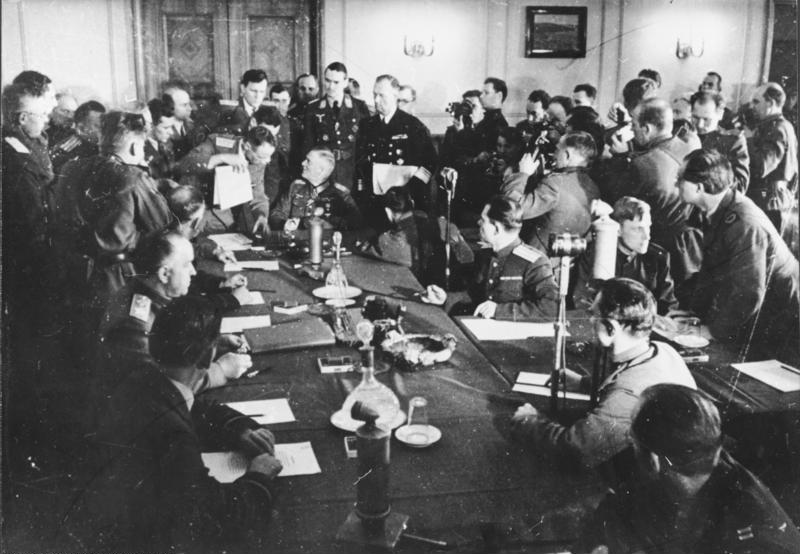
ADN-ZB/Archiv
II.Weltkrieg 1939-1945
Die bedingungslose Kapitulation der faschistischen deutschen Wehrmacht wird am 8. Mai 1945 in Berlin-Karlhorst unterzeichnet.
Links: Der Vertreter des Oberkommandos der Roten Armee, Marschall der Sowjetunion G. K. Shukow, am Tischende Generalfeldmarschall Wilhelm Keitel.
J 0422/600/2 N
It was at three in the morning on Tuesday, 8 May 1945, that Generaloberst Alfred Jodl of the German High Command, signed a surrender document at General Dwight Eisenhower’s headquarters in Rheims, France. The European war was over. It was VE-Day. Stalin’s representative, General Ivan Susloparov, cabled his chief the great news.
However, the Russian leader flew into a rage. He wanted his own observance and insisted on a further ceremony at the Soviet military HQ in Karlshorst, a former Wehrmacht officers’ mess, six miles south-east of central Berlin. Chosen simply because it was one of the few buildings in the capital left with windows and a roof, the formalities were presided over by the captor of the city, Marshal Georgy Zhukov.
This time, it was Generalfeldmarschall Wilhelm Keitel, Jodl’s superior, who read over a near-identical document. Susloparov was again present, along with Carl Spaatz for the Americans and Jean de Lattre de Tassigny, representing France. Newsmen were unaware of the diplomatic spat that delayed proceedings.
De Lattre refused to sign unless the French tricolore was in evidence among the standards and pennants decorating the surrender room. The first Soviet solution hilariously produced a Dutch flag. To pacify an even-more outraged de Lattre, a Red Army seamstress was summoned to run up the appropriate banner. More delays ensued while the Allies bickered over the order of signatures and witnesses, only agreed after the mollifying effects of vodka and some food.
This is why the final ceremony began shortly after midnight. Cameras captured Keitel in full dress uniform, arriving in pompous mood. Flashlights caught the glint of his many medals, and the arrogant flourish of his marshal’s baton, held with gloved hands. He gazed around the room, haughty contempt written across his face. The field marshal removed only his right glove, screwed his monocle into his left eye and applied a fountain pen to the two-page, typewritten document. It was 00:16 local time on Wednesday, 9 May, which became Soviet Victory Day and remains so in Eastern Europe.
Each subsequent year on Victory Day, Red Square has echoed to the “Hurrahs” of vast numbers of Russian soldiers, sailors, marines and paratroopers, national guardsmen and airmen. They are drawn up to listen to their commander-in-chief and inspected by generals. Banners are saluted; swords flash through the air. Serenaded by massed bands playing stirring tunes, they march past the top brass, assembled on the roof of Lenin’s Mausoleum.
Comments Off on When the Germans had to surrender twice
April 17, 2022
Operation Mincemeat, 1943
Once an obscure bit of espionage and military disinformation, the events of Operation Mincemeat are being brought to the big screen (boy, does that term seem dated) in a feature film starring Colin Firth. Michael Curtis provides a look at the actual deception mission that inspired the film:
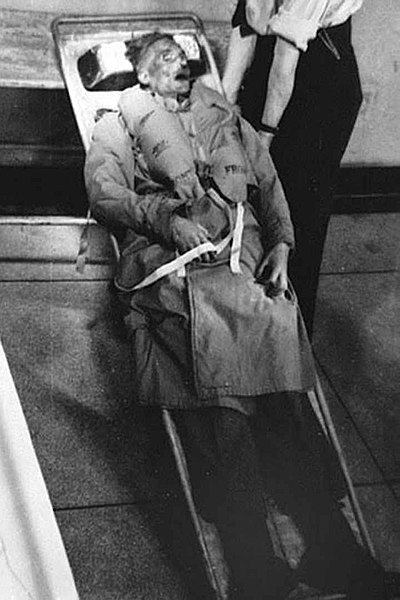
The corpse of Glyndwr Michael, dressed in a Royal Marine uniform with false documents and a fake ID, used in Operation Mincemeat, 1943.
Public domain image from The National Archives.
The story of the British deception, a fascinating story of Allied subterfuge, is now told in the film Operation Mincemeat. It is a remarkable and seemingly highly improbable story of a plan of Allied intelligence to deceive Hitler and misdirect German intelligence. Indeed, it is one of the best examples in history of military deception.
The concept of a plan starts with the Trout Memo, officially written in 1939 by Admiral John Godfrey, director of Naval Intelligence, but almost certainly written by his subordinate Lieutenant Commander Ian Fleming, not yet dreaming of 007, about the deception of an army in war time by fly fishing. Many ideas were suggested, including sending out tins of explosives disguised as food so that hungry sailors would pick them up. One idea, number 28 on the list, almost certainly the thought of Fleming who thought of elaborate deception options, was to use a dead body dressed as an airman dropped from a parachute that had failed and carrying false papers, and drop it where the Germans would find it and be deceived by it.
The deception was planned by a group, the Twenty Committee, XX, headed by Lieutenant Commander RNVR, Ewen Montagu, Cambridge, Harvard, a naval intelligence officer and prominent Jewish lawyer, who later became a judge, together with an RAF officer Squadron Leader Charles Cholmondeley. Montagu later wrote an account of the affair in a book, The Man who Never Was, 1953. The memory of the event is also simply commemorated in a mortuary in Hackney in East London where the body that was used in the plot is buried. In a rather unkind but truthful remark Montagu said of the man who was used, “The only worthwhile thing he ever did, he did after his death.”
The main deception in the plot was a personal letter purported to be from General Sir Archibald Nye to General Sir Harold Alexander, starting, “My dear Alex.” Nye’s letter contained details of sensitive topics, and of a new commander of the Guards brigade, and U.S. service medal awards. He also referred to Operation Husky, an imminent Allied invasion of Greece, that the Germans had been reinforcing and strengthening their defenses in Greece and Crete, and therefore the chief of the Imperial General Staff felt that the Allied troops planned for the assault were insufficient. Thus, it was agreed by the chiefs of staff that the 5th division should be reinforced by one brigade group for the assault on the beach south of Cape Araxos and that similar reinforcement should be made for the 56th division at Kalamata. The letter was a clever double bluff. Nye wrote that “we stand a very good chance of making the Germans think we will go for Sicily, it is an obvious objective and one about which they must be nervous.” To confuse Hitler, he therefore suggested the Allies would invade Sicily.
It is interesting but not surprising that a key figure in the deception appears to have been Ian Fleming, Mr. James Bond, who had written of methods to confuse the enemy, and was crucial to the Trout Memo.
The plot developed. After some difficulty a suitable body was found by a London coroner and kept on ice for few months. It was Glyndwr Michael, 34, homeless Welsh laborer, penniless, with mental health problems, who had died after ingesting rat poison in a London warehouse. He was transformed into Major William Martin, of the Royal Marines whose body contained love letters from a non-existent fiancé named Pam, a jewelry bill for an engagement ring, ticket stubs, religious medal, a copy of a letter marked “personal and most secret”, and above all the false Nye letter. The body had to look as if it had died in an air crash, but floated ashore and he had died at sea. Major Martin, his body wrapped in a life jacket, and with a black attaché case chained to his wrist, was found on April 30, 1943, by a Spanish fisherman off the coast of Huelva.
Even more unlikely than the plan itself was the impact the “secret” document had on Axis planning, summarized in the Wikipedia article:
On 14 May 1943 Grand Admiral Karl Dönitz met Hitler to discuss Dönitz’s recent visit to Italy, his meeting with the Italian leader Benito Mussolini and the progress of the war. The Admiral, referring to the Mincemeat documents as the “Anglo-Saxon order”, recorded
The Führer does not agree with … [Mussolini] that the most likely invasion point is Sicily. Furthermore, he believes that the discovered Anglo-Saxon order confirms the assumption that the planned attacks will be directed mainly against Sardinia and the Peloponnesus.
Hitler informed Mussolini that Greece, Sardinia and Corsica must be defended “at all costs”, and that German troops would be best placed to do the job. He ordered that the experienced 1st Panzer Division be transferred from France to Salonika, Greece. The order was intercepted by GC&CS on 21 May. By the end of June, German troop strength on Sardinia had been doubled to 10,000, with fighter aircraft also based there as support. German torpedo boats were moved from Sicily to the Greek islands in preparation. Seven German divisions transferred to Greece, raising the number present to eight, and ten were posted to the Balkans, raising the number present to 18.
On 9 July the Allies invaded Sicily in Operation Husky. German signals intercepted by GC&CS showed that even four hours after the invasion of Sicily began, twenty-one aircraft left Sicily to reinforce Sardinia. For a considerable time after the initial invasion, Hitler was still convinced that an attack on the Balkans was imminent, and in late July he sent General Erwin Rommel to Salonika to prepare the defence of the region. By the time the German high command realised the mistake, it was too late to make a difference.
Kursk – The Next Great Battle? – WW2 – 190 – April 16, 1943
World War Two
Published 16 Apr 2022The Allies have one chance left to catch the Axis forces in Tunisia before they can reach the Tunis defences; in the USSR both the Axis and Soviets are making plans for a fight near Kursk; and in the skies, in the South Pacific a Japanese aerial offensive ends and Yamamoto himself flies off to congratulate his pilots.
(more…)
Comments Off on Kursk – The Next Great Battle? – WW2 – 190 – April 16, 1943
April 16, 2022
Tank Chats #143 | Hetzer | The Tank Museum
The Tank Museum
Published 31 Dec 2021Our Patreons have already enjoyed Early Access and AD free viewing of our weekly YouTube video! Consider becoming a Patreon Supporter today: https://www.patreon.com/tankmuseum
The Munich Agreement averted the outbreak of war but for Czechoslovakia, it meant giving way to German occupation. Join David Willey to discover how Germany was able to use the country’s existing military outputs to build the tank destroyer, Hetzer.
00:00 – Intro
00:28 – The history of the tank destroyers name
14:55 – Wartime production
(more…)
Comments Off on Tank Chats #143 | Hetzer | The Tank Museum
April 15, 2022
The West Sacrifices Poland to the Soviets – WAH 056 – April 1943, Pt.1
World War Two
Published 14 Apr 2022There are cracks in the alliances on both sides. Hitler’s allies are refusing to do his every bidding, and the revelations about the Soviet massacre of Poles in Katyn has set a wedge between Poland and the USSR.
(more…)
Comments Off on The West Sacrifices Poland to the Soviets – WAH 056 – April 1943, Pt.1
April 13, 2022
Life in a German U-Boat – WW2 Special
World War Two
Published 12 Apr 2022The German U-Boats were one of the most dangerous armed forces of World War II. From the North Sea to the Mexican coast to the Cape of Good Hope, everywhere they put fear into the Allied merchant marine. But what was life like on a German submarine? What dangers did the crew face? How did they endure the long voyages far away from home?
(more…)
Comments Off on Life in a German U-Boat – WW2 Special
April 12, 2022
Last War Patrol of HMS Terrapin
The History Guy: History Deserves to be Remembered
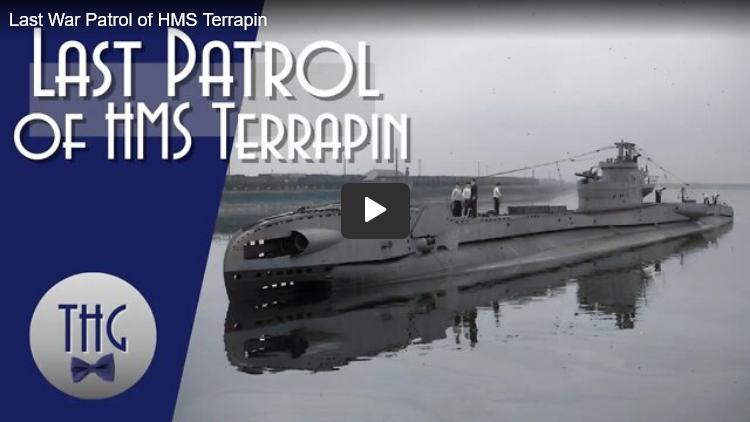
Published April 11, 2022On her seventh war patrol, in the south Java Sea, the T class British submarine HMS Terrapin and her crew had faced the terror of battle and barely survived. Badly damaged and far from home, sometimes the drama of war is not just in the battle, but in the voyage home.
Check out our new community for fans and supporters! https://thehistoryguyguild.locals.com/
This is original content based on research by The History Guy. Images in the Public Domain are carefully selected and provide illustration. As very few images of the actual event are available in the Public Domain, images of similar objects and events are used for illustration.
You can purchase the bow tie worn in this episode at The Tie Bar:
https://www.thetiebar.com/?utm_campaign=BowtieLove&utm_medium=YouTube&utm_source=LanceGeigerAll events are portrayed in historical context and for educational purposes. No images or content are primarily intended to shock and disgust. Those who do not learn from history are doomed to repeat it. Non censuram.
Find The History Guy at:
New community!: https://thehistoryguyguild.locals.com/
Please send suggestions for future episodes: Suggestions@TheHistoryGuy.netThe History Guy: History Deserves to Be Remembered is the place to find short snippets of forgotten history from five to fifteen minutes long. If you like history too, this is the channel for you.
Awesome The History Guy merchandise is available at:
https://teespring.com/stores/the-history-guyScript by THG
#history #thehistoryguy #WWII
Experimental video embed from Rumble.com. Please let me know if you have problems viewing this video.
Comments Off on Last War Patrol of HMS Terrapin
April 11, 2022
Book Review: Sturmgewehr! From Firepower to Striking Power (New Expanded Edition)
Forgotten Weapons
Published 17 Sep 2017Get your copy from Collector Grade Publications: http://www.collectorgrade.com/bookshe…
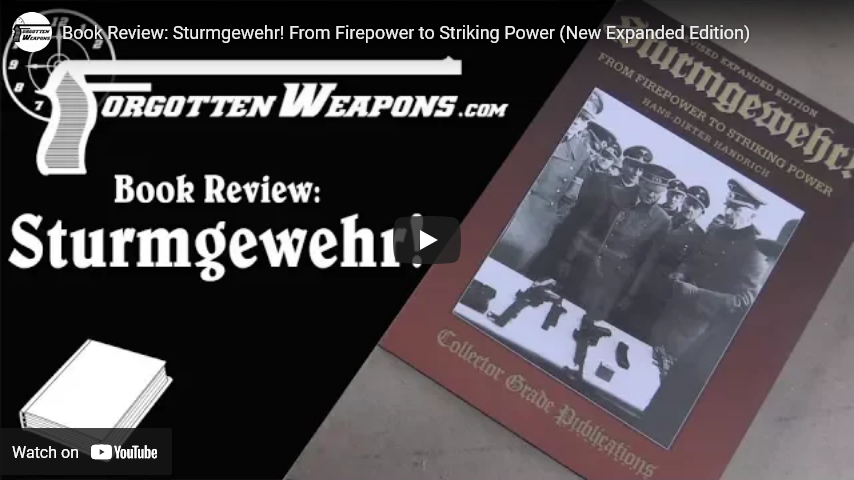
Collector Grade is known for being a premiere publisher of technical firearms reference books, and I would be willing to argue that Sturmgewehr! by Hans-Dieter Handrich is the best book they have yet printed. The book was originally printed in 2004, and by the time I started looking for a copy myself, it was out of print and the price had jumped to at least $250, when I could even find a copy. I could never quite bring myself to pay that much, and so I was very excited when I learned that an expanded second edition was in the works. Well, that second edition is available now, and it’s even better than I had anticipated.
What makes Sturmgewehr! such an excellent book in my opinion is how it tackles the story of the MP43/MP44/StG44 from several different angles in depth. It has the mechanical development of the gun from prewar experiments to the open-bolt MKb-42 trials guns to the production versions. But it also puts those guns in historical context, how they related to the other weapons being used by both Germany and other nations. It discusses how the design criteria of the Sturmgewehr were arrived at, in terms of logistics and manufacturing methodologies. It explains in detail the political disagreements and convoluted process of weapon design and adoption in Germany, including the three direct rejections of the concept by Hitler.
In short, it gives you the fully-rounded story of how the German military conceived and implemented a whole new class of small arms. In this way, it is really much more than just a book about a single gun’s history — what you learn reading Handrich’s work will give you insight into virtually all arms design programs of the 20th century, from the Chauchat to the 7.62mm NATO rifle trials to the SA80.
If you already have a copy of the original work, you will probably want this one as well, to get the additional 120 pages of information that have been added. And it should go without saying that if you don’t have the original, you should absolutely get a copy of this new edition before it also falls out of print!
http://www.patreon.com/ForgottenWeapons
Cool Forgotten Weapons merchandise! http://shop.bbtv.com/collections/forg…
If you enjoy Forgotten Weapons, check out its sister channel, InRangeTV! http://www.youtube.com/InRangeTVShow
Comments Off on Book Review: Sturmgewehr! From Firepower to Striking Power (New Expanded Edition)
April 10, 2022
Mussolini is Tired of War – WW2 – 189 – April 9th , 1943
World War Two
Published 9 Apr 2022Adolf Hitler meets with Benito Mussolini to hopefully restore his flagging morale and convince him that the Axis can hold out in North Africa, but the situation there grows more precarious and this week there the Allies advancing from the west and the east link up for the first time. The Axis are also holding out in the Caucasus, as new Soviet attacks to take Krymskaya begin.
(more…)
Comments Off on Mussolini is Tired of War – WW2 – 189 – April 9th , 1943


