Quotulatiousness

March 20, 2015

A new 12-step program … to turn yourself into a wine snob

Filed under: Humour, Wine — Tags: — Nicholas @ 02:00

Carolyn Evans-Hammond on the fastest way to become the person everyone else in the restaurant (or at the party) just despises:

  1. When tasting a wine over $50, always use the phrase, “excellent value.”
  2. Make sexual allusions to describe wine, especially when talking to a member of the opposite gender. Tight, muscular, voluptuous, hard, long. You get the idea. Best done while making soft moans before and after the sentiment.
  3. When at a restaurant, grill the wine waiter about the wines. Ask how a certain bottle is “showing”, whether it’s fruit forward or restrained, and whether the Champagne on the list has undergone malolactic fermentation.
  4. Bring a bottle of wine to a party already decanted, and tell the host you’d like it poured at a precise temperature.

March 19, 2015

Getting to know the “the cocaine of Chardonnay”

Filed under: Europe, France, Wine — Tags: , — Nicholas @ 02:00

At Wine Folly, Morgan Harris talks about the original home of Chardonnay:

For winemakers, white Burgundy may just be the Helen of Troy of Chardonnay because nearly everyone who’s ever made Chardonnay has looked towards white Burgundy as the golden standard. All in all, white Burgundy is just Chardonnay, but the region is also the origin place of the variety, which is by the way, the world’s most planted white grape. In Burgundy, the combination of climate, land and tradition produce a wine that is coveted by many and never precisely replicated anywhere else.

Once you’re hooked on white Burgundy, there’s no going back. White Burgundy is the crack cocaine of Chardonnay. Sommeliers and retailers who sell white Burgundy sound like drug dealers: “Just try some, you’ll love it…”

Now that you’ve had a proper introduction, let’s get started exploring the region and the wine. While people have dedicated their lives to understanding the region, anyone can be learn how buy and appreciate white Burgundy.

Broadly, white Burgundy can be found in four production areas within Burgundy. Each area has a different terroirs and characteristics and thus, different flavor profiles:

  1. Bourgogne Blanc ($$$): unoaked simple wines with mineral and apple notes
  2. Chablis ($$$$): unoaked wines that are zippy and lean with lime-like mineral flavors
  3. Mâconnais ($$$): usually unoaked wines with melon and starfruit notes
  4. Côte de Beaune ($$$$$): typically oak-aged wines with rich fleshy melon and starfruit flavors and undertones of truffle and hazelnut

($) $5–10; ($$) $10–15; ($$$) $15–20; ($$$$) $20–30; ($$$$$) $30+;

NOTE: There are a few wines from outlier regions within Burgundy not included in this guide.

Click to see full-sized map

Click to see full-sized map

I’m a fan of oaked chardonnay … I don’t particularly like unoaked chardonnay, but add that hit of oak and it’s a wonderful experience. The best white Burgundy I’ve ever had was a Chassagne-Montrachet, but I rarely risk buying French wines these days due to the sometimes chancy relationship between the price at the LCBO and the actual quality of the wine.

February 28, 2015

A quick guide to Spanish red wines

Filed under: Europe, Wine — Tags: — Nicholas @ 02:00

I don’t drink a lot of Spanish wine, and part of that is that most of the Spanish wines I see in the LCBO remind me too much of their early 1980s counterparts that seemed to embody so many faults (especially cork taint) that few were worth the money. This was probably not true at the upper end of the price scale, but I never had the kind of wine-buying budget to allow me to try the “good stuff” anyway. A recent post by Madeline Puckette at Wine Folly may tempt me to experiment a bit more with Iberian red wines:

Spanish red wine

Spanish red wines offer offer exceptional value and a bold entry into the red wines of Europe. Here are 7 major Spanish red wines to get a basic understanding of what the country has to offer. You can find great sub-$15 fruity crowd pleasers but there are also bold high tannin red wines that easily match the top collector’s wines of the world.

Wine was introduced to Spain by the Phoenicians in 800 BC. Because of this, the wines of the Iberian peninsula are not the same French varieties we grow in the US. The wines are striking and unique, they also match perfectly with rich foods including thick cut cheddar burgers, empanadas, bbq skewers and pork roast.

February 2, 2015

Your favourite wine might just reveal more about you than you think

Filed under: Humour, Wine — Tags: — Nicholas @ 03:00

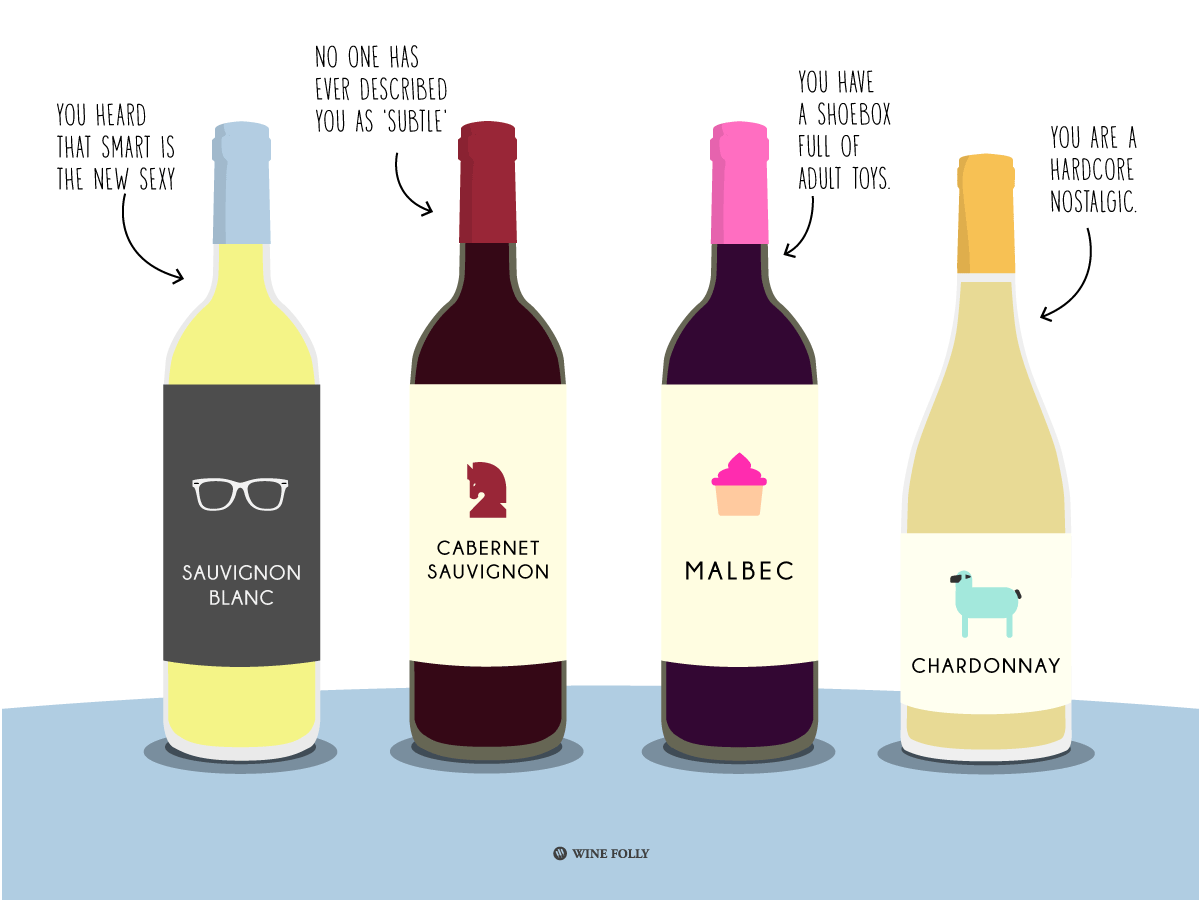
Why pay for therapy sessions, when Wine Folly can tell you all about your inner self just by finding out what kind of wine you prefer:

what-your-wine-says-about-you

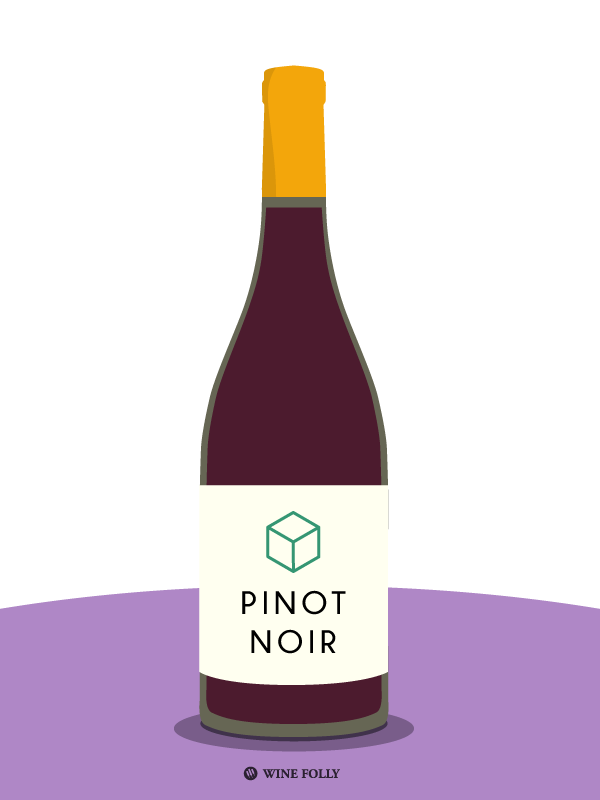
If you love Pinot Noir…
pinot-noir-bottle
You’re the person who loves the idea of the beach but hates sand in between your toes. Pinot Noir is the ideal wine because it’s not too fruity, not too herbaceous, not too tannic and not too bold. Your go-to color to wear is gray. You have a silver car.

January 26, 2015

Balancing the art and the science in winemaking

Filed under: Australia, Science, Wine — Tags: , , — Nicholas @ 03:00

In Cosmos, Andrew Masterson investigates what is still an art and what has been codified as science:

“With commercial yeast you get certainty – you can sleep at night,” says Bicknell. “But how do you make wine more interesting? You exploit the metabolic processes of different yeast species.”

Bicknell’s faith in wild yeasts adds stress at fermentation time, but the pay-off is multi-award-winning wines regularly acknowledged as some of the best in Australia. “The wines do taste different, even if there’s no way you can show that statistically,” Bicknell says. “The only way to really know is to taste.”

Exploiting the diverse and fluctuating populations of wild yeasts found on the plants, fruit and in the air of vineyards is “the new black” (not to mention red and white) in oenology. The practice is becoming more commonplace among artisan winemakers. Even some of the giant commercial wine corporations are investing in the method.

Wild fermentation, says Bicknell, represents the intersection of science, craft and philosophy. But it could also form the basis of a profound shift in the narrative of wine. The more we study winemaking’s microbes, the more it appears they might explain one of the wine industry’s most beloved, but vaguest, terms: terroir.

Terroir is a wonderful marketing term,” says David Mills, a microbiologist at UC Davis, who studies microbes in wine. “But it’s not a science.”

The French word terroir is difficult to translate. The closest translation is “soil”, but that is just one of its components. Terroir connotes the unique sense of place – the soils, the topography and the microclimate. It’s what makes the wines of Bordeaux or Australia’s Coonawarra so distinctive, and so inimitable.

Sommeliers like Ren Lim, former captain of the Oxford University Blind Tasting Society (and a PhD biophysics student) will tell you merely from swirling a mouthful of Cabernet Sauvignon which Australian winery produced it.

“The ones from Margaret River often give off a more pronounced green pepper note, a note found commonly in Cabernets grown in regions which experience pronounced maritime influences. Coonawarra Cabernets are somewhat different and unique in their own way. They are often minty and have a eucalyptus or menthol note in addition to the usual ripe blackcurrant notes. The green pepper note is often suppressed under the menthol notes. Nonetheless, the Cabernet structure remains in both these wines.”

It’s a feat that Mills does not question. “I don’t doubt regionality exists, but what causes it is a whole other set of issues.”

January 24, 2015

Pairing appropriate cheeses with wines

Filed under: Food, Wine — Nicholas @ 11:24

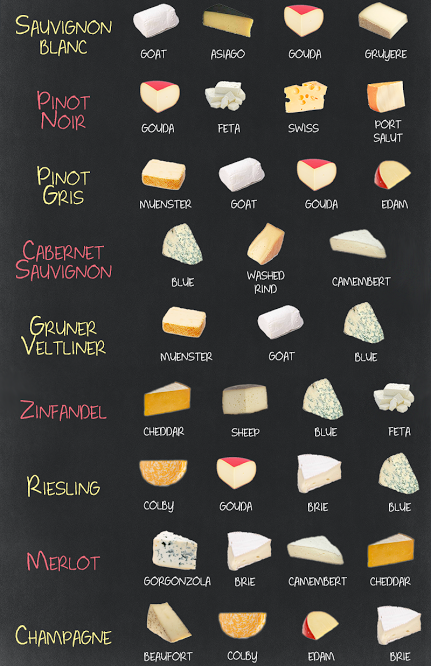
Wine and cheese are a natural pairing, but finding the right match to optimize the experience may not be as obvious. On Google+, B-Winegrower offers some recommendations:

CheeseWinePairing1Image from B-Winegrower on Google+

January 23, 2015

Gifts for the wine fan in your life

Filed under: Wine — Nicholas @ 02:00

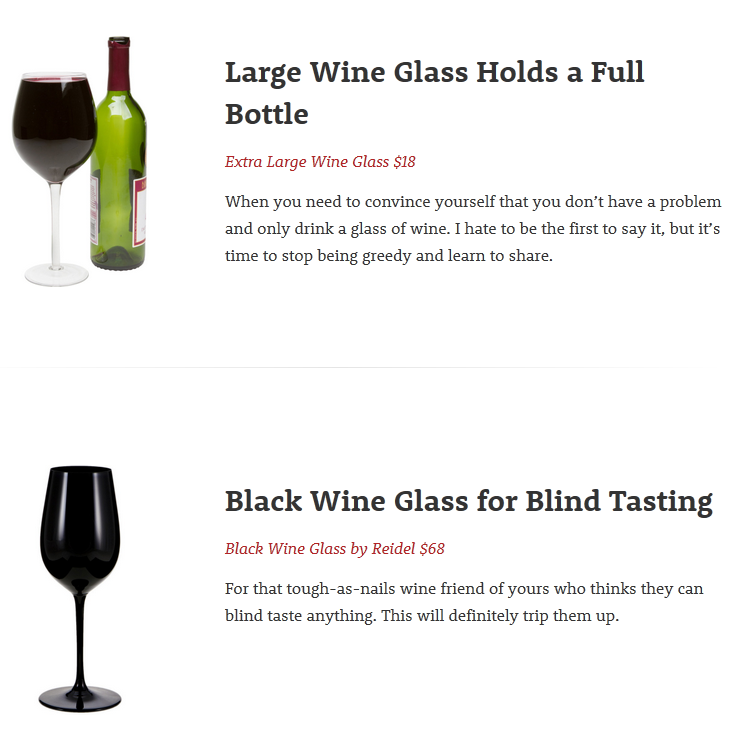
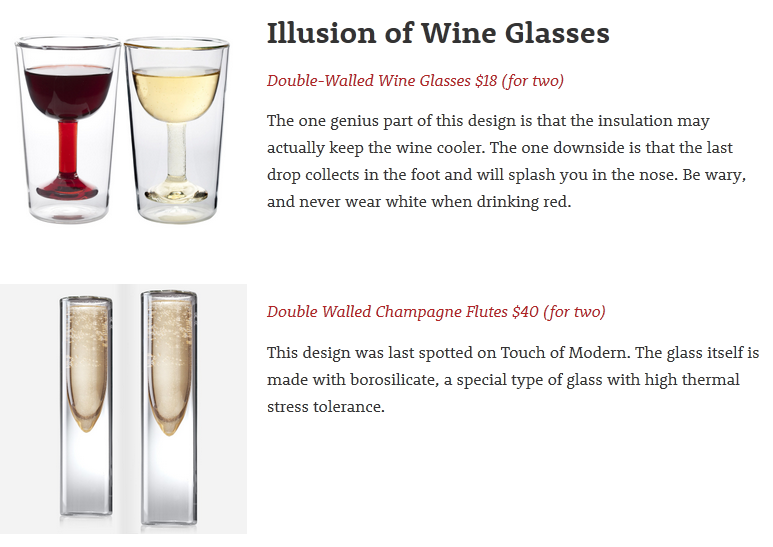
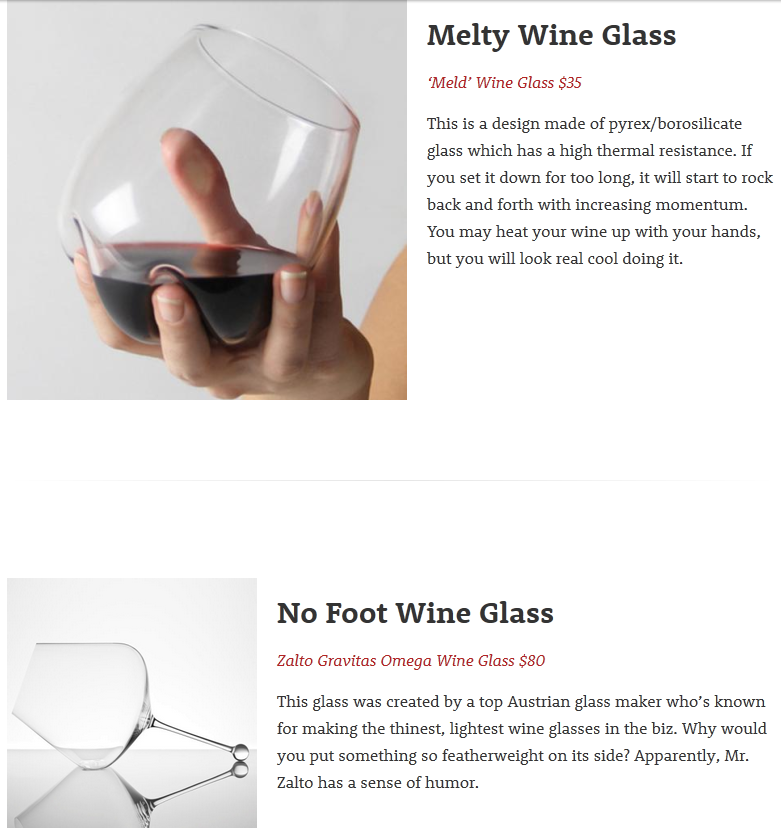
I have a variety of wine glasses for various kinds of wine, but most of these are esoteric, even by my standards:

Wine glasses

Pretty mundane? How about these:

Wine glasses 2

And then, off to crazy town:

Wine glasses 3

January 22, 2015

Rumours of privatization in Ontario’s liquor control monopoly?

Filed under: Bureaucracy, Cancon, Government, Law, Wine — Tags: , , , — Nicholas @ 09:57

In the latest issue of Michael Pinkus Wine Review, Michael talks about the hints and portents (dealing with the Ontario government requires a certain amount of Kremlinological observation skills) that a tiny measure of privatization may be coming:

There’s a rumour in the wind that a certain amount of privatization is coming to Ontario (wouldn’t that be nice), but I wouldn’t get my hopes up about it just yet – no time line has been given and I am sure that ‘more study’ is necessary … and of course, if track record is any indication, this government will find some way to either screw it up or make it such a complicated piece of legislation that it’ll take years to get through all the red tape behind it. I once heard Jerry Agar, of NewsTalk 1010 fame, say (and I’m paraphrasing here) ‘if you want something screwed up get government involved’; he’s a proponent of the private sector because they can do it more efficiently than government if only ‘the man’ would just get outta the way … I would have to agree with him here. So far the government has made a mess of our liquor system that even repressed, despotic and 3rd world countries have better access to alcohol then we do.

Sadly, I believe it might be too little too late for some of Ontario wineries who have suffered this long, but might not be around to see the light at the end of the tunnel (if and/or when it comes). Yes, this might be the end of the line for a number of our precious wineries and we only have ourselves to blame for their demise. They have been as vocal as any sector, crying for help, not necessarily a hand out (which the grape growers seem to get) as much as a hand up – basically they’ve been pleading with each government: “please give us access to (our own) market (at the very least) and we’ll show you what we can do”, all to no avail.

Why the pessimistic attitude? Let’s look at the facts. It takes some rather deep pockets to own a winery in Ontario, that or a good credit rating, because money is the number one thing required to open the doors. But making it is more of an uphill battles then in any other business I this province. Post-1993, when the majority of the wineries around today opened their doors, your cellar door is the only place you can sell your wine – sure you could tap into the LCBO and the restaurant market, but that’s it. And although recent federal regulations have been lifted regarding the selling and especially shipping of wine across the country, many provinces have yet to enact their own legislation governing the practice, hence leaving the entire topic, not to mention hundreds of wineries, in limbo, unable to tap the rest of the country as a market for fear of breaking the law. With so few avenues to sell home-grown wine the government has basically handcuffed the industry – let alone the number of asinine rules that govern the industry from within (more on that next time) – it has all been put in place it would seem, so that wineries are destined to fail; that they remain open is a testament to their resolve and passion.

November 28, 2014

Niagara’s wineries … too many too soon?

Filed under: Cancon, Wine — Tags: , — Nicholas @ 00:03

Michael Pinkus shares a cringeworthy report from a foreign wine writer on a recent winery tour in the Niagara region:

After giving it some thought it came to me as a sports reference: have we hit that expansion team overload amongst the wineries of Niagara? What I mean by that is a watering down of the talent available. For example: when a league (NHL, NFL, CFL, etc.) expands to include more franchises the biggest worry is that there will not be enough high-caliber talent in the pool to feed that new franchise and keep it competitive. Now apply the same theory to the wineries: with more and more wineries opening every year is the talent pool of engaged and conscientious prospective “manpower” really there to staff them? Is that the problem? Or should we just blame training and be done with it?

A wine writer from another country (who will remain nameless) wrote to me about a visit he recently made to a winery in Niagara (which will also remain nameless). Here were some of his comments about the tour he took:

“Worst tour: Inexperienced tour guide who didn’t understand what she’d been taught and gave a series of garbled ideas … e.g. windmill in vineyard uses propane to heat the vines, grafting is done because it’s too cold here to grow on own roots, [also] told us we wouldn’t enjoy the wines in the tasting and that their barrel fermented and aged Chardonnay was best in a spritzer.”

I’m not saying all wineries are bad, but there are some that leave, for lack of a better expression, a bad taste in the mouth — even when their food (or, for that matter, wine) is delicious. One of the wineries we visited in Niagara-on-the-Lake provided us such a lousy experience that they almost did not make our top five … but their food was just so memorably delicious, it was the thing that saved them — now imagine if they did not have that food, it would have been memorable for all the wrong reasons.

Whether it’s the lollygagging behind the counter, chatting with co-workers to the point where you indicate where to go with your chin (“it’s over there”), ignoring a guest until they approach you, or just being grumpy and surly, it all takes its toll on the winery’s reputation. A bad experience sticks in your mind more and longer than a good one. I especially remember a tasting at a famous Niagara-on-the-Lake winery about 10 years ago where, after buying two cases of wine between the three people I was with, the staff member who served us chased us out into the parking lot for the $5.50 tasting fee … I have never, ever forgotten that one.

I wonder if that last winery was the same one I’ve been avoiding for the last ten years … the experience wasn’t exactly the same, but it soured me on ever having anything to do with them again. Bad customer service in the wine trade has a much greater long-term than it does in, say, the fast food business.

September 10, 2014

QotD: Smoking and drinking

Filed under: Health, Quotations, Wine — Tags: , — Nicholas @ 00:01

Apart from all the other arguments, you’re a fool to smoke if you like the taste of drink. It isn’t the cigarette you smoke with your glass of wine or whisky that damages the taste of it it’s all the ones you smoked yesterday and the day before and last week. Your senses are chronically anaesthetized. Really, smokers could afford to consider what they’re certainly missing as well as what they’re in danger of getting.

After much pondering I think I understand a basic reason why a glass of something reviving is so welcome in the early evening. Partly, of course, it’s just that, to revive, to relax, but its also a convenient way of becoming a slightly different person from your daytime self, less methodical, less calculating — however you put it, somebody different, and the prospect of that has helped to make the day tolerable. And, conversely, it’s not having that prospect that makes the day look grim to the poor old ex-boozer, more than missing the alcohol as such.

Changing for dinner used to be another way of switching roles. Coming home from work has a touch of the same effect. Writers haven’t got that advantage — when they finish work they’re at home already. So perhaps they need that glass of gin extra badly. Any excuse is better than none.

Kingsley Amis, Everyday Drinking: The Distilled Kingsley Amis, 2008.

August 30, 2014

That’s not vintage wine. This is vintage wine.

Filed under: History, Wine — Tags: , , , — Nicholas @ 10:31

Storing a few old bottles in your cellar? Not as old as these bottles:

Israel isn’t particularly famous for its wine today, but four thousand years ago, during the Bronze Age, vineyards in the region produced vintages that were prized throughout the Mediterranean and imported by the Egyptian elite.

Last summer, archaeologists discovered a rare time capsule of this ancient drinking culture: the world’s oldest known wine cellar, found in the ruins of a sprawling palatial compound in Upper Galilee.

The mud-brick walls of the room seem to have crumbled suddenly, perhaps during an earthquake. Whatever happened, no one came to salvage the 40 wine jars inside after the collapse; luckily for archaeologists, the cellar was left untouched for centuries. [In Images: An Ancient Palace Wine Cellar]

Excavators at the site took samples of the residue inside the jars. In a new study published today (Aug. 27) in the journal PLOS ONE, the researchers describe what their chemical analysis turned up: biomarkers of wine and herbal additives that were mixed into the drink, including mint, cinnamon and juniper.

[…]

The residue from all 32 jars sampled in the study contained tartaric acid, one of the main acids in wine. In all but three jars, the researchers found syringic acid, a marker of red wine. The absence of syringic acid in those three jars may indicate that they contained some of the earliest examples of white wine, which got its start later than red wine, Koh said.

The researchers found signatures of pine resin, which has powerful antibacterial properties and was likely added at the vineyard to help preserve the wine. Scientists also found traces of cedar, which may have come from wooden beams used during the wine-pressing process.

The researchers noticed that the cellar’s simplest wines, those with only resin added, were typically found in the jars lined up in a row against the wall near the outdoor entrance to the room. But the wines with the more complex additives were generally found in jars near a platform in the middle of the cellar and two narrow rooms leading to the banquet hall next door. Koh and colleagues believe the wine would have been brought from the countryside into the cellar, where a wine master would have mixed in honey and herbs like juniper and mint before a meal.

As for the taste, Koh said the ancient booze may have resembled modern retsina, a somewhat divisive Greek wine flavored with pine resin — described by detractors as having a note of turpentine. (Koh said he and his colleagues usually hear two different kinds of remarks about the ancient wine: Some say, “I would love to drink this wine,” while others say, “It must have just tasted like vinegar with twigs in it.”)

August 23, 2014

Pennsylvania police to destroy rare wine collection

Filed under: Law, USA, Wine — Tags: , , , — Nicholas @ 12:14

Michelle Minton tells the sad tale of a rare wine fan who got too greedy (as the state tells it) or a state that got too greedy (as Pennsylvania wine fans tell it):

In the fifth century BCE, famous Greek tragedian Euripides supposedly said, “where this no wine there is no love.” This certainly holds true in present day Pennsylvania, which has one of the nation’s strictest alcohol regulatory regimes. And according to Tom Wark, executive director for the American Wine Consumer Coalition, Pennsylvania is “the worst state to live in if you’re a wine lover.” In Philadelphia, one man surely isn’t feeling the brotherly love after police raided his home and seized 2,426 bottles of rare wine—with an estimated value of more than $125,000—that the police reportedly plan to “destroy.”

Arthur Goldman, a 50-year-old lawyer, alleged ran afoul of Pennsylvania’s archaic wine laws by purchasing and selling through unapproved channels. In Pennsylvania, one of ten states that doesn’t allow direct shipping of wine to consumers, the only place one can purchase wine is through state-owned liquor stores. For wine connoisseurs looking for a bottle unavailable for purchase in state stores, the only other option is to order their wine through one of the sanctioned “direct wine shippers” and have it sent to a state store. Of course, this adds a certain cost to the purchase (shipping charge, plus $4.50 handling, the state’s 18 percent Johnstown Flood tax, 6 percent sales tax, and an addition 2 percent Philadelphia tax). With an average shipping rate of $7 per bottle or $22 per case, this means that a typical $50 bottle of wine would end up costing $74. A case of that wine, which would have cost $600 could cost around $832 after jumping through the Pennsylvania Liquor Control Board’s hoops. Of course, Goldman was likely purchasing much rarer and more expensive wines—the tax and shipping costs, assuming the approved direct shipping companies had the wines he wanted—could have been astronomical.

Cops paint a picture of a sophisticated racket meant to make Goldman a lot of money, but his lawyer asserts it was more like a group of 15-20 wine connoisseurs for whom Goldman would procure bottles unavailable in the state, only charging them for his costs.

August 20, 2014

New report calls for Ontario to break up the LCBO

Filed under: Business, Cancon, Economics, Wine — Tags: , , , , , — Nicholas @ 13:33

In the Toronto Star, Richard Brennan reports on a new study by the C.D. Howe Institute calling for the province to join the modern era:

The “quasi-monopoly” LCBO and The Beer Store have hosed Ontario consumers long enough, a C.D. Howe Institute report says.

The right-wing think tank said the Ontario government should strip them both of their almost exclusive right to sell beer, wine and spirits, suggesting the report proves that opening up to alcohol sales to competition will mean lower prices.

“The lack of competition in Ontario’s system for alcoholic beverage retailing causes higher prices for consumers and foregone government revenue,” states the 30-page report, Uncorking a Strange Brew: The Need for More Competition in Ontario’s Alcoholic Beverage Retailing System, to be released publicly Wednesday.

The report includes tables comparing Ontario beer prices to other provinces with greater private sector involvement, particularly with Quebec, where a case of 24 domestic beers can be as much as $10 cheaper and even more for imported brands.

Since 1927, when the Liquor Control Act was passed, the Liquor Control Board of Ontario and the privately owned Brewers Warehousing Company Limited have had a stranglehold on alcohol sale in the province.

“The Beer Store’s quasi-monopoly of beer retailing is … an anachronism,” the report says, referring to the foreign-owned private retailer that is protected by provincial legislation.

August 11, 2014

The science of “wine fingerprints”

Filed under: Science, Wine — Tags: , , — Nicholas @ 12:27

Okay, the title of this post is a bit ahead of the facts: scientists are still developing ways to detect the differences in wine from various regions, but they think they’re on the right track.

Malbecs from Argentina and California made by the same winemaker and using the same protocol had distinct molecular signatures and flavours.

But the delicate aroma of a rare vintage can quickly be eroded by poor storage after bottling, the team said.

Details were reported at the American Chemical Society meeting.

Despite the cynicism over wine critique — and the rather grandiose adjectives lavished upon certain appellations — it really does matter where your plonk comes from, according to the researchers from the University of California Davis.

They are attempting to fingerprint “terroir” — the unique characteristics that the geography, geology and climate of a certain place bestows upon a wine.

Subjective regional character is based on the appearance, aroma, taste and mouthfeel (texture) of the wine — all of which combine to create its flavour.

But demand is growing for a more objective test — to help consumers bypass woolly terminology, protect artisan producers’ intellectual property, and help auction houses detect fraud — a growing problem.

August 9, 2014

Faking fine old wines for fun and profit

Filed under: Wine — Tags: , — Nicholas @ 00:02

A couple of years ago, I posted an item about a wine collector who got into the business of “creating” expensive old wines. BBC News talks about how this worked and how he was caught:

Rudy Kurniawan was sentenced to 10 years in jail for committing wine fraud. But just how easy is it to fake a fancy bottle of Burgundy?

Wine fraud was a problem in classical Rome and it continues to be one now. Some estimate that over 5% of wine consigned and sold at auction is fake.

But even though it is a very big problem, it is a very difficult thing to do.

“There is a distinctive taste in aged wine,” says wine chemist Andrew Waterhouse, of the University of California, Davis.

That taste?

“Canned asparagus,” he says.

Old wines — mostly those from the Burgundy and Bordeaux regions of France — have lost the majority of their tannins, giving them a softer taste reminiscent of the spring vegetable.

Bu taste is only one part of the equation. “It is the experience of drinking something that’s quite rare that’s appealing,” explains Prof Waterhouse.

A few key ingredients to the fraud: corks, capsules, and soaked-off labels from the authentic wines, plus good but not expensive wine to use either to rejuvenate the older wine or to pass off as the real thing to a less-discriminating buyer.

And that’s exactly what Mr Kurniawan was doing in his kitchen in Arcadia, California — essentially creating a “better” vintage by mixing old, good-but-not-great wines with some newer, vibrant pinot noirs.

Give it a shake, put it in an old bottle, smack on a vintage label — say, one from 1985 instead of 1982 — and voila.

“He could take a $200 bottle and turn it into over a $1,000 bottle,” says Mr Troy.

Unless you are used regularly drinking fine vintages — which at thousands of dollars a bottle, is not that many people — the taste would not raise alarm bells.

“By blending the fruitiness of a new wine with the aged character of the old wine he would approximate in some manner a very, very good aged Burgundy,” explains Prof Waterhouse.

« Newer PostsOlder Posts »

Powered by WordPress