Quotulatiousness

August 7, 2014

Can you really call it a “cork” when it’s made of plastic?

Filed under: Wine — Tags: , , — Nicholas @ 09:16

I have to agree with Michael Pinkus on this issue: wines that are sealed with a synthetic cork really should carry a warning label or at least use a transparent capsule to avoid disappointment for the consumer. Fortunately, most of the wineries I favour have either stuck with traditional cork or have gone to steel closures, but I’ve had some unhappy experiences with Californian wine (and not always the cheap stuff) locked down under a blob of synthetic material.

The question I brought up in my post was why use a plastic cork in a knowingly ageable wine? First generation plastic, self-admitted by one of the leading synthetic manufacturer’s in the US, is for drink-now wines (at least within 3-4 years maximum); yet the Washington based Hedges is still claiming the possibility of 20 years. Now I am aware that better technology in synthetic is currently being studied and marketed to preserve bottles longer, but the fact still remains that a bottle closed in 2002 and opened in 2014 wasn’t given proper opportunity to age 5 years, let alone 20, based solely on choice of closure by the wine makers. But knowing what they know now about the older synthetics should not Hedges change their tune on their older bottles? Why stick by the 20 year number? It would be more appropriate to say: ‘you’d be very lucky for 20 years, or even 10, we recommend a maximum of 5 years.’

The Montreal-based writer, who took me to task, said that he did not approve of my anti-synthetic stance and said that I blamed the producer for a choice they made 12 years ago “as if they knew it would fail” over the long haul. He argued that taking into account the thinking of the time: that synthetic would do a better job and eliminate dreaded cork taint (TCA), I should give the producer a break. I’ll agree that maybe it is a little unfair of me to blame them for a decision they made 12 years ago; but what’s their excuse today? My demand NOW is to know what is sealing my bottles today.

A well-known and award winning winery here in Ontario used synthetic for their 2002-2005 vintage wines and consider it now to be “one of their worst mistakes ever”, once they realized their poor ageing ability. I recently dumped a number of their wines down the drain after discovering, and tasting, the wines I had in my cellar, sealed synthetically, and their marketing manager says he has done the very same with what he had considered, at the time of bottling, “some beautiful wines”. A popular, longtime wine writer and friend confided that upon noticing that this winery had moved to the synthetic closure said “my opinion of their wines was tainted”.

These are just two examples of industry insiders, from two sides of the industry (writing and marketing — each over 15 years in the business) knowingly making the decision against synthetic for long-term aging. So I know I’m not alone in my thinking; and where there is two in such close vicinity that means there are plenty more of us around the world.

July 22, 2014

QotD: Drinking wine

Filed under: Food, Quotations, Wine — Tags: , — Nicholas @ 00:01

Follow the advice of wine merchants, wine clubs, wine waiters, even wine journalists, but never forget that your own taste is the final judge. Like the solicitor who keeps his clientele safely under sedation by the use of fanciful legal jargon — did you know that any fool can do his own conveyancing, i.e. legally transfer property between himself and another? — so the wine snob, the so-called expert and the jealous wine merchant (there are a few) will conspire to persuade you that the subject is too mysterious for the plain man to penetrate without continuous assistance. This is, to put it politely, disingenuous flummery. It is up to you to drink what you like and can afford. You would not let a tailor tell you that a pair of trousers finishing a couple of inches below the knee actually fitted you perfectly; so, with wine, do not be told what is correct or what you are sure to like or what suits you. Specifically:

(a) Drink any wine you like with any dish. You will, in practice, perhaps find that a heavy red burgundy drowns the taste of oysters (though my wife likes claret with them), or that a light flowery hock is overpowered by a steak au poivre. But what is wrong with red wine and chicken, a light claret accompanying a Dover sole? The no-reds-with-fish superstition is widespread and ingrained, so much so that, in the film of From Russia, With Love, James Bond was able to say, in jest but without further explanation, that he ought to have spotted one of the opposition when the man broke that “rule” in the dining-car of the Orient Express. All he should reasonably have inferred was that the chap was rather independent-minded. I myself will even more happily drink a hock, a Moselle, or an Alsatian wine with my fish stems from the other fact that I am particularly fond of hocks, Moselles, and Alsatian wines. The North of England couple I once read about who shared a bottle of crème de menthe (I hope it was a half-bottle) to go with their grilled turbot should be an inspiration, if not a literal example to us all. Anyway, why not start by choosing a wine you know you like and then build your meal round it?

(b) Vintages — aargh! Most of the crap talked about wine centres on these. “The older the better” is another popular pseudo-rule. It does apply up to a point to chateau-bottled clarets, especially those known as classed growths. This is a precise technical term, not a piece of wine-snobs’ jargon, but I cannot expound it here: consult your wine merchant or wine encyclopedia. There are rich men who will drink nothing but old first-growth clarets to show their friends how well they know their wines (and how rich they are). These are likely to be wonderful wines, true, but such men are missing a lot — see below. And old wines as such are not necessarily good: they may well have gone off or always have been bad, whatever that bloody vintage chart or card may have said. Throw it away, or keep it in a drawer until you know the subject a bit and can pick up cheap the good wines of a “bad” year.

Kingsley Amis, Everyday Drinking: The Distilled Kingsley Amis, 2008.

July 17, 2014

Geddy Lee, wine fan

Filed under: Cancon, France, Media, Wine — Tags: , — Nicholas @ 07:12

I don’t recall a lot of wine references in Rush songs, but perhaps I’m not listening hard enough: Geddy Lee is a huge wine fan and has a recent interview in Terroni Magazine (transcribed by Power Windows).

How long have you been collecting wine?

I was trying to think about that this morning actually, because I knew you’d ask me. I started collecting wine probably in the mid ’80s but not in a serious way. It wasn’t until the late ’80S that I got more serious about it.

I read that you built a modest cellar in your home but your collection quickly outgrew that one so you had to construct a second. Has your collection outgrown your cellar space or is it still hovering at around 5,000 bottles?

I don’t like to talk about how much wine I have [laughing] but I have surpassed that. I also spend a lot of time out of the country so I have wine in those places, too.

Was it love at first sip or was a taste for wine something that you acquired over time?

Well, what happened with me was when I was touring in the late ’70s, we were starting to get a little successful in America and promoters would always ask our manager, “What can I buy the guys and leave in their dressing room?” So Alex, my guitar player/partner, he was always into wine before I was so he would always say, “Great wine. Great Bordeaux.” So we would get these great bottles left for us. He would drink his and I would take all mine home because I wasn’t really fanatical About wine yet and I had a little wine fridge and I kept them safe and sound. At first I acquired a taste for Bordeaux but after many years of trying different wines, I discovered Burgundy and it changed my life, my palate and I completely crossed over to the other side-the pinot side.

[…]

I’ve read that you’re an avid traveler. Is sampling locally produced wine, if the country you’re in indeed produces it, import ant to you?

Yes it is. I’ll give you an example: last year my wife and I spent a month in New Zealand. And I’m not a big New World wine fan but seeing as we were going to be there for a month 1 thought, well you know, I should try. So every night I made it a project to try a different pinot noir. I came away from the country with about four or five New Zealand pinots that I absolutely love. It was good for me, helping to lose that French wine snobbishness that I happen to have. New Zealand makes, in my view, the best pinot noir outside of France.

Now bear with me here, but Louis Pasteur once said, “A bottle of wine contains more philosophy than all the books in the world.” And Rush lyrics are famously philosophical. Any chance that you imbibe in wine to help fuel the writing process?

Absolutely not! [Laughing] I imbibe in wine to forget the writing process! I drink coffee to inspire the writing.

July 8, 2014

The wine trade, legal “adjuncts”, and honest labelling

Filed under: Law, Technology, USA, Wine — Tags: , — Nicholas @ 14:47

In Wired, Christopher Null talks to Californian winemaker Paul Draper about what’s actually in the wine that you buy:

Unlike most food and drink, wine and other alcoholic beverages are governed not by the Food and Drug Administration (part of Health and Human Services) but by the Alcohol and Tobacco Tax and Trade Bureau (part of the U.S. Treasury). As the name suggests, the TTB’s primary goal is to collect taxes on booze and cigarettes, a longstanding vestige of Prohibition. Consumers have largely been left in the dark about what’s really inside the bottle.

Not everyone is thrilled about this, and as with many secrecy-laden industries, transparency is a buzzword that has a few wine industry leaders twittering. Their savior is Paul Draper, who has been lambasting adjuncts for years and who eschews their use at Ridge, where he’s been the chief winemaker since 1969. A legend in the business, his Cabernet placed fifth in the famous Judgment of Paris in 1976. His newest, somewhat Quixotic quest: to introduce full and truthful labeling to wine bottles. Ridge has published real ingredients labels on its bottles since 2012.

While Draper dislikes adjuncts, the enemy, he says, isn’t just cheap wine: It’s also winemakers’ increasing thirst for wines that are ready to drink without significant aging. This not only drives consumer sales, it also helps to drive higher scores from wine critics, as even professionals can struggle to rate a wine based on its future potential.

That in turn has led to a more nefarious way in which adjuncts are being deployed. While they are often used as an easy way to make cheap wine more palatable, adjuncts are increasingly being applied to high-end wines to eke another couple of points out of the critics. “You have that machine. It costs a half a million or a million dollars and it’s sitting in your winery,” Draper says. “The temptation to use it in years when you don’t need to use it is immense.” But ultimately, he complains, “If you use these techniques, you aren’t making fine wine.”

You’d think the various adjuncts wouldn’t make it past the sommeliers, high-end buyers, and big-name critics of the wine world, that such chemical or mechanical shortcuts would be picked up by their well-trained palates. But the truth is that these things can’t be sniffed, tasted, or spotted unless they are overused.

June 21, 2014

The science of booze

Filed under: History, Science, Technology, Wine — Tags: , , — Nicholas @ 09:18

Mankind has been making alcoholic beverages for thousands of years, yet there are still some pretty basic things we don’t know about alcohol:

Consider the number of things we still don’t know: Yeast, the single-celled fungus responsible for fermentation (the conversion of sugar into alcohol), seems to have been domesticated about 12,000 years ago, but we don’t know for sure where it came from, why it makes ethanol, or why some strains do it better than others.

The physics of distillation are well established, but nobody knows who invented it — an alchemist in ancient Alexandria called Maria the Jewess? — and getting a consistent taste from the finicky process is more an art than a science.

Aging in toasted barrels clearly does hooch good, as the wood breaks down and the liquid penetrates its pores to mix with tannins and other molecules. But the final flavor of a spirit depends on everything from the temperature in the warehouse where it is aged to the climate where the trees are grown, and attempts to create synthetic processes to season liquor quicker (read: more profitably) have come mostly to naught.

Even at the most basic level, scientists don’t yet understand why booze makes us feel the way it does. Alcohol’s mode of action in the brain is much more complicated and elusive than that of a drug such as heroin, which locks into specific, identified receptors meant for natural neurotransmitters. “The truth is, we don’t know at the molecular level what alcohol is binding to,” Rogers quotes the director of the National Institute on Alcohol Abuse and Alcoholism as saying. “It’s never been resolved.”

June 17, 2014

Not all wines should be cellared

Filed under: France, Wine — Nicholas @ 00:01

At the Wall Street Journal, Will Lyons has some suggestions for wines you can — and should — drink sooner rather than stashing them in your cellar for a far distant future date:

These are styles of wines that aren’t enormously serious, in that they don’t have a huge range of flavors. (A shorthand for this category, suggested by Charles Lea, owner of London fine wine merchant Lea & Sandeman, is “anything you can drink out of an ice bucket,” which includes a variety of reds as well as whites.) That isn’t to deride these wines in any way. It is as legitimate to appreciate an uncomplicated style of white wine, designed to refresh and be sipped without too much thought, as it is to purr enthusiastically over the grandeur of a classed growth Bordeaux. In that vein, let’s celebrate this expression of youth.

The obvious place to start is with white wine, as the vast majority are best drunk within a year of the harvest — although the later bottlings always tend to taste a little better. Sauvignon Blanc, Vinho Verde, Moscato, Pinot Grigio and Picpoul de Pinet are the best candidates for “better when young.”

One wine that is absolutely made for this time of year is France’s Condrieu, made from the Viognier grape. Wine writer Hugh Johnson likened its smell to that of a “garden of unknown flowers.” You can find Viognier now planted all over the world, particularly in Australia and California, and I always find it is best drunk young. Chenin Blanc, dry Riesling and Argentina’s Torrontés can also bypass the cellar, as can almost any rosé.

With red wines, the choices aren’t as obvious. As a rule of thumb, anything heavy with lots of tannin, like Cabernet Sauvignon, Barolo or a heavy Merlot, improves with time in the bottle. Italy’s soft, fruity Dolcetto; straight Beaujolais, by which I mean Nouveau and Beaujolais-Villages (not Cru Beaujolais); and anything made with the Gamay grape are good to go from the off.

June 11, 2014

Winter damage to vineyards in Niagara and on the Bench

Filed under: Business, Cancon, Wine — Tags: , , — Nicholas @ 08:20

The first — and probably not the last — definite sign of how bad this winter was for the wineries comes from today’s newsletter from Featherstone, where Louise Engel says they’ve suffered severe damage to some of the vines:

Every season is an adventure in weather here in Niagara. Every year since we bought the vineyard fifteen years ago, Dave and I have looked at each other at some point during the grape growing season, sighed deeply, and said:

“Hmm … well, never seen that before.”

This past year we added ‘polar vortex’ to our table talk. However, we were optimistic that the vines would come through relatively unscathed from the punishing winter temperatures. Our optimism was misplaced. Both the Merlot and Sauvignon Blanc vines have been badly damaged and will need extensive re-planting.

The Gewürztraminer has been virtually wiped out. We are considering replanting that entire field with a hardier variety, like Riesling. The Riesling field that was planted in 1998 is sixteen, going on seventeen, and still thrives. So it may be so long, farewell, auf Wiedersehen, goodbye Gewürztraminer.

Does this mean that prices will increase? No, it doesn’t. But if you are a fan of our Gewürztraminer, I suggest you climb ev’ry mountain to get here before it’s all gone. Forever.

If you’re not familiar with the Niagara Escarpment sub-appellations, Featherstone is in the Twenty Mile Bench: most of my favourite wineries are in this sub-appellation.

June 7, 2014

“30, 40 or 50 years ago, a year the quality of 2013 Bordeaux would have been a complete disaster”

Filed under: Business, Europe, France, Wine — Tags: — Nicholas @ 00:01

Even in a good year, I don’t have the money to invest in Bordeaux futures, so I rarely bother to read much about them. Even so, I’d heard that the 2013 vintage was not going to be a good one given the weather that year in the region. The price for Bordeaux wines, however, didn’t do the rational thing and drop below previous (good) years: prices went up. The Wine Cellar Insider explains what happened next:

2013 Bordeaux is not the vintage of the century. The growing season, with its cold, damp character made sure of that. 30, 40 or 50 years ago, a year the quality of 2013 Bordeaux would have been a complete disaster.

But that is not what took place with 2013 Bordeaux. With the willingness to sacrifice quantity for quality, the best producers, with the financial ability to do what needed to be done made some fine wine. 2013 Bordeaux is not an exciting, sexy vintage. But having tasted close to 400 different 2013 Bordeaux wines, clearly, there are some nice wines worth drinking.

So, what’s the problem? When it comes to the wine, none. The average scores from the majority of wine writers and critics show the wines at an average of 89/90 Pts for perhaps the top 100 – 200 wines. Clearly, those are the not the scores for a bad vintage.

[…]

Had the wines been priced in proportion to consumer demand, while 2013 Bordeaux was never going to be an easy sell, it would not have been an impossible sale. I am all for the open, free market when it comes to pricing. Producers can and should price their wine for what they think the market will bear. But 2013 Bordeaux wines remain unsold. Selling the wines to a negociant is not selling the wine. Merchants need to buy and consumers need to purchase as well for it to be a true sale. For some odd reason, in the great vintages, Bordeaux has a knack for pricing the wines correctly. They might seem expensive to mature collectors that are used to paying lower prices, but for the next generation of wine lovers, the wines seem fairly priced.

I get it. On the one hand, due to the excessive unflattering and at times, unfair press, 2013 Bordeaux was never going to receive a warm reception in the marketplace. Perhaps the price the market was actually willing to pay was unappetizing to the chateau owners. But it would have been nice to see an effort. It is difficult for 2013 Bordeaux to sell through to consumers when other recent, and more successful vintages are available in the market for less money.

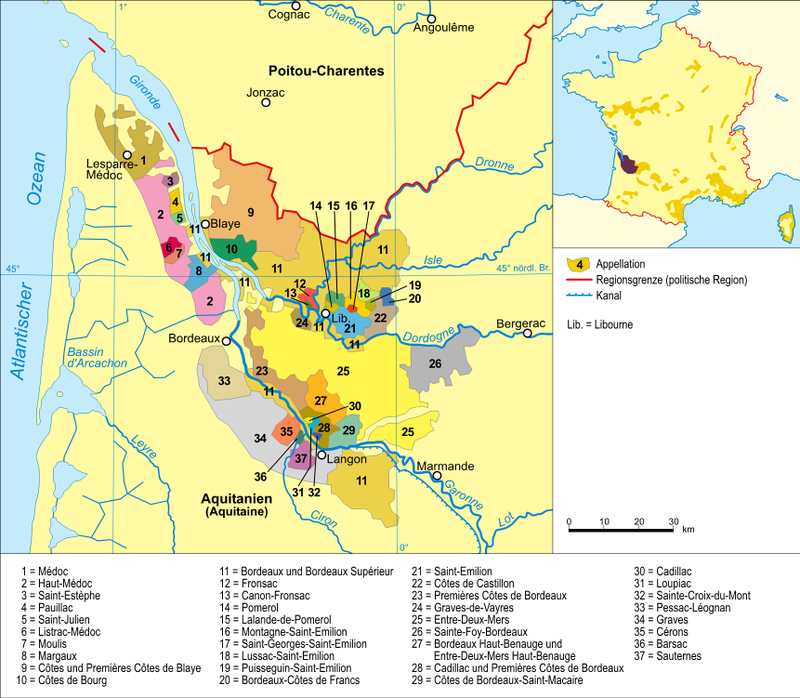
Bordeaux map

H/T to Brendan for the link.

June 6, 2014

“Fizzy dishwater” instead of Champagne for the “wine Fuhrer”

Filed under: Europe, France, Germany, History, Wine, WW2 — Tags: — Nicholas @ 06:45

Chris Mercer on the various ways the French Champagne producers tried to keep their best wine from being diverted to the use of the Nazis:

By the time the French city of Reims was liberated in August 1944, many Champagne houses and growers had spent four years playing a game of high stakes cat-and-mouse with the local Nazi ‘wine fuhrer’, Otto Klaebisch.

As Julian Hitner writes in a feature published in the July issue of Decanter magazine, it was Klaebisch’s job to keep the Nazi empire topped up with France’s finest Champagnes. At its peak, Klaebisch was demanding 400,000 bottles per week.

In response, many Champenois resorted to subterfuge to try to protect their most precious vintages and cuvees.

As noted in the book Wine & War by Don & Petrie Kladstrup, some built fake walls in their cellar to hide their best stocks, while others intentionally mislabelled bottles.

On more than one occasion, Klaebisch suspected he was being duped. ‘How dare you send us fizzy dishwater?’ he asked 20-year-old Francois Taittinger.

‘Who cares? It’s not as if it’s going to be drunk by anyone who knows anything about Champagne,’ replied the young Taittinger, who was subsequently thrown in prison for several days.

H/T to Brendan for the link.

May 29, 2014

The “Pairs Perfectly” campaign

Filed under: Cancon, Wine — Tags: , , , , — Nicholas @ 09:03

Just as the Ontario election writ was dropped, the small wineries of Ontario started pushing the Pairs Perfectly campaign, to move the province toward a more mature wine retailing model (like British Columbia’s). While I’d prefer a full privatization model (like Alberta’s), at least the move to allowing some private wine stores would be an improvement. Despite the quick work to launch the campaign, Michael Pinkus says it’s already being forgotten on the hustings:

Ontario is deep into an election campaign and the best thing done so far is a little initiative from the Wine Council called “Pairs Perfectly”. They’ve backed it with radio and television promos and in truth they make a lot of sense. Ontario is one of the only provinces not to have some sort of private system in place, either along with their provincial monopoly (a la British Columbia) or fully privatized (a la Alberta). This initiative seemed to be already formed and waiting in the wings: no sooner had an election been called than the “Pairs Perfectly” slogan was in my inbox (with its twitter handle @PairsPerfectly, hashtag #PairsPerfectly and website PairsPerfectly.com), articles were written to explain the notion, social media seemed abuzz from wineries to writers to the average-Joe, all were tweeting, re-tweeting, blogging, tumbling, gramming, hooting, hollering, casting, accosting and I initially thought, “Wow, the buzz is really out there, this just might have legs, or at least more legs that that ‘My Wine Shop’ that seemed to go nowhere.”

But 6 weeks is a long time in the political realm, just ask Rob Ford, so much can happen over the course of 6 weeks that can turn the tide on a well-thought-out, well-organized plan of attack. Instead of the Ontario booze media jumping whole hog onto the initiative and writing piece after piece after piece about the benefits of privatization to keep the idea in our collective consciousness, a new issue has come along to polarize: the VQA, which I have repeatedly said is a sham of a system, most notably because of its tasting panel. Now there’s a new horse to ride, a newer and shinier issue to get all worked up about. The VQA is easy pickings because it is so wrong, crushes creativity and stymies’ our winemakers making them think “will this pass VQA”. Every winery has come into conflict with it at least once in its existence and it needs an overhaul (radical? Maybe not, but definitely a big tweak).

[…]

I believe this: Ontario is a mess and is destined to remain that way long after this election season has been put to bed. We already know the Liberals position on privatization of any sort (over their dead body); the NDP seem in lockstep with the Liberals train of thought because it would disrupt union jobs. And the Conservatives, before the campaign the only party willing to talk privatization, have somehow gone mute about the whole issue – as if someone told them not to rock the boat; which makes them the wild card. But if history shows us anything it’s doubtful it’ll get past committee if it ever does come up.

And don’t even get me started on the asinine things happening on the beer side of the ledger. The Beer Store’s cockamamie campaign against corner stores carrying the product that they have a duopoly to sell (with the LCBO), is as misguided and ill-conceived as any I can think of. Does beer not also get sold in corner stores in other provinces? Are all those owners corrupt-minor-sellers? It seems to have galvanized the public against them; especially when people find out they aren’t government controlled; which a vast majority of the province was under the false notion it was. This also took focus away from the larger issue of an open and freer market for all in the alcohol industry (craft brewers, craft winemakers, etc.)

May 13, 2014

Coravin – a new technique for sampling wine in the bottle

Filed under: Business, Wine — Tags: — Nicholas @ 06:59

Brendan linked to this article about an innovative wine sampling device:

Five years later and news of another device with even more exciting ramifications for the wine trade began to ripple across from the US. Nuclear engineer and, crucially, wine lover Greg Lambrecht turned his mind to exploring whether it might be possible to sample the contents of a cellar without having to pull the cork.

Fourteen years and 23 prototypes later, Coravin was born. The portable apparatus allows a needle to be inserted through the foil capsule and cork; it then extracts the wine, fills in the gap with inert argon and withdraws, leaving the flexible cork to reseal itself.

Having initially launched in the US, Coravin is now available to be shipped to 22 countries and made its first UK appearance last October, priced at £300.

Although vice-president for marketing Howard Leyda says “the primary target market for Coravin is wine enthusiasts first for personal use”, it is the UK restaurant scene that has been generating the biggest buzz around what many believe is a real game changer.

[…]

Until Coravin becomes more easily available, a number of restaurants that have managed to get their hands on one can be seen drumming up excitement among their clientele by promoting this gadget’s most obvious application: the chance to taste some serious old wines.

At one early adopter, D&D London restaurant Avenue, the French- and American-focused wine list now reaches its apogee in the form of vertical flights of Mouton Rothschild and the first growth’s Californian sister venture Opus One.

Other options include Cheval Blanc 1999 at £91 for a 125ml glass or, for those looking to treat themselves on a tighter budget, a 75ml sample of Clerc Milon 2004 for £13.

“It’s really interesting for us to be able to offer these wine flights,” enthuses Avenue restaurant manager Robert Kihlstrom.

May 10, 2014

Former head of the LCBO at the Ontario Wine Awards

Filed under: Business, Cancon, Humour, Wine — Tags: , — Nicholas @ 13:17

Michael Pinkus attended last night’s award ceremony and found the star of the proceedings was the master of ceremonies, former LCBO head Andy Brandt:

The 20th Annual Ontario Wine Awards were held Friday night at the Queen’s Landing Inn in Niagara-on-the-Lake hosted by former head of the LCBO Andy Brandt; who had to be one of the unintentionally funny MC I’ve ever experienced. Between the butchering of words (Pinot “Griss”, Cabernet “Frank”, “Sara” for Syrah, “Ca-lom-us” for Calamus and “Toss-e” for Tawse) and the total omission of names he did not want to pronounce like Musque and Viognier during the presentation — he seemed uncomfortable giving out the awards, but was good at puns and for a few stories. All-in-all Brandt was a train-wreck, but at least you knew the room was listening for his next faux-pas and he was the talk of the room over beers and desserts at the after-party (the most talked about host I can remember). One person commented to me, “He’s my favourite MC at [The Ontario Wine Awards] ever, I just never knew what was going to come out of his mouth from one moment to the next. Obviously pronunciation has gone out the window tonight, it’s a free-for-all.” Others could not believe that the once head of the LCBO could not pronounce grape varieties correctly.

May 4, 2014

How to start a wine cellar (not applicable in Ontario)

Filed under: Business, Cancon, Wine — Tags: , , — Nicholas @ 10:21

In rational jurisdictions — where you don’t have a government-mandated monopoly supplier — following the advice of Will Lyons makes a lot of sense. For obvious reasons, wine fans in Ontario can only stare in envy at the concept of competitive pricing for wine and not being limited to what the government chooses to bring in for sale:

IF YOU ENJOY WINE, are starting to take more than a passing interest and have perhaps bought the odd reference book about vino varieties, it might be time to think about beginning your very own wine cellar.

The worst habit you can get into is to stop off at your local wine shop once a week and pick up the odd few bottles. A much better approach is to buy by the dozen or a six pack, as most wine merchants will offer a discount on a mixed case. Better still is to select two or three wine merchants, order their catalogs or look online and, when you’re in the mood, spend some time selecting your favorite wines and comparing prices. I like to do this on the weekend, with a cup of tea and all the catalogs spread out over the kitchen table.

But a cellar isn’t just a few cases of your favorite wine. It may sound like a cliché but a good cellar requires a bit of forethought and planning to provide pleasurable drinking over the long term. I like to break wine collecting into three categories: wines for immediate drinking, wines to lay down that will improve with age, and investment wines — those special bottles whose value will steadily increase year on year.

I started my own cellar soon after I left university and began working in the wine trade. I well remember buying a case of northern Rhône Syrah to lay down — I still have four bottles — and six bottles of a well-known New Zealand Sauvignon Blanc producer. I now buy most of my wine twice a year: during the bin end sales at the beginning of the year, when merchants are unloading old stock at discounted prices, and when a wine is offered En Primeur (wine futures). This is where the wine is put up for sale from the barrel, months before it is bottled and shipped. The advantages are that you can guarantee an allocation of your chosen wine, you can choose the size of the bottle it is shipped in and also secure it at a discounted price. However, the latter isn’t always guaranteed — Bordeaux 2010 being a case in point. Many of the wines are cheaper now than when they were when released En Primeur.

May 2, 2014

PC “credentials” as a “positional good”

Filed under: Economics, Media, Wine — Tags: , , , , — Nicholas @ 14:56

Kristian Niemietz agrees with much of the pro-free speech coverage in sp!ked, but suggests that the real reason for politically correct attitudes are not quite as presented:

Over the past few years, spiked online magazine has consistently and robustly defended the principle of free speech against the censorship demands of the politically correct, whatever quarter they may come from. It is great, of course, that there is at least one magazine in which the phrase ‘I believe in free speech’ is unlikely to be followed by a ‘but…’, and more likely to be followed by an ‘even for…’. But while I fully support the spiked line, I also think the spiked authors sometimes misinterpret the intentions of the ‘PC brigade’, and would like to offer an alternative interpretation rooted in boring, old-fashioned textbook economics.

Spiked authors believe that PC is driven by a loathing for ordinary people. According to spiked, PC brigadiers view ordinary folks as extremely impressionable, easily excitable, and full of latent resentment. Exposure to the wrong opinions, even isolated words, could immediately awaken the lynch mob. PC, then, is about protecting ‘the vulnerable’ from the nasty tendencies of the majority population.

But if PC was not really about protecting anyone, and really all about expressing one’s own moral superiority, PC credentials would be akin to what economists call a ‘positional good’.

A positional good is a good that people acquire to signalise where they stand in a social hierarchy; it is acquired in order to set oneself apart from others. Positional goods therefore have a peculiar property: the utility their consumers derive from them is inversely related to the number of people who can access them.

Positionality is not a property of the good itself, it is a matter of the consumer’s motivations. I may buy an exquisite variety of wine because I genuinely enjoy the taste, or acquire a degree from a reputable university because I genuinely appreciate what that university has to offer. But my motivation could also be to set myself apart from others, to present myself as more sophisticated or smarter. From merely observing that I consume the product, you could not tell my motivation. But you could tell it by observing how I respond once other people start drinking the same wine, or attending the same university.

If I value those goods for their intrinsic qualities, their increasing popularity will not trouble me at all. After all, the enjoyment derived from wine or learning is not fixed, so your enjoyment does not subtract from my enjoyment. I may even invite others to join me – we can all have more of it.

But if you see me moaning that the winemakers/the university have ‘sold out’, if you see me whinging about those ignoramuses who do not deserve the product because they (unlike me, of course) do not really appreciate it, you can safely conclude that for me, this good is a positional good. (Or was, before everybody else discovered it.)

April 17, 2014

The patented Heath Robinson/Rube Goldberg wine opener

Filed under: Technology, Wine — Tags: — Nicholas @ 08:12

Certainly the most SteamPunk wine-opener-and-pourer you’ll see this week:

H/T to Roger Henry for the link.

« Newer PostsOlder Posts »

Powered by WordPress