
The progressives have a lot of problems with America. That is the entire point of their politics: They don’t like what America is, and wish to change it.
This is what it means to be “progressive” — you want to move away from what actually exists.
Conservatives, by and large, defend the current order, because they like it, and do not wish to “fundamentally transform” America.
This is what it means to be “conservative” — one conserves, or keeps, what already exists.
Progressives play this game where they launch nothing but nasty Marxist Critiques upon America, agitating for the country to remake itself entirely, but want to claim simultaneously: We love America as much as anybody.
Oh you most certainly do not! Definitionally, you do not: One who “loves” with a long list of caveats and criticisms does not love as much as someone who loves completely (or with a much shorter list of caveats and criticisms).
Furthermore, progressives take patriotism itself to be the sanctimony of the unsophisticated. Or, as Oscar Wilde called it, “the virtue of the vicious.”
Progressives, when they’re speaking honestly (that is, when they’re not speaking in front of TV cameras), love to lampoon their fellow countrymen’s unsophisticated, stupid, and obese love of country.
They have in fact defined themselves as being Those who are too smart to buy into this “patriotism” nonsense.
Ace, “Rudy Is Right”, Ace of Spades H.Q., 2015-02-20.
August 23, 2016
QotD: American Progressives
August 21, 2016
Why Trains Suck in America
Published on 16 Aug 2016
Trains, well, just aren’t that great in America. Here’s why.
August 17, 2016
Cover art and outtakes from Tom Waits’ Small Change, 1976
I didn’t know that the “go-go dancer” in the background of the photos from Tom Waits’ album Small Change was Cassandra Peterson (better known for her portrayal of “Elvira” to most of us):
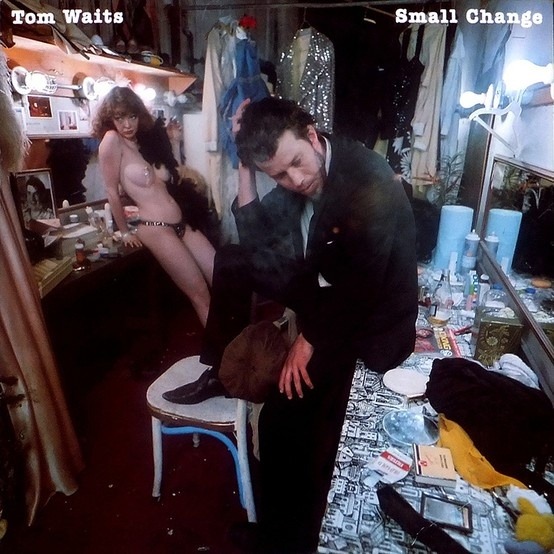
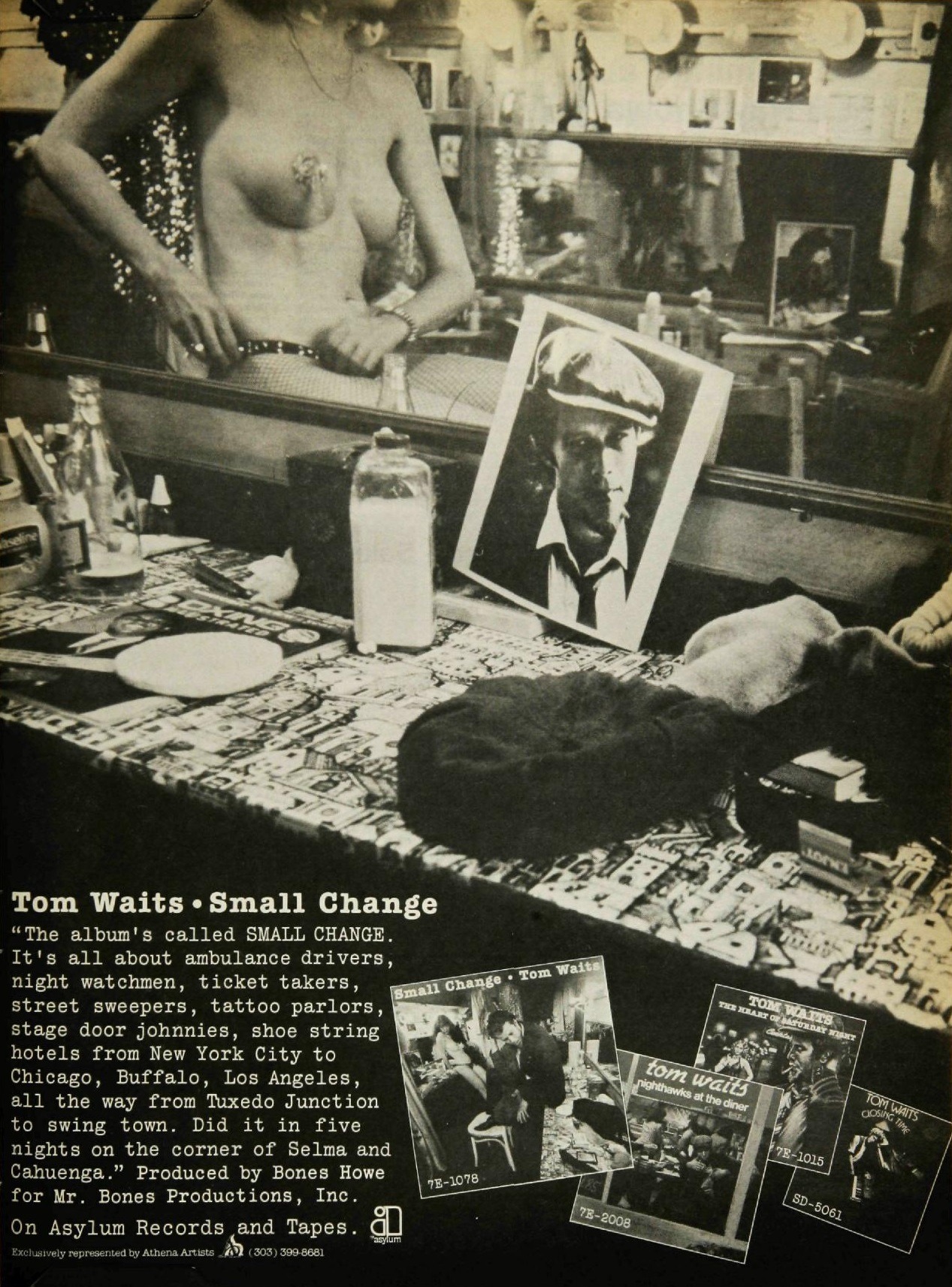
A couple of outtakes at the link.
American Conservatives
David Warren helpfully outlines the job description of US conservatives, based on the last century or so of progress:
Often I am asked by correspondents to define something they call “conservatism.” I rather thought I’d answered this question before, though it is always possible I was mumbling. So lest there be confusion, or perchance new readers, let me give the definition again.
Conservatism is a form of embarrassment or timidity; in an American context, the politics of the cartoon character, Caspar Milquetoast (see here). It is a way of standing astride history to say, “Please watch where you are going,” while being run over. It is a form of apology for being alive.
And no, Trump is not a conservative. He is what is called a “populist,” or to use the older term, insane.
The problem with these “conservatives” today is that they are too conservative. They merely oppose change. Each new generation of them becomes the rearguard for the previous liberal vanguard. They accept the revolutionary advances imposed by the last team of social engineers as “a fact of political life,” that only a fool would gainsay. They survive by breeding, I suppose, but also by adding new constituencies to their ranks, as the liberals safely discard them; then selling out each in turn.
“Free trade” was an example from decades ago. The liberals didn’t want that any more, so the conservatives became the free trade party. Skip forward another three score and ten, and the conservatives are now becoming the “gay” party. They are defending the right of homosexual persons to stay gay on their own terms, as the liberal agenda “moves on.” Along the way they (the cons) bought into second- then third-wave feminism, and now they are the old-fashioned, liberated women’s party, too. In another generation they’ll be defending old-fashioned mixed bathrooms, and the old-fashioned post-sexed against … what? (We must wait and see.)
The function of the modern conservative is to be sincerely appalled by the engineers’ latest proposal, without being able to remember why. And they will resist, cautiously, in the certainty that they will lose. Whenupon their children will go to work, consolidating their loss, to prepare for surrender in the mop-up round.
I hope I have made their position clear.
QotD: The Lifestyle Charity Fraud
For decades I have observed an abuse of charities that I am not sure has a name. I call it the “lifestyle” charity or non-profit. These are charities more known for the glittering fundraisers than their actual charitable works, and are often typified by having only a tiny percentage of their total budget flowing to projects that actually help anyone except their administrators. These charities seem to be run primarily for the financial maintenance and public image enhancement of their leaders and administrators. Most of their funds flow to the salaries, first-class travel, and lifestyle maintenance of their principals.
I know people first hand who live quite nicely as leaders of such charities — having gone to two different Ivy League schools, it is almost impossible not to encounter such folks among our alumni. They live quite well, and appear from time to time in media puff pieces that help polish their egos and reinforce their self-righteous virtue-signaling. I have frequently attended my university alumni events where these folks are held out as exemplars for folks working on a higher plane than grubby business people like myself. They drive me crazy. They are an insult to the millions of Americans who do volunteer work every day, and wealthy donors who work hard to make sure their money is really making a difference.
Warren Meyer, “The Lifestyle Charity Fraud”, Coyote Blog, 2016-08-04.
August 16, 2016
Would Trump pull the US out of NATO?
Tom Kratman regretfully says no:
The last several months have seen repeated claims and variants on claims that presidential candidate Donald Trump wants to, and intends to, pull the United States out of NATO. Hillary Clinton made the claim on 28 March of this year, repeating a version of it on 8 May on Face The Nation.
Sad to say, Trump hasn’t said we need to pull out; would that he had. Instead, he’s made far weaker calls to “reconsider” our role in NATO, and to restructure or reform NATO to deal with modern threats, like terrorism, rather than Cold War threats, like the former Soviet Union and Warsaw Pact. These were couched in terms generally reasonable and factual; to paraphrase, NATO other than the US doesn’t pay its fair share.
I’m not so concerned with what politicians may say – and Trump’s become one now – who are vying for political office. See, for example, Hillary’s lies about what Trump actually said, cited above. I’m far more concerned with what they should do following election. In this particular case, though what Hillary has claimed of Trump is a lie, it’s a lie he should follow through on.
NATO has rarely pulled its weight in the past, nor is it pulling its weight in the present. Of twenty-eight NATO countries, only five meet their defense spending goal of two percent of GDP. Even that is begging the question, though; because none of them, not one, come near to our level of spending. Britain, for example, with a GDP of 2.679 trillion, spends about fifty-two billion, or just over two percent. France’s defense budget runs under two percent. Germany, Europe’s largest economy, disgracefully, spends a mere thirty-seven billion, or just over one percent. Some smaller NATO countries, the Netherlands, for example, spend about what Germany does.
We, conversely, spend about three times what Germany does, and even more than that if one tallies in a number of indirect expenditures, like the VA, on which we spend more than twice Germany’s entire defense budget.
Frankly, all of NATO is on a kind of moral defense welfare and has been pretty much since inception.
[…]
But the Truman Doctrine! The Truman Doctrine!
I know a lot of people must have missed it, but the Truman Doctrine wasn’t designed to contain Russia. Neither should one be taken in by flighty rhetoric presented to congress. The Truman Doctrine arose in the context of containing communism. That was done. Communism is no longer an international threat (and if we can keep the Hildebeast out of the White House we may be able to keep it from becoming a domestic threat, too).
But we need European troops!
Some of them have been, indeed, excellent. I am thinking especially of the UK’s, Canada’s, Australia’s, and Denmark’s. I am not thinking of Germany’s, the reports on whom, such as I have seen, are almost uniformly wretched, and I am not thinking of France’s, the reports on which are mixed. However, in accord with their defense budgets, those troop slices were objectively small, and they generally did not come with logistic self-sufficiency. In other words, in huge part, we had to provide the transportation and other support to keep them in the field in Afghanistan and Iraq, and that, especially in Afghanistan, where our own logistic capability was badly strained.
That was bad enough, but there is something much worse. There has grown up over the decades since the Second World War a regime of treaties, advancing what is often called “International Humanitarian Law” – IHL – and purporting to subordinate the law of war to it. Some of those claims are so preposterous as to be unbelievable, except that many, many of the world’s elites do believe in them and do force us to subordinate our own laws to them. A discussion of IHL is beyond the scope of this column. Note, however, two aspects of it that have arisen, the International Criminal Court, created by what is called “the Rome Statute,” and the Protocols Additional to Geneva Convention IV. The former subverts national sovereignty by placing it subordinate to unelected, partisan, largely left wing, jurists. The latter were specifically designed and pushed forward by the former Soviet Union to undermine the west.
We accept neither of these and, in fact, have a conditional declaration of war in place, the American Servicemembers Protection Act, should anyone try to grab our troops for trial before the ICC. Unfortunately, our “allies,” for the most part, have signed onto these obscenities. What that means is that we are constrained from acting with the full rigor of the law of armed conflict by the presence of allies, for whom, should we act in accordance with the law of war but against IHL, makes them complicit in what are, by their own domestic laws, war crimes. This constraint is intolerable, a rotten, stinking albatross tied around our necks. And this is what makes the presence of allied NATO troops not worth the bother, even when those troops are superb.
August 14, 2016
QotD: Women in graduate math programs
Academic programs presumably want people with high ability. The GRE bills itself as an ability test, and under our expanded definition of ability this is a reasonable claim. So let’s talk about what would happen if programs selected based solely on ability as measured by GREs.
This is, of course, not the whole story. Programs also use a lot of other things like grades, interviews, and publications. But these are all correlated with GRE scores, and anyway it’s nice to have a single number to work with. So for now let’s suppose colleges accept applicants based entirely on GRE scores and see what happens. The STEM subjects we’re looking at here are presumably most interested in GRE Quantitative, so once again we’ll focus on that.
Mathematics unsurprisingly has the highest required GRE Quantitative score. Suppose that the GRE score of the average Mathematics student – 162.0 – represents the average level that Mathematics departments are aiming for – ie you must be this smart to enter.
The average man gets 154.3 ± 8.6 on GRE Quantitative. The average woman gets 149.4 ± 8.1. So the threshold for Mathematics admission is 7.7 points ahead of the average male test-taker, or 0.9 male standard deviation units. This same threshold is 12.6 points ahead of the average female test-taker, or 1.55 female standard deviation units.
GRE scores are designed to follow a normal distribution, so we can plug all of this into our handy-dandy normal distribution calculator and find that 19% of men and 6% of women taking the GRE meet the score threshold to get into graduate level Mathematics. 191,394 men and 244,712 women took the GRE last year, so there will be about 36,400 men and 14,700 women who pass the score bar and qualify for graduate level mathematics. That means the pool of people who can do graduate Mathematics is 29% female. And when we look at the actual gender balance in graduate Mathematics, it’s also 29% female.
Vast rivers of ink have been spilled upon the question of why so few women are in graduate Mathematics programs. Are interviewers misogynist? Are graduate students denied work-life balance? Do stereotypes cause professors to “punish” women who don’t live up to their sexist expectations? Is there a culture of sexual harassment among mathematicians?
But if you assume that Mathematics departments are selecting applicants based on the thing they double-dog swear they are selecting applicants based on, there is literally nothing left to be explained.
I am sort of cheating here. The exact perfect prediction in Mathematics is a coincidence. And I can’t extend this methodology rigorously to any other subject because I would need a much more complicated model where people of a given score level are taken out of the pool as they choose the highest-score-requiring discipline, leaving fewer high-score people available for the low-score-requiring ones. Without this more complicated task, at best I can set a maximum expected gender imbalance, then eyeball whether the observed deviation from that maximum is more or less than expected. Doing such eyeballing, there are slightly fewer women in graduate Physics and Computer Science than expected and slightly more women in graduate Economics than expected.
But on the whole, the prediction is very good. That it is not perfect means there is still some room to talk about differences in stereotypes and work-life balance and so on creating moderate deviations from the predicted ratio in a few areas like computer science. But this is arguing over the scraps of variance left over, after differences in mathematical ability have devoured their share.
Scott Alexander, “Perceptions of Required Ability Act As A Proxy For Actual Required Ability In Explaining The Gender Gap”, Slate Star Codex, 2015-01-24.
August 13, 2016
If Trump actually wanted to lose, what would he be doing differently?
I think the jury is still out over whether Donald Trump really wants to win the presidency. Back when he entered the race, several people pointed out just how close he had been to the Clintons for decades, and floated the idea that his role wasn’t to win but to make it possible for Hillary to win (by crippling or eliminating anyone on the GOP bench who could beat her in the general election). Since he won the Republican nomination, he has consistently made unforced errors that allowed the media to concentrate their fire on him, especially when something came up that might have hurt Clinton. Maybe Scott Adams will explain how this is actually Trump’s version of the “rope a dope” strategy, but right now it looks like Trump is doing everything he can to lose the election.
At Never Yet Melted, David Zincavage says that Trump’s supporters have been played as suckers:
Donald Trump isn’t a conservative. Donald Trump is not a down-home American like you. Donald Trump is a conniving, cynical New Yorker. He’s 70 years old, fabulously wealthy, already famous and already living a completely sybaritic life-style. For him, moving from one of his luxury residences to the White House and having to be president would be like moving down-market in housing and getting a full-time job. It would be a real bummer.
He is not into personal sacrifice. Donald Trump cares about political ideas the way I care about Olympic soccer matches. Donald Trump has no real personal political ideas or preferred policy agenda at all. He’s just a businessman, a total pragmatist.
Donald Trump is not your buddy and he is no kind of patriot. Trump likes money, tail, and Trump, period.
So we’re watching him campaign. He carelessly contradicts himself. He routinely takes one position and then the opposite one. He constantly offends rival candidates and significant potential voting blocs. He does exactly as he pleases, casually taking time away from campaigning, often spending no money, doing no advertising and no fund-raising. He behaves like a crazy person, defying convention, political correctness, and rather frequently ordinary good manners and civility as well. He says something embarrassing or outrageous several times a week.
One is obliged to conclude that either Donald Trump is crazy and the most incompetent candidate for office in human history, or he is motivated by something other than winning.
Since we know that Trump is a close friend of the Clintons, on the whole, I like best the theory that contends that Trump has really just been running, all along, in order to kill Republican chances in what ought to have been a landslide Republican year and to make possible the impossible: Hillary’s election.
He’s having lots of fun. He’s soaking up the limelight and laughing at all the dopes supporting him, while mischievously dropping another turd in the electoral punchbowl every now and then and watching the commentariat have fits over what they think is a gaffe.
Update: After I had this post queued up for Saturday morning, I noticed this tweet from Megan McArdle:
If the Clintons *had* cooked up a scheme w/Trump to get the nomination & dump the election, how would that look different from what we got?
— (((Megan McArdle))) (@asymmetricinfo) August 11, 2016
August 12, 2016
QotD: Belief and faith
By what route do otherwise sane men come to believe such palpable nonsense? How is it possible for a human brain to be divided into two insulated halves, one functioning normally, naturally and even brilliantly, and the other capable only of such ghastly balderdash which issues from the minds of Baptist evangelists? Such balderdash takes various forms, but it is at its worst when it is religious. Why should this be so? What is there in religion that completely flabbergasts the wits of those who believe in it? I see no logical necessity for that flabbergasting. Religion, after all, is nothing but an hypothesis framed to account for what is evidentially unaccounted for. In other fields such hypotheses are common, and yet they do no apparent damage to those who incline to them. But in the religious field they quickly rush the believer to the intellectual Bad Lands. He not only becomes anaesthetic to objective fact; he becomes a violent enemy of objective fact. It annoys and irritates him. He sweeps it away as something somehow evil …
H.L. Mencken, The American Mercury, 1926-02.
August 10, 2016
Populists and open borders
In City Journal, Victor Davis Hanson says the rise of Trump and other populist politicians is being powered by lower- and middle-class rejection of the elite preference for open borders:
Driving the growing populist outrage in Europe and North America is the ongoing elite push for a borderless world. Among elites, borderlessness has taken its place among the politically correct positions of our age — and, as with other such ideas, it has shaped the language we use. The descriptive term “illegal alien” has given way to the nebulous “unlawful immigrant.” This, in turn, has given way to “undocumented immigrant,” “immigrant,” or the entirely neutral “migrant” — a noun that obscures whether the individual in question is entering or leaving. Such linguistic gymnastics are unfortunately necessary. Since an enforceable southern border no longer exists, there can be no immigration law to break in the first place.
Today’s open-borders agenda has its roots not only in economic factors — the need for low-wage workers who will do the work that native-born Americans or Europeans supposedly will not — but also in several decades of intellectual ferment, in which Western academics have created a trendy field of “borders discourse.” What we might call post-borderism argues that boundaries even between distinct nations are mere artificial constructs, methods of marginalization designed by those in power, mostly to stigmatize and oppress the “other” — usually the poorer and less Western — who arbitrarily ended up on the wrong side of the divide. “Where borders are drawn, power is exercised,” as one European scholar put it. This view assumes that where borders are not drawn, power is not exercised — as if a million Middle Eastern immigrants pouring into Germany do not wield considerable power by their sheer numbers and adroit manipulation of Western notions of victimization and grievance politics. Indeed, Western leftists seek political empowerment by encouraging the arrival of millions of impoverished migrants.
QotD: “Pro-business” versus “Pro-consumer”
In popular discourse, America is said to be more “pro-business” than is France. When people use this term “pro-business” they typically have in mind some vague notion of a government policy made up of low-ish taxes and not a great deal of government regulation. That is, “pro-business” is commonly used to mean a free, or free-ish, market.
But such language is mistaken.
A true free market is at its core pro-consumer. In a genuinely free-market economy, businesses are valued only insofar as they serve consumers. The performance of a genuinely free-market economy is assessed by how well it satisfies, over time, the demands of consumers spending their own money and not by how well it satisfies the demands of business owners and managers.
Obviously, because businesses are a useful – indeed, practically indispensable – means of abundantly satisfying consumers’ demands, government policies that obstruct the smooth operation of these means are undesirable. But such policies that obstruct or discourage business operations are economically undesirable not because they harm businesses but, rather, because they harm consumers.
Anyway, for all of its faults, American culture and policy are actually much less pro-business than are the culture and policy of France. If you’re really looking for a government that is deeply pro-business – one that regards the protection of existing businesses as a worthy end in and of itself – one that forcibly transfers resources from taxpayers, consumers, and other non-businesses in order to promote the material interests of existing businesses – look at France. You’ll find there what you seek. In France you’ll find one of the most business-friendly policy regimes on the face of the earth. (HT Chris Meisenzahl)
Pity the French.
Don Boudreaux, “Pity the French Consumer and Worker”, Café Hayek, 2016-06-27.
August 9, 2016
Growing up White Trash in the modern university
Holly Genovese on the difficulties of an academic career when you come from a “White Trash” background:
I bought The Professor Is In by Karen Kelsky, a terrifying book full of blunt (and much needed advice) about navigating the academic job market. While the author gives outspoken advice about the struggles of the job market, particularly for women, she also implicitly argues for the importance of hiding one’s class. She wrote about clothing and makeup and speaking patterns in women. Around the time I read this book, I realized that I, for a lack of a better term, code “white trash.” I have bad teeth, frequently say “ya’ll” and “how come,” and have a habit of running around South Philadelphia in a Dale Earnhardt Jr. t-shirt. It is one thing to have your hometown judged by your peers, but it is quite another to realize that qualities you possess, habits born of a lifetime that you don’t even realize you have, make you read as unqualified or unfit for your chosen profession.
But you can’t go home either, as they say. The more formal education I acquired, the larger the gap between my family and I became. My parents are incredibly proud of me and have never been anything other than supportive. But everyone from cousins to former employers have insinuated that I am arrogant because I left my small town for the city and enrolled in a Ph.D program. Why couldn’t I get a real job in the Harley Factory? What could you even do with a history Ph.D anyway? And most common of all, was I ever coming home? Slowly I realized the answer to that question had to be no.
Coming home still feels like a relief, a break from a life of pretending. But very gradually, my life has become very different from that of my family and old friends. We no longer watch the same TV or drink the same beer or read the same books. It takes a good week to get acclimated to the Folgers coffee my mom still buys. And many of my friends have no frame of reference for my chosen career, having never gone to college or even finished high school themselves. And sometimes my liberal and quasi-socialist opinions run up against those of the people in my hometown. How can I contest their sometimes racist, homophobic, or anti-intellectual opinions without confirming their stereotypes about who I have become, an elitist snob from the city?
H/T to Rick McGinnis for the link. “Except for the use of the voguish word “microaggression,” this resonates strongly with what I’ve seen (and lived.) That in-between feeling, of never quite fitting in where you’ve come from or where you are now. Class is a powerful thing, and in my experience Americans have a hard time talking about it. (And Canadians only marginally less so.)”
August 8, 2016
QotD: Peace
Almost everyone wants peace, the problem is that we’ve had peace in this country for so long that most people don’t recognize it for the aberration that it is. Because of this, a curiously contradictory mindset holds sway over a large segment of the population, most of them on the left side of the political spectrum. It goes something like this: “Well, we want peace, so we’ll just refuse to fight. If we refuse to fight, the other guy will have no reason to fight us.” If you point out to them that the other guy just might not want peace, you’ll get a predictable response: “Well, since peace is the default state of the world, if we can figure out what we did to make the other guy mad at us and desirous of war, and make it up to him, then he’ll feel comfortable with allowing the default state to resume.”
The problem is, of course, that peace isn’t the default state of the world, war is. Human beings are predators, and we are genetically designed to be in competition with other human beings, either individually or in groups. If group A has something group B wants, the natural instinct of group B is to attack group A and take it. The only way that group A can prevent this from happening is to be stronger than group B. For centuries, the Mongol tribes roamed the countryside of Mongolia, squabbling with and fighting each other. The great neighboring dynasties, the Xia and Jin, had little to fear from the Mongols beyond nuisance raids, because they were stronger. Then Temujin united the tribes, assumed the title Genghis Khan, and swept both empires off the face of the earth. The empires had enjoyed peace for generations — because they were strong. When they ceased to be stronger than their foes, they soon ceased to be entirely.
So what? Primitives. Barbarians. Savages. We’re different now. Civilized. Cultured. Superior.
I hate to break it to you, but we’re not. 13th century man is behaviorally identical to modern man. 8 centuries is nowhere near long enough for that kind of evolutionary change in the human animal. People are … people. Always have been, always will be. The reason that we’ve enjoyed centuries of peace in America (even our wars haven’t been fought here since the 1860s) is because we’ve been strong enough that nobody has had the ability to fight us over here, and we’ve had the ability to go fight them over there when we needed to. There is nothing about this situation that is written in stone. Our homeland is peaceful because we’ve had the military might necessary to make it impossible for foes to make it not peaceful.
But now, with so many believing that peace is the natural order of things, we are in grave danger of finding out that peace is not the natural order of things, it’s a luxury, one that is paid for in blood and the willingness and ability to shed it. Our military is a shell of its former self, hollowed out to buy bread and circuses for the masses. Our diplomacy a joke, conducted insecurely and thus transparent to our foes. Our foreign policy is a hot mess of appeasement and apology. All of this makes us look weaker and weaker to the world, and so now they believe that they can take what they want from us because we can no longer defend it. Bill Clinton gave Ukraine a rock solid guarantee of protection in return for them giving up their nukes to ensure “peace”. That’s gone, along with half that country. Our strongest allies are realizing that they are on their own against genocidal aggressions and prepare to act alone or in concert with new allies. We issue ultimatums and draw red lines and the world laughs at us. This isn’t peace, it’s the prelude to destruction. Our destruction.
Weirddave, “Fundamental Concepts – Weakness Invites Aggression”, Ace of Spades H.Q., 2015-03-07.
August 5, 2016
QotD: Slavery as an American invention
I started giving quizzes to my juniors and seniors. I gave them a ten-question American history test… just to see where they are. The vast majority of my students – I’m talking nine out of ten, in every single class, for seven consecutive years – they have no idea that slavery existed anywhere in the world before the United States. Moses, Pharaoh, they know none of it. They’re 100% convinced that slavery is a uniquely American invention… How do you give an adequate view of history and culture to kids when that’s what they think of their own country – that America invented slavery? That’s all they know.
Dr. Duke Pesta, in conversation with Stefan Molyneux, transcribed by David Thompson, 2016-07-27.
July 30, 2016
The alienated parts of the old Republican coalition
In the New York Review of Books, Jonathan Freedland looks at some of the significant factions of the Republican party who have not embraced Il Donalduce:
Yet this is not solely a revolt of “values conservatives” against the brash, thrice-married vulgarian from Queens — a battle of Iowa against New York, as Cruz likes to frame it. There are other fault-lines. Neoconservatives such as Bill Kristol (or Robert Kagan, who says he will vote for Hillary Clinton) oppose Trump too, as do foreign policy realists such as Brent Scowcroft. Some of this is personal: Scowcroft and others feel a strong loyalty to the Bush family, whose animus toward Trump is incandescent thanks to the billionaire’s trashing of Jeb. But policy substance has also played its part in Trump’s improbable achievement: he has managed to turn many disparate Republican strands — Log Cabin types and evangelicals, neocons and Bush 41 stalwarts, Wall Streeters and military brass — against him. (That these different elements have not been able to cohere around an alternative candidate or program helps, in part, to explain Trump’s success, but it does not make their opposition any less real.)
Trade is a crucial example. The GOP has long been the party of free trade; in 1993, Bill Clinton could only pass NAFTA with Republican votes. But now its nominee denounces such trade as a destroyer of American jobs, apparently seeing commerce as something the US should do to, rather than with, other countries. The result was the astonishing sight of a Republican presidential nominee, in his acceptance speech, bidding for the voters of an avowed socialist, Bernie Sanders, “because,” as Trump put it, “we will fix his biggest issue, trade deals.” The issue was hardly debated in Cleveland, but the shift is remarkable all the same. Trump has refashioned the GOP as the party of protectionism, advocating an approach Republicans previously denounced as a threat to American prosperity.
Similarly, Republicans have for decades enjoyed an advantage on national security, obliging the Democrats to match them on strength and military commitment. Trump has broken from that too. He implies a rupture not only from the neocon, democracy-spreading policies associated with Bush the son, but also with the engaged internationalism of Bush the father. Trump is seemingly uninterested in America’s traditional status as sheet-anchor of the international system, central in a series of interlocking alliances that have maintained relative order and stability since 1945. Instead, he took time out from Cleveland to tell The New York Times he did not believe in the cardinal principle underpinning NATO — that an attack on one member is an attack on all — and that, as president, he would only defend one of the Baltic states from hypothetical Russian invasion if he deemed that state to have been paying its proper dues. Put aside the huge implications of such a shift for global security. Trump is turning his back on decades of Republican Party doctrine.
That’s true on the scale of government, too, with Trump implicitly advocating gargantuan powers for an imperial presidency: “I alone can fix this problem,” he says of crime, ISIS, immigration and much else. That’s quite a change for a party that has long regarded it as an article of faith that government is the problem and never the solution.
[…]
Republicans alarmed at these developments are not quite sure what will be worse: for Trump to lose or for Trump to win. Some have persuaded themselves that a Trump victory is best for America, simply because Hillary Clinton must not be president. (One Utah delegate, anguished about Trump’s “rough edges,” told me he believed Clinton was “evil.”)
But others are terrified by the possibility of a Trump victory. If that happens, they fear, the upheaval of 2016 will become permanent: the Republican Party will be reshaped in Trump’s image. It will be protectionist, nativist, authoritarian, and the vehicle for an exclusively white rage. Richard Tafel recoils so sharply from that prospect, he is talking seriously of forming a new party of the center-right. He’s already had conversations with “some of the wealthiest” CEOs and others, worried that Trumpism does not respect the prudent, cautious, free-market conservatism they value. For millennials especially, Tafel says, Trump is making the Republican Party a “toxic brand.”
The biggest challenge to forming a new political party is that the current system is completely rigged in favour of the two big parties to the extent that even long-established third parties like the Libertarians and the Greens still have to spend vastly disproportional efforts (and funds) just trying to get their candidates onto the ballot. A new “centre-right” party would face the same problem — and neither of the two big beneficiaries of the current system will be eager to see their institutional advantages eroded.


