
When I look through my own recipe for the perfect cup of tea, I find no fewer than eleven outstanding points. On perhaps two of them there would be pretty general agreement, but at least four others are acutely controversial. Here are my own eleven rules, every one of which I regard as golden:
First of all, one should use Indian or Ceylonese tea. China tea has virtues which are not to be despised nowadays — it is economical, and one can drink it without milk — but there is not much stimulation in it. One does not feel wiser, braver or more optimistic after drinking it. Anyone who has used that comforting phrase ‘a nice cup of tea’ invariably means Indian tea. Secondly, tea should be made in small quantities — that is, in a teapot. Tea out of an urn is always tasteless, while army tea, made in a cauldron, tastes of grease and whitewash. The teapot should be made of china or earthenware. Silver or Britanniaware teapots produce inferior tea and enamel pots are worse; though curiously enough a pewter teapot (a rarity nowadays) is not so bad. Thirdly, the pot should be warmed beforehand. This is better done by placing it on the hob than by the usual method of swilling it out with hot water. Fourthly, the tea should be strong. For a pot holding a quart, if you are going to fill it nearly to the brim, six heaped teaspoons would be about right. In a time of rationing, this is not an idea that can be realized on every day of the week, but I maintain that one strong cup of tea is better than twenty weak ones. All true tea lovers not only like their tea strong, but like it a little stronger with each year that passes — a fact which is recognized in the extra ration issued to old-age pensioners. Fifthly, the tea should be put straight into the pot. No strainers, muslin bags or other devices to imprison the tea. In some countries teapots are fitted with little dangling baskets under the spout to catch the stray leaves, which are supposed to be harmful. Actually one can swallow tea-leaves in considerable quantities without ill effect, and if the tea is not loose in the pot it never infuses properly. Sixthly, one should take the teapot to the kettle and not the other way about. The water should be actually boiling at the moment of impact, which means that one should keep it on the flame while one pours. Some people add that one should only use water that has been freshly brought to the boil, but I have never noticed that it makes any difference. Seventhly, after making the tea, one should stir it, or better, give the pot a good shake, afterwards allowing the leaves to settle. Eighthly, one should drink out of a good breakfast cup — that is, the cylindrical type of cup, not the flat, shallow type. The breakfast cup holds more, and with the other kind one’s tea is always half cold — before one has well started on it. Ninthly, one should pour the cream off the milk before using it for tea. Milk that is too creamy always gives tea a sickly taste. Tenthly, one should pour tea into the cup first. This is one of the most controversial points of all; indeed in every family in Britain there are probably two schools of thought on the subject. The milk-first school can bring forward some fairly strong arguments, but I maintain that my own argument is unanswerable. This is that, by putting the tea in first and stirring as one pours, one can exactly regulate the amount of milk whereas one is liable to put in too much milk if one does it the other way round.
Lastly, tea — unless one is drinking it in the Russian style — should be drunk WITHOUT SUGAR. I know very well that I am in a minority here. But still, how can you call yourself a true tea-lover if you destroy the flavour of your tea by putting sugar in it? It would be equally reasonable to put in pepper or salt. Tea is meant to be bitter, just as beer is meant to be bitter. If you sweeten it, you are no longer tasting the tea, you are merely tasting the sugar; you could make a very similar drink by dissolving sugar in plain hot water.
Some people would answer that they don’t like tea in itself, that they only drink it in order to be warmed and stimulated, and they need sugar to take the taste away. To those misguided people I would say: Try drinking tea without sugar for, say, a fortnight and it is very unlikely that you will ever want to ruin your tea by sweetening it again.
George Orwell, “A Nice Cup of Tea”, 1946.
September 19, 2017
QotD: A Nice Cup of Tea
August 30, 2017
QotD: Democratic education
… a passage transcribed from one of Étienne Gilson’s public lectures in the early 1950s, and let it be said that a man in the Deep South who signs himself N.W. Flitcraft, found it first. (He is here.) Gilson has been one of my own “heroes,” or guiding lights, these last few decades:
“If our school system exists, not in view of a chosen minority, but in view of all, its average level should answer the average level of the population as a whole. Hence the unavoidable consequence that the best gifted among the pupils will be discriminated against. Nor should we imagine that creative minds will multiply in direct proportion to the growth of the school population. The reverse is much more likely to happen. In aristocratic societies, genius has often found access to higher culture, even under adverse circumstances; in democratic societies, it will have no higher culture to which to gain access. Since equality in ignorance is easier to achieve than equality in learning, each and every teacher will have to equalize his class at the bottom level rather than at the top one, and the whole school system will spontaneously obey the same law. It is anti-democratic to teach all children what only some of them are able to learn. Nay, it is anti-democratic to teach what all children can learn by means of methods which only a minority of pupils are able to follow. Since, as has been said, democracy stands for equality, democratic societies have a duty to teach only what is accessible to all and to see to it that it be made accessible to all. The overwhelming weight of their school population is therefore bound to lower the centre of gravity in their school systems. The first peril for democracies, therefore, is to consider it their duty, in order to educate all citizens, to teach each of them less and less and in a less and less intelligent way.”
Pause, gentle, then read that through again, until committed to memory. I cannot think of a better single-paragraph explanation of how John Dewey’s “democratic vistas” sent us all to hell. Verily, I wish I’d been armed with that when asked, some forty-six years ago, why I was leaving school with only a Grade X education (plus, to be fair to me, nearly one full term of Grade XI). It explains everything, in less than three hundred words.
David Warren, “Democracy versus God”, Essays in Idleness, 2015-11-10.
August 19, 2017
QotD: “I’m too old for this”
There is a lot that is annoying, and even terrible, about aging. The creakiness of the body; the drifting of the memory; the reprising of personal history ad nauseam, with only yourself to listen.
But there is also something profoundly liberating about aging: an attitude, one that comes hard won. Only when you hit 60 can you begin to say, with great aplomb: “I’m too old for this.”
This line is about to become my personal mantra. I have been rehearsing it vigorously, amazed at how amply I now shrug off annoyances that once would have knocked me off my perch.
A younger woman advised me that “old” may be the wrong word, that I should consider I’m too wise for this, or too smart. But old is the word I want. I’ve earned it.
Dominique Browning, “I’m Too Old for This”, New York Times, 2015-08-08.
August 10, 2017
QotD: The comfortable shoe revolution
When I was a kid back in the 1960s and early 1970s, “shoes” still meant, basically, “hard leather oxfords”. Ugly stiff things with a high-maintenance finish that would scuff if you breathed on them. What I liked was sneakers. But in those bygone days you didn’t get to wear sneakers past a certain age, unless you were doing sneaker things like playing basketball. And I sucked at basketball.
I revolted against the tyranny of the oxford by wearing desert boots, which back then weren’t actually boots at all but a kind of high-top shoe with a suede finish and a grip sole. These were just barely acceptable in polite company; in fact, if you can believe this, I was teased about them at school. It was a more conformist time.
I still remember the first time I saw a shoe I actually liked and wanted to own, around 1982. It was called an Aspen, and it was built exactly like a running shoe but with a soft suede upper. Felt like sneakers on my feet, looked like a grownup shoe from any distance. And I still remember exactly how my Aspens — both of them — literally fell apart at the same moment as I was crossing Walnut Street in West Philly. These were not well-made shoes. I had to limp home.
But better days were coming. In the early 1990s athletic shoes underwent a kind of Cambrian explosion, proliferating into all kinds of odd styles. Reebok and Rockport and a few other makers finally figured out what I wanted — athletic-shoe fit and comfort with a sleek all-black look I could wear into a client’s office, and no polishing or shoe trees or any of that annoying overhead!
I look around me today and I see that athletic-shoe tech has taken over. The torture devices of my childhood are almost a memory. Thank you, oh inscrutable shoe gods. Thank you Rockport. It’s not a big thing like the Internet, but comfortable un-fussy shoes have made my life better.
Eric S. Raymond, “Eric writes about the shoes”, Armed and Dangerous, 2005-09-09.
July 6, 2017
QotD: Youth
You see, when one’s young one doesn’t feel part of it yet, the human condition; one does things because they are not “for good”; one thinks everything is a rehearsal. To be repeated ad lib, to be put right when the curtain goes up in earnest. One day you know that the curtain was up all the time. That was the performance.
Sybille Bedford, A Compass Error, 1968.
July 2, 2017
James May crossing his Meccano Bridge
Published on 15 Nov 2009
James May crossing his Meccano bridge in Liverpool across the Mersey (actually a canal). He’s nuts! lol…what a star! He then crosses his bridge, but cheats with a harness.
June 14, 2017
“How Do They Do It” – Traditional Balsamic Vinegar of Modena
Published on 25 Nov 2014
It was a pleasure to host the crew of “How do they do it” at the Villa of our membership Davide!!
More info: http://www.balsamico.it
June 1, 2017
AK47 Vs. French Cars – James May’s Cars Of The People – BBC
Published on 24 Jul 2016
James May sets up a simulation of the terrible attacks that would of been inflicted upon some of these cars in war.
Taken from James May’s Cars of the People.
May 6, 2017
QotD: Cooking for one
You thought about cooking. You had frozen fish filets in the freezer and a rather nice-looking head of broccoli sitting right there in the produce drawer. But then, somehow, it was 8:10, and it all seemed like too much trouble, so instead you grabbed a bowl of Tostitos, a jar of salsa, and three slices of pepper jack, and you ate it in front of “Chopped.”
Or at least, that’s the explanation that an NPD analyst gave Marketwatch for America’s snacking habits.
“It’s hard to shop and cook for one.” That’s one reason why people are buying more snack foods, she says. “They are individually packaged and often have a very long shelf life. That, and an awful lot of people do not have cooking skills.”
Those whitefish filets were probably going to be overcooked anyway. Tostitos, on the other hand, are always done to a turn.
I have some sympathy. When the Official Blog Spouse travels, sometimes I make things he doesn’t like, such as tofu stir-fry. And sometimes, I surrender to the siren call of Trader Joe’s Mac and Cheese Balls, which require no effort and are every bit as good to eat as they are bad for my waistline.
There are any number of articles and books that promise to tell you how to solve this problem. The best are merely adequate; the worst emit the quiet despair of an unmarked grave. I’ll concede that cooking for small numbers simply isn’t as much fun as cooking for a bigger group. Part of the joy of cooking is sharing the results. The labor-to-output ratio is lower for one or two, and you have to spend a lot of time fiddling with small amounts. Some things simply can’t be done efficiently for one or two people, which is why I save the rib roast for dinner parties. Other things shouldn’t be done for one or two people, which is why I am trying not to give in to the urge to make a layer cake this weekend.
Megan McArdle, “Friday Food Post: 10 Tips on Cooking for One”, Bloomberg View, 2015-08-21.
April 28, 2017
QotD: Tenure
What about tenure? We can imagine an alternate universe where academia is populated with various PhDs on equal footing. Since there would be a glut, their salaries would be very low to start, but low salaries would mean easy employment, and colleges would find a lot of room for them to do one-on-one tutoring, or low-level research, or something like that. Eventually some of them would become a bit more prestigious in their fields and could demand higher salaries from hiring institutions, and a few superstars like Nobel Prize winners and the like could demand millions. At no point would there ever be anything called a “tenure track”. It seems like the main difference between this universe and our own is that tradition plus the reasonable desire of professors to be free from political interference has created this dichotomous variable called “tenure” and caused it to replace the continuous variable of salary as the prize for success. In favor of that theory, top professors seem weirdly underpaid compared to eg top athletes or top artists, even though I would expect having one of the world’s top scientists or historians to be a big draw for a school. According to the List Of Highest Paid Professors, only five professors in the US make more than a million dollars a year, and all of those are professors of lucrative medical subspecialties or of finance, who presumably are being paid that much to compensate them for teaching instead of participating in the high-paying professions they are otherwise qualified for.
Scott Alexander, “Non-Dual Awareness”, Slate Star Codex, 2015-07-28.
April 25, 2017
Cultural appropriation of “poverty culture” in the Tiny House Movement
Ann Althouse linked to this older article by July Westhale on “Poverty Appropriation”:
How many folks, I wonder, who have engaged in the Tiny House Movement have ever actually lived in a tiny, mobile place? Because what those who can afford homes call “living light,” poor folks call “gratitude for what we’ve got.”
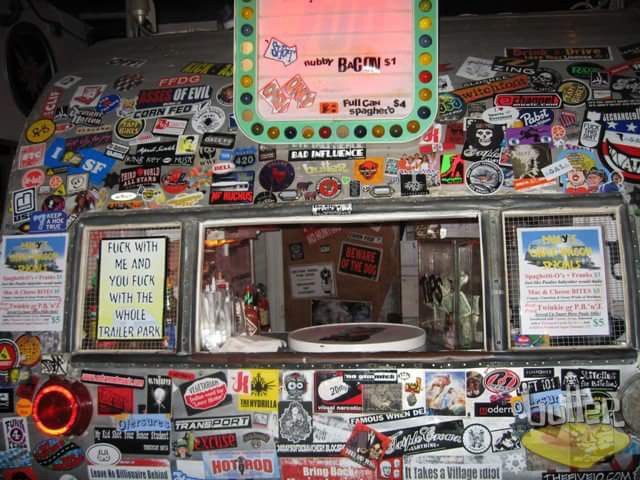
And it’s not just the Tiny House Movement that incites my discontent. From dumpster diving to trailer-themed bars to haute cuisine in the form of poor-household staples, it’s become trendy for those with money to appropriate the poverty lifestyle — and it troubles me for one simple reason. Choice.
The Tiny House Movement began in the ’90s, but has only been rising in popularity since the recession. And to be fair, it’s rooted in a very real problem: more and more people being displaced as a result of soaring housing costs, especially in tech-boom areas like the Bay Area.
[…]
It’s likely, from where I sit, that this back-to-nature and boxed-up simplicity is not being marketed to people like me, who come from simplicity and heightened knowledge of poverty, but to people who have not wanted for creature comforts. For them to try on, glamorize, identify with.
Such appropriation isn’t limited to the Tiny House trend, or even to the idea of simplicity. In major cities, people who come from high-income backgrounds flock to bars and restaurants that both appropriate, and mock, low-income communities. Perhaps the most egregious example is San Francisco’s Butter Bar, a trendy outpost that prides itself on being a true-blue, trailer park-themed bar, serving up the best in “trashy” cuisine and cocktails. With tater tots, microwaved food, and deep-fried Twinkies on the menu, the bar also serves cocktails that contain cheap ingredients, such as Welch’s grape soda. The bar has an actual trailer inside, and serves cans in paper bags, so that bar flies can have a paid-for experience of being what the owners of this bar think of when they think of trailer trash.
Butter Bar in San Francisco (Credit: Facebook)
It’s but one example of an entire hipster movement — can it be called a movement when it’s a subculture rooted not in political consciousness, but in capitalism? — that has brought with it an ethos of poor-culture appropriation and the “re-invention” of things that have largely been tools of survival for poor, disabled, working class, and/or communities of color for decades.
April 3, 2017
Decoding TLAs among the PUAs
Kim du Toit on a specific example of the use of jargon heavily sprinkled with three-letter acronyms (TLAs) and extended three-letter acronyms (ETLAs, or four-letter acronyms) to create or enhance the impression of their specialized insider knowledge, in this case among the pick-up artists (PUAs):
In every cult, there are people who try to set their group aside from the rest of the population with language — in other words, creating a shorthand that only the initiates or insiders know, which (I guess) makes them feel superior to outsiders. Many times, this language is made up of abbreviations or (my particular bête noir) acronyms that create a level of inscrutability to the casual reader or onlooker and render the simplest of statements completely opaque to the uninitiated. (I’ll talk another time about academic language, which shuns abbreviation and acronym in favor of dense, elliptical words and phrases used as a shorthand among fellow academics and gives the users a veneer of erudition, usually false.)
[…]
All this pales into insignificance by comparison to people who toss off expressions like “This beta orbiter tried to neg the AMOG in front of the SHB to increase his SMV.” Allow me to translate: “This weakling who hangs around pretty women trying to curry favor with them tried to cut down a charismatic man in front of a beautiful woman, in order to make himself more attractive to her.” (AMOG = Alpha Male Of [the] Group or Alpha Male Other Guy, SHB = Smokin’ Hot Babe [sometimes V(very)H(ot)B(abe), and SMV = Sexual Market Value.)
I speak here, of course, of the PUA (pick-up artist) community, in which the High Priests have created this entire glossary of acronyms to show that, yes, they are the gate-keepers of knowledge which, if you buy their training manuals or pay to attend their seminars, you too, Mr. Sad Beta Male, can unlock the secrets of access to SHB pudenda (Latin alert) and become a “notch collector” similar to these skilled exponents of the art.
It’s bad enough when used in a sentence, but when used graphically or in a chart to illustrate a concept or theory, it becomes completely opaque. Here’s a beauty which attempts to show the correlation between a woman’s looks and the likelihood of her being bitchy:
VHB10 -> BQ 0
HB9 -> BQ 0-1
HB8 -> BQ 1-2
PJ7 -> BQ 3-4
PJ6 -> BQ 5-7
PJ5 -> BQ 6-10
PJ4 -> BQ 4-10
UG3 -> BQ 1-8
UG2 -> BQ 1-4
UG1 -> BQ 0-3
VUG0 -> BQ 0-1VHB = Very Hot Babe, HB = Hot Babe, PJ = Plain Jane, UG = Ugly Girl, VUG = Very Ugly Girl, and the numeric qualifiers 1-10 are the common delimiters on the Female Hotness Scale (FHS). BQ, by the way, is Bitchiness Quotient, and the numeric qualifiers there are the levels thereof.
Note that this is presented as a scientific analysis or model, when in fact it’s no such thing: it’s a creation solely of the writer’s observation or theory and not by actual, you know, data — but creating acronyms gives it quasi-scientific gravitas — damn it, another Latin word, but you know what I mean, right? It’s kind of a pity, because the author at Chateau Artiste has an excellent way with the English language, when he’s not talking utter bullshit like the above. (Credit where it’s due, though: he also called Trump for the overwhelming electoral victory long before anyone else did, so he’s a more-insightful observer of trends than most mainstream media pundits.)
QotD: Female “pacifism”
I’m really bad at fighting. Oh, not physical fighting, though I suppose I’m bad at that too at this point, since I haven’t been exercising like I used to and I’m not twenty anymore.
And I don’t mean I’m not good at landing metaphorical blows. No. The part I’m bad at is staying angry.
It’s funny, as much as we get accused of “hating” the only things and people I’ve hated are historical people and regimes that have killed millions of their citizens. Yeah, yeah, I hate red and black fascism, aka Nazism and Communism like I hate hell, all Capulets and … well. Not thee. The other things I hate are more things I strongly dislike: Licorice, bad, preachy books, teachers who don’t do their job, cold days. I don’t spend my time sitting around and going “I hate you snow, I do.” I just mumble disconsolately about not being able to walk and my fingers hurting with cold even while inside.
There is on the left this certainty that women are more peaceful than men that I think comes from two things: first the empathy which women have, or at least display more, which is part of raising infants; two women’s inability to stay burning at peak flame and the ability to find excuses for even the worst misdeeds, in order to keep their “tribe” together. What my mom called “Mothers always love the worst child the best.” (I never asked whether this was an admission I’m her favorite.)
This doesn’t mean, mind you, that women are not capable of aggression and war. I’ve said before that having attended an all-girl high school I could tell these people something about women and fighting.
It’s just that when women are bad, they’re very, very bad. They tend to fight in an underhanded way that leaves plausible deniability and the ability to pose as an angel before the world.
Sarah A. Hoyt, “Weaponized Empathy”, According to Hoyt, 2015-09-06.
March 7, 2017
QotD: Boys, girls, and Noblesse oblige
Men are bigger and stronger than women. We’re talking women on average, of course. I think right now I’m bigger than my husband, though he’s still stronger. And probably Lizzy Lifter is stronger than Geoffrey Geek who spends his entire time playing computer games and never sees the sun. BUT on average, over the population, men are so much stronger/faster/physically able than women that any random man can overpower any given woman.
So, why aren’t ALL women victims of domestic abuse? Why are women even outside, without being raped? (And if you think all women are victims, you must be living in an Arab country, where those two above are the pre-assumptions of the cultural norms.) How is this possible? Why don’t men press home their advantage?
Well, first because men aren’t a group with “group consciousness.” Contrary to what “feminists” seem to think, men are not alien creatures who reproduce by fission. They’re women’s children, friends, brothers, fathers. So of course, being human, they care for some women and they’re decent enough to extrapolate their feelings to strange women. (And Women’s Studies programs make a lot of those.)
But more than that, there’s a built in noblesse oblige that prevents men from pressing home their last advantage. Our society runs with it, and is soaked deep with strains of female privilege.
No?
Well, take your three year old boy to a playground. Have him get in a fight with a girl. At that age, their strengths are equivalent, and the girl might be larger and stronger (girls develop faster.) Have him punch her. What do you do? You pull him back and say “you don’t hit a girl. Ever, ever, ever.”
At which point if the girl is a little sh*t who wasn’t taught her part in the bargain, she will beat him to a pulp, but never mind.
You do it because you have to. This is not some fossilized rule. It’s because if your boy doesn’t have that trained into him REALLY early, he’ll hit thirteen and seriously injure a girl. Worse, in an intimate relationship with a girl (should he turn out to like them) he will lose his cool (we all do) and suddenly become a wife abuser. Because the chances his wife will be smaller and weaker than himself are high.
So you tell your three year old this “arbitrary” rule and establish the boundaries of “female privilege” to stop him from becoming a monster when the imbalance of (physical) power sets in.
Of course, the rule has its opposite. Because women have power too, in the relationship. Oh, sure, not at three, when they’re just annoying, extra-whiney little boys as far as boys are concerned. (Average, statistical girls, that is. Some of us were Vengeance of G-d hellions.)
I tell you as the girl who was often pulled back from these with “girls don’t fight” or “girls don’t hit boys in public” but most often (my being outsized for my time and place) with “you don’t hit people smaller than you. Ever, ever, ever.”
Sarah Hoyt, “Noblesse Oblige and Mare’s Nests”, According to Hoyt, 2015-05-05.
February 28, 2017
How to Make Medieval Stocks – Torture Your Friends and Family With This DIY Pillory
Published on 7 Oct 2016
You can make this fun DIY medieval torture device in a weekend! FREE PLANS and full article►► http://woodworking.formeremortals.net/2016/10/how-to-make-medieval-stocks-pillory/


