Quotulatiousness

April 11, 2011

Budget was over-optimistic, but promises based on that budget are fantasies

Filed under: Cancon, Economics, Politics — Tags: , , — Nicholas @ 10:36

Over at the consistently interesting Economy Lab blog at the Globe and Mail, Stephen Gordon casts scorn equally on Liberal, Conservative, and NDP campaign promises:

All parties are using the March 22 budget as a baseline for their scenarios; their platforms enumerate tax and spending plans in terms of deviations from the budget scenario. So the first problem to point out is that the budget’s scenario of freezing nominal expenditures for five years without cutting services or programs is at best implausibly optimistic.

The Liberal platform [. . .] builds on that implausible baseline by overestimating anticipated revenues from an increase in the corporate income tax (CIT) by a factor of 2.5.

The Conservative platform’s variation on its own budget is a promise to identify and implement savings worth $4-billion a year within the next three years without cutting programs or reducing services. No other explanation is offered, but then again, neither do they seem to be able to explain the cuts that were announced in the budget.

But the prize for budgetary opacity must surely go to the New Democrats’ “costing document”. Firstly, their estimate of $9-billion a year from increasing the CIT rate is even more implausible than that of the Liberals: an overestimate by a factor of at least three. The next largest source of revenue — “Tax Haven Crackdown” — is supposed to produce more than $3-billion in 2014-15. I cannot offer you any more in the way of explanation behind that number, because the NDP platform is completely silent on the matter. No measures are announced, no reasoning is offered to explain why those measures might be sensible, and no research is offered to justify the $3-billion estimate. The same goes for the “Ending Fossil Fuel Subsidies” entry: $2-billion a year in extra revenues, again with no explanation, discussion or research.

April 10, 2011

NYC’s backlash against the bicycle

Filed under: Politics, USA — Tags: , , — Nicholas @ 10:19

Stephen Smith does a quick analysis of the reaction to P.J. O’Rourke’s anti-bike article in the Wall Street Journal last weekend:

Could it be that the bike lobby actually has alienated the rest of America (and even New York), playing into stereotypes (Stuff White People Like #61) of spandex-wearing, pasty-legged effete liberals who think that the bicycle is a reasonable tool for, say, intra-Brooklyn house moves? No, says Streetsblog — it must be some sort of advertiser-driven conspiracy. (Does The New Yorker even have an auto section? How many car ads are there in the latest issue?) This article is of course absurd, but I think it’s a symptom of the way that many bike advocates lionize their preferred mode of transit, perhaps unknowingly prioritizing it above even other non-automobile modes.

Don’t get me wrong — I have no problem with bikes, and even bike lanes. I’ve seen the stats on the Prospect Park West lane, about how it’s improved safety without slowing down auto commutes, and I don’t doubt it for a second. But as much as we wish it weren’t so, political capital is an exhaustible resource, and only so many reforms can be made before voters and citizens start to punish the politicians making them. Janette Sadik-Khan is, realistically, only allowed to anger so many people by changes to the status quo — every bike lane she stripes is a Select Bus Service route that won’t be implemented, a Haitian dollar van driver who will be fined and imprisoned, an outer-borough resident who won’t be able to catch a cab because of the medallion system. The fundamental problem, in my opinion, is that bike lanes are very culturally-loaded, and the anger they produce — which translates directly into other projects being shot down — is out of proportion with their benefits.

QotD: The real issue of the election

Filed under: Cancon, Government, Politics, Quotations — Tags: , — Nicholas @ 00:08

What is the issue in this election? Why, the same as in all elections, my libertarian self exclaims. In the last 45 years, the only question has been whether the government implementing the NDP’s policies will be Liberal or Conservative.

OK, my libertarian self exaggerates. Does it exaggerate by much? I don’t think so.

The NDP may do abysmally in federal elections, but the NDP’s ideas flourish. Canada is governed from the middle, yes, but the middle is on the left. The politicians who form our next government will be statist — socialists in all but name — because there are no other kinds running. Our statists may vary in degree, but not in kind. Since the 1960s, classical liberals or conservatives either haven’t entered the arena or changed their policies afterwards. They wouldn’t have had a chance otherwise.

Here’s the irony, though: If socialists called themselves socialists, they wouldn’t stand a chance either. Canadians are funny that way. They’ll buy nothing but socialist policies and practices, but never from socialists. Calling things what they are isn’t politically polite in Canada.

George Jonas, “In Canada, socialists don’t win elections. But their policies do”, National Post, 2011-04-09

April 9, 2011

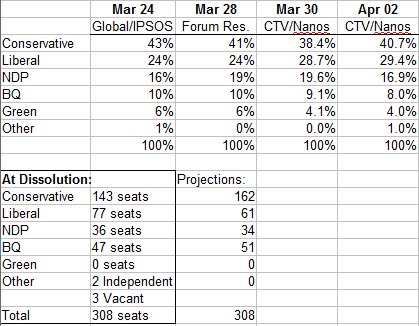
Latest poll: Liberals up, NDP down

Filed under: Cancon, Politics — Tags: , — Nicholas @ 11:22

The Liberals appear to the party primarily benefitting from a slackening in NDP support:

Upheaval in Finnish politics?

Filed under: Europe, Government, Media, Politics — Tags: , , , , — Nicholas @ 00:03

Ilkka is enjoying the spectacle of the “right-thinking” (i.e., left-thinking) folks in Finland who are horrified at the rise of a new party:

Canada will have yet another federal election that will bring yet another minority government, and back in the old country, the parliamentary elections have begun with the first early voting days, and the right-wing protest party True Finns is predicted to grab a significant chunk of the parliamentary seats. The impotent tantrum of the SWPL greens and leftists, along with the media that they still mostly control, reacting to the cognitive dissonance of the working class abandoning them has certainly been a laugh riot. Besides, this whole surge illustrates how just one voice of just the right pitch can smash a sufficiently ossified, smug and complacent echo chamber to little shards of glass by its mere existence. One can only imagine what the Finland of the 1970’s would have been like, had the Internet existed back then to give these voices a voice, as all leftism and progressivism can keep the reality at bay only if they get to have a totalitarian control of all media to constrain the parameters of debate.

April 8, 2011

Graphic illustrating why I don’t expect my MP to change

Filed under: Cancon, Politics — Tags: , , , , — Nicholas @ 00:06

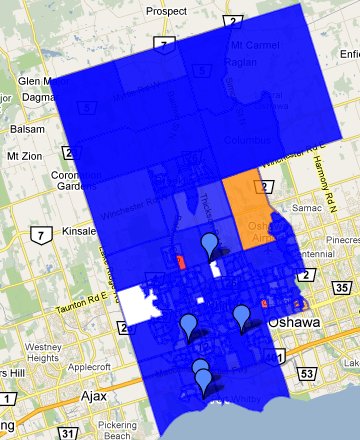
Whitby-Oshawa 2008 votingWhitby-Oshawa 2008 legendHere’s the riding of Whitby-Oshawa in the 2008 election. Notice all that deep blue colour? As the legend says, the opacity of colour indicates the strength of the party in that area. Up in the Brooklin area, you can barely see the underlying road pattern for all the blueness.

You can find how blue (or red, or whatever) your riding is by using the cyberpresse.ca Interactive map (this is now available in English: the original was in French). It’s another illustration of how to use Google Maps to display geographical data in interesting ways.

This time around, I’ll at least have a Libertarian candidate to vote for: Josh Insang is running for the Libertarian Party. Check the LPC Candidate page to see if you have a Libertarian running in your riding.

April 6, 2011

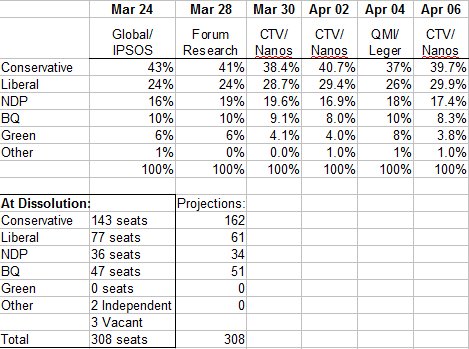
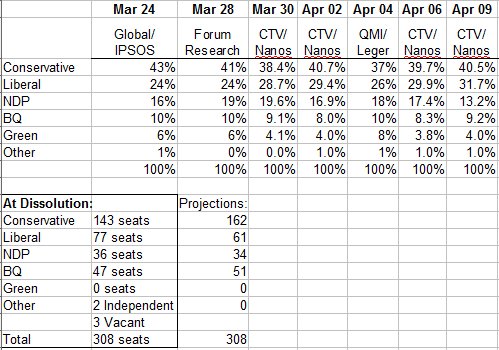
Latest polling results

Filed under: Cancon, Politics — Tags: , — Nicholas @ 07:46

April 5, 2011

Monbiot: the anti-nuclear lobby has mislead us all

Filed under: Media, Politics, Science — Tags: — Nicholas @ 09:50

George Monbiot has had an uncomfortable year of revelations. Full credit to him for being willing to admit in public that he was wrong:

Over the last fortnight I’ve made a deeply troubling discovery. The anti-nuclear movement to which I once belonged has misled the world about the impacts of radiation on human health. The claims we have made are ungrounded in science, unsupportable when challenged, and wildly wrong. We have done other people, and ourselves, a terrible disservice.

I began to see the extent of the problem after a debate last week with Helen Caldicott. Dr Caldicott is the world’s foremost anti-nuclear campaigner. She has received 21 honorary degrees and scores of awards, and was nominated for a Nobel peace prize. Like other greens, I was in awe of her. In the debate she made some striking statements about the dangers of radiation. So I did what anyone faced with questionable scientific claims should do: I asked for the sources. Caldicott’s response has profoundly shaken me.

First she sent me nine documents: newspaper articles, press releases and an advertisement. None were scientific publications; none contained sources for the claims she had made. But one of the press releases referred to a report by the US National Academy of Sciences, which she urged me to read. I have now done so — all 423 pages. It supports none of the statements I questioned; in fact it strongly contradicts her claims about the health effects of radiation.

I pressed her further and she gave me a series of answers that made my heart sink — in most cases they referred to publications which had little or no scientific standing, which did not support her claims or which contradicted them. (I have posted our correspondence, and my sources, on my website.) I have just read her book Nuclear Power Is Not the Answer. The scarcity of references to scientific papers and the abundance of unsourced claims it contains amaze me.

H/T to Chris Greaves for the link.

Update: Here’s wormme with a remarkably timely example of the sort of thing that George Monbiot encountered:

And Rana included this report, subtitled “Experts warn that any detectable level of radiation is “too much”.”

The only “experts” who would say that are political activists who are either ignorant of science or traitors to it.

“The U.S. Department of Energy has testified that there is no level of radiation that is so low that it is without health risks,” Jacqueline Cabasso, the Executive Director of the Western States Legal Foundation,

There’s only three possibilities here: 1) whoever testified for the DOE did a truly awful job (doubtful), 2) Ms. Cabasso misunderstood the testimony and paraphrased it according to her liking (quite likely), or 3) Ms. Cabasso is a dirty little liar (don’t rule it out).

For chronic (long-term) concerns, the DOE (and NRC) use the linear no-threshold model.

“But what does that mean,” our non-geeks cry. It means it’s assumed that any increase in dose is an increase in long-term risk. No threshold, see?

So is this model true? No. Anyone expert in radiation knows it isn’t true, because we have the whole wide world to look at. And natural doses vary greatly. People pick up between 200 and 2000 mrem/year (2-20 mSv). With absolutely no harm observed at higher doses, so how is there heightened risk? And thousands of Taiwanese picked up 5000-6000 mrem/year (50-60 mSv) for years and years and had a much lower incidence of cancer than usual.

Then why do the DOE and NRC assume risk? Because they couldn’t prove there isn’t. Still can’t, despite the real world examples above.

But that is also true about everything. Marshmallows have killed in the past, and they will in the future. Dihydrogen oxide is the greatest mass murderer of all time.

Ionizing radiation is held to standards that would basically outlaw every other activity and material on earth. Fukushima is proof of that. No one has been killed by radiation, but we’re staring at maybe 25,000 dead. And how much have we heard about non-nuke carcinogens, no doubt swirling around by the ton?

The Wikileaks view of Indian politics

Filed under: Government, India, Media, Politics — Tags: , — Nicholas @ 09:03

Pankaj Mishra talks about the ongoing release of information on India and the political and mercantilist string-pullers who infest every government function:

Food prices become intolerable for the poor. Protests against corruption paralyse the national parliament for weeks on end. Then a series of American diplomatic cables released by WikiLeaks exposes a brazenly mendacious and venal ruling class; the head of government adored by foreign business people and journalists loses his moral authority, turning into a lame duck.

This sounds like Tunisia or Egypt before their uprisings, countries long deprived of representative politics and pillaged by the local agents of neoliberal capitalism. But it is India, where in recent days WikiLeaks has highlighted how national democratic institutions are no defence against the rapacity and selfishness of globalised elites.

Most of the cables — being published by the Hindu, the country’s most respected newspaper in English — offer nothing new to those who haven’t drunk the “Rising India” Kool-Aid vended by business people, politicians and their journalist groupies. The evidence of economic liberalisation providing cover for a wholesale plunder of the country’s resources has been steadily mounting over recent months. The loss in particular of a staggering $39bn in the government’s sale of the telecom spectrum has alerted many Indians to the corrupt nexuses between corporate and political power.

April 4, 2011

Politics: Tories have terrible week, yet are up to 14 point lead

Filed under: Cancon, Politics — Tags: , — Nicholas @ 09:34

The most useful polling right now is coming from Nanos Research, who are conducting daily summaries of the previous three-day trend. After getting slapped around by the press much of last week, the Conservatives are . . . the only party making gains over the last three days:

  • Conservative: 42%, up 1.6%
  • Liberal: 28%, down 1%
  • NDP: 16%, down 0.5%
  • Bloc Quebecois: 8%, unchanged
  • Green: 4%, down 0.2%

The Twitter reactions are . . . surprised. Paul Wells “If the Conservatives lost week one and gained four points, the Liberals can’t afford to win many more weeks.” Andrew Coyne “Another such victory and I come back to Epirus alone.”

Updating the non-scientific, unbalanced sample of published polls:

“Free speech is a great idea, but we’re in a war”

Filed under: Government, Liberty, Politics, Religion, USA — Tags: , , , — Nicholas @ 09:17

I love the smell of censorship in the morning. It smells like politics:

[Senator Lindsey Graham said] “I wish we could find a way to hold people accountable. Free speech is a great idea, but we’re in a war. During World War II, we had limits on what you could say if it would inspire the enemy. So, burning a Koran is a terrible thing but it doesn’t justify killing someone. Burning a Bible would be a terrible thing but it doesn’t justify murder. Having said that, anytime we can push back here in America against actions like this that put our troops at risk we should do it, and I look forward to working with Senators Kerry, and Reid, and others to condemn this, condemn violence all over the world based on the name of religion. But General Petreaus understand better than anybody else in America what happens when something like this is done in our country and he was right to condemn it and I think Congress would be right to reinforce what General Petreasus said.

[. . .]

Here’s your answer Senator. No, you don’t need to hold hearings and you don’t need to be looking into ways to limit the free speech rights of American citizens because of the insane reaction of people thousands of miles away who were obviously ginned up by demagogues. War or not, Terry Jones had every right to do what he did.

Jim Geraghty perhaps put it most appropriately:

This pastor, Terry Jones, has a jones for media attention that makes the Kardashians look like J.D. Salinger. He knows that there’s a good chance that tossing the Koran on a pile of charcoal briquettes will make the easily-enraged in far-off lands lash out in that time-tested tradition, killing aid workers, and he doesn’t give a damn. He knows there’s a chance that the Muslim tantrums might put our men and women in uniform at greater risk. He still doesn’t give a damn. He has never given a damn. What, he’s gonna go weak-kneed at the thought of a unanimous Senate resolution?

April 3, 2011

QotD: The reason not to anticipate a simpler tax system

Filed under: Cancon, Economics, Politics, Quotations — Tags: , — Nicholas @ 12:54

But boutique credits are smart politics. First, they appeal to people’s sense that they deserve a break, validate their choices, and reaffirm their sense of self-worth. The Children’s Art Tax Credit goes to good parents, ones who enroll their children in Suzuki violin lessons, not bad parents who spend their money on beer and popcorn. Second, they give people a sense of control. Tax liabilities stop being something outside of an individual’s control. Instead, the plethora of credits available mean that taxes can be reduced through planning and wise choices.

Policies are smart politics for a reason: they appeal to voters. If economists want to have a positive influence on the policy debate, they have to understand voter psychology: why do voters like special tax credits so much? “Smart politics” isn’t a criticism. Sometimes it’s a way of saying “I don’t understand why people like this policy.” At other times, it’s a way of saying, “I understand why this policy appeals to people, but if they were well-informed, they would think otherwise.”

There’s no point in telling politicians that a particular policy is “smart politics, bad economics.” They’ll take it as a compliment, and keep on making the same kind of policy choices.

Frances Woolley, “Economy Lab: Why politicians love boutique tax credits”, Globe and Mail, 2011-04-03

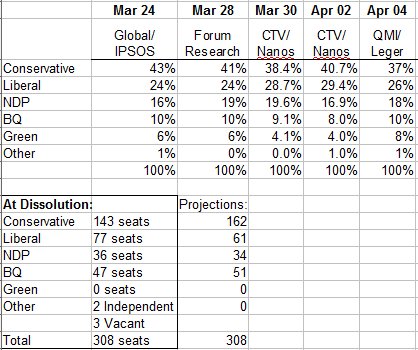
Latest polling numbers

Filed under: Cancon, Politics — Tags: — Nicholas @ 12:36

The Tory lead continues to hold fairly steady, in spite of the drumbeat of disapproval from the newspapers:

April 2, 2011

QotD: The nature of Harper’s “slap in the face” to Quebec

Filed under: Cancon, Economics, Politics, Quotations — Tags: , , , , — Nicholas @ 12:19

I labour over this history to place in context the astounding, even outré, comments offered by Canada’s First Separatist, Gilles Duceppe, on hearing of the proposed arrangement — which, I hasten to mention, is merely a $4.2-billion loan guarantee from Ottawa, not some massive outright subsidy. Mr. Duceppe, with a logic that can only belong to a man who gets paid to be a separatist by the government he’s trying to extinguish, called the deal “a direct attack on Quebec.”

What really bothers Mr. Duceppe and other separatists is that they want to retain Quebec’s monopoly on southbound power sales to the United States — something the Lower Churchill project, including its 1,100 km of underwater transmission cables, would threaten. “By financing the Newfoundland project, Stephen Harper has given Quebec a slap right in the face,” the BQ leader declared.

It’s one of the continuing risibilities of the Canadian federation that we cosset and pamper and pay for the separatist faction in the House of Commons, and go along with the pretense that they’re parliamentarians like any other. They are not. They displace the natural balance of the federation. They have a vested interested in seeing the parliament they attend not working. And they leap to any perceived or manufactured imperfection in our system as evidence of dark perfidy or contempt for Quebec. They warp the system. Nowhere do these observations meet with greater validation than these ludicrous comments by Duceppe on the proposed assistance to the Lower Churchill.

Rex Murphy, “Newfoundland’s three-gigawatt insult to Gilles Duceppe”, National Post, 2011-04-02

March 31, 2011

Corcoran: Harper’s family tax plan full of “shabby contradictions”

Filed under: Cancon, Economics, Politics — Tags: , , — Nicholas @ 12:28

I think it’d be fair to say that Terence Corcoran is not a fan of Stephen Harper’s proposed “family tax plan”:

By calling this a “family tax cut,” and playing it as a matter of tax fairness, the Conservatives have managed to gloss over the shabby contradictions it introduces into Canadian tax policy. The Tory announcement said that the United States, France and other countries allow some form of income splitting. They do, but that’s not saying much about taxation or fairness.

France has a full-blown family tax regime, in which the incomes of both spouses are blended at a tax rate that is based on a formula that includes the number of children. But so what? France has one of the highest marginal tax rates in the world, and a notoriously dysfunctional tax burden that distorts behaviour and incentives. The U.S. income-splitting regime isn’t exactly revered for its soundness, in part because it clearly discriminates against single earners or anyone not part of a married couple. Nor are children a requirement to be part of the U.S. splitting regime.

[. . .]

The Harper family tax cut, based on the debatable tax policy ideal of taxing families instead of individuals, is a misguided income-splitting scheme that demonstrates once again that the Conservatives will never, ever get around to cutting personal income tax rates. The cost of the family tax cut will come at the expense of across-the-board income tax cuts for other Canadians. To pay for the family cut, other Canadians will have to continue to pay marginal tax rates that are too high.

The family tax cut, in some ways, is just another tax expenditure, a special tax treatment aimed at fulfilling some social-policy objective. The major beneficiaries are likely to be higher-income single-earner couples with children. Everybody else is out of luck.

To pull out the old saying, “that’s a feature, not a bug” to the Conservative party faithful.

« Newer PostsOlder Posts »

Powered by WordPress