Quotulatiousness

April 21, 2011

News topic for today: the rise in NDP support in Quebec

Filed under: Cancon, Politics — Tags: , , , , , , — Nicholas @ 08:04

It may be just another blip in the polling, or it could really be the NDP benefitting from weaker BQ numbers. Lots of trees will be consumed in this debate, and many electrons will be inconvenienced. The national numbers don’t show the pattern all that well, but the NDP may finally be close to that popularity breakthrough they’ve been hoping for since the brief taste of power they got in the Trudeau years. Instead of asking the Liberal leader how many NDP cabinet seats he’d need to give to Jack Layton, we might be asking Jack how many Liberal cabinet ministers he’d have in his coalition.

Jack Layton’s New Democratic Party has surged past Gilles Duceppe’s faltering Bloc Quebecois and is now in first place in Quebec, according to an Ekos public opinion poll released exclusively to iPolitics.

The poll, conducted earlier this week, found the New Democrats have jumped 10 percentage points since the eve of the leaders debate to 31.1% while the Bloc has dropped like a rock by 7.4 percentage points to 23.7%.

The Liberals are steady at 20.6% while the Conservatives have dropped slightly to 16.9%.

While the margin of error is higher at the city level, in Montreal the NDP is at 32.9% while the Bloc is at 29.7%.

Nationally, the NDP is now in a statistical tie with the Liberals at 24.9% to 25.8%. Both lag well behind the Conservatives who were preferred by 34.5% of respondents.

Update: Jane Taber has more on the regional breakdown:
Atlantic Canada now is shaping up to be a three-way race, with the NDP gaining every day for the past seven days. The Tories are at 36.3 per cent followed by the Liberals with 33.1 per cent and the NDP at 28.3 per cent. (There is a margin of error of plus or minus 9.7 percentage points, 19 times out of 20 in the regional sample.)

In British Columbia, the Liberals have dropped significantly — Mr. Ignatieff has seen his support decrease from 33.5 per cent Monday to 22.7 per cent Wednesday night. The Conservatives have 43.5 per cent support and the NDP are at 29.6 per cent, up from 24.7 per cent the night before. (The margin of error in that province is plus or minus 7.9 percentage points, 19 times out of 20.)

In Quebec, Mr. Layton remains strong although the Bloc is still in first place with 32 per cent support compared to 23.4 per cent for the NDP, 20.8 per cent for the Liberals and 17.5 per cent for the Conservatives. “At 32 per cent it would be the worst ever showing for the BQ in a federal election,” Mr. Nanos said, noting that their previous worst showing was in 1997 where they won 37.9 per cent of the vote.‬

If all of this isn’t just a blip, it’s terrible news for Michael Ignatieff. That grinding noise you hear is the knife-sharpening back at Liberal HQ.

Update, the second: If the initial news was promising for Jack Layton, the poll done for La Presse must have been like a big shot of adrenalin:

A new poll by CROP for La Presse suggests that the enthusiasm for Mr. Layton is such that the NDP has now overtaken the Bloc Québécois in voting intentions for the first time in Canadian history. The online poll suggested that the NDP is now first choice for 36% of Quebecers, compared to 31% for the Bloc, 17% for the Conservatives and a mere 13% for the once mighty Liberal Party.

Having heard the NDP boast about “historic breakthroughs” over the years, I’m loath to get too carried away until these numbers are confimed by other pollsters. In 2008, Mr. Layton was in a statistical tie with Stéphane Dion two weeks before election day but ended up trailing by eight points and 40 MPs.

Yet there are signs this time might be different. In Quebec in particular, the Liberal brand is damaged goods and the Bloc is looking like a tired, one-trick pony. There is nowhere else to go for left-of-centre voters.

Update, the third: Forum Research says that the NDP is already in second place nationally:

“The Tories are ahead everywhere except Quebec, it’s all going to come down to what happens in Quebec,” says Mr. Bozinoff, noting the tradition of Quebec voters to move en masse when they have sharply changed preferences in past elections.

The survey of 2,727 voting-age Canadians was conducted Wednesday evening. It was an interactive voice response survey with a margin of error of plus or minus 2.2 per cent 19 times out of 20. The margin of error for regional and provincial breakdowns is slightly higher, but in such a large survey, with 348 citizens reached in the GTA alone, it is a reliable indicator of election trend lines.

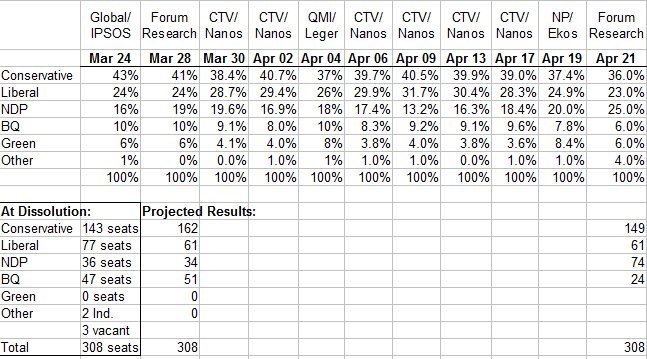
Nationally, the survey gave the Conservative Party support from 36 per cent of decided and leaning voters, 25 per cent for the NDP, 23 per cent for the Liberal party, and six per cent each for the Green Party and the Bloc Québécois. A separate Forum Research analysis, based partly on ridings won and lost in the 2008 election, suggest the survey results would give the Conservatives 149 of the 308 Commons seats if an election were held today, with 71 seats for the NDP, 64 for the Liberals and the Bloc Québécois would have 24 seats.

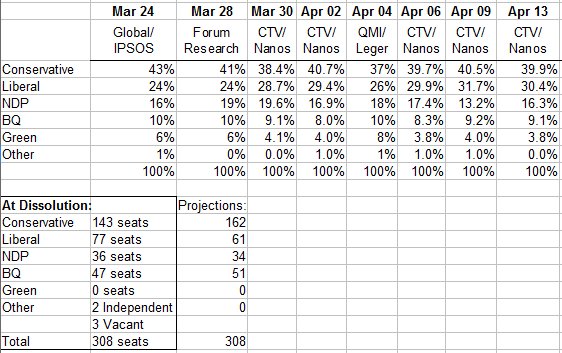
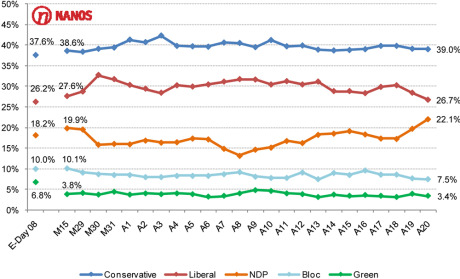
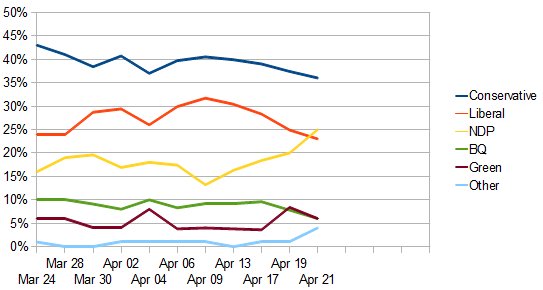
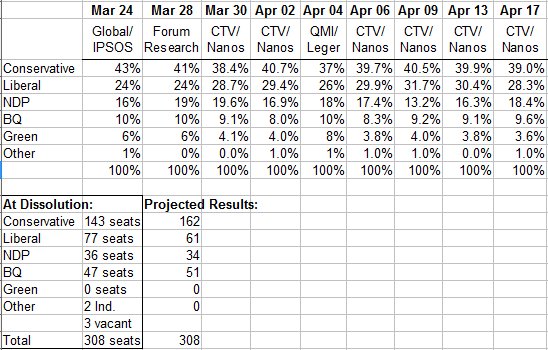
My occasionally updated percentage tracker, now (thanks to commenter request) with a graph to match:
April 20, 2011

Michael Ignatieff as a modern Kaiser Wilhelm II?

Filed under: Cancon, Germany, History, Politics, WW1 — Tags: , — Nicholas @ 13:00

This is a fascinating article. I’m not sure I agree, although we’ll find out in less than two weeks if this is the “Black Day of the German Army Liberal Party”:

The Liberal party, like the Kaiser’s Germany, is stuck in the middle. (An analogy I do not expect any Liberal to use in public, ever.) To the right is the Conservative party. To the left, the NDP. Every election campaign is a two-front war.

To deal with this mortal peril, the Liberals have traditionally followed their own Schlieffen Plan.

In the event of electoral war, the Liberals move swiftly to the left. Taking ground from the NDP ensures vote splits go their way but also creates the perception that the NDP is out of the fight. Voters whose primary concern is stopping the barbarians in the East — the Conservatives, naturally — are thus forced to support the Liberals.

Now, here comes the part of the column Michael Ignatieff won’t like.

Modern bigotry

Filed under: Britain, Media, Politics — Tags: , , — Nicholas @ 12:27

Brendan O’Neill says that the worst form of bigotry today is the liberal elites’ view of the working classes:

We often hear of self-loathing Jews, but what about self-loathing proles — working-class people who look back with contempt at the communities they had the misfortune to grow up in? There’s a very good example of it in today’s Guardian, in this column by Lynsey Hanley, a woman who has made a writing career on the back of the fact that she grew up on a council estate. (It is testament to the middle classes’ continuing colonisation of the media that Ms Hanley can be treated as a curious novelty by Granta and the Guardian, almost as a messenger from some distant, dark planet, simply because she once lived in social housing.) Ms Hanley writes of the “terrible ignorance” of the community she used to live in, prior to her moral and mental rescue by “metropolitan elite liberal values”.

Perhaps keen to assure her current employers that she is now one of them and has been scrubbed clean of any trace of working-class brutishness, Ms Hanley sneers at the “view of life” that held strong in the community she was born into. These people were “paranoid, suspicious, mistrustful, misogynist and racist”, she says. She heaps disdain on the “social conservatism” of white working-class communities, which are given to “silently or violently rejecting anyone who is different or who expresses a different opinion to that of the crowd”. Thankfully for her (and let’s face it, probably for the community she was born into), Ms Hanley escaped from this “crowd” (in pre-PC times they called it “the mob”) by embracing what she refers to as metropolitan, liberal values. She pleads with New Labour not to ditch these values, since there might be other “provincial working-class teenagers” who, like Ms Hanley, also want to be rescued.

[. . .]

What’s more, Ms Hanley’s dutiful provision of moral porn for the chattering classes, who so enjoy reading about the weird goings-on in mysterious council estates over breakfast, speaks to the prejudices that are rife amongst the community she has now embraced: the “metropolitan liberal elite”. The great irony of this elite’s war on the wantonness, gluttony, slothfulness and bigotry of the little people is that it is fuelled by a bigotry of its own, a respectable, PC form of bigotry — one which treats the white working classes as unenlightened Daily Mail drones in need of moral deliverance by sussed outsiders. It is not the working classes who “silently or violently reject anyone who is different”; rather it’s this increasingly intolerant metropolitan elite, which can’t even abide the fact that some communities eat and drink differently, never mind think differently, to itself. In presenting Britain as being neatly split between a morally superior race of liberals and mongrel race of paranoid racists, Ms Hanley and others are unwittingly rehabilitating the very prejudices that originally fuelled the politics of racism in the 19th century: a mean-spirited, Malthusian view of Britain’s own native lower classes as morally defunct.

April 18, 2011

True Finn party surges to 39 seats in Finnish election

Filed under: Europe, Politics — Tags: , , , , — Nicholas @ 15:53

From nowhere to third-largest party:

The True Finns finished just behind the conservative NCP and the Social Democrats on around 19%.

While the Social Democrats have called for changes on EU bail-outs, including the planned Portuguese rescue, True Finns opposes the plans altogether.

A hostile Finnish government could theoretically veto the package.

Unlike other eurozone countries, Finland’s parliament can vote on whether to approve the measures.

Correspondents say the increased sway of Euro-sceptics in Finland’s parliament could hold up any further bail-out deals.

As the biggest party, the NCP is tipped to lead the next government with former Finance Minister Jyrki Katainen likely to become prime minister of whatever coalition emerges, replacing Mari Kiviniemi of the Centre Party.

Gavin Hewitt called it a “tremor” with an “epicentre” in Finland:

A few years ago the True Finns were a fringe party, that received almost no attention. So what happened? The vote was not just about the bailout. There was anxiety about unemployment and fears of a jobless economic recovery. Reductions in pensions had angered many workers. The party also tapped into fears about immigration.

What makes this election so significant is that it follows a pattern across Europe. Establishment and incumbent parties are being rejected. Nationalist parties are gaining influence.

In the Netherlands, the anti-Islam MP Geert Wilders leads the country’s third largest party. In Italy the Northern League — hostile to immigration and wary of the EU — is increasingly powerful. In France, Marine Le Pen — who wants to abandon the euro — is showing strong support in the polls.

Recently, writing in the Financial Times, Peter Spiegel questioned whether we were seeing the emergence of a European Tea Party. Certainly there is a strong sense of alienation and dissatisfaction. Immigration is a key factor. It is shaking governments. There are more than 24 million people without work in the EU and there is no appetite to welcome new arrivals. That is why the migrants from Tunisia are sparking such tension between Italy and France.

As important as immigration is unemployment. In countries like Italy and Spain there is talk of a “lost generation” that cannot find work. There is a growing awareness that Europe may be a low-growth area.

H/T to Elizabeth, who reminded me that I had an obligation to report the final results after having posted links to the election race twice before.

April 17, 2011

Steve Paikin on moderating the leaders’ debate

Filed under: Cancon, Media, Politics — Tags: , — Nicholas @ 09:55

Everyone is watching the debate to hear what the leaders say. Nobody tunes in to watch the moderator, so the best moderator is the one who manages to keep the debate moving smoothly but remains mostly invisible to the viewers. Steve Paikin was the moderator for the leaders’ English language debate this time around. He has a post on his experiences:

I’ve had the honour of moderating two previous federal leaders’ debates, and both times, the four minutes of waiting for the top of the clock can be agonizing. It’s not an exaggeration to say that in 2006 — the first time I ever participated in a leaders’ debate at any level — I felt like vomiting during those four minutes. Yes, I was that petrified.

So I cracked a joke.

“I don’t know what you guys are so nervous about,” I said to them. “You’ve all done this before. I never have.”

For all the criticism that he’s wooden and humourless, it was actually then opposition leader Stephen Harper who had a funny comeback.

“Yeah,” he said, “but you’ve got someone talking in your ear to help you. We’ve got nothing.”

So how about that whole “being invisible” part of the moderator’s role?

For some reason, I always seem to mess something up. The first time in 2006, I had forgotten to turn off my BlackBerry. As I was reading the introduction, I felt it buzz. How embarrassing was it going to be to have my phone ring as I was 30 seconds into my script. Somehow, I reached down and silenced it as I was reading the intro. Then the TelePrompter broke, so I quickly had to find my place in the script and keep reading, trying to make it all look seamless. Was someone trying to give me a heart attack?

This year, I somehow managed to kick the wiring out of the monitor on my desk, again, while reading the intro, meaning I spent the entire two hours flying blind. I couldn’t see the videos of the questions and couldn’t see what shots were being used during the broadcast. I spent the first five minutes of the debate playing with the wires, trying to reattach them, hoping the camera wasn’t catching me trying to play technician. Ultimately, I gave up.

Was the debate a good television experience? I don’t know. I never saw it.

Latest polling data

Filed under: Cancon, Politics — Tags: , — Nicholas @ 09:38

This is why the Finnish election matters to Portugal

Filed under: Economics, Europe, Politics — Tags: , , , — Nicholas @ 09:00

Unlike most other EU states, Finland has an option of putting the bailout to a vote:

Opinion polls suggest the True Finns have nearly quadrupled in popularity since the last election though they are unlikely to enter government.

Analysts see mainstream parties taking a harder line on the EU as a result.

Unlike other eurozone states, Finland can put requests for bail-out funds to a majority vote in parliament.

Since any bail-out must be approved unanimously by all 17 eurozone members, a hostile Finnish government could theoretically veto it.

The outcome of Sunday’s election may affect EU plans to shore up Portugal as well as impacting on stability in debt markets.

April 15, 2011

Finnish election still up for grabs

Filed under: Europe, Politics — Tags: , , — Nicholas @ 15:11

Remember I mentioned the “True Finns” party in passing last week? The election is this weekend and it looks like a four-way race:

Finland votes on Sunday in its most closely watched general election in years, with the campaign hijacked by a Eurosceptic maverick riding roughshod over the consensus that has long characterised the country’s politics.

Timo Soini has alarmed the European and Finnish elites by leading his True Finns party into a neck-and-neck position with the three mainstream parties that traditionally dominate Finnish politics.

The quadrupling of support for the True Finns since the last election in 2007 puts Finland firmly in line with the cardinal trend in politics across Europe in the past year — the emergence of the populist far right combining nostalgia for disappearing values and traditions with anti-immigrant and anti-EU appeal.

An opinion poll on Friday put the True Finns at around 16% in a coalition system, soaring from 4% in 2007 albeit sliding a little from their position in surveys last week. That put True Finns neck and neck with the Centre party of the prime minister, Mari Kiviniemi, and the opposition social democrats, and a few points behind the poll leaders, the National Coalition party led by the finance minister, Jyrki Katainen.

Steve Paikin interviews Rick Mercer

Filed under: Cancon, Humour, Media, Politics — Tags: , , — Nicholas @ 14:26

Arousing the voters, Menorcan style

Filed under: Europe, Media, Politics — Tags: , , , — Nicholas @ 09:45

It’s a perennial problem: how do you manage to get the voters interested in your candidacy? How can you get them excited? Sole Sánchez Mohamed has an answer for you:

A Menorcan political candidate has caused a bit of a rumpus ahead of Spain’s forthcoming municipal elections with a seriously in-your-face advert in the local press.

Sole Sánchez Mohamed, head of the Partit Democràtic de Ciutadella (PDC), posed with an evidently willing pair of male hands to make her point, or rather, pair of points. The caption declares: “Two great arguments.”

To further her election cause, the wannabe mayoress of Ciutadella appeared in monthly magazine Més Iris Menorca dressed only in her smalls while adopting “sadomasochistic poses”, as you can see here (NSFW).

And you folks complain about “attack ads” in Canadian elections.

RAF proves Eurofighter can take out stationary, unmanned, abandoned enemy tanks

Filed under: Africa, Britain, Military, Politics — Tags: , , , , — Nicholas @ 09:29

In a triumph of military daring and precision bombing public relations, the Royal Air Force has demonstrated the ground-attack capability of their Eurofighter Typhoon aircraft:

The RAF has blown up two apparently abandoned Libyan tanks using a Eurofighter Typhoon jet in a move which appears to have been motivated more by Whitehall infighting than by any attempt to battle the forces of dictator Muammar Gaddafi.

[. . .]

The video appears to show a T-72 tank neatly parked, stationary and unmanned: the target was plainly not in use. The Telegraph reports that the location struck was “an abandoned tank park”. Many Libyan armoured vehicles are old and not serviceable due to lack of parts and servicing. RAF sources admitted to the paper that the jets making the strike had had to spend “a long time” searching before they could find a valid target to hit, and that the timing of the strike was “no coincidence”.

So why is the RAF not only conducting unnecessary air attacks on useless hunks of metal? The answer is not so much military as it is political:

This hasty effort by the RAF to get Typhoons into ground-attack action took place just ahead of the scheduled release by the Parliamentary Public Accounts Committee of a damning report on the Eurofighter, titled Management of the Typhoon project. This report had been expected to be highly critical of the Typhoon, and indeed it is. It says:

In 2004, the Department decided to retire the ground attack Jaguar aircraft early and to spend £119 million to install ground attack upgrades on early Typhoons to cover the resulting capability gap. These upgrades were ready for use by 2008. A year later, the Department decided to retire the air defence Tornado F3 aircraft early to save money and therefore re-prioritised Typhoon away from ground attack missions to air defence tasks. It is now not using Typhoon’s ground attack capability.

So, absent some secret plan of the Libyan army to somehow put their abandoned equipment back into immediate use, this was a PR strike to rally public opinion against parliamentary interference.

April 14, 2011

Scott Feschuk is one of those “ethnic voters” for the Harper photo-op

Filed under: Cancon, Humour, Politics — Tags: , , — Nicholas @ 09:38

Scott Feschuk is delighted to have the opportunity to have his photo taken with the prime minister. He’s overjoyed:

What a moment.

I never thought that I — a regular, ordinary Canadian — would get the chance to have my photo taken with the Prime Minister of Canada.

But as luck and crass political calculation would have it, he’s eager to be seen with me! All I have to do is attire myself in such a manner as to flamboyantly display my heritage, thereby rendering me a subhuman prop that Stephen Harper can exploit to woo more of my kind.

Needless to say, I’m in.

As is true of much national folklore garb, it can take quite a while to get into my ethnic costume. Each item has been carefully selected to represent a historic and sacred element relating to my suitably exotic but non-threatening culture.

Join me, won’t you, as I get dressed.

I think I can speak for all of us about our deep gratitude that this blog post is not illustrated.

It’s also nice to see that the Conservatives have not yet figured out how to avoid handing their opponents such wonderful opportunities for mockery.

Original tempest-in-an-ethnic-teapot here. 680News reported yesterday that the staffer who wrote the letter is no longer working for the candidate.

April 13, 2011

Surprisingly little movement in the polls

Filed under: Cancon, Politics — Tags: , — Nicholas @ 12:07

So far, based on the three-day sample Nanos works with for their daily poll release, there hasn’t been a lot of identifiable shifting support among the parties in spite of the leaked AG report:

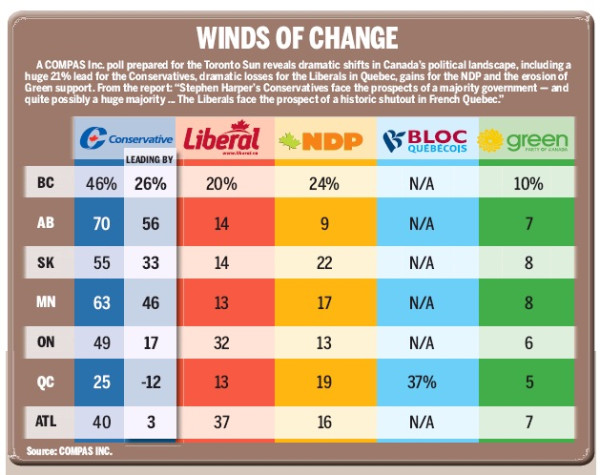
Update: Of course, not all polls agree, but the Compas poll for the Toronto Sun has radically different numbers based on the regional breakdown:

H/T to David Akin for the image (via Twitpic).

Leaders’ debate provides no significant changes

Filed under: Cancon, Media, Politics — Tags: , , , , , — Nicholas @ 07:26

I didn’t bother watching the first debate on TV last night, as I didn’t think there would be any purpose in doing so. Lots of people seem to have felt the same way, as polling immediately after the debate showed little change in support:

It was Stephen Harper’s debate to lose — and he did not.

It was Michael Ignatieff’s debate to win — and he did not.

A poll done exclusively for QMI Agency immediately after Tuesday night’s English-language debate shows that English-speaking Canada was, by and large, unmoved by the two-hour duel among the four party leaders.

Asked who won the debate, 37% of those surveyed by Leger Marketing said Harper was the victor. About 21% said Ignatieff won.

Those numbers roughly mirror voter support in polls Leger has done before and during the election campaign.

April 12, 2011

A “gun-crazed oil-drunk Albertan” on the NDP and Green platforms

Colby Cosh tries to be nice about the Green Party and NDP platforms:

The contrast between the parties’ platforms is interesting: the Green ideas induce slightly more sheer nausea of the “literally everything in here is eye-slashingly horrible” kind, but at the same time there is a consoling breath of radicalism pervading Vision Green, a redeeming Small Is Beautiful spirit. At least, one feels, their nonsense is addressed to the individual. A typical laissez-faire economist would probably like the Green platform the least of the four on offer from national parties, but the Greens may be the strongest of all in advocating the core precept that prices are signals. At one point, denouncing market distortions created by corporate welfare, Vision Green approvingly quotes the maxim “Governments are not adept at picking winners, but losers are adept at picking governments.” (The saying is attributed to a 2006 book by Mark Milke of the Fraser Institute, but a gentleman named Paul Martin Jr. had uttered a version of it as early as 2000.)

That has always been the biggest failing of the regulatory view of politics: no matter how carefully you select the regulators, the regulated have many, many ways to (eventually) suborn them. Regulatory capture is the most common result, as the regulators become more closely attuned to the needs of their “charges” and work to protect them from competitors and social and technological change. What may have started as an attempt to rein-in over powerful industrial interests slowly becomes a de facto arm of government protection over the existing major players in that industry.

The New Democratic platform is more adult and serious than the Greens’ overall, which comes as no surprise. But it occurs to me, not for the first time this year, how much some folks love “trickle-down politics” when they are not busy denouncing “trickle-down economics”. How does Jack Layton hope to remedy the plight of the Canadian Indian? By “building a new relationship” with his politicians and band chiefs. How does he propose to improve the lot of artists? By flooding movie and TV producers, and funding agencies, with money and tax credits. He’ll help parents by giving money to day care entrepreneurs; he’ll sweeten the pot for “women’s groups” and “civil society groups”. One detects, perhaps mostly from prejudice, a suffocating sense of system-building, of unskeptical passion for bureaucracy, of disrespect for the sheer power of middlemen to make value disappear.

It’s useful to check who would be the actual beneficiaries of this kind of increased bureaucratization of life — and we’re generally not talking about the putative winners, but the actual ones — the ones who will staff the new agencies, bureaux, and commissions, the ones who will provide consulting services, and the ones who will study the results.

The Greens get a big thumbs-up from this corner for this particular clause of their platfom:

In 2008, according to the Treasury Board, Canada spent $61.3 million targeting illicit drugs, with a majority of that money going to law enforcement. Most of that was for the “war” against cannabis (marijuana). Marijuana prohibition is also prohibitively costly in other ways, including criminalizing youth and fostering organized crime. Cannabis prohibition, which has gone on for decades, has utterly failed and has not led to reduced drug use in Canada.

The Greens promise that cannabis would be removed from the schedule of illegal drugs and that the growth and sale of cannabis products would be regularized (and taxed), although with the usual shibboleth about the market needing to be restricted to small producers. If you’re making the stuff legal to sell, you shouldn’t try to micro-manage the product and producers you’re moving into the legal marketplace.

« Newer PostsOlder Posts »

Powered by WordPress