Quotulatiousness

December 13, 2020

Islamism and the French Republic

Filed under: France, Politics, Religion — Tags: , , — Nicholas @ 03:00

Niccolo Soldo talks to Pascal-Emmanuel Gobry about the rise of Islamism in France and the dangers it poses:

Brigitte Macron and Emmanuel Macron, 11 November, 2018.
Photo from the office of the President of Ukraine via Wikimedia Commons, CC-BY-4.0.

Islamism presents an existential threat to the French Republic. Statements are being made, positions are being taken, and the smell of action is in the air to counter this threat. Will we see a follow through from Macron?

Your guess is as good as mine. Macron is hard to predict. Although there are many reasons to be pessimistic, from French elites’ general lack of follow-through to Macron’s own (I believe, sincere and deeply-held) commitment to so-called “liberal values”, I will note that it hasn’t been all talk. BarakaCity (the biggest Muslim NGO in France) whose leaders happen to think ISIS is misunderstood, was shut down by executive decree. CCIF, a prominent “anti-islamophobia” organization, dissolved itself after the government announced its intent to shut it down. So an important Rubicon has been crossed, at least in principle: the French government has rhetorically and legally committed itself to combating not just those who engage in Islamist violence, but those who engage in Islamist advocacy and activism.

Can France’s secularism hold on in light of this challenge? Islamism is rather dynamic, and secularism lacks the ingredients for fanaticism that only the irrational are able to muster. In many countries it seems that only the elites are strongly-wedded to secularism.

I’ll let you in on a little secret we don’t share with foreigners: nobody in France believes in “laïcité“, it’s all a code to say we don’t like Islam. We have a freaking concordat, for crying out loud!

The entire notion that there is this specific French culture of “laïcité” that goes beyond institutional separation of church and state was a retcon invented in the 1980s when the Muslim population became too big to ignore. Nobody — nobody — is fooled that banning the hijab in public schools as well as “large ostentatious crosses” is a neutral secularist measure.

Today some people are claiming that wearing religious garb in the National Assembly is a breach of laïcité, but after the War the Canon Kir sat as a member of Parliament in his cassock for twenty years and nobody had any problem with it. (My favorite Kir story: during a late-night parliamentary session, a Communist deputy asked him “How come you believe in God, even though you’ve never seen him?” “What about my asshole? You’ve never seen it, yet you know it exists!”)

The fig leaf of laïcité was useful, and perhaps still is, as politically correct cover for defending French identity, but over time it will have to be discarded. There are signs that it’s beginning.

The bottom line is that France has always been assimilationist. The idea is that assimilation was invented by the Republic, but it’s not true. When Louis XIV invaded a province, he would create schools with scholarships for poor, talented youth from those places to “turn them into Frenchmen.” The self-conscious project of the French Kings was to restore the Roman Empire, and this bequeathed to us the Roman concept of citizenship: laws, language, and culture. This is what is behind “laïcité.” This assimilationism therefore has deep roots, and it is perfectly legitimate that we demand of immigrants that they assimilate into our culture, which is inescapably Judeo-Christian.

H/T to Colby Cosh for the link.
December 12, 2020

“Canada’s party system has long been an outlier that has baffled political scientists”

Filed under: Cancon, Environment, History, Politics — Tags: — Nicholas @ 03:00

Ben Woodfinden emerges from a pre-winter hibernation to mull on how environmental issues intersect with regional and linguistic issues in a uniquely Canadian way that does not match how these issues play out in other countries:

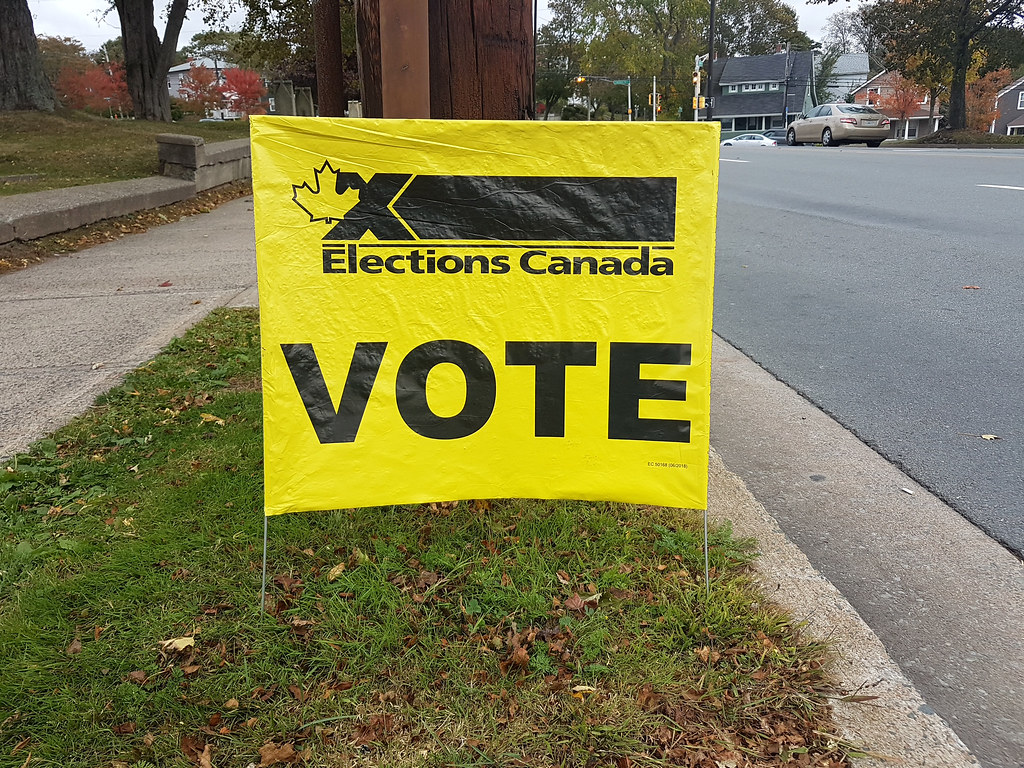
“2019 Canadian federal election – VOTE” by Indrid__Cold is licensed under CC BY-SA 2.0

… if you want to understand how democratic politics work, you have to begin with the premise that voters and electoral coalitions are made up of individuals with overlapping and complicated political identities, not just rationalistic voters who need to be convinced with some charts and data.

These identities and value divides coalesce and become the basis of the political cleavages around which competition in democratic regimes is built. There are many classic accounts of party system formation in political science, the one I think most plausible and still useful is the now classic account of cleavage politics posited by the political scientists Seymour Martin Lipset and Stein Rokkan.

This now classic account of the formation of party systems in Western Europe argues that long existing social conflicts and divides that existed prior to the gradually universal extension of voting across Western Europe helped to structure political competition. Specifically, industrialization and nation building generated four major cleavages that structured political conflict and party systems going forward: territorial cleavages defined by a centre-periphery divide, religious cleavages defined by a church versus state divide, an urban-rural cleavage, and a labour-capital cleavage.

Canada’s party system has long been an outlier that has baffled political scientists who study these things. If you’re looking for a good comprehensive overview of the history of the Canadian party system I’d recommend this recent book by Richard Johnston. Since the 1930’s Canada has defied what is perhaps the single most generalizable finding in comparative politics: Duverger’s Law. Canada also defies many of the expectations of the cleavage theory of party formation. But Canadian politics can still be broadly understood in terms of cleavages, albeit idiosyncratic Canadian cleavages (regional and linguistic cleavages especially).

I won’t bog you down with too much academic explanation. There is an enormous body of literature that builds on, tests, and modifies the cleavage thesis. Much of the talk in recent decades has been about an “unfreezing” of the traditional cleavages that have dominated party politics in western democracies, and the reorganizing of politics around new cleavages.

As traditional industrial, class, and religious cleavages have declined new cleavages have emerged and politics has been playing a catch up game. These new cleavages coalesce around educational, geographic, gendered, and age divides. This realignment, which has been in the making for decades has become the dominant political narrative since 2016, and as I’ve written in the newsletter recently these divides exist in Canada just as they do in Europe and America.

But the realignments these new cleavages produce often require singular events or defining figures to fully emerge. In the United Kingdom, the 2016 referendum produced a realignment because it scrambled the existing partisan and political arrangements so much that it gave rise to a hyper-polarized culture war around a remain/leave divide that people reoriented their own politics around this divide.

Trains and Oil | California History [ep.8]

Filed under: Business, Economics, Government, History, Politics, Railways, USA — Tags: , , , — Nicholas @ 02:00

The Cynical Historian
Published 4 Jul 2019

After a long hiatus, here is the return of the History of California series. For those who haven’t seen the previous episodes, here’s the playlist: https://www.youtube.com/playlist?list…

Today we’re going over the history of transcontinental railroads, monopolistic practices, and crude oil production in California.
————————————————————
references:
eds. Richard Francaviglia and David Narrett, Essays on the Changing Images of the Southwest (Arlington: University of Texas at Arlington, 1994). https://amzn.to/2JwNiHk

William H. Goetzmann, Army Exploration in the American West, 1803-1863, new ed. (1959; Lincoln: University of Nebraska, 1979). https://amzn.to/2K8tslY

Paul Sabin, Crude Politics: The California Oil Market, 1900-1940 (Berkeley: University of California Press, 2005). https://amzn.to/2W16gtt

Jules Tygiel, The Great Los Angeles Swindle: Oil, Stocks, and Scandal During the Roaring Twenties (Berkeley: University of California Press, 1996). https://amzn.to/2ASH7Z0

Richard White, Railroaded: The Transcontinentals and the Making of Modern America (New York: W.W. Norton, 2011). https://amzn.to/2zkURO3
————————————————————
Support the channel through PATREON:
https://www.patreon.com/CynicalHistorian

LET’S CONNECT:
Discord: https://discord.gg/Ukthk4U
Twitter: https://twitter.com/Cynical_History
————————————————————
Wiki: The history of the Southern Pacific stretches from 1865 to 1998. For the main page, see Southern Pacific Transportation Company; for the former holding company, see Southern Pacific Rail Corporation. The Southern Pacific was represented by three railroads. The original company was called Southern Pacific Railroad, the second was called Southern Pacific Company and the third was called Southern Pacific Transportation Company. The third Southern Pacific railroad, the Southern Pacific Transportation Company, is now operating as the current incarnation of the Union Pacific Railroad.

The story of oil production in California began in the late 19th century. In 1903, California became the leading oil-producing state in the US, and traded the number one position back-and forth with Oklahoma through the year 1930. As of 2012, California was the nation’s third most prolific oil-producing state, behind only Texas and North Dakota. In the past century, California’s oil industry grew to become the state’s number one GDP export and one of the most profitable industries in the region. The history of oil in the state of California, however, dates back much earlier than the 19th century. For thousands of years prior to European settlement in America, Native Americans in the California territory excavated oil seeps. By the mid-19th century, American geologists discovered the vast oil reserves in California and began mass drilling in the Western Territory. While California’s production of excavated oil increased significantly during the early 20th century, the accelerated drilling resulted in an overproduction of the commodity, and the federal government unsuccessfully made several attempts to regulate the oil market.
————————————————————
Hashtags: #history #California #trains #oil

December 11, 2020

“Politically correct language … seemed like a nice, polite, and Canadian sort of thing to do”

Filed under: Cancon, Politics — Tags: , , , , , , — Nicholas @ 03:00

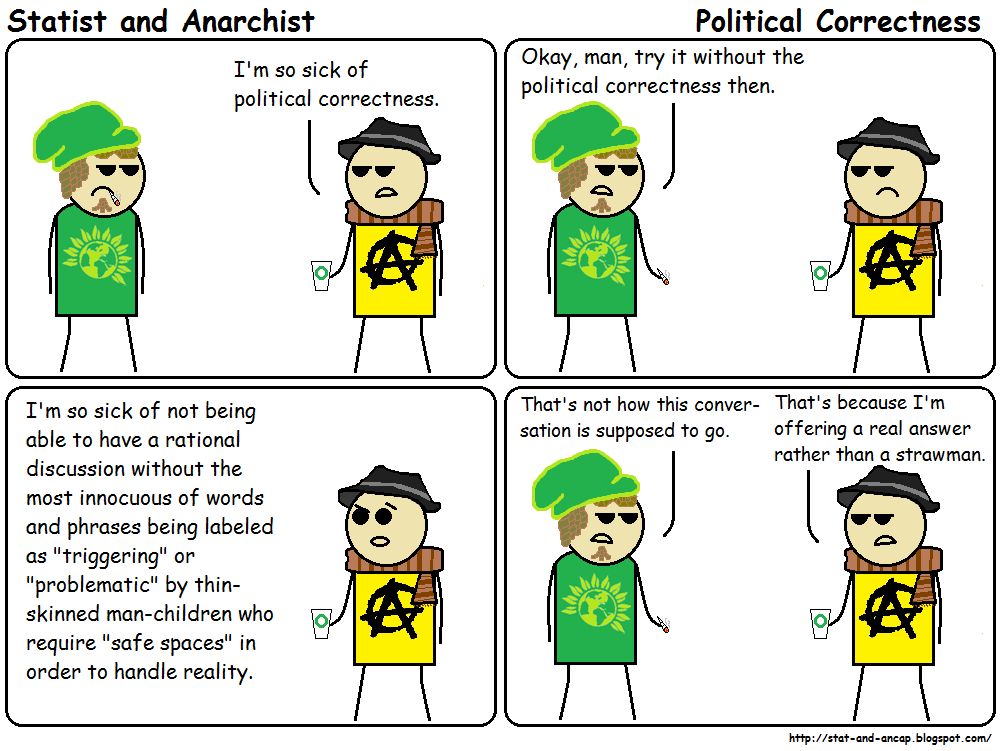
Meaghie Champion discusses politically correct language in The Line:

Source: https://www.deviantart.com/blamethe1st/art/Statist-And-Anarchist-063-Political-Correctness-589944623

I grew up in the 1970s and ’80s. I have never lived in a world without what we now call “political correctness” — typically understood to mean using a kind of stilted and artificial language in order to atone for the disadvantages and slights suffered by marginalized groups and avoid inflicting new ones. Politically correct language required more effort to communicate, but it seemed like that effort was worth it to not offend people. It seemed like a nice, polite, and Canadian sort of thing to do.

I went along with political correctness out of a sincere desire to be accommodating to disadvantaged and dis-enfranchised groups. This became especially true after I learned about the “Sapir Whorf theory of psycho neurolinguistics.” The theory suggests that language shapes our perception of reality; that by altering the way we talk, we can shift the way we think — and, thus, collectively, we can shape reality itself. From this, it seemed logical to “de-gender” language or stop using stereotypes. It seemed like a small ask. Maybe I personally couldn’t solve big problems that concerned me as a good liberal … i.e. things like poverty or world hunger, but I could be nice in how I expressed myself and try to use language that everybody was using to be equitable and more fair.

What I didn’t understand, then, was that this precedent set a trap in which many good, well-intentioned liberals are finding themselves stuck. It’s no longer about ameliorating past sins: there is a project afoot to re-make the English language. The purpose of this project is to re-engineer how people think about certain subjects like gender, sex, and race, while skipping the necessary prerequisites of persuasion and logic. Conservative positions are declared off limits, even bigoted, simply by shaping the way we are allowed to talk about them.

Right now, even as I type this, there is a veritable army of academics hard at work on what they call “de-colonizing” and “de-gendering” language at many universities and colleges. There are tens of thousands of activists and academics in universities and online organizing and pushing for ever-changing rules to be enforced as it relates to the English language. It’s a multi-million-dollar industry in academia and woke corporatism. And it’s already starting to spill over into government regulations and enforcement.

I love the English language. I have been a voracious reader since childhood. I thrill at well-spoken and written prose and poetry. A finely turned witticism or fantastic mot juste can break my heart with its perfection. Further, I’m First Nations, and that love of the English language has also carried me into a love of the study of my tribal cradle tongue “Hul’qumi’num.” Shouldn’t I, as a First Nations person, be in favour of de-colonizing the English language? No. No, I do not think so. I have little patience or regard for any effort that makes language a less workable and functional tool of human endeavour. I identify strongly as a writer, and I take this assault upon the tool with which I conduct my craft very personally.

QotD: Airbrushing out the worst parts of “Lost Cause” mythology

Filed under: History, Military, Politics, Quotations, USA — Tags: , , , , — Nicholas @ 01:00

The South could have become a running sore, a cauldron of low-level insurrection and guerilla warfare that blighted the next century of U.S. history. Instead, it is now the most patriotic region of the U.S. – as measured, for example, by regional origins of U.S. military personnel. How did this happen?

Looking back, we can see that between 1865 and around 1914 the Union and the former South negotiated an imperfect but workable peace. The first step in that negotiation took place at Appomattox, when the Union troops accepting General Robert E. Lee’s surrender saluted the defeated and allowed them to retain their arms, treating them with the most punctilious military courtesy due to honorable foes.

Over the next few years, the Union Army reintegrated the Confederate military into itself. Confederate officers not charged with war crimes were generally able to retain rank and seniority; many served in the frontier wars of the next 35 years. Elements of Confederate uniform were adopted for Western service.

The political leaders of the revolt were not executed. Instead, they were spared to urge reconciliation, and generally did. By all historical precedent they were treated with shocking leniency. This paid off.

Of course, not all went smoothly. The Reconstruction of the South between 1863 and 1877 was badly bungled, creating resentments that linger to this day and – in the folk memory of Southerners – often overshadow the harms of the war itself. The condition of emancipated blacks remained dire.

But overall, the reintegration of the South went far better than it could have. Confederate nationalism was successfully reabsorbed into American nationalism. One of the prices of this adjustment was that Confederate heroes had to become American heroes. An early and continuing example of this was the reverence paid to Robert E. Lee by Unionists after the war; his qualities as a military leader were extolled and his opposition to full civil rights for black freedmen memory-holed.

Lee’s heroism and ascribed saintliness would layer become a central prop in “Lost Cause” romanticism, which portrayed the revolt as an honorable struggle for a Southern way of life while mostly airbrushing out – but sometimes, unforgiveably, defending – the institution of slavery. Even today, the “soft” airbrushing version of Lost Cause retains a significant hold on Southerners who would never dream of defending slavery.

Eric S. Raymond, “Unlearning history”, Armed and Dangerous, 2017-09-22.

December 10, 2020

QotD: Italian Fascism and “corporatism”

Filed under: Europe, History, Italy, Politics, Quotations — Tags: , , , , — Nicholas @ 01:00

… recently I ran across a quote beloved of American leftists in an email signature:

From Benito Mussolini: “Fascism should more properly be called corporatism, since it is the merger of state and corporate power.”

This quote is often misconstrued nowadays by leftists who view profit-making corporations under capitalism (especially multinational corporations) as instruments of the devil. They love the implied image of capitalist fat-cats and fascist dictators conspiring in gilded opulence. Alas for them that this quote actually doesn’t imply anything like that; the terminological ground under it has shifted.

The “corporatism” Mussolini to which was referring had, actually, nothing to do with corporations, joint-stock or otherwise (in the 1920s the word “corporation” did not yet have its modern sense, either in English or Italian). His use of the word had to do with a feature of fascist theory forgotten by almost everybody but specialist historians.

In fascist theory, “corporations” were bodies like unions, craft guilds, professional societies, and grange associations. See http://en.wikipedia.org/wiki/Corporatism for discussion; see especially the section “[F]ascist corporativism” [section name changed since 2009].

What Mussolini was actually enunciating was a sort of organic statism in which the state would bless or admit representatives of various “corporations” into its governing councils — and no, that didn’t mean Fiat or Beretta but (say) the Abruzzo Building Trades Association, or the Society of University Professors.

While corporations-in-the-modern-sense were not outright excluded from being legitimized “corporations” in the fascist sense, neither did they have any special status or power in the system. Actually, it was rather the reverse …

It’s worth remembering that the founders of fascism were mainly Leninists like Mussolini with a sprinkling of anarcho-syndicalists (George Sorel being the best known of those). Actual fascism retained the founders’ doctrinal hostility to what modern leftists would call “corporate power”, never renouncing its state-socialist roots and being (in fact) hostile to all centers of power other than the state itself.

The modern idea that German and Italian fascism were conservative or pro-business ideologies is essentially a fantasy constructed by pro-Soviet propagandists during and after World War II. In fact, classical fascism never wandered very far from its left-wing origins; corporatism can be seen as an elaboration of the theoretical role of worker’s soviets in Leninist theory.

Eric S. Raymond, “Misconstruing Mussolini”, Armed and Dangerous, 2009-06-29.

December 7, 2020

QotD: American politics as “the playoffs”

Filed under: Liberty, Politics, Quotations, USA — Tags: , , , — Nicholas @ 01:00

Like other Americans, however, many libertarians think of political parties like sports teams. They want their own team to root for and cannot root for the other teams. Voting Libertarian gives them psychological satisfaction, while in the aggregate diminishing their political impact.

Libertarians should stop thinking of parties as teams and think of them instead as the playoffs. In NFL football terms, The Democrats are the AFC and the Republicans the NFC. To get into the Superbowl, you have to survive the season and the playoffs in your respective conference. In effect, Libertarians want to form their own league which no one but themselves is interested in watching. And they assure themselves of never making the playoffs much less the Superbowl.

Randy Barnett, “Parties Are Not Sports Teams — Parties are the Playoffs”, The Volokh Conspiracy, 2005-02-24

December 6, 2020

“As ever, our Liberal friends prefer to be judged by their pure intentions rather than their rather tattered record”

The good folks at The Line suggest that we monsters in the peanut gallery stop hurting poor Little Potato’s feeeeeeeeeelings:

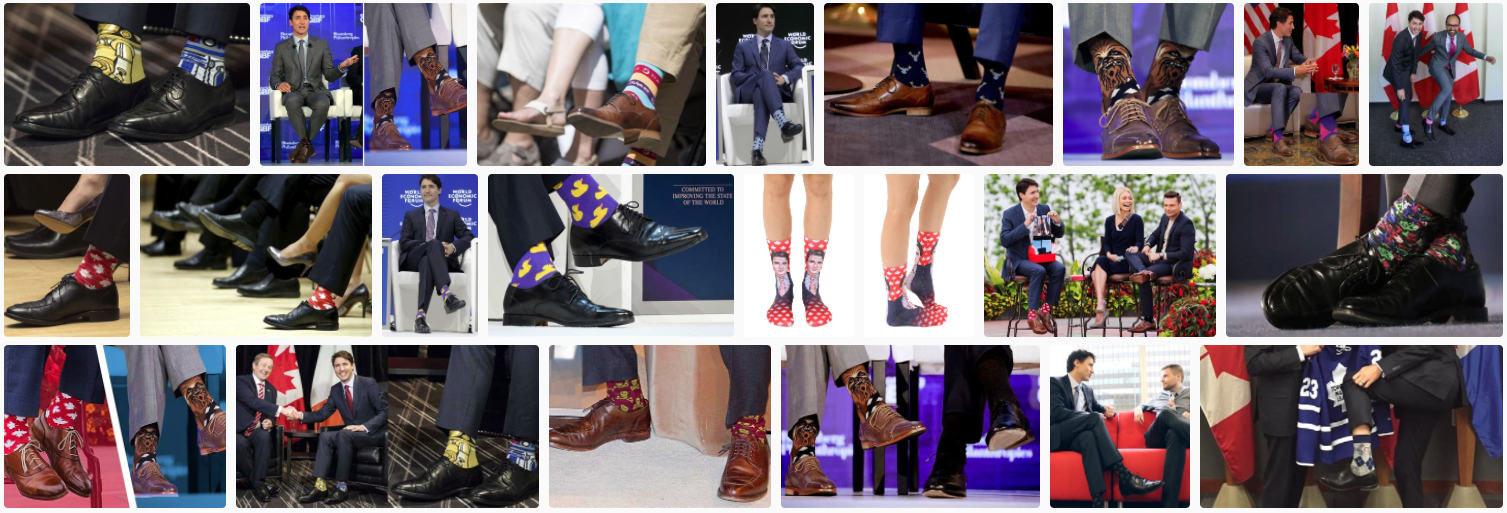
Typical image search results for “Justin Trudeau socks”

What we can say is that supporters of our current government continue to insist that the prime minister and his cabinet be granted a level of benefit of the doubt that they simply have not earned. Declarations that the Liberals have botched the vaccine rollout are premature, but they are not preposterous. As ever, our Liberal friends prefer to be judged by their pure intentions rather than their rather tattered record. We at The Line have known enough true Grits in our time to believe that this isn’t an act. Liberals really do believe that so long as they mean well, they should be forgiven their failures. Indeed, the failures should be forgiven and forgotten.

And boy, can they get testy when someone declines to do them the courtesy of treating this five of a government like a nine. They’ll shriek about Harper and Ford and Kenney and American-style whatever, they’ll argue in bad faith, they’ll demand an audit of Andrew Scheer’s household expenses, they’ll shut parliament down in the middle of a national emergency to spare the boss from embarrassing questions about his latest ethical flub. In short, they’ll do anything to avoid admitting that this Liberal government has blown more than enough high-profile issues to have forfeited any right to be bummed out when someone dares wonder if they’ll do any better on vaccines.

Over the last five years, the Liberals have failed to hit their own targets on balancing the budget and cleaning up Indigenous water supplies. They failed to hit Harper’s targets on carbon reduction, failed to win a UN seat, failed to deliver promised military procurements, failed on electoral reform, failed to improve our decrepit transparency system, and failed to notice any number of outrageous policies and proposals so long as they were proffered en français, in which case they couldn’t avert their eyes fast enough.

We could go on, but the point is made. And they’ve done it all after daring to talk in their opening days of deliverology, a term that’s now a political punchline thanks to how badly Trudeau and the Gang failed to live up to the hype of their own managerial jargon.

The problem with all this failure is far bigger than the sum of its various sad parts. A government that routinely writes cheques its competence can’t cash may be in a hurry to forgive itself, but not all Canadians are as fond of Justin Trudeau as Justin Trudeau clearly is. A proven track record of failure by the state erodes public confidence in the state, and the sneering contempt Liberals have for anyone who notices the failure doesn’t help. We find it absolutely amazing how many Liberals (rightly!) decry the rise of populism without ever seeming to ponder for a New York minute what role their own manifest mediocrity has played in fuelling it. So we’ll kindly hear no more from the Liberals about the know-nothing idiocy of the woke left and the destructive buffoonery of the nationalist right until they stop doing such a shabby job with the goddamned centre.

December 4, 2020

Canada used to have a “none of the above” option in federal elections … let’s bring it back

Filed under: Cancon, Government, History, Liberty, Politics — Tags: , — Nicholas @ 03:00

David Warren describes how the “returned ballot” functioned as a “none of the above” vote in Canadian federal elections:

“2019 Canadian federal election – VOTE” by Indrid__Cold is licensed under CC BY-SA 2.0

Back to the polling station, where the electoral officer is now passing me a ballot, with a hint on how to make an X on it. I am directed to a voting stall.

But I refuse to go there. Instead, I turn earnestly to the officer and say: “I am returning this ballot.”

Chances were, even decades ago, he would be thrown into confusion. So one would explain his job to him. He was supposed to have a book, entitled “Returned Ballots.” Into this he was supposed to transcribe one’s name and address. Getting into the book was one’s only way to avoid the secret ballot. But it was important to get in, to be recorded correctly, rather than as a “spoilt ballot,” as one is counted now if one’s ballot has no X.

After voting, I would check the result, and if not even one returned ballot had been recorded, I could doubt it was legitimate.
Now comes the good part. For returned ballots were supposed to be a separate category in the election tally. It was competing with all the other candidates. If it won a plurality — more returned ballots than the leading candidate — the election was to be formally thrown out, and a by-election called, in which none of the candidates for the thrown out one were allowed to run again. Too, voters could “theoretically” do this over and over, until at least one Party chose a candidate we could stomach.

In theory, this was an excellent way for voters to “drain the swamp,” directly, by eliminating the political sleaze in successive groups. In practice — aheu — it was never used. The political sleaze nevertheless spotted the possibility, and had it taken off the books, at both Dominion and Provincial levels. What can I say? They are sleaze.

So the first thing we must do is campaign for the return of the returned ballot, up here; and for its institution in all the other Western nations. Then the second is to impartially, but massively, campaign for its use. It could be the greatest thing since the ancient Athenian ostracon.

December 3, 2020

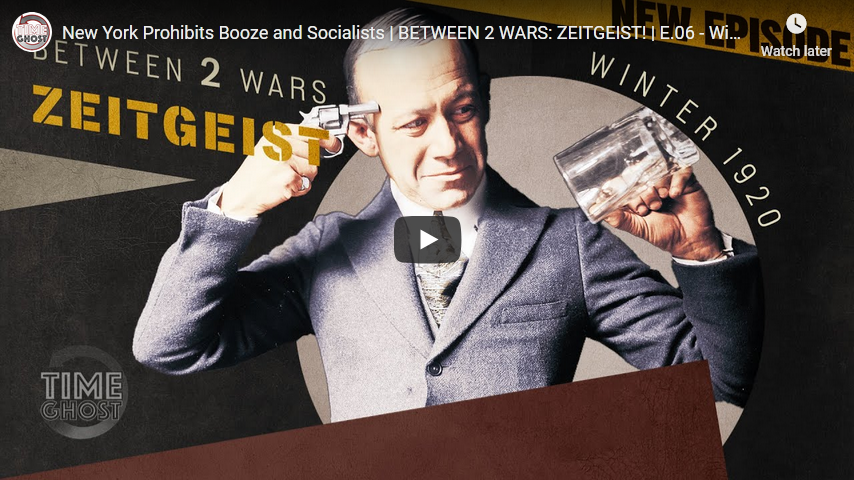
New York Prohibits Booze and Socialists | BETWEEN 2 WARS: ZEITGEIST! | E.06 – Winter 1920

Filed under: History, Politics, USA — Tags: , , , , — Nicholas @ 04:00

TimeGhost History
Published 2 Dec 2020

Science and technology is marching on as the world enters the 1920’s. But Americans have more to reckon with than just a new decade: every state in the country has gone “dry”.

Join us on Patreon: https://www.patreon.com/TimeGhostHistory

Hosted by: Indy Neidell
Written by: Indy Neidell and Francis van Berkel
Director: Astrid Deinhard
Producers: Astrid Deinhard and Spartacus Olsson
Executive Producers: Astrid Deinhard, Indy Neidell, Spartacus Olsson, Bodo Rittenauer
Creative Producer: Maria Kyhle
Post-Production Director: Wieke Kapteijns
Research by: Indy Neidell and Francis van Berkel
Image Research by: Daniel Weiss
Edited by: Daniel Weiss
Sound design: Marek Kamiński

Colorizations:
Daniel Weiss – https://www.facebook.com/TheYankeeCol…
Spartacus Olsson
Mikolaj Uchman

Sources:
Some images from the Library of Congress
Image from the Holocaust Museum

From the Noun Project:
Baker – by Wichai
Protest – by Juan Pablo Bravo
Store – by Fahmi

Soundtracks from Epidemic Sound and Frédéric Chopin
– “One More for the Road” – Golden Age Radio
– “Dark Shadow” – Etienne Roussel
– “Heroes On Horses” – Gunnar Johnsén
– “That’s How I Like It” – Oakwood Station
– “Not Safe Yet” – Gunnar Johnsen
– “Dark Beginning” – Johan Hynynen
– “Chopin Sonata no2” – 3rd movement
– “Faith in Truth” – Oakwood Station
– “Innocence of a Child” – Rupert Sachs
– “Endlessness” – Flouw
– “First Responders” – Skrya

Archive by Screenocean/Reuters https://www.screenocean.com.

A TimeGhost chronological documentary produced by OnLion Entertainment GmbH.

QotD: Presidential droit du seigneur

Filed under: Government, Politics, Quotations, USA — Tags: , , , , , , — Nicholas @ 01:00

For a party that toots its own horn about how it’s all-in for the ladies, the Democrat Party sure has a weird way of showing it. The fact is that when the check comes for its dangerous and degenerate policies, every single time the Dem dudes dine and dash and stick the chicks with the bill.

Let’s look at some of the Dem dudes who do it, starting with the aptly named Bill Clinton. Mr. Felonia Milhous von Pantsuit was all too happy to use women as his personal playthings with varying degrees of consent, ranging from none to “I always wanted to do it in the Oval Office!” And the feminists, the media and the rest of the Democrat Party adjuncts gave him a pass. Some were willing to give him even more. The message was simple: if you are called upon to be a Clinton sex toy, kneel down then shut up for the cause.

This is a Democrat tradition. JFK, when he wasn’t tapping the help he was pimping them out to his buddies in the White House pool. His dalliance with Marilyn Monroe was one thing – she was a consenting adult who could have told him to pound sand (or something else). It’s his serial preying upon the interns and secretaries and other assorted Dem doxies in his orbit that really demonstrates the essential contempt for women that drove his satyriasis – and that (which along with its traditional racism) still drives the Democrat Party.

Oh, and speaking of driving, no discussion of the chronic Democrat abuse of women would be complete without observing that the Lion of the Senate left his booty call du jour to drown in an Oldsmobile at the bottom of a pond. And the same message we hear over and over again to protect Democrat exploiters protected Teddy Kennedy – hey Mary Jo, take one for the team.

She didn’t have much choice about taking one for the team since, in those last agonizing minutes, she couldn’t take a breath.

But hey, Teddy saved abortion, and his ceaseless campaign for a perpetual open season on troublesome fetuses makes it all worthwhile. Abortion is another of those Democrat policies that women get to pay for. The idea that it is somehow empowering or liberating for women is so much garbage. It’s empowering and liberating for men who don’t want to reap the result of their sowing.

Kurt Schlichter, “Women Always Have To Pick Up The Check For Democrats”, Townhall.com, 2020-08-30.

November 30, 2020

Cultural Marxism or cultural leftism?

Filed under: History, Politics, Religion — Tags: , , , , — Nicholas @ 03:00

In the most recent Libertarian Enterprise, Sean Gabb discusses what British Conservatives have been warned against describing as “Cultural Marxism”:

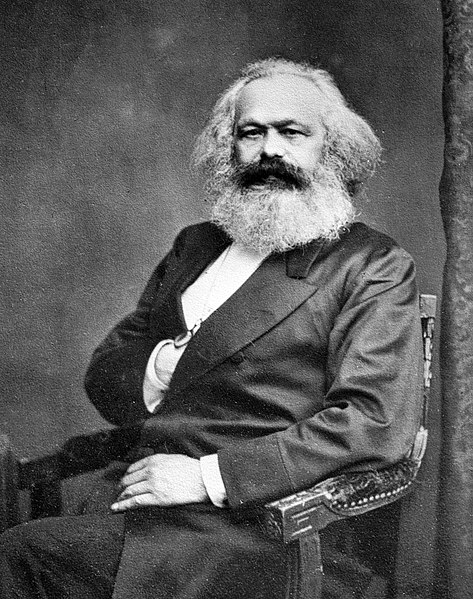
So far as I understand him — and I write as an outsider to any school of Marxist ideology — Marx made five essential points. First, there have been, since the French Revolution, two classes — the bourgeoisie and the proletariat. Second, the bourgeoisie owns the means of production and exploits the proletariat through the extraction of surplus value. Third, this is an unstable parasitism, as the reinvestment of surplus value leads to periodic crises of over-production. Fourth, these crises concentrate wealth in fewer hands and expand and immiserise the proletariat. Fifth, there will be an inevitable revolution, in which the expropriators will be expropriated and a communist society will emerge. A further and perhaps optional sixth point is that the inevitable revolution can be hurried by the defection of informed bourgeois intellectuals to radicalise and form a vanguard for the proletariat.

Now, where is any of this in the present mix of climate alarmism and obsession with the alleged oppression of racial and sexual minorities? How is capitalism supposed to be overthrown by getting Sainsbury to fill its advertisements with pictures of black people eating Christmas dinner? Ditto boycotts of Israeli pharmaceuticals? Ditto arguing with or against radical feminists over the exact status of men who change sex?

The answer, of course, is the Cultural Marxist hypothesis — that the present culture wars are a product of the writings of Antonio Gramsci and the Frankfurt School. These men took the Marxian concept of “false consciousness” — that the bourgeoisie keeps the workers quiet by making them believe that all is for the best — and enlarged it into a project for achieving a counter-hegemony by taking over the means of cultural reproduction.

There is some truth in this answer, so far as these writings are prescribed in most university humanities departments, and many advocates of the new totalitarianism have at some time called themselves Marxists. It is, even, so a weak answer. Before about 60 AD, most Christians were Jews, and Christianity ever since has retained some Jewish religious writings among its core texts. But nothing is achieved by describing Christianity as “Gentile Judaism.” The differences between the two faiths are too essential to define either by reference to the other. In the same way, the present totalitarianism has nothing to do with the essential claims of Marxism. It lacks any interest in the analysis of surplus value, and its belief in the instability of unregulated markets derives mainly from a reading of Keynes and the welfare economists of the Cambridge School.

I prefer the term “cultural leftism.” I prefer this because the present totalitarianism is based on belief in an appearance of equality mediated by the State. It therefore has elements of socialism as reasonably defined. But it is in no sense Marxist. Its revealed preference is for a ruling class that is a coalition of politicians, administrators, policemen, lawyers, educators, plus media and business interests. So far as individuals move freely between them, these groups are mutually permeable. If they disagree over incidentals, they preside collectively over a mass of the ruled who are mostly well-nourished, but who are too atomised and intimidated by often meaningless words to combine in opposition.

Indeed, if I prefer my chosen term, I see little point in arguing against what it describes. Undoubtedly, this must be explained and opposed. But too much analysis of particulars can risk an overlooking of the much more important generality. This is that, in every time and place, there have been those who want to get on with their lives and those who want to control others. These latter will take up whatever body of ideas is most likely within the prevailing assumptions of their age to legitimise their urges.

QotD: Grandstanding, or more properly, cant

Filed under: Politics, Quotations — Tags: , , — Nicholas @ 01:00

A major proximate cause of the polarisation of opinion and consequent envenoming of political life is what the authors of this book call grandstanding, though a better word for it (in my opinion) is cant, a word which, oddly enough, they never use.

To cant is to utter moral sentiment far in excess of what is felt or could ever be felt. The purpose of cant is either to present the person who utters it as morally superior to others or to himself as he really is, or to shut other people up entirely. These purposes are not mutually exclusive, of course.

Cant is not new in the world, though the authors of this book offer no history of it. “Of all the cants that are canted in this canting world …” Laurence Sterne wrote more than quarter of a millennium ago, and Doctor Johnson suggested that his interlocutor should clear his mind of cant. My late friend, Peter Bauer, when elevated to the House of Lords, took “Let us be free of cant” as his heraldic motto, but far from ushering in an era free of it, subsequent years have proved a golden age of cant. The social — or antisocial — media have been a powerful catalyst of cant.

Theodore Dalrymple, “The Expanding Tyranny of Cant”, The Iconoclast, 2020-08-26.

November 26, 2020

Deport All Anarchists! – The Palmer Raids | BETWEEN 2 WARS: ZEITGEIST! | E.05 – Harvest 1919

Filed under: Britain, Government, History, Media, Politics, USA — Tags: , , , , , , — Nicholas @ 04:00

TimeGhost History
Published 25 Nov 2020

The First World War has been over for a year, and the modern era plows ahead. But so does fear and paranoia. In America, the Red Scare goes into overdrive.

Join us on Patreon: https://www.patreon.com/TimeGhostHistory

Hosted by: Indy Neidell
Written by: Indy Neidell and Francis van Berkel
Director: Astrid Deinhard
Producers: Astrid Deinhard and Spartacus Olsson
Executive Producers: Astrid Deinhard, Indy Neidell, Spartacus Olsson, Bodo Rittenauer
Creative Producer: Maria Kyhle
Post-Production Director: Wieke Kapteijns
Research by: Indy Neidell and Francis van Berkel
Image Research by: Daniel Weiss and Spartacus Olsson
Edited by: Daniel Weiss
Sound design: Marek Kamiński

Colorizations:
Daniel Weiss – https://www.facebook.com/TheYankeeCol…

Sources:
Some images from the Library of Congress

Some Soundtracks from Epidemic Sound, ODJB, Edward Elgar, Richard Strauss and Pietro Mascagni:
– “One More for the Road” – Golden Age Radio
– “Dawn Of Civilization” – Jo Wandrini
– “Deviation In Time” – Johannes Bornlof
– “Easy Target” – Rannar Sillard
– “Dark Beginning” – Johan Hynynen
– “Steps in Time” – Golden Age Radio
– “Tiger Rag” – ODJB
– “Cello Concerto” – Edward Elgar
– “Pomp and Circumstance” – Edward Elgar
– “Die Frau ohne Schatten: Act III” – Richard Strauss
– “Cavalleria Rusticana” – Pietro Mascagni
– “What Now” – Golden Age Radio

Archive by Screenocean/Reuters https://www.screenocean.com.

A TimeGhost chronological documentary produced by OnLion Entertainment GmbH.

Fixing the US federal election mechanism to prevent errors or fraud from distorting the results

Filed under: Government, Law, Politics, USA — Tags: , — Nicholas @ 03:00

Down south, our American neighbours held a federal election at the beginning of November. Ignoring the Associated Press trying to annoint the winner, we still don’t legally know who won and the tallies in several states are still being challenged. This is an embarassing situation for the “leaders of the free world” and common sense changes to the way the vote is conducted seem to be the best way to ensure that the results are known quickly and that the results will fairly represent the way the voters chose to exercise their franchise. At Steyn Online, Tal Bachman has a fairly concrete set of suggestions that would be a significant improvement over the system in place today:

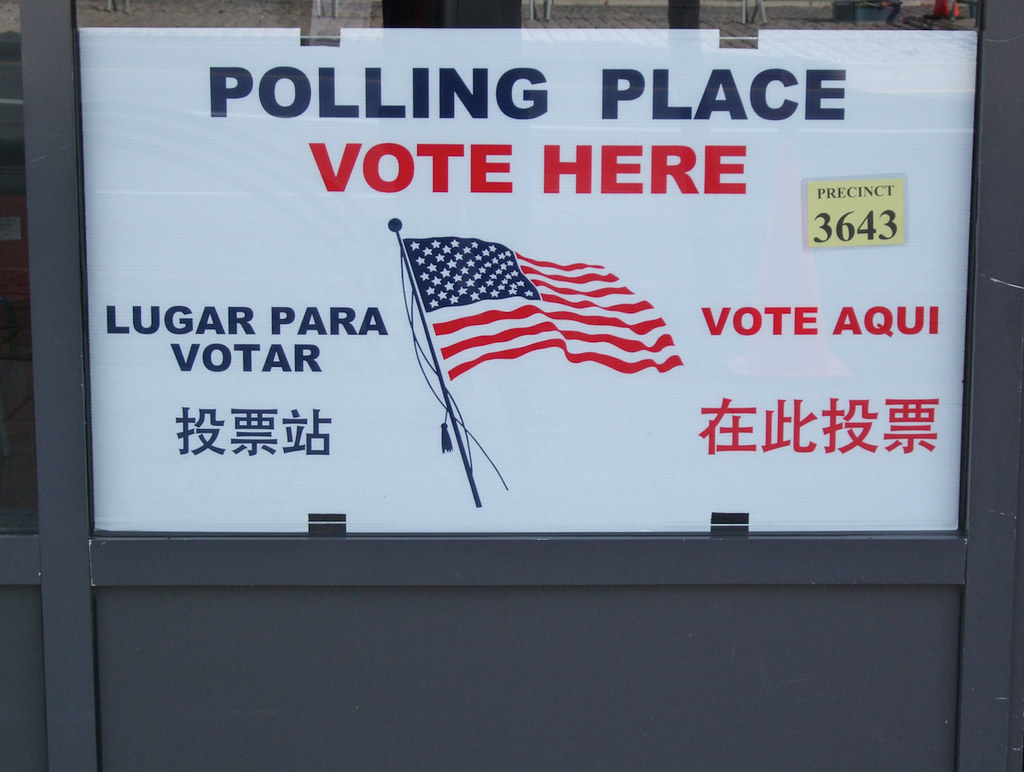
“Polling Place Vote Here” by Scott Beale is licensed under CC BY-NC-ND 2.0

First, it’s run by a single-purpose, rigorously impartial, devoutly transparent federal entity overseeing federal elections (about which more below).

Yes, I know we’re all sick of the federal Leviathan. I know it already has far too much power. It’s just that in this case, we don’t have much choice, do we? We’re going on well over a century of chronic Democrat Party presidential vote-rigging; and it appears they just ran one of their classic tricks again just a few weeks ago. At some point, pro-America voters have to stop making excuses for why they shouldn’t try solutions to these nation-destroying problems, and just try them.

Yes, I know this would require a constitutional amendment. But let’s assume for now we could get one of those passed.

Second: The new federal entity — let’s call it Elections USA — would then divide the nation into voting districts of equal size for purposes of federal election (that could occur within pre-existing congressional districts). Elections USA would then further subdivide the voting districts into smaller units. Working with the postal service, Elections USA would then draw up a list of voters in each unit, and designate a voting station for residents of that particular unit.

Third: In preparation for election day, Elections USA would send out flyers informing households of where to vote. The information would also be made available on the Elections USA website.

Fourth: On election day, voters travel to their designated voting stations: an elementary or high school, a union hall, a community center, whatever.

Each voting station is watched over by police or other security guards.

As voters approach, they join a quick-moving line. At the front, they present two pieces of government issued ID, at least one with a photo. A volunteer finds the voter on her list of voters for that unit. (If they’ve come to the wrong polling station, they are redirected to the right polling station).

The voter then approaches the voting station in a large, open room, where another volunteer hands him a paper ballot. Picking up the provided pencil, he marks the ballot behind a screen, folds the ballot, and drops into the voting box in full view of the poll clerk and attendant witnesses sitting a few feet away—typically, a few volunteers from political parties who act as “scrutineers”, or official observers and verifiers. The voter then leaves. The entire process never takes more than fifteen minutes.

Once polls close, no one is allowed to enter or leave the premises until the vote count is completed.

The poll clerk — still in full view of the scrutineers — dumps the ballots on to a table and sorts them into piles according to the candidate/party voted for. She then counts the votes for each, showing them to the scrutineers as she goes. Once the votes are counted, a supervisor is called over to the table. After verifying that the scrutineers are satisfied with the counting, and resolving any lingering concerns, the supervisor signs off on the count, and the ballots are immediately placed in a special, sealed envelope. The sealed envelope is then stamped, and cannot be opened without subsequent detection.

The ballot count numbers are then phoned into Elections USA, right then and there, again in view of the scrutineers, who verify that the numbers called in match the numbers they witnessed during the count.

Once all the numbers are called in to Elections USA — a process which never takes more than two hours — the supervisor then physically transports the sealed envelopes (each marked with information like Voting Desk #4 at Poll Station #15) to the Elections USA depot, where she hands them over.

“2019 Canadian federal election – VOTE” by Indrid__Cold is licensed under CC BY-SA 2.0

The sealed envelopes are then transported to Elections USA employees, who will then verify, and eventually formally certify, that all the numbers called in from each desk of each polling station of each voting district in the country matches the number of actual ballots. In the unlikely event any question arises about accuracy, the ballots can be accessed and counted again.

In a simple process like this, the media will have accurate election results within two hours of the polls closing, and there is virtually no opportunity for fraud. I can attest to that, because I myself have witnessed this exact process in real life quite a few times, and am friendly with several people who volunteer as election workers on election days. What I described is how elections are conducted in Canada, but not only in Canada: an identical or similar process is used in most other English-speaking countries. A few simple security protocols — not least of which is, no computerized voting machines — and your election is as fraud-proof as this mortal realm would ever allow.

When you compare this typical voting procedure to the morass of conflicting voting regulations representing fifty states, many of which — incredibly — do not even require that the voter present identification before voting, and which are being manipulated by the very state party hacks tasked with preventing fraud, you begin to see just how desperately America needs electoral reform. Credible stories of poll watchers being denied access, for example, in any normal country, would be regarded as completely unacceptable, to the point where the votes in that area would be likely thrown out as a matter of course. And yet, that type of chicanery is now so common in the United States, most people take for granted it goes on. That’s how far the window of acceptable behavior has moved.

« Newer PostsOlder Posts »

Powered by WordPress