Are there any photos of Canadian PM Justin Trudeau where he isn’t in blackface? I’m struggling to remember the last time I saw one. There he was again yesterday, this wokest of world leaders, this darling of centrist Twitter, covered in black facepaint and sticking his tongue out. You know, like those dark-skinned foreigners do. The pic is from an Arabian Nights fancy-dress party – man, the bourgeoisie are weird – that Trudeau attended in 2001, when he was 29. Twenty-nine. If you’re on the cusp of 30, at the dawn of this new millennium, and you still don’t know it’s wrong to don blackface, there’s something wrong with you.
This is only the latest in a long line of Trudeau blackface scandals, of course. The man appears to have spent a significant chunk of his younger years blacked up. There are three blackface incidents that we know of. There could be more. As one headline put it: “Trudeau says he can’t recall how many times he wore blackface make-up.” Imagine blacking up so often you can’t remember all the times you did it. Trudeau’s defenders say it was youthful daftness. Really? I don’t know a single person who has ever blacked up. I know people who have done daft things, of course. But not that.
Trudeau’s penchant for blackface is very odd. He puts it down to the fact that he has always been “more enthusiastic about costumes than is sometimes appropriate“. Riiight. It is mostly a matter for Mr Trudeau and his conscience, of course, as to why he was black-painting his face – and, in one incident, his tongue too – well into his twenties. But it’s a matter for all of us who inhabit the online world as to why Trudeau has never been cancelled, or even seriously threatened with cancellation, for doing something that would be ferociously denounced as racist if anyone else on earth had done it.
Brendan O’Neill, “The never-ending ridiculousness of Justin Trudeau”, Spiked, 2021-09-21.
December 31, 2021
QotD: Justin Trudeau … “virtue-signalling made flesh”
December 20, 2021
Even libertarians can fall victim to progressive hysteria
In the latest Libertarian Enterprise, Sean Gangol mourns the discovery that Penn Jillette has abandoned his libertarian beliefs due at least in part to a bout of Trump Derangement Syndrome:
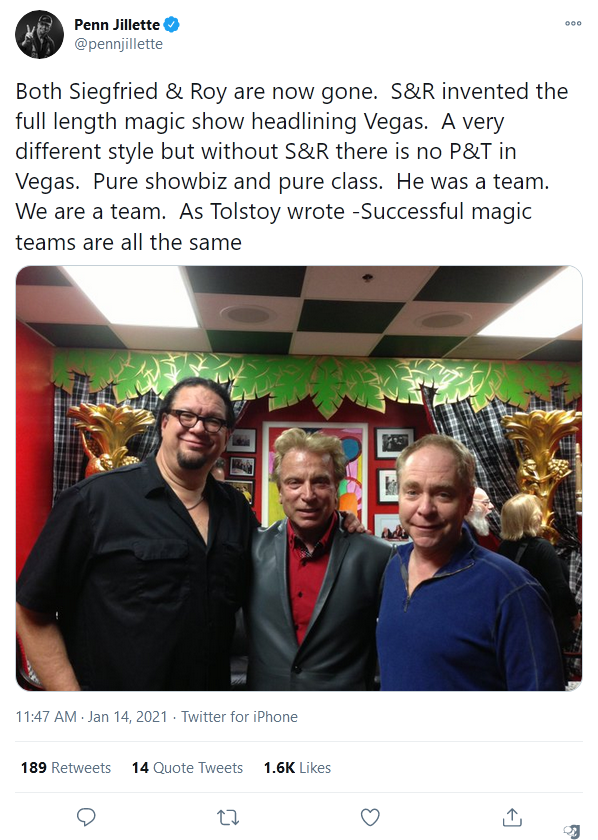
In the last three years I have found myself becoming increasingly disappointed with certain organizations and people who have called themselves libertarian. My first disappointment was Christopher Cantwell, a libertarian who joined the Free State movement in New Hampshire. I used to be a regular listener of his podcast up until he got involved in the so-called Alt-Right movement, where he found himself mixed up in the fiasco that took place in Charlottesville. To this day I still can’t comprehend how a no-nonsense Anarcho-Capitalist like Cantwell could trade the principles of individual freedom for the principles peddled by a neo-fascist group. Then there was Reason magazine, who blamed Trump for the death of a young protestor in Charlottesville, which led to me cancelling my subscription. I also got tired of libertarians constantly belly-aching about how Trump is far from their ideal president, which is why I stopped watching Kennedy. Though I would say that my biggest disappointment was Judge Andrew Napolitano who had an obvious vendetta against Trump since he seemed to support any charge that was made against the former president no matter how bogus it seemed. At least Napolitano was my biggest disappointment, up until I heard about Penn Jillette’s recent abandonment of his libertarian principles.
When I first discovered Penn & Teller’s Bullshit on Showtime back in 2005, I not only fell in love with the show but with the witty duo. They were never afraid to pull any punches when it came to the subjects that they went out of their way to debunk. It didn’t matter if the subject was gun control, The War on Drugs or just about every form of pseudoscience that Western Civilization had to offer. The most controversial episodes involved slave reparations, climate change hysteria and AA meetings. The episode on the AA meetings was so controversial that their own film crew threatened to go on strike over it. I had the pleasure of getting my picture taken with the duo back in 2008, when I went to see one of their magic shows in Las Vegas.
I can definitely say that I take no pleasure in criticizing Penn Jillette, but I couldn’t believe that he actually said these words on an episode of Big Think : “[A] lot of the illusions that I held dear, rugged individualism, individual freedoms, are coming back to bite us in the ass. It seems like getting rid of the gatekeepers gave us Trump as president, and in the same breath, in the same wind, gave us not wearing masks, and maybe gave us a huge unpleasant amount of overt racism.” When I heard those words, I wanted to ask Penn, “who the hell he was and what did he do with the real Penn Jillette?” This statement sounded like it came from somebody like Edwin Lyngar from Salon, who claims to be a former libertarian, but seems to know very little about the ideology that he now trashes. If I didn’t know anything about Penn Jillete, I would have thought of him as big of a phony as Lyngar. It’s hard to believe that this is the same man that went to a TSA checkpoint at the airport with his pants around his ankles to protest the invasive security measures that that they put the passengers through on a daily basis. What happened to that man?
I find it disappointing and perplexing that Penn Jillette would associate any damage caused by the CORONA virus to individualism, when it was a totalitarian government that caused the whole mess in the first place. I don’t know if anyone every explained this to him, but China isn’t renowned for their individualism. I also find it perplexing that a hard-nosed skeptic like Penn can have such a fixation with masks. I remember a time when Penn Jillete would criticize people who put their faith in certain ideas without evidence. It didn’t matter if it was a belief in a deity or a misguided faith in alternative medicine. Yet, he seems to believe in the same quackery that he and Teller used to routinely debunk on Bullshit. Yes, I do believe that masks are a form of pseudoscience and for that matter I believe that most of the measures that have been shoved down our throats for the past year and half are complete bunk. I assume these things are complete bunk because the officials pushing those measures have yet to show a single shred of evidence that they have been effective in reducing infection rates.
I’ve had the same disillusionments with former libertarians, and Penn’s conversion to progressive nostrums was certainly one of the most disappointing. I’m not renewing my more-than-30-year subscription to Reason magazine — in fact, I haven’t read many issues in the last several years, as I keep finding arguments that might appear in The Atlantic or other consciously progressive organs rather than the libertarian reporting they used to be so good at delivering.
December 19, 2021
Remember the megabucks Andrew Cuomo received for his (ghostwritten) book? It’s going to New York State instead
Back in November, Kenneth Whyte reported on the unlikely pay-off for Andrew Cuomo and his American Crisis. In this week’s SHuSH newsletter he’s delighted to report that the state government — which effectively funded the research and writing of the book — will be the eventual recipient of the whole advance:
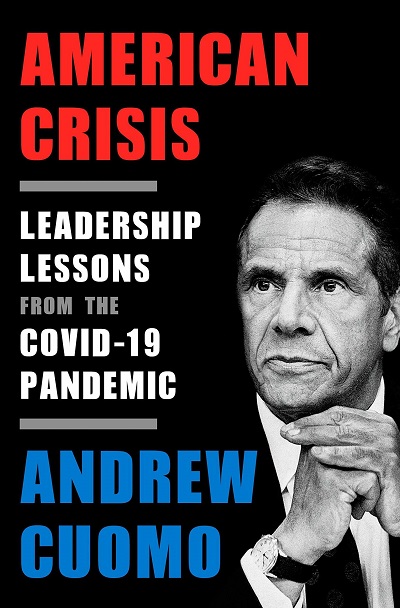
Sorry to keep harkening back to previous SHuSHs but I can’t overlook the latest on the Andrew Cuomo shambles.
You’ll remember that now-disgraced former governor of New York, Andrew Cuomo, played dirty with his publisher and the public while landing a lucrative book contract. More specifically, he suppressed bad news about pandemic deaths in his state while coaxing a $5.1 million advance out of Penguin Random House for a book about his heroic activities as a COVID-19 fighter.
I mentioned that it was astonishing that the governor of America’s hardest-hit pandemic state could produce a fat manuscript in just three months, and that media reports suggested his staff and a ghostwriter authored the book for him. The same reports said he was in danger of violating state ethics prohibitions against the use of state resources or personnel in producing his book.
I also noted that weeks after the grandly titled American Crisis: Leadership Lessons from the COVID-19 Pandemic was released in October 2020, Cuomo was hit with the first in a long series of sexual harassment allegations. He was forced to resign his office in August 2021. By then, it had also emerged that Cuomo’s office had covered up roughly half of the fatalities among state nursing home residents during the pandemic.
Penguin Random House took a bath on the project. American Crisis has sold only about 50,000 copies, about a tenth of what the publisher needed to cover the advance it paid the author.
This week it was Cuomo’s turn in the tub. An ethics panel ruled that he had broken his promises not to use state resources or government staff to write his self-congratulatory book, and gave him thirty days to hand over to the State of New York the $5.1 million he earned with the book.
‘Tis the season to be jolly
Fa-la-la-la-la, la-la-la-la
December 17, 2021
Those Olympic rings are more than just tarnished
In First Things, George Weigel notes the, ah, Olympian disdain for mere morality and human decency is far from a new thing as the IOC prepares for the Beijing games in 2022:
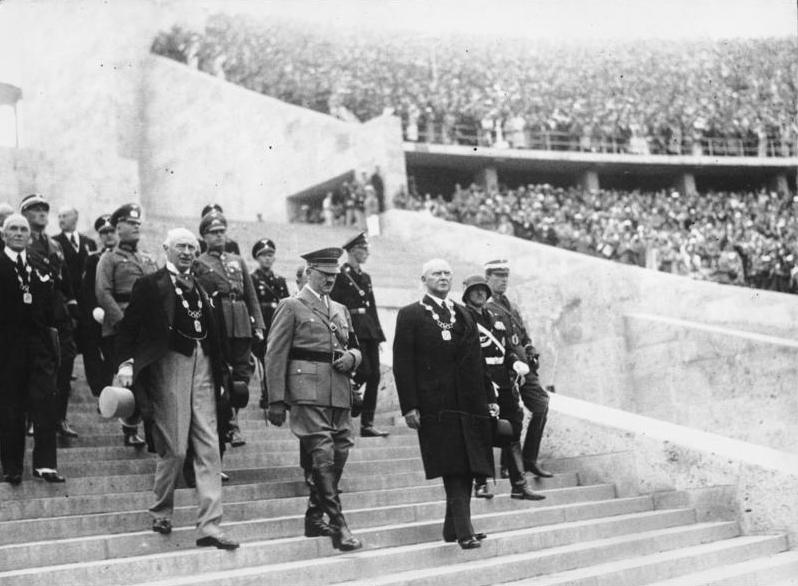
Google translation of the original German caption: “Before the ceremonial opening of the XI Olympic Games. Together with the members of the International and National Olympic Committee, the Führer and Reich Chancellor enters the stadium through the marathon gate. On the left of Adolf Hitler [Henry] Graf Baillet-Latour, on the right His Excellency [Theodor] Lewald.”
German Federal Archives (Accession number Bild 183-G00372) via Wikimedia Commons.
In July 2016, as we were sitting on the fantail of the Swiss sidewheeler Rhone while she chugged across Lake Geneva, my host pointed out the city of Lausanne, where a massive, glass-bedecked curvilinear building was shimmering in the summer sun. “Isn’t that the headquarters of the International Olympic Committee?” I asked. When my friend replied in the affirmative, I said, “I thought I smelled it.”
That rank odor — the stench of greed overpowering the solidarity the Olympics claim to represent — has intensified recently.
Even the casual student of modern Olympic history knows about the August 1936 Berlin Games, at which America’s Jesse Owens, a black man, took four gold medals and trashed Hitler’s Aryan supremacy myth. Fewer may be aware that, in February that year, the Olympic Winter Games were held in the Bavarian town of Garmisch-Partenkirchen. How, we ask today, could two Olympics be held in the Third Reich? How could people not know?
There was some controversy about holding the summer and winter Olympics under Nazi auspices. But in 1936, the German situation was not as comprehensively ghastly as it would become in later years. Yes, the Dachau concentration camp for political prisoners had opened in March 1933, and the Nuremberg Laws banning Jews from German citizenship and prohibiting marriage between Jews and “Aryans” had been enacted in 1935. The horrors of the Kristallnacht pogrom in November 1938 were two years in the future, however, and the satanic Wannsee Conference to plan the “Final Solution” to the “Jewish Question” would come six years later. Clear-minded people ought to have discerned some of the implications of the Nuremberg Laws. But the industrialized mass slaughter of millions, simply because they were children of Abraham, was beyond the imagination of virtually everyone.
So Hitler and his thugs temporarily behaved themselves (sort of) in the run-up to the Garmisch-Partenkirchen and Berlin Olympics. And the International Olympic Committee could salve whatever conscience it had in those days and proceed with the games.
The IOC has no excuses today, two months before the XXIV Olympic Winter Games open in Beijing. Because today, everyone knows.
QotD: The Kafkatrap that is known as “white feminism”
Many describe Franz Kafka’s disenchanted fables as tragic. And this is certainly true. But they are also farcical. To watch someone being relentlessly wrong can be grimly enjoyable — as long as you’re not the person in question.
The term white feminism, as it is commonly used today, is a classic example of the Kafka Trap. If you show too much interest in the lives of people of colour, you risk being accused of white saviourism — which is another way of saying you have a suspiciously condescending attitude to people of colour. But if you don’t show enough interest, you are insufficiently intersectional. You only care about the white, middle-class cisgendered women in your social circle.
White feminism is a classic example of the Kafka Trap because whatever you do is either too much or not enough. You are never right.
Tomiwa Owolade, “The problem with white saviours”, UnHerd.com, 2021-09-12.
December 15, 2021
Christopher Hitchens, ten years gone
In The Critic, Ben Sixsmith laments our loss of the “last cool columnist”:
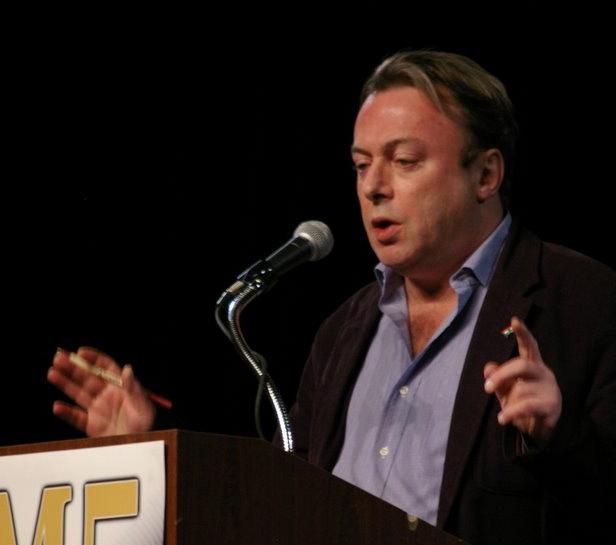
Christopher Hitchens speaking at The Amaz!ng Meeting held at the Riviera Hotel, Las Vegas, Nevada on 20 January 2007.
Photo detail by ensceptico via Wikimedia Commons.
The ten year anniversary of the death of Christopher Hitchens (15 December) brings to mind two questions. Firstly, has it really been ten years since Christopher Hitchens died? Secondly, has it only been ten years since Christopher Hitchens died? The vivid nature of his prose and rhetoric makes him feel like our contemporary. His obsessions, though, — like atheistic evangelism and Middle Eastern nation building — feel as dated as a Roman artifact.
Columnists have a short cultural lifespan. Once, millions of Britons read Bernard Levin every week. Now? I doubt that most young writers have even heard of him. Classic books are reprinted. Newspapers gather dust. Hitchens’s name does not have all the weight it had ten years ago but it has stayed alive, because the Internet archives essays and appearances and because of the esteem that he is held in by his peers.
Janan Ganesh, writing for the Financial Times, believes that Hitchens would have thrived if he had lived to comment on 2021. “He was made for our time, not his own,” Ganesh writes, “The great vacancy in today’s public life is for an equal scourge of the censorious left and the feral right … Hitchens would have been in his element.”
This is bunkum. Hitchens would have been hopelessly out of sorts in the 2020s. How, for example, would he have responded to the COVID-19 pandemic? It is as implausible to imagine that a man with such a lust for life would have endorsed long-term restrictions as it is to imagine that a man with such cheerful faith in the scientific establishment would have had time for COVID sceptics and vaccine hesitancy. Anybody hoping that Hitchens would have carved out some kind of nuanced middle ground, meanwhile, must have forgotten who we are dealing with. No, the plain truth is that the high moralism and rhetorical fury of “the Hitch” were perfectly suited to the heydays of the War on Terror and cable TV.
Liberal commentators like Ganesh miss Hitchens not so much because of his opinions as because he was cool. Ross Douthat mentions Mark Lilla, Anne Applebaum and Andrew Sullivan as other liberals who criticise the left and the right. But while I respect Lilla and Applebaum’s accomplishments and enjoy Sullivan’s writing, how many people do you think have fantasised about having a few drinks with them — or, indeed, with any other political commentator not named “Hitchens”?
QotD: Suppressing intellectual heresy
The young people at Middlebury who shouted down Charles Murray and assaulted a faculty member who had tried to engage him in civil debate were, in effect, suppressing the ideas of a heretic. After all, a heretic’s ideas are too dangerous to be heard.
Dangerous ideas are, of course, interesting ideas, especially to young people. When we fail to address dangerous ideas in our courses, we add to their mystique. When activists shout down or assault heretical speakers they send two messages. The first and intended message is a display of righteous disapproval. The other, unintended message, is that there is something so menacing about the idea being expressed that it cannot simply be laughed off or even argued with, rather it cannot be allowed to be spoken.
Consider how that looks to someone who is starting to question the premises of the liberal orthodoxy on race, gender, diversity and so on. Why, our alt-right curious person might wonder, are there some ideas that are so laughably false that one need not even mount a counter argument (a flat earth or the financial benefits of college athletics), some ideas that are considered contentious but still open to debate (supply-side economics), and some ideas that are so outré that they can only be met with back turning, shouting, or by punches to the face?
Might it be, our waverer must wonder, that these people don’t want me to hear this idea because they don’t have a good answer to it?
Erik Gilbert, “Liberal Orthodoxy and the New Heresy”, Quillette, 2019-02-04.
December 14, 2021
QotD: Insulated from reality
The first notable thing about today’s act of public nuisance masquerading as a protest was the hilarity of the campaign group itself. Remember when radicals fought for higher wages or better working conditions or for a revolution to replace capitalism with something else? Not anymore. Today’s self-styled militants demand the insulation of houses. “What do we want? The creation of a thermal envelope in people’s homes! When do we want it? Now!” What a crock to go to the barricades for. Also notable is the irony of supposed planet-lovers causing so much pollution by forcing hundreds of cars and trucks to sit still for ages, chugging fumes into the air for nought. Well played, greenies.
But the most striking thing about these kinds of protests is their sheer arrogance. Their inherently anti-democratic, anti-masses nature, where the aim is always, but always, to inconvenience the little people and teach us a lesson. You’re on your way to Heathrow for a much-needed jaunt to Malaga to escape the stresses of work? Not anymore, you’re not – the eco-elitists blocked junction 14, which leads to one of Heathrow’s terminals. You’re a knackered trucker who’s been driving all night long and now wants to get back to his family? Tough shit. These plummy alarmists have decided to make you the collateral damage of one of their narcissistic stunts.
Brendan O’Neill, “Environmentalism is a revolt against the people”, Spiked, 2021-09-13.
December 13, 2021
QotD: Cultural undermining of the British “establishment” was effectively complete by 1970
[…]
It also made the middle class, especially the educated and well-off middle class, despise themselves and feel a sort of shame for their supposedly elitist prejudices, based upon injustice and undermined by their failure to defend the nation from its enemies in the era of appeasement. Thanks to this, in another paradox, they have often felt unable to defend things within Britain which they value and which help to keep them in existence, from the grammar schools to good manners. They are ashamed of being higher up the scale, though for most middle-class people this is more a matter of merit than birth, and nothing to be ashamed of at all.
[…]
Since the 1960s, when the Left began its conquest of the cultural battlements, it has always been surprised and annoyed by Tory election victories. The 1970 Tory triumph, though entirely predictable, took the cultural establishment by surprise. The 1979 Tory win, though even more predictable, infuriated them. They had won control of broadcasting, of the schools, of the universities, the church, the artistic, musical and architectural establishment? How was it possible that they could not also be the government? Their rage was enormous, and increased with each successive Labour defeat. It was an injustice. How could the people be so foolish? Now, instead of aristocratic snobs misgoverning the country, the establishment was portrayed as a sort of fascistic semi-dictatorship, hacking at the NHS and the welfare state, waging aggressive wars abroad and enriching itself while the poor lived in misery.
This series of falsehoods has now become a weapon ready and waiting for unscrupulous demagogues to harness, and perhaps use against the new “establishment” which has benefited so much from the satire boom and the alternative comedians. Once you have begun to use dishonest mockery as a weapon, you can never be entirely sure that it will not eventually be turned against you, by others who have learned that abuse and jeering pay much easier and swifter dividends than hard fact or serious argument. It could be that the civilized mirth of the sixties leads in a direct line to the crude hyena cackling of the mob. In any case, there is no sign of the humour industry taking the side of traditional morality, patriotism or civility. The best it can do is dignify itself with noisy and public collections for sentimental and prominent charity. Once you step beyond the fringe, you sooner or later find yourself in very wild country indeed.
Peter Hitchens, The Abolition of Britain, 1988.
December 12, 2021
“[T]oday’s antiracism paradoxically requires the crudest of racist categories to justify and explain itself”
Andrew Sullivan on the racism of modern “anti-racist” movements and his hope that Hispanic Americans may provide a way out of the current political deadlock:
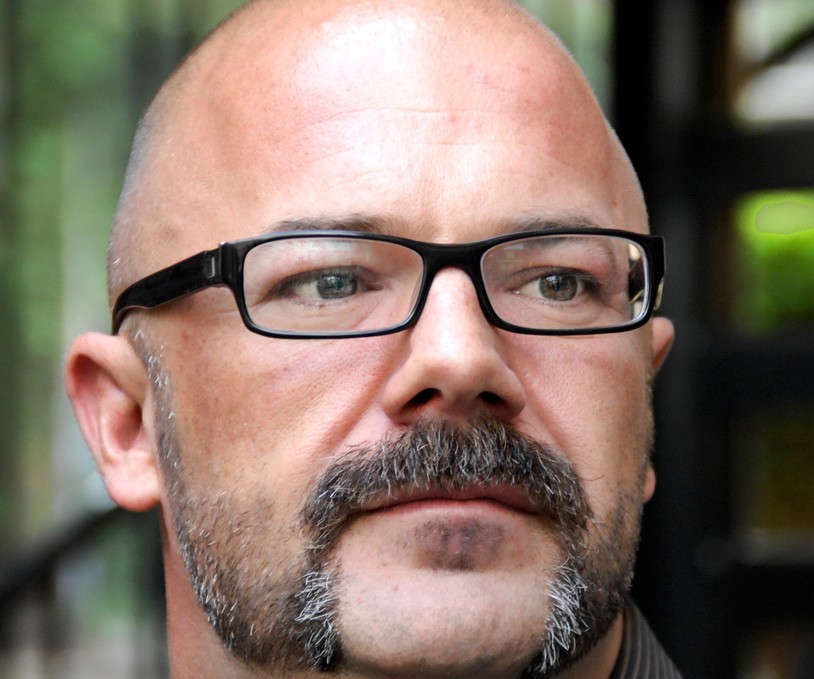
Of all the acronyms, euphemisms and sophisms pioneered by critical theory, one of the most revealing is the term “black and brown people”. You hear it all the time now. Whether it’s about “the lack of Black and brown representation in Hollywood”, vaccine hesitancy in “Black and brown neighborhoods in large cities”, the right to vote for “Black and brown people”, or “allyship between Black and brown people”, the “B&b” formula is now yet another ubiquitous media virtue-signal. It’s subtler than some others. It doesn’t shriek woke like “BIPOC”; it isn’t as instantly risible as “2SLGBTQIA+”; it gives “Black” a Capital Letter, and “brown” feels a bit like a lower-case add-on — but at least it uses actual English words, and doesn’t end in an X.
Still: what does it tell you that a staggering and brilliant array of totally different ethnicities, races, religions, histories and cultures can now routinely be reduced to just two drab colors?
I think it speaks to two things. The first is that today’s antiracism paradoxically requires the crudest of racist categories to justify and explain itself. A whole kaleidoscope of immigrant difference — from Kurds and Mexicans and Somalis to Dominicans, Chileans, Nigerians, and Pakistanis — has now been turned into one monochrome racial “brown” — just to fit into an oppressor/oppressed, white/black narrative.
Equally, a diverse African diaspora — ranging from Nigerian immigrants to descendants of Southern slaves to biracial men and women with mainly European ancestry who go back to this country’s miscegenated origins — is now just “Black”. And this new racial unit has one politics: left-Democrat. Individuals disappear; diversity of opinion within groups evaporate; all that matters is a single skin color and oppression.
The second aspect of critical theory that “B&b” helps reveal is that the crude binary of “black” and “white” simply has less salience with every passing day, as more and more races, ethnicities and cultures complicate and enrich our society, and render it structurally, demographically and culturally unrecognizable from even the recent past. To give one example: 60 years ago, four percent of Americans approved of inter-racial marriage; today, it’s 94 percent. Or check out the rapid decline in the “white Christian” share of the population — from 80 percent in 1996 1976 to 44 percent today. Look around you and you’ll see how the crude rubric of “white supremacy” is, in fact, wildly out of date.
This is why so many of the most passionately woke are so obsessed with history in America, and the further back the better, as the 1619 Project shows. The past is a world they are much more comfortable in than the present, a place where the racial divide was infinitely simpler, and racial inequality both brutal and actively enforced by the government. Before the Civil Rights Act in 1964, before mass non-white immigration began in 1965, before mass non-white illegal immigration since the 1990s, the “white supremacy” rubric had some lingering traction.
But in the 21st Century, it’s been hopelessly compounded by layer upon layer of mass immigration from every conceivable corner of the planet. The Latino population in the US is now larger than the African-American one; and Asians, of many different varieties, are now immigrating in higher numbers than Latinos. Before too long, the black/white dynamic may disappear into the multi-colored, multi-hued background entirely.
QotD: Britain’s alienated intelligentsia of the 1930s
It is clear that the special position of the English intellectuals during the past ten years, as purely negative creatures, mere anti-Blimps, was a by-product of ruling-class stupidity. Society could not use them, and they had not got it in them to see that devotion to one’s country implies “for better, for worse”. Both Blimps and highbrows took for granted, as though it were a law of nature, the divorce between patriotism and intelligence. If you were a patriot you read Blackwood’s Magazine and publicly thanked God that you were “not brainy”. If you were an intellectual you sniggered at the Union Jack and regarded physical courage as barbarous. It is obvious that this preposterous convention cannot continue. The Bloomsbury highbrow, with his mechanical snigger, is as out-of-date as the cavalry colonel. A modern nation cannot afford either of them. Patriotism and intelligence will have to come together again. It is the fact that we are fighting a war, and a very peculiar kind of war, that may make this possible.
George Orwell, “The Lion And The Unicorn: Socialism and the English Genius”, 1941-02-19.
December 11, 2021
Another front opens in the “War On Christmas”
In The Line, Jen Gerson looks at the latest offence against mainstream views of the Christmas season:
it was impossible not to get sucked into the blossoming horror of Santa Inc.
The eight-part television show made for HBO Max by comedians Sarah Silverman and Seth Rogen may soon attain the record of one of the most poorly rated television series of all time. And watching but a brief trailer, it’s not hard to see why.
I mean … Jesus. If you were trying to craft a perfect example of hate-bait for the reactionary right in a lab, this is pretty much what it would look like. It’s got woke politics, feminism, hatred of white guys and a pot shot in the War on Christmas neatly tied up in a claymation bow. The fact that the show is fronted by comedians who are Jewish has dug this mess into the very ugliest, muddiest trench of the culture war.
[…]
If you want to create an outrageous, bawdy Christmas movie that features a miserable and bored Mrs. Claus giving head to Santa, or a gag with a miner’s hat filled with dildos, there’s nothing wrong with that. But there’s a very specific audience for “sausage party” humour — lacrosse-playing young white men, and older white men who wish they were still young white men who could play lacrosse. In other words, people who look like Seth Rogen.
And do you know what that crowd doesn’t generally enjoy?
Thinly veiled manifestos on how awful white men are; the terribleness of corporate America, and a show featuring a lot of downtrodden women complaining about health insurance and lack of maternity leave.
On the other hand, if Santa Inc. was trying to appeal to the #resistence pussy hat and rainbow tattoo crowd, certainly a woke-appropriate message is here for them. But, does this crowd need to be so lectured? Meanwhile, the juvenile humour is off-putting. Is the feminist set going to keel over laughing because one of the female reindeer characters brags about having a threesome with Donner?
Lol. Thud.
There’s no sophistication here. No clever set up or punch line. It’s just a story about an angry female elf who wants to be Santa Claus that pretends to be funny by leaning on sex jokes.
Raunchiness is fine for a cheap laugh. It relies on the taboo of shock and sex to generate an emotional reaction. But, man, one of the most popular music videos of the last few years was Wet Ass Pussy. Who even notices swearing anymore? Who is shocked by a scene in which the main character’s mother bangs the Easter bunny?
This kind of lazy humour is old hat. It’s boring.
So, no, Santa Inc. is not good.

Pretendians in Canadian academia may resemble “those legendary Klan gatherings where everyone is an uncover FBI agent”
After recounting the rise and fall of Carrie Bourassa, Ed West looks at other examples of white people deliberately passing themselves off as members of First Nations groups and other disadvantaged groups:

Carrie Bourassa with media.
Lead photo in Geoff Leo’s article for the CBC – https://www.cbc.ca/newsinteractives/features/carrie-bourassa-indigenous
… then some serious allegations came to light casting doubt on Morning Star Bear’s fitness for office: Bourassa, it turned out, was white. Her forebears were all Russian, Czech and Polish farmers, who while the Metis struggled with the arrival of the Europeans were back in Tsarist Russia, living lives of unbridled white privilege as agricultural workers.
The response was merciless anger. Bourassa’s colleague Winona Wheeler, an associate professor of Indigenous Studies at the University of Saskatchewan, told the Canadian Broadcasting Corporation that what she did was “abuse” and “theft”, “colonialism in its worst form and it’s a gross form of white privilege.”
Another called her “the modern-day Grey Owl” in reference to the famous early 20th century English conservationist who had managed to convince the world he was Native American, rather than being Archibald from Hastings.
Bourassa’s outing was followed last weekend by that of Jessica Bardill, an “indigenous” language speaker at Montreal University who was reportedly suspended because of doubts about her race. And who could have suspected she was white?
Bourassa and Bardill are hardly exceptional: the past two years have seen at least half a dozen similar racial unmaskings, almost all female academics. Is this the result of the strange racial spoils system created by affirmative action, or does it reflect the cultural emptiness felt by some North Americans, the unbearableness whiteness of being?
Among them is Suzy Kies, an indigenous “expert” in – yet again – Canada, on whose advice a Catholic school district burned 30 library books about indigenous people, removing another 4,700. Kies had become quite a prominent figure on all matters indigenous; again, how could they have possibly noticed?
One suspects that a conference of Canada’s indigenous educators would turn out like those legendary Klan gatherings where everyone is an uncover FBI agent, or that meeting of Holocaust survivor memoir writers where both were fake.
Many of these “indigenous” experts had risen far by telling white liberals what they wanted to hear, confirming their worldview. The same was true of @Sciencing_Bi, who enthralled Twitter last spring with her powerful denunciations of sexual misconduct in higher education. The mysterious young woman had grown up in Alabama, a member of the Hopi tribe, but had “fled the south because of their oppression of queer folk”. Sadly, Sciencing Bi contracted Covid in April 2020, having been forced by her cruel university to do in-person teaching just at the point when that issue was becoming a culture war hot topic, and died, quite unusually for someone so young.
December 8, 2021
What if the refugee flow was crossing the Channel the opposite way?
In The Critic, Joel Rodrigues considers what the media narrative would say if the constant stream of migrants from the EU to Britain was reversed, as all the major media outlets predicted would happen if Brexit went through:
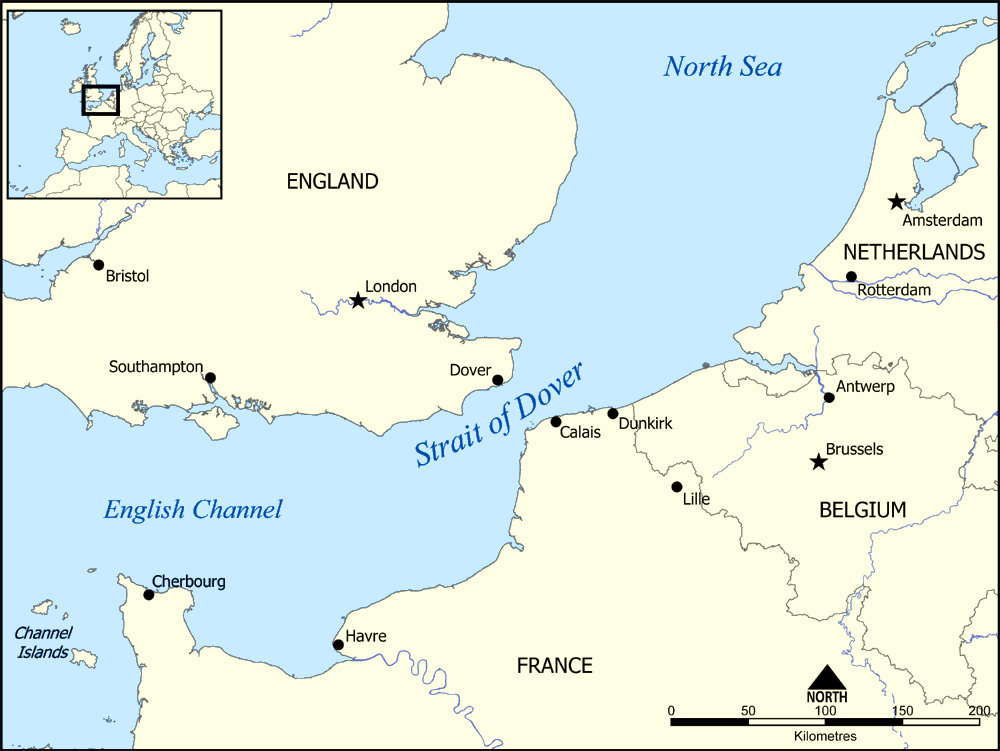
This map shows the location of the Strait of Dover between England and France, and part of the English Channel and the North Sea. It also shows nearby towns such as Dover, Calais, and Dunkirk.
Image created by NormanEinstein via Wikimedia Commons.
Imagine “tent” cities on the Kent coast, similar to “the Jungle” that existed in Calais up until 2016. These camps are the type of camps that the Remain campaign (wrongly) warned would spring up if Britain voted to leave the EU, as part of their Project Fear campaign. The tent cities are full of migrants, hoping to reach the French coast and the “sunlit uplands” of the European Union.
The camps are filthy, riddled with violent crime, and it is here that people traffickers sell spaces on dinghies to cross the channel for thousands of pounds a ticket. The British police and immigration services are aware of undocumented people living in squalor in the camps, but largely do nothing.
Occasionally a camp is cleared to placate the locals, but it quickly springs up somewhere else. The British government make no effort to document, accommodate or process the migrants living in appalling conditions on its territory. Instead, it blames the “pull factor of the EU’s single market”, saying that many of these migrants have family in France and want to live in a French or German speaking society. A junior British minister suggests that the black market economies in the EU are also a pull factor, and that there are a “lack of safe asylum routes” into the EU.
People smugglers continue operating from the British coast, and the migrant camps expand. Dinghies are now launched daily from the UK towards the continent. Police are aware of the launches, but do nothing. The RNLI and Royal Navy escort these flimsy boats until they are in EU waters, despite their not being seaworthy. Thousands succeed in making the crossing.
Then, tragedy strikes when a boat sinks. Statements are released from the British and French governments lamenting the loss of life. Trying to find a solution, Emmanuel Macron writes a letter to Boris Johnson urging increased collaboration, with joint patrols if necessary, to prevent a repeat of the tragedy.
The British government issue a response claiming that the perfectly conciliatory letter is in fact unacceptable, a “threat to British sovereignty”, and that France is uninvited from crisis talks. British media later reports that in a meeting with some of his advisors, Boris Johnson branded Emmanuel Macron as “a clown in charge of a circus”.
Imagine the media commentary and narrative in the UK surrounding such a situation, especially post-Brexit.
“Migrants die fleeing racist, Brexit-ridden, plague island,” says an op-ed in the Guardian. The comments are largely agreed that Boris Johnson is personally responsible for each of their deaths.
“UK condemned as using migrants to destabilise the EU’s single market,” reports the BBC. Parallels are also drawn in The Times between Boris Johnson and Belarus’ Lukashenko. There are mass demonstrations outside Parliament as the crisis worsens.
One can imagine the EU Commission swiftly and publicly denouncing the UK and drawing up sanctions. The Labour party would likely call it a national scandal, and demand resignations, as well as accusing the government of taking a hardline stance as cynical electioneering.
I searched for public domain or Creative Commons images of the English Channel migrant crisis, but came up surprisingly empty, hence the generic map to illustrate this post. I had expected to be inundated with lots of heart-rending images of desperate refugees, but not this time…
December 7, 2021
How are things going in Honduras?
For those not following the Honduran experiment with ZEDEs (las Zonas de Empleo y Desarrollo Económico — Zones for Employment and Economic Development) also known as “charter cities” or “model cities”, Scott Alexander provides a handy summary of the situation in the wake of the recent Honduran elections:

Honduras, Guatemala and El Salvador
Image via Google Maps.
The socialist opposition has won Honduras’ election and pledges to fight against charter cities there. “Immediately upon assuming the presidency, we are going to send the National Congress an initiative for the repeal of the ZEDE law,” incoming president Xiomara Castro said.
This was what everyone was afraid of. But the last party tried pretty hard to protect ZEDEs from trigger-happy successors, and the constitution currently says that the only way to get rid of them is to win two consecutive 2/3 votes to do so, then give the existing projects ten years to wind down.
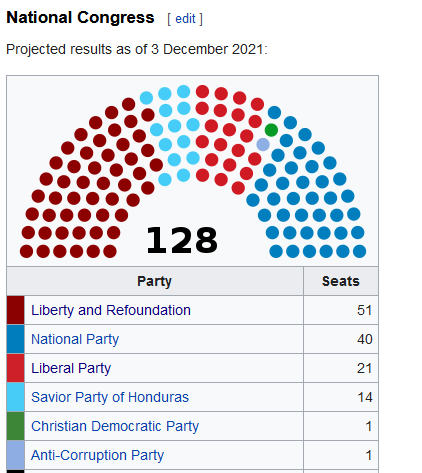
Can the socialists get a 2/3 majority? Wikipedia predicts the incoming Honduran Congress will look like this:
Liberty and Refoundation (the socialists) will probably enter into a coalition with the Savior Party and have 65/128 seats for a bare majority. They need 86 votes for a 2/3 majority, which in theory they can get if the Liberal Party agrees. The Liberal Party seems centrist and hard to pin down, but this article includes the following great quote:
“The Liberal Party opposes the ZEDEs because, above all, they undercut our national sovereignty, and because we don’t want them to become hideouts for extraditable criminals,” said [Liberal Party leader Yani] Rosenthal, who served a three-year prison sentence in the United States for money laundering and participating in a criminal scheme with the Los Cachiros cartel.
Rosenthal kind of goes back and forth elsewhere, but in the end I think he’ll vote with the socialists on this. Still, there’s some speculation that his party might not vote as a bloc, and even a few defectors would be enough to prevent a supermajority.
In theory, even if the socialists win two consecutive votes, they have to give the projects ten years to wind down. Ten years is forever in politics, and probably before then the capitalists will get back into power and say never mind, everyone can keep doing what they’re doing. The socialists are aware of this and say that their supplementary strategy is to have everything about the ZEDE law declared unconstitutional.
This should be a hard sell, because ZEDEs are a constitutional amendment, plus the current Supreme Court explicitly ruled a few years ago that they were constitutional. But apparently the Honduran Supreme Court can declare constitutional amendments unconstitutional if it really wants. And the new government will get to appoint a new Supreme Court in two years, and although the exact process is complicated, they may be able to get people who agree with them on this.
Also, incoming president Castro is married to Manuel Zelaya, a former president who tried to pull an Andrew Jackson after the Supreme Court ordered him to stop holding an illegal referendum to change term limits in his favor. He ordered the military to hold the referendum anyway, and was only ousted after the military couped him instead. So this is not exactly a family known for their deep respect for the exact wordings of laws or court rulings (not that anyone in Honduras has really excelled on that front). See further speculation eg here and here. And here’s Mark Lutter from Charter Cities Institute on the elections and the future.