
Warships are complicated engineering marvels, requiring extensive work and support to keep operational and effective. A modern escort ship is a floating town, able to generate power to provide life support and hotel services, propulsion, aviation operations and the ability to operate a variety of very complicated electronic systems and weapon systems, and it is built to do this while surviving damage from enemy attack.
This complex world requires attention on a regular basis, both to make sure that the constituent parts still work as planned, and also to update and replace parts with more modern or better alternatives, or to provide planned upgrades. For instance, it is common for new ships entering service to undergo a short refit to add in any extra capability upgrades that may have been rolled out since construction began, and to rectify any defects.
For the purposes of planning how the fleet works, the Royal Navy looks to provide enough ships to meet agreed defence tasks. In simple terms the MOD works out what tasks are required of it, and what military assets are needed to meet them. This can range from providing a constantly available SSBN to deliver the deterrence mission through to deploying the ice patrol ship to Antarctica.
Once these commitments are understood, planners can work out how many ships / planes / tanks are needed to meet this goal. For example, it may be agreed that the RN needs to sustain multiple overseas deployments, and also be able to generate a carrier strike group too.
If, purely hypothetically the requirement for this is 6 ships, then the next task is to work out how many ships are needed to ensure 6 ships are constantly available. Usually, this has historically been at a 3:1 ratio – one ship is on task or ready to fulfill it, one is in some form of work up or other training ahead of being assigned to the role, and one is just back or in refit.
In practical terms this means that the RN never looks to get 100% of its force to sea, but rather to ensure it doesn’t fail to ensure enough ships are available to meet all the tasks that it is required to do. Consequently there is always going to be a mismatch between the number of ships owned, and the number of ships deployed.
Sir Humphrey, “Inoperable or just maintenance”, Thin Pinstriped Line, 2019-10-24.
April 6, 2024
QotD: No navy ever has all its ships at sea at the same time
April 5, 2024
Ero: The Croatian Uzi (With Israeli Help?)
Forgotten Weapons
Published Jan 3, 2024The best of the submachine guns made in Croatia during the Homeland War was the Ero, made by a company called Arma. The Ero is a basically perfect, parts-interchangeable copy of the Israeli Uzi that was developed in 1992 and adopted into Croatian Army service in 1993. The only really distinguishable difference between the Ero and Uzi is the Ero’s use of Croatian-language selector markings (and receiver markings). Between 15,000 and 20,000 were produced, and they remained in service long after Croatian independence was secured. They were issued to vehicle crews, military police, special forces, and reconnaissance units.
Arma was a subsidiary of a major Croatian engineering firm, and after the Ero production it developed the APS-95 Croatian AK (which is a story for another video). They were a very competent company, but the details and quality of the Ero are so good that I believe it must have been made with tacit or explicit assistance from Israel. Croatia does have a strong Jewish community, and there were rumors during the war that the technical data package for the Uzi did find its way into Croatia. There is no official acknowledgement of this happening, but it would certainly not be hard to believe. But however the development happened, the result was a very high quality submachine gun.
A big thanks to the Croatian Police Museum (Muzej Policije) in Zagreb for giving me access to film this cool piece for you! Check them out at: https://muzej-policije.gov.hr
(more…)
April 4, 2024
See Inside Panther | Tank Chats Reloaded
The Tank Museum
Published Dec 29, 2023Chris Copson takes a detailed look inside and out, of arguably the most advanced German tank of WW2 … the Panther.
Is the Panther the formidable opponent that is was made out to be? Would the allies use such a vehicle and was it over engineered? Find out in today’s video.
00:00 Intro
00:54 Overview – Our Panther
02:41 War time variants & armour
06:06 Design
08:30 Weaponry
10:18 Crew, equipment and flaws – a look inside
17:53 Performance & conclusion
(more…)
April 3, 2024
Man of his era, indeed – “we think too much of Thomas Jefferson, because we don’t see his cultural context”
Chris Bray on the sudden discovery of his dissertation topic in a quite unexpected venue:

Thomas Jefferson, 1800.
Oil portrait by Rembrandt Peale via Wikimedia Commons.
Fifteen years ago, more or less, I stumbled into a topic for a dissertation when I got frustrated and took a walk. I was in Worcester, Massachusetts, working in the archives at the American Antiquarian Society and finding just absolutely nothing at all that answered my question. So I wandered, and passed a decommissioned armory with a sign over the door that said MASSACHUSETTS MILITARY ARCHIVES. They let me poke around, and by the end of the day I was running around with my hair on fire and shouting at everybody that my dissertation was about something else, now.
State militia courts-martial in the opening decades of a new republic recorded every word, in transcripts that could run to hundreds of pages — frequently interspersed with a line that said something like, “Clerk again reminded witnesses to speak slowly.” The dozen officers who made up a militia court weren’t military professionals, but were instead the prominent farmers and craftsmen who were elected to militia office by their townsmen. So transcripts of state military trials were verbatim discussions among something like the most respected farmers of a county, or of this county and the next one over. They were not recorded debates between the great statesmen of the era. And they needed a big room where a dozen men could sit at a long table in front of the parties and the spectators, so state courts-martial tended to convene in taverns.
One more important thing: The formalization of military courts was way in the future, and there wasn’t a professional JAG Corps in the militia to run trials. State courts-martial were a lawyer-free forum. The accuser was expected to “prosecute” his case — to show up and prove the wrongdoing he had claimed to know about. And defendants were expected to personally defend themselves, questioning witnesses and presenting arguments to the court. At the end of testimony, the “prosecutor” and the defendant personally went home to write their own closing statements, and we still have these documents, tied into the back of the trial transcripts with a ribbon. Courts would stop in the evening and resume in the morning, and men accused of military offenses would show up with twenty-page closing statements in their own handwriting, with holes in the page where the pen poked through.
So: a panel of farmers, serving as local militia officers, listening to an argument between farmers who served as local militia officers, in a tavern, and we have a detailed record of every word they said.
They were magnificent. They were clear, thoughtful, fair, and logical. They had no patience at all for dithering or innuendo; they expected a man who accused another man of wrongdoing to get to it, in an ordered and serious way. Witnesses who fudged or evaded ran into a buzzsaw. The officers on the courts would interject with their own questions: Look, captain, did he say it or didn’t he? And then they wanted a serious summary of the evidence, with a consistent argument. Their thinking was structured, and they expected the same of others.
We distinguish between talking and doing, and between talkers and doers. But these men were doers in the hardest sense. Their families starved or thrived because of their work with tools and the skill in their hands. Their food came from their dirt, outside their front door. They mostly weren’t formally educated; they didn’t spend their young lives going to school. They worked, from childhood. And yet they could talk, meaningfully and carefully. They could address a controversy with measured discourse, gathering as a community to assess an institutional failure and organize a logical response. Their talking was another way of doing.
The historian Pauline Maier has written that we think too much of Thomas Jefferson, because we don’t see his cultural context. The Declaration of Independence looks to us like a startling act of political creativity, systematically describing a set of grievances and proposing an ordered response based on a clear philosophy of action. But Jefferson showed up after years of disciplined and thoughtful local proclamations on the crisis, Maier says. He was the national version of a hundred skillful town conventions, standing on the foundation of an ordered society that knew what it believed and what it meant to do about it.
The Flying Saucer Designed To Ram Soviet Bombers | Avro Canada Silver Bug
Rex’s Hangar
Published Dec 29, 2023Today we’re taking a look at a concept “aircraft” developed in the 1950s, the Avro Canada Silver Bug — part of a long line of flying discs drawn up by designer John Frost.
(more…)
April 2, 2024
Gear-Ratio-Accelerated? Yep, It’s a Thing: French MAT 1955 Prototype
Forgotten Weapons
Published Dec 20, 2023EDIT: Shoot, I managed to get the gear ratio backwards. Sorry! The recoil action provides the necessary delay, and then the gear ratio provides acceleration to ensure the bolt can open reliably, akin to the accelerator in a Browning M1917 or 1919 machine gun, or a Lahti L35 pistol. Please excuse the error …
In the search for an improvement to the MAS 1949 rifle for the French military, all the French arsenals proposed new designs. MAS supplied an updated version that was ultimately adopted as the MAS 49/56, but the Tulle Arsenal (MAT) had a wacky idea of its own. In 1955, they presented a short-recoil, tilting bolt, gear-ratio-delayed system. It was an open bolt firing rifle chambered for the 7.5x54mm cartridge, using detachable 20-round magazines. Today we have one of the first models to look at, and there was a second iteration in 1956, which lightened the rifle by replacing some steel parts with aluminum. Neither was successful, much to the relief of the French Army …
Many thanks to the IRCGN (Institut de Recherche Criminelle de la Gendarmerie Nationale) for allowing me access to film this unique rifle for you!
(more…)
April 1, 2024
The most likely outcome of a 2nd US Civil War isn’t two successor states, but a modern version of the Holy Roman Empire
Kulak, at the start of a very long post on historical eras of centralization and decentralization, touches on the most likely outcome of a second US civil war, and it’s not a rump USA and a neo CSA:
Every time the subject of a possible US civil war or national divorce comes up I hear the same micron deep takes. America couldn’t break up because the division isn’t by state, its Urban Vs. Rural. Or that Urban vs. Rural isn’t the divide, even then people of different politics are mixed up together. Or that for every clear red or blue state there’s a purple state. None of which is in any way relevant to anything until you recognize the naïve mental model many of these people are working on …
These takes betray a belief that a second civil war would be some kind of conflict between coherent independent states who’ve started identifying with/against the idea of union such as happened in the 1860s … or that somehow there’d be a series of tidy Quebec style referendums resulting in a clean division such as exists in so many meme maps:
The truth is any post-breakup map of America would not resemble an electoral map following state lines, nor even a redrawing of state boundaries, such that the fantastical greater Idaho or Free State of Jefferson might exist as part of a wider Confederation of Constitutional Republics, or a Breakaway Philadelphia city-State join a Union of Progressive Democracies …
No. It’d be nothing so comprehensible or easily mapped to modern politics.
A post breakup America would probably look closer to this:
If you’re a sane person and your immediate reaction is: WHAT THE HELL AM I LOOKING AT!?
… Well that’s kinda the point.
(I really do apologize for all I’m going to have to digress)
For our purposes we can broadly divide history into 2 types of period … Periods of Centralizing trends, and periods of Decentralizing trends.


March 31, 2024
Allies Charge Forward from the Rhine! – WW2 – Week 292 – March 30, 1945
World War Two
Published 30 Mar 2024All along the Western Front the Allies break out in force, invading German territory and receiving German surrenders by the thousands. In the east, the Soviets take Danzig and Gdynia, and rout the Germans in Hungary. There’s a new Japanese offensive in China, though the fight on Iwo Jima ends with a Japanese defeat.
Chapters
00:45 Recap
01:08 Big Advances all over the West
05:48 Soviets take Gdynia and Danzig
07:09 Zhukov’s forces take Kustrin
10:39 The War in China
12:21 Iwo Jima Ends
14:30 Preliminaries for Okinawa
18:46 More Landings in the Philippines
19:23 Slim focuses on Rangoon
20:12 Notes to end the week
20:48 Summary
21:28 Conclusion
24:47 Call To Action
(more…)
August, 1945 – The Soviets enter the war in China
Big Serge outlines the Soviet invasion of Manchuria in August 1945 and its devastating impact on the Japanese Kwantung Army, finally shattering any remaining illusions that the Soviets would broker a peace between Japan and the western allies:
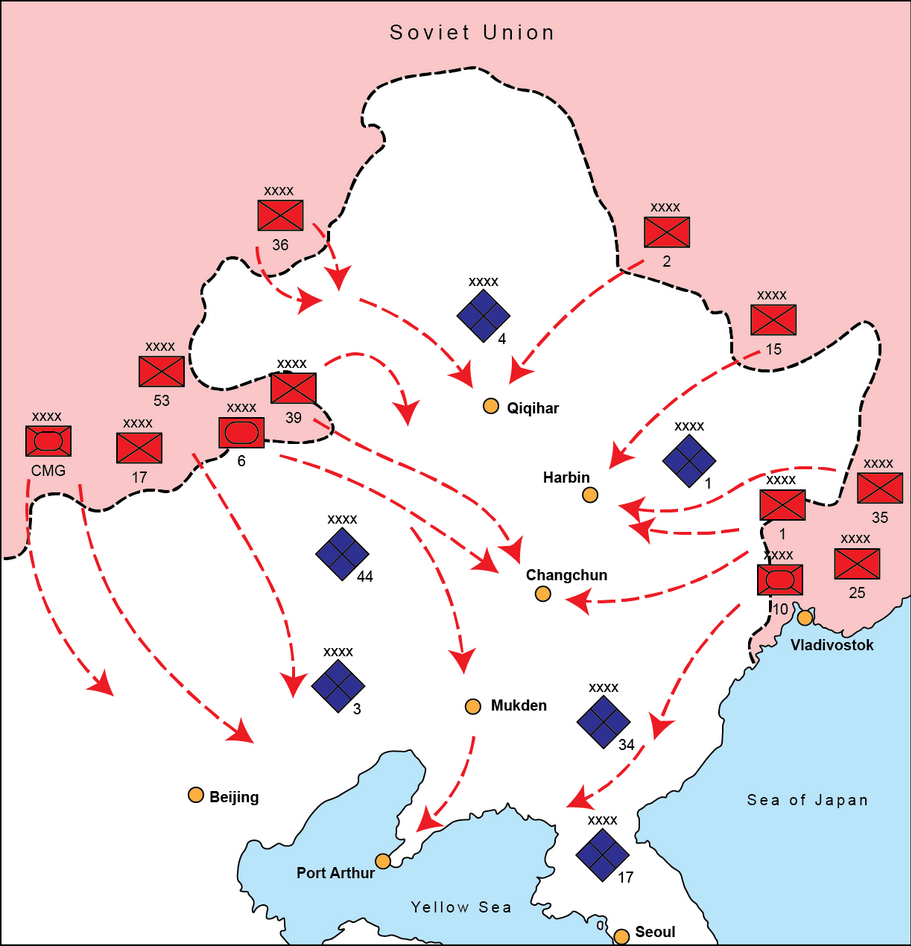
August Storm: The Soviet Invasion of Manchuria (August 9-20, 1945)
The Second World War had a strange sort of symmetry to it, in that it ended much the way it began: namely, with a well-drilled, technically advanced and operationally ambitious army slicing apart an overmatched foe. The beginning of the war, of course, was Germany’s rapid annihilation of Poland, which rewrote the book on mechanized operations. The end of the war — or at least, the last major land campaign of the war — was the Soviet Union’s equally totalizing and rapid conquest of Manchuria in August 1945.
Manchuria was one of the many forgotten fronts of the war, despite being among the oldest. The Japanese had been kicking around in Manchuria since 1931, consolidating a pseudo-colony and puppet state ostensibly called Manchukuo, which served as a launching pad for more than a decade of Japanese incursions and operations in China. For a brief period, the Asian land front had been a major pivot of world affairs, with the Japanese and the Red Army fighting a series of skirmishes along the Siberian-Manchurian border, and Japan’s enormously violent 1937 invasion of China serving as the harbinger of global war. But events had pulled attention and resources in other directions, and in particular the events of 1941, with the outbreak of the cataclysmic Nazi-Soviet War and the Great Pacific War. After a few years as a major geopolitical pivot, Manchuria was relegated to the background and became a lonely, forgotten front of the Japanese Empire.
Until 1945, that is. Among the many topics discussed at the Yalta Conference in the February of that year was the Soviet Union’s long-delayed entry into the war against Japan, opening an overland front against Japan’s mainland colonies. Although it seems relatively obvious that Japanese defeat was inevitable, given the relentless American advance through the Pacific and the onset of regular strategic bombing of the Japanese home islands, there were concrete reasons why Soviet entry into the war was necessary to hasten Japanese surrender.
More specifically, the Japanese continued to harbor hopes late into the war that the Soviet Union would choose to act as a mediator between Japan and the United States, negotiating a conditional end to war that fell short of total Japanese surrender. Soviet entry into the war against Japan would dash these hopes, and overrunning Japanese colonies in Asia would emphasize to Tokyo that they had nothing left to fight for. Against this backdrop, the Soviet Union spent the summer of 1945 preparing for one final operation, to smash the Japanese in Manchuria.
The Soviet maneuver scheme was tightly choreographed and well conceived — representing in many ways a sort of encore, perfected demonstration of the operational art that had been developed and practiced at such a high cost in Europe. Taking advantage of the fact that Manchuria already represented a sort of salient — bulging as it did into the Soviet Union’s borders — the plan of attack called for a series of rapid, motorized thrusts towards a series of rail and transportation hubs in the Japanese rear (from north to south, these were Qiqihar, Harbin, Changchun, and Mukden).
By rapidly bypassing the main Japanese field armies and converging on transit hubs in the rear, the Red Army would effectively isolate all the Japanese armies both from each other and from their lines of communication to the rear, effectively slicing Manchuria into a host of separated pockets.
There were, of course, a host of reasons why the Japanese had no hope of resisting this onslaught. In material terms, the overmatch was laughable. The Soviet force was lavishly equipped and bursting with manpower and equipment — three fronts totaling more than 1.5 million men, 5,000 armored vehicles, and tens of thousands of artillery pieces and rocket launchers.
The Japanese (including Manchurian proxy forces) had a paper strength of perhaps 900,000 men, but the vast majority of this force was unfit for combat. Virtually all of the Japanese army’s veteran units and equipment had been steadily transferred to the Pacific in a cannibalizing trickle — a vain attempt to slow the American onslaught. Accordingly, by 1945 the Japanese Kwantung Army had been reduced to a lightly armed and poorly trained conscript force that was suitable only for police actions and counterinsurgency against Chinese partisans.
Really, there was nothing for the Japanese to do. The Kwantung Army had far less of a fighting chance in 1945 than the Wehrmacht had in the spring of that year, and everyone knows how that turned out. Unsurprisingly, then, the Soviets broke through everywhere at will when they began the assault on August 9. Soviet armored forces found it trivially easy to overrun Japanese positions (armed primarily with archaic, low caliber antitank weaponry that could not penetrate Soviet armor even at point blank range), and by the end of the first day the Soviet pincers were driving far into the rear.
It is easy, in hindsight, to write off the Manchuria campaign as something of a farce: a highly experienced, richly equipped Red Army overrunning and abusing an overmatched and threadbare Japanese force. In many ways, this is an accurate assessment. However, what the offensive demonstrated was the Red Army’s extreme proficiency at organizing enormous operations and moving at high speeds. By August 20 (after only 11 days), the Red Army had reached the Korean border and captured all their objectives in the Japanese rear, in effect completely overrunning a theater that was even larger than France. Many of the Soviet spearheads had driven more than three hundred miles in a little over a week.
To be sure, the combat aspects of the operation were farcical, given the totalizing level of Soviet overmatch. Red Army losses were something like 10,000 men — a trivial number for an operation of this scale. What was genuinely impressive — and terrifying to alert observers — was the Red Army’s clear demonstration of its capacity to organize operations that were colossal in scale, both in the size of the forces and the distances covered.
More to the point, the Japanese had no prospect of stopping this colossal steel tidal wave, but who did? All the great armies of the world had been bankrupted and shattered by the great filter of the World Wars — the French, the Germans, the British, the Japanese, all gone, all dying. Only the US Army had any prospect of resisting this great red tidal wave, and that force was on the verge of a rapid demobilization following the surrender of Japan. The enormous scale and operational proclivities of the Red Army thus presented the world with an entirely new sort of geostrategic threat.
HMS Unicorn (I72) – Guide 367
Drachinifel
Published Dec 23, 2023The Unicorn, a fleet maintenance carrier of the British Royal Navy, is today’s subject.
(more…)
March 30, 2024
Extra Firepower for Vietnam: the Aussie “B!tch”
Forgotten Weapons
Published Dec 18, 2023Many of the special forces groups that operated during the Vietnam War found their standard issue weapons a bit unwieldy for use in confined jungle environments. They also found a need for something that could deliver an immediate large volume of fire to break contact during an ambush (or deliver an ambush of their own). The Australians were no exception, and with the typical Special Forces attitude towards customization a few guys made some improvements to what they were issued …
What we have today is a recreation (by Mark Graham of ARS, build on a DSA semiauto receiver) of an Australian L1A1 with its flash hider cut down and a second pistol grip mounted to the barrel. The real examples of these often had rather shorter barrels, and ones that began life as semiauto L1A1 rifles were typically converted to fully automatic (some began as L2A1 automatic rifles and did not require this extra step). Fitted with a large LMG magazine, they could deliver a lot of firepower in a very short time; just the ticket for a small jungle patrol.
(more…)
March 28, 2024
Justin Trudeau never misses an opportunity to make a performative announcement, even if it harms Canadian interests
Canadian Prime Minister Justin Trudeau made an announcement last week that the Canadian government was cutting off military exports to Israel … except that Canada buys more military equipment from Israel than vice-versa:
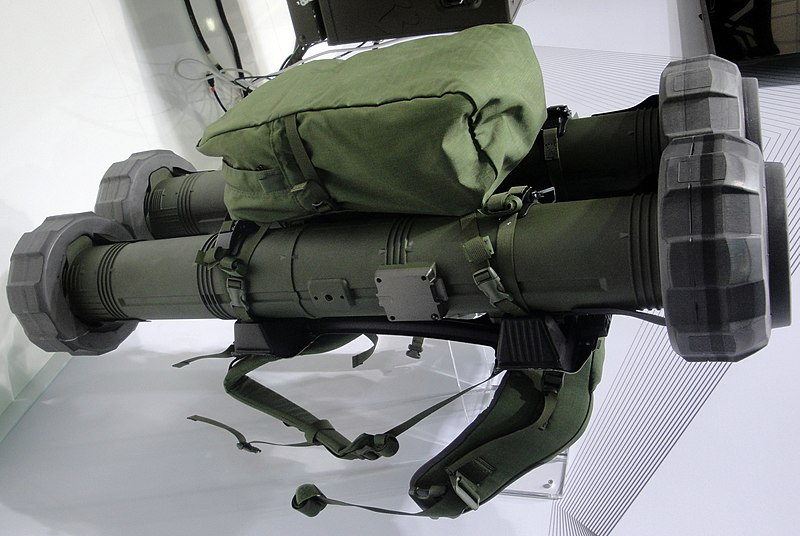
Israeli Spike LR2 antitank missile launchers, similar to the ones delivered to the Canadian Army detachment in Latvia in February.
Wikimedia Commons.
When the Trudeau government publicly cut off military exports to Israel last week, the immediate reaction of the Israeli media was to point out that Canada’s military was far more dependent on Israeli tech than was ever the case in reverse.
“For some reason, (Foreign Minister Melanie Joly) forgot that in the last decade, the Canadian Defense Ministry purchased Israeli weapon systems worth more than a billion dollars,” read an analysis by the Jerusalem Post, which noted that Israeli military technology is “protecting Canadian pilots, fighters, and naval combatants around the world.”
According to Canada’s own records, meanwhile, the Israel Defense Forces were only ever purchasing a fraction of that amount from Canadian military manufacturers.
In 2022 — the last year for which data is publicly available — Canada exported $21,329,783.93 in “military goods” to Israel.
This didn’t even place Israel among the top 10 buyers of Canadian military goods for that year. Saudi Arabia, notably, ranked as 2022’s biggest non-U.S. buyer of Canadian military goods at $1.15 billion — more than 50 times the Israeli figure.
What’s more — despite Joly adopting activist claims that Canada was selling “arms” to Israel — the Canadian exports were almost entirely non-lethal.
“Global Affairs Canada can confirm that Canada has not received any requests, and therefore not issued any permits, for full weapon systems for major conventional arms or light weapons to Israel for over 30 years,” Global Affairs said in a February statement to the Qatari-owned news outlet Al Jazeera.
The department added, “the permits which have been granted since October 7, 2023, are for the export of non-lethal equipment.”
Even Project Ploughshares — an Ontario non-profit that has been among the loudest advocates for Canada to shut off Israeli exports — acknowledged in a December report that recent Canadian exports mostly consisted of parts for the F-35 fighter jet.
“According to industry representatives and Canadian officials, all F-35s produced include Canadian-made parts and components,” wrote the group.
March 27, 2024
Civil Defence is a real thing in Finland
Paul Wells reports back on his recent trip to Finland, where he got to tour one of the big civil-defence shelters in Helsinki:
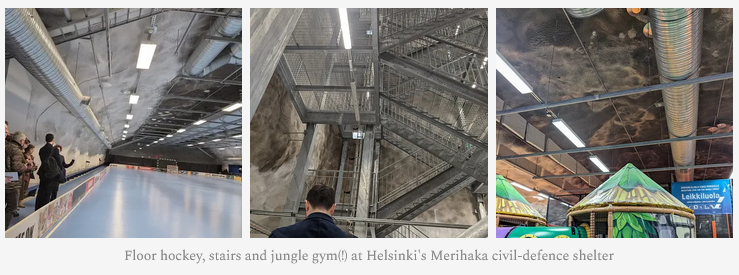
One of the best playgrounds for children in Helsinki is the size of three NFL football fields, dug into bedrock 25 metres below a street-level car park, and built to survive a nuclear bomb.
The air down here is surprisingly fresh. The floor-hockey rinks — there are two, laid end to end — are well maintained. The refreshment stands are stocked with snacks. The steel blast doors are so massive it takes two people to slam one shut.
Finland has been building civil-defence shelters, methodically and without fuss, since the late 1950s. This one under the Merihaka residential district has room for 6,000 people. It’s so impressive that it’s the Finnish capital’s unofficial media shelter, the one visiting reporters are likeliest to be shown. The snack bar and the jungle gym are not for show, however: as a matter of government policy, every shelter must have a second, ordinary-world vocation, to ensure it gets used and, therefore, maintained between crises.
The Merihaka shelter was one of the stops on my visit to Helsinki last week. The first anniversary of Finland’s membership in NATO, the transatlantic defence alliance, is next week, on April 4. Finland’s foreign office invited journalists from several NATO countries to visit Helsinki to update us on Finland’s defence situation. I covered my air travel and hotel. Or rather, paid subscribers to this newsletter did. Your support makes this sort of work possible. I’m always grateful.
The Finnish government used to build most of the shelters. But since 2011, the law has required that new shelters be built at the owners’ expense, by owners of buildings larger than 1,200 square metres and industrial buildings larger than 1,500 square metres.
The city of Helsinki has more shelter space than it has people, including visitors from out of town. Across the country the supply is a little tighter. Altogether today Finland has a total of 50,500 shelters with room for 4.8 million people.
That’s not enough for the 5.5 million people in Finland. But then, if war ever comes, much of the population won’t need shelter, because they’ll be staying groundside to fight.
Conscription is universal for Finnish men between 18 and 60. (Women have been enlisting on a voluntary basis since the 1990s.) The standing armed forces, 24,000, aren’t all that big. But everyone who finishes their compulsory service is in the reserves for decades after, with frequent training to keep up their readiness. In a war the army can surge to 280,000. In a big war, bigger still.
The Soviet Union invaded Finland in 1939, during what was, in most other respects, the “phony war” phase of the Second World War. The Finnish army inflicted perhaps five times as many casualties on the Soviets as they suffered, but the country lost 9% of its territory and has no interest in losing more. Finland’s foreign policy since then has been based on the overriding importance of avoiding a Russian invasion.
The Volkssturm – a Million men to save the Reich?
World War Two
Published 26 Mar 2024The Volkssturm is the last-ditch people’s army of the Third Reich. Sure, on paper, there are millions of old men and boys ready to defend Germany. But how will they be armed? Are they truly willing to die for Hitler? Will they make any difference at all?
(more…)
Weirdest of the French Trials SMGs: the EROP 1954
Forgotten Weapons
Published Dec 15, 2023“EROP” was a small company based in Paris, which produced about 18 submachine gun prototypes between 1954 and 1956. These were submitted to French military trials in several different configurations first in 1954 and later in 1956, and none of them were given any further consideration after that.
Mechanically, the EROP guns are closed-bolt and striker-fired, using modified MP40 magazines (and chambered for 9mm Parabellum). They use a small square-profile tubular receiver, and several (including this particular one) have a very perplexing buttstock system that I really can’t figure out.
Many thanks to the IRCGN (Institut de Recherche Criminelle de la Gendarmerie Nationale) for allowing me access to film this unique SMG for you!
(more…)


