
There’s a useful term in the modern study of international relations, called “escalation dominance”. What escalation dominance means is that in any sort of conflict, there’s a big game theoretic advantage to being the one who decides how nasty it’s going to be. Ancient wars usually moved slowly up a ladder of escalation, from dudes yelling insults at each other across the border, to some light raiding and looting, to serious affairs where armies made an actual effort to kill and subjugate each other or conquer land.1 Highly mobile forces tended to work best at the lower rungs of the escalation ladder, and Rome frequently allowed conflicts to stay simmering at this level. But the existence and loyalty of the legions meant that it was their choice to do so, because they could also choose to slowly and inexorably march towards your capital city killing everything in their path and doing something truly unhinged when they got there, like building multiple rings of fortifications or a giant crazy siege ramp in the desert. And, paradoxically, the fact that they could do this meant that they didn’t have to as often. Thus the threat of disproportionate escalation became the ultimate economizing measure, by preventing wars from breaking out in the first place.
If deterrence fails and you have to fight, then the next best way to economize on force is by making somebody else do the fighting for you. In the late Republic and early Empire, much of Roman territory wasn’t “officially” under Roman rule. Instead, it was the preserve of dozens of petty and not-so-petty kingdoms that, on paper at least, were fully independent and co-equal sovereign entities.2 Rome actually went to some effort to keep up the charade: the client rulers were commonly referred to as “allies” [socii], and Rome took care never to directly tax or conscript their citizens. But, to be clear, it was a charade. If any of these “allies” ever wanted to leave the alliance or conduct any sort of independent foreign policy, he would not continue to be a king for long. Oftentimes the legions wouldn’t even have to show up — the terrified citizens of the client kingdom would overthrow and execute their wayward ruler themselves, in the hopes that Rome might thereby be induced not to make an example of the citizenry.
What was the point of all of this complicated kabuki theater? Once again, it’s about economy of force, this time on both the “input” and the “output” sides of the great machine of the state. On the input side: efficient government is hard to scale. Roman provincial governors were legendarily corrupt, and could get up to all kinds of mischief out there without supervision. Having a Roman ruling a whole bunch of non-Romans was also bound to cause resentment: it could lead to rebellions, or worse, tax-evasion. All of these problems were solved by pretending to have the barbarians be ruled by one of their own, a barbarian king. He could collect the taxes, and suppress revolts, and generally keep an eye on things. Moreover, as a fellow barbarian, he would know better how to keep his subjects in line, and would be less likely to commit an awkward cultural blunder. On the output side, he could also deal with border raids and other low-intensity threats. This exponentially magnified Roman military power, because it meant that instead of being stuck on garrison duty, spread out along the frontiers, the legions could be concentrated in a strategic reserve. They could then be deployed for “high intensity” operations in some remote part of the empire without worrying that they were thereby leaving the borders unguarded: operations like conquering new lands, or persuading a rebellious client kingdom that their interests lay with Rome.
If you can’t make somebody else do the fighting, then the next, next best thing is to carefully choose the time, circumstances, and location of the fight. Ideally you would muster a heavy concentration of your own forces and confront the enemy while they’re still dispersed. Ideally the ground would be thoroughly surveyed, well understood, and perhaps even prepared with static defenses. Ideally your own forces would have ample supply and good lines of communication, and your opponent would have neither of these things. It was to all these ends that in the second of the periods Luttwak surveys, the Romans built the limes3 — a massive system of defensive emplacements. These extended for thousands of miles around almost the entire frontier of the empire, but the most famous portion was Hadrian’s Wall.
John Psmith, “REVIEW: The Grand Strategy of the Roman Empire by Edward Luttwak”, Mr. and Mrs. Psmith’s Bookshelf, 2023-11-13.
1. This is actually also true of modern wars, and if you think you have an exception in mind, you may just not know the history that well. For instance, the current war in the Donbass wasn’t really a surprise invasion, but is best viewed as the latest and most violent stage of a conflict that’s been slowly ratcheting up for a decade.
2. Were you ever confused by who exactly this King Herod guy in the Gospel stories was? Why was there a king and also a Roman governor? He was precisely one of these client rulers!
3. Pronounced “lee-mays”, not like the fruit.
March 27, 2024
QotD: Roman imperial strategy
March 26, 2024
Why the USN isn’t using their “Littoral Combat Ships” in the Red Sea littoral zone
CDR Salamander explains why the US Navy has chosen not to deploy the ships specifically designed and built to operate in environments like the Red Sea:
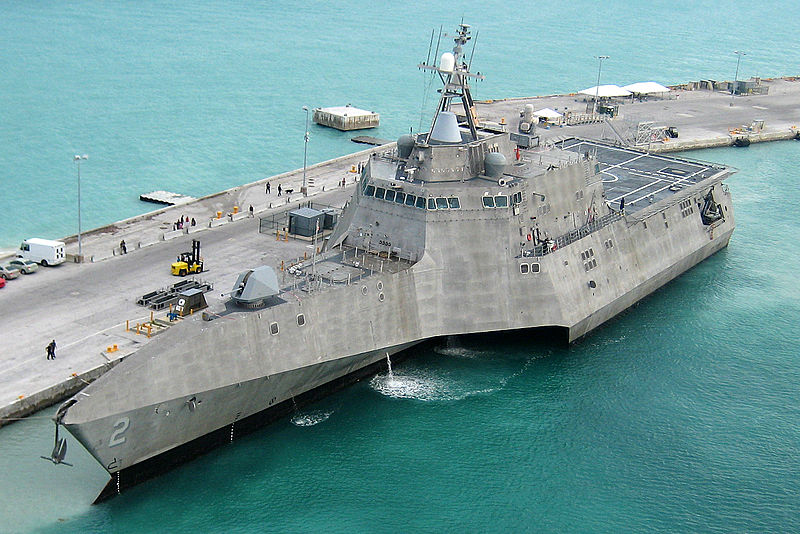
LCS USS Independence (LCS-2)
On yesterday’s Midrats, my co-host mentioned that recently in the Red Sea our Navy has seen the most littoral combat it has in a very long time, but our Littoral Combat Ships are not to be seen. Why? Simple. They cannot conduct combat on the littorals.
This AM, fellow “First LCS Critic” Chapomatic sent me a link to an article from September of last year that I think at the time I made a passing comment on over at X, but did not bring here. Well, let’s fix that.
Why do we need to periodically drag LCS out of the gimp box and hoist her up for all to behold? Simple; as an example to others. We simply cannot afford another CG(X) or DDG-1000 situation with DDG(X) or any other ship we have in the design phase. We have already lost one generation of ship design due to the Age of Transformationalism.
With the Constellation Class FFG we now have building, we are at last taking the course I first suggested in 2006 to correct the error of LCS. That is our version of FREMM that was first commissioned by the French in 2012, a dozen years ago.
LCS was not a problem with our shipbuilding industry or even our design people – though there are areas to critique there. No, this was a people problem, a mindset problem, a culture problem.
It needs to be dragged up regularly. I last did a dedicated post on it back in August 2023. It is time.
As we dive into the details remember this; since the disaster of LCS no senior personnel have yet been held to public account. We have the same acquisition system. We have the same incentives and disincentives as before. Critics of LCS were pushed over to the off-ramp; its most NORK-like advocates promoted.
There is no guarantee this won’t happen again.
Joaquin Sapien at ProPublica and his extensive almost novella – not just an article – on LCS that even opens with a quote of the phrase that first came into the general conversation here on CDR Salamander; The Inside Story of How the Navy Spent Billions on the “Little Crappy Ship”.
Sadly, we did not even get a mention or link – though most of the arguments are the same ones we’ve been making here and on the OB Blog since 2004 – if you spot me six months or so, two decades ago.
Some people have critiques of ProPublica, especially from the right side of the spectrum, but I’m sorry – their critique here is spot on.
It starts right in center mass;
The USS Freedom had its own special place within the armada. It was one of a new class of vessels known as littoral combat ships. The U.S. Navy had billed them as technical marvels — small, fast and light, able to combat enemies at sea, hunt mines and sink submarines.
In reality, the LCS was well on the way to becoming one of the worst boondoggles in the military’s long history of buying overpriced and underperforming weapons systems. Two of the $500 million ships had suffered embarrassing breakdowns in previous months. The Freedom’s performance during the exercise, showing off its ability to destroy underwater mines, was meant to rejuvenate the ships’ record on the world stage. The ship was historically important too; it was the first LCS built, the first in the water, commissioned just eight years prior.
The summary of their findings in spot on, especially the last sentence;
Our examination revealed new details on why the LCS never delivered on its promises. Top Navy leaders repeatedly dismissed or ignored warnings about the ships’ flaws. One Navy secretary and his allies in Congress fought to build more of the ships even as they broke down at sea and their weapons systems failed. Staunch advocates in the Navy circumvented checks meant to ensure that ships that cost billions can do what they are supposed to do.
Both inside and outside the Navy, LCS critics warned two decades ago that 2024 would find the Little Crappy Ship roughly where it wound up
QotD: Cavalry logistics for Steppe raiders
Each steppe warrior rode to battle with not one horse, but several: typically five to eight. For reasons that will rapidly become obvious, they preferred mares for this purpose. The Steppe warrior could ride the lead horse and keep the rest of them following along by connecting them via a string (thus “horse-string logistics”), such that each steppe warrior was his own little equine procession. These horses are, you will recall, fairly small and while they are hardy, they are not necessarily prodigiously strong, so the warrior is going to shift between them as he rides, sparing his best mount for the actual fight. Of course we are not looking at just one warrior on the move – that would be very dangerous – but a group on the move, so we have to imagine a large group (perhaps dozens or hundreds or even thousands) of warriors moving, with something like 5-8 times that many horses.
[Edit: It is worth noting that a horse-string war party might well also bring some number of sheep with them as an additional food supply, herding them along as the army rode. So even here, sheep maintain their importance as a core part of the subsistence system.]
Now of course the warriors are going to bring rations with them from the camp, including milk (both liquid in leather containers and dried to qurut-paste) as well as dried meat. But the great advantage of moving on mares is that they when they are lactating, mares are already a system for turning the grass of the steppe into emergency rations. As Timothy May (op. cit.) notes, a mare produces around 2.25-2.5 quarts of milk in excess of the needs of her foal per day during her normal five-month lactation period, equal to about 1,500kcal/day, half of the daily requirement for a human. So long as at least two of the horses in the horse-string were lactating, a steppe warrior need not fear shortfall. This was more difficult in the winter when less grass was available and thus mare’s milk became scarce, which could impose some seasonality on a campaign, but a disciplined band of steppe warriors could move massive distances (the Mongols could make 60 miles a day on the move unencumbered, which is a lot) like this in just a few months.
In adverse conditions (or where time permitted because meat is tasty), steppe warriors on the move could also supplement their diet by hunting, preserving the meat as saddle-jerky. In regions where water became scarce, we are frequently told that the Mongols could keep going by opening a vein on their horse and drinking the blood for both nourishment and hydration; May (op. cit.) notes that a horse can donate around 14 pints of blood without serious health risk, which is both hydrating, but also around 2,184kcal, about two-thirds of the daily requirement. This will have negative impacts on the horses long term if one keeps doing it, so it was an emergency measure.
The major advantage of this kind of horse-string logistics was that a steppe warrior party could move long distances unencumbered by being essentially self-sufficient. It has a second major advantage that I want to note because we’ll come back to it, they light no fires. For most armies, camp fires are essential because food preparation – particularly grains – essentially requires it. But a steppe warrior can move vast distances – hundreds of miles – without lighting a fire. That’s crucial for raiding (and becomes a key advantage even when steppe warriors transition to taking and holding territory in moments of strength, e.g. the Mongols) because sight-lines on the steppe are long and campfires are visible a long way off. Fireless logistics allow steppe warriors to seemingly appear from the steppe with no warning and then vanish just as quickly.
That said, these racing columns of steppe warriors, while they could move very fast and be effectively independent in the short term, don’t seem generally to have been logistically independent of the camp and its herds of sheep in the long term. Not only, of course, would there be need for things like hides and textiles produced in the camp, but also the winter snows would drastically reduce the mares milk the horses produced, making it more difficult to survive purely on horse-string logistics. Instead, the camp formed the logistical base (and store of resources, since a lot of this military activity is about raiding to get captives, sheep and horses which would be kept in the camp) for the long range cavalry raids to strike out from. To the settled peoples on the receiving end of a Mongol raid, it might seem like the Mongols subsisted solely on their horses, but the Mongols themselves knew better (as would anyone who stayed with them for any real length of time).
Bret Devereaux, “That Dothraki Horde, Part II: Subsistence on the Hoof”, A Collection of Unmitigated Pedantry, 2020-12-11.
March 25, 2024
WWII Allied Vehicles – Universal Carrier
Ontario Regiment Museum
Published Jan 26, 2022This multi-part series was originally created in support of our friends at D-Day Conneaut for presentation during their live stream in 2020.
In part 5 the Museum’s Operation Manager Dan Acre details the history of a Canadian-made WWII vehicle, the Universal Carrier. (Please forgive the sound quality, it was one of the first videos we produced in the early stages of the pandemic.)
(more…)
March 24, 2024
Chiang versus Mountbatten – WW2 – Week 291 – March 23, 1945
World War Two
Published 23 Mar 2024Chiang Kai-Shek is demanding his Chinese troops back from Burma, but this doesn’t fit well with Mountbatten’s plans for the region. In Burma, Bill Slim’s forces liberate Mandalay this week and make plans to head south for Rangoon. There’s also friction elsewhere in Allied command — between the Soviets and the Western Allies — over Italy. In the field in Europe, the Soviets advance all along the eastern front, and in the west, the Allies secure another Rhine crossing, and they also launch a double operation to send even more men across the river in force.
0:00 Intro
0:53 Recap
1:20 Iwo Jima
2:15 Plans for Okinawa
3:53 Mandalay liberated and plans for Burma
08:19 Allied Machinations about Italy
10:25 Soviet advances all along the Eastern Front
16:55 Plans for Operation Grapeshot
17:45 Four Allied Operations in the west
23:25 Summary + Conclusion
(more…)
Gahendra: the Nepalese Not-A-Martini
Forgotten Weapons
Published Jul 8, 2018(This video has been updated from its original form to fix translation issues and to clarify that Nepal was not, in fact, a British colony. Originally published January 10, 2017.)
Long a mysterious unknown member of the Martini family, the Nepalese Gahendra rifles finally became available in the US and Europe after IMA purchased Nepal’s cache of historic arms. The Gahendra is a uniquely Nepalese design built to sidestep British reluctance to supply military arms to the country. Developed by a General Gahendra (who is also responsible for the Bira copy of the Gardner Gun), the rifle is not actually a Martini at all. Instead, it shares its mechanical features mostly with the earlier Peabody falling block rifles, using a hammer and flat mainspring (the Martini improvement replaces there with a striker and coil spring).
Gahendras are chambered for the standard British .577/.450 Martini cartridge, although their bore diameters vary substantially, and one should absolutely slug a specific rifle before loading ammunition for it. In fact, unless you are capable of proficiently assessing the safety of the Gahendra, it is wiser not to shoot them at all. These rifles were individually handmade well over a hundred years ago using steels of questionable metallurgy and hardening.
That said, the guns were actually much better made than most people assume, considering their non-interchangeable parts. Craftsmen built each rifle part by part, giving the factory an output of just four rifles per day. Production began in the 1880s, and according to the Nepalese government ended prior to 1899. Dates on the rifles, however, are commonly found as late as 1911. These dates are generally assumed to be inventory or refurbishment dates.
(more…)
March 23, 2024
The Roman Army’s Biggest Building Projects
toldinstone
Published Dec 15, 2023The greatest achievements of the Roman military engineers.
Chapters:
0:00 Introduction
0:38 Marching camps
1:36 Bridges
2:40 Siegeworks
3:26 PIA VPN
4:32 Permanent forts
5:49 Roads
6:24 Frontier defenses
7:41 Canals
8:21 Civilian projects
8:54 The aqueduct of Saldae
(more…)
March 22, 2024
Char B1 V Panzer III | Size doesn’t matter – it’s how you use it!
The Tank Museum
Published Dec 15, 2023Two tanks that fought against each other in the early part of World War Two. On one side, the heavily armoured French Char B1 … on the other, the mobile German Panzer III. On paper it’s no contest – but what actually happened when these two tanks fought it out in 1940?
00:00 | Intro
00:49 | Char B1 History
02:16 | Radio Communications
02:45 | Panzer III Crew
03:43 | Char B1 Crew
05:16 | Char B1 V Panzer III
(more…)
March 21, 2024
French NATO Standardization: the MAS 49-56 in 7.62mm
Forgotten Weapons
Published May 27, 2019In the late 1950s, France was still part of the NATO integrated military structure. When the 7.62x51mm cartridge was adopted as standard for the alliance, France looked to be in a good position to simply convert their MAS 49-56 rifles to use it. After all, the 7.5mm cartridge the rifle was designed for was very similar to the new NATO round. After several years of trials, however, the project was dropped as impractical. It turned out that the much different pressure curve of the 7.62mm round would require significant redesign of the MAS rifles. They suffered from poor extraction, broken parts from high bolt velocity, and other issues (not coincidentally, the exact same problems reported with the 308 MAS 49-56 rifles imported by Century …). The St Etienne factory only made a total of 150 of them in 7.62x51mm before the project ended.
(more…)
March 19, 2024
QotD: “Not In Our Name”
Mark Steyn, “Omar’s Girls”, National Post, 2001-11-29.
March 18, 2024
Moore’s Patent Revolver (Swing-Out Cylinder)
Forgotten Weapons
Published Feb 13, 2015Manufactured in Brooklyn from 1861 until 1863, Moore’s revolver was a 7-shot single-action piece firing .32 rimfire cartridges. What makes it unique is its swing-out cylinder design — the first commercial revolver in the US to use this mechanism. A latch on the back of the frame released the entire barrel and cylinder assembly, allowing it to tip over to the right, exposing the chambers for loading and unloading. The ejector rod is stored under the barrel, but must be removed and used by hand when needed. Moore’s revolvers were popular with New Yorkers heading off to the Civil War and almost 8000 were made, but production was halted when Rollin White successfully sued for patent infringement (over his patent on the bored-though cylinder).
http://www.forgottenweapons.com
Theme music by Dylan Benson – http://dbproductioncompany.webs.com
March 17, 2024
Smiling Albert Takes Command – WW2 – Week 290 – March 16, 1945
World War Two
Published 16 Mar 2024After the Allies took a Rhine Bridge last week, Adolf Hitler has again shuffled his commanders, moving Kesselring to the west. Meanwhile, the German offensive in Hungary comes to its end — and it does not end well for the Germans. The Japanese are nearly defeated on Iwo Jima, are feeling a bit of desperation in Burma, but are far, far from defeated on Luzon.
01:02 Recap
01:33 Remagen Bridge and the Western Front
06:44 Army Group Courland and 3rd Belorussian Front
10:23 Konev’s new attacks
11:29 Operation Spring Awakening ends
15:00 A German surrender in Italy?
17:01 Japanese being ground down on Iwo Jima
18:12 The war in the Philippines
20:48 The war in Burma
23:07 Summary
23:36 Conclusion
(more…)
QotD: Imperial Japan and Nazi Germany never had a “long game” … but Stalin did
The Russians, meanwhile, never stopped playing the long game. While Goebbels made a few token gestures at rapprochement with “the West” (yeah, they called it that), and to sell Nazism to ditto, his heart wasn’t in it, any more than the Japanese’s heart was in their “Greater East Asia Co-Prosperity Sphere” hooey. Stalin, by contrast, was always pimping Communism to the West — even in the deepest, darkest days of the war, when it looked like the Wehrmacht was about to march into Moscow, the propaganda directed at the West continued full blast.
Like the German and Japanese aircraft industries, the German propaganda industry was ideologically locked into its core mission: To sell Nazism to Germans. And they were aces at it, no doubt … but then the mission changed. The smart thing for the Germans (and Japanese) to have done with their conquered territories was, in the context of the war, to ease up on the Nazi shit for the duration. The Nazis could’ve had zillions of Ukrainians fighting for them in 1941 just as the Japanese probably could’ve waltzed into India in 1941 had they not been so … well, so Japanese, in the rest of the Pacific rim. Stalin would’ve done it in a heartbeat, had the situation been reversed, and to hell with “authentic” Marxism-Leninism. Win the war first; square the ideology later.
As this is running way long, one example should suffice. Goebbels approached the task of selling Nazism to Germans in the most German way possible: He created the Reich Culture Chamber, which controlled all newspapers, radio broadcasts, film distribution, etc. And it worked, as far as it went — Goebbels deserves his “evil genius” rep — but as we’ve seen, that locked the leadership into an ideological straightjacket. Telling the Wehrmacht to ignore the Commissar Order and buddy up with the Ukrainians would’ve been the smart thing to do, militarily, but it was culturally impossible. Goebbels did his job too well … and then the mission changed.
The Soviets had a similar problem inside the USSR, but — here’s Stalin’s evil genius — they had free reign in propagandizing the West. Goebbels hardly bothered, but the Soviets poured massive resources into it. Forget, as far as you can, everything you think you know about “Nazism” […]. Even if you look at it as objectively as possible, it still seems ridiculous, and there’s a simple explanation for that — it’s not for you. Unless you were a pure blooded Aryan, actually living in Germany (or within Germany’s potential military reach), [they] couldn’t care less about you. Which made being a “Nazi” in, say, America uniquely pointless — you just look like a bigot at best, a traitorous bigot at worst.
Being a “Communist”, though? That was universal. Indeed, that made you a Smart person, a very very smart person, and morally superior to boot. Why? Because you care so much that you’ve mastered this large body of deliberately esoteric doctrine, comrade … all straight out of the NKVD playbook. And if actual life as it was lived in the Soviet Union didn’t quite measure up to the promises, well, that’s because they didn’t have the right people — people like YOU — running things. It’s fucking brilliant — a totally ideologically closed, indeed brutal, system at home, presented as the most open-minded, enlightened, tolerant one possible abroad.
Which is why Joey G. needed a huge Reich Culture Chamber that never came close to justifying its budget, and Stalin needed, effectively, nothing. Being so very, very Smart, wannabe “elites” in the West were happy to spread Commie propaganda for free. The NKVD, let alone the Gestapo, ain’t got shit on the Junior Volunteer Thought Police of Twitter and Facebook …
… which forces us to confront the question: Which model of propaganda are our rulers using? Has the one morphed into the other? Is it real, or is it just “German efficiency”?
Severian, “The Myth of German Efficiency”, Rotten Chestnuts, 2021-05-26.
March 15, 2024
Starr DA & SA Revolvers
Forgotten Weapons
Published Feb 4, 2015Starr revolvers are one of the less recognized designs used in the US Civil War, although tens of thousands of them were made and issued. Indeed, in many ways they were superior to the much more common Colt and Remington revolvers of the period. One of the interesting facts about the Starr is that the double action design came first, and was only replaced with the more typical single action design several years into the war (due to problems with price and complexity). Today we’re taking a look at a pair of Starrs, one single action and one double action. Ultimately the company shut down after the end of the war, and Colt would go on to dominate the revolver market in the United States.
(more…)
March 14, 2024
Book Reviews – Juno Beach and the Canadians
WW2TV
Published Dec 5, 2023A short live show where I talk about my favourite Juno Beach and Canadian focussed Normandy books
WW2TV Bookshop – where you can purchase copies of books featured in my YouTube shows. Any book listed here comes with the personal recommendation of Paul Woodadge, the host of WW2TV. For full disclosure, if you do buy a book through a link from this page WW2TV will earn a commission.
UK – https://uk.bookshop.org/shop/WW2TV
USA – https://bookshop.org/shop/WW2TV


