
Before we dive in, we should stop to clarify some of our key actors here, the Roman magistrates and officers with a role in all of this. A Roman army consisted of one or more legions, supported by a number (usually two) alae recruited from Rome’s Italian allies, the socii. Legions in the Republic did not have specific commanders, rather the whole army was commanded by a single magistrate with imperium (the power to command armies and organize courts). That magistrate was usually a consul (of which there were two every year), but praetors and dictators,1 all had imperium and so might lead an army. Generally the consuls lead the main two armies. When more commanders were needed, former consuls and praetors might be delegated the job as a stand-in for the current magistrates, these were called pro-consuls and pro-praetors (or collectively, “pro-magistrates”) and they had imperium too.
In addition to the imperium-haver leading the army, there were also a set of staff officers called military tribunes, important to the process. These fellows don’t have command of a specific part of the legion, but are “officers without portfolio”, handling whatever the imperium-haver wants handled; at times they may have command of part of a legion or all of one legion. Finally, there’s one more major magistrate in the army: the quaestor. A much more junior magistrate than the imperium-haver (but senior to the tribunes), he handles pay and probably in this period also supply. That said, the quaestor is not usually the general’s “number two” even though it seems like he might be; quaestors are quite junior magistrates and the imperium-haver has probably brought friends or advisors with a lot more experience than his quaestor (who may or may not be someone the imperium-haver knows or likes). […]
The first thing to note about this process, before we even start is that the dilectus was a regular process which happened every year at a regular time. The Romans did have a system to rapidly raise new troops in an emergency (it was called a tumultus), where the main officials, the consuls, could just grab any citizen into their army in a major emergency. But emergencies like that were very rare; for the most part the Roman army was filled out by the regular process of the dilectus, which happened annually in tune with Rome’s political calendar. That regularity is going to be important to understand how this process is able to move so many people around: because it is regular, people could adapt their schedules and make provisions for a process that happened every year. I should note the dilectus could also be held out of season, though often the times we hear about this it is because it went poorly (e.g. in 275 BC, no one shows up).
The process really begins with the consular elections for the year, which bounced around a little in the calendar but generally happened around September,2 though the consuls do not take office until the start of the next calendar year. As we’ve discussed, the year originally seems to have started in March (and so consuls were inaugurated then), but in 153 was shifted to January (and so consuls were inaugurated then).
What’s really clear is that there is some standard business that happens as the year turns over every year in the Middle Republic and we can see this in the way that Livy structures his history, with year-breaks signaled by these events: the inauguration of new consuls, the assignment of senior Roman magistrates and pro-magistrates to provinces, and the determinations of how forces will be allotted between those provinces. And that sequence makes a lot of sense: once the Senate knows who has been elected, it can assign provinces to them for the coming year (the law requiring Senate province assignments to be blind to who was elected, the lex Sempronia de provinciis consularibus, was only passed in 123) and then allocate troops to them. That allocation (which also, by the by, includes redirecting food supplies from one theater to another, as Rome is often militarily actively in multiple places) includes both existing formations, but is also going to include the raising of new legions or the conscription of new troops to fill out existing legions, a practice Livy notes.
The consuls, now inaugurated have another key task before they can embark on the dilectus, which is the selection of military tribunes, a set of staff officers who assist the consuls and other magistrates leading armies. There are six military tribunes per legion (so 24 in a normal year where each consul enrolls two legions); by this point four are elected and two are appointed by the consul. The military tribunes themselves seem to have often been a mix, some of them being relatively inexperienced aristocrats doing their military service in the most prestigious way possible and getting command experience, while Polybius also notes that some military tribunes were required to have already had a decade in the ranks when selected (Polyb. 6.19.1). These fellows have to be selected first because they clearly matter for the process as it goes forward.
The end of this process, which as we’ll see takes place over several days at least, though exactly how many is unclear, will have have had to have taken place in or before March, the Roman month of Martius, which opened the normal campaigning season with a bunch of festivals on the Kalends (the first day of the month) to Mars. As Rome’s wars grew more distant and its domestic affairs more complex, it’s not surprising that the Romans opted to shift where the year began on the calendar to give the new consuls a bit more of winter to work with before they would be departing Rome with their armies. It should be noted that while Roman warfare was seasonal, it was only weakly so: Roman armies stayed deployed all year round in the Middle Republic, but serious operations generally waited until spring when forage and fodder would be more available.
That in turn also means that the dilectus is taking place in winter, which also matters for understanding the process: this is a low-ebb in the labor demands in the agricultural calendar. I find it striking that Rome’s elections happen in late summer or early fall, when it would actually be rather inconvenient for poor Romans to spend a day voting (it’s the planting season), but the dilectus is placed over winter where it would be far easier to get everyone to show up. I doubt this contrast was accidental; the Roman election system is quite intentionally designed to preference the votes of wealthier Romans in quite a few ways.
So before the dilectus begins, we have our regular sequence: the consuls are inaugurated at the beginning of the year, the Senate meets and assigns provinces and sets military priorities, including how many soldiers are to be enrolled. The Senate’s advice is not technically legally binding, but in this period is almost always obeyed. Military tribunes are selected (some by election, some by appointment) and at last the consuls can announce the day of the dilectus, conveniently now falling in the first couple of months of the year when the demand for agricultural labor is low and thus everyone, in theory, can afford to show up for the selection process.
Bret Devereaux, “Collections: How To Raise a Roman Army: The Dilectus“, A Collection of Unmitigated Pedantry, 2023-06-16.
1. And the dictator’s master of the horse.
2. On this, see J.T. Ramsey, “The Date of the Consular Elections in 63 and the Inception of Catiline’s Conspiracy”, HSCP 110 (2019): 213-270.
March 14, 2024
QotD: Recruiting an army in the Roman Republic
March 13, 2024
“They won’t be in Gaza, but they’ll be just offshore — a few hundred yards from Gaza”
Apparently a bunch of former military types are getting their collective panties in a bunch just because Biden is sending part of a highly specialized US Army support brigade to install a temporary offshore unloading facility to get “humanitarian aid” in to Hamas fighters the civilian population of Gaza. All the political advisors to the President want to assure everyone that there will be no “boots on the ground”, so there’s no real risk …
The Pentagon has said something that should make us all sit up and pay attention.
Quick background first:
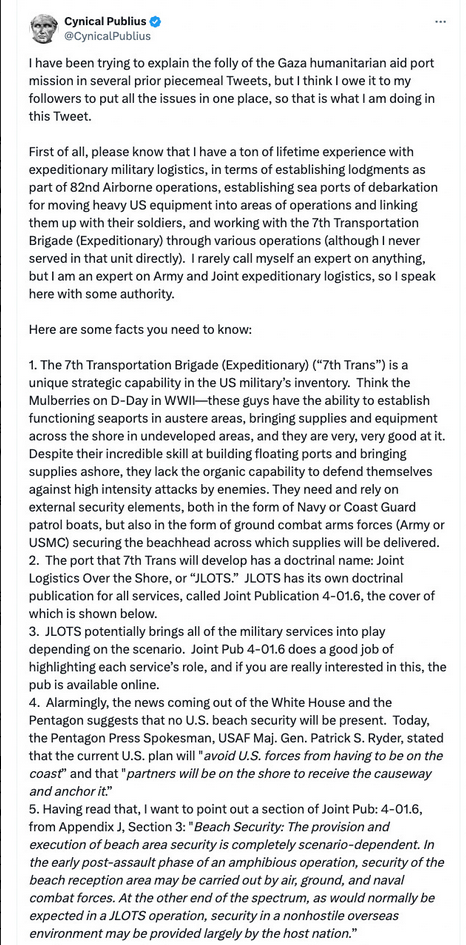
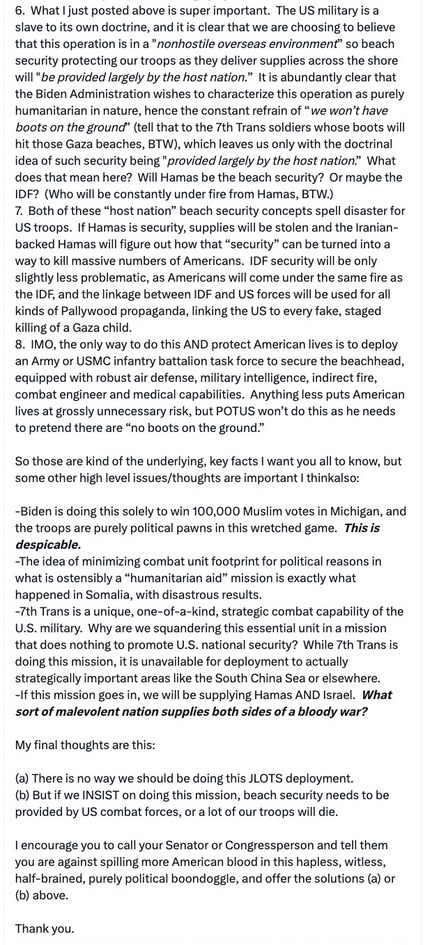
Elements of the US Army’s 7th Transportation Brigade are on the way to Gaza. […] They won’t be in Gaza, but they’ll be just offshore — a few hundred yards from Gaza. Now read this, and take the time to read it closely. I’ll split it into two screencaps to get it all in, which will be awkward to look at, but you can just click on the link to see it all whole (and subscribe to keep up with “Cynical Publius” as all of this develops):
The extremely important part of all of that is that transportation troops aren’t combat arms troops; they’re armed for some degree of self-protection, but “they lack the organic ability to defend themselves against high-intensity attacks by enemies.” In a hostile environment, they need to be screened: they need to be protected by combat-focused forces, both on-shore and off. They need infantry in front of them, warships behind them, and aircraft overhead.
Now, via this account, look at this transcript of an … interesting Pentagon press briefing on March 8, in which a major general talks at length about the security plan for the 7th Transportation Brigade when it gets to Gaza. Sample exchange:
Q: (Inaudible) partner nations on the ground, but you’re talking about operational security, you can’t discuss what will be (inaudible).
GEN. RYDER: Right. I mean, we will — these forces will have the capability to provide some organic security. I’m just not going to get into the specifics of that.
But they don’t — or they do, but the capability of transportation troops, from a combat service support branch, is extremely limited. Again, these are not combat arms troops, and aren’t armed or trained as combat arms troops. Talking about their organic security capability is an interesting choice.
March 12, 2024
A JLOTS for Gaza?
The Biden administration has made a decision to create a temporary shore unloading facility to provide Gaza with “humanitarian aid”. The particular installation is called an Army Joint Logistics Over-the-Shore (JLOTS) and will be delivered by a US Army logistics ship, USAV General Frank S. Besson (LSV-1) which was reported as departing a base in Virginia and will arrive as soon as its 12-knot top speed will allow. CDR Salamander has the details:
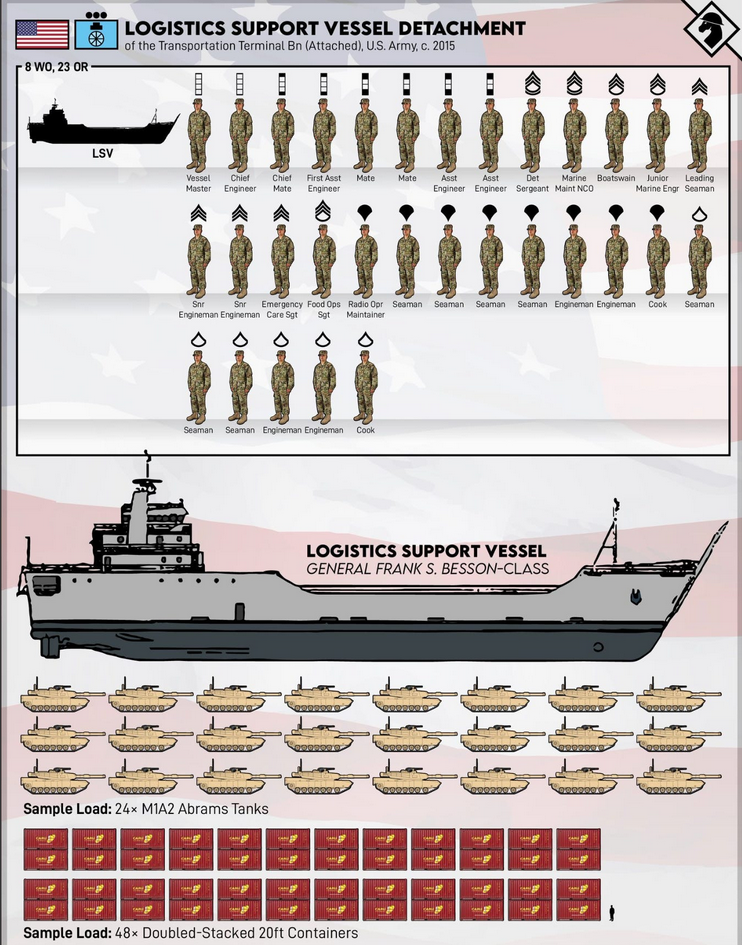
… and yes my friends — the Army has its own navy. Let’s take a quick look at the Besson.
Yep’r, that 243 foot, 4,200 ton ship is commanded by … a Warrant Officer. Discuss amongst yourselves.
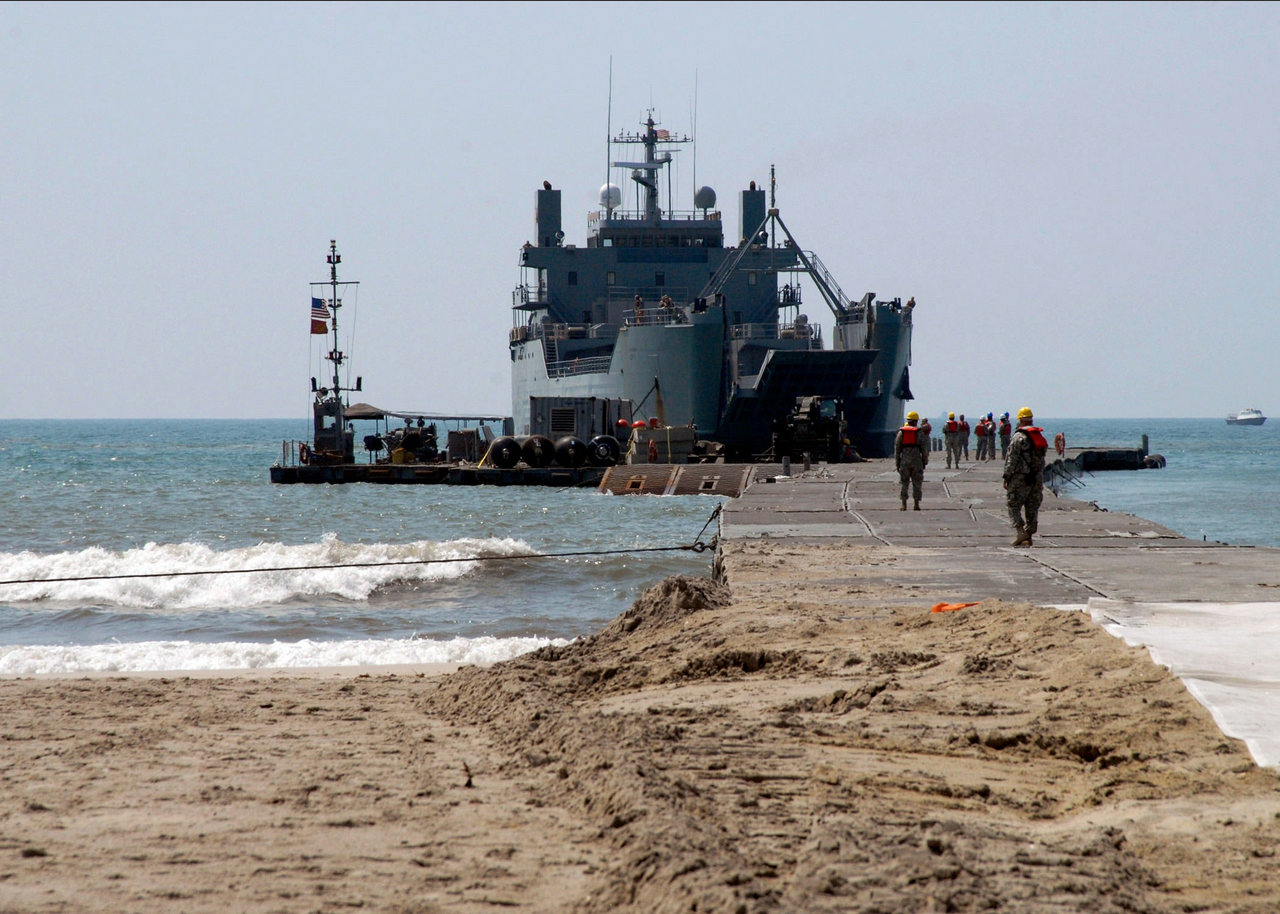
If you’re wondering what she looks like putting a JLOTS in place;
This will take about 1,000 personnel to accomplish. I don’t know a single maritime professional who thinks this is a good idea given the location and conditions ashore, but orders are orders. Make the best attempt you can.
An interesting note; this is not a Navy operation, but an Army operation. Remember what I told you about the fate of the East Coast Amphibious Construction Battalion TWO (ACB2) last summer? This story aligns well with the Anglosphere’s problem with seablindness we discussed on yesterday’s Midrats with James Smith.
As for my general thought on doing this? I’ll avoid the politics as much as I can, but I have concerns.
Generally speaking, no operation starts out on the right foot with a lie.
“We’re not planning for this to be an operation that would require U.S. boots on the ground,” said a senior administration official.
I’m not mad at the official. They are just making sure their statement is in line with higher direction and guidance. President Biden was clear in his SOTU speech;
The United States has been leading international efforts to get more humanitarian assistance into Gaza. Tonight, I’m directing the U.S. military to lead an emergency mission to establish a temporary pier in the Mediterranean on the coast of Gaza that can receive large shipments carrying food, water, medicine, and temporary shelters.
No U.S. boots will be on the ground.
You cannot build a pier, even JLOTS, without putting boots on the ground. Just look at the above picture again.
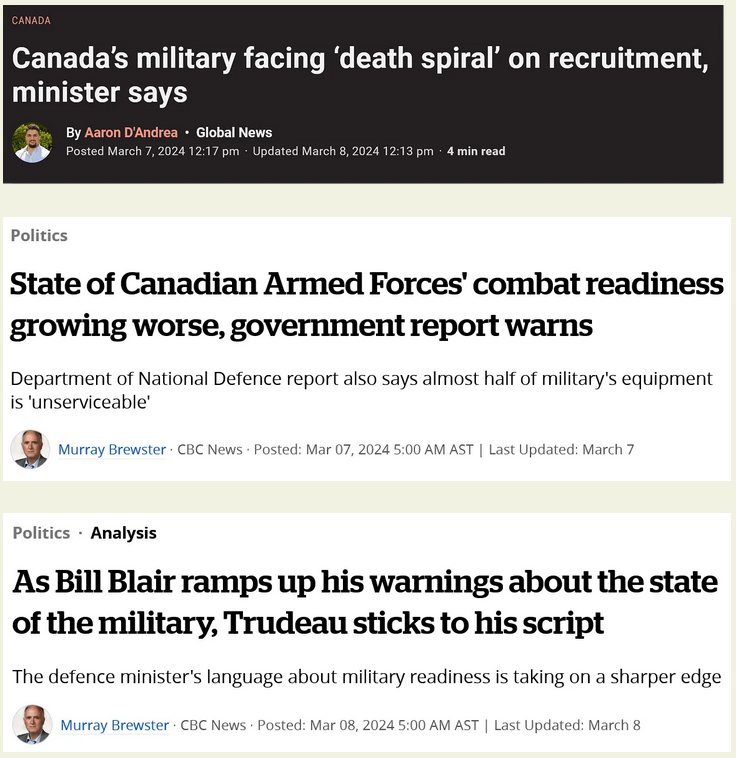
The recently admitted “death spiral” for the Canadian Armed Forces is nothing new
“Shady Maples” outlines just a few of the historical procurement fuckups Canada’s armed forces have had to work through, showing that the recent admission that the armed forces are in a “death spiral” by MND Bill Blair is almost “situation normal” for the troops:
The Canadian Armed Forces are fucked. By this term of art, I mean that the CAF:
- are in dire circumstances; and
- are being used for such aggressive political gratification that it’s practically perverse.
You don’t have to take my word for it. The Minister of National Defence made the following remarks last week:
because, the bottom line is the Canadian Armed Forces must grow. We’re short a lot of people. Almost 16,000 in our regular forces and reserves.
If that wasn’t bad enough, he added:
more than half of our trucks, more than half of our ships and more than half of our planes are not available for service because they are in need of parts and repair. We’re going to have to do better.
Translation: we are fucked.
The MND’s remarks come eleven months after the CDAI published an open letter on the state of national security and defence:
Years of restraint, cost cutting, downsizing and deferred investments, have meant that Canada’s defence capabilities have atrophied. Our military capabilities are outdated and woefully inadequate to protect our landmass and maritime approaches. We have also fallen short in meaningful contributions to burden sharing for the collective defence and security of our allies and partners.
Translation: we have been fucked for awhile.
More recently, the Vice Admiral Tophsee made waves on the RCN’s official YouTube channel by stating the obvious:
Colleagues and Shipmates, the RCN is facing some very serious challenges right now that could mean we fail to meet our Force Posture and Readiness commitments in 2024 and beyond. La situation est grave mais nos problèmes ne sont pas uniques et je sais que l’aviation et l’armée sont confrontées a des défis similaires. [The situation is serious, but our problems are not unique, and I know that the Air Force and the Army are facing similar problems.]
Translation: we will be fucked for the foreseeable future.
He then shows that this sort of thing has been part-and-parcel of Canada’s delusionary approach to national defence since the year before Confederation. Canada’s WW1 army was sent off with fantastically bad equipment — from rifles to web gear, from automobiles to artillery ammunition — all scandals of the day that no lessons were learned from.
Soldiers and officers at the tactical level will readily tell you that these headlines are only surprising because senior leaders are finally saying the quiet part out loud: the CAF is undermanned, under-equipped, under-trained, and unprepared. We know this because we live it every day: situation normal, all fucked up. But you don’t need a source or a leak to learn about our deplorable state of readiness. Here is a link to DND’s 2023 audit and evaluation reports. They paint a bleak picture: we have insufficient equipment and what we have keeps breaking. We have insufficient personnel to match with commitments, and we are struggling to recruit, train, and retain more. Go have a look at the reports, they lay it all out.
March 10, 2024
German Blunder Hands Allies a Rhine Crossing – WW2 – Week 289 – March 9, 1945
World War Two
Published 9 Mar 2024The Allies manage to take an intact bridge over the mighty Rhine at Remagen, a major piece of luck; the Germans launch a new offensive in Hungary, and the Allies end one in Italy. Over in Burma, Meiktila falls, sabotaging the entire Japanese supply system for the country, and on Iwo Jima the fight continues, bloodier than ever for both sides.
00:59 Recap
01:35 The Fall of Meiktila
03:46 The fight on Iwo Jima
05:27 Advances on the Western Front
07:44 The Rhine River
10:05 Remagen Bridge
16:20 Operation Encore
17:10 Rokossovsky and Zhukov attack
18:09 Operation Spring Awakening
21:57 Notes to end the week
23:42 Conclusion
(more…)
Why Germany Lost the Battle of Kursk, 1943
Real Time History
Published Nov 3, 2023In summer 1943, Germany and the Soviet Union fought the arguably biggest single battle in history with millions of men, thousands of tanks and artillery guns – the battle of Kursk. The German Army wanted to hit the Red Army so hard that they couldn’t go on the offensive again. And indeed, new research shows that the Soviets suffered shockingly high casualties, up to six times more men and equipment. But why then did the Germans lose this historic battle?
(more…)
March 9, 2024
The Jewish Avengers Who Hunted Nazi Murderers
World War Two
Published Mar 8, 2024In March 1945, the first Jewish unit in the Allied forces reaches the frontline. Before fighting the Nazis, the men spent years battling against the policies of the British government. After the war, they will take vengeance on the perpetrators of the Holocaust and join the Zionist movement in building and fighting for Israel.
(more…)
1871 Spencer Rifle Conversion
Forgotten Weapons
Published Nov 12, 2014The Spencer repeating rifle was a major leap forward in infantry firepower, and more than one hundred thousand of them were purchased by the US military during the Civil War. The Spencer offered a 7-round magazine of rimfire .56 caliber cartridges in an era when the single-shot muzzle-loading rifle was still predominant. This particular Spencer is a long rifle which was one of roughly 1100 rebuilt from damaged carbines in 1871 at Springfield Arsenal.
(more…)
March 8, 2024
Know Your Ship #20 – Flower Class Corvettes
iChaseGaming
Published Oct 27, 2014Episode 20 of Know Your Ship! In this educational video I cover the Flower class corvettes. These corvettes used by the Royal Canadian Navy and the Royal Navy to great effect during the Battle of the Atlantic. The Flower class were built quickly and cheaply in order to provide as many ships for convoy duty and anti-submarine operations as possible. The Royal Canadian Navy in particular achieved significant success and became experts in anti-submarine operations. Sadly, these ships and their crews are mostly forgotten with the passage of time as attention is mostly given to the surviving capital ships. It is my hope that this educational video will help people to understand and know these important ships that helped safeguard the convoys during World War 2. The only remaining ship of this class is HMCS Sackville which you will see later in this episode.
(more…)
March 7, 2024
Canadian Armed Forces belatedly starts to worry that their pandemic fake news propaganda stunt might, somehow, undermine public confidence
When I first heard about this, despite all the evidence we’d seen during the Wuhan Coronavirus years of governments going out of their way to mislead and deceive the voters, I thought it was fake news. But according to David Pugliese’s report in the Ottawa Citizen, they really did do and and only now are starting to worry that they should not have done that:
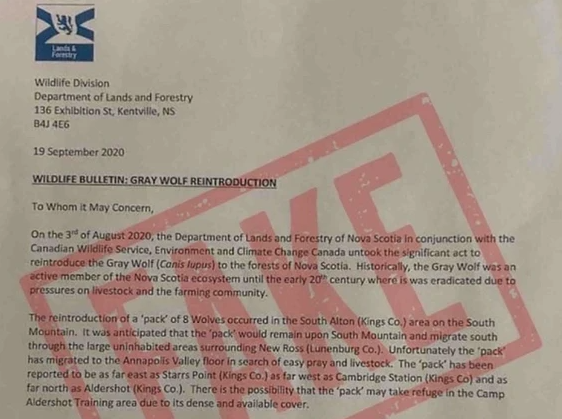
A screenshot of the fake letter from the Nova Scotia government which was sent out to residents to warn about a pack of wolves on the loose in the province. The letter was actually a forgery by Canadian military personnel as part of a propaganda training mission.
Photo by NS Lands Forestry Twitter/X /Handout
The Canadian Forces worried the public would link its previous efforts to test propaganda techniques during the pandemic to a bungled exercise in which the military spread disinformation about rampaging wolves, according to newly released records.
Military officers worried the 2020 wolves training fiasco, combined with previous coverage in this newspaper about their efforts during the COVID outbreak to test new methods to manipulate Canadians, could have “the effect of undermining our credibility and public trust”.
The October 2020 exercise involving fake letters about wolves on the loose, which caused panic in one community in Nova Scotia, was a propaganda test gone awry, generating embarrassing news coverage across Canada and in some U.S. media outlets.
Just as that incident was being reported by media outlets, a non-government group called the Organized Crime and Corruption Reporting Project released details about the Canadian Forces spending more than $1 million on training on how to modify public behaviour. That training had been used by the parent firm of Cambridge Analytica, the company that was at the centre of a scandal in which personal data of Facebook users was provided to U.S. President Donald Trump’s political campaign.
In addition, this newspaper had reported months earlier, the Canadian Forces had tested new propaganda techniques during the pandemic and had concocted a plan to influence the public’s behaviour during coronavirus outbreak.
The various reporting set off alarm bells inside the military’s public affairs branch at National Defence headquarters in Ottawa, according to documents released under the access to information law.
Col. Stephanie Godin wrote Brig.-Gen. Jay Janzen on Oct. 16, 2020 warning that since the story about the fake wolf letters broke “there has been a resurgence of media and public criticism regarding perceived nefarious IO/IA (propaganda) against the Canadian public”.
She also noted how then-army commander Lt.-Gen. Wayne Eyre contacted Laurie-Anne Kempton, then the assistant deputy minister for public affairs at National Defence. Eyre wanted to “discuss how the wolf letter issue could be removed from being conflated with” the $1 million training course on influence techniques as well as the previous articles on military pandemic propaganda plans, Godin wrote.
I mean, did they hire George Monbiot as a consultant for this idiocy?

M60: Cold War Guardian | Tank Chats #175
The Tank Museum
Published Dec 1, 2023The high point of a series of American tank designs that began in WW2, the M60 stood guard in a divided Europe during the Cold War. David Willey gives us a detailed analysis of a tank that served far longer than anyone intended.
(more…)
QotD: Helmuth von Moltke’s Kabinettskriege of 1870
From an operational perspective, this sequence of events was (and is) considered a masterclass, and a major reason why Moltke has become revered as one of history’s truly great talents (he is on this writer’s Mount Rushmore alongside Hannibal, Napoleon, and Manstein). The Prussians had executed their platonic ideal of warfare — the encirclement of the main enemy body — not once, but twice in a matter of weeks. In the conventional narrative, these great encirclements became the archetype of the German kesselschlacht, or encirclement battle, which became the ultimate goal of all operations. In a certain sense, the German military establishment spent the next half-century dreaming of ways to replicate its victory at Sedan.
This story is true, to a certain extent. My objective here is not to “bust myths” about blitzkrieg or any such trite thing. However, not everyone in the German military establishment looked at the Franco-Prussian War as an ideal. Many were terrified by what happened after Sedan.
By all rights, Moltke’s masterpiece at Sedan should have ended the war. The French had lost both of their trained field armies and their head of state, and ought to have given in to Prussia’s demand (namely, the annexation of the Alsace-Lorraine region).
Instead, Napoleon III’s government was overthrown and a National Government was declared in Paris, which promptly declared what amounted to a total war. The new government abandoned Paris, declared a Levee en Masse — a callback to the wars of the French Revolution in which all men aged 21 to 40 were to be called to arms. Regional governments ordered the destruction of bridges, roads, railways, and telegraphs to deny their use to the Prussians.
Instead of bringing France to its knees, the Prussians found a rapidly mobilizing nation which was determined to fight to the death. The mobilization prowess of the emergency French government was astonishing: by February, 1871, they had raised and armed more than 900,000 men.
Fortunately for the Prussians, this never became a genuine military emergency. The newly raised French units suffered from poor equipment and poor training (particularly because most of France’s trained officers had been captured in the opening campaign). The new mass French armies had poor combat effectiveness, and Moltke managed to coordinate the capture of Paris alongside a campaign which saw Prussian forces marching all over France to run down and destroy the elements of the new French Army.
Big Serge, “The End of Cabinet War”, Big Serge Thought, 2023-11-30.
March 6, 2024
Venezuelan FN49: The First FN49 Contract
Forgotten Weapons
Published Dec 1, 2023Venezuela was the first nation to purchase the FN-49 rifle, before even the Belgian military. In fact, the Venezuelan contract was signed in 1948, before the “FN-49” designation was even in place. Venezuela bought a total of 8,012 rifles in two batches — 4,000 rifles plus 12 cutaway training examples delivered in 1949 and a further 4,000 more rifles delivered in June 1951. All of them included the integral muzzle brake and scope mounting cuts, although no scopes were ever procured. They were all semiautomatic models.
Some of the rifles were issued and used, but some appear to have remained in depots their entire life. Venezuela was also an early adopter of the FAL, and the FN-49 was only used for a short time. In 1966, all of them (or virtually all) were sold as surplus to InterArms, and brought onto the US collector market.
(more…)
March 5, 2024
The 1st Punic War – Corvus, Rams and Drachma
Drachinifel
Published Sep 13, 2023Today we take a look at the strategy and shipping of the 1st Punic War with expert Bret Devereaux!
(more…)
March 3, 2024
Allied Deception Surrounds Japanese in Burma – WW2 – Week 288 – March 2, 1945
World War Two
Published 2 Mar 2024Bill Slim’s master plan is near fruition and the Japanese are surrounded at Meiktila in Burma. The Allies have also nearly cleared Manila on Luzon, but the fighting on Iwo Jima is just growing in intensity. In Europe, the Soviets are still on the move in Poland, though attacking now to the north, but in Hungary it’s the Germans who are making plans for a new offensive. The big news on the Western Front is the Allies reaching the Rhine, though how they’ll cross that mighty river is anyone’s guess.
(more…)


