
The Line
Published Apr 16, 2024General Wayne Eyre served for decades in the Canadian Army, including as its commander, before being promoted to Chief of the Defence Staff in 2021. During his time as Canada’s top soldier, he has overseen not only a series of challenges inside the Canadian military, but also a rapid deterioration in the geopolitical environment. The world is a more dangerous place, and Gen. Eyre has been unusually outspoken in noting that Canada needs to do more to be ready for what’s coming.
In this conversation with The Line‘s Matt Gurney, the general provides his take on the state of the world today, shares his thoughts on the recently announced Defence Policy Update, and talks about why he is encouraged by some of what he is already seeing change with Canada’s military readiness.
On The Line is The Line‘s newest podcast, featuring longer interviews by either Jen or Matt with someone who is currently in the news or able to speak to something topical (or, sometimes, simply fun and interesting). We are still getting it up to speed, but Line listeners and viewers can expect an episode weekly by next month, at the latest.
To never miss an episode of either On The Line or The Line Podcast, sign up today to follow us on YouTube, on the streaming app of your choice and, of course, at ReadtheLine.ca, home of The Line. Like and subscribe!
Please note: This interview was recorded on Friday, before the Iranian attack on Israel.
April 18, 2024
On The Line with General Wayne Eyre, commander of the Canadian Armed Forces
What to do if Romans Sack your City
toldinstone
Published Jan 12, 2024Chapters:
0:00 Introduction
0:34 Progress of a siege
1:55 Looting and violence
3:42 Recorded atrocities
4:45 Captives
5:27 BetterHelp
6:36 Surviving a Roman sack
7:13 Where to hide
8:27 What to do if you’re captured
9:20 Advice for women
10:09 The fate of captives
(more…)
April 17, 2024
Soviet Berlin Offensive Begins – WW2 – Week 294B – April 16, 1945
World War Two
Published 16 Apr 2024The final Soviet assault on Berlin begins today. The Soviets have two million men supported by tens of thousands of guns, tanks, and aircraft. Opposite them stand millions of men and boys of the German Wehrmacht, Waffen SS, Volkssturm, and Hitler Youth. The forces of Nazism are weakened and disorganised but determined to fight on as long as possible.
00:41 Roosevelt’s death
03:09 Preparations for the Soviet drive on Berlin
08:49 Zhukov’s Offensive
12:48 Konev’s Offensive
14:57 Summary & Conclusion
(more…)
French M14 Conversion – the Gras in 8mm Lebel
Forgotten Weapons
Published May 16, 2016The French adopted the Gras as their first mass-issued metallic cartridge rifle in 1874, replacing the needlefire 1866 Chassepot. Quite a lot of Gras rifles were manufactured, and they became a second-line rifle when the 1886 Lebel was introduced with brand-new smokeless powder and its smallbore 8mm projectile. When it became clear that the quick and decisive war against Germany was truly turning into the Great War, France began looking for ways to increase the number of modern Lebel rifles it could supply to the front.
One option that was used was to take Gras rifles from inventory and rebarrel them for the 8mm Lebel cartridge (which was based on the Gras casehead anyway). These could be issued to troops who didn’t really need a top-of-the-line rifle (like artillery crews, train and prison guards, etc). Then the Lebel rifles from those troops could be redirected to the front.
The rebarreling process was done by a number of contractors, using Lebel barrels already in mass production. The 11mm barrel from the Gras would be removed, and only the front 6 inches (150mm) or so kept. A Lebel barrel and rear sight would be mounted on the Gras receiver, and that front 6 inches of Gras barrel bored out to fit tightly over the muzzle of the new 8mm barrel. This allowed the original stock and nosecap to be used (the 8mm barrel being substantially smaller in diameter, and not fitting the stock and hardware by itself). It also allowed the original Gras bayonet to be fitted without modification, since the bayonet lug was also on that retained section of barrel. In addition, a short wooden handguard was fitted. This was designated the modification of 1914, and an “M14” was stamped on the receivers to note it.
These guns are of dubious safety to shoot, since the retain the single locking lug of the Gras, designed for only black powder pressures. However, this was deemed safe enough for the small amount of actual shooting they were expected to do.
April 16, 2024
Gabriele D’Annunzio’s Impresa – the 1919 occupation of Fiume
Ned Donovan on the turbulent history of the Adriatic port of Fiume (today the Croatian city of Rijeka) after the end of the First World War:
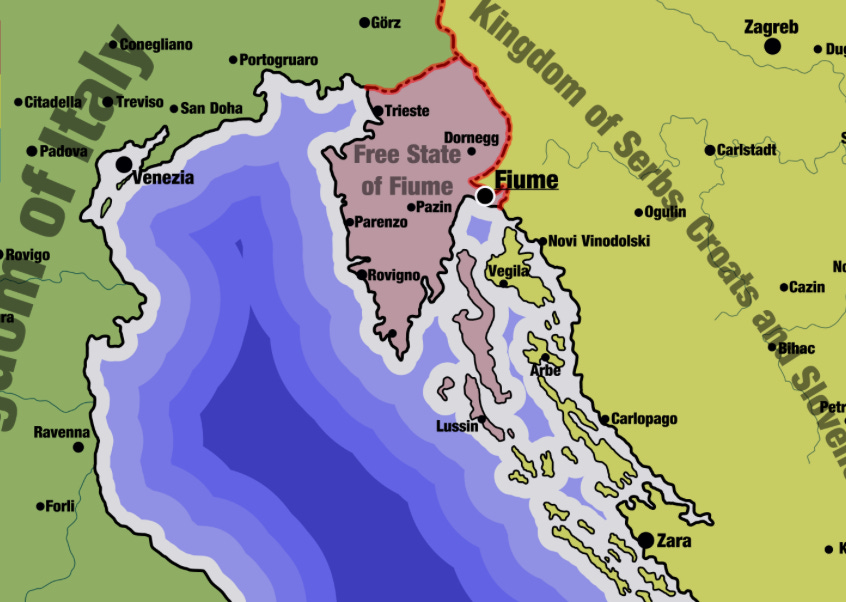
Fiume was a port on the Adriatic coast with several thousand residents, almost half of whom were ethnic Italians that had been under Austro-Hungarian rule for several hundred years after it once having been a Venetian trade port. By some quirk, Fiume was missed in the Treaty of London, probably because it had never been envisioned by the Allies that the Austro-Hungarian Empire would ever truly disintegrate and the rump of it that would remain required a sea port in some form. The city’s other residents were ethnically Serbian and Croatian, who knew the city as Rijeka (as you will find it named on a map today). All of this complexity meant that the fate of Fiume became a major topic of controversy during the Versailles Peace Conference. President Woodrow Wilson had become so unsure of what to do that he proposed the place become a free city and the headquarters of the nascent League of Nations, under the jurisdiction of no country.
By September 1919 there was still no conclusion as to the fate of Fiume. Events had overtaken the place and through the Treaty of St Germain, the Austro-Hungarian Empire had been dissolved after the abdication of the final Habsburg Emperor Charles I. Once again, Fiume had not been mentioned in the treaty and the country it had been set aside for no longer existed. The city’s fate was still at play.
Enter Gabriele D’Annunzio, an aristocrat from Abruzzo on the eastern coast of Italy. Born in 1863, he was a handsome and intelligent child and was nurtured by his family to be exceptional, with a predictable side effect of immense selfishness. As a teenager, he had begun to dabble in poetry and it was praised by authors unaware of his age. At university he began to be associated with Italian irredentism, a philosophy that yearned for all ethnic Italians to live in one country – by retaking places under foreign rule like Corsica, Malta, Dalmatia and even Nice.
[…]
The Italian government’s lack of interest [in Fiume] was unacceptable to D’Annunzio and he made clear he would take action to prevent it becoming part of Yugoslavia by default. With his fame and pedigree he was able to quickly assemble a small private force of ex-soldiers, who he quickly took to calling his “legionaries”. In September 1919 after the Treaty of St Germain was signed, his small legion of a few hundred marched from near Venice to Fiume in what they called the Impresa – the Enterprise. By the time he had reached Fiume, the “army” numbered in the thousands, the vanguard crying “Fiume or Death” with D’Annunzio at its head in a red Fiat.
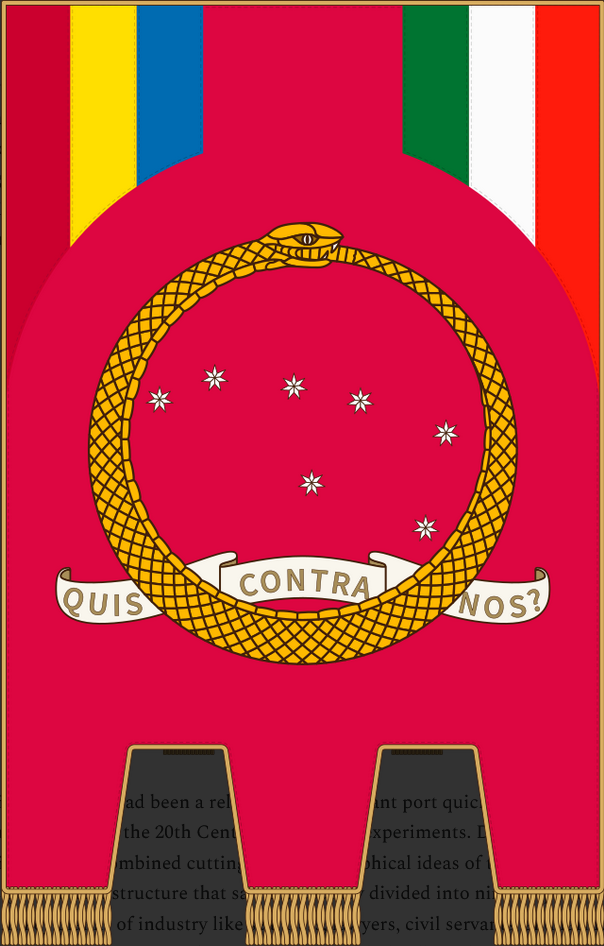
A flag designed by Gabriele D’Annunzio for the would-be independent state of Fiume, 1919.
The only thing that stood in his way was the garrison of the Entente, soldiers who had been given orders to prevent D’Annunzio’s invasion by any means necessary. But amongst the garrison’s leaders were many [Italian officers] sympathetic to D’Annunzio’s vision, some even artists themselves and before long most of the defenders had deserted to join the poet’s army. On the 12th September 1919, Gabriele D’Annunzio proclaimed that he had annexed Fiume to the Kingdom of Italy as the “Regency of Carnaro” – of which he was the Regent. The Italian government was thoroughly unimpressed and refused to recognise their newest purported land, demanding the plotters give up. Instead, D’Annunzio took matters into his own hands and set up a government and designed a flag (to the right).
The citizens of what had been a relatively unimportant port quickly found themselves in the midst of one of the 20th Century’s strangest experiments. D’Annunzio instituted a constitution that combined cutting-edge philosophical ideas of the time with a curious government structure that saw the country divided into nine corporations to represent key planks of industry like seafarers, lawyers, civil servants, and farmers. There was a 10th corporation that existed only symbolically and represented who D’Annunzio called the “Supermen” and was reserved largely for him and his fellow poets.
These corporations selected members for a state council, which was joined by “The Council of the Best” and made up of local councillors elected under universal suffrage. Together these institutions were instructed to carry out a radical agenda that sought an ideal society of industry and creativity. From all over the world, famous intellectuals and oddities migrated to Fiume. One of D’Annunzio’s closest advisers was the Italian pilot Guido Keller, who was named the new country’s first “Secretary of Action” – the first action he took was to institute nationwide yoga classes which he sometimes led in the nude and encouraged all to join. When not teaching yoga, Keller would often sleep in a tree in Fiume with his semi-tame pet eagle and at least one romantic partner.
If citizens weren’t interested in yoga, they could take up karate taught by the Japanese poet Harukichi Shimoi, who had translated Dante’s works into Japanese. Shimoi, who quickly became known to the government of Fiume as “Comrade Samurai” was a keen believer in Fiume’s vision and saw it as the closest the modern world had come to putting into practice the old Japanese art of Bushido.
The whole thing would have felt like a fever dream to an outsider. If a tourist was to visit the city, they would have found foreign spies from across the world checking into hotels and rubbing shoulders with members of the Irish republican movement while others did copious amounts of cocaine, another national pastime in Fiume. The most fashionable residents of Fiume carried little gold containers of the powder, and D’Annunzio himself was said to have a voracious habit for it. Sex was everywhere one turned and the city had seen a huge inward migration of prostitutes and pimps within days of D’Annunzio’s arrival. Almost every day was a festival, and it was an odd evening if the harbour of Fiume did not see dozens of fireworks burst above it, watched on by D’Annunzio’s uniformed paramilitaries.
D’Annunzio himself lived in a palace overlooking the city, Osbert Sitwell describes walking up a steep hill to a Renaissance-style square palazzo which inside was filled with plaster flowerpots the poet had installed and planted with palms and cacti. D’Annunzio would cloister himself in his rooms for 18 hours a day and without food. Immaculate guards hid amongst the shrubs to ensure he would not be disturbed. In D’Annunzio’s study, facing the sea, he sat with statutes of saints and with French windows onto the state balcony. When he wanted to interact with his people he would wait for a crowd to form over some issue, walk to the balcony and then ask what they wanted.
April 14, 2024
Soviets Take Vienna and Königsberg – WW2 – Week 294 – April 13, 1945
World War Two
Published 13 Apr 2024The prizes of Vienna and Königsberg fall to the Soviets as they continue what seems an inexorable advance. In the West the Allies advance to the Elbe River, but there they are stopped by command. The big news in their national papers this week is the death of American President Franklin Roosevelt, which provokes rejoicing in Hitler’s bunker. The Allied fighting dash for Rangoon continues in Burma, as does the American advance on Okinawa, although Japanese resistance is stiffening and they are beginning counterattacks.
Chapters
00:32 Recap
01:05 Operation Grapeshot
01:57 Roosevelt Dies
06:01 Soviet Attack Plans for Berlin
12:45 Stalin’s Suspicions
14:31 The fall of Königsberg
17:02 The fall of Vienna
18:38 Japanese Resistance on Okinawa
20:34 The War in China
21:09 Burma and the Philippines
22:38 Summary
22:57 Conclusion
25:05 Memorial
(more…)
April 13, 2024
The Death of Franklin Roosevelt
World War Two
Published 12 Apr 2024He lead his nation through the Great Depression, transformed it into a war-winning titan, and is working to shape the coming postwar world in his image. But today, 4,422 days into his record breaking presidency, Franklin Roosevelt dies. What was his final year really like?
(more…)
April 11, 2024
SVT-40: The Soviet Standard Semiauto from WW2
Forgotten Weapons
Published Jan 10, 2024The Red Army was interested in developing a semiautomatic rifle clear back to the mid 1920s, and they spent about 15 years running trials and development programs to find one. First in 1930 a Degtyarev design was adopted, followed by the Simonov AVS-36, and then Tokarev won out in 1938 with the SVT-38. Combat experience in the Winter War led to an upgrade program to reduce the weight of the rifle, and that created the SVT-40. Between April 1940 and mid 1942, about 1.4 million SVT-40s were produced in three different factories. They were supposed to be the new standard infantry rifle and also the sniper’s rifle — although they ultimately failed to really be either.
In 1942, production shifted to the AVT-40, identical to the SVT-40 but with a trigger group capable of fully automatic fire. Another roughly 500,000 of these were produced by the end of the war, but the focus of small arms issue had changed to Mosins and submachine guns — options that were a lot cheaper to produce.
(more…)
April 10, 2024
Saving Our Democracy watch – “[Trump] has to do at least ten years, or everybody will hate the navy”
Chris Bray suggests that reading the full linked document may be hazardous to your mental health, so he’s helpfully highlighted a few of the key points that may have you scratching your head and saying something like “The Fuh? What??”
I have a mixed view of Donald Trump’s argument about presidential immunity, which you can read here. But an amicus brief filed with the Supreme Court today by retired flag officers and service secretaries is so bizarre that reading it may permanently alter the structure of my face.
You can read the whole amicus brief here, but treat it like a solar eclipse and don’t stare at it directly. As a first sign of how much good faith the thing contains, one of the amici is Michael Hayden.
The first argument is that Trump has to go to prison or else civilians won’t control the military anymore. You think I’m kidding.
“Amici are deeply interested in this case because presidential immunity from criminal prosecution would threaten the military’s role in American society, our nation’s constitutional order, and our national security.” See the connection? If Donald Trump doesn’t go to prison, “the military’s role in American society” will be damaged. He has to do at least ten years, or everybody will hate the navy.
The prevailing feature of the entire brief is an essence of flattening. Every issue is very simple. There are no competing examples. None of this has ever come up before: The brief deals with questions of presidential immunity around Obama drone-killing a 16 year-old US citizen, or Lincoln unilaterally suspending habeas corpus and using the military to arrest critics of the war, by not mentioning any of it, or any other historical example. Everything is a surface. I’ve graded undergraduate essays, so the tone and depth of the effort feels familiar.
Third argument: Donald Trump has to be prosecuted, because America promotes democracy all over the world, and Trump not being prosecuted is against democracy, so it will be harder for us to promote democracy if we don’t prosecute him. Authoritarian regimes say that American democracy doesn’t work, so: “Presidential immunity from criminal prosecution feeds those false and harmful narratives. Unless Petitioner’s theory is rejected, we risk jeopardizing America’s standing as a guardian of democracy in the world and further feeding the spread of authoritarianism, thereby threatening the national security of the United States and democracies around the world.”
We have to imprison the leader of the political opposition, or people won’t think we’re a democracy, and then there will be more authoritarianism, like when regimes imprison the political opposition.
CDR Salamander says it’s “time to drag LCS out of the gimp box again”
CDR Salamander has never held back on his dislike of the Little Crappy Ship (Littoral Combat Ship) design(s) the US Navy settled on nearly 20 years ago:
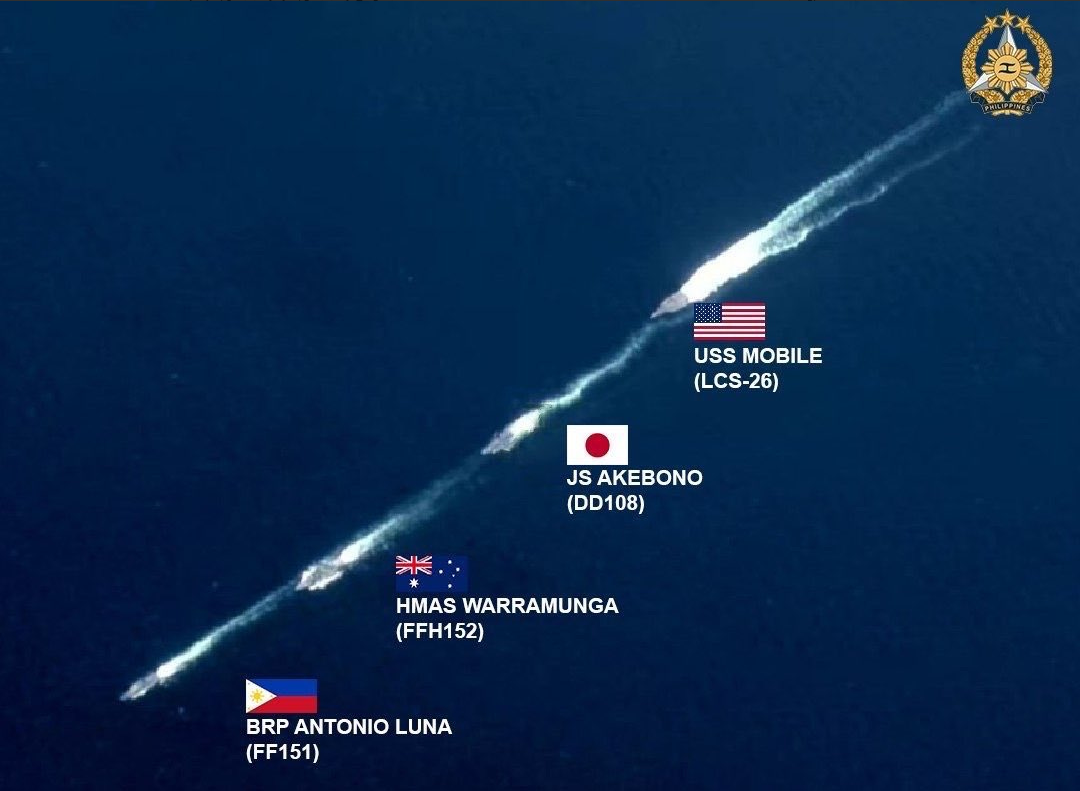
As promised yesterday, time to drag LCS out of the gimp box again, because it fits in well with last week’s 3×8 Grid of Shame, flavored in no small part with the Navy’s decision to pull its head inside its shell and cancel its ship briefings.
To solve the many problems we have created for ourselves, we must have a foundational change in our culture. Expecting a different result without changing that, I’m not sure how we get any headway.
From our FITREPs to our shipbuilding plans to the testimony by our leadership to Congress. We spin, mindlessly drone talking points and carefully scripted PAOisms, and from our FITREP to awards system, we willfully share untruths, obscure, hope things just blow up on someone else’s PCS cycle.
[…]
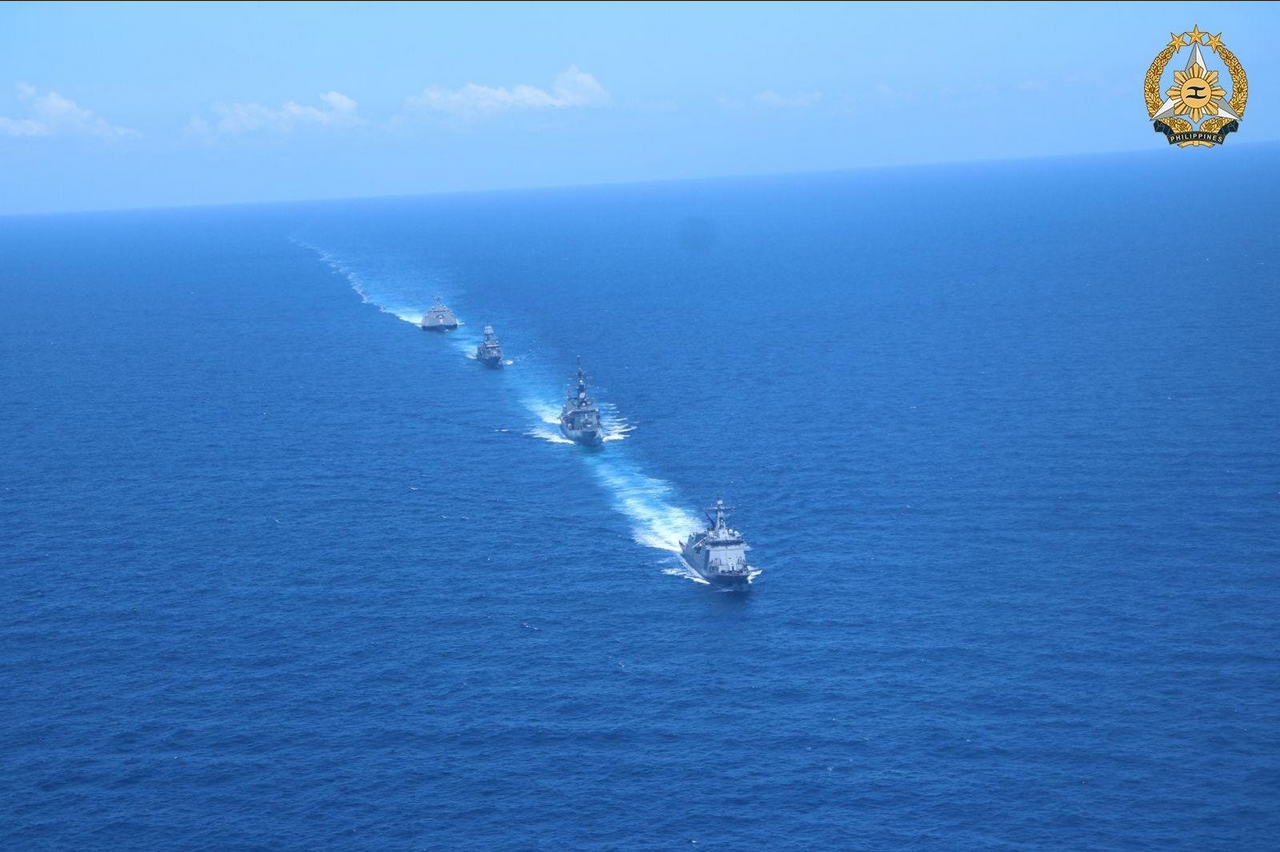
Now, let’s take a look at this second pic. On its face it demonstrates that LCS is a direct byproduct of an institutional habit of not being honest with the American people, their elected representatives, and hell … even ourselves.
Besides both this pic and the first one showing the USN ship being the most out of formation, what catches you eye?
The ship furthest away in formation should look the smallest … but there is nothing “small” about an LCS in the visual spectrum.
In an age where satellites with multi-spectral surveillance capability matched with artificial intelligence, look at that first pic. Is there any way to hide that wake?
Of course not.
Then look at the LCS’s weapons capability compared to the other ships. Is she ready for combat in the littorals against an enemy that will bring modern air, surface, and subsurface threats to her?
Should people only realizing this in the third decade of the 21st Century be taken seriously?
No. I don’t buy any of what they are selling. Either they are lying to my/our face, or they lack the critical thinking skills to see what this kludge was/is/will be.
April 9, 2024
US PT Boats of WW2 – Guide 369
Drachinifel
Published Jan 6, 2024The PT Boats, fast attack craft of the United States Navy, is today’s subject.
(more…)
April 8, 2024
The Battle of Okinawa Begins – WW2 – Week 293 – April 6, 1945
World War Two
Published Apr 6, 2024It’s the next step toward invading Japan’s Home Islands — invading Okinawa, and it begins April 1st. Advances are easy by land, but at sea the kamikaze menace is in full swing. In Burma, plans are made to liberate Rangoon; in the west hundreds of thousands of Germans are surrounded in the Ruhr; and in the east, the Soviets begin assaults on Königsberg and Vienna.
(more…)
Beecher’s Bible: A Sharps 1853 from John Brown’s Raid on Harpers Ferry
Forgotten Weapons
Published Jan 8, 2024On October 16, 1859 John Brown and 19 men left the Kennedy farmhouse and made their way a few miles south to the Harpers Ferry Arsenal. They planned to seize the Arsenal and use its arms — along with 200 Sharps 1853 carbines and 1,000 pikes they had previously purchased — to ignite and arm a slave revolt. Brown was a true fanatic for the abolitionist cause, perfectly willing to spill blood for a just cause. His assault on the Arsenal lasted three days, but failed to incite a rebellion. Instead of attracting local slaves to his banner, he attracted local militia and the US Marines. His force was besieged in the arsenal firehouse, and when the Marines broke through the doors they captured five surviving members of the Brown party, including Brown himself. All five were quickly tried and found guilty of murder, treason, and inciting negroes to riot. They were sentenced to death, and hanged on December 2, 1859.
Most of Brown’s 200 Sharps carbines were left in the farmhouse hideout, to be distributed when the insurrection took hold. These were found by local militia, among them the Independent Greys, and some were kept as souvenirs — including this example.
There is an intriguing historical question as to whether Brown’s raid was ultimately good for the country or not. It was extremely divisive at the time, and it can be argued that the raid was a major factor leading to Lincoln’s election and the Civil War. Could slavery have been abolished without the need for a cataclysmic war if John Brown had not fractured the Democratic Party? To what extent is killing for a cause justifiable? Do the ends always justify the means? John Brown had no doubts about his answers to these questions … but maybe he should have.
(more…)
April 7, 2024
Instructions for American Servicemen in Britain (1942)
Henry Getley on the US War Department publication Instructions for American Servicemen in Britain produced for incoming GIs on arrival in Britain from early in 1942:
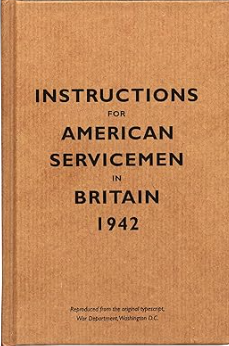
[W]ith their troops pouring into this country from 1942 onwards to prepare for D-Day, officials at the US War Department did their best to make the culture clash as trouble-free as possible. One of their main efforts was issuing GIs with a seven-page foolscap leaflet called Instructions for American Servicemen in Britain.
It’s available in reprint as a booklet and makes fascinating reading, not least for its straightforward, jargon-free writing style and its overriding message – telling the Yanks to use “plain common horse sense” in their dealings with the British.
In parts, it now seems clumsy and condescending. But its purpose was praiseworthy – to try to get American troops to damp down the impression that they were overpaid, oversexed and over here. Many GIs qualified in all three aspects, of course, but you couldn’t blame the top brass for trying.
The leaflet paints a sympathetic (some would say patronising) picture for the incoming Americans of a Britain – “a small crowded island of forty-five million people” – that had been at war for three years, having initially stood alone against Hitler and braved the Blitz. Hence this “cradle of democracy” was now a “shop-worn and grimy” land of rationing, the blackout, shortages and austerity. But beneath the shabbiness, there was steel.
The British are tough. Don’t be misled by the British tendency to be soft-spoken and polite. If need be, they can be plenty tough. The English language didn’t spread across the oceans and over the mountains and jungles and swamps of the world because these people were panty-waists.
There were helpful hints about cricket, football, darts, pounds, shillings and pence, warm beer and badly-made coffee. And because we are two nations divided by a common language, the Yanks were urged to listen to the BBC.
In England the “upper crust” speak pretty much alike. You will hear the newscaster for the BBC (British Broadcasting Corporation). He is a good example, because he has been trained to talk with the “cultured” accent. He will drop the letter “r” (as people do in some sections of our own country) and will say “hyah” instead of “here”. He will use the broad “a”, pronouncing all the a’s in “banana” like the “a” in father.
However funny you may think this is, you will be able to understand people who talk this way and they will be able to understand you. And you will soon get over thinking it’s funny. You will have more difficulty with some of the local accents. It may comfort you to know that a farmer or villager from Cornwall very often can’t understand a farmer or villager in Yorkshire or Lancashire.
The GIs were warned against bravado and bragging, being told that the British were reserved but not unfriendly. “They will welcome you as friends and allies, but remember that crossing the ocean doesn’t automatically make you a hero. There are housewives in aprons and youngsters in knee pants in Britain who have lived through more high explosives in air raids than many soldiers saw in first-class barrages during the last war.”
April 6, 2024
Italian Communists, the French in Indochina, and the fate of Italy’s army – WW2 – OOTF 34
World War Two
Published 5 Apr 2024What happened to Italian soldiers overseas after the fall of Mussolini? What about the French soldiers left over in Indochina after the Japanese “occupation by invitation”? And, what did the Allies think of the Italian Communist movement and its partisan forces?
(more…)


