
Forgotten Weapons
Published Jan 26, 2024Today we are going to take a look at the three main battle rifles of World War Two — the M1 Garand, the SVT-40, and the Gewehr 43. We will also consider the SVT-38, Gewehr 41(W), and Gewehr 41(M). The United States, Soviet Union, and Germany were the three countries that fielded large numbers of semiautomatic full-power rifles in combat in WW2; how did they differ in their approaches to infantry firepower?
(more…)
April 29, 2024
Battle Rifles of World War Two: Overview
Comments Off on Battle Rifles of World War Two: Overview
QotD: The draft
What frightened me was not going to Vietnam. What frightened me was going in the Army. The haircut, the uniform, the discipline: If I’d been allowed to go to Vietnam in my old clothes … The minute the draft disappeared, the whole hippie-dippy thing just went up in smoke.
P.J. O’Rourke, interviewed by Scott Walter, “The 60’s Return”, American Enterprise, May/June 1997.
Comments Off on QotD: The draft
April 28, 2024
The Battle of Berlin! – WW2 – Week 296 – April 27, 1945
World War Two
Published 27 Apr 2024The battle for the German capital rages on all week, as the Soviets get ever closer to the Reich Chancellery, under which lies Hitler’s bunker. Berlin is surrounded, but can it be relieved? There are also Allied advances in East Prussia, Czechoslovakia, and in Western Germany, but beyond that, it looks like the Axis lines have completely collapsed in Italy. The Allies are also advancing — and quickly — in Burma toward Rangoon, though not much at all on Okinawa, and it is the Japanese who are on the move in Western Hunan. It’s a real rollercoaster of a week.
Chapters
01:10 Recap
01:43 Soviets fight their way into Berlin
07:45 Berlin surrounded
10:28 Rokossovsky advances
12:48 Göring and Himmler betray Hitler
13:57 Fighting on the Eastern Front
15:23 Allied advance in the West
15:51 German collapse in Italy
17:31 4th Corps racing through Burma
19:36 The Battle of Western Hunan
21:40 Okinawa and the Philippines
22:59 Notes
23:59 Conclusion
(more…)
Comments Off on The Battle of Berlin! – WW2 – Week 296 – April 27, 1945
April 26, 2024
The British Army from the start of the Cold War
Dr. Robert Lyman discusses the state of the British Army through the Cold War years down to today, with emphasis on the defence budget tracking against perceived threats to the UK and allies over that period:
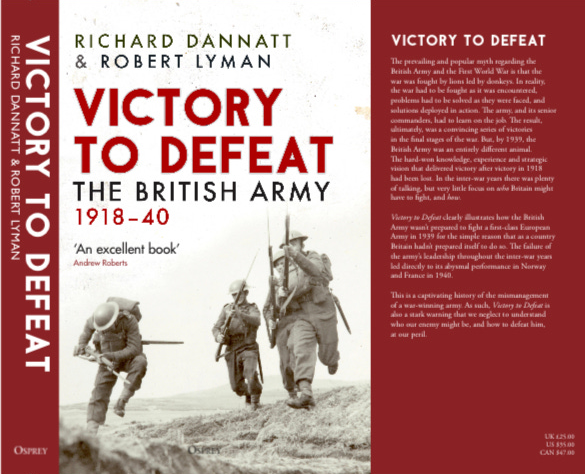
Last year General Lord Dannatt and I published an account of the British Army between 1918 — when it achieved a great victory — and 1940, when it did not. The book was written in part to challenge the UK to think seriously about what happens when our country neglects the requirement for an army able to fight at a high-intensity for a prolonged period against a peer adversary.
Part of our argument was to look at the amount of money the country spends on its defence as a barometer of the seriousness or otherwise of our political masters towards spending money on the primary duty of government, namely the security of its citizens. Our fear is that in the rampant feel-goodery that has plagued the West since 1991 the harsh realities of our unstable world have become forgotten. It has taken Putin’s invasion of Ukraine, and Russia’s subsequent bludgeoning of that benighted country for politicians to gradually wake up to the scale of the threat that this sort of instability offers to the world, not merely Europe or the West.
My fear, like that of many others, is that the wake-up call is taking too long and our country’s defences remain in a parlous state. We haven’t had an army able to deploy at divisional level or above in sustained all-arms manoeuvre for perhaps ten years or more. In other words, our ability to provide what our forefathers would have described as a robust “continental commitment” is almost non-existent.
In the book we trace the origins of the failure to think seriously about the need to have a deployable, expeditionary army, able to fight and operate alongside its allies in NATO on an all-arms battlefield. The reality is that the Cold War forced Britain to retain the ability to fight a general war in Europe, all the while finding the resources to undertake its other commitments across the world. Although worldwide events were dynamic from 1945 to 1989 with further conflicts for the United Kingdom in Malaya, Dhofar, Cyprus, Kenya, Borneo, the Falklands, and the long-running Troubles in Northern Ireland, it was the Cold War in Europe that principally drove the defence agenda and kept the budget at around 5 per cent of GDP. As the major bridge between the United States and Europe, the Royal Navy was heavily committed above and below the surface of the Atlantic Ocean to keep open the sea lines of communication to NATO’s dominant partner, while the British Army retained some 55,000 troops in four armoured divisions as part of NATO’s Northern Army Group and the Royal Air Force was also largely forward-based in West Germany as part of the Second Allied Tactical Air Force. These conventional deployments were all conducted under the nuclear umbrella of Mutual Assured Destruction. By the 1980s, with the West under the leadership of US President Ronald Reagan and British Prime Minister Margaret Thatcher and with increased spending on both conventional armaments and the highly experimental Inter-Continental Ballistic Missile Defence system, the strain of strategic military competition began to show on the political and economic stability of the Soviet Union. Despite the perestroika political movement for reform within the Communist Party of the Soviet Union and the associated openness of glasnost under General Secretary Mikhail Gorbachev, the cracks in the Berlin Wall that opened on 9 November 1989 led inexorably to the collapse of the Soviet Union two years later and the old flag of Russia being raised over the Kremlin on 26 December 1991. The Cold War was over, and an apparent New World Order had begun. The historian Francis Fukuyama declared – somewhat ambitiously – the end of history.
It was at this point that international leaders and their finance ministers in the West began to overlook the cautionary tale that the history of the 20th century might have taught them. With the Soviet Union gone and rump Russia apparently enfeebled, Western states eagerly embarked on military reduction and a peace dividend. In the United Kingdom, the “Options for Change” exercise saw a major slashing of defence capability, beneficially coincidental to help ameliorate a significant economic downturn. The British Army was reduced from 155,000 to 116,000 soldiers, notwithstanding the first Gulf War of 1990–91 which many wishful thinkers regarded as something of an aberration. However, despite that war and the subsequent deployment of large parts of the armed forces to Bosnia from 1992 and then to Kosovo in 1999, the new Labour government of Prime Minister Tony Blair continued with the implementation of its Strategic Defence Review of 1997–98. As a piece of policy work, this was considered an honest review of the United Kingdom’s defence policy and a progressive blueprint for future defence planning and expenditure. Endorsed by Tony Blair and the Chiefs of Staff, this review might have stood the nation in good stead for the future had the Chancellor of the Exchequer, Gordon Brown, fully funded its outcome. For his own reasons, he chose not to do so. The underfunding of the United Kingdom’s defence capability began to show its deficiencies a year after with the second Gulf War of 2003, and the situation was then exacerbated by a protracted campaign in Iraq for the British Army lasting until 2009 and an even more intense one in Afghanistan lasting until 2014.
Comments Off on The British Army from the start of the Cold War
April 25, 2024
Were the Waffen-SS Really Germany’s Elite Fighters? – WW2 – OOTF 35
World War Two
Published 24 Apr 2024It’s time for another thrilling installment of Out of the Foxholes, but what sort of questions does Indy answer today? Well, it’s good stuff — about Allied security and logistics at the major conferences, about what the British navy was doing once the Atlantic and Mediterranean were secure, and about the skills (or lack thereof) of the soldiers of the Waffen SS. How can you live without knowing about such things? I suppose it’s possible, but it would be a sad life indeed, so check it out!
(more…)
Comments Off on Were the Waffen-SS Really Germany’s Elite Fighters? – WW2 – OOTF 35
The Handley Page Hampden; A Plane for Fat Shaming
Ed Nash’s Military Matters
Published Apr 29, 2022One of the key British bombers at the start of the war, the Hampden was eclipsed by its more successful equivalent, the Vickers Wellington, and the later four-engine “heavies”. But it is worth remembering for the role it played in developing the RAF’s experience and methods during WW2.
(more…)
Comments Off on The Handley Page Hampden; A Plane for Fat Shaming
April 23, 2024
KICKING IT TO THE MOON? Canada’s Military Procurement: A history of broken promises
Esprit de Corps Canadian Military Magazine
Published Apr 22, 2024The Liberal government have finally released their long awaited Defence Policy Update which promises billions of dollars in increased spending for the CAF. Critics wonder if such promises are worth the paper they are printed on. History says that when it comes to military budgets, promises are made to be broken. Good Grief.
(more…)
Comments Off on KICKING IT TO THE MOON? Canada’s Military Procurement: A history of broken promises
April 22, 2024
Did Japan Attack Pearl Harbor Because Of China?
Real Time History
Published Dec 1, 2023December 7, 1941: The Japanese attack on Pearl Harbor shocked the world and brought the US into the Second World War. But why did the Japanese resort to such an attack against a powerful rival and what did it have to do with the Japanese war in China?
(more…)
Comments Off on Did Japan Attack Pearl Harbor Because Of China?
QotD: Before England could rely on the “wooden walls” of the Royal Navy
Anton Howes, “The House of Trade”, Age of Invention, 2019-11-13.
Comments Off on QotD: Before England could rely on the “wooden walls” of the Royal Navy
April 21, 2024
Canada’s latest unlikely-to-meet-expectations defence update
In The Line, Michael Den Tandt considers the Trudeau government’s most recent update to Canada’s defence plans (where the cynic might be tempted to read “plans” as “vague gestures toward treaty obligations with no real intent to do more”):
… Among the more intriguing findings is that no likely economic path has China overtaking the United States in terms of global influence, between now and 2040. And all likely paths project a sharp decline in global population growth over the same period, including in China.
This is worrying, because declining population growth is a precursor to declining economic power, which in turn means declining military might, and also a tendency to lash out. As the American political scientist Michael Beckley has noted, there is a lengthy historical pattern of rising powers becoming expansionist when their initial economic boom slows. In a prolonged multipolar interregnum between the U.S.-led order that followed the Second World War, and whatever comes next, threats will continue to multiply. A capable military is essential to national survival.
Which brings us back to the federal defence update, and its raft of new spending, with $8.1 billion in additional funding by 2029-30, by which time Canada’s military spending will reach just under 1.8 per cent of GDP, with steady increases adding up to $72.3-billion by 2043-44. Commitments include ramping up recruitment, revamping procurement, new subs for the Arctic, tactical helicopters, new vehicles and long-range missiles, drones, a new Canadian Cyber Command, and more. There is a laudable commitment to developing reserves of ammunition.
The commitment — as was a prior promise, from 2022, to spend $38 billion on NORAD modernization over 20 years — is all to the good.
But the elephant in the room, when it comes to federal defence commitments, is that we’ve seen these before, from both major governing parties, with disappointing results. The purchase of new fighters for the Royal Canadian Air Force was first announced in July of 2010. The rebuild of the Royal Canadian Navy’s surface combatants, replacements for the 1980s-era frigates, was first announced in the fall of 2011. We don’t yet have either new fighter jets or new surface combatants. And the vast majority of funding outlined in the updated policy statement will be up to future governments. Net incremental new spending in 2024-25 is just $612 million.
There was a historical moment, not long ago, when Canadian military preparedness advanced at a wartime pace — when Canadian soldiers were fighting and dying in Afghanistan. From 2005 through 2010, the governments of Canada, initially Liberal, then Conservative, set about getting our soldiers the kit and equipment they needed. In short order the CAF acquired Chinook helicopters, Boeing C-17s and Hercules C-130 transports, and more. It is possible.
The great risk in building up Canada’s defences at a leisurely, peacetime rate, is that the days of leisurely, peacetime stability are over. The update can be counted as progress. But it needs a major infusion of urgency.
Comments Off on Canada’s latest unlikely-to-meet-expectations defence update
300,000 Germans Surrender in the Ruhr – WW2 – Week 295 – April 20, 1945
World War Two
Published 20 Apr 2024The Soviet drive on Berlin continues, but it is now very much a race between the forces of Georgy Zhukov and those of Ivan Konev. In the west, over 300,000 Germans surrender to the Allies as the Ruhr Pocket is eliminated, though there are advances by all Allied armies this week on the whole Western Front. There is even an Allied breakthrough in Italy, though on Okinawa American attacks get nowhere. The Japanese are advancing in China, and in Burma the Allied drive for Rangoon continues.
(more…)
Comments Off on 300,000 Germans Surrender in the Ruhr – WW2 – Week 295 – April 20, 1945
QotD: The “omni-spear” of the Mediterranean World
So let us posit a spear. Its haft is made of wood – our ancient sources tend to be particular that certain kinds of wood, particularly ash and cornelian cherry (cornel wood), are best – and about 2.5 to 3m in length and roughly 2.5cm in diameter. Obviously, on one end we’ll have our iron spear head. On the other end, we probably have a smaller iron spear butt, sometimes called a ferrule.
For our spear tip, we’re going to have a hunk of iron about 250-450g in mass. It’s going to have a circular socket, about 2 to 2.5cm in diameter (to fit the haft) at its base. That socket will then proceed upwards into the tip as a “mid-ridge”, though it generally stops being entirely hollow at some point. In two directions from the mid-ridge are going to project some “blades” – if we’re French, we’ll call them flamme, “flames”, while if we’re Spanish they’ll be hoja, “blades”, and if we’re German they’re Blätter, “sheets, leaves”. These taper at the tip and widen towards the base, usually before curving gracefully inward on the socket a few inches up from its base. Often scholars have called this a “leaf shaped” spearhead, which I always find a bit awkward in phrasing (leaves can have many shapes), but the alternatives, like “tear-drop” shaped, aren’t any less awkward. If you are having a hard time conceptualizing that picture, here is an example of what I mean.
For the bottom of the spear we could just go with nothing. We could also make a simple conical socket in iron and secure it with a rivet or, if we’re being really creative, a nail hammered into the base of the shaft. If we want to be really fancy, we might make a spear-butt that combines a circular socket with a long square-sectioned projection so that it serves better as a backup point in a pinch. If you want to see the more developed version of that, here is a Greek “sauroter“, about the most elaborate this part of the spear gets.
And there we go. We have the “omni-spear”. Basic spear-butt, “leaf-shaped” spearhead with a strong mid-ridge, both generally in iron, joined by a 2.5-3m long wooden haft, about 2.5cm thick (though the haft might be thicker, as it could taper before meeting the socket) made of hardwood, with a grip at the center of balance.
That basic description describes the famous Greek dory, the spear of the hoplite. It also describes one of the more common forms of the Roman hasta, one with what I’ve termed a “Type A” Roman spearhead. And it also describes the La Tène spear, the native name of which we don’t know.1 And it also describes common thrusting spears of the Iberian Peninsula, both those used by the Iberians living in the coastal Levante and the Celtiberian peoples living on the Meseta; the names of those spears too are lost to us.2 And it also describes the common weapon of the Persian infantry, including their elite infantry which Herodotus calls “Immortals”. Almost certainly it describes spears even further afield, but we are rapidly reaching the edge of my expertise, so I’ll stop with the Persian Empire.
Bret Devereaux, “Collections: The Mediterranean Iron Omni-Spear”, A Collection of Unmitigated Pedantry, 2023-11-10.
1. And before you jump up to tell me “oh, it was called a gaesum“, no, that’s a javelin and we do not know what sort of javelin correlates to that name preserved in our sources.
2. And before someone jumps up and tells me, “oh, it was called a soliferreum, no, that’s also a javelin and we do know exactly what sort of javelin that correlates to. They’re super cool, but they are throwing weapons, not thrusting spears. Interestingly, all over the Iberian peninsula it seems to have been standard for warriors to carry one javelin (often, but not always a soliferreum) and one thrusting spear. We find that pattern over and over again in burial deposits.
Comments Off on QotD: The “omni-spear” of the Mediterranean World
April 20, 2024
Russian and French Nazis Defend the Reich – ϟϟ Foreign Fighters Part 3
World War Two
Published 19 Apr 2024As the war turns ever more against Germany, Reichsführer-SS Heinrich Himmler keeps loosening the racial standards of his Waffen SS. More and more non-Germans fill the ranks of his forces. Some of these non-German fighters will be among the last defenders of the Third Reich.
Click here for parts one and two:
Comments Off on Russian and French Nazis Defend the Reich – ϟϟ Foreign Fighters Part 3
Cape Esperance and the Japanese Evacuation of Guadalcanal
Forgotten Weapons
Published Jan 12, 2024Today we return to Guadalcanal, to the site of the last actions of the campaign. For the Japanese, the defeat at Edson’s Ridge (aka Bloody Ridge) forced a disastrous and uncoordinated retreat into the jungle. With their supply lines destroyed, Japanese troops largely moved west on the island, away from American positions and in search of food. This would eventually bring them to Cape Esperance, where a rearguard force was landed, and some 10,652 Japanese soldiers were successfully evacuated on fast-moving destroyers over the course of several nights in early February, 1943.
On the American side, Army troops landed to relieve the Marines. In January and into early February they ran what was considered a mopping-up campaign west, including landings on the far west end of the island beyond Esperance. The intention was to encircle the remaining Japanese forces, under the assumption that the destroyer activity was landing fresh troops. Instead, when the American forces joined up at Cape Esperance it was an anticlimactic end to the fighting, as all they found were remnants of equipment that had been left on the beaches.
(more…)
Comments Off on Cape Esperance and the Japanese Evacuation of Guadalcanal
April 19, 2024
The Führerbunker – Hitler’s Grave
World War Two
Published 18 Apr 2024The man who once conquered Europe, Adolf Hitler, now cowers underground in the Führerbunker as bombs and artillery rain down on the ruins of the Reich. Today Sparty gives you a tour of the damp and claustrophobic concrete maze that will soon become the dictator’s coffin.
(more…)
Comments Off on The Führerbunker – Hitler’s Grave


