
Forgotten Weapons
Published on 30 Oct 2018Available from Amazon: https://amzn.to/2yy2zRf
Desert Sniper is an autobiographical account of Ed Nash’s time fighting as a volunteer with Kurdish forces against ISIS in Syria in 2015 and 2016. Nash had been working as a volunteer with the Free Burma Rangers when he decided in 2015 that the growing list of ISIS atrocities demanded action. With his background in journalism and experience as a liaison for the FBR, he thought he could do some good helping to fight one of the most starkly evil groups the 21st century has yet seen. So, he boarded a plane to the middle east.
Kurdish organization being somewhat subpar, his skills as a journalist were not exploited, and instead he went to a sniper tabor (fighting unit) with a Dragunov, which would be his primary weapon for the rest of his time in country. His book describes the experience from start to finish, including insight into Kurdish culture and politics, training, tactics, and more. He worked with both Kurdish men and women (a substantial fraction of the Kurdish fighters and commanders were female) and with other foreign volunteers like himself and various Special Forces teams from coalition nations like France, the UK, and the US.
There are several things that I particularly appreciate about Nash’s work. First is its honesty and lack of either bravado or squeamishness. Today’s popular sensibilities insist that doing violence must inevitably damage a person psychologically, but this is not true. When one believes in the rightness of one’s actions, one can survive combat without becoming a psychological victim of it. There are certainly physiological exceptions like the prolonged shelling experienced by many in WW1 and the brain injuries caused by pressure waves associated with bomb blasts, but if we are to believe Nash (and I do), one can engage in lethal violence for a just cause and sleep well at night afterward.
On a more technical side, Nash’s journalism experience shows in his writing. The book is engaging and informative, and never left me bored. He gives the reader a feel for the wide variety of situations that he found himself in and the many people we developed relationships with during his time.
Finally, Nash has a good familiarity with firearms, and writings clearly and rationally about them. The guns themselves are not the focus of the book, but when they are relevant they are explained in a way that gun nerds will appreciate. As a sniper, Nash used a Dragunov primarily, but also carried an AK as a secondary rifle. He also had experience with the Zagros and Ser heavy rifles, and cogently explains their use. His descriptions of the range limitations of his SVD will certainly spark interest in readers who are shooters. In fact, Nash provided me with the photo and video material for a video about these Kurdish arms a while back, although I did not identify him by name at that time.
Anyway, this is an inexpensive book and I found it to be an excellent read. Men and women who volunteer to fight like Nash did ought to have their stories more widely known, and recognized for seeing a bad situation and doing something extremely concrete about it, despite often facing daunting legal situations upon their return home as a result.
http://www.patreon.com/ForgottenWeapons
If you enjoy Forgotten Weapons, check out its sister channel, InRangeTV! http://www.youtube.com/InRangeTVShow
Contact: Forgotten Weapons
PO Box 87647
Tucson, AZ 85754
November 20, 2018
Book Review: Desert Sniper, by Ed Nash
November 19, 2018
What we know about the sinking of the HNoMS Helge Ingstad near Bergen
The Verdigris blog has a very interesting analysis of what seems to have happened leading up to the collision of the Norwegian frigate HNoMS Helge Ingstad and the tanker Sola TS in the restricted waters near Bergen:
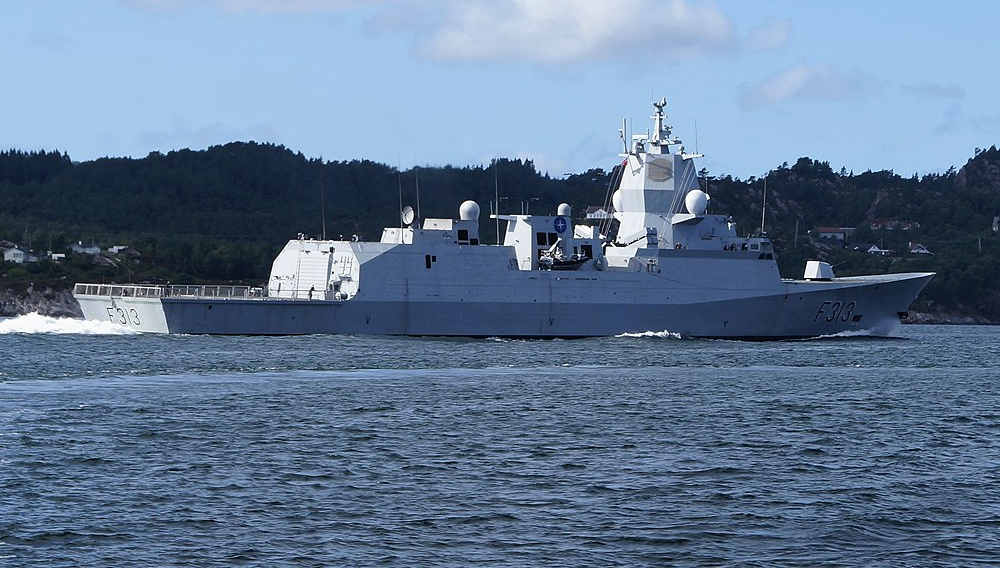
HNoMS Helge Ingstad, a Fridtjof Nansen-class frigate commissioned in 2009.
Photo detail via Wikimedia Commons
The island west of the collision location is Alvoyna in the Oygarden municipality, and the oil terminal at Sture is a busy port that receives large tankers such as the Sola TS which was involved in the collision. Otherwise the islands in this area are relatively sparsely populated with just 4,900 or so inhabitants across the whole municipality. From that we can assume that there would be few lights at night to mark the shoreline, with the exception of the oil terminal which would be brightly lit. The channel is approximately 2 miles wide but is relatively deep, narrowing south of Sture into a channel little over a mile wide.
The collision occurred at approximately 0400 local time on Thursday 8th November 2018. Sunset the previous evening was at approximately 1623; sunrise would not be until 0821. There was no moon; the moon set at around 1718 the previous day and would not rise until 0847. We cannot be certain of the weather conditions which may have restricted visibility. However, there is no evidence of weather or high seas on the radar picture and if visibility was restricted by rain or fog, a ship would be unlikely to be sailing at high speed.
Finally the ships involved. Sola TS is a Maltese flagged oil tanker of 62,000 tonnes. We know she had 23 personnel onboard and after the collision was reported to have little or no damage. Merchant ships are usually well built, especially when carrying petroleum cargoes which if leaked could have devastating environmental consequences; consequently the lack of damage is hardly a surprise. As a result they are sluggish, slow to manoeuvre or accelerate/decelerate. They are not, however, considered to be ‘restricted in their ability to manoeuvre’, a special condition identified in the International Regulations for the Prevention of Collision at Sea – the IRPCS or ‘Rules of the Road’ – this is a condition applied only to vessels which are restricted by their work, such as picking up or laying submarine cables or pipelines, launching or recovering aircraft, carrying out underway replenishment, etc. Sola TS might have been slow to manoeuvre, but she is not exceptional and is unlikely to have carried any special status. Sola TS had a tug, Tenax, in company and might conceivably have been considered to be under tow; however, once again no special status is conferred unless the nature of the tow made it particularly difficult to alter course. The tug is more than likely to have been pacing the tanker, probably not connected and likely a precaution for a fully laden oil tanker in narrow waters.
Helge Ingstad, by contrast, is a Fridtjof Nansen-class air defence frigate of just 5,290 tonnes. Lightly built for speed and manoeuvrability, warships are invariably less robust than merchant ships, but are more tightly compartmented and have more complex damage control arrangements to compensate.
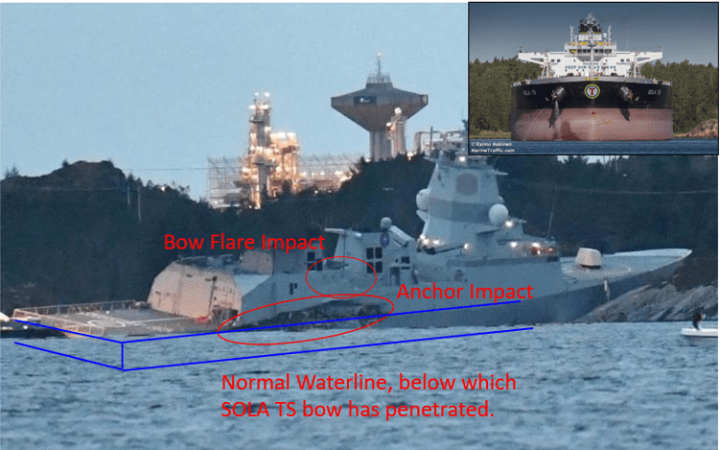
Very quickly after the collision, the Helge Ingstad was run ashore to prevent the ship sinking, but the ship slid down further into the water, despite attempts to keep her close in shore, and eventually slipped down almost completely beneath the waterline:
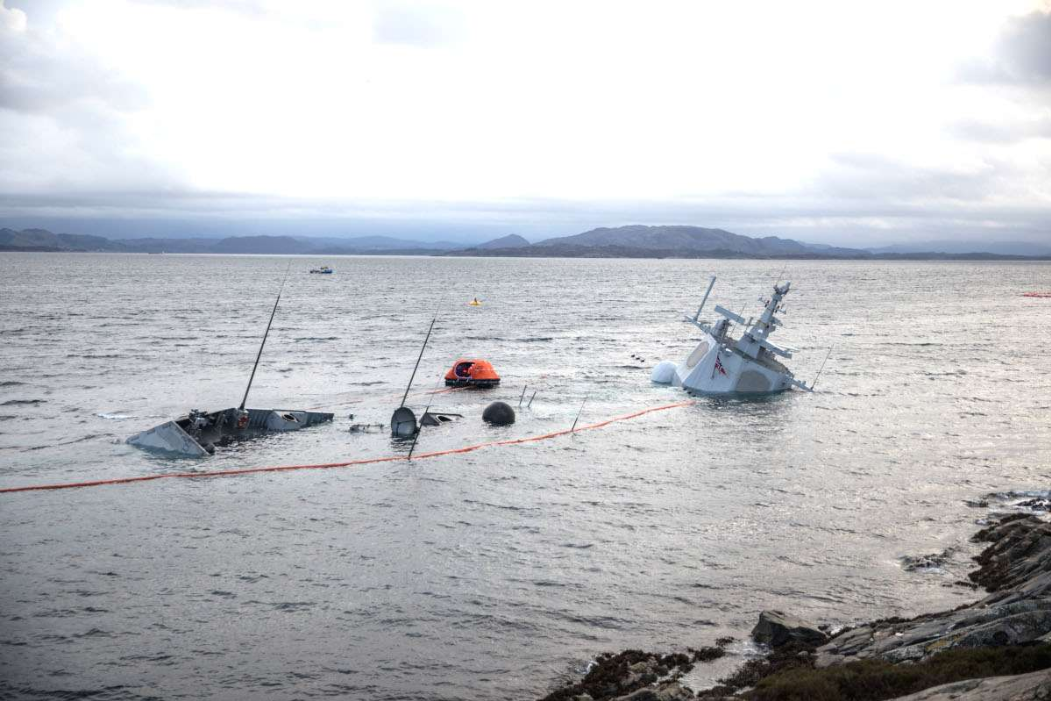
HNoMS Helge Ingstad after grounding, 13 November 2018.
Photo via The Drive.
The consensus among the commenters is that the ship can probably be re-floated, but that the damage to the electronic gear onboard most likely renders her a complete loss:
Regardless of the circumstances, the loss of Helge Ingstad, even temporarily, is a major blow to the Royal Norwegian Navy, which relies on the Fridtjof Nansen-class as its primary surface combatants, especially in a time of increased tensions between Norway and its NATO allies and Russia. The frigate had been on its way back from a massive NATO-led exercise, called Trident Juncture, the largest such drill in decades, when the accident occurred.
If it turns out that Helge Ingstad is a total loss, which seems likely at this point, it could have a significant impact on Norwegian naval operations for years to come. In the meantime, we will continue to follow this story closely and provide any additional updates as they become available.
November 18, 2018
The Mysterious Threat to the Royal Navy – WW2 – 012 17 November 1939
World War Two
Published on 17 Nov 2018While the Finns and the Soviets seem to be moving ever closer to war, the Royal Navy is losing ships at a frightening rate to an explosive threat not yet understood.
WW2 day by day, every day is now live on our Instagram account @World_war_two_realtime https://www.instagram.com/world_war_t…
Between 2 Wars: https://www.youtube.com/playlist?list…
Join us on Patreon: https://www.patreon.com/TimeGhostHistory
Or join The TimeGhost Army directly at: https://timeghost.tvWritten and Hosted by: Indy Neidell
Produced and Directed by: Spartacus Olsson and Astrid Deinhard
Executive Producers: Bodo Rittenauer, Astrid Deinhard, Indy Neidell, Spartacus Olsson
Research by: Indy Neidell
Edited by: Wieke Kapteijns and Spartacus Olsson
Community Manager: Joram AppelColoring by Spartacus Olsson
Archive by Screenocean/Reuters https://www.screenocean.com
A TimeGhost chronological documentary produced by OnLion Entertainment GmbH
November 17, 2018
The MG 08/15 Updated Between the Wars
Forgotten Weapons
Published on 25 Oct 2018https://www.forgottenweapons.com/the-…
http://www.patreon.com/ForgottenWeapons
In the aftermath of World War One, the Treaty of Versailles strictly limited the number of machine guns that the German military could keep in inventory. The main type that the Germans chose to keep was the MG08/15 (although a substantial number of MG08 guns were kept as well). Through the 1920s and 1930s, these Maxim guns were improved and updated in a variety of ways until finally replaced by the MG34 starting in 1936. Many of these updated 08/15s would be deployed in reserve areas during World War Two, but relatively few survive today. Today we are looking at one such gun, and noting the changes made to it compared to the 08/15 of World War One. Specifically:
* Anti-aircraft sights and mounting brackets
* Oiler bottle in the stock
* Bipod attachment at the muzzle
* New water drain and fill plugs
* Modified drum hanger bracket
* Feed block for both cloth Maxim belts and metal MG34 belts
* Leather pistol grip cover
* Top cover locking latchContact:
Forgotten Weapons
PO Box 87647
Tucson, AZ 85754If you enjoy Forgotten Weapons, check out its sister channel, InRangeTV! http://www.youtube.com/InRangeTVShow
November 16, 2018
The Victors & The Vanquished I THE GREAT WAR Epilogue
The Great War
Published on 15 Nov 2018G.J. Meyer: A World Undone
Martin Gilbert: The First World War
Peter Hart: The Great War
David Zabecki: The German Spring Offensives
Alexander Watson: Ring of Steel
Robin Neillands: Western Front Generals
November 15, 2018
Colt Model 639: MACVSOG’s Vietnam Carbine
Forgotten Weapons
Published on 24 Oct 2018http://www.forgottenweapons.com/colt-…
http://www.patreon.com/ForgottenWeapons
The Colt Model 639 was the export version of the Colt Model 629, which was type classified by the US military as the XM177E2 and issued to MACVSOG special operations units in 1967 and 1968. Improved from the Model 609 carbine, the 629/639 has an 11.5 inch barrel and an interesting small muzzle device (“moderator”) which served to change the signature of its firing to sound much more like an AK-type rifle than an M16. The device does that job well – at least until it had been fired extensively, which slowly fills up the (non-disassemblable) unit with carbon and powder residue, substantially reducing its effectiveness. It has a full-fence lower, standard carbine buffer and spring, and a two position aluminum collapsing stock. It is the iconic weapon of US special forces in Vietnam.
Only about 100 of the Model 639 were made in the early 1970s, and many of those were sent back to Colt in 1975 under a recall. At that time, the ATF decided to classify the muzzle device as a silencer, prompting Colt to recall the guns and remove and destroy the devices. Some owners, however, kept their carbines and instead registered the muzzle devices, allowing them legally remain on the guns.
Contact:
Forgotten Weapons
PO Box 87647
Tucson, AZ 85754If you enjoy Forgotten Weapons, check out its sister channel, InRangeTV! http://www.youtube.com/InRangeTVShow
November 13, 2018
THE GREAT WAR IS NOT OVER
The Great War
Published on 12 Nov 2018The Patreon Page: https://www.patreon.com/thegreatwar
The following information — basically the same as what Flo discusses in the video above — was sent out to Patreon supporters:
July 14, 2014 was our first day with The Great War project. 4 1/2 years later, and we managed to not miss a single Thursday to bring you the latest weekly update from 100 years ago. We could not have done this without your support on Patreon. We are not exaggerating when we say that our show would have been cancelled several times if we had to rely on YouTube revenue alone. For that we, and the rest of the production team want to say: “Thank you!”
Now, in the last few weeks we were rather quiet here on Patreon but also on Social Media in general. The main reason for that was that we, the team who researched big parts of this project, who edited, animated and published all the episodes and we who responded to your questions and criticisms over the years needed to figure out what we want to do after 11/11/18.
We quickly realised that we want to continue working in the field of historical film production and with that in mind we will start our own company in early 1919, pardon 2019. So far, we were employees of Mediakraft, the company that initially financed this channel and kept it afloat before you all started supporting us on Patreon. But now we want to stand on our feet.
And the great news is, that The Great War will stay with us and with you in the future. We reached an agreement with Mediakraft that we can continue working on the channel and publish more content. For this content, we still need your support and we hope that you trust our capabilities based on the past 4 1/2 years.
From a historical perspective, 11/11/1918 may have marked the end of hostilities in the First World War but it certainly didn’t usher in an era of world peace – quite the contrary. New wars, more revolutions, difficult peace negotiations and the attempts to create a new world order all were pivotal moments in our world history and we want to continue to tell these stories on The Great War channel.
But, there is always a but, that doesn’t mean that we won’t change things up behind the scenes and on the channel. The first, and for you probably most important point, is that Indy has moved on to new projects (and we wish him all the best for that) which means we will be looking to find a new host. This won’t be easy and I know you will be nervous, but we are sure that we can find someone that can fill these shoes over time.
Moreover, we will probably move away from the weekly episode format that was also accompanied by two extra weekly uploads for the past years. This incredible high output meant that we couldn’t always focus on topics as much as they deserved and we know from the numbers on YouTube that it was an overwhelming amount of content for a lot of our fans, too. Instead we will probably move to less uploads but longer episodes with more detail, more polish, better animations and just overall try to take it to the next level.
To wrap this long post up, I want to kindly ask you to trust in our abilities, to be open for this new direction and most importantly to continue to support us here on Patreon as now independent creators. Over the next few weeks, I will send out more updates on this evolution of The Great War. Right now we want to publish the first new episode in early January. In the meantime, you can enjoy the epilogue episodes with Indy that we will put up in the future.
And if you have any questions or ideas, feel free to put them in the comments of this post, we will try to answer them to the best of my ability.
Flo & Toni
Producers of The Great War
The Maginot Line: Actually a Good Idea
Historigraph
Published on 13 Oct 2018If you enjoyed this video and want to see more made, consider supporting my efforts on Patreon: https://www.patreon.com/historigraph
My old video on the invasion of France in 1940, which is useful for background info to this video: https://www.youtube.com/watch?v=-4-l0…
Check out my Norway 1940 series: https://www.youtube.com/playlist?list…
► Twitter: https://twitter.com/historigraph
Sources:
James Holland, The War in the West – A New History Vol. 1: Germany Ascendant 1939-1941 (kindle edition)
Lloyd Clark, Blitzkrieg: Myth, Reality and Hitler’s Lightning War – France, 1940.
Alistair Horne, To Lose a Battle: France 1940.
Charles River Editors, The Maginot Line: The History of the Fortifications that failed to protect France from Nazi Germany during World War II.
November 12, 2018
German U-Boat Line-Thrower Rifle Conversions
Forgotten Weapons
Published on 21 Oct 2018https://www.forgottenweapons.com/germ…
http://www.patreon.com/ForgottenWeapons
These two Gewehr 98 rifles were converted by the Mauser factory to be used as naval line-throwing rifles. The exact nature of the line and lead projectiles is not clear, but they are clearly original military conversions and came form the Geoffrey Sturgess collection. Entirely new stocks were made for these guns, with a substantially increased length of pull to mitigate the harsh recoil of line throwing. The magazines were blocked with wooden plugs, allowing only one short (blank) round to be held, but allowing that round to be depressed enough to close the rifle’s bolt over it and keep the chamber empty. The barrels were replaced with launch tubes, on 10 inches long with a 2 inch bore and the other 10.5 inches long with a 1.75 inch bore.
Contact:
Forgotten Weapons
PO Box 87647
Tucson, AZ 85754If you enjoy Forgotten Weapons, check out its sister channel, InRangeTV! http://www.youtube.com/InRangeTVShow
November 11, 2018
Armistice – But Peace? I THE GREAT WAR Week 225
The Great War
Premiered 4 hours agoOn November 11 1918, the German delegation and the Allies reach an agreement for an armistice. At the 11th hour the guns go silent and the First World War is over, well at least the guns go silent but is it a peace already? Germany is struggling with revolution and civil war at home, the break up of the Austro-Hungarian Empire causes a lot of chaos. And in Romania, the men are taking up arms again.
Hitler Almost Killed – WW2 – 011 10 November 1939
World War Two
Published on 10 Nov 2018As Hitler drives for a fast invasion he faces covert and open resistance, even an assignation attempt. In the background British and German agents and double agents play a game of betrayal and counter-betrayal.
WW2 day by day, every day is now live on our Instagram account @World_war_two_realtime https://www.instagram.com/world_war_t…
Join us on Patreon: https://www.patreon.com/TimeGhostHistory
Or join The TimeGhost Army directly at: https://timeghost.tvWritten and Hosted by: Indy Neidell
Produced and Directed by: Spartacus Olsson and Astrid Deinhard
Executive Producers: Bodo Rittenauer, Astrid Deinhard, Indy Neidell, Spartacus Olsson
Research by: Indy Neidell
Edited by: Ben Ollerenshaw and Spartacus OlssonColoring by Spartacus Olsson and Sarvesh
Archive by Screenocean/Reuters https://www.screenocean.com
A TimeGhost chronological documentary produced by OnLion Entertainment GmbH
Mark Knopfler – “Remembrance Day”
Bob Oldfield
Published on 3 Nov 2011A Remembrance Day slideshow using Mark Knopfler’s wonderful “Remembrance Day” song from the album Get Lucky (2009). The early part of the song conveys many British images, but I have added some very Canadian images also which fit with many of the lyrics. The theme and message is universal… ‘we will remember them’.
In memoriam
A simple recognition of some of our family members who served in the First and Second World Wars:
The Great War
 Private William Penman, Scots Guards, died 16 May, 1915 at Le Touret, age 25
(Elizabeth’s great uncle)- Private Archibald Turner Mulholland, Argyll & Sutherland Highlanders, mortally wounded 25 September, 1915 at Loos, age 27
(Elizabeth’s great uncle) - Private David Buller, Highland Light Infantry, died 21 October, 1915 at Loos, age 35
(Elizabeth’s great grandfather) - Private Harold Edgar Brand, East Yorkshire Regiment. died 4 June, 1917 at Tournai.
(My first cousin, three times removed) - Private Walter Porteous, Durham Light Infantry, died 4 October, 1917 at Passchendaele, age 18
(my great uncle) - Corporal John Mulholland, Argyll & Sutherland Highlanders, wounded 2 September, 1914 (shortly before the First Battle of the Aisne), wounded again 29 June, 1918, lived through the war.
(Elizabeth’s great uncle)
The Second World War
- Flying Officer Richard Porteous, RAF, survived the defeat in Malaya and lived through the war
(my great uncle) - Able Seaman John Penman, RN, served in the Defensively Equipped Merchant fleet on the Murmansk Run (and other convoy routes), lived through the war
(Elizabeth’s father) - Private Archie Black (commissioned after the war and retired as a Major), Gordon Highlanders, captured at Singapore (aged 15) and survived a Japanese POW camp
(Elizabeth’s uncle) - Elizabeth Buller, “Lumberjill” in the Women’s Land Army in Scotland through the war.
(Elizabeth’s mother) - Trooper Leslie Taplan Russon, 3rd Royal Tank Regiment, died at Tobruk, 19 December, 1942 (aged 23).
A recently discovered relative. Leslie was my father’s first cousin, once removed (and therefore my first cousin, twice removed).
For the curious, the Commonwealth War Graves Commission the Royal British Legion, and the Library and Archives Canada WW1 and WW2 records site provide search engines you can use to look up your family name. The RBL’s Every One Remembered site shows you everyone who died in the Great War in British or Empire service (Canadians, Australians, New Zealanders, South Africans and other Imperial countries). The CWGC site also includes those who died in the Second World War.
In Flanders fields the poppies blow
Between the crosses row on row,
That mark our place; and in the sky
The larks, still bravely singing, fly
Scarce heard amid the guns below.We are the Dead. Short days ago
We lived, felt dawn, saw sunset glow,
Loved and were loved, and now we lie
In Flanders fields.Take up our quarrel with the foe:
To you from failing hands we throw
The torch; be yours to hold it high.
If ye break faith with us who die
We shall not sleep, though poppies grow
In Flanders fields.Lieutenant Colonel John McCrae, MD Canadian Army Medical Corps (1872-1918)
How Peter Jackson ‘Brought To Life’ WW1 Footage In His New Film | RATED
Forces TV
Published on 10 Oct 2018Lord Of the Rings director Peter Jackson has seen footage of a mine explosion that his own grandfather was only a hundred yards away from on the Western Front at the time. He saw the footage while making his new film They Shall Not Grow Old.
QotD: “Chateau” generals and the modern Canadian Army
… the great British strategist, one of the “fathers” of modern armoured-mechanized-mobile warfare, Major General JFC “Boney” Fuller, wrote in the mid 1930s called Generalship: Its Diseases and Their Cure: A Study of the Personal Factor in Command. In it Fuller was harshly critical of what he saw as an old, fat (quite literally) and out of touch military command structure that was intent on fighting the last war, or even the one before that, and was unable to innovate or accept change. Too many generals, he suggested, were physically and mentally unfit for the stresses of modern war, they could not “rough it” with soldiers and actually needed to be in nice warm chateaux behind the lines while soldiers and colonels fought in the mud. This is related to something that the brilliant British soldier-scholar Field Marshal Lord Wavell said in his comments on “generalship:” commanders need to be “robust … able to withstand the shocks of war.” Fuller, especially, went to great lengths, and back two thousand plus years in history, to say that wars and military leadership require physical and mental vigour and that young people, often very young people can master both war and leadership. I suspect that both Fuller and Wavell would look at our modern Canadian Army, especially at our seasoned, experienced and relatively old sergeant section and tank commanders and so, “No, no, no! You’re wasting all that good training and experience at too low a level. Section commanders need only half that much training; those sergeants should be doing more and more important things.”
I believe that we, the Canadian public, need and deserve a more efficient and cost effective Army, and one way to make it so is to lower the ranks of junior leaders: tank and rifle section and tank troop and rifle platoon commanders. It should be harder but quicker for young soldiers to achieve the ranks of lance corporal, corporal and master corporal and command a tank or a rifle section ~ but the corporals and master corporals should be paid more. Junior officers should spend longer in the ranks of second lieutenant and lieutenant, and be paid more, while they are given the opportunities to master the basics of their profession. If you have first rate platoon commanders you’ll get good generals without too much trouble … if you don’t have a plentiful supply of really good tank troop and rifle platoon commanders then good generals will only appear now and again, by happy accident.
Ted Campbell, “The foundation (2)”, Ted Campbell’s Point of View, 2017-02-21.


