
FootageArchive – Videos From The Past
Published on 19 Mar 2015Welcome to FootageArchive! On this channel you’ll find historic and educational videos from the 1900s. Watch, learn, and take a trip back in time as we gain insight into a previous time. Subscribe for more.
Note: this video contains archived public domain / licensed footage. This footage serves documentary purposes on world history and is to be viewed as educational.
December 7, 2018
“A date that will live in infamy” – Speech
Comments Off on “A date that will live in infamy” – Speech
December 6, 2018
FAL Paratrooper 50.63
Forgotten Weapons
Published on 16 Nov 2018https://www.forgottenweapons.com/fal-…
http://www.patreon.com/ForgottenWeapons
FN introduced the paratrooper folding-stock version of the FAL rifle in the early 1960s, and it became a very popular addition to their rifle line. Since the recoil spring on the standard pattern FAL runs down the length of the buttstock, fitting a side folding stock required a redesign to the internal parts, moving the recoil spring in front go the bolt, inside the top cover. For this reason, standard and paratrooper lower receivers, top covers, springs, and bolt carriers are not interchangeable. In addition to those changes, FN developed the folding charging handle for these rifles and shortened their barrels to approximately 17 3/8 inches. The standard muzzle brake was used, and the standard handguards and folding bipod also fitted. The rear sight was fixed, with just a single 250m aperture.
A batch of 1,375 of semiauto Para FAL rifles was imported into the US before the various bans on military style rifles were instituted, and this is one of them – an all-original FN made Para!
Contact:
Forgotten Weapons
PO Box 87647
Tucson, AZ 85754
Comments Off on FAL Paratrooper 50.63
December 5, 2018
The Spanish Flu I THE GREAT WAR Epilogue 2
The Great War
Published on 3 Dec 2018The Spanish flu has quickly spread all over the world since the spring of 1918 and will become the disease that killed more people in a shorter period of time than any other disease in human history.
Comments Off on The Spanish Flu I THE GREAT WAR Epilogue 2
December 4, 2018
QotD: B.H. Liddell Hart and J.F.C. Fuller
The military commentators of the popular press can mostly be classified as pro-Russian or anti-Russian pro-blimp or anti-blimp. Such errors as believing the Maginot Line impregnable, or predicting that Russia would conquer Germany in three months, have failed to shake their reputation, because they were always saying what their own particular audience wanted to hear. The two military critics most favoured by the intelligentsia are Captain Liddell Hart and Major-General Fuller, the first of whom teaches that the defence is stronger that the attack, and the second that the attack is stronger that the defence. This contradiction has not prevented both of them from being accepted as authorities by the same public. The secret reason for their vogue in left-wing circles is that both of them are at odds with the War Office.
George Orwell, footnote to “Notes on Nationalism”, Polemic, 1945-05.
Comments Off on QotD: B.H. Liddell Hart and J.F.C. Fuller
December 2, 2018
Preliminary report posted on the sinking of Norwegian frigate Helge Ingstad
The Accident Investigation Board of Norway (AIBN) and the Defense Accident Investigation Board of Norway (DAIBN) have made their initial joint report on the sinking of HNoMS Helge Ingstad available to the public:
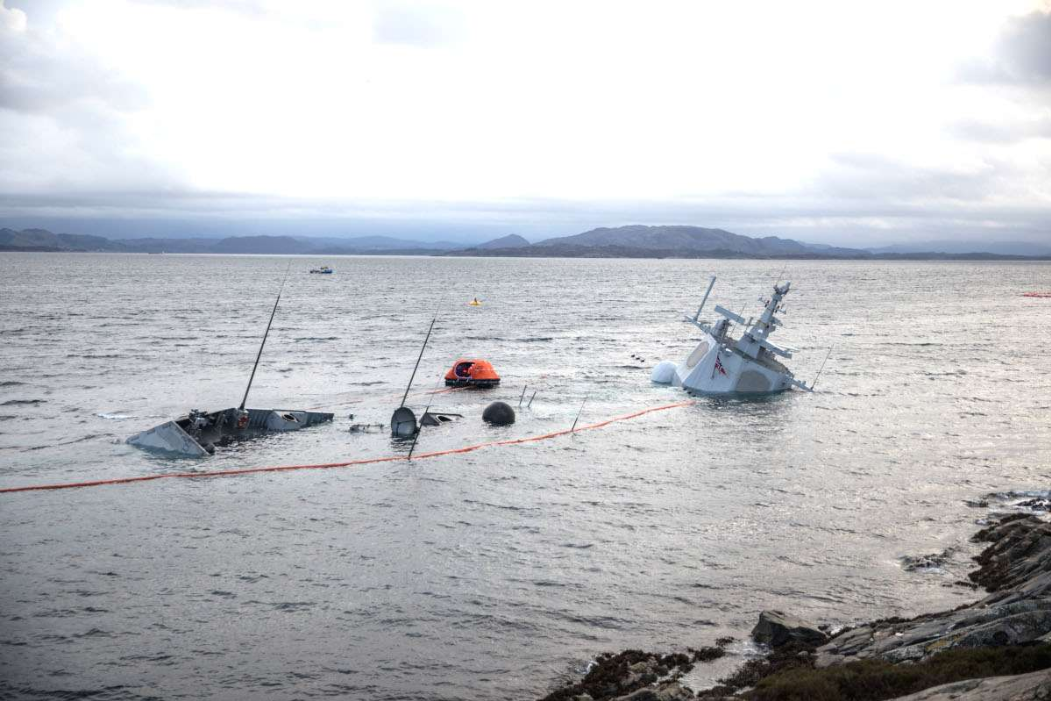
HNoMS Helge Ingstad after grounding, 13 November 2018.
Photo via The Drive.
“This report is a preliminary presentation of the AIBN’s investigations relating to the accident and does not provide a full picture,” the report warns up front. “The report may contain errors and inaccuracies.”
Based on what the investigators have determined so far, Helge Ingstad entered the fjord heading south and checked in with the Fedje Maritime Traffic Center, or Fedje VTS, at around 2:40 AM local time. Any ship over 80 feet long has to alert this control center before entering due to the narrow nature of the waterway.
The ship was traveling at approximately 20 miles per hour and had its navigation lights on. The ship’s Automatic Identification System (AIS) transponder was set to “receive only” mode, meaning that it was not transmitting its own position and other information to ships in the area.
At 3:40 AM, personnel on Helge Ingstad‘s bridge began to turn control of the ship over the next watch. At that time, the ship’s crew was aware of three northbound ships on its radar screen and had also visually observed “an object with many lights was observed lying still just outside the Sture terminal,” according to the report.
Sola did not leave the terminal until 3:45 AM. Less than 15 minutes later, the tanker’s crew radioed the Fedje VTS to inquire about a contract on their radar that was sailing with its AIS transponder apparently off.
At 4:00 AM, Fedje VTS identified the ship in question as probably Helge Ingstad and the tanker and the frigate began communicating directly. Approximately one minute later, the two ships collided.
[…]
A final report on the incident should contain more thorough explanations of exactly how the final moments of the collision played out and recommendations for the Norwegian Navy to try and prevent these sorts of accidents in the future. “So far, the AIBN has not seen any indication of technical systems not working as intended up until the time of the collision,” the report notes.
Separate from its findings regarding the events leading to the collision, the AIBN has also uncovered a serious technical issue that could have impacts well beyond this particular accident. Norwegian officials have alerted both the country’s navy and Spanish shipbuilder Navantia, which built the Helge Ingstad and Norway’s four other Fridtjof Nansen-class frigates, with concerns they have about the basic “watertight integrity” of the ships.
“The AIBN has found safety critical issues relating to the vessel’s watertight compartments,” an annex to the main report explains. “This must be assumed to also apply to the other four Nansen-class frigates. It cannot be excluded that the same applies to vessels of a similar design delivered by Navantia, or that the design concept continues to be used for similar vessel models.”
Update, 24 June 2019: The Norwegian government has decided to scrap the ship rather than undertake repairs.
To no one's surprise, #Norway has officially decided to scrap the #frigate #HELGEINGSTAD F313 rather than repair her. Repairs would cost a bit more than building a new ship. The govt wants to replace the lost capability but has yet to decide how. https://t.co/eslMmkQ6Jj pic.twitter.com/o0YB2R4zrY
— Chris Cavas (@CavasShips) June 23, 2019
Comments Off on Preliminary report posted on the sinking of Norwegian frigate Helge Ingstad
The Winter War – WW2 – 014 December 1 1939
World War Two
Published on 1 Dec 2018On the last day of November 1939 the Red Army of the USSR invades Finland and the Winter War begins.
WW2 day by day, every day is now live on our Instagram account @World_war_two_realtime https://www.instagram.com/world_war_t…
Between 2 Wars: https://www.youtube.com/playlist?list…
Join us on Patreon: https://www.patreon.com/TimeGhostHistory
Or join The TimeGhost Army directly at: https://timeghost.tvWritten and Hosted by: Indy Neidell
Produced and Directed by: Spartacus Olsson and Astrid Deinhard
Executive Producers: Bodo Rittenauer, Astrid Deinhard, Indy Neidell, Spartacus Olsson
Research by: Indy Neidell
Edited by: Iryna Dolka
Community Manager: Joram AppelColoring by Spartacus Olsson and Norman Stewart
Norman’s pictures https://oldtimesincolor.blogspot.com/Archive by Screenocean/Reuters https://www.screenocean.com
A TimeGhost chronological documentary produced by OnLion Entertainment GmbH
Comments Off on The Winter War – WW2 – 014 December 1 1939
Canada’s initial WW1 infantry weapon, the Ross rifle
During the Boer War, the British were busy producing Lee-Enfield rifles for the British army and didn’t have enough extra manufacturing capacity to fulfill a modest Canadian order. The government of the day took this opportunity to try to find a distinctly Canadian weapon to equip the (tiny) Canadian militia. They ended up purchasing the Ross rifle, which is what the men of the Canadian Corps took into the field during the First World War. It didn’t go well, as the highly accurate Ross was not well-suited to the rough-and-tumble life of an infantry weapon in the trenches of Flanders. The mechanism was prone to jamming in muddy conditions and did not work well with low-quality ammunition. It became a national scandal, and eventually most of the Ross rifles were replaced with British Lee-Enfields, except for the sniper weapons (where the Ross was much better suited to the needs of the job). The National Interest has the story:
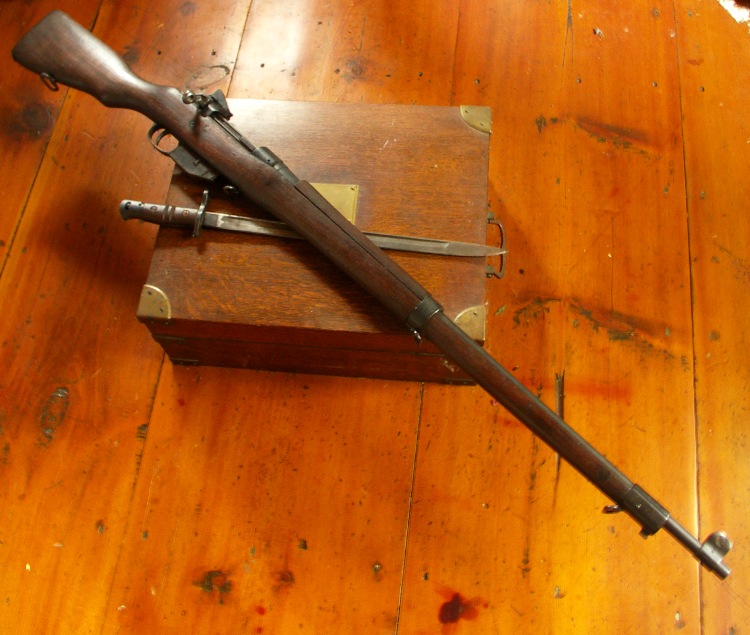
Ross rifle model 1910B
Photo by Vaarok via Wikimedia Commons.
Tested head to head with the Lee-Enfield Mark I, the Ross did well in some of the trials but came up short in other crucial ones, such as the endurance test. Some 1,000 rounds were fired through each rifle and, while the Lee-Enfield functioned well, the Ross repeatedly jammed. After the 300th round, the heat of firing melted away the foresight, which was fastened with common solder. Ross explained that prior tests had been conducted with ammunition of American and Austrian manufacture and that “the standard called for in the manufacture of British .303 cartridges is not of the same precision and quality of material hence greater limits have to be allowed.” His dubious explanation was accepted by the committee.
Already the enterprise was off on the wrong foot. Due to Borden’s choices, the investigative committee leaned in favor of the Ross. It was obvious that no accurate appraisal of anything can result from a biased investigative body. Hughes in particular championed the rifle, and his stubborn resistance to evidence that contradicted his opinions bordered on the irrational. To the end he would insist that the Ross was superior to the Lee-Enfield, even after thousands of Canadian soldiers had simply thrown theirs away on the battlefield.
If the weapon had flaws, so did the purchase contract. Under its terms, Ross was to provide 12,000 rifles during 1903 and 10,000 every year thereafter, with a 75 percent advance on all rifles ordered for the duration of the contract, which was not stipulated. The cost of the Ross was not to exceed that of a Lee-Enfield in Britain, yet the price set was $25, compared to $18.27 the War Office paid for a Lee-Enfield. The contract also stated that materials and machinery Ross needed to import to meet the manufacturing requirements were to be exempt from import taxes. Because there was no division outlined between military and sporting rifles, Ross could get all his imports duty-free, regardless of whether they were built for government contract or not. There was no guarantee Ross would provide more rifles in the event of a national emergency, only that he would provide 10,000 annually after the initial 12,000. There was also no mention in the contract of providing a bayonet.
[…]
The final verdict on the Ross was rendered in the vile ooze of mud, filth, and rotting corpses that characterized trench warfare during the Great War. From the first day of fighting, the frequent jamming of the Ross forced soldiers to strike the bolts with entrenching tools or boot heels to clear them. The problem was attributed to the British ammunition being used, which was slightly larger than Canadian- manufactured rounds, but a significant factor was faulty manufacturing that resulted in deformed firing chambers. Long and unwieldy, the Ross was also not well suited for use in narrow trenches. Soon, British Small Magazine Lee-Enfield rifles began appearing in the Canadian ranks, causing First Division commander Lt. Gen. E.A.H. Alderson to issue an order that his men were not permitted to be in possession of SMLE rifles. It was an order largely ignored.
If earlier investigations had repeatedly given the rifle a pass and rendered a skewed verdict, the Canadian soldiers in the trenches did not. In April 1915, after the bloody fight at the Second Battle of Ypres, Belgium, which also saw the first gas attacks of the war, 1,452 of the 5,000 surviving Canadian soldiers threw away their Ross rifles and picked up Lee-Enfields from British casualties. The verdict of the fighting soldier had been delivered. With confidence in the rifle badly damaged, British Commander in Chief Sir John French issued orders rearming the First Canadian Division with the SMLE.
Not all the reports from the line were negative; the superb accuracy and faster loading capability of the Ross made it an excellent sniper’s rifle, as Sergeant William Carey, one of Canada’s top snipers, discovered one morning at St. Eloi. He and a German sniper spotted each other at the same time and both fired, each missing the other. But the bolt action of the Ross gave Carey the edge; he was able to reload and fire faster than the German, and his next shot was lethal. Although it would be replaced as the standard issue service rifle, the Ross would remain a valuable sniper’s weapon.
Comments Off on Canada’s initial WW1 infantry weapon, the Ross rifle
November 30, 2018
Defense of Poland – Under Siege – Extra History – #2
Extra Credits
Published on 29 Nov 2018This series is brought to you by World of Tanks PC. Check out the game at https://redir.wargaming.net/z3ehuthn/… and use the code ORLIK for extra goodies.
Poland, alone, faces off both Soviet Russia armies and the Germans for five long weeks. Foreign reporter Julien Bryan captures footage of the siege of Warsaw to deliver to the outside world. A resistance builds inside.
Join us on Patreon! http://bit.ly/EHPatreon
Comments Off on Defense of Poland – Under Siege – Extra History – #2
November 29, 2018
The Royal Navy’s “Nelsol” and “Rodnol” – a battleship design driven by lessons from Jutland
One of my favourite quirky ship designs is profiled at Naval Gazing: HMS Nelson and HMS Rodney. These two ships, known derisively by the names “Nelsol” and “Rodnol” (because of their odd profile resemblance to a class of RN oilers, whose names all ended in “-ol”), were the first post-WW1 British battleships designed to incorporate the bitter lessons learned at the battle of Jutland in 1916. Their construction was also influenced by the round of naval treaty talks that aimed to stop a renewed naval arms race and limit the major navies in both number and size of ships.
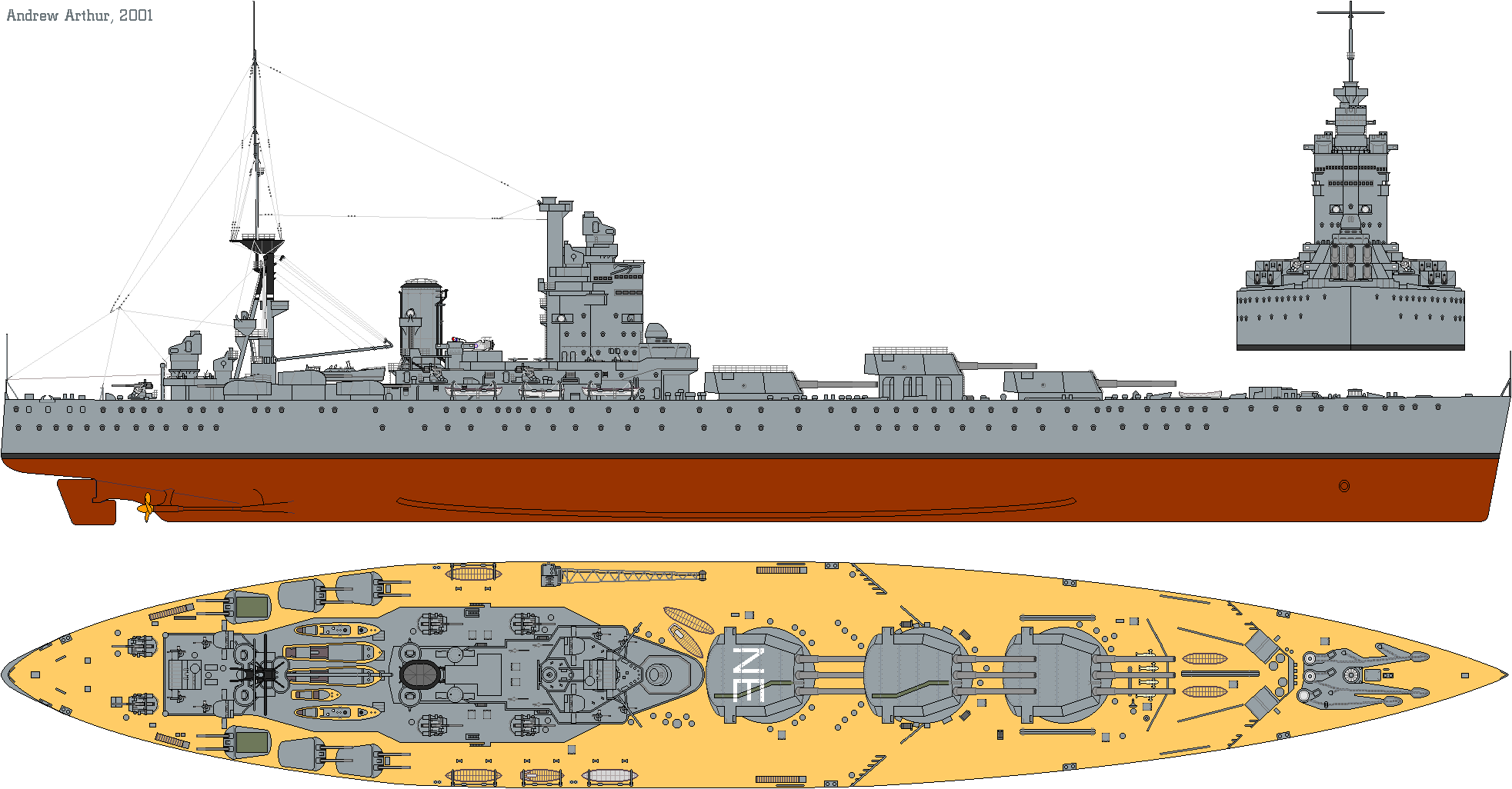
HMS Nelson profile drawing as she appeared circa 1931.
Image by Emoscopes via Wikimedia Commons.
At the end of WWI, the Royal Navy faced a crisis. During the war, it had suspended new capital ship construction except for a handful of battlecruisers, while the American and Japanese building programs had continued to churn out ships that were more modern than the bulk of the British fleet. Worse, the British battlefleet had seen hard war service, and many of the early dreadnoughts were in bad shape and essentially unfit for further service. New battleships would be needed, ships that fully reflected the lessons of the war.
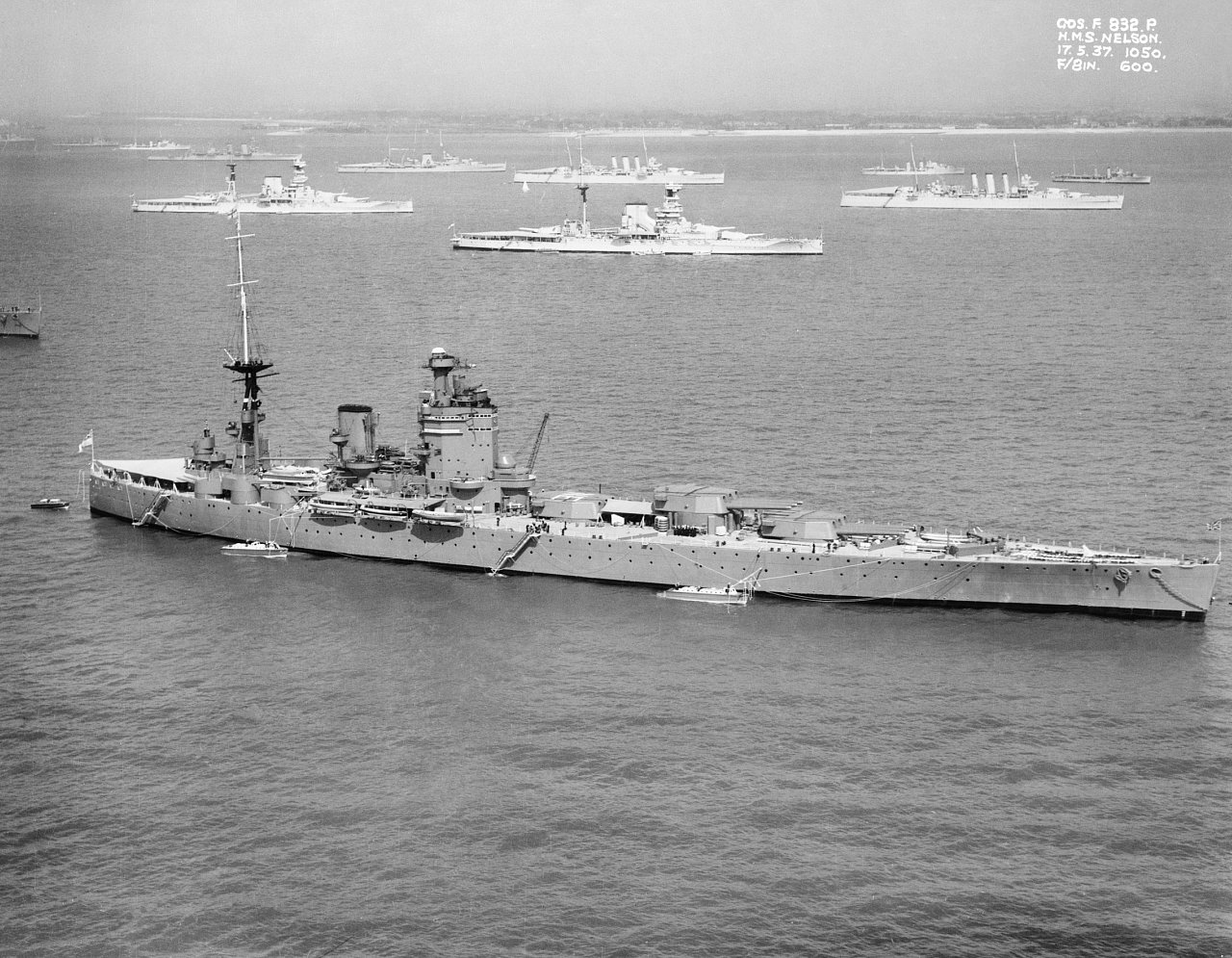
HMS Nelson off Spithead for the 1937 Fleet Review. Anchored in the background are two Queen Elizabeth-class battleships and two cruisers of the London class.
Photo via Wikimedia Commons.The most important of these was the need for an all-or-nothing armor scheme, as developed in the US. The war had seen major improvements in armor-piercing shells, and they required significantly more armor than previous vessels. However, the increased range gave designers a way out. Previously, the size of citadels had been set by the need to preserve stability and buoyancy if the ends were riddled. At long range, the many hits necessary to riddle the ends would not happen, and the citadel could be shrunk to thicken the armor. The British also looked to improve on the 15″ gun due to the proliferation of 16″ weapons in the American and Japanese navies. They investigated the triple turret, abandoned a decade earlier amid fears of increased mechanical complexity, and the 18″ gun under the cover name of 15″/B.
Two parallel design series were started, one for battleships, the other for battlecruisers. As this series was developed, the designers saw a serious problem with the battlecruisers. The boiler uptakes would leave large holes in the armored deck, and if the ship was headed towards the enemy, shells might be able to pass through the holes and into the aft magazines. The solution was to move all three turrets forward of the engines, on the basis of war experience showing that ships rarely if ever engaged targets directly aft.
Comments Off on The Royal Navy’s “Nelsol” and “Rodnol” – a battleship design driven by lessons from Jutland
The Kerch Strait stand-off
The Russians are attempting to cut off Ukrainian access to the Sea of Azov, cloaking that action in standard disinformation to claim that Ukraine is the aggressor, etc. Shoshana Bryen outlines the situation at the moment:
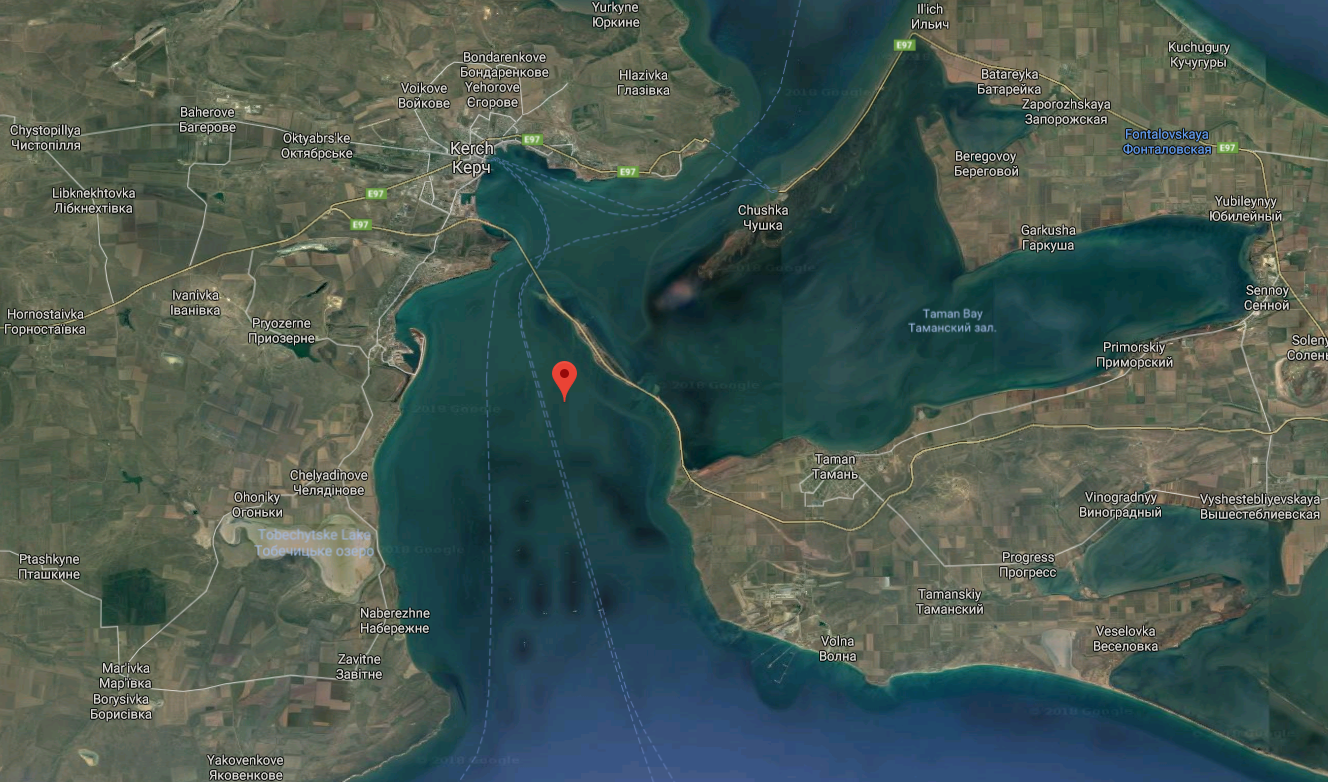
Satellite view of the Kerch Strait via Google Maps
Every story has a starting point. Don’t start with the Russian capture this week of two (or three) Ukrainian ships and the injury to three (or six) Ukrainian sailors. The Russian habit is to do as it likes with smaller countries and then announce that the other guy did it (or it never happened at all). That is the story of the Russian war in Ukraine and the 2014 illegal annexation of Crimea, and that is the Russian story of the Ukrainian ships – two ships, not three, three injured not six; anyhow, Ukraine was sailing out of its lane.
Start instead with the bridge over the narrow Kerch Strait that opened earlier in 2018. It is the only entrance to the Azov Sea from the Black Sea, spanning the Taman Peninsula in Russia and the Kerch Peninsula in Crimea. Earlier plans for the bridge were completed between Russia and Ukraine, but that was before the Russians occupied Crimea. There is an agreement for Ukrainian passage to its two ports along the Azov Sea, but Ukraine has complained that the bridge is the beginning of a blockade that would ultimately control or end Ukrainian shipping. There have been delays for Ukrainian ships passing through, sometimes days, and oh, by the way, the bridge is very low – nearly flat – over the water, meaning that Ukrainian ships over 115 feet can’t pass at all. And now there is a Russian ship parked under the bridge, blocking traffic.
It is estimated that Ukrainian shipping through the strait is down nearly 25% since the bridge opened – as the Ukrainians feared and as the Russians planned.
Austin Bay looks at the military and diplomatic side:
Closing the Kerch Strait effectively blockades Berdyansk and Mariupol, two Ukrainian ports on the Sea of Azov’s north coast.
In 2015, while visiting Crimea, Vladimir Putin himself said he hoped there would be no “full-scale direct clashes” between Ukrainian and Russian forces.
But on Nov. 25, Russia’s war against Ukraine escalated as verifiably Russian coast guard forces under the command of the Russian Federal Security Service intercepted (rammed says Ukraine), boarded and seized two verifiably Ukrainian naval vessels and a Ukrainian tugboat. The 24 Ukrainians on board the ships became Russian prisoners.
The Kremlin claimed the Ukrainian vessels had conducted “dangerous maneuvers” in Russian territorial water.
Putin’s Kremlin specializes in adding complex twists to blatant falsehoods. There is no evidence the Ukrainian ships did anything but try to avoid being intercepted. Russian territorial water? To buy that you must accept Russia’s illegal seizure of the peninsula. However, the strait is an internationally recognized waterway open to transit by commercial shipping and naval vessels. Kerch is comparable to other straits around the globe, like the Strait of Hormuz at the mouth of the Persian Gulf. Iran routinely threatens to close Hormuz to shipping, but to do so would violate freedom of navigation and constitute an act of war.
Defense One reported that Kiev had informed Moscow that its naval vessels would transit the strait. Moreover, the Russians who boarded the Ukrainian ships were special operations commandos.
The Ukrainian ships were making a legal transit. As recently as 2003, Russia guaranteed Ukraine’s right to transit the strait. The 2003 treaty made the strait and Sea of Azov shared territory.
Like invading Crimea, the Russian seizure of Ukrainian ships is a calculated act of war. Russia has now anchored an oil tanker in the main sealane beneath the bridge, blocking all ship traffic.
Ukrainian Foreign Minister Pavlo Klimkin said ramming a Ukrainian vessel was an “act of armed aggression” and that Russia had violated “the freedom of maritime traffic.” He also cited specific articles in the United Nations Convention on the Law of the Sea that “bans the obstruction of peaceful transit across the Kerch Strait.”
Several articles referenced the possibility that NATO would … do something. Other than the usual diplomatic protests, I doubt that there’s much NATO can do in a situation like this. Direct military action should not even be considered an option (not that it’ll stop the odd wild-eyed editorial writer), as NATO does not have a direct interest at risk here. All western nations do have an interest in preserving and upholding freedom of the seas, but Russia knows that the west won’t likely risk getting into a shooting war over incidents like this.
You can get a very useful list of links including the current Kerch Strait confrontation from MILNEWS.ca.
Comments Off on The Kerch Strait stand-off
November 28, 2018
The Difficult Road To Peace 1919 I THE GREAT WAR Epilogue 2
The Great War
Published on 26 Nov 2018After 4 1/2 years of war and millions of dead and wounded any kind of peace would be difficult. The peace process in 1919 was even more difficult because it happened in turbulent times with a rapidly changing landscape and new ideas about a future world order that should prevent this level of bloodshed in the future.
Comments Off on The Difficult Road To Peace 1919 I THE GREAT WAR Epilogue 2
November 26, 2018
Will the Kriegsmarine Rule the Waves? – WW2 – 013 24 November 1939
World War Two
Published on 24 Nov 2018The European Allies seek a countermeasure to the mysterious German mines, in China the Japanese advance, and in Poland it is the beginning of the Warsaw Ghetto.
WW2 day by day, every day is now live on our Instagram account @World_war_two_realtime https://www.instagram.com/world_war_t…
Join us on Patreon: https://www.patreon.com/TimeGhostHistory
Or join The TimeGhost Army directly at: https://timeghost.tvWritten and Hosted by: Indy Neidell
Produced and Directed by: Spartacus Olsson and Astrid Deinhard
Executive Producers: Bodo Rittenauer, Astrid Deinhard, Indy Neidell, Spartacus Olsson
Research by: Indy Neidell
Edited by: Wieke Kapteijns and Spartacus Olsson
Community Manager: Joram AppelColoring by Spartacus Olsson and Norman Stewart
Norman’s pictures https://oldtimesincolor.blogspot.com/Archive by Screenocean/Reuters https://www.screenocean.com
A TimeGhost chronological documentary produced by OnLion Entertainment GmbH
Comments Off on Will the Kriegsmarine Rule the Waves? – WW2 – 013 24 November 1939
November 23, 2018
Defense of Poland – The Battle of the Border – Extra History – #1
Extra Credits
Published on 22 Nov 2018This series is brought to you by World of Tanks PC. Check out the game at https://redir.wargaming.net/z3ehuthn/… and use the code ORLIK for extra goodies.
Poland is threatened in 1939 not just by the Nazis, but by its own precarious geography between Germany and Soviet Russia. Edward Rydz-Śmigły spreads the Polish cavalry and tanks as thin as he has to around the border…
Join us on Patreon! http://bit.ly/EHPatreon
Comments Off on Defense of Poland – The Battle of the Border – Extra History – #1
November 21, 2018
Allied War Economy During World War 1 I THE GREAT WAR Special
The Great War
Published on 19 Nov 2018Check Out Supremacy 1914: https://www.supremacy1914.com/index.p…
Financing and supplying the First World War was a huge economic undertaking that influenced the British, French, American and Italian economies profoundly and shaped the global balance of power.
Comments Off on Allied War Economy During World War 1 I THE GREAT WAR Special
November 20, 2018
Book Review: Desert Sniper, by Ed Nash
Forgotten Weapons
Published on 30 Oct 2018Available from Amazon: https://amzn.to/2yy2zRf
Desert Sniper is an autobiographical account of Ed Nash’s time fighting as a volunteer with Kurdish forces against ISIS in Syria in 2015 and 2016. Nash had been working as a volunteer with the Free Burma Rangers when he decided in 2015 that the growing list of ISIS atrocities demanded action. With his background in journalism and experience as a liaison for the FBR, he thought he could do some good helping to fight one of the most starkly evil groups the 21st century has yet seen. So, he boarded a plane to the middle east.
Kurdish organization being somewhat subpar, his skills as a journalist were not exploited, and instead he went to a sniper tabor (fighting unit) with a Dragunov, which would be his primary weapon for the rest of his time in country. His book describes the experience from start to finish, including insight into Kurdish culture and politics, training, tactics, and more. He worked with both Kurdish men and women (a substantial fraction of the Kurdish fighters and commanders were female) and with other foreign volunteers like himself and various Special Forces teams from coalition nations like France, the UK, and the US.
There are several things that I particularly appreciate about Nash’s work. First is its honesty and lack of either bravado or squeamishness. Today’s popular sensibilities insist that doing violence must inevitably damage a person psychologically, but this is not true. When one believes in the rightness of one’s actions, one can survive combat without becoming a psychological victim of it. There are certainly physiological exceptions like the prolonged shelling experienced by many in WW1 and the brain injuries caused by pressure waves associated with bomb blasts, but if we are to believe Nash (and I do), one can engage in lethal violence for a just cause and sleep well at night afterward.
On a more technical side, Nash’s journalism experience shows in his writing. The book is engaging and informative, and never left me bored. He gives the reader a feel for the wide variety of situations that he found himself in and the many people we developed relationships with during his time.
Finally, Nash has a good familiarity with firearms, and writings clearly and rationally about them. The guns themselves are not the focus of the book, but when they are relevant they are explained in a way that gun nerds will appreciate. As a sniper, Nash used a Dragunov primarily, but also carried an AK as a secondary rifle. He also had experience with the Zagros and Ser heavy rifles, and cogently explains their use. His descriptions of the range limitations of his SVD will certainly spark interest in readers who are shooters. In fact, Nash provided me with the photo and video material for a video about these Kurdish arms a while back, although I did not identify him by name at that time.
Anyway, this is an inexpensive book and I found it to be an excellent read. Men and women who volunteer to fight like Nash did ought to have their stories more widely known, and recognized for seeing a bad situation and doing something extremely concrete about it, despite often facing daunting legal situations upon their return home as a result.
http://www.patreon.com/ForgottenWeapons
If you enjoy Forgotten Weapons, check out its sister channel, InRangeTV! http://www.youtube.com/InRangeTVShow
Contact: Forgotten Weapons
PO Box 87647
Tucson, AZ 85754
Comments Off on Book Review: Desert Sniper, by Ed Nash


