Quotulatiousness

December 10, 2021

History Summarized: Britain and the Empire

Overly Sarcastic Productions
Published 20 Aug 2021

How is it that the history of some islands off the northern coast of Europe balloons into a worldwide history? Empire is how! Let’s dig into the history of Britain since Union of the Crowns of England and Scotland in 1603, and follow that narrative through the monumental rise and precipitous fall of the British Empire.

Special thanks to the community members on Discord who assisted me with my script: Corvin the Crow, Johnny, Jdedredhed, Joud, Jéuname, Klieg, RileyTheProcrastinator, The Missing Link, and thesleepingmeerkat

SOURCES & Further Reading: The Great Courses Lecture series Foundations of Western Civilization II: A History of the Modern Western World by Robert Buchols lectures 11, 12, 13, 14, 15, 18, 19, 20, 21, 22, 30, The History Of England volumes 3 Rebellion, 4 Revolution & 5 Dominion by Peter Ackroyd, Scotland: A Concise History by Fitzroy MacLean, The Great Cities in History by John Julius Norwich, A Concise History of Wales by Geraint H. Jenkins, Sea Power: The History and Geopolitics of the World’s Oceans by James Stavridis.

Our content is intended for teenage audiences and up.

PATREON: https://www.Patreon.com/OSP

PODCAST: https://overlysarcasticpodcast.transi…

DISCORD: https://discord.gg/osp

MERCH LINKS: http://rdbl.co/osp

OUR WEBSITE: https://www.OverlySarcasticProductions.com
Find us on Twitter https://www.Twitter.com/OSPYouTube
Find us on Reddit https://www.Reddit.com/r/OSP/

December 9, 2021

Rzhev Meatgrinder: Day-by-Day Recap 02

Filed under: Germany, History, Military, Russia, WW2 — Tags: , — Nicholas @ 06:00

World War Two
Published 8 Dec 2021

It is one of the deadliest battles of the Eastern Front and entire conflict, yet it is often overlooked next to the fighting at Stalingrad. Today, we will take a look at the 1942 Summer Battles of Rzhev.
(more…)

The sequel to the British disaster at the Battle of Coronel, the German disaster at the Battle of the Falkland Islands

Filed under: Americas, Britain, Germany, History, Military, WW1 — Tags: , , , , — Nicholas @ 03:00

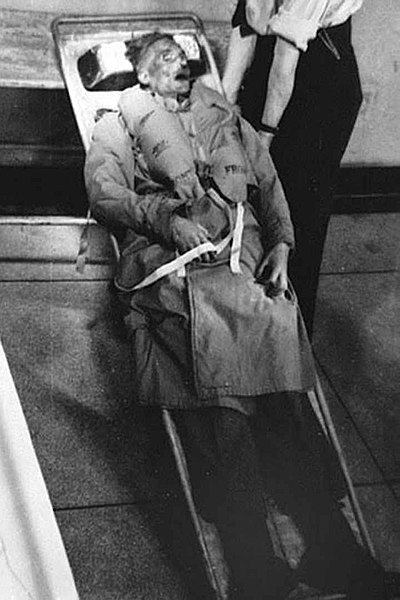
On December 8th, the people of the Falkland Islands observe “Battle Day” to commemorate the British naval victory off the islands in 1914. This is the bookend to the Battle of Coronel the previous month (described here and here), where a Royal Navy squadron was almost annihilated by Imperial Germany’s East Asia Squadron under Vice-Admiral Graf Maximilian von Spee. At the Battle of the Falkland Islands, an equally lop-sided victory eliminated von Spee’s ships with minimal damage to Rear Admiral Sir Frederick Doveton Sturdee’s squadron. In The Critic, A.S.H. Smyth outlines the events as shown in a British film released in 1927:

Battle of the Falkland Islands, 1914 by William Lionel Wyllie. SMS Scharnhorst rolls over and sinks while SMS Gneisenau continues to fight.
Originally published in 1918 by Cassel & Company. Retouched image via Wikimedia Commons

Rear Admiral Sir Frederick Doveton Sturdee (unimprovably British, isn’t it?), Chief of War Staff at the Admiralty, and at distinct risk of being scapegoated for the Coronel catastrophe, was summarily appointed Commander-in-Chief South Atlantic and Pacific(!) and despatched posthaste by [First Sea Lord John “Jackie”] Fisher (with whom he did not get on), on something of a do-or-die mission as the commander of new, eight-cruiser squadron.

The Admiral Superintendent of Devonport warns that Sturdee’s two battle cruisers, Invincible and Inflexible, cannot be ready before Friday the 13th November. First Lord of the Admiralty Winston Churchill balks at that ill-omened date, and orders that they sail on the 11th, ready or not. (Students of the 1982 conflict may see more than a couple of parallels here.) Cue: dockyard refitting montage.

Cut to the German colony at Valparaiso, where his countrymen fête von Spee’s glorious German victory in their first naval battle. “Damnation to the British Navy!” they want to toast. No, says, von Spee: “to a gallant enemy.” Handed a bouquet of flowers, he says he’ll keep them for his funeral “when my time comes.” For “when were the British ever content to leave an enemy to his triumph?”

Von Spee was well aware, it seems, that running the gauntlet up through the Atlantic was going to be a torrid prospect, even without a veangeful enemy on the look-out for him personally. But homeless (Tsingtau had fallen to the Japanese), in need of fuel, and down to half their ammunition, von Spee’s captains urged him now to head for Germany, and he agreed.

Von Spee’s ships were in need of dockyard maintenance and not steaming efficiently, but thanks to a captured British collier they were not in need of coal to be able to get home. Before setting off from where they’d been refuelling, Spee decided to strike another blow against the British and raid the Royal Navy’s supply base at Port Stanley in the Falkland Islands where only local militia were expected to be defending.

It was, among other things, sheer bad luck that von Spee came up to Stanley just a few hours after Sturdee had arrived with his group of cruisers — all newer, faster, and better-gunned than their fatigued German counterparts — and was busily refuelling. Likewise, that the sea was calm, there was little wind, and visibility was excellent. Too late, Gneisenau observes that there are British warships in the harbour! (The acting here is particularly terrible.)

It has been suggested that von Spee had not known that the British ships were “waiting” there (they hardly were); but it has also been alleged that he was misled by poor German intelligence, or even false British cryptography. [The Wikipedia article on the battle credits misinformation by British intelligence for leading von Spee into the trap.]

In Britain, meanwhile, the Admiralty is under the impression that Sturdee is the one who has been caught unawares in the Falkland Islands. Von Spee is a mere 12 miles away, and none of the British ships have their steam up. The FIVF [the Falklands Islands Volunteer Force] are called out, as the ships are ordered to go from zero to hero. One poor lad has to run up the Union Jack in local weather conditions (I’ve been that lad: he has my sympathies); another forgets his rifle, as emphasised by a heavily-asterisked title card.

As so often happens, Fate now played its hand, and Canopus, parked, with her fully-functioning 12-inch guns (so missed at Coronel) in Stanley Harbour, as the Islands’ main defensive battery, came into her own. As the Germans turn and run, Canopus opens fire, and soon enough the “grimly purposeful” cruiser group — “fittingly bearing names from the four corners of Britain … Kent, Cornwall, Glasgow and Carnarvon” — set off in pursuit.

The maths was simply not on the Germans’ side. Sturdee even sent his men below to eat. At midday, he called them back to Action Stations. Von Spee responded by ordering his light cruisers to scatter and make for neutral ports, while Scharnhorst and Gneisenau remained to “accept action to cover their escape”. Flashback to the presentation of those flowers.

Tank Chat #135 | Marder | The Tank Museum

Filed under: Germany, History, Military, Weapons — Tags: , , , , , , — Nicholas @ 02:00

The Tank Museum
Published 27 Aug 2021

In this latest episode of Tank Chats, Curator David Willey details the German Marder. A post-war Infantry Fighting vehicle.
(more…)

December 8, 2021

Imperial Japan – A Spy Comedy? – WW2 – Spies & Ties 11

Filed under: History, Japan, Military, USA, WW2 — Tags: , , , , — Nicholas @ 04:00

World War Two
Published 7 Dec 2021

Japanese spy rings were somewhat successful up until December 1941, but after Pearl Harbor, Japanese intelligence remains only a shell of its former self.
(more…)

SA80 History: The Pre-Production XL85 and XL86

Filed under: Britain, History, Military, Weapons — Tags: , , , , , , — Nicholas @ 02:00

Forgotten Weapons
Published 17 May 2017

Armament Research Services (ARES) is a specialist technical intelligence consultancy, offering expertise and analysis to a range of government and non-government entities in the arms and munitions field. For detailed photos of the guns in this video, don’t miss the ARES companion blog post:

http://armamentresearch.com/british-e…

The SA80 saga continues today with the final pre-production versions of the L85A1 and L86A1, although at this point they still both carry XL designations, as they were not yet formally adopted weapons. In these weapons we can see a couple last distinctive mechanical changes, but perhaps more importantly by this time the worker morale at RSAF Enfield was thoroughly in the tank. It had become well known that the factory complex was going to be taken public or sold outright, and it was widely expected that Enfield would be shut down as a result. A new facility would be built in Nottingham, but none of the rank and file staff expected to transfer. They would be laid off, and they knew it. Not surprisingly, quality control suffered as a result.

As for the guns themselves, the first distinctive visible improvement was in the magazine well. In the XL70 weapons, the bottom half of the magazine well had been simple welded onto the bottom of the lower receiver, in order to retain the easy stamping of that element. On these guns, that have been replaced by a separate box which encompassed the magazine and was spot welded into the lower receiver. This change in construction method allow the magazine well to be much more precisely located in the receiver, and then fixed in place without the risk of warping the thin sheet metal of the lower receiver – while still retaining the simple stamping of that lower.

The other visible change was to the Light Support Weapon, and it consisted of a long “girder” support added below the barrel. This was intended to mount the bipod onto, in the hopes of resolving the long-running problem of split groups in the LSW. This was a problem in which the first round of a burst would hit substantially low and left relative to the rest of the burst. While the LSW was a quite accurate weapon in semiautomatic mode, this split group problem was a substantial detriment to its effectiveness as a proper support weapon.

http://www.patreon.com/ForgottenWeapons

Cool Forgotten Weapons merch! http://shop.bbtv.com/collections/forg…

If you enjoy Forgotten Weapons, check out its sister channel, InRangeTV! http://www.youtube.com/InRangeTVShow

December 7, 2021

Kokoda Trail: D-by-D Recap 01

Filed under: Australia, History, Japan, Military, Pacific, USA, WW2 — Tags: , , , — Nicholas @ 06:00

World War Two
Published 6 Dec 2021

For the past months, we have continuously mentioned the fighting on the Kokoda Track, but it was often a mere footnote next to the colossal battles happening throughout the world. Today, we give you a unique recap of all that’s been going on in this remote theater of war.
(more…)

The Byzantine Army, Dark To Golden Age

Filed under: Europe, History, Middle East, Military, Religion — Tags: , , , , , , , — Nicholas @ 04:00

Epimetheus
Published 22 Mar 2019

The Byzantine army, Dark to Golden age

This video was sponsored by Skillshare

Sources
Romano-Byzantine armies 4th-9th Centuries (David Nicolle)
Larousse Encyclopedia of Ancient and Medieval History (Marcel Dunan)
The Late Roman Infantryman (Simon MacDowall)
Byzantium Beyond the Golden Gate
Fall of the West (John Lambshead)
The Late Roman Cavalryman (Simon MacDowall)

Tags:
Byzantine history, Byzantine, Byzantine documentary, Eastern Roman, Byzantine army, ancient history, Byzantine Cataphract, Byzantine Roman, history, Bulgaria Byzantium, Byzantine military, Byzantine legion, Byzantine empire, fall Byzantine, ancient, Rome, Constantinople, Byzantine empire documentary, crash course Byzantine empire, Byzantium, Byzantine army structure, Byzantine vs Roman, theme system, theme Byzantine, Roman tactics, Byzantine tactics, eastern Roman empire

From the comments:

Epimetheus
2 years ago (edited)
Notes/additional info:

1. Should the empire be called Byzantine, Roman or Greek? I see people arguing for each of these in the comments and there is merit to each of these; but it is important to note that they called themselves Roman, they were majority Greek in population and language spoken, and the term Byzantine is useful in differentiating the time period and has been colloquially used for a long time (although not during the empire) Being a reference to the earlier name of Byzantium for the city of Constantinople.

2. When I refer to “native troops” this includes many other ethnic groups living within the empire, notably the Armenians who lived in Anatolia for hundreds of years and had assimilated in many ways but maintained different views on aspects of the Christian faith which was the most striking differentiating factor between them and the rest of the population of the empire.

3. The Strategos and Domestikos label should be switched on the captions at 6 mins 17 secs in. A Strategos led a Thema(ta) and a Domestikos led a Tagma(ta). Unfortunately I switched those by accident and stared at the screen for a while and did not notice that … sorry guys ;(

4. The Varangian Guard was a personal bodyguard unit to the emperor which are pretty cool, they were mostly comprised of Norsemen (Scandinavians), Rus and Saxons. They are the unit I refer to when I mention a Scandinavian unit.

5. The coolest unit (in my opinion) that I did not mention was the Akritai which were kinda like the Cossacks in that they were a loosely controlled border guard on the eastern side of the empire; and were the subject of much folklore and poems and such.

The Oberg Color Film Footage of Pearl Harbor – December 7, 1941

Filed under: History, Military, Pacific, USA, WW2 — Tags: , — Nicholas @ 02:00

midway512
Published 7 Dec 2018

This short documentary tells the story of Harold & Eda Oberg, and the film footage they recorded of the Pearl Harbor attack on December 7, 1941. The couple captured shots during and after the attack on Hickam Army Airfield.

December 6, 2021

The Battle of Lake Trasimene (217 B.C.E.)

Filed under: Africa, Europe, History, Italy, Military — Tags: , , , , — Nicholas @ 02:00

Historia Civilis
Published 22 Jun 2015

Patreon | http://historiacivilis.com/patreon
Donate | http://historiacivilis.com/donate
Merch | http://historiacivilis.com/merch
Twitter | http://historiacivilis.com/twitter
Website | http://historiacivilis.com

Music is Beethoven’s “Sonata No. 07 in D Major, Op. 10 No. 3” – I. Presto, performed by Daniel Veesey.

December 5, 2021

Axis Armies Facing Starvation – WW2 – 171 – December 4, 1942

World War Two
Published 4 Dec 2021

The Soviets have launched offensives on the entire eastern front and by now hundreds of thousands of men are surrounded at Stalingrad. The Japanese win a battle at sea, but are losing a war of attrition.
(more…)

MAS 44: The French Adopt a Semiauto Rifle

Filed under: France, History, Military, Weapons — Tags: , — Nicholas @ 02:00

Forgotten Weapons
Published 17 May 2019

The French Army had been planning a semiauto infantry rifle since 1921, but indecisiveness and bureaucracy delayed its development. A major trial was held in 1931, and elements of two experimental rifles were chosen to be combined into what would eventually become the MAS 1944. It was put through field trials in late 1939, and passed with flying colors — but too late to get into production before the 1940 armistice with Germany. The project was hidden from the Germans at St. Etienne, and would be revived upon the factory’s liberation in the fall of 1944. By late 1945, rifles were coming off the production line.

The MAS 44 was a direct gas impingement operating system with a tilting bolt, and was a remarkably rugged, dependable, and simple rifle. It was initially adopted by the French Navy, and only 6200 were made before a number of improvements were made and a new model was designated; the MAS 1949. When those 6200 rifles were ultimately surplussed in the 1980s, the vast majority of the surviving examples came to the United States, where their scarcity is not well appreciated.

http://www.patreon.com/ForgottenWeapons

Cool Forgotten Weapons merch! http://shop.bbtv.com/collections/forg…

Contact:
Forgotten Weapons
PO Box 87647
Tucson, AZ 85754

December 3, 2021

French Breakout Attempt During The Siege of Paris 1870 – Battle of Villiers-Champigny

Filed under: France, Germany, History, Military — Tags: , , , , , — Nicholas @ 06:00

Real Time History
Published 2 Dec 2021

Sign up for Curiosity Stream and get Nebula bundled in and SAVE 26%: https://curiositystream.com/realtimeh…

The Siege of Paris has been going on for months in November 1870 and the population is starving. The French Army has previously tried and failed to break out but this week they are starting their biggest attempt yet — not knowing that it has been doomed from the start.

» THANK YOU TO OUR CO-PRODUCERS
John Ozment
James Darcangelo
Jacob Carter Landt
Thomas Brendan
James Giliberto
Kurt Gillies
Albert B. Knapp MD
Tobias Wildenblanck
Richard L Benkin
Scott Deederly
John Belland
Adam Smith
Taylor Allen
Jim F Barlow
Rustem Sharipov

» OUR PODCAST
https://realtimehistory.net/podcast – interviews with historians and background info for the show.

» LITERATURE
Arand, Tobias: 1870/71. Der Deutsch-Französische Krieg erzählt in Einzelschicksalen. Hamburg 2018

Ders.: “Rogerowski oder Rasumowsky? Überlegungen zur nationalen ‘Meistererzählung’ in Fontanes ‘Kriegsgefangen’“, in: Fontane-Blätter 105 (2018). S. 61-86

Ders.: “‘… dazu find ich keine Worte’ – Der Blick auf den Krieg von 1870/71 in Erinnerungsbüchern deutscher Veteranen“, in: Nation im Siegesrausch. Württemberg und die Gründung des Deutschen Reichs 1870/71, hrsg. u. bearb. von W. Mährle. Stuttgart 2020. S. 85-98

Bourguinat, Nicolas and Gilles Vogt: La guerre franco-allemande de 1870. Une histoire globale. 2020

Gouttman, Alain: La grande défaite. 1870-1871. Paris 2015

Lecaillon, Jean-François: Les Femmes et la Guerre de 1870/71. Histoire d’un engagement occulté. Paris 2020

» SOURCES
Hérisson, Maurice d’: Journal d’un officier d’ordonnance. Paris 1885

De Trailles, Paul et Henry: Les femmes de France pendant la guerre et les deux sièges de Paris. Paris 1872

Fontane, Theodor: Der Krieg gegen Frankreich. Bd. 3. Berlin 1874

Fontane, Theodor: Kriegsgefangen. Erlebtes 1870. Briefe 1870/71. Berlin (Ost) 1984

Kühnhauser, Florian: Kriegs-Erinnerungen eines Soldaten des königlich bayerischen Infanterie Leibregiments. Partenkirchen 1898

N. N. (Hrsg.): Bismarcks Briefe an seine Gattin aus dem Kriege 1870/71. Stuttgart, Berlin 1903

Schikorsky, Isa (Hrsg.): “Wenn doch dies Elend ein Ende hätte”, Ein Briefwechsel aus dem Deutsch-Französischen Krieg 1870/71. Köln, Weimar, Wien 1999

Wöllwarth, Julie von: Unter den Verwundeten von 1870/71. Aufzeichnungen aus einer großen Zeit. o.O, o.J. (1890)

Zola, Émile: La Débacle. Paris 1892

» OUR STORE
Website: https://realtimehistory.net

»CREDITS
Presented by: Jesse Alexander
Written by: Cathérine Pfauth, Prof. Dr. Tobias Arand, Jesse Alexander
Director: Toni Steller & Florian Wittig
Director of Photography: Toni Steller
Sound: Above Zero
Editing: Toni Steller
Motion Design: Philipp Appelt
Mixing, Mastering & Sound Design: http://above-zero.com
Maps: Battlefield Design
Research by: Cathérine Pfauth, Prof. Dr. Tobias Arand
Fact checking: Cathérine Pfauth, Prof. Dr. Tobias Arand

Channel Design: Battlefield Design

Contains licensed material by getty images
All rights reserved – Real Time History GmbH 2021

Australian-American War of 1942 – The Battle of Brisbane

Filed under: Australia, Britain, History, Military, USA, WW2 — Tags: , , , , , , , — Nicholas @ 04:00

World War Two
Published 2 Dec 2021

America shares a language and large parts of its culture with Britain and Australia. But when tens of thousands of US troops arrive in 1942, things will be far from smooth. While the alliance remains firm, their soldiers will spend almost as much time fighting each other as they do the Axis.
(more…)

The Battle of the Trebia River (218 B.C.E.)

Filed under: Africa, Europe, History, Italy, Military — Tags: , , , , — Nicholas @ 02:00

Historia Civilis
Published 12 Jun 2015

Patreon | http://historiacivilis.com/patreon
Donate | http://historiacivilis.com/donate
Merch | http://historiacivilis.com/merch
Twitter | http://historiacivilis.com/twitter
Website | http://historiacivilis.com

Music is Beethoven’s “Sonata No. 11 in B Flat Major Op. 22” – I. Allegro con brio. Performed by Daniel Veesey

« Newer PostsOlder Posts »

Powered by WordPress