
World War Two
Published 23 Apr 2022The mastermind of Pearl Harbor meets his fate this week in the Solomons, as do a great many Italian airmen and sailors in the Mediterranean in the Palm Sunday Massacre trying to supply the desperate Axis forces in Tunisia.
(more…)
April 24, 2022
Ladies and Gentlemen, We Got Him – Yamamoto – WW2 – 191 – April 23, 1943
Comments Off on Ladies and Gentlemen, We Got Him – Yamamoto – WW2 – 191 – April 23, 1943
Colt Model 1929 Prototype .276 Rifle, by Ed Browning
Forgotten Weapons
Published 22 Jul 2016http://www.patreon.com/ForgottenWeapons
https://centerofthewest.org/explore/f…On October 1, 1928, the US War Department published a request for semiautomatic rifle designs. The Colt company submitted this .276 caliber rifle to the ensuing trials in 1929. It was designed by Jonathan Edward “Ed” Browning (half brother of John Moses Browning) and was a recoil-operated, tilting bolt design weighing 9lb 9oz and using 108 parts. The tilting bolt system was derived from the 1911 pistol system as designed by John Moses Browning, and the operating system also used an accelerator reminiscent of JMB’s Model 1917 and 1919 machine guns.
After the trials, the Colt 1929 rifle was deemed unfit for further testing by the Ordnance Department because of poor feeding, poor cooling ability, an overly long receiver and short barrel, too many parts, and being too heavy overall. Ed Browning would take the design back to his workshop and continue working on it, eventually replacing the short recoil operating system with an annular gas piston, and bringing it to the Winchester company in the late 1930s.

Comments Off on Colt Model 1929 Prototype .276 Rifle, by Ed Browning
April 23, 2022
Spring 1917: Why the Allies Failed (WW1 Documentary)
The Great War
Published 22 Apr 2022Sign up for Curiosity Stream and get Nebula bundled in and SAVE 26%: https://curiositystream.com/thegreatwar
The Allied 1917 Spring Offensive masterminded by French general Robert Nivelle was supposed to end the stalemate on the Western Front and bring a decisive breakthrough. But the German Army also knew they couldn’t win the war on the offensive and thus prepared a new type of defensive system: The Hindenburg Line.
» SUPPORT THE CHANNEL
Patreon: https://www.patreon.com/thegreatwar» THANKS TO OUR CO-PRODUCERS
John Ozment, James Darcangelo, Jacob Carter Landt, Thomas Brendan, Kurt Gillies, Scott Deederly, John Belland, Adam Smith, Taylor Allen, Rustem Sharipov, Christoph Wolf, Simen Røste, Marcus Bondura, Ramon Rijkhoek, Theodore Patrick Shannon, Philip Schoffman, Avi Woolf,» SOURCES
Cook, Tim, “Storm Troops: Combat Effectiveness and the Canadian Corps in 1917” in Dennis, Jeffrey & Grey, Peter (eds), 1917: Tactics, Training and Technology: the 2007 Chief of Army’s Military History Conference, (Canberra: Australian History Military Publications, 2007)Coombes, David, Bloody Bullecourt, (Barnsley: Pen & Sword Military, 2016)
Doughty, Robert T, Pyrrhic Victory: French Strategy and Operations in the Great War, (Cambridge, MA: Harvard University Press, 2005)
Doughty, Robert A, “How did France Weather the Troubles of 1917?” in Dennis, Jeffrey & Grey, Peter (eds), 1917: Tactics, Training and Technology: the 2007 Chief of Army’s Military History Conference, (Canberra: Australian History Military Publications, 2007)
Farr, Don, A Battle Too Far: Arras 1917, (Warwick: Helion & Company, 2018)
Foley, Robert T, “The Other Side of the Wire: The German Army in 1917” in Dennis, Jeffrey & Grey, Peter (eds), 1917: Tactics, Training and Technology: the 2007 Chief of Army’s Military History Conference, (Canberra: Australian History Military Publications, 2007)
Lupfer, Timothy T, “The Dynamics of Doctrine: The Changes in German Tactical Doctrine During the First World War” Leavenworth Papers, No. 4, Combat Studies Institute, U.S. Army Command and General Staff College, (Fort Leavenworth, KS: 1981)
Nicholls, Jonathan, Cheerful Sacrifice: The Battle of Arras 1917, (London: Leo Cooper, 1990)
» OUR SISTER CHANNEL
https://youtube.com/realtimehistory» CREDITS
Presented by: Jesse Alexander
Written by: Jesse Alexander
Director: Toni Steller & Florian Wittig
Director of Photography: Toni Steller
Sound: Toni Steller
Editing: Jose Gamez
Motion Design: Philipp Appelt
Mixing, Mastering & Sound Design: http://above-zero.com
Research by: Jesse Alexander
Fact checking: Florian WittigChannel Design: Yves Thimian
Contains licensed material by getty images
Maps: MapTiler/OpenStreetMap Contributors & GEOlayers3
All rights reserved – Real Time History GmbH 2022

Comments Off on Spring 1917: Why the Allies Failed (WW1 Documentary)
Tank Chats #144 | Staghound | The Tank Museum
The Tank Museum
398K subscribers
Dissent This
Our Patreons have already enjoyed Early Access and AD free viewing of our weekly YouTube video! Consider becoming a Patreon Supporter today: https://www.patreon.com/tankmuseumHistorian David Fletcher is kicking off 2022 with the Staghound! It is an American armoured car that was designed and produced during the Second World War. Watch the video to find out more!
0:00 – Intro
0:30 – What is the Staghound
5:17 – Other variants
(more…)
Comments Off on Tank Chats #144 | Staghound | The Tank Museum
QotD: The “Modern System” of combat
… I am going to borrow an idea from Stephen Biddle’s Military Power (2004). Biddle identifies what he calls the “Modern System” of combat (though I am going to treat it a bit more broadly than he does). In short, it’s a set of tactics and operational art that emerged out of the First World War and were refined in the European theaters (East and West) of the Second, to cope with the tremendous potency of industrialized firepower which had fundamentally reshaped war. Rather than relying on fixed positions for defense and dense shock-formations (“shock” here – think “bayonets, grenades and trench-knives”), the modern system relies on cover-and-concealment for survivability and maneuver in the offense (go around, not through your opponent’s overwhelming firepower). Adroit use of terrain on the tactical level is a key component of the system, which in turn requires both extensive training of junior officers and NCOs and devolving quite a bit of command agency down to them so that they can make local decisions (compare to, for instance, linear tactics which leave virtually no decision-making to the individual rifleman).
The modern system assumes that any real opponent can develop enough firepower to both obliterate any fixed defense (like a line of trenches) or to make direct approaches futile. So armies have to focus on concealment and cover to avoid overwhelming firepower (you can’t hit what you can’t see!); since concealment only works until you do something detectable (like firing), you need to be able [to] move to new concealed positions rapidly. If you want to attack, you need to use your own firepower to fix the enemy and then maneuver against them, rather than punching straight up the middle (punching straight up the middle, I should note, as a tactic, was actually quite successful pre-1850 or so) or trying to simply annihilate the enemy with massed firepower (like the great barrages of WWI), because your enemy will also be using cover and concealment to limit the effectiveness of your firepower (on this, note Biddle, “Afghanistan and the Future of Warfare” Foreign Affairs 82.2 (2003); Biddle notes that even quantities of firepower that approach nuclear yields delivered via massive quantities of conventional explosives were insufficient to blast entrenched infantry out of position in WWI.)
That means that modern system forces are focused on cover and concealment in defense, but on mobility – often very rapid mobility – in attack. The doctrines that developed to operationalize variations on the modern system (Bewegungskrieg, Deep Battle, AirLand Battle, and so on) all relied (intentionally or not) on pushing the tempo of an attack beyond the ability of a defender to coordinate a defense, on the theory that this would produce tactical and even operational collapse. That theory, it turns out, works very well, but it comes with some costs (I should note here I am stretching the definition of Biddle’s “modern system” a bit and also glossing over a lot of detail in maneuver warfare doctrines).
The thing is, embracing the Modern System is hard. Actually pulling this off requires a relatively high degree of training. It also requires delegating a lot of authority down to lower officers and NCOs. You need both because individual small units need to keep moving and maneuvering even when they may not have time to get direct orders from above, and they need the freedom to respond to local conditions and utilize local terrain, often down to the squad or fireteam level. In turn, that means it is really hard to do if your common soldiers are undertrained, simply illiterate, or if (as in an authoritarian regime) you can’t trust your officers with any kind of independence. Modern authoritarian “coup-proofing” makes it practically impossible to actually implement the modern system effectively (which is part of why most tin-pot dictators produce such poor military performance; though note that not all authoritarian regimes need to coup-proof in this way).
It’s also expensive. Getting the mobility to pull this off on the operational level means mechanizing almost everything in your army, so that the infantry and artillery can keep up with the advance units and so that the logistics can keep up with them. Doing that requires a lot of command sophistication, but it also just requires a ton of hardware. Everything needs to be motorized, mechanized and portable, and then all of that needs to be tied into radio communications, GPS, and so on. And because you’re delegating authority down to smaller and smaller units, those units need all of that expensive communications, and so on. All of that hardware costs a fortune.
But – and this is the core of Biddle’s argument – when modern system armies encounter armies that have not implemented the modern system in conventional pitched battle, the result is generally a crushingly one-sided affair. That’s going to matter a lot for the analysis going forward: so far, it doesn’t seem possible to hold territory (meaning not fighting as guerillas, but actually engaging in positional warfare in the Maoist sense) with a non-modern system army against a modern system army. Non-modern system armies that try get pretty badly wrecked. The 1991 Iraq war is the traditional case study in just how badly wrecked: the coalition (using the modern system) took 292 KIA; 776 WIA compared to the Iraqi Army (without the modern system) suffering 25,000+ KIA and 75,000+ WIA. That stunning lopsidedness is going to matter a lot for the argument going forward.
Bret Devereaux, “Collections: Why Don’t We Use Chemical Weapons Anymore?”, A Collection of Unmitigated Pedantry, 2020-03-20.
Comments Off on QotD: The “Modern System” of combat
April 22, 2022
How Russian Partisans Waged Guerilla War Against Napoleon
Real Time History
Published 21 Apr 2022Sign up at https://curiositystream.com/realtimeh… and get Nebula bundled in.
The face of war was changing in 1812. While the Russian Army retreated and left behind scorched earth, Russian partisans took up arms against Napoleon’s troops. They harassed and attacked vital supply lines and we a true menace to the Grande Armée‘s rear.
» SUPPORT US ON PATREON
https://patreon.com/realtimehistory» THANK YOU TO OUR CO-PRODUCERS
John Ozment, James Darcangelo, Jacob Carter Landt, Thomas Brendan, Kurt Gillies, Scott Deederly, John Belland, Adam Smith, Taylor Allen, Rustem Sharipov, Christoph Wolf, Simen Røste, Marcus Bondura, Ramon Rijkhoek, Theodore Patrick Shannon, Philip Schoffman, Avi Woolf,» SOURCES
Boudon, Jacques-Olivier. Napoléon et la campagne de Russie en 1812. 2021.
Chandler, David: The Campaigns of Napoleon, Volume 1, New York. 1966.
Durova, Nadezhda. Cavalry Maiden. Journals of a Female Russian Officer in the Napoleonic Wars. 1990.
Lieven, Dominic. Russia Against Napoleon. 2010.
Mikaberidze, Alexander. “The Lion of the Russian Army”: Life and Military Career of General Prince Peter Bagration 1765-1812. PhD Dissertation, 2003.
Rey, Marie-Pierre. L’effroyable tragédie: une nouvelle histoire de la campagne de Russie. 2012.
Zamoyski, Adam. 1812: Napoleon’s Fatal March on Moscow. 2005.» OUR STORE
Website: https://realtimehistory.net»CREDITS
Presented by: Jesse Alexander
Written by: Jesse Alexander
Director: Toni Steller & Florian Wittig
Director of Photography: Toni Steller
Sound: Above Zero
Editing: Toni Steller
Motion Design: Toni Steller
Mixing, Mastering & Sound Design: http://above-zero.com
Digital Maps: Canadian Research and Mapping Association (CRMA)
Research by: Jesse Alexander
Fact checking: Florian WittigChannel Design: Simon Buckmaster
Contains licensed material by getty images
Maps: MapTiler/OpenStreetMap Contributors & GEOlayers3
All rights reserved – Real Time History GmbH 2022

Comments Off on How Russian Partisans Waged Guerilla War Against Napoleon
Lucy Worsely on The Jacobites & the Scottish Enlightenment
Whitehall Moll History Clips
Published 22 Jul 2018A segment on the Jacobites and the Scottish Enlightenment that blossomed in the face of Hanoverian oppression.

Comments Off on Lucy Worsely on The Jacobites & the Scottish Enlightenment
April 21, 2022
L8(T) Enfield: The British Army Fails to Make a Sniper
Forgotten Weapons
Published 14 Dec 2021http://www.patreon.com/ForgottenWeapons
https://www.floatplane.com/channel/Fo…
Cool Forgotten Weapons merch! http://shop.forgottenweapons.com
We looked at the 7.62mm conversion of the No4 Enfield into Rifle L8 yesterday. Part of that program was an attempt to develop a new sniper rifle on the L8 platform. To this end, six good-quality No4(T) Lee Enfield sniper rifles were tested for accuracy, then made into L8 rifles and fitted with No.32 telescopic sights (the standard scope from the .303 days) and tested for accuracy again. Much to the chagrin of the Army, the new L8(T) rifles were barely able to match the performance of the .303 rifles they began as. The goal was to significantly improve on the No4(T) accuracy, and that was clearly not happening.
However, at this same time, British civilian competition shooters were having excellent success making 7.62mm versions of the No4. It was only when Enfield was willing to collaborate with the British NRA and others that they were able to successfully create the L42A1 rifle, which at last met the accuracy goals of the program.
The rifle we are looking at today is one of those original six trials L8(T) rifles. Many thanks to the generous collector who allowed me to film it for you!
Contact:
Forgotten Weapons
6281 N. Oracle 36270
Tucson, AZ 85740

Comments Off on L8(T) Enfield: The British Army Fails to Make a Sniper
April 20, 2022
Khrushchev – Stalin’s Loyal Enforcer?
World War Two
Published 19 Apr 2022Nikita Khrushchev has served Joseph Stalin faithfully for the past decade. He’s a career commissar and party man. So, when war breaks out, are commissars like Khrushchev little more than Stalinist enforcers? Or is there more to the institution than that?
(more…)
Comments Off on Khrushchev – Stalin’s Loyal Enforcer?
The Unbreakable ROCKEX: Canada’s answer to the Enigma machine
Polyus Studios
Published 30 Dec 2021Well before digital encryption and VPNs there was Rockex, Canada’s unbreakable cipher machine that rivaled the German Enigma in its day. Although completely hidden from the public, Canada has played a noticeable role in the history of espionage. During the Cold War Canadian cipher machines worked alongside those of her allies to keep communications secure and helped to preserve the peace.
Check out cryptomuseum.com for more information about Rockex and to find the source of most of the pictures of the device I used.

Comments Off on The Unbreakable ROCKEX: Canada’s answer to the Enigma machine
April 19, 2022
Alexander’s Successors (the Diadochi): Series Introduction and Historical Context
Thersites the Historian
Published 24 Nov 2018This video introduces my series on Alexander’s Successors by talking about what the series will be like and by going through the historical context that the viewer might need to understand the age of the Successors.
Patreon link: https://www.patreon.com/thersites
PayPal link: paypal.me/thersites
Twitter link: https://twitter.com/ThersitesAthens
Minds.com link: https://www.minds.com/ThersitestheHis…
Steemit/dtube link: https://steemit.com/@thersites/feed
Backup Channel: https://www.youtube.com/channel/UCUrD…

Comments Off on Alexander’s Successors (the Diadochi): Series Introduction and Historical Context
When the Germans had to surrender twice
The end of the war in Europe is usually noted as being the 8th of May, 1945, when General Eisenhower received the surrender of German forces, but the Soviets (and now the Russians) mark the anniversary on the 9th:
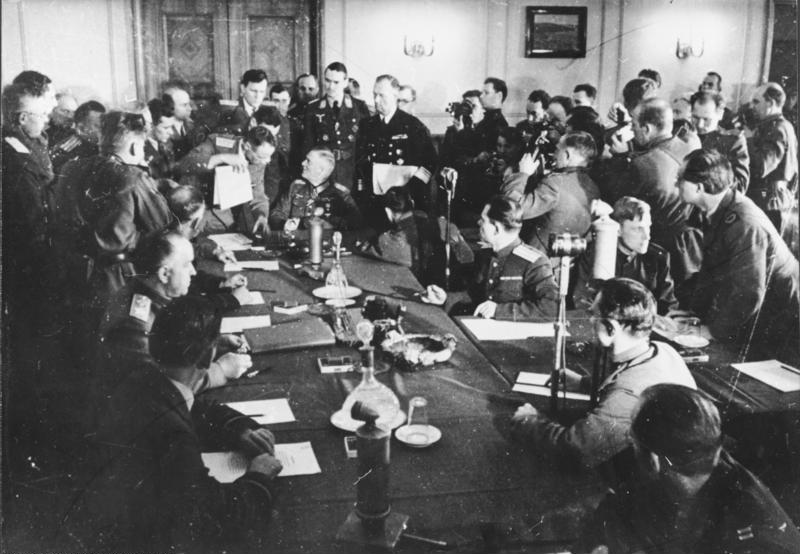
ADN-ZB/Archiv
II.Weltkrieg 1939-1945
Die bedingungslose Kapitulation der faschistischen deutschen Wehrmacht wird am 8. Mai 1945 in Berlin-Karlhorst unterzeichnet.
Links: Der Vertreter des Oberkommandos der Roten Armee, Marschall der Sowjetunion G. K. Shukow, am Tischende Generalfeldmarschall Wilhelm Keitel.
J 0422/600/2 N
It was at three in the morning on Tuesday, 8 May 1945, that Generaloberst Alfred Jodl of the German High Command, signed a surrender document at General Dwight Eisenhower’s headquarters in Rheims, France. The European war was over. It was VE-Day. Stalin’s representative, General Ivan Susloparov, cabled his chief the great news.
However, the Russian leader flew into a rage. He wanted his own observance and insisted on a further ceremony at the Soviet military HQ in Karlshorst, a former Wehrmacht officers’ mess, six miles south-east of central Berlin. Chosen simply because it was one of the few buildings in the capital left with windows and a roof, the formalities were presided over by the captor of the city, Marshal Georgy Zhukov.
This time, it was Generalfeldmarschall Wilhelm Keitel, Jodl’s superior, who read over a near-identical document. Susloparov was again present, along with Carl Spaatz for the Americans and Jean de Lattre de Tassigny, representing France. Newsmen were unaware of the diplomatic spat that delayed proceedings.
De Lattre refused to sign unless the French tricolore was in evidence among the standards and pennants decorating the surrender room. The first Soviet solution hilariously produced a Dutch flag. To pacify an even-more outraged de Lattre, a Red Army seamstress was summoned to run up the appropriate banner. More delays ensued while the Allies bickered over the order of signatures and witnesses, only agreed after the mollifying effects of vodka and some food.
This is why the final ceremony began shortly after midnight. Cameras captured Keitel in full dress uniform, arriving in pompous mood. Flashlights caught the glint of his many medals, and the arrogant flourish of his marshal’s baton, held with gloved hands. He gazed around the room, haughty contempt written across his face. The field marshal removed only his right glove, screwed his monocle into his left eye and applied a fountain pen to the two-page, typewritten document. It was 00:16 local time on Wednesday, 9 May, which became Soviet Victory Day and remains so in Eastern Europe.
Each subsequent year on Victory Day, Red Square has echoed to the “Hurrahs” of vast numbers of Russian soldiers, sailors, marines and paratroopers, national guardsmen and airmen. They are drawn up to listen to their commander-in-chief and inspected by generals. Banners are saluted; swords flash through the air. Serenaded by massed bands playing stirring tunes, they march past the top brass, assembled on the roof of Lenin’s Mausoleum.
Comments Off on When the Germans had to surrender twice
April 18, 2022
Once upon a time, the American military wanted to know precisely nothing about the sex lives of servicemen
Yet another trip into a far distant past, this time in the US armed forces, long before the Current Year:
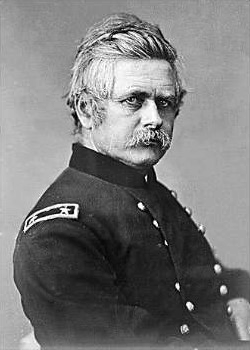
General Edward Ord (1818-1883), the designer of Fort Sam Houston, saw action in the Seminole War, the Indian Wars, and the American Civil War.
Undated photo from before 1883 via Wikimedia Commons.
For much of its history, the American military has had an aversion to hearing in any official way about the sexual conduct of servicemembers. In one of the US Army’s most notorious 19th-century legal conflicts, Captain Andrew Geddes reported from a remote post in Texas that Lieutenant Louis Orleman had been forcing his teenaged daughter to have sex; in a written statement to his commanding officer, Geddes wrote that Orleman “had been having sexual intercourse with her for the past five years, or since she was thirteen years of age, and that he had placed a loaded revolver to her head, threatening that he would blow out her brains if she did not consent to his horrible desires.” Thus informed, then-Brigadier General Edward Ord convened a court-martial — to conduct a trial of Captain Geddes, for putting such an appalling thing in writing.
As Louise Barnett concludes in her book about the trial, “acknowledging the possibility of incest by bringing charges against Orleman would have officially validated and magnified a scandal that would have haunted the Army, and the Department of Texas, for years to come. Fortunately for Orleman, this course of action was unthinkable because incest itself was unthinkable in America in 1879.”
Similarly, a rich and colorful history of the early American navy attempts to count recorded acts of sodomy at sea, and finds them buried in euphemism within official reports of sailor misconduct: “improper conduct too base to mention”, or “filthy conduct”, or “improper conduct on the berth deck”. As the historian James Valle has written, naval courts-martial finding themselves hearing testimony about shipboard sodomy tended to adjourn quickly, or to end testimony and immediately vote to acquit — after which the accused tended to vanish from a ship’s rolls, without explanation, the very next time the ship made port. “Consequently,” Valle concludes, in the early republic “not one navy man was ever convicted of homosexuality by a formal court-martial.” Herman Melville mentioned the unmentionable by writing, in White Jacket, of complaints regarding shipboard acts “from which the deck officer would turn away with loathing.” They didn’t want it to happen, but if it happened, they didn’t want to know about it.
The exceptions are, you know, interesting. In the early years of the Cold War, the sudden arrival of the threat posed by nuclear weapons and the emerging political power of the Eastern Bloc produced a moral panic in which security officials in the federal government hunted communists by looking for homosexuality; the “lavender scare” ran alongside the red scare. And so, as Elizabeth Lutes-Hillman has written, the Cold War military justice system became endlessly obsessed with sexual difference, throwing aside the usual disinclination to take notice of sexual behavior in the ranks: “Courts-martial instead became a performance of military values for the culture at large, setting the boundaries of deviant behavior for the armed forces, and so, to a certain extent, for the American body politic.” To drag that language about the performance of values down to the plane of action, Lutes-Hillman reports the example of the shore patrol in Norfolk, Virginia, which proudly reported in the late-1950s that it had caught 231 sailors in acts of sodomy by drilling holes in the wall of the local YMCA.
Putting all of that together, the American military has mostly preferred to avert its eyes from the sexual behavior of servicemembers, except in moments of transition and political crisis. If the armed forces are really interested in the question of which bed you spent the weekend in, Private Snuffy, something different is happening. For something more than 200 years, the default message from a company commander on Friday afternoon has generally been, “Handle your business, don’t interrupt my weekend with a phone call from a police department, and you’d best be in formation when the flag goes up on Monday morning.” Normal is the view that servicemembers are grown-ups whose intimate matters aren’t military business. Historically, if the armed forces officially have sex on the brain, something has been disrupted; anxiety and disorder outside the military have seeped into the ranks.
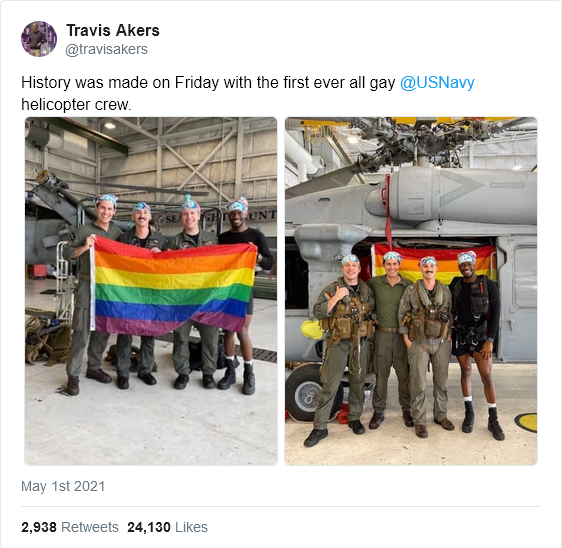
Now. To go back to an example from last year, this:
… suggests a number of obvious questions, starting with how did the United States Navy know this? Is this liberation, or is it intrusion? (BREAKING: The Department of the Navy proudly announces which helicopter pilots are into dudes, and stand by for detailed information on which surface warfare officers are bi-curious. We’re still asking around on that one, so.) It’s like the shore patrol is drilling holes in the wall at the YMCA again, but this time it’s so they can bus in a cheering section. The chain of command is right outside your door, you guys, and we hear what you’re doing in there, and OH MY GOD WE’RE SO PROUD OF YOU DO YOU NEED SOME CONDOMS? The Department of Defense isn’t a regular mom, it’s a cool mom.
Comments Off on Once upon a time, the American military wanted to know precisely nothing about the sex lives of servicemen
Republic to Empire: The Augustan Settlement
seangabb
Published 23 Mar 2021Here is the tenth lecture, which covers the Augustan Settlement and the ending of the Roman Republic. Discussion includes: the Constitutional Settlements, graphical representations of the old and new Roman Constitutions; opinions in Rome and the provinces of the new order; the legitimisation propaganda; the general success of the reign of Augustus.
(more…)
Comments Off on Republic to Empire: The Augustan Settlement
7.62mm Rifle L8: The Last Gasp of the Service Lee Enfield
Forgotten Weapons
Published 13 Dec 2021http://www.patreon.com/ForgottenWeapons
https://www.floatplane.com/channel/Fo…
Cool Forgotten Weapons merch! http://shop.forgottenweapons.com
After the British adopted the FAL as the L1A1 rifle, there was still an interest in converting stocks of existing No4 Enfield rifles to the new 7.62x51mm cartridge for reserve and training use. A conversion system was developed using a new barrel, bolt, and magazine — although the Sterling company was doing much the same thing at the same time and intellectual property lawsuits would close the project for nearly 10 years. By the time the lawsuits cleared up, it had become clear that the rifles were neither particularly successful nor particularly necessary anymore. The problem the British has was one of accuracy — the 7.62mm version just wasn’t sufficiently accurate. A thousand were sold to Sierra Leone, and a few more used in New Zealand and by cadet organizations in the UK, but the project was basically a failure.
Contact:
Forgotten Weapons
6281 N. Oracle 36270
Tucson, AZ 85740

Comments Off on 7.62mm Rifle L8: The Last Gasp of the Service Lee Enfield


