Forgotten Weapons
Published 25 Feb 2022https://utreon.com/c/forgottenweapons/
http://www.patreon.com/ForgottenWeapons
Cool Forgotten Weapons merch! http://shop.forgottenweapons.com
Contact:
Forgotten Weapons
6281 N. Oracle 36270
Tucson, AZ 85740

Forgotten Weapons
Published 25 Feb 2022https://utreon.com/c/forgottenweapons/
http://www.patreon.com/ForgottenWeapons
Cool Forgotten Weapons merch! http://shop.forgottenweapons.com
Contact:
Forgotten Weapons
6281 N. Oracle 36270
Tucson, AZ 85740
Real Time History
Published 16 Jun 2022Sign up for the CuriosityStream + Nebula Bundle: https://curiositystream.com/realtimeh…
Napoleon’s retreat from Moscow and from Russia as a whole is one of the most dramatic scenes in history. Starving and freezing, the French Grande Armée is desperately trying to reach the Berezina River. The revitalized Russian Army is on their heels and almost catches their prey in the 2nd Battle of Krasny. But it wasn’t just “General Winter” that defeated Napoleon in Russia.
» SUPPORT US ON PATREON
https://patreon.com/realtimehistory» THANK YOU TO OUR CO-PRODUCERS
John Ozment, James Darcangelo, Jacob Carter Landt, Thomas Brendan, Kurt Gillies, Scott Deederly, John Belland, Adam Smith, Taylor Allen, Rustem Sharipov, Christoph Wolf, Simen Røste, Marcus Bondura, Ramon Rijkhoek, Theodore Patrick Shannon, Philip Schoffman, Avi Woolf, Emile Bouffard, William Kincade, Daniel L Garza, Stefan Weiß, Matt Barnes, Chris Daley, Marco Kuhnert, Simdoom» SOURCES
Boudon, Jacques-Olivier. Napoléon et la campagne de Russie en 1812 (2021).
Chandler, David. The Campaigns of Napoleon, Volume 1 (New York 1966).
Lieven, Dominic. Russia Against Napoleon (2010).
Mikaberidze A. The Battle of the Berezina: Napoleon’s Great Escape (Pen&Sword Military, 2010)
Rey, Marie-Pierre. L’effroyable tragédie: une nouvelle histoire de la campagne de Russie. (2012).
Zamoyski, Adam. 1812: Napoleon’s Fatal March on Moscow. (2005).
Отечественная война 1812 года. Энциклопедия (Москва: РОССПЭН, 2004)
Безотосный В. М. Россия в наполеоновских войнах 1805–1815 гг. (Москва: Политическая энциклопедия, 2014)
Троицкий Н.А. 1812. Великий год России (Москва: Омега, 2007)
(Прибавление к «Санкт-Петербургским ведомостям» №87 от 29 октября 1812 / http://www.museum.ru/museum/1812/War/…)» OUR STORE
Website: https://realtimehistory.net»CREDITS
Presented by: Jesse Alexander
Written by: Jesse Alexander
Director: Toni Steller & Florian Wittig
Director of Photography: Toni Steller
Sound: Above Zero
Editing: Toni Steller
Motion Design: Toni Steller
Mixing, Mastering & Sound Design: http://above-zero.com
Digital Maps: Canadian Research and Mapping Association (CRMA)
Research by: Jesse Alexander, Sofia Shirogorova
Fact checking: Florian WittigChannel Design: Simon Buckmaster
Contains licensed material by getty images
Maps: MapTiler/OpenStreetMap Contributors & GEOlayers3
All rights reserved – Real Time History GmbH 2022

The Tank Museum
Published 25 Feb 2022► JOIN OUR PATREON: Our Patreons have already enjoyed Early Access and AD free viewing of our weekly YouTube video! Consider becoming a Patreon Supporter today: https://www.patreon.com/tankmuseum
► TIMESTAMP:
00:00 – INTRO
00:31 – FEATURES
(more…)
World War Two
Published 14 Jun 2022Neutral Turkey appears to be an island of peace in a sea of war. But if you look a little closer though and there’s another story. Assassins ply their deadly trade. Spies slip in and out of occupied Europe. The Allies and Axis battle for influence. The secret war is in full swing.
(more…)
Forgotten Weapons
Published 19 Jul 2017http://www.patreon.com/ForgottenWeapons
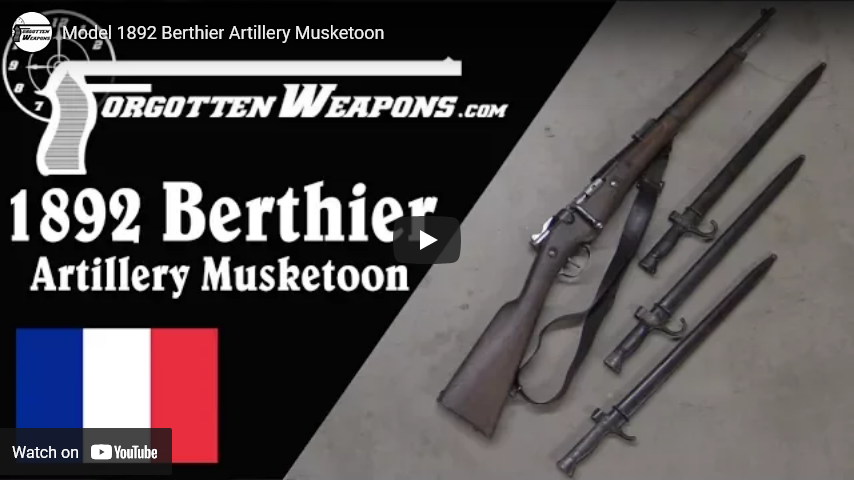
The original 1890 Berthier carbine was designed for cavalry, but a slightly modified version was produced (in small numbers) with a bayonet lug, for use by the Gendarmerie. In 1892, the French military would adopt that same carbine for use by an assortment of troops who were better suited with a carbine than a full size Lebel rifle. These included primarily artillery crews, but also engineers, messengers, drivers, and others.
The Modele 1892 Mousqueton d’Artillerie was basically identical to the 1890 cavalry carbine, including the same 3-round Mannlicher-type clip. It was put into production at both the St Etienne and Chatellerault factories, and by August of 1914 384,000 were in French inventory. By the time the improved 1916 model was put into production, a total of 675,000 of these carbines would be built.
If you enjoy Forgotten Weapons, check out its sister channel, InRangeTV! http://www.youtube.com/InRangeTVShow
World War Two
Published 12 Jun 2022In the Balkans, the Axis powers fail to rout Yugoslav and Greek Partisans. In Bengal, British India starvation is spreading, and in the Netherlands, the Nazis send 1,296 children and infants from the Vught Camp to the gas chambers at Sobibor.
(more…)
Polyus Studios
Published 29 Sep 2020Don’t forget to like the video and subscribe to my channel!
Support me on Patreon – https://www.patreon.com/polyusstudiosThis is an UPDATED version of the video. It includes many changes and corrections to the original video. Many thanks to Gary Watson for all his contributions!
Starting in 1959 Canadair began building Canada’s fastest jet at their plant in Montreal. It was designed as a sleek high altitude and high speed interceptor, but was adapted for low level ground strike missions with conventional and nuclear weapons. It was the Canadair CF-104 Starfighter, Canada’s missile with a man in it.
0:00 Introduction
0:33 Historical Context
2:01 Design Choice
4:15 Canadair’s Production Run
6:50 Configuration and Specifications
11:04 Nuclear Strike Role
12:13 Operational History
16:06 Conventional Role
17:53 Retirement and Replacement
19:28 Accidents, Controversy and Legacy
22:56 ConclusionMusic:
“Denmark” – Portland Cello ProjectResearch Sources:
Canadair CF-104 Starfighter by Harold A. Skaarup (http://silverhawkauthor.com/canadian-…)
Canadair CF-104 Starfighter by Canadian Starfighter Association (http://canadianstarfighterassociation…)
CF-104 Flight Operations by Air Force Museum of Alberta (https://www.rcaf.museum/history/rcaf-…)
Story of the F-104 Starfighter in Norwegian Service by Bjorn Hafsten (http://starfighter.no/hist-en3.html)
Starfighters with Turkey by Joe Baugher (http://www.joebaugher.com/usaf_fighte…)
ASN Aviation Safety Database by Aviation Safety Network (http://aviation-safety.net/wikibase/d…)
Starfighter by David L. Bashow (Fortress Publication, 1990, ISBN: 0-919195-12-1)
Photography credit 6mins10sec: Gary WatsonFootage Sources:
Personal Footage – Gary Watson
Cold War Fighter Pilot – Ken Castle, CD, Flight-Lieutenant (ret’d) – Canada Aviation and Space Museum (https://youtu.be/sEUOFyPLL94)
CF 104 Baden Soellingen 1965 – Gordon Price (https://youtu.be/4UZ9PE58Eq0)
CF104 Germany 1983/4 441 Squadron CAF – Tom Hammond (https://youtu.be/xrqjAKHflCo)
Great Planes Lockheed F-104 Starfighter – Discovery Channel (1996)
Avro Canada CF 100 Canuck – Avro (1956)#Starfighter #CanadianAerospace #PolyusStudios

World War Two
Published 11 Jun 2022The Allies bomb Mediterranean islands in preparation for their invasion of Sicily next month; they also prepare a lot of deceptions to mislead the enemy as to where they will attack. The German plans for the summer offensive against the Kursk salient are ever more concrete, and in the field this week, the Chinese stop the Japanese offensive cold.
(more…)
Forgotten Weapons
Published 29 Sep 2016Cool Forgotten Weapons Merch! http://shop.bbtv.com/collections/forg…
The original design of the M1 Garand as adopted in 1936 used a “gas trap” system instead of a gas port drilled in the barrel. This system used a type of muzzle cap and false muzzle to redirect gas into the gas cylinder in the short distance between the end of the rifled barrel and when the bullet left the muzzle. The system worked, but was not ideal.
Several problems were found with the gas trap system as the guns went into production. These included cleaning complexity, an unstable front sight, and a potentially weak bayonet mounting point. Most significantly, however, one rifle in testing had a screw work loose in the muzzle cap, which allowed parts to shift out of alignment and resulted in a bullet striking the gas plug and blowing the entire assembly off the gun. This led to a decision to redesign the gas system of the M1 to use a simpler gas port drilled in the barrel.
When this design change was made, 18,000 rifles had been completed and parts were made for an additional 33,000. Those guns were completed with the available parts, and the new gas system was used for all further production. Gas trap M1s are very rare today because the guns were updated to the new system when they were overhauled during WWII, and in 1947 the Army ordered all remaining gas trap rifles destroyed.

At The Critic, Jonathan Healey reviews The Siege of Loyalty House by Jessie Childs:

Late in the summer of 1641, with Charles I deep in dispute with his Parliament, alarming reports reached Westminster of Catholics amassing arms at Basing House in Hampshire. At this point in time, few expected civil war, but plenty feared an imminent Catholic plot. Recent reform to the Church had introduced lavish ceremonies which looked, to many eyes, like the trappings of Rome, and Charles himself was married to a Catholic.
More to the point, England’s Catholics had done it before. Every year, people marked the anniversary of the Gunpowder Treason, which was already stuck in the national consciousness as the quintessential Popish rebellion: an armed coup plotted by dissident aristocrats gathering weapons on their great rural estates and planning subterfuge at the highest levels.
Yet civil war came, and when it did it would be nothing like the “Popish Plots” of Protestant imagining. It would be fought over constitutional as much as religious divides. And, rather than a rebellion, it would be an armed struggle between two competing fiscal-military organisations — effectively between two competing states.
The English countryside became militarised. Now, it was not just a landscape. It was territory. The great houses were no longer places for covert plotting; now they were centres of command and control. And few were more important than Basing House.
Hampshire today is a pleasant place: gentle and verdant with rolling chalk hills, shaded woodlands, and quiet valleys. But in the 1640s it became contested and dangerous: a dark, malevolent land of violence and death. People looked upon one another with suspicion, and riders were ambushed and killed as they travelled at night. Parish churches were stormed, towns starved and bombarded. Armies of musketeers, pikemen, and cavalry traversed the folding lanes of the county looking to bring bloodshed and plunder.
[…]
A crucial theme is encapsulated in the book’s denouement. The deputy sent to pacify Hampshire for the New Model was Oliver Cromwell. He had been in the thick of the fighting from the start, and before then was an earnest — if obscure and scruffily-attired — Member of Parliament. But Cromwell really rose to prominence in 1644 and 1645, on the back of his military abilities. He represented a new approach to the war: the pursuit of total victory even at the cost of sharp bloodshed.
It was Cromwell’s direct — even brutal — efficiency that brought the siege of Basing House to its end. The walls fell and many of the garrison were killed. Slaughtered, too, were a number of Catholic priests in a moment of violence that was representative of the way the war was heading. Cold-blooded murder of female camp followers had been perpetrated by royalists in Cornwall and by parliamentarians after Naseby. King Charles had allowed a bloody storm of Leicester which had cost many civilian lives, and Cromwell would go on to oversee the horrors of Drogheda and Wexford in Ireland. The chivalry of Waller and Hopton would come to seem a long way in the past.
World War Two
Published 7 Jun 2022The thousand-bomber offensive was about to begin as Air-Marshall Harris was assembling his forces. Yet one man was to challenge his strategy. The aircraft designer Barnes Wallis thought: “What if there was a way to destroy Germany’s industrial might not by simply dropping thousands of bombs over its cities, but by a precision strike against its dams?” For this, a new kind of bouncing bomb was to be delivered.
(more…)
Forgotten Weapons
Published 27 Feb 2017Shooting the MAC 1950: https://www.youtube.com/watch?v=sduZ4…
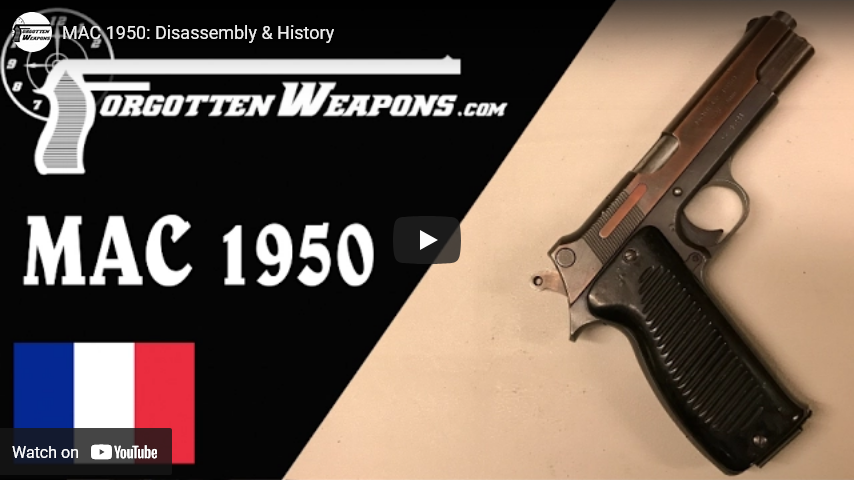
The PA MAC 1950 (Pistolet Automatique Modele 1950) was the result of a 1946 French effort to standardize on a single military pistol. By the end of WWII, the French military had accumulated a mess of different pistols of French, Spanish, American, and German origin; officially using the Luger, P38, Mauser HSc, 1911 (and A1), 1935A, 1935S, Star, Ruby, and Model 1892 revolver.
Trials were held in 1950, although the outcome was predetermined — this pistol, designed by St Etienne and largely derived from the Model 1935S, was to be the next French military sidearm. A design from the SACM company was also tested, as was a commercially purchased SIG SP47/8, but this was for comparison sake only. In fact, the SIG was the best performer in the testing, with the St Etienne design suffering from cracked parts and durability problems. It would be improved, however, and deemed suitable for adoption by early 1951.
Production began in 1953 at the Chatellerault arsenal (hence the “MAC” name used in the US). All of 221,900 were made by Chatellerault until it was shut down in 1963, when production transferred to St Etienne, where another 120,000 would be made by 1978.
Mechanically, the gun is largely taken form the Browning 1911, with a few improvements. The recoil spring is of a captive design, and the fire control group is all built into a single easily replaced unit (similar to the Tokarev and the 1935S). It is single action only, with hammer-block and magazine safeties and a 9-round magazine of standard 9x19mm ammunition. It is still in French service, having proven to be a reliable and dependable weapon, if outdated by today’s standards.
http://www.patreon.com/ForgottenWeapons
Cool Forgotten Weapons merch! http://shop.bbtv.com/collections/forg…
If you enjoy Forgotten Weapons, check out its sister channel, InRangeTV! http://www.youtube.com/InRangeTVShow
The History Guy: History Deserves to Be Remembered
Published 6 Jun 2022There are so many stories of heroism involved in the massive Operation Overlord, among them the extraordinary story of the little-known first Canadian Parachute Battalion. The lightly armed Canadians were among the first allied soldiers to hit the ground in France on D-Day.
Check out our new community for fans and supporters! https://thehistoryguyguild.locals.com/
This is original content based on research by The History Guy. Images in the Public Domain are carefully selected and provide illustration. As very few images of the actual event are available in the Public Domain, images of similar objects and events are used for illustration.
You can purchase the bow tie worn in this episode at The Tie Bar:
https://www.thetiebar.com/?utm_campai…All events are portrayed in historical context and for educational purposes. No images or content are primarily intended to shock and disgust. Those who do not learn from history are doomed to repeat it. Non censuram.
Find The History Guy at:
New community!: https://thehistoryguyguild.locals.com/
Please send suggestions for future episodes: Suggestions@TheHistoryGuy.netThe History Guy: History Deserves to Be Remembered is the place to find short snippets of forgotten history from five to fifteen minutes long. If you like history too, this is the channel for you.
Awesome The History Guy merchandise is available at:
teespring.com/stores/the-history-guyScript by THG
#history #thehistoryguy #DDay

In The Line, Andrew Potter rounds up the latest open source data on the Russo-Ukrainian war of 2022, and notes that the briefly enthusiastic western nations — having all posted Ukraine flags on their social media accounts and boycotted Russian vodka — are now noticeably suffering from battle (cheerleading) fatigue and are all rather obviously hoping Ukraine will sue for peace with the Russian aggressor:
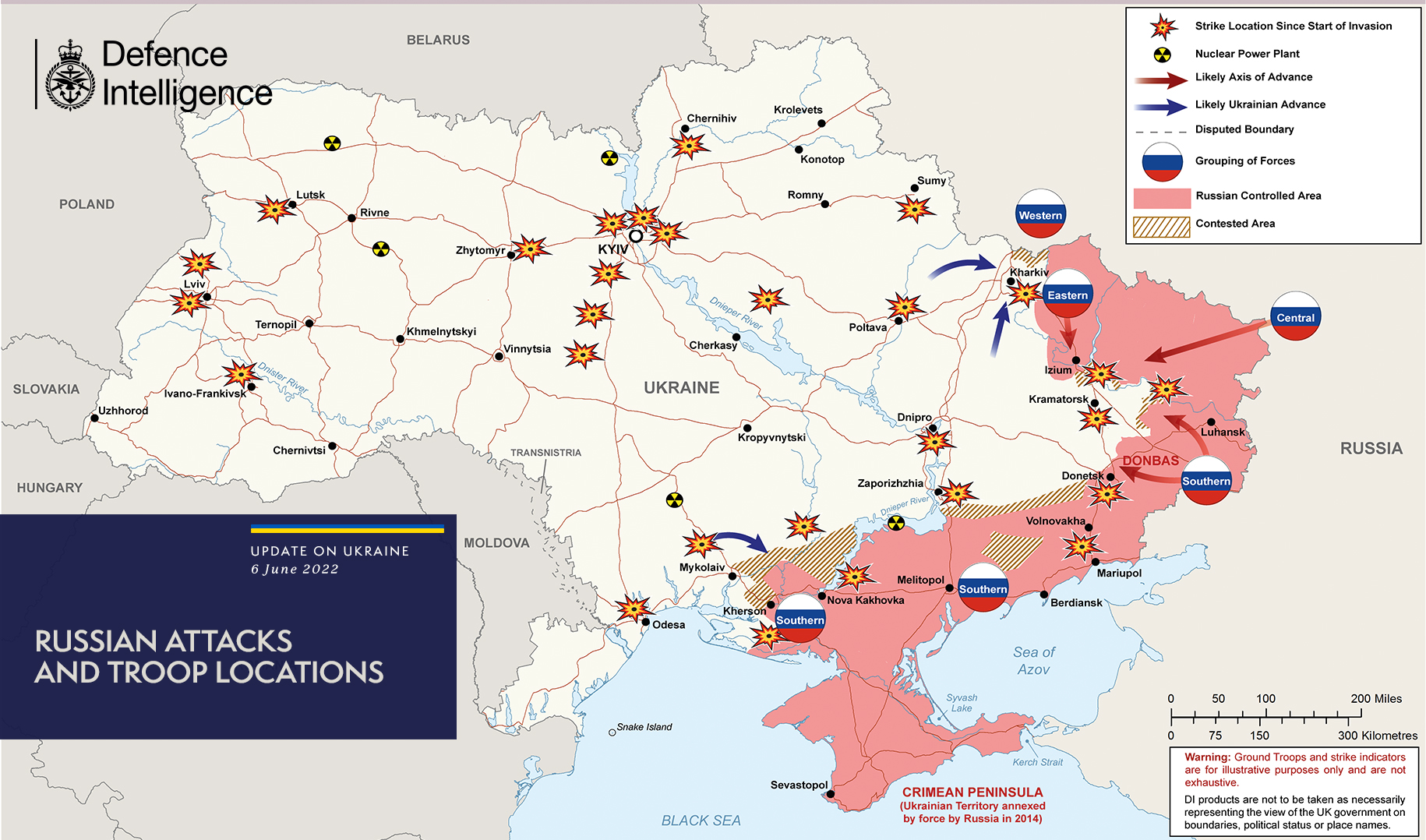
We are now just past the one hundred day mark of Vladimir Putin’s insane invasion of Ukraine. But even as the Ukrainian forces are fighting ferociously for Severodonetsk, with president Volodymyr Zelensky making an amazing visit to troops right on the edge of the front lines of the eastern salient, a few Western leaders marked the occasion by suggesting that it’s getting on time for them to think about giving up.
According to Zelensky, Russian forces currently control around one fifth of Ukrainian territory, mostly in the east and the south. As he pointed out last Thursday in an address to the Luxembourg parliament, this is an area that is much larger than the entire Benelux region.
For Russia, this has come at a considerable cost. Reliable open source intelligence estimates put Russian losses at over 31,000 soldiers killed, 3,300 armoured vehicles and another 2,500 trucks destroyed, 200 lost aircraft, 175 helicopters, and 13 ships or boats. All of this for a “special operation” that was supposed to take no more than a long weekend including the victory parade, with the invaders welcomed as liberators.
Dear as this has been for Russia, for Ukrainians the price has been much, much higher. Reliable estimates of Ukrainian military losses are hard to come by, but something around half of the Russian figures is probably in the ballpark, though they could easily be much higher. Zelensky has not been totally shy in talking about losses; the other day he said the Ukrainian forces were losing 60-100 fighters a day, with another 500+ wounded, in fighting in the east.
These are staggering losses (recall that Canada lost 158 soldiers over the course of more than a decade in Afghanistan), but they don’t even begin to compare with what has happened to Ukraine’s civilians and to its cities. This war has been going on for so long, reports of Russian outrages and war crimes now so numerous, that history-making acts of outright barbarism have come and gone from the news pages in a matter of days: Bucha, Kramatorsk, Mariupol … the list goes on and grows. When all this is done, how many dead, deported and disappeared Ukrainians will there be? If it is 50,000 dead in Mariupol alone, a million or more is not out of the question.
For a few days and even weeks, the narrative was that Putin had gravely miscalculated. He clearly expected the Ukrainians to roll over and for the neighbours to just shrug and look the other way. Instead, the Ukrainians fought back and NATO and the West were galvanized into support and action. If Putin was worried about Ukraine bringing NATO and the EU to his doorstep, well, his worst nightmare had come true, with Sweden and Finland applying for expedited admission to the alliance.
But as degraded his army, as inept his generals, as degenerate his kleptocracy might be, Putin has always had a couple of aces up his sleeve: The abiding and reliable perfidy of the Germans and the French, and the increasing inability of the American-led anglosphere to maintain its focus. As Putin sees it, as this war stretches on the Americans and the Brits will lose interest, and the burning desire of Emmanuel Macron and Olaf Scholz to help Putin “save face” — i.e. give Russia some Ukrainian territory — will grow increasingly appealing.
George Mason, quoted in the title of this post, had a very expansive view of the US militia. Most Americans of the day did not seem to share this view, as Chris Bray explains:
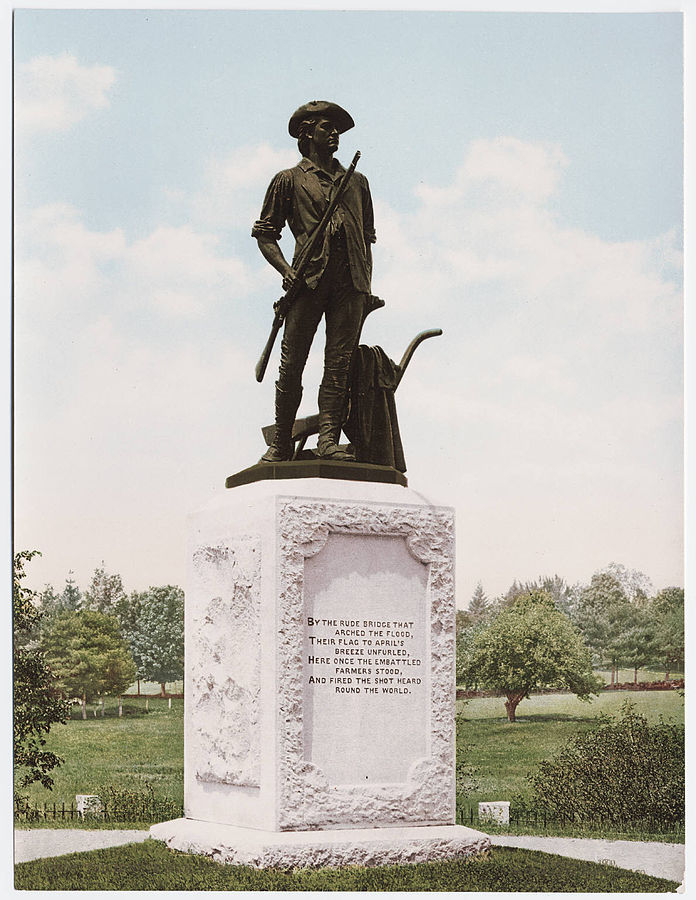
How Congress may have visualized the individual minutemen who would compose the militia of the United States after 1792.
Postcard image of French’s Concord Minuteman statue via Wikimedia Commons.
In the second Militia Act of 1792, Congress defined a uniform militia in all of the states:
That each and every free able-bodied white male citizen of the respective States, resident therein, who is or shall be of age of eighteen years, and under the age of forty-five years (except as is herein after excepted) shall severally and respectively be enrolled in the militia … That every citizen, so enrolled and notified, shall, within six months thereafter, provide himself with a good musket or firelock, a sufficient bayonet and belt, two spare flints, and a knapsack, a pouch, with a box therein, to contain not less than twenty four cartridges, suited to the bore of his musket or firelock, each cartridge to contain a proper quantity of powder and ball … and shall appear so armed, accoutred and provided, when called out to exercise or into service, except, that when called out on company days to exercise only, he may appear without a knapsack.
So, by federal law, every military-age white male in the country (except men who were exempted by the states, like clergymen) had to report to the local militia commander to be enrolled in their local company, and had to own a long list of equipment, and had to show up to train with that equipment when ordered.
They mostly didn’t. For decades, states reported their militia enrollment to the War Department, and it sometimes appeared that some states, by trying really hard, sometimes almost made it to something in the neighborhood of half participation. In 1826, the Barbour Board — named after Secretary of War James Barbour — evaluated the unmistakable failure of the federally defined uniform militia, and suggested trying again with a smaller group of select militiamen. The board’s report was universally ignored, because by 1826 the federal government, like, couldn’t even: Everyone knew the model of widely shared militia service had failed.
Historians have usually described the failure of universal white male militia service in the early republic as a top-down policy blunder in which political leaders didn’t try hard enough to make the thing work. But a marginal historian named Chris Bray, in a dissertation that generated no excitement of any kind in academia, argued that the universal white male militia obligation was doomed by something else: widespread irritation and popular resistance. The militia obligation reached into the lives of militiamen in ways they didn’t expect and wouldn’t tolerate, so they stopped showing up.
There are many different ways to tell this story, but let’s do it quickly.



Powered by WordPress