
H/T to Marc Campbell.
August 24, 2010
August 23, 2010
Unmasking “The Stig”
A court case will decide whether HarperCollins can publish a book that reveals the identity of Top Gear‘s anonymous driver:
Publisher HarperCollins is in a legal dispute with the BBC over a book that reveals the identity of Top Gear‘s The Stig, BBC News understands.
Both sides appeared in London’s High Court on Monday after the BBC confirmed it was trying to halt its publication.
The Stig regularly takes to the track on the BBC Two show, but never removes his helmet on screen.
The BBC says the publication of the book breaches contractual and confidentiality obligations.
HarperCollins declined to give any official comment.
The dispute comes amid suggestions from several newspapers speculating that the character’s true identity is former Formula Three driver Ben Collins, based on the financial reports of his company.
Comments Off on Unmasking “The Stig”
How to become an instant expert on Afghanistan
P.J. O’Rourke had a few days to visit Afghanistan and managed to become an expert on the nation, its people, and the problems they face:
Women cover themselves in public but not more than my grandmother did at Mass. An occasional down-to-the-ground burka is seen but not as often as in London. In the malls, clothing shops predominate. Men’s and women’s clothes are shinier and more vividly colored than those seen in a traditional society such as New Hampshire.
Traditionalism being one of the things that makes Afghanistan so hard for Americans to understand. We Americans have so many traditions. For instance our political traditions date back to the 12th-century English Parliament if not to the Roman Senate. Afghans, on the other hand, have had the representative democracy kind of politics for only six years. Afghanistan’s political traditions are just beginning to develop. A Pashtun tribal leader told me that a “problem among Afghan politicians is that they do not tell the truth.” It’s a political system so new that that needed to be said out loud.
The Pashtun tribal leader was one of a number of people that Amin arranged for me to interview. Tribalism is another thing that makes Afghanistan hard to understand. We Americans are probably too tribal to grasp the subtlety of Afghan tribal concepts.
The Pashtun tribal leader was joined by a Turkmen tribal leader who has a Ph.D. in sociology. I asked the Turkmen tribal leader about the socioeconomic, class, and status aspects of Afghan tribalism.
“No tribe is resented for wealth,” he said. So, right off the bat, Afghans show greater tribal sophistication than Americans. There is no Wall Street Tribe upon which the Afghan government can blame everything.
Even the worst of Afghan governments never acquired the special knack of pitting tribe against tribe that is vital to American politics — the Squishy Liberal Tribe vs. the Kick-Butt Tribe; the Indignantly Entitled Tribe vs. the Fed-Up Taxpayer Tribe; the Smug Tribe vs. the Wipe-That-Smirk-Off-Your-Face Tribe.
There you have it: the reason we all find Afghan politics so hard to unravel!
Comments Off on How to become an instant expert on Afghanistan
August 16, 2010
Cory Doctorow on the new Robert Heinlein biography
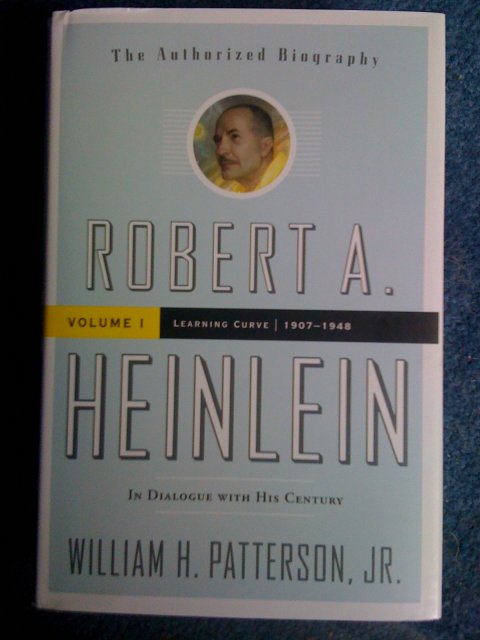 I finished reading the first volume last night, and I can’t wait for volume two. Cory Doctorow summarizes John Clute’s review with his own observations (Clute compared Heinlein’s work to Doctorow’s):
Heinlein was notoriously recalcitrant about his early life and the two wives he was married to before his epic marriage to Virginia Heinlein. He repeatedly burned correspondence and other writings that related to that period. Clute suggests that this is partly driven by Heinlein’s desire to be Robert A Heinlein, titan of the field, without having to cope with his youthful embarrassments. It’s a good bet — lots of the stuff that drives young people to write science fiction also makes them a pain in the ass to be around until they work some of the kinks out of their system (I wholeheartedly include myself in this generalization).
It’s interesting to see his own growth, from his early priggishness (he was nicknamed “the boy general” as a plebe at the Naval Academy) which undoubtedly was not helped by his health issues and tendency to stammer. He was in the shadow of his older brother Rex Ivar for most of his youth, even following him to the Academy three two years later. Rex Ivar was the favourite child in the family and Robert never seemed to be able to do as well in his parents’ eyes as the older boy.
Robert Heinlein was probably a pretty toxic individual as a teenager, based on the evidence Patterson presents — it’s pretty clear even after most of the information was sanitized by Heinlein’s third wife Virginia. Patterson never met Heinlein, and by the time he took on the biography, most of the people who knew Heinlein were fading from the scene. I think he did a very good job with the information available to him, but the biography definitely improves after the Academy years.
Patterson also puts forward a pretty comprehensive case for the idea that Heinlein’s fiction generally conveys Heinlein’s own political beliefs. This is widely acknowledged among Heinlein fans, save for a few who seem distressed by the idea that the blatant racism and sexism (especially in the earlier works) are the true beliefs of the writer at the time of writing and would prefer to believe that Heinlein didn’t write himself into his works. I got into a pretty heated debate with one such person at the Heinlein panel at the 2007 Comicon, who maintained the absurd position that Heinlein’s views could never be divined by reading his fiction — after all, his characters espouse all manner of contradictory beliefs! (To which I replied: “Yes, but the convincing arguments are always for the same set of beliefs, and the characters who challenge those beliefs are beaten in the argument.”) Not that I fault Heinlein for this — it’s an honorable tradition in SF and the mainstream of literature, and I find Heinlein’s beliefs to be nuanced and complex, anything but the reactionary caricature with which he is often dismissed.
It should be no surprise to anyone over 30 that Robert Heinlein’s political and philosophical views changed over his lifetime. This is discussed in some depth in the book, frequently from Heinlein’s own letters to friends at various points. He lost his religious views very early on (if he ever really had them, other than for conforming to familial expectations), and after leaving the Navy he was deeply involved in Upton Sinclair’s EPIC movement.
His belief in world government must have been hard to sustain, given that he had a great deal of experience of the political process, both in Kansas City during the Pendergast years, and in California with EPIC. Corruption, dirty dealing, and backroom bargaining were the way things got done, and it would be hard to believe that things would be better with a single world-wide government.
What seems to have gotten him involved in EPIC was his first-hand experience of poverty and seeing the plight of the “Okies” who’d come to California after the dust bowl wiped out so many farms in the central states. There were not enough jobs for them, even displacing the Mexican migrant labourers, and they were ineligible for state assistance until after they’d been in California for a year. Sinclair appeared to be the only politician with any plan other than oppressing the Okies enough to force them to move on.
Comments Off on Cory Doctorow on the new Robert Heinlein biography
August 13, 2010
Weekend reading material
When I got back from lunch today, the UPS truck had delivered my weekend reading material:
Update: The first fifty pages have been excellent. It’s interesting how many characters in his fiction are recognizably people from his early life in Missouri.
Raise your kid in the Rand-approved manner
Eric Hague would like to assure you that today’s little contretemps was inevitable:
I’d like to start by saying that I don’t get into belligerent shouting matches at the playground very often. The Tot Lot, by its very nature, can be an extremely volatile place — a veritable powder keg of different and sometimes contradictory parenting styles — and this fact alone is usually enough to keep everyone, parents and tots alike, acting as courteous and deferential as possible. The argument we had earlier today didn’t need to happen, and I want you to know, above all else, that I’m deeply sorry that things got so wildly, publicly out of hand.
Now let me explain why your son was wrong.
When little Aiden toddled up our daughter Johanna and asked to play with her Elmo ball, he was, admittedly, very sweet and polite. I think his exact words were, “Have a ball, peas [sic]?” And I’m sure you were very proud of him for using his manners.
To be sure, I was equally proud when Johanna yelled, “No! Looter!” right in his looter face, and then only marginally less proud when she sort of shoved him.
H/T to The Tiger who said “The shove was uncalled for . . . but I’m otherwise with the girl.”
Maybe I should try to find a copy of Eric’s “illustrated, unabridged edition of Atlas Shrugged“. It sounds like great bedtime reading for the kiddies, “glossing over all the hardcore sex parts”.
Comments Off on Raise your kid in the Rand-approved manner
August 11, 2010
Felicia Day talks about making The Guild
More at Fast Company.
Comments Off on Felicia Day talks about making The Guild
iPhone girls are easy
Colby Cosh links to a dating website that actually provides useful photography information:
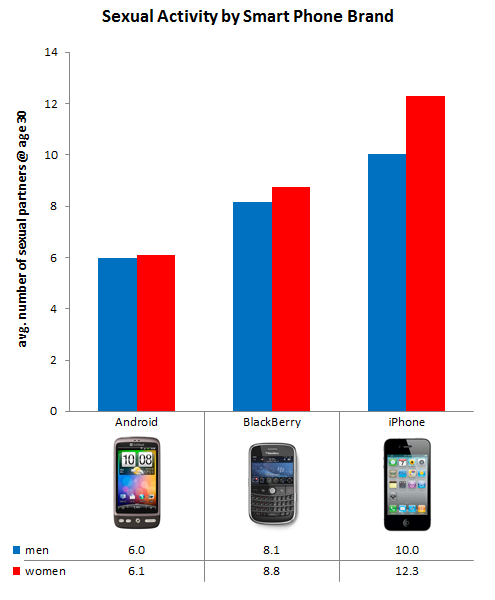
oh, also — iPhone users have more sex.
File this under “icebreakers, MacWorld ’11”. Finally, statistical proof that iPhone users aren’t just getting fucked by Apple:
The chart pretty much speaks for itself; I’ll just say that the numbers for all three brands are for 30 year-olds, so it’s not a matter of older, more experienced people preferring one phone to another. We found this data as part of our general camera-efficacy analysis: we crossed all kinds of user behaviors with the camera models and found we had data on the number of sexual partners for 9,785 people with smart phones.
Okay, I’ve posted the funny bit. The rest of the article actually does have useful photography tips, especially if you’re a user of dating websites.
August 10, 2010
Travel advice for unsettled times
“Gulliver” offers some useful travel tips for people going to dangerous cities:
The first concerns how not be blown up when in Kabul, and comes courtesy of an American TV journalist who was on the course with us. You do not need Kevlar, or night-vision goggles, or an armoured car to evade the Taliban, he said: your secret weapon is to have a jolly good long lie-in every morning. In Kabul, at least, suicide bombs apparently almost always go off early in the morning. Have a leisurely breakfast and, once you venture out after 11am or so, your chances of being killed are drastically reduced. The explanation given was that the bombers spend all night psyching themselves up, then say their prayers at dawn, and go off to murder. A second helping of Corn Flakes could save your life.
The second tip is useful even for those of us who don’t travel to warzones. When booking a hotel, we were told, try to get a room between the second and sixth floors. Being on at least the second floor means you’re a little further away from whatever dangers may lurk near reception: opportunist robbers won’t venture deep into the hotel, and if things get nastier — car-bombs, shootouts and so on — you’re a little further away from the action. So far, pretty obvious.
But why not go above the sixth floor — wouldn’t that be even safer? Apparently not. More likely than a bomb or a shootout is a plain old fire, in which case you will want to make a hasty exit. More storeys mean more stairs and more delay, of course. But the killer, literally, is this: if the stairs are blocked, you will need rescuing from your window by a ladder. And in many parts of the world, the sixth floor is as high as the local fire-engines can reach.
Comments Off on Travel advice for unsettled times
August 9, 2010
Apple execs’ worst fears coming true
Apple has seemed almost ham-handed in their attempts to control the media “storyline” since the iPhone 4 was released. If Eric Raymond is correct in his analysis, Apple will continue to struggle:
Apple’s bid to define and control the smartphone market is going down to defeat. I was going to describe the process as “slow but inexorable”, but that would be incorrect; it’s fast and inexorable. My prediction that Android’s installed base will pass the iPhone’s in the fourth quarter of this year no longer looks wild-eyed to anybody following these market-share wars; in fact, given the trends in new-unit sales a crossover point late in the third quarter is no longer out of the question.
There’s an important point that, so far, all the coverage seems to have missed. You can only see it by juxtaposing the market-share trendlines for both 1Q and 2Q 2010 and noticing what isn’t there — any recovery due to the iPhone 4. This product has not merely failed to recover Apple’s fortunes against Android, it has not even noticeably slowed Apple’s loss of market share to Android.
Forget for now the blunder the trade press has been calling “Antennagate”; I had fun with it at the time, but bruising as it was, it’s only a detail in the larger story. With the iPhone 4, Apple tried to counter the march of the multiple Androids using a single-product strategy, which was doomed to fail no matter how whizbang the single product was. As I predicted would happen months ago, the ubiquity game is clobbering the control game; Apple has wound up outflanked, outgunned, and out-thought.
As I’ve noted before, Apple had been running a very slick, very successful media image-building strategy of coolness and technological sophistication. For several years, they barely put a foot wrong in their complex dance of marketing and public-perception-influencing. When something finally did go wrong, they clearly lacked the ability to respond gracefully and recapture the wavering affections of both the reporters and the readers.
In short, the short-term effect of “antennagate” could have been limited to a one-off glitch: give the punters a free “bumper” for their phones, do it quickly and ungrudgingly, and reap the PR reward for being pro-active and showing that you care for your customers. Instead, the “smartest guys in the room” managed to squander almost all their accumulated goodwill in a few short weeks of bluster, denial, and arrogance. Nice work.
Comments Off on Apple execs’ worst fears coming true
The inevitable decline in public respect for the police
Paul Bonneau examines the declining levels of respect among members of the public for the police:
I’ve gotten the impression lately that cops aren’t getting very much support in Internet forums these days, even in places where in the past you’d find almost unqualified support. About everyone seems fed up with ’em.
I wondered why this should be. Why are they becoming so much more frequently scorned?
[. . .]
I think one reason cops are hated is that people generally don’t like being scrutinized, and put under suspicion for minding their own business; they really, really don’t like that. Cops are always checking you out, looking for a reason to “brace” you (an old meaning of the word that looks very useful these days).
The War on Some Drugs has to cause some hatred, as more and more peoples’ lives are ruined by it. Indeed, this prison industry boondoggle has stained all aspects of the “Justice” system, not just cops.
Another reason is that cops are treated, and see themselves, as superior to the rest of us. In innumerable ways, cops are always given the benefit of the doubt; certainly legally, and also informally — although the latter seems to be fading a bit, as trust in cops fades. They are “The Only Ones”, we are “mundanes”, “proles”, peons. They can lie to us, we can’t lie to them; they can beat us up and torture us, but if we touch them it is “assault”.
Along with this insufferable attitude is a self-regard that what they are about is important and good. I suppose everyone suffers from this malady, but usually it does not impact a person as it does when one runs into a cop in the throes of it. As C.S. Lewis put it, “Of all tyrannies, a tyranny exercised for the good of its victims may be the most oppressive. It may be better to live under robber barons than under omnipotent moral busybodies. The robber baron’s cruelty may sometimes sleep, his cupidity may at some point be satiated; but those who torment us for our own good, will torment us without end for they do so with the approval of their own conscience.” What are cops, if not “omnipotent moral busybodies”? At least when the Mafia runs a protection racket, they don’t deceive themselves they are doing you a benefit. One appreciates the Mafia’s honesty, in comparison.
Comments Off on The inevitable decline in public respect for the police
August 5, 2010
US governments still finding this “free speech” thing annoying
If you support the notion of free speech, it is most important to support it during elections . . . but not everyone feels this way:
The Associated Press reports that California’s Fair Political Practices Commission (FPPC) is considering “how to regulate new forms of political activity such as appeals on a voter’s Facebook page or in a text message.
Not whether to regulate these new forms of political speech, but how.
The recommendations apparently include “requiring tweets and texts to link to a website that includes . . . full disclosures, although some people feel the disclosure should be in the text itself no matter how brief . . . .”
To paraphrase Chief Justice John Roberts, this is why we don’t leave our free speech rights in the hands of FPPC bureaucrats. To bureaucrats like those at the FPPC, the Federal Election Commission or their analogues, there seems to be no need to show any evidence that Twitter, Facebook or text messages actually pose any threat to the public. It is enough that they these new forms of low-cost media aren’t currently regulated, but could be. Their primary concern, apparently, is that the regulation of political speech be as comprehensive as possible.
Free speech can be a messy thing — but censorship is worse.
Examining DNA testing from the client’s point of view
Mary Carmichael is writing a multi-part series about DNA testing:
On July 22, Congress held a hearing on direct-to-consumer (DTC) genetic tests, services that analyze your DNA and interpret the results in exchange for a few hundred bucks — no doctor necessary. The hearing could have been a thoughtful national conversation about science, business, and ethics. Alas, it devolved instead into a series of gotcha moments, starring a General Accounting Office sting operation that came off like a cross between the ACORN videos and the world’s worst ad for snake oil.
Time and again, on tape, an undercover agent called up an unidentified testing company and asked an ill-informed question. (“Is it OK if I stop taking my cholesterol meds and instead take the nutritional supplements you sell? If I can manage to get hold of my fiancé’s saliva without him knowing, will you run it through your machines so I can surprise him with the ‘gift’ of his own data?”) And time and again, the phone rep sank to the occasion and made the company look awful. (Sure, lay off the pills and take our supplements! Of course we’ll analyze your fiancé’s spit without his permission even though that’s illegal, unethical, and weird!)
I listened to the tape several times the day it was released, despairing at the way people were taking advantage of gullible, albeit fictional consumers, which was clearly how the congressmen who held the hearing wanted me to react. Then I started to worry about something else. How much time did I even have left to decide whether I was going to take a test myself? Even before the hearing, the FDA had announced its plans to regulate all DTC genetic tests, possibly so heavily as to keep them off the market; the hearing was just the sort of thing that could push it to move faster. What if, by the time I finally decided if I wanted one of these tests, I couldn’t buy one anymore? My credit card was sitting next to my laptop. I did something that in retrospect seems a bit rash. There’s a DNA-collection kit on my desk now, taunting me — because although I bought the thing, I still can’t decide whether I actually want to use it.
The sheer volume of misinformation on DNA testing — combined with public belief in the amazing accuracy of DNA testing (probably induced by watching too many crime investigation TV shows) — leaves the legitimate companies in an awkward situation. The actual DNA self-tests don’t tell you what you might expect, and can tell you things you don’t want to know. Politicians jumping in now (at the prompting of bureaucrats who want more power to regulate) will only make the situation more confused.
H/T to BoingBoing for the link.
Comments Off on Examining DNA testing from the client’s point of view
August 4, 2010
QotD: Keyshawn keeps his priorities straight
For as much as the network has made fun of Favre over the last couple of years for his decision to keep playing, when he speaks — or texts — people listen, and ESPN became “All Favre All the Time” Tuesday. From 10 a.m. to 4 p.m., almost every minute of coverage was devoted to Favre and, considering that ESPN employs just about as many NFL people as the league itself, it had a variety of people to draw from.
Steve Young thought he would play three or four more years. Mike Golic said the Vikings are a borderline playoff team without Favre and not a Super Bowl contender. Trent Dilfer was “shocked.” Andy Reid said, “I’ve been asked that question once or twice.” Antonio Freeman said he won’t believe it until Sept. 9 when the Vikings play and Favre isn’t there. Mike Ditka said, “He’s a 40-year old 17-year old.” Jon Gruden said he is “one of the toughest human beings to ever walk the planet.” Keyshawn Johnson talked about himself.
John Holler, “With Favre, everyone has an opinion”, Viking Update, 2010-08-04
Comments Off on QotD: Keyshawn keeps his priorities straight
Favre retirement story switches again
Yesterday, the sports news was full of the “Brett Favre is retiring” meme. Today, we’re back to “Of course he’s going to play”. Favre denies having sent any text messages announcing his decision:
Brett Favre told ESPN’s Ed Werder in Hattiesburg, Miss., on Wednesday that he has not made any decision about returning to play for the Minnesota Vikings this season and says he will play if healthy.
Favre’s agent, Bus Cook, said in a statement to the NFL Network on Wednesday that the quarterback has an appointment with Dr. James Andrews next week and will know more at that time. Andrews performed surgery on Favre’s ankle in May.
Favre denied sending text messages to Vikings teammates and club officials that might have indicated he had decided to retire.
Favre told ESPN that he has decided to play for Minnesota in 2010 if his surgically repaired ankle heals but said the fact he has not been able to decide his future reflects his level of concern about regaining his health.
Tarvaris Jackson isn’t the happiest man in Minnesota today (but then again, he probably didn’t take the story seriously yesterday either).
Comments Off on Favre retirement story switches again


