Over at How to be a Retronaut, a couple of examples of very early manipulated photographs, including adding a spare general to a group portrait:
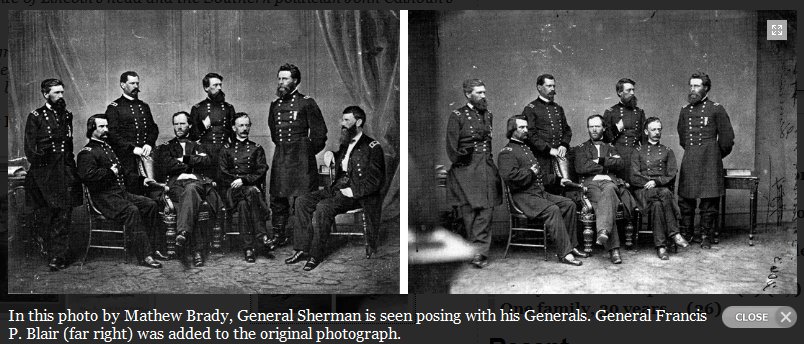

Over at How to be a Retronaut, a couple of examples of very early manipulated photographs, including adding a spare general to a group portrait:
H/T to Mark Frauenfelder for the link.
Either he’s really worried about that ankle, or he’s upset that his intentions are being taken for granted . . . and this will certainly shake things up in the NFC North. Bleacher Report has a quick summary:
Brett Favre began to inform Vikings officials Monday night he will not return for his 20th season, according to the Minneapolis Star-Tribune and Jay Glazer of FOX.
Favre reportedly told teammates and coaches that his ankle has not responded and he doesn’t plan to play this year. Favre is expected to issue a press release later Tuesday and the team hopes he changes his mind.
If the retired-then-unretired-then-re-retired Favre doesn’t change his mind again, the happiest man in Minnesota today is Tarvaris Jackson.
Update: ESPN report:
Update, the second: Of course, for some people this news means that the sad-sack Vikings will be lucky to beat anyone this season. Apparently the only thing that matters for success in the NFL is your quarterback: running backs, wide receivers, offensive line, defence, they’re all immaterial compared to the quality of your quarterback.
H/T to “Inkless” Paul Wells for the link.
Toyota has been claiming for quite some time that they have found no fault in their cars that could cause unintended acceleration. The US government’s report is reported to support that claim, but officials have been delaying the release of that information:
Senior officials at the U.S. Department of Transportation have at least temporarily blocked the release of findings by auto-safety regulators that could favor Toyota Motor Corp. in some crashes related to unintended acceleration, according to a recently retired agency official.
George Person, who retired July 3 after 27 years at the National Highway Traffic Safety Administration, said in an interview that the decision to not go public with the data for now was made over the objections of some officials at NHTSA.
“The information was compiled. The report was finished and submitted,” Mr. Person said. “When I asked why it hadn’t been published, I was told that the secretary’s office didn’t want to release it,” he added, referring to Transportation Secretary Ray LaHood.
A Transportation Department spokeswoman, Olivia Alair, said NHTSA is still reviewing data from the Toyota vehicles the agency is examining. “Its review is not yet complete. The investigation remains ongoing,” she said.
It could be suspected that the reason the government doesn’t want to release the report is that it pretty much exonerates Toyota after their trial-by-media over the sudden acceleration issue. The US government’s holdings in GM and Chrysler make them effectively competitors with Toyota, and the media has done a fine job of trying to depress Toyota sales (to indirectly benefit GM and Chrysler).
But that would be an unfair thing to suspect, wouldn’t it?
More and more, the history of dietary guidelines that our public-health authorities promulgate resembles the Woody Allen comedy Sleeper, in which the main character, awaking from a centuries-long slumber, learns that every food we once thought bad for us is actually good, starting with steak and chocolate. But you wouldn’t know that from government experts’ increasing efforts to nudge us into their approved diets. In 2006, New York City passed the nation’s first ban on the use of trans fats by restaurants, and other cities followed suit, though trans fats constitute just 2 percent of Americans’ caloric intake. Now the Bloomberg administration is trying to push food manufacturers nationwide to reduce their use of salt — and the nutrition panel advising the FDA on the new guidelines similarly recommends reducing salt intake to a maximum of 1,500 milligrams daily (down from 2,300 a day previously). Yet Dr. Michael Alderman, a hypertension specialist at Albert Einstein College of Medicine, observed in the New York Times that because sodium is an essential component of our diets, the city’s effort amounts to a giant uncontrolled experiment with the public’s health that could have unintended consequences. And in 2006, Harvard Medical School professor Norman Hollenberg concluded that while some people benefit from reduced salt intake, the evidence “is too inconsistent and generally too small to mandate policy decisions at the community level.”
Steven Malanga, “Egg on Their Faces: Government dietary advice often proves disastrous”, City Journal, 2010-07
Iowahawk tries to find the right way to introduce the new Chevy Volt (click through to get the full linkulacious glory):
Consider, if you will, Chevy’s once proud musical history: In the Fifties, Dinah Shore famously saw the USA in her Chevrolet. In the Sixties the Beach Boys saved their pennies and saved their dimes for a 4-speed dual quad positraction 409, while Shutting Down a 413 Superstock Dodge with a fuel injected Stingray; Paul Revere and the Raiders countered with a porcupine Chevelle SS 396. Those vatos from War rocked the Seventies gas crisis in an Impala Low-ri-der, while Sammy Johns was alright with makin’ love in his creepy Chevy Van. In the Eighties, the Dead Milkmen sang the praises of a Bitchin’ Camaro; In the Nineties the Ramones further egged it on with Go Little Camaro Go.
Fine iPod selections all, and in praise of a revered American car brand. Now behold — if you dare — the brave new world of government-sponsored Chevrolet song.
Stephen Harper is feeling some of that effect from the millions he put into “infrastructure” projects as part of Canada’s own stimulus plan. You will recall that Ottawa solicited proposals from local governments before handing over the money. Inevitably, a goodly number turned out to be . . . shall we say . . . not entirely crucial, leading to articles like this, pointing out that — oh dear — taxpayers were financing bocce courts via deficit spending. Not to mention sending money to rich people in good neighbourhoods! Even funding for the arts — which Harper was previously criticized for providing too little of — was thrown back in his face as a cheap attempt to correct his earlier gaffe. (If he hadn’t corrected the gaffe, of course, it could have been portrayed as a “continuing snub.” Don’t try to beat the media folks, you can’t win.)
So what’s the lesson here? Politicians should ignore the experts and do what makes people happy, even if it’s unlikely to have much long-term benefit? Politicians should never expect the public to appreciate their efforts unless there’s some kind of individual payoff? Politicians should stay out of the economy, because no one is ever satisfied anyway?
Pick any one of those. Just don’t run for president or prime minister if you want to be popular.
Kelly McParland, “Obama could save America and lose the election”, National Post, 2010-07-29
Colby Cosh linked to this Guardian article, saying “I’m afraid she’s right. ‘Thin’ is something every girl can at least strive for. Only God can make Christina Hendricks.”
When it comes to the ideal female body-shape the pipe cleaner is out, the hourglass is in — or at least it will be if the new equalities minister, Lynne Featherstone, manages to chisel out her will on the perfect body image.
“In the autumn the minister will convene the first of a series of roundtable discussions with members of the fashion industry, including magazine editors, models and advertisers, to discuss how to boost body confidence among the young,” the Sunday Times reported yesterday.
One might think that one of the first steps to boost such confidence might be to abolish school weigh-ins and make puppy fat a normal rite of passage rather than the subject of a health warning via the National Child Measurement Programme. (Can any woman think of anything more likely to have produced a fear of being on the chunky side than turning up to school one morning and being plonked on a set of scales?)
While I’m happy to have any excuse to post a photo of the delightful “YoSaffBridge”, this is another example of Nanny State thinking: (some) women have body image issues, therefore we must spring into action and fix it.
Rather than replacing the old impossible images with new impossible images (as the creative director of Harper’s Bazaar pointed out, the fashion industry exists to create the fantasy you’ll never live up to) an equalities minister should throw out all notions of obsessing about feminine beauty and concentrate on helping young girls think about the size of their achievements rather than the flatness of their navels, and the scale of their ambitions rather than — in Joanie’s case — the rather spectacular power of their bosoms.
BBC News thinks that the much-maligned ASBO may be going away.
Home Secretary Theresa May has signalled the possible end of Asbos in England and Wales, saying it is “time to move beyond” the orders, first introduced by Labour 11 years ago.
They have been imposed on 10-year-old boys and 80-year-old women, used to sober up persistent drunks and mute noisy neighbours.
Of course, one of the more useful aspects of the ASBO has been to allow the media an easy way to find stories to run in the quiet times, like this one:
A 60-year-old man from Northampton was banned from dressing as a schoolgirl.
Peter Trigger’s Asbo stopped him from wearing skirts or showing bare legs on school days between 0830 and 1000 and 1445 and 1600.
The authorities acted after parents complained he was waiting near a primary school dressed in clothes similar to school uniform. He then breached this in December last year by bending over in front of his neighbours repeatedly.
You see, without the ASBO, reporters would have to dig up gems like that themselves, instead of having the local police blotter highlight the most newsworthy items for them.
I often wondered, when reading some of the weird and whacky things that people were hit with ASBOs over, why existing laws weren’t applied (lots of these violations were clearly against the law before ASBOs were created). The intent may have been to give judges more flexibility in sentencing, but in practice it appears to have created a “market” in unusual sentences and distorted the notion of equality before the law.
If you’re not a bit of a word geek, you can safely skip this post. “Johnson” looks at the role of the copy editor:
Having recently had my forthcoming book copy-edited, I jumped right on the link (at Andrew Sullivan) to read Lori Fradkin’s “What It’s Really Like To Be A Copy Editor”. I’d struggled for hours with my manuscript, wondering what to stet and what not to stet, marvelling both at my copy editor’s care and at the confusion she introduced in places. So I was eager to see what Ms Fradkin had to say about the other side of this relationship.
But the experience isn’t quite what he hopes: Ms Fradkin is inclined to a “because the dictionary says so” approach that “Johnson” finds overly restrictive.
This is not to say “everything is right” and to get back into the tired prescriptivist-descriptivist debate. A debate about hyphens or compounds should have something useful to say about language itself. For example, The Economist hyphenates compounds when they are used as modifiers: interest-rate hikes, balance-of-payments crises, and so forth. These aren’t hyphenated when used as nouns. (“Interest rates must go up.”) I like this hyphenation. It helps prevent so-called garden-path misanalysis, by letting the reader know that even though he’s seeing two nouns in a row, they should be understood as a compound modifier, and another noun is coming up. In other words, if someone asked me why I hyphenate “interest-rate hikes”, this is what I’d tell them, and not “Because the style book says so.” The latter answer is worse than wrong; it’s not interesting.
In some cases I might disagree with our style book. I obey it nonetheless, because rulings, even when arbitrary, keep a style consistent, so readers aren’t finding “Web sites” here and “websites” there in the same article. Readers expect and enjoy uniformity as a mark of quality.
. . . now instead of playing the “will I/won’t I” game, he’s tossing out the notion of playing for another decade:
Minnesota Vikings quarterback Brett Favre figured he was “done” playing football at 40 years old immediately after the NFC Championship Game, but now isn’t ready to say whether he will return for 2010, retire — or maybe hang around for another decade.
In an interview published today in USA Today, Favre compared the latest left ankle surgery he underwent 10 weeks ago to “doin’ patchwork on a your truck or lawn mower.
“If you do enough patchwork, eventually you’ve got to a get a new one,” he joked. “Hell, you gotta quit sometime. Then again, maybe I will be doing this when I’m 50 years old, who knows?”
While I expect Favre to decide to play just after training camp breaks (as he’s on record as hating to attend, and arranged to sign with Minnesota at that point last year), I could do without the constant public indecision . . .
Mike Elgan debunks the latest “mind-crogglingly cheap computer for the masses” announcement:
“India unveils $35 computer for students,” says CNN.com. “India unveils prototype for $35 touch-screen computer,” reports BBC News. “India to provide $35 computing device to students,” says BusinessWeek.
Wow! That’s great! Too bad it will never exist. That this announcement is reported straight and without even a hint of skepticism is incomprehensible to me.
[. . .]
India itself doesn’t build touch screens. They would have to be imported from China or Taiwan. The current price for this component alone exceeds $35. Like touch screens, most solar panels are also built in China. But even the cheapest ones powerful enough to charge a tablet battery are more expensive to manufacture than $35.
Plus you need to pay for the 2GB of RAM, the case and the rest of the computer electronics. Even if you factor in Moore’s Law and assume the absolute cheapest rock-bottom junk components, a solar touch tablet with 2GB of RAM cannot be built anytime soon for less than $100.
More to the point, no country in the world can build a cheaper computer than China can. The entire tech sector in China is optimized for ultra-low-cost manufacturing. All the engineering brilliance in India can’t change that.
There’s also the point that government bureaucracies and university engineering departments are not designed for or experienced in the mass production techniques that any of these “ultra-cheap but powerful” computing initiatives all require. Have you ever heard of a government that could keep their hands (and political priorities) out of the critical decision of where this wonder device would be assembled, tested, packed, and distributed? The “industrial policy” wonks would need to get intensely involved in such a decision and the location would have to meet diverse electoral and financial requirements (note that the economics of the project won’t even make the top five priorities in the process).
Awarding the contract to just one area would be unthinkable: the benefits must be seen to be helping areas that elected the current government and emphatically not going to opposition ridings. The horsetrading over that alone would consume any possible price advantage such a scheme might have over ordinary computers and software bought commercially.
Unlike the British class system, which notoriously has three classes, the American system has only two:
. . . the United States today is divided into (a) a ruling class, which dominates the government at every level, the schools and universities, the mainstream media, Hollywood, and a great deal else, and (b) all of the rest of us, a heterogeneous agglomeration that Codevilla dubs the country class. The ruling class holds the lion’s share of the institutional power, but the country class encompasses perhaps two-thirds of the people.
Members of the two classes do not like one another. In particular, the ruling class views the rest of the population as composed of ignoramuses who are vicious, violent, racist, religious, irrational, unscientific, backward, generally ill-behaved, and incapable of living well without constant, detailed direction by our betters; and it views itself as perfectly qualified and entitled to pound us into better shape by the generous application of laws, taxes, subsidies, regulations, and unceasing declarations of its dedication to bringing the country — and indeed the entire world — out of its present darkness and into the light of the Brave New World it is busily engineering.
This class divide has little to do with rich versus poor or Democrat versus Republican. At its core, it has to do with the division between, on the one hand, those whose attitudes are attuned to the views endorsed by the ruling class (especially “political correctness”) and whose fortunes are linked directly or indirectly with government programs and, on the other hand, those whose outlooks and interests derive from and focus on private affairs, especially the traditional family, religion, and genuine private enterprise. Above all, as Codevilla makes plain, “for our ruling class, identity always trumps.” These people know they are superior in every way, and they are not shy about letting us know that they are. Arrogance might as well be their middle name.
In an issue of Granta several years back, Binyavanga Wainaina provided some highly detailed guidelines for western writers to use in their work about Africa. Based on the results, you’d have to say that his guidance has been taken to heart by most novelists, journalists, and television personalities:
Always use the word ‘Africa’ or ‘Darkness’ or ‘Safari’ in your title. Subtitles may include the words ‘Zanzibar’, ‘Masai’, ‘Zulu’, ‘Zambezi’, ‘Congo’, ‘Nile’, ‘Big’, ‘Sky’, ‘Shadow’, ‘Drum’, ‘Sun’ or ‘Bygone’. Also useful are words such as ‘Guerrillas’, ‘Timeless’, ‘Primordial’ and ‘Tribal’. Note that ‘People’ means Africans who are not black, while ‘The People’ means black Africans.
Never have a picture of a well-adjusted African on the cover of your book, or in it, unless that African has won the Nobel Prize. An AK-47, prominent ribs, naked breasts: use these. If you must include an African, make sure you get one in Masai or Zulu or Dogon dress.
In your text, treat Africa as if it were one country. It is hot and dusty with rolling grasslands and huge herds of animals and tall, thin people who are starving. Or it is hot and steamy with very short people who eat primates. Don’t get bogged down with precise descriptions. Africa is big: fifty-four countries, 900 million people who are too busy starving and dying and warring and emigrating to read your book. The continent is full of deserts, jungles, highlands, savannahs and many other things, but your reader doesn’t care about all that, so keep your descriptions romantic and evocative and unparticular.
Make sure you show how Africans have music and rhythm deep in their souls, and eat things no other humans eat. Do not mention rice and beef and wheat; monkey-brain is an African’s cuisine of choice, along with goat, snake, worms and grubs and all manner of game meat. Make sure you show that you are able to eat such food without flinching, and describe how you learn to enjoy it — because you care.
H/T to Gerard Vanderleun for the link.



Powered by WordPress