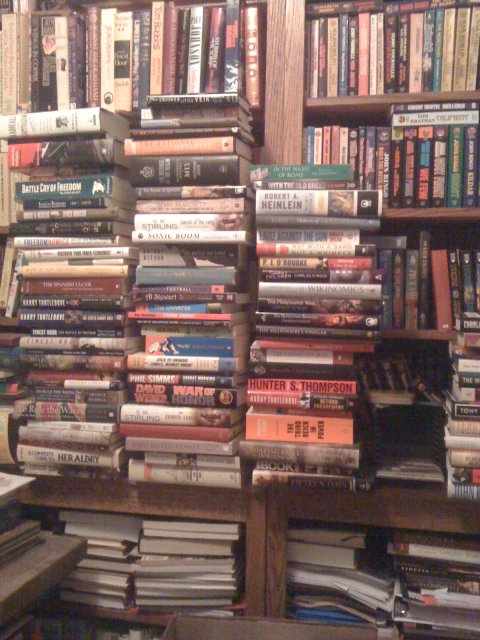
I think I need to build more bookshelves.

I think I need to build more bookshelves.
H/T to BoingBoing.
Michael Blastland thinks there’s a serious issue with how pollsters do their work:
I don’t know about you, but quite often there seems to me only one sensible answer the questions posed in these attempts to canvass opinion: I don’t know.
But that’s not really what I mean. What I really mean is: “it depends”. And for that reason, I might not answer.
Yet the standard way for pollsters to treat people like me is to ignore them.
“Excluding don’t-knows and no answers” say the reports, before telling us that most of us think we should or shouldn’t do this or that. It’s as if the “don’t knows” haven’t been paying attention while the “no answers” don’t care.
Strip out the apathetic and the ignorant and see what’s left, they seem to say.
But isn’t it at least arguable that we’ve thought about it and decided uncertainty is the best response?
Lots of issues don’t fall into easily classified answers, and pollsters often take the easy way out and provide one or two obvious answers (usually tailored to the interests of the commissioning organization, of course), and leave people with a more nuanced view out of the equation.
British police forces may be starting to accept that photography is legal in public spaces, but the Sussex police have come up with a new and sneaky way to get between photographers and their equipment:
According to a statement by Sussex Police: “Under Section 19 of the Police and Criminal Evidence Act [1984], an officer policing the event seized a video tape from a member of the public. Section 23 of the Act states that this can take place in ‘any place’, providing the officer is lawfully there and has reasonable grounds to believe it provides evidence of a criminal offence.
“The officer reasonably believed the tape contained evidence of a protester being assaulted by someone taking part in the march. It has been seized temporarily to ensure that evidence cannot be inadvertently lost or altered and will be returned, intact, to the owner as soon as possible.”
See, the very worst people to leave in charge of the camera or the storage media are the photographers: those people always take photos just to delete them, out of spite. The plod are totally within their rights to confiscate safeguard it, just to preserve the evidence.
Good luck on getting it back in working order, of course.
Update, 9 September: Jane Fae Ozimek updates the original story with a bit of additional information:
The police officer taking the film claimed legal justification under Section 19 of the Police and Criminal Evidence Act 1984, which permits the police to seize film or memory sticks discovered “under lawful search” and where there are reasonable grounds to believe they provide evidence of a criminal offence.
So far, so straightforward. However, under s.14 of the same legislation, police may not remove “special procedure material” of a journalistic nature without a warrant. The question therefore arises whether Williams’ filming efforts, even though he does not describe himself as “a journalist”, is nonetheless of a journalistic nature.
The waters are further muddied by a letter sent out just four days earlier by Andy Trotter, Chair of ACPO’s Media Advisory Group to all Chief Constables. In it, Mr Trotter reminds police chiefs that there are no powers to prevent the public from taking photographs in a public place. Significantly, he goes on: “We must acknowledge that citizen journalism is a feature of modern life.”
“Once an image has been recorded, the police have no power to delete or confiscate it without a court order.”
Update, 10 September: Clarifying the clarification to the declaration, or something. The Register is still on the case:
It would appear that at this point alarm bells started ringing at ACPO HQ, and late yesterday afternoon we received a further communication from ACPO. A spokeswoman told us: “We have clarified our guidance note to forces, however, as this does not affect the legal right of officers to seize photographic equipment in certain circumstances, such as during the course of a criminal investigation.
“While it is the job of police officers to be vigilant, to keep an eye out for any suspicious behavior and to act accordingly, we have been very clear in expressing our view that the taking of photographs is not normally a cause for concern. Whether s.19 PACE was used appropriately in the case in question would ultimately be a matter for Sussex.”
More to the point, Trotter’s freshly updated advice has been re-issued and now reads: “Once an image has been recorded the police have no power to delete it without a court order; this does not however restrict an officer’s power to seize items where they believe they contain evidence of criminal activity.”
For those readers too busy to play compare and contrast, the original guidance stated that the police have no power to confiscate recorded images, whereas the clarified guidance explains that they have. Clear?
Too often, they make you look like a jerk:
The CRTC has nixed the idea of “mak[ing] us all pay” for Fox TV News for now. But a CRTC under a compliant chairman could rubber-stamp whatever sort of licence Quebecor wanted, purely for political reasons, and the Fox News-ification of Canada would be unstoppable. Would that not be outrageous?
Yes. It would be outrageous. I’d sign a petition protesting it. But Ms. Atwood seems to accept this theory as fact. And it isn’t fact. Fact is that the petition is called “Stop ‘Fox News North’ ” and refers to its product as “hate media.” In a particularly astonishing Tweet on Thursday, Ms. Atwood revealed that she hadn’t even realized the Quebecor network wasn’t, in fact, to be called Fox News North! Had she done any due diligence whatsoever?
Anyone who supports Quebecor’s right to beam its product into our homes under reasonable commercial circumstances, as Ms. Atwood claims to, would do well not to sign that petition. It’s clearly opposed to the existence of Sun TV News, not just to the Prime Minister’s hypothetical meddling in the CRTC’s affairs. She’s far from the first celebrity to embarrass herself by blundering headlong and uninformed into politics (an urge that still baffles me). But she could at least own up to the gaffe. Surely it’s not a far-fetched idea that one’s signature beneath a block of text signifies approval of the foregoing.
Because I don’t watch much TV (except for NFL games), I must have missed the mass takeover of American TV by hate mongers. Yet another advantage of avoiding TV watching, I guess.
Stephan Salisbury writes that many “foiled” terror plots could never have become actual threats . . . without government assistance:
Informers have by now become our first line of defense in our battles with the evildoers, the go-to guys in the never-ending domestic war on terror. They regularly do the dirty work — suggesting and encouraging the plots, laboring as bag men to move the money, fashioning the bombs, and eliciting the flamboyant dialogue, even while following the scripts of their handlers to the letter. They have attended to all the little details that make for the successful and now familiar arrests, criminal complaints, trials, and (for the most part) convictions in the ever-distracting war against . . . what? Al-Qaeda? Terror? Muslims? The inept? The poor?
The Liberty City Seven, the Fort Dix Six, the Detroit Ummah Conspiracy, the Newburgh Four — each has had their fear-filled day in the sun. None of these plots ever came close to happening. How could they? All were bogus from the get-go: money to buy missiles or cell phones or shoes and fancy duds — provided by the authorities; plans for how to use the missiles and bombs and cell phones — provided by authorities; cars for transport and demolition — issued by the authorities; facilities for carrying out the transactions — leased by those same authorities. Played out on landscapes manufactured by federal imagineers, the climax of each drama was foreordained. The failure of the plots would then be touted as the success of the investigations and prosecutions.
It’s often been observed that war is the health of the state. Can we now also say that the war on terror is the health of the intelligence agency?
H/T to Bruce Schneier for the link.
I got tagged with this Facebook meme by David Stamper a little while ago, but I’m only now just getting around to addressing it. Here’s the description I was sent:
The rules: Do this if it’s fun. Don’t take too long to think about it. Fifteen albums you’ve heard that will always stick with you. List the first fifteen you can recall in no more than fifteen minutes. Tag fifteen friends, including me, because I’m interested in seeing what albums you choose.
So, because I’m too lazy to do it in Facebook, I’m doing it here (eventually, through the magic of Twitter, the link’ll appear in Facebook anyway). Roughly in chronological order:
I had to take it in chronological order to limit it to only fifteen, so no really recent stuff . . . but perhaps that’s fair as it’ll take time to show if more recent stuff will hold up to long-term listening. Not quite making it onto the list was Sketches of Spain by Miles Davis & Gil Evans.
David Harsanyi loves economists — at least the ones he can quote to support his articles:
[. . .] I can’t seem to get enough of economists who blog about human behavior or write wickedly counterintuitive books about how all the bad things we do are good for society.
Professionally speaking, economists are also vital. Where else are columnists going to find a Ph.D. to corroborate all the gibberish we put in our pieces?
But the most crucial lesson I’ve gleaned from smart men and women who practice the dismal science is this: Those who claim to grasp the vagaries of the economy enough to predict the future with any amount of certitude are charlatans.
The Pogues appear to have a bit of dissent going on:
The Pogues have announced a “farewell tour” for the UK, much to the consternation of their guitarist. Phil Chevron has blasted notices for the goodbye tour, calling it “a marketing ploy” by others in the band. “This claim does not come from me,” he wrote on the group’s website, “and I will neither be supporting it nor discussing it.”
The seven-date tour begins in Glasgow and ends on 21 December in Brixton, with reported Irish gigs earlier in the month. These concerts will close the band’s 28th year, and their ninth since frontman Shane MacGowan re-formed the folk-punk rabble-rousers. But despite the flier’s unequivocal “Farewell Christmas Tour” tag-line, the Pogues don’t exactly seem ready to say farewell.
Not long after Chevron’s grumpy post to the official message-board, bandmate Spider Stacy popped in with a clarification. “This is the last Christmas tour for the foreseeable future,” he wrote. “That’s not to say we won’t be showing up at festivals here and there or maybe even the odd gig around the UK and Ireland and certainly in Europe. But we’re tired of dragging our weary, freezing carcasses around these drowning islands every December, so we’re going to give it a rest before you get tired of it, too. Go and see the Libertines. They’re the best.”
Shows how much attention I’d been paying . . . I thought 1996’s “Pogue Mahone” was the last album they’d recorded, and that they’d pretty much stopped performing. Off to Wikipedia . . .
The Pogues is a band of mixed Irish and English background, playing traditional Irish music with influences from punk rock and folk, formed in 1982 and fronted by Shane MacGowan. The band reached international prominence in the 1980s and early 1990s. MacGowan left the band in 1991 due to drinking problems but the band continued first with Joe Strummer and then with Spider Stacy on vocals before breaking up in 1996. The band reformed in 2001, and has been playing regularly ever since, most notably on the US East Coast every spring (bar 2010) and around the UK and Ireland every December. The group has yet to record any new music and according to Spider Stacy on Pogues.com has no inclination to do so.
That explains it nicely.
Lewis Page rounds up the GM-versus-Tesla ad campaigns of the near future:
As US motor mammoth GM gears up for the launch of its plug-in hybrid Chevrolet Volt, it has applied to trademark the term “range anxiety” — meaning the fear suffered by battery-car owners regarding their ability to get home again after a given journey. Upstart battery car maker Tesla Motors has issued a panicky and unconvincing statement in response.
[. . .]
GM feels that “range anxiety” is a major reason why its original EV-1 battery car of the 1990s failed.
”We’ve been here before,” says GM marketing honcho Joel Ewanick. “We have first-hand experience with what the issues are.”
In short, the difficulty with an all-electric battery car is that there is little certainty of actually being able to complete any journey even close to the vehicle’s rated range, as battery endurance is highly variable — and manufacturers can’t publicise the worst-case (or even perhaps the likely-case) figures. If they did, nobody would ever buy their products.
[. . .]
Meanwhile, reputable Swiss boffins have lately pointed out that in fact a VW Golf powered by one of the new, super-low-emission injected turbodiesels is responsible for less carbon emissions over its lifespan than one with a li-ion battery running on typical grid power.
So, to wrap up the discussion briefly, nobody will be buying Tesla Roadsters or Government Motors Volts for their economic virtues: they’ll be buying them as expensive status-signalling devices to show off their (real or imaginary) environmental awareness.
John Pilger pays “tribute” to one of the more persuasive contributors to both militarism and commercialism of the 20th century:
Edward Bernays, the American nephew of Sigmund Freud, is said to have invented modern propaganda. During the first world war, he was one of a group of influential liberals who mounted a secret government campaign to persuade reluctant Americans to send an army to the bloodbath in Europe. In his book, Propaganda, published in 1928, Bernays wrote that the “intelligent manipulation of the organized habits and opinions of the masses was an important element in democratic society” and that the manipulators “constitute an invisible government which is the true ruling power in our country.” Instead of propaganda, he coined the euphemism “public relations.”
The American tobacco industry hired Bernays to convince women they should smoke in public. By associating smoking with women’s liberation, he made cigarettes “torches of freedom.” In 1954, he conjured a communist menace in Guatemala as an excuse for overthrowing the democratically-elected government, whose social reforms were threatening the United Fruit company’s monopoly of the banana trade. He called it a “liberation.”
Bernays was no rabid right-winger. He was an elitist liberal who believed that “engineering public consent” was for the greater good. This was achieved by the creation of “false realities” which then became “news events.”
Propaganda definitely existed before Bernays, but he may have been the one who codified and systematized the “science”.
As I mentioned a while back, the BBC went to court to try to prevent a book publisher from revealing the identity of Top Gear‘s mysterious race car driver “The Stig”. The court has ruled against the BBC. James May, one of the presenters on the show, had this to say:
“Obviously I’m now going to have to take some legal action of my own, because I have been the Stig for the past seven years, and I don’t know who this bloke is, who’s mincing around in the High Court pretending it’s him.”
Ezra Levant isn’t amused by some US businesses trying to make political statements by slagging Alberta’s oilsands while being less than clean themselves:
Walgreens is the largest pharmacy chain in the U.S.
It’s also corrupt.
For years, they secretly altered their customers’ prescriptions, without their doctor’s knowledge, in a giant insurance scam across 42 states. They targeted Medicaid, the program for low-income Americans. So they were stealing from taxpayers and the poor at the same time. That kind of big thinking is why Walgreens is number one.
Walgreens replaced inexpensive drugs with drugs that were up to four times more costly. Only when an honest pharmacist finally blew the whistle on them were they stopped — and fined a whopping $35 million.
Are you ready to take moral lessons from Walgreens? Because they’ve just announced that they’re switching their trucks to fuel that doesn’t come from Canada’s oilsands — as an ethical statement.
Taking ethical guidance from Walgreens is sort of like taking abstinence lessons from Hugh Hefner.
I’d call for a boycott of Walgreens, but they don’t have any stores in Canada (and, despite their name, they are no relation to Walmart).
But Walgreens isn’t the only moral hypocrite to come out against Canada. So did The Gap, which also owns Banana Republic and Old Navy.
Do yourself a favour: Don’t buy their clothes.
This report should come as no real surprise to anyone who’s been paying attention:
The two biggest highway-safety issues right now, as far as Washington is concerned, are runaway Toyotas and distracted driving. But what if these aren’t the most important factors driving the nation’s annual highway death toll, which averages about 100 fatalities a day?
That’s the view of Adrian Lund, president of the Insurance Institute for Highway Safety, who says the U.S. Transportation Department, Congress and the media have gotten sidetracked by issues like texting while driving.
“There’s nothing rational about the way we set highway safety priorities,” Mr. Lund says in the Insurance Institute’s Aug. 21 “Status Report” newsletter.
Mr. Lund’s organization is the safety research and advocacy arm of the insurance industry. The IIHS has been critical of the government’s highway safety policies over the past few years, usually arguing that the government wasn’t moving fast enough to require better crash-prevention technology from auto makers.
Mr. Lund and the Insurance Institute also say recent laws banning motorists from using mobile phones behind the wheel don’t correlate with a significant reduction in accidents.
“You’d think from the media coverage, congressional hearings, and the U.S. Department of Transportation’s focus in recent months that separating drivers from their phones would all but solve the public-health problem of crash deaths and injuries,” he wrote. “It won’t.”



Powered by WordPress