
Quotulatiousness

November 24, 2010

Sexting . . . or was it attempted extortion?

Filed under: Football, Law, Media — Tags: , , — Nicholas @ 15:02

A report at Viking Update may explain why the NFL’s investigation into the Favre-Sterger “sexting” situation has taken so long:

Reese told The Associated Press that he called Bus Cook, Favre’s agent, to let him know about an Internet story — first thrown out by Deadspin.com — that was going to purport that lewd photos had been sent by Favre to Sterger. Apparently, Reese was doing a pre-emptive professional courtesy.

However, Reese said that Cook’s response was to ask “if there was a specific figure that could make this go away.”

Asked about that, Cook responded with a statement claiming that Sterger’s manager and lawyer have made “numerous overtures to me” — claiming six such calls between the two of them. Cook said there was never any intention of paying them because there is no reason to pay them, adding that “their attempts to negotiate privately and through the media have failed.”

If it can be proved that Sterger’s people were seeking out some form of cash settlement, extortion is a crime that is investigated and prosecuted. It would seem the truth lies somewhere in between the polar opposite stories being told by the agents. But, if there is a case of hush money being thrown around or blackmail being requested, this story may have more legs than anyone could have imagined.

I had wondered why the NFL’s investigation — which should have occupied a few days at most — still hasn’t come to any conclusions.

Geek Speak interviews Lois McMaster Bujold

Filed under: Books, Media — Tags: , — Nicholas @ 13:08

If you haven’t read Cryoburn, be warned that there are some spoilers in the interview (this excerpt is spoiler-free):

I would have been content to leave the series on the high note of A Civil Campaign, but in the course of the amicable negotiations involved in taking The Curse of Chalion elsewhere, I ended up with an option-filling contract with Baen Books, hence Diplomatic Immunity. For a time, I wasn’t sure if I would alternate books between the two publishers or not, but I got on rather a roll with the fantasies for Eos. Happily, I was able to come up with a second upbeat organic closure for the series with Diplomatic Immunity, after which I turned to Paladin of Souls. (For a while, I had the two Chapter Ones on my plate at the same time, which basically resulted in nine months of writer’s block, at which point I decided to just do Diplomatic Immunity first. Some fortunate, prolific writers seem to be able, efficiently, to keep several projects going at once; it appears I am not one of them.)

[. . .]

The notion of exploring the wider social implications of cryonics, a well-established technology in the series, had been kicking around in my head for at least fifteen years. And the vision of an opening scene where a drug-allergy-addled Miles has a hallucinatory meeting with a street kid, no further story or setting attached, had also been lurking for a long time. (On some level, I think this unanchored scene was a really twisted re-visioning of the opening of Heinlein’s classic Citizen of the Galaxy.) I put the two together, and suddenly hit critical mass. Thematic implications followed.

[. . .]

Ethnic diversity has always been out there; all the colony worlds in Miles’s universe (i.e., everyplace but Earth) are much shaped by their founder populations. We’ve only seen a handful, out of a supposed sixty to one hundred settled worlds/stations/systems; I just haven’t worked around to all the possibilities. (Readers keep wanting me to go back to Vorbarr Sultana, where all their friends are. It’s as frustrating as trying to take a teenager on vacation.)

And for those Vorkosiverse fans hoping for yet another fix after Cryoburn, be of good cheer: Lois is working on a new project with the working title Ivan: His Booke (no, that’s not what it’ll end up being published as).

November 23, 2010

Succinct summary of Irish situation

Filed under: Economics, Europe, Humour, Media — Tags: , , — Nicholas @ 09:08

From Andrew Bloch’s Twitpic page and brought to my attention by Damian Penny.

QotD: “Shut up and be scanned”

Filed under: Bureaucracy, Law, Liberty, Media, Quotations, USA — Tags: , , , — Nicholas @ 08:59

More on your authoritarian media . . .

Earlier today, my colleague Matt Welch ran off a list of newspaper editorial boards who are lining up behind TSA. The headline to this post is the actual headline from the L. A. Times’ editorial. Given such cowardice about defending civil liberties in the face of hysterical hand-wringing about national security, I was going to post a snarky comment about how the L.A. Times would probably have told Japanese-Americans to “shut up and report to your internment camp” back in 1942, too.

Then I did some Googling, and discovered that the paper pretty much did exactly that. As did a number of other papers.

Radley Balko, “Shut Up and Be Scanned”, The Agitator, 2010-11-22

A Whedon-less reboot of “Buffy”

Filed under: Media — Tags: , — Nicholas @ 08:42

The good news: they’re talking seriously about doing a cinematic reboot of “Buffy the Vampire Slayer”. The bad news: Joss Whedon won’t be anywhere near it:

Joss Whedon, who created Buffy for the original 1992 film and subsequently guided her to TV success, will play no part in the project.

Although Whedon wrote, produced and directed the hit TV series, he apparently does not own the film rights. He told E! Online: “There is no legal grounds for doing anything other than sighing audibly.”

Anderson is aware that in Whedon’s absence, “the most devoted fans of the old series will be keeping a skeptical eye on this nascent revival – and sharpening their wooden stakes”.

She assured the LA Times, though, that she’d “take the touchstones of the Whedon world but frame them in ‘a new story’ that is very much of the moment”.

November 22, 2010

“Anti-racism” is not the same as being opposed to racism

Filed under: Britain, Liberty, Media, Politics — Tags: , , — Nicholas @ 09:33

Ed West responds to reader complaints about a recent column:

The conventional definition of racism is the belief that “race” (however one defines that) is a primary or significant cause of differences between men; that some of these races are superior to others; and that it is acceptable to discriminate on grounds of race, or to behave unpleasantly to someone because of their race. The term dates to the 1930s, although “racialist” and “racialism” go back to the Edwardian period.

“Anti-racism” means something altogether different, and is best explained by the Civitas book Racist Murder and Pressure Group Politics, an account of the Salem-like events that gripped Britain in the 1990s. The authors cite the example of the Central Council for Education and Training in Social Work (CCETSW), which in 1991 set out the implementation of its new Diploma in Social Work.

The first tenet was “the self-evident truth” that “racism is endemic in the values, attitudes and structures of British society”.

The training manual then stated “steps need to be taken to promote permeation of all aspects of the curriculum by an anti-racist analysis”. All “racist materials” had to be withdrawn from the syllabus and CCETSW would decide what was racist.

In the rules there would be no freedom of speech for opinions that can be constructed as “racist” or favourable to “racism”, and “anti-racist practice requires the adoption of explicit values”. The first value is that individual problems have roots in “political structures” and “not in individual or cultural pathology”. (In other words, if different groups have different outcomes in terms of education or crime levels, it is all the fault of British racism, not of individuals).

A second value is that racial oppression and discrimination are everywhere to be found in British society, even when invisible. In other words, impossible to disprove!

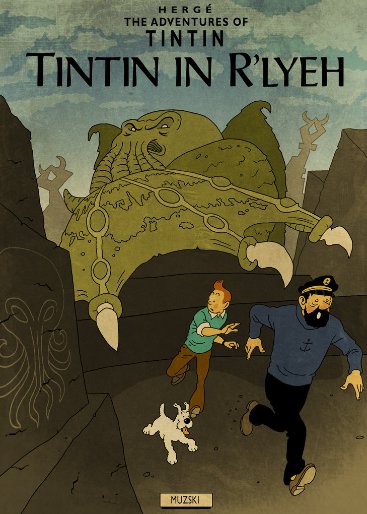
Tintin adventures I’d like to read

Filed under: Books, Humour, Media, Randomness — Nicholas @ 09:24

Murray Groat illustrated some covers to Tintin adventures that don’t, but should, exist:

H/T to BoingBoing.

November 21, 2010

He comes not to bury Twitter, but to praise it

Filed under: Media, Technology — Tags: , , , , — Nicholas @ 12:00

Linked from one of Walter Olson’s Twitter updates, an interesting summary by Alan Rusbridger on the things that Twitter does for media folks:

I’ve lost count of the times people — including a surprising number of colleagues in media companies — roll their eyes at the mention of Twitter. “No time for it,” they say. “Inane stuff about what twits are having for breakfast. Nothing to do with the news business.”

Well, yes and no. Inanity — yes, sure, plenty of it. But saying that Twitter has got nothing to do with the news business is about as misguided as you could be.

Here, off the top of my head, are 15 things, which Twitter does rather effectively and which should be of the deepest interest to anyone involved in the media at any level.

There are lots of people who send Twitter updates on what they made for dinner, or what they’re watching on TV, but you don’t have to follow them. I’ve been amazed at how useful Twitter has been to me for keeping on top of what I think of as “blogfodder” items: things that I think my own readers would be interested in.

November 20, 2010

The use of glamour to advance weak economic ideas

Virginia Postrel highlights the power of glamour even in technical and economic arguments:

When Robert J. Samuelson published a Newsweek column last month arguing that high-speed rail is “a perfect example of wasteful spending masquerading as a respectable social cause,” he cited cost figures and potential ridership to demonstrate that even the rosiest scenarios wouldn’t justify the investment. He made a good, rational case — only to have it completely undermined by the evocative photograph the magazine chose to accompany the article.

The picture showed a sleek train bursting through blurred lines of track and scenery, the embodiment of elegant, effortless speed. It was the kind of image that creates longing, the kind of image a bunch of numbers cannot refute. It was beautiful, manipulative and deeply glamorous.

The same is true of photos of wind turbines adorning ads for everything from Aveda’s beauty products to MIT’s Sloan School of Management. These graceful forms have succeeded the rocket ships and atomic symbols of the 1950s to become the new icons of the technological future. If the island of Wuhu, where games for the Wii console play out, can run on wind power, why can’t the real world?

Policy wonks assume the current rage for wind farms and high-speed rail has something to do with efficiently reducing carbon emissions. So they debate load mismatches and ridership figures. These are worthy discussions and address real questions.

But they miss the emotional point.

I guess it’s a sign of weakness for the economic folks that they don’t realize how much of the battle for public support can rest on non-economic factors. You might be able to win all the technical battles, but it’s often the emotional factors that determine victory overall.

JourneyQuest, Episode 1

Filed under: Gaming, Humour, Media — Tags: — Nicholas @ 01:17

H/T to Ghost of a Flea for the link. There are several episodes available, so do follow along. The first episode is a bit slow, but it picks up nicely in later episodes.

November 18, 2010

QotD: On the quality of writing, mediated through technology

Filed under: Humour, Media, Quotations, Technology — Tags: , , , — Nicholas @ 08:45

I own a computer. I don’t use the Internet very much. I’m not a technophobe. It just doesn’t help me very much. Writing is a slow and a difficult process mentally. How you physically render the words onto a screen or a page doesn’t help you. I’ll give you this example. When words had to be carved into stone, with a chisel, you got the Ten Commandments. When the quill pen had been invented and you had to chase a goose around the yard and sharpen the pen and boil some ink and so on, you got Shakespeare. When the fountain pen came along, you got Henry James. When the typewriter came along, you got Jack Kerouac. And now that we have the computer, we have Facebook. Are you seeing a trend here?

P.J. O’Rourke, “Very Little That Gets Blogged Is Of Very Much Worth”, Radio Free Europe/Radio Liberty, 2010-11-18

November 15, 2010

New on A&E: Psychics with Serious Mental Illnesses Hunting Hitler’s Ghost While Driving A Big Truck with Their Freakish Family

Filed under: Media, Randomness, Science — Tags: , , , — Nicholas @ 00:32

Another link from Chris Myrick: Bad move, A&E.

The A&E Channel has a new show coming up: Psychic Kids: Children of the Paranormal. Sounds awful already, doesn’t it? But it’s worse than you think: they’re looking for disturbed kids who think they’ve got magic powers, and then they’re flying in “professional psychics” to coach them in dealing with their awesome powers, i.e., indulge their delusions, get off on feeling superior to unhappy kids, and collect a paycheck for psychic child abuse.

They’re putting kids in the hands of a creepy skeevo like Chip Coffey, all for your entertainment.

This is quite possibly the most loathsome thing I’ve ever seen on TV, and my cable gives me access to the Trinity Broadcast Network, so that’s saying a lot.

Skepchicks are mobilizing the skeptic hordes. Call or write to A&E and let them know that their schlock has reached a new and despicable low.

November 14, 2010

Life replicates art, kinda

As one of the comments on this article in The Cord points out, it’s highly ironic that “at a speech about a book detailing how the police did nothing to uphold the laws of the land the university did exactly the same thing.”

What was scheduled as a speech by Globe and Mail columnist Christie Blatchford turned sour tonight as protesters opposing the journalist’s new book Helpless: Caledonia’s Nightmare of Fear and Anarchy, and How the Law Failed All of Us took over the stage.

Three protesters locked themselves together at the centre of the stage where Blatchford was meant to speak at the University of Waterloo’s (UW) Humanities Theatre in Hagey Hall, with another individual acting as their “negotiator”. A fifth, Tallula Marigold, acted as the group’s media representative.

“We don’t want people who are really, really racist teaching [the people we love],” said Marigold of Blatchford. “And we don’t want that person to have a public forum because it makes it dangerous for others in the public forum.”

If nothing else, the passion of the protesters has persuaded me that I must buy and read Blatchford’s latest book . . .

Well, give them partial credit for their answer . . .

Filed under: Liberty, Media, Technology — Tags: , , — Nicholas @ 11:33

Another article where the headline really carries the whole story:

WSJ Warnings About Privacy-Invading Cookies Carry Privacy-Invading Cookies
Can you move this one to the ‘Irony’ section?

The Wall Street Journal posted a story yesterday about the Obama administration’s plan to add a privacy watching task force to evaluate rules on cookies, metacookies, flash cookies and all the other online threats to consumer privacy.

[. . .]

Of the threatening, deletion-resistant Flash cookies they revealed on in my browser, tracking my trip over to the NYT to read more: two from the Wall Street Journal.

November 13, 2010

Train movies, and movies with trains

Filed under: Media, Railways, Randomness — Tags: — Nicholas @ 12:17

Donald Liebenson at Armchair Commentary has a large (but probably not complete) list of films about or featuring trains:

“Everybody loves the sound of a train in the distance,” Paul Simon sings, “Everybody thinks it’s true.” There’s nothing truer. Nothing pierces the heart like a lonesome train whistle. Nothing holds the promise of mystery, romance, and adventure like a train bound for somewhere. That thundering locomotive in the kick-ass trailer for Unstoppable looks like it’s bound for trouble. While waiting to see if Denzel Washington and Chris Pine can avert disasters in their path, let’s take a scenic journey aboard some of the most memorable movies in which trains played scene-stealing roles. (The Polar Express is not on this list. Those dead-eyed children give me the creeps).

H/T to Jeff Shultz for the link.

« Newer PostsOlder Posts »

Powered by WordPress


