Quotulatiousness

August 12, 2011

“The riots have confirmed … the gaping chasm between Britain’s elites and its white working-class natives.”

Filed under: Britain, Law, Media, Politics — Tags: , , , — Nicholas @ 12:30

The problem, according to the governing class, is not the rioters — it’s the people who want to stop the rioters:

And so it has been this week, which kicked off with reckless rioting by multi-ethnic yoof in inner-city patches, yet which ended, bizarrely but at the same time predictably, with an orgy of elite handwringing about those non-rioting white working classes who haunt London’s suburbs. That some of ‘these people’ dared to patrol their streets, to set up miniature citizen armies to see off the chancers and tricksters of the looting lobby, has been treated as the No.1 threat now facing Britain. They are a ‘white mob’, we are told, who could precipitate a ‘race war’. According to the deputy mayor of London, Kit Malthouse, their community-protection antics are ‘deeply undesirable’. Come on Kit, you can say it: you think these people are ‘undesirables’.

This riotous week has confirmed that the great and the good of Great Britain don’t have much in the way of a shared morality anymore. At the start of the week, the political class, cops and Fourth Estate all proffered various explanations for the youthful violence, often pointing the finger of blame at each other in a moral stand-off not dissimilar to the final scene in Reservoir Dogs. Yet by Friday they were tentatively re-linking arms around the one thing they agree on: that there is nothing scarier — nothing — than the sight of 100+ white blokes on the streets, shouting things in those gruff voices they have. You may have looked at the groups of men in Enfield and Eltham and seen working people keen to protect their homes and shops, but the upper echelons of society, through their snob-goggles, saw the emergence of an English version of the Third Reich — they saw ‘race hate’ and ‘fascists patrolling the streets’.

[. . .]

Note to the cultural elite: Just because someone is white and possibly a labourer and not currently glued to the American remake of The Killing, that doesn’t mean he is a fascist. The police’s PR assault on the ‘vigilantes’ in Enfield and Eltham, suburbs with large white working-class communities, shows that what the cops lack in riot-tackling skills they more than make up for with shamelessness. This is a force so paralysed by risk-aversion, so witlessly scared of provoking controversy, that this week it effectively stood back and allowed young people to loot shops, burn cars and destroy homes. It seems that in the morally inverted world of the modern police, such destruction is a price worth paying if it means their own officers don’t get a graze or PTSD. Upon what moral authority is the Met now telling working people not to patrol their communities? Cops bussed into a suburb might consider it acceptable to allow youth to smash things up in the hope that they’ll eventually tire, but for the people who live in those suburbs, who have a moral, emotional and economic attachment to them, that really isn’t an option. It takes brazenness to a brand new level for a state which failed to police the streets to libel those citizens who decided to do it for themselves.


Why Obama is being attacked from the left

Filed under: Economics, Media, Politics, USA — Tags: , , , , , — Nicholas @ 12:12

Victor Davis Hanson outlines the reasons for increasing attacks on President Obama and his administration from his erstwhile allies on the left:

Politics, of course. The combination of sinking polls to the near 40% range, the stock market nosedive, the Standard and Poor’s downgrade, the tragedy in Afghanistan, the confusion over Libya, the embarrassing golf outings and First Family insensitive preferences for the aristocratic Martha’s Vineyard, Vail, and Costa del Sol have contributed to a general unease on the Left about Obama’s judgment, perhaps to the extent that he might well take the Left down in 2012, both in the House and Senate, whether he wins reelection or not.

But the argument remains incoherent: Obama is being blamed for not being liberal enough — after federalizing much of the health care delivery system, expanding government faster than at any time since 1933, borrowing more money in two and a half years than any president in history, absorbing companies, jawboning the wealthy, going after Boeing, reversing the order of the Chrysler creditors, adding vast new financial and environmental regulations, appointing progressives like a Van Jones or Cass Sunstein, and institutionalizing liberal protocols across the cabinet and bureaucracy, from the EPA to the Attorney General’s Office.

In other words, there is now an elite liberal effort to disentangle Obama from liberalism itself, and to suggest that his sagging polls are not a reflection of Obama’s breakneck efforts to take the country leftward — but either his inability or unwillingness to do so!

Partly, the disappointment is understandably emotional. Just three years ago Obama was acclaimed as a once-in-a-lifetime prophet of liberalism, whose own personal history, charisma, teleprompted eloquence and iconic identity might move a clearly center-right country hard leftward where it otherwise rarely wished to go.

Partly, the anger is quite savvy: if one suddenly blames Obama the man, rather than Obama the ideologue, then his unpopularity is his own, not liberalism’s. There is a clever effort to raise the dichotomy of the inept Carter and the politically savvy Clinton, but in the most improbable fashion: Clinton supposedly was a success not because he was personable, sometimes compromising, and often centrist, and Carter was a failure not because he was sanctimoniously and stubbornly ideological, but just the opposite: Clinton is now reinvented as the true liberal who succeeded because of his principled leftwing politics; Carter like Obama was a bumbling compromiser and waffler.

August 11, 2011

NPR’s top 100 SF and Fantasy titles

Filed under: Books, Media — Tags: — Nicholas @ 13:22

They’ve tallied more than 60,000 votes from their fans on top science fiction and fantasy books. The rankings are a bit odd, in that they include votes for groups of books as well as votes for individual books from various series.

Given the voters were self-selected from among those who either listen to NPR or were directed to the voting by people who do, there were a few surprises in the results, like finding Robert Heinlein’s Starship Troopers clocking in at #31 and The Moon Is A Harsh Mistress at #34 (Stranger In A Strange Land at #17 was less surprising).

There were a few books I’ve never even heard of, like The Kingkiller Chronicles, by Patrick Rothfuss at #18 and The Mistborn Series, by Brandon Sanderson at #43.

I think it’s a pretty fair list overall, although I’d quibble about some of the individual rankings. On a quick count, I’ve read 16 of the top 20 (but only 50 of the entire list).

You have to wonder why it took them this long

Filed under: Law, Media, Technology — Tags: , , , , — Nicholas @ 12:20

The New York City police department announced that it’s setting up a group to monitor Facebook, Twitter, and other social media in order to detect criminals who are stupid enough to boast about their crimes online:

According to The New York Daily News, freshly-appointed assistant commissioner Kevin O’Connor — styled as the NYPD’s “online and gang guru” — will head the new unit, which will trawl Web 2.0 for information on “troublesome house parties, gang showdowns, and other potential mayhem”.

The idea is to pinpoint net-savvy un-savvy juveniles who divulge their criminal plans on the web or boast about crimes already committed. You might think of them as Idiots 2.0.

In his former post with a north Manhattan gang unit, O’Connor apparently tapped the net for vital information on “a number” of shooting cases. In March, the Daily News says, the NYPD nabbed an eighteen-year-old who was part of a fatal beating after he boasted about the killing on Facebook.

August 9, 2011

To every action, there’s a reaction

Filed under: Britain, Law, Media — Tags: , , , , — Nicholas @ 09:34

The rioters in Toronto and Vancouver were frequently caught on camera, and the photos were posted on the various photoblogging sites. Many people were identified this way, and some of them were charged as a result. Londoners are responding in the same way, with sites like http://catchalooter.tumblr.com/ where photos are being posted from the last few nights’ mayhem.


Every action does have a reaction, though, as rioters and even “innocent bystanders” are becoming more likely to attack anyone with a camera. This means a much greater risk for would-be citizen journalists (and professional journalists), as the police generally try to surround and contain mobs (when they don’t just evacuate altogether, of course). If someone in the mob decides that you’re “the enemy”, you won’t have much support — don’t risk your life just to get a “good shot”.

Update: Speaking of police unwillingness to protect civilians, there’s this account:

Cypran Asota, who has run the Boots opticians for 25 years, told the London Evening Standard how he watched as the shop was destroyed.

He said police stood by yards away, adding: ‘White boys ripped off the shutters, then a group of around eight or nine children went in and stole the day’s takings.

‘I ran back over the road to plead with them, this is my livelihood and I have to protect it, but they kept coming back in. They must have got away with £15,000 worth of frames. My insurance doesn’t cover acts of terrorism.

‘All the time the police were about 15 yards away, just watching. They didn’t do anything to stop it. They looked more scared of those kids than I was.’

Shopkeeper Shiva Kadih, 39, told the Standard he had ‘nothing left’ as witnesses said they prevented an attempt to burn down the shop as police watched nearby.

Fish. Barrel. Bang

Filed under: Books, Humour, Media — Tags: , , — Nicholas @ 08:16

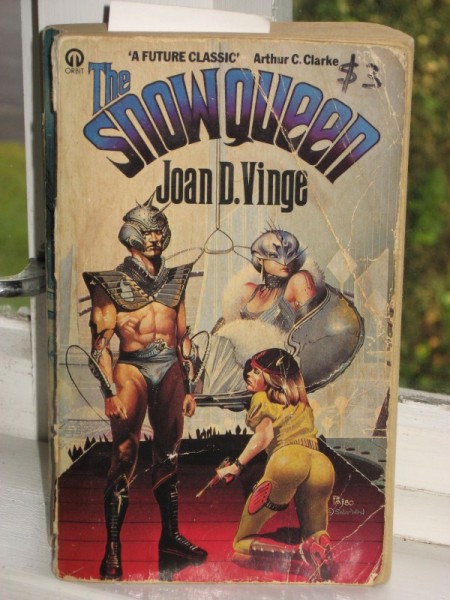
If you’ve never seen these god-awful science fiction book covers, you’ll quickly understand why this website will have a long, long list of candidates for mockery:

Kelly Comments: Considering that later editions have an absolutely gorgeous cover by Michael Whelan, I’m always a bit horrified to see the travesty on my own copy of the book. It looks like a poster for some kind of low-budget 70s bondage. My poor eyes!

H/T to Lois McMaster Bujold, who said “SF covers more dire than my own. Some of these even make me feel better . . .”

August 8, 2011

China discovers that “You can’t stop the signal” again

Filed under: China, Government, Media, Technology — Tags: , , , , , — Nicholas @ 12:32

Strategy Page looks at the way news was disseminated about the high speed rail crash despite the Chinese government’s attempts to quash the story:

Since July 27th, China got another reminder that it no longer can control the news. On July 27th, China’s high-speed “bullet train” had a fatal accident, leaving over 30 dead and many more injured. The cause was inadequate safety and communications systems. In this case, one train was halted by a flaw in the signalling system and another came up from behind and there was the collision that sent four train cars off the tracks, and a bridge. The government immediately tried to keep the accident out of the news. This effort failed because of the ingenuity of Chinese Internet users, despite the government ban on Twitter in China. The ban was meant to impede the rapid spread of news the government wanted to control. Given enough time, the state controlled media could get out a story the government could live with. But blog, RSS and other Internet tools have been tweaked to do the same thing Twitter does. This was especially true of “micro-blogs” that quickly distribute the same 140 character messages Twitter does. Not as well, but good enough, and the news the government wanted to control spread uncontrollably. This included pictures and video of the accident, which the government planned to keep out of the news.

August 1, 2011

QotD: Redefining guilt

Filed under: Law, Liberty, Media, Quotations — Tags: , , , — Nicholas @ 11:33

I’m aware that Obama, Napolitano, the Southern Poverty Law Center, and a host of organized collectivists have been working hard for a long time to defame and smear everything and everybody that once made this nation great. They want as many of its people as possible to believe that knowing the Constitution, or calling upon its provisions at need, is as good as a criminal act. I have been concerned that in television dramas from CSI, through NCIS, to Castle, whenever the accused demands to see a lawyer, it’s considered a confession of guilt.

L. Neil Smith, “Madison’s Ghost”, Libertarian Enterprise, 2011-07-31

July 31, 2011

Another book to add to the “to be read” pile

Filed under: Books, Economics, History, Media — Tags: , — Nicholas @ 18:00

From the current issue of Reason, a review of a pair of new books on the concept of “empire”:

The Rule of Empires, by the Washington University historian Timothy Parsons, explores the fundamental contradictions of imperial rule, making the case that empires have become increasingly difficult to maintain as potential subjects’ identities have become less fluid and more nationalistic. In Merchant Kings: When Companies Ruled the World, 1600–1900, the independent historian Stephen Bown takes a less systematic approach to the study of imperial power, but his book supplements Parsons’ by filling in the biographical details of the men who built Europe’s modern commercial empires. Both books demonstrate that while empire may seem a quick route to power and wealth, in the long run the idea is a military and financial loser.

[. . .]

Empires throughout history have claimed “to rule for the good of their subjects,” Parsons maintains, but this “was and always will be a cynical and hypocritical canard. Empire has never been more than naked self-interest masquerading as virtue.” To keep resources flowing from subjects to rulers, empires must walk a tightrope between subjugation and assimilation. If the state imposes draconian laws and taxes, it will face rebellion, so the rulers must seek out collaborators among their subjects who will assist in the domination of their fellow citizens. In return, collaborators are frequently brought into the imperial fold and given a portion of the spoils. But this leaves the empire vulnerable to conquering from the inside out, with many masters and few servants.

[. . .]

Empire building typically falls under the purview of governments, but in the 17th through 19th centuries, European states outsourced imperial conquest to quasi-private joint-stock companies. Governments granted these companies monopoly trading rights in distant regions and frequently offered their military might to ward off potential rivals. States rarely intended for the companies to become independent imperial powers, but the potential spoils of conquest proved hard for company officials to resist. After all, they had been freed from the discipline of competition, they were thousands of miles from political oversight, and their military risks were socialized by their state sponsors. As Bown points out in Merchant Kings, the EIC and similar corporations “were less the product of free-market capitalism than the commercial extension of European national wars and struggles for cultural and economic supremacy. They occupied the muddy grey zone that exists between government and enterprise.”

I’ve been looking for a good (recent) history of the East India Company for the last several months, so Merchant Kings sounds like it’d be of interest.

Is it time to update this to “16 (trillion) tons”?

Filed under: History, Media, USA — Tags: , — Nicholas @ 17:44

H/T to Gerard Vanderleun.

July 30, 2011

Penn Jillette on his new book, and other experiences

Filed under: Books, Humour, Media, Religion — Tags: , , — Nicholas @ 11:53

Video GamesE3 2012AOTS Exclusive

July 29, 2011

Boomer bashing: how the idea evolved

Filed under: Economics, History, Media — Tags: , , , , , , — Nicholas @ 10:20

Frank Furedi looks at the evolution of the “bash the boomers” meme, and how it differs from more traditional generational conflict:

Gone are the days when the baby boomers were perceived as the personification of a relaxed but enlightened 1960s live-and-let-live lifestyle.

This cohort of people, generally defined as those born between 1945 and 1965, are globally pathologised as the source of most forms of economic and environmental distress. Constantly accused of living way beyond their means, the baby boomers are blamed for depriving the young of opportunities for a good life. They are condemned for thoughtlessly destroying the environment through their mindless pursuit of material possessions and wealth, as well as resisting change, hanging on to their power and preventing the younger generations from progressing.

[. . .]

The idea that ‘it’s all their fault’ captures the intense sense of cultivated immaturity of the parent-basher. A sentiment that is usually associated with the intellectual universe of a truculent five-year-old is now embraced in earnest by biologically mature generational warriors. Paul Begala’s Esquire article ‘The Worst Generation’ captures this sense of uncontained resentment. ‘I hate the baby boomer’, he wrote, concluding that ‘they’re the most self-centred, self-seeking, self-interested, self-absorbed, self-indulgent, self-aggrandising generation in American history’.

[. . .]

The guilt-tripping of boomers is underwritten by an unusually philistine interpretation of the way society works. The 18th-century Malthusian obsessions about natural limits has been recycled as a warning to human ambition. From this standpoint, resources are fixed and the consumption of one generation reduces what’s available to the next. Accordingly, the flipside of boomer wealth is the poverty of the generations coming of age today. Catastrophic accounts of how young people have been deprived of opportunities for a comfortable life have fostered a cultural climate where the moral status of the elderly is continually questioned.

[. . .]

One of the most distinctive feature of the denunciation of the baby boomers is that it lacks any hint of a future-oriented idealism. It is principally driven by a sense of resentment against a generation that apparently had a really good time.

Instead of tackling the question of how to create a prosperous future, anti-boomers are more interested in gaining a larger slice of the wealth created in the past. Baby boomer self-indulgence pales into insignificance in comparison to the low horizons of their unambitious critics.

Never has the term ‘rebels without a cause’ had more meaning than today. At least Bazarov’s nihilism was in part motivated by the cause of ridding Russia of its feudal autocracy. Even the Lost Generation of the inter-war period were responding to a very real event that shaped their existence. Today’s anti-boomers are freed from the burden of a cause to fight for. As Tyler Durden remarked in the 1999 film Fight Club: ‘Our generation has had no Great Depression, no Great War’, before adding that ‘our depression is our lives’.

Kashmir performed by the London Philharmonic Orchestra

Filed under: Law, Media — Tags: , , — Nicholas @ 00:05

Originally posted by Ghost of a Flea. I listened, I liked, I wanted to buy . . . but neither iTunes nor hmvdigital.ca have it available for purchase.

July 28, 2011

Penn and Teller talk about their new TV show

Filed under: Media, Science — Tags: , , — Nicholas @ 12:29

Erik Amaya reports on the duo’s latest show, Penn & Teller Tell a Lie:

“We kind of forced Showtime into doing a show about science and reality,” admitted Penn Jillette, the more outspoken half of the duo. “We did get to have naked people and we did get to say profanity. I am one of the only people who does not own a motorcycle who has said ‘motherfucker’ enough.”

After referring to their new home as “The Disco Channel,” Jillette mentioned that the cable network was “more interested in science.” Unlike Bullshit, the performer hopes Tell a Lie will take a more pointed view of both science and objective reality. He then outlined the format: “We’re doing six packages, most of them [featuring] us. One of those stories will be a fake, a complete lie. [After each episode], the audience can go to discovery.com and vote on which is a lie.”

Teller clarified that segments within each episode will make certain claims. “We will claim that a single head of human hair can lift a Mustang,” he began. “We will claim that a wrecking ball can be stopped by special wallpaper. We’ll claim that you can put a person into a tank of live piranha and they will not kill him.”

“The person will be Teller,” Jillette interjected.

Is Breivik sane enough to prosecute?

Filed under: Europe, Law, Media — Tags: , , , , — Nicholas @ 12:20

Douglas Murray points out that Breivik’s actions even before the attacks would have marked him as insane:

Anders Behring Breivik believed himself a Knight Templar and awarded himself various military ranks accordingly. He also believed that he and other self-described Islamophobic racists had common cause with jihadis and that the USA has a Jewish problem. So even before he planted a car bomb in a civilian area and gunned down scores of young people, it would have been clear to anyone who bothered to question him that Breivik was insane.

Of course, no discussion of the Oslo massacre is complete without considering the media reaction:

But in the coverage since his atrocities first broke on to the world, two troubling tendencies have converged. The first is the search for reason in a mind that was clearly a stranger to it. The second is the tendency — particularly strong on the left — to use any horrific act as a megaphone for existing prejudices. In the aftermath of the shooting of Congresswoman Gabrielle Gifford in January, the left-wing media and politicians hunted for the right-wingers who they claimed had inspired the attack. That the gunman was not only a loner but a psychotic maniac was largely ignored as they rushed off excitedly to attack their ideological enemies. And so it is with Breivik.

For the past decade and more, every time an Islamist has blown something up, a chorus of voices — mainly from the left — has rightly said that ‘we shouldn’t jump to any conclusions’. But this time it was different. The Labour MP Tom Harris observed, with great frankness, that a ‘palpable relief that swept through the left when the identity of the terrorist was made known… Here, thank God, was a terrorist we can all hate without equivocation: white, Christian and far right-wing. Phew.’ So never mind not jumping to conclusions. When it seemed to emerge that, among many other things, the killer also claimed to be opposed to immigration and was fearful of Islam, that jump became a great leap towards group blame.

« Newer PostsOlder Posts »

Powered by WordPress