
Quotulatiousness

July 16, 2012

Mitt Romney and the NAACP

Filed under: Media, Politics, USA — Tags: , , , — Nicholas @ 08:46

Steve Chapman provides a bit of rare praise for Mitt Romney after his speech to the NAACP:

It may have been a bit surprising when the NAACP held its national convention and Mitt Romney showed up. Romney, as comedian Reggie Brown put it, is “what people who hate white people think of when they think of white people.” He’s likely to do about as well among black voters as he is among Wiccans.

But there he was, taking precious campaign time in a vain and even humiliating search for votes. Naive folly or an excess of ambition on his part? Not quite.

Candidates normally put a high priority on assuring enthusiastic receptions and supportive audiences. Campaign managers typically prefer to avoid the risk of making the boss look unpopular. Sometimes, however, that risk is not a bug but a feature.

[. . .]

By presenting himself to the nation’s premier civil rights group, Romney signaled his aversion to bigotry without embracing any policies favored by the Congressional Black Caucus. With a college-educated suburban woman who dislikes Rush Limbaugh, say, the gesture could only help his cause.

But things may have worked out even better than that. By condemning Obamacare, Romney offered doubters a rare sighting of the Romney backbone. By reaping a chorus of boos, he strengthened his standing among hard-line conservatives who regard the NAACP as anathema. It was political jiu-jitsu, turning a weakness to his advantage.

While Romney was confronting his foes, Obama was avoiding his friends. Though he has spoken at past conventions, including last year’s, the president sent Joe Biden in his stead. Press secretary Jay Carney cited scheduling conflicts and said cryptically that his boss was busy working to help “all Americans.”

The nation’s most prominent black group convenes, and a brother can’t be bothered? Maybe this is what actor Morgan Freeman was getting at the other day when he volunteered, “He’s not America’s first black president; he’s America’s first mixed-race president.”

July 15, 2012

Individual data points are less important than trends

Filed under: Environment, Media, USA — Tags: , , , , — Nicholas @ 00:06

Remember the summer of 2001? It was a media feeding frenzy on the highly appropriate topic of sharks: shark attacks in US coastal waters were the third-most reported news item. But the media was calling attention to a “trend” of increasing shark attacks that didn’t actually exist. 2001 was actually a lower than average year for shark attacks. Warren Mayer explains the similarities between 2001’s “Summer of the Shark” and 2012’s heat wave:

This summer we have been absolutely bombarded with stories about the summer heat wave in the United States. The constant drumbeat of this coverage is being jumped on by many as evidence of catastrophic man-made global warming.

[. . .]

Trend, you say? Doesn’t a 100-year high temperature in and of itself imply warming? Certainly not. I believe this will prove to be an exaggeration, but for a moment let’s assume that this heat wave has created the hottest June in 100 years for half the Continental US. That seems pretty extreme, right? But the Continental US is about 2.5% of the world’s land mass. Just by math, in a stochastic system with a stable mean, a land area of this size somewhere should have a 100-year high month about five times a year! One data point about one small patch of the Earth having a hot month tells us nothing about trends.

[. . .]

What the Summer of the Shark needed, and what this summer’s US heatwave needs, is a little context. Specifically, if we are going to talk about supposed “trends”, then we should look at the data series in question over time. So let’s do so.

July 14, 2012

Discovering old favourites

Filed under: Cancon, Media — Tags: , — Nicholas @ 09:20

I was delighted to discover last night that my favourite Quebec folk group has finally appeared in digital form on iTunes. I first heard the music of Barde in about 1978 and was immediately captivated by it. It’s a blend of Celtic music with a Quebec twist. Here’s their entry in the Canadian Pop Encyclopedia:

Richard Chapman (vocals, mandolin, banjo, dulcimer, guitar)
Toby Cinnsealac (aka Kinsella) (tin flute, tin whistle, recorders, clarinet, tambourine)
Pierre Guerin (vocals, acoustic guitar, accordion, concertina, flute, recorder)
Chris (aka Crilly) MacRaghallaigh (vocals, violin, keyboards, bodhran, tambourine)
Elliot Selick (violin, tin flute, tin whistle, banjo)
Ed Moore (bodhran, tambourine, concertina, tin flute, tin whistle, glockenspiel)
Jacques Joubert (violin; 1983)
Richard Paquette (keyboards; 1983)
Jocelyn Therrien (bass; 1983)

This sextet from Montreal was formed in 1973 and found their brand of Acadian & Celtic reels and jigs popular around the Maritimes, Quebec and overseas in Europe. The group was known for its utilization of a twin Celtic fiddle sound courtesy of Crilly and Selick.

They signed to Polygram then to Direction Records, then to Flying Fish, and finally to Porte Parole. Their eponymous debut, Barde, was released in 1977. By their the second album, Images, in 1978 Chris Crilly had introduced keyboards in the form of synths and pianos. By 1983’s Voyage Selick had also left and the remaining members changed musical direction by incorporating keyboards bass and violin courtesy of studio musicians Jacques Joubert, Richard Paquette, and Jocelyn Therrien.

Pierre Guerin led a revamped Barde at the 10th Annual Winnipeg Folk Festival. The band finally disbanded for good shortly thereafter with Guerin marrying and settling in the St. Boniface region of Winnipeg. He became a disc jockey before becoming Artistic Director of The Winnipeg Folk Festival.

QotD: Monty Python fans

Filed under: Humour, Media, Quotations — Tags: , — Nicholas @ 00:01

Monty Pythonites are a specific breed of movie quoters, ones you have to handle gently, like Renaissance Faire people and Dungeons & Dragons players (and if we’re being honest, the Venn Diagram on those three groups probably isn’t too complicated). Your film editor says this without judgment; I spent a fair amount of high school trading lines from the Parrot Sketch and “nudge nudge” with my friends, which probably (partially) explains why I didn’t spent a fair amount of high school on, y’know, dates. So my love for MPATHG is strong, but I (and all of us Python fans) must at least make the effort to resist the urge to insert “It’s just a flesh wound” and “It’s only a model” and “Ni” into every social situation. That said, if you can find an reasonable excuse to say “Supreme executive power derives from a mandate from the masses, not from some farcical aquatic ceremony” in an everyday conversation, well, I’m not going to judge you.

Jason Bailey, “The Movies People Need to Stop Quoting”, Flavorwire, 2012-07-12

July 13, 2012

A more accurate title would have been The Locavore Delusion

Filed under: Environment, Food, Health, Media — Tags: , , , — Nicholas @ 08:58

Rob Lyons reviews the new book by Pierre Desrochers and Hiroko Shimizu:

The fundamental question underpinning both those earlier papers and The Locavore’s Dilemma is this: if local food is so great, why did a globalised food system develop at all? The answer, as Desrochers and Shimizu argue, is that the creation of a worldwide trade in food reduced prices, increased variety and improved security of supply. If there is a problem with this world market in food, they argue, it is that it is not open or far-reaching enough.

The online eco-magazine Grist ran an interview with Desrochers earlier this month. In a follow-up piece, readers came up with responses to the interview. One of these responses provides such a neat summary of the arguments in favour of local food that it is worth repeating in full.

‘I am a local-food advocate for many reasons: Taste: An heirloom tomato picked that morning runs circles around a hybridised tomato picked two weeks ago in Florida and gassed so it turns red en route; Quality: the better the soil and the farmer, the better the food; Nutrition: food sheds nutrients after it is picked. The longer it takes to get to market, the less nutritional value it has, comparatively; Transparency: I like knowing how my food is grown and harvested. I visit my meat producer; try that at a CAFO [concentrated animal feeding operation]; Environmental: A minimisation of the use of chemicals that wash into waterways, creating algae blooms, choking out life, or killing beneficial insects, including honey bees; Sane stewardship: I like to support farmers who create more naturally fertile soil, which is better able to resist pests, floods, and droughts; Pleasure: I buy local food at my farmers’ market because it’s more pleasant to do so than going into an air-conditioned grocery store. I see neighbours, chat with farmers, taste before I buy. Economic: I want my food dollars to support my local economy; Humanity: Animals and humans are treated better on the small farms I know than they are on the large ones; I value green open spaces: Supporting local farms with my money encourages those farmers to maintain those green open spaces rather than selling off to developers.’

As Desrochers and Shimizu explain, these ideas are either not necessarily true, are matters of personal taste or, more often, are completely wrong. Instead, the authors argue, ‘the available evidence convincingly demonstrates that long-distance trade and modern technologies have resulted in much greater food availability, lower prices, improved health and reduced environmental damage than if they had never materialised. Indeed, more trade and ever-improving technologies remain to this day the only proven ways to lift large numbers of people out of rural poverty and malnutrition.’

Let’s take those arguments for local food, one by one, using (though not exclusively) the arguments in The Locavore’s Dilemma.

July 12, 2012

QotD: The real reasons for criticizing Fifty Shades of Grey

Filed under: Books, Humour, Media, Quotations — Tags: , , — Nicholas @ 12:52

When you get down to it, the problem most people seem to have with Fifty Shades of Grey is that it’s for girls. Even worse — it’s “mommy porn”, porn for mommies, for older women to read and get excited about, and that dangerous nonsense really needs to be stopped right now. Everyone knows that the only women who are allowed to actually have sexuality are slender, high-breasted twenty-one year old virgins — rather like, it has to be said, the heroine of Fifty Shades of Grey.

Laurie Penny, “In defence of Fifty Shades of Grey”, New Statesman, 2012-07-08

JourneyQuest S2E1: An Epic?

Filed under: Gaming, Humour, Media — Tags: — Nicholas @ 08:15

If you’re coming in at the middle, you can start from season 1, episode 1.

Firefly 10th anniversary TV special to air in November

Filed under: Media — Tags: , , — Nicholas @ 00:03

James Hibberd has the details:

To celebrate the cult-favorite sci-fi drama’s 10th anniversary, Science Channel is shooting a new one-hour special chronicling the Firefly cast reunion at Comic-Con this week.

The special — titled Browncoats Unite — will include footage from Friday’s reunion panel, featuring several members of the original team including star Nathan Fillion and creator Joss Whedon. Plus, the cast is shooting an in-depth behind-the-scenes roundtable interview that will dive deeper into burning fan questions about the beloved series. Both the panel and the roundtable will be moderated by Entertainment Weekly‘s own Jeff Jensen.

The newest literary subgenre: the stream of unconsciousness

Filed under: Education, Humour, Media, USA — Tags: , — Nicholas @ 00:02

James Courter in the Wall Street Journal:

Is it true that college students today are unprepared and unmotivated? That generalization does injustice to the numerous bright exceptions I saw in my 25 years of teaching composition to university freshmen. But in other cases the characterization is all too accurate.

One big problem is that so few students are readers. As an unfortunate result, they have erroneous, and sometimes hilarious, notions of how the written language represents what they hear. What emerged in their papers and emails was a sort of literary subgenre that I’ve come to think of as stream of unconsciousness.

Some of their most creative thinking was devoted to fashioning excuses for tardiness, skipping class entirely, and failure to complete assignments. One guy admitted that he had trouble getting into “the proper frame of mime” for an 8 a.m. class.

Then there were the two young men who missed class for having gotten on the wrong side of the law. They both emailed me, one to say that he had been charged with a “mister meaner,” the other with a “misdeminor.”

July 11, 2012

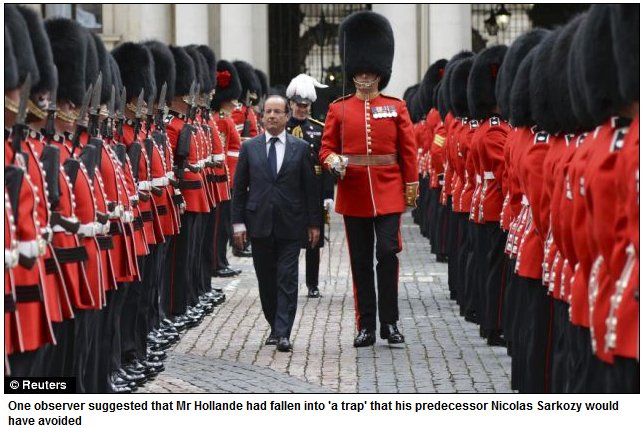
President Hollande “dwarfed” by Coldstream Guards

Filed under: Britain, Europe, France, Media, Military, Politics — Tags: , , — Nicholas @ 10:08

So much for a honeymoon period in office for French President Francois Hollande:

Francois Hollande was ridiculed today after allowing himself to look like a ‘dwarf’ alongside a British regiment which won battle honours at Waterloo and then occupied Paris.

During an official visit to London on Tuesday, the French President inspected a guard of honour from the 1st Battalion of the Coldstream Guards at the Foreign Office.

He then appeared in hugely embarrassing photographs alongside Major James Coleby, who looked around two feet taller than the Gallic head of state.

Comments alongside the image on a website of pictures taken by AFP, France’s national news agency, suggested Hollande had fallen into a ‘trap’ made to make him look ridiculous.

‘Poor France,’ wrote Jean-Marc Rameau, from Paris, while Dmitri Kovaley mocked Mr Hollande, who is 5ft 7ins, with the words ‘Dwarfs rule the world’.

H/T to Nicholas Packwood for the link.

Obama’s tax proposal being misreported by all major media outlets

Filed under: Government, Media, USA — Tags: , , , , — Nicholas @ 09:48

How so? Dan Amira explains:

Obama is not proposing that families making up to $250,000 a year keep their tax cuts while families making more than that don’t. He’s proposing that every family keep their tax cuts on their first $250,000 of taxable income (which is not the same as “income” or “earnings,” by the way).

That includes families with taxable income of $260,000, $1 million, $5 billion, $3 trillion, or whatever Jay-Z and Beyonce make in a year. Everyone would continue to pay a lower tax rate on their first $250,000 of taxable income under Obama’s plan. To report that Obama only wants to maintain tax cuts for families making less than $250,000 is simply false.

[. . .]

Normally, a president would want to publicize that he’s trying to cut taxes for everyone in the country. But Obama actually has an incentive this time to downplay the number of Americans who would benefit from his tax plan. His proposal is, at its heart, a political maneuver meant to force Mitt Romney to defend tax cuts for the wealthy. It’s more effective, then, for it to be seen as a cut solely for the middle class. The reality is that Obama’s proposal would also keep Warren Buffett’s taxes lower, if only a little bit.

H/T to Iowahawk for the link.

July 10, 2012

Does “Rule 34” have an exception after all?

Filed under: Cancon, Humour, Media — Tags: , , , — Nicholas @ 09:58

Kathy Shaidle may have found the only known exception to Rule 34:

Since women (and not a few men) obviously love a man in uniform, where is all the porn featuring the Royal Canadian Mounted Police?

Dirty cops are an X-rated staple, and “the UPS guy” has almost driven the once-ubiquitous “mailman” out of the porn business.

Even Nazis get to go where Mounties fear to tread. Those sleek black (Hugo Boss-designed) SS getups can get under even the most surprising skins: During the Eichmann trial in Israel, “Stalag” porn became Über-popular sexual samizdat.

So this slightly put-out Canuck wonders: What’s wrong with the RCMP, eh? Their uniforms are pretty sharp, too. And Due South fandom was rabid.

Yet there’s a distinct Mountie-porn void, one that violates a law of the Internet — “Rule 34” to be exact, which declares, “If it exists, there is porn of it.”

BMI: Badly Misleading Indicator

Filed under: Health, Media — Tags: , , , — Nicholas @ 09:04

Lewis Page explains why being too thin is a bad idea health-wise:

Yet another study has shown that the so-called “obesity” epidemic sweeping the wealthy nations of the world has been massively over-hyped, as new results show that is is far more dangerous to be assessed as “underweight” than it is to be assessed even as “severely obese” — let alone merely “obese” or “overweight”.

“There is currently a widespread belief that any degree of overweight or obesity increases the risk of death, however our findings suggest this may not be the case,” says health prof Anthony Jerant, lead author of the study. “In the six-year timeframe of our evaluation, we found that only severe obesity was associated with an increased risk of death.”

Most statistics in this field are still based on the now widely discredited Body Mass Index (BMI) system, under which people are assessed as “underweight”, “normal”, “overweight”, “obese” or “severely obese”. BMI, devised in the early 19th century by an obscure Belgian sociologist without medical qualifications, copes poorly with increases in height as it assumes the human body will scale up in mass in proportion to the square of height — which doesn’t allow for the fact that bodies are three dimensional — and further fails to allow for the greater cross-sectional area needed in supporting structures to carry increasing weights.

July 6, 2012

This might be damage that even the Internet can’t route around

Filed under: Law, Liberty, Media, Technology, USA — Tags: , , , — Nicholas @ 12:50

Tim Worstall on the worst-case interpretation of a recent legal decision in the US courts:

… we now have a ruling that websites are a place of public accommodation under the Americans with Disabilities Act. If this ruling holds then this really will break the internet and web as we have come to know it.

The case is discussed here.

    The case involves a Cyberlaw perennial: are websites obligated to comply with the Americans with Disabilities Act (the ADA)? In this case, the desired accommodation is close-captioning for Netflix-streamed video. If websites must comply with the ADA, all hell will break loose. Could YouTube be obligated to close-caption videos on the site? (This case seems to leave that door open.) Could every website using Flash have to redesign their sites for browsers that read the screen? I’m not creative enough to think of all the implications, but I can assure you that ADA plaintiffs’ lawyers will have a long checklist of items worth suing over. Big companies may be able to afford the compliance and litigation costs, but the entry costs for new market participants could easily reach prohibitive levels.

[. . .]

The place of publication is where the reader is, where the browser through which the site is being viewed. Thus would mean that any foreign website which an American might want to read (say, my personal blog) would become subject to the rules and restrictions of the ADA. And believe me, the 6.7 billion people who are not Americans are not going to put up with that. We might all ignore the law, or we might try and ban access from the US (or more alarmingly, ISPs might be told to do so). Or possibly be subject to the tender ministrations of an ambulance chasing lawyer.

July 4, 2012

ACTA rejected decisively by European Parliament

Filed under: Europe, Law, Media — Tags: , , , , — Nicholas @ 09:37

Apparently even the insulated, protected European Parliament can be moved if enough people are actively against something — in this case it was the Anti-Counterfeiting Trade Agreement (ACTA). Michael Geist explains:

When ACTA was formally signed by most participants in October 2011 in Tokyo, few would have anticipated that less than a year later, the treaty would face massive public protests and abandonment by leading countries. But with tens of thousands taking to the streets in Europe earlier this year, ACTA became the poster child for secretive, one-sided IP agreements that do not reflect the views and hopes of the broader public. This morning, the European Parliament voted overwhelmingly against the agreement, effectively killing ACTA within the EU. The vote was 478 against, 39 in favour, with 165 abstentions. This is a remarkable development that was virtually unthinkable even a year ago. Much credit goes to the thousands of Europeans who spoke out against ACTA and to the Members of the European Parliament who withstood enormous political pressure to vote against the deal.

The European developments have had a ripple effect, with the recent Australian parliamentary committee recommendation to delay ACTA ratification and the mounting opposition around the world. ACTA is not yet dead — it may still eke out the necessary six ratifications in a year or two for it to take effect — but it is badly damaged and will seemingly never achieve the goals of its supporters as a model for other countries to adopt and to emerge as a new global standard for IP enforcement. That said, ACTA supporters will not take today’s decision as the final verdict. In the coming weeks and months, we can expect new efforts to revive the agreement within Europe and to find alternative means to implement its provisions. That suggests the fight will continue, but for today, it is worth celebrating how the seemingly impossible — stopping a one-sided, secretly negotiated global IP agreement — became possible.

This has been referred to as the biggest parliamentary defeat ever for a European Commission initiative. In theory, the ACTA treaty cannot be enacted into EU law without being approved by the European Parliament (although, as we’ve seen before, the EU is adept at getting around minor inconveniences like referenda and recalcitrant national governments).

« Newer PostsOlder Posts »

Powered by WordPress

