
Quotulatiousness

June 23, 2013

Wine tasting scores are bullshit

Filed under: Business, Media, Science, Wine — Tags: , , — Nicholas @ 11:49

In the Guardian, David Derbyshire takes the modern “science” of wine tasting to the woodshed:

… drawing on his background in statistics, Hodgson approached the organisers of the California State Fair wine competition, the oldest contest of its kind in North America, and proposed an experiment for their annual June tasting sessions.

Each panel of four judges would be presented with their usual “flight” of samples to sniff, sip and slurp. But some wines would be presented to the panel three times, poured from the same bottle each time. The results would be compiled and analysed to see whether wine testing really is scientific.

The first experiment took place in 2005. The last was in Sacramento earlier this month. Hodgson’s findings have stunned the wine industry. Over the years he has shown again and again that even trained, professional palates are terrible at judging wine.

“The results are disturbing,” says Hodgson from the Fieldbrook Winery in Humboldt County, described by its owner as a rural paradise. “Only about 10% of judges are consistent and those judges who were consistent one year were ordinary the next year.

“Chance has a great deal to do with the awards that wines win.”

These judges are not amateurs either. They read like a who’s who of the American wine industry from winemakers, sommeliers, critics and buyers to wine consultants and academics. In Hodgson’s tests, judges rated wines on a scale running from 50 to 100. In practice, most wines scored in the 70s, 80s and low 90s.

Results from the first four years of the experiment, published in the Journal of Wine Economics, showed a typical judge’s scores varied by plus or minus four points over the three blind tastings. A wine deemed to be a good 90 would be rated as an acceptable 86 by the same judge minutes later and then an excellent 94.

Today’s headline is a slightly stronger version of one I ran in May: Is wine tasting bullshit? with this rather amusing caption:
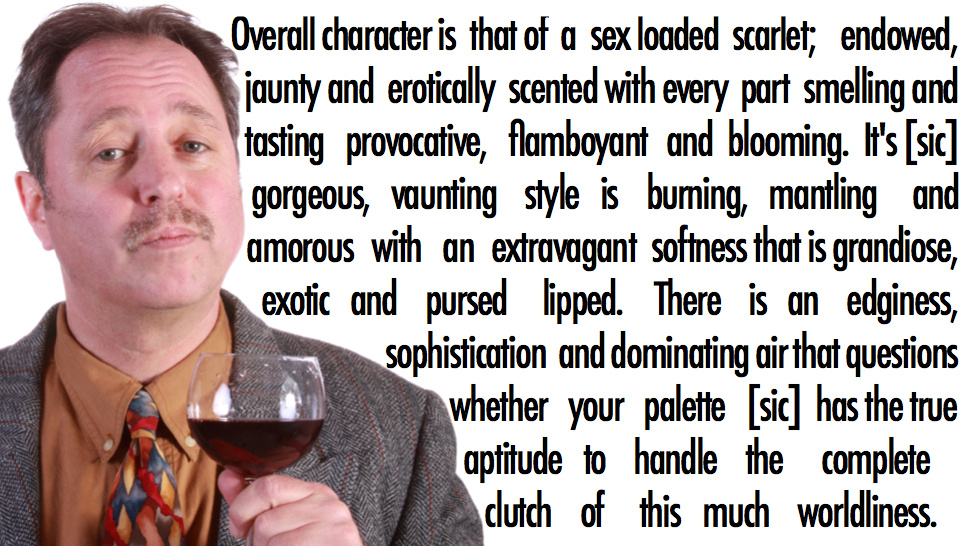
A real wine review

Although that “real” wine “review” illustrates the verbal bullshit side of wine reviewing, the statistical analysis in Robert Hodgson’s tests rather undermines the claims to any kind of actual analysis in most or all wine reviewing.

I’ve said for years that for most people there is a range of wine prices that will satisfy their tastes without emptying their wallets — in Ontario, the range for most people seems to be in the $14-$40 price spectrum. Pay less than that, and you risk buying wine that really isn’t very good (although there are some underpriced gems even there), and pay over $40 and you’re just paying extra for the “prestige” and most of us wouldn’t really be able to detect any flavour differences.

It’s interesting to see what kind of immediate environmental changes seem to be able to directly influence the scores given by reviewers:

More evidence that wine-tasting is influenced by context was provided by a 2008 study from Heriot-Watt University in Edinburgh. The team found that different music could boost tasters’ wine scores by 60%. Researchers discovered that a blast of Jimi Hendrix enhanced cabernet sauvignon while Kylie Minogue went well with chardonnay.

Ecuador press law to mandate coverage of government propaganda items

Filed under: Americas, Law, Liberty, Media — Tags: , , , , , — Nicholas @ 10:28

Ecuador has a new law on the books that may force the media to carry government propaganda or risk prosecution:

Under Ecuador’s new Communications Law, however, journalists may have to pay far more attention to ribbon-cutting ceremonies and other government PR events. Article 18 of the law forbids the “deliberate omission of … topics of public interest.” But this wording is so vague that nearly any action by local, state, or national government official could be considered of public interest.

“Newspapers don’t have enough journalists or space to cover all these events. Radio programs don’t have enough air time,” Paúl Mena, president of the Ecuadoran Journalists’ Forum, told CPJ. “If the government starts demanding coverage, there are going to be problems.”

More conflict between the media and the Correa government seems inevitable under the Communications Law, which was approved by the National Assembly on June 14 and will go into effect next month. Not only does the law create a state watchdog entity to regulate media content, but it is filled with ambiguous language demanding that journalists provide accurate and balanced information or face civil or criminal penalties. “This is completely crazy,” Monica Almeida, an editor at the Guayaquil daily El Universo, told CPJ. “The law is designed to regulate everything we do.”

[. . .]

The 44-page law contains 119 articles. In interviews with CPJ, Ecuadoran journalists were at a loss to pick out the worst provisions since they view nearly all of them as serious violations of press freedom.

For example, under the law reporters are now required to earn a journalism degree. Rather than serving as a neutral referee, the Superintendence of Information and Communication — the government’s new watchdog agency — could be used by Correa to simply bash the press. And reporters are especially incensed by Article 26 that prohibits “media lynching.” This is defined as “the dissemination of concerted and reiterative information … with the purpose of undermining the prestige” of a person or legal entity. Media outlets found violating this provision could be ordered to issue public apologies and would be subject to criminal and civil sanctions that are not specified in the legislation.

One magazine editor in Quito, who asked to remain anonymous, said the article seems designed to thwart investigations. That’s because such in-depth reporting often requires publishing a series of stories over several days or weeks that could be construed as harassment.

June 22, 2013

The Economist on the cooling chances of major climate control legislation

Filed under: Environment, Government, Media, Science — Tags: , , — Nicholas @ 09:37

I was disappointed when The Economist switched sides to join the “consensus” on global warming and started arguing for massive government intervention in the economy to “save the planet”. Fifteen years after the last significant bout of warming, The Economist is starting to sound a bit more sensible (and skeptical):

…there’s no way around the fact that this reprieve for the planet is bad news for proponents of policies, such as carbon taxes and emissions treaties, meant to slow warming by moderating the release of greenhouse gases. The reality is that the already meagre prospects of these policies, in America at least, will be devastated if temperatures do fall outside the lower bound of the projections that environmentalists have used to create a panicked sense of emergency. Whether or not dramatic climate-policy interventions remain advisable, they will become harder, if not impossible, to sell to the public, which will feel, not unreasonably, that the scientific and media establishment has cried wolf.

Dramatic warming may exact a terrible price in terms of human welfare, especially in poorer countries. But cutting emissions enough to put a real dent in warming may also put a real dent in economic growth. This could also exact a terrible humanitarian price, especially in poorer countries. Given the so-far unfathomed complexity of global climate and the tenuousness of our grasp on the full set of relevant physical mechanisms, I have favoured waiting a decade or two in order to test and improve the empirical reliability of our climate models, while also allowing the economies of the less-developed parts of the world to grow unhindered, improving their position to adapt to whatever heavy weather may come their way. I have been told repeatedly that “we cannot afford to wait”. More distressingly, my brand of sceptical empiricism has been often met with a bludgeoning dogmatism about the authority of scientific consensus.

Of course, if the consensus climate models turn out to be falsified just a few years later, average temperature having remained at levels not even admitted to be have been physically possible, the authority of consensus will have been exposed as rather weak. The authority of expert consensus obviously strengthens as the quality of expertise improves, which is why it’s quite sensible, as matter of science-based policy-making, to wait for a callow science to improve before taking grand measures on the basis of it’s predictions.

As I wrote back in 2004, “I’ve never been all that convinced of the accuracy of the scientific evidence presented in favour of the Global Warming theory, especially as it seemed to play rather too clearly into the hands of the anti-growth, anti-capitalist, pro-world government folks. A world-wide ecological disaster, clearly caused by human action, would allow a lot of authoritarian changes which would radically reduce individual freedom and increase the degree of social control exercised by governments over the actions and movement of their citizenry.”

June 20, 2013

Supreme Court refuses to hear appeal of Rob Ford’s conflict-of-interest case

Filed under: Cancon, Law, Media, Politics — Tags: , , , , , — Nicholas @ 11:07

The Toronto Star must be feeling devastated by this:

The Supreme Court of Canada says it will not hear an appeal in a conflict-of-interest case against Toronto Mayor Rob Ford.

The court dismissed it with costs, but did not give reasons for the ruling.

Lawyer Clayton Ruby was trying to restore a lower court decision from November 2012, in which Superior Court Justice Charles Hackland ruled Ford be removed from office.

However, as part of Ford’s appeal, the decision was overturned by an Ontario Divisional Court panel in January 2013.

Deputy mayor Doug Holyday said this was all about antagonizing the mayor.

“There was no reason to take this to the Supreme Court; there was very little likelihood of it every getting put before the Supreme Court,” Holyday said.

Update: The CBC reports that Ford feels vindicated by the decision:

Toronto Mayor Rob Ford expressed relief Thursday that a conflict challenge that previously threatened to oust him from office won’t be revived in the country’s top court.

“I’m so happy this is finally over. I’ve been vindicated and we can move on,” Ford told reporters in Toronto, about two hours after the Supreme Court of Canada rejected an application to hear a final appeal in the much-publicized conflict case that began last year.

As is customary, the Supreme Court gave no reasons for dismissing the appeal, but legal experts — including the lawyer who filed the application himself — had acknowledged the odds of reviving the conflict of interest case were a long shot.

The court only accepted 12 per cent of appeal requests made last year.

Toronto resident Paul Magder filed an application in an Ontario court last year, alleging that Ford had violated conflict of interest legislation when he participated in a council vote that absolved his need to pay back funds donated to his private football foundation.

The UK debate over online porn

Filed under: Britain, Law, Media, Technology — Tags: , , , , — Nicholas @ 09:04

Willard Foxton says that the real problem is that the two “sides” of the argument are not even talking the same language:

Claire Perry, the Prime Minister’s “special adviser on preventing the sexualisation and commercialisation of childhood”, has three demands which she claims will save the world from the horrors of porn. First, that internet service providers and other internet companies block child pornography at its source; second, that any sort of simulated rape pornography is banned; and third, that pornography is banned from public WiFi.

On the face of it, these all seem like reasonable demands. I mean, if you oppose them, you must be some kind of filth peddler or mad porn obsessive, right? Or you might just be a person who understands how the internet works, and therein lies the problem. Let’s tackle Perry’s demands one by one and explain, patiently, why she is wrong.

Firstly, her request that internet service providers block images of child abuse “at their source”. It sounds perfectly reasonable, doesn’t it? Indeed, it’s so reasonable that they already do, and indeed have been doing since 2007. It’s done through a system called Cleanfeed, which is a rare example of a British state-funded IT project that works like a charm. They way it works is, any time a website is reported as illegal to the police, it’s added to a list. Any sites on that list are inaccessible from British ISPs. It’s a very secure system, and very hard to work around – it works so well that we’ve exported it to Canada and Australia.

Perry also wants Google to “do more” to block child porn. As I’ve said before on these pages, Google (and other large search providers), already have enormous departments devoted to blocking it, with thousands of employees checking YouTube for offensive images. On top of that, very little of the material that so offends Perry is available though a simple Google search; most of the illegal stuff is hidden in Internet Relay Chat file servers or on the dark web, accessible only via anonymising browsers like Tor.

Update: At Techdirt, Tim Cushing addresses the common claim by grandstanding politicians that child pornography is easy to “stumble upon”:

How hard would it be to access child porn if you weren’t looking for it specifically? The Ministry of Truth puts your odds at 1 in 2.6 million searches. (MoT points out the odds will fluctuate depending on search terms used, but for the most part, it’s not the sort of thing someone unwittingly stumbles upon.)

All those demanding Google do more to block child porn fail to realize there’s not much more it can do. The UK already has an underlying blocking system filtering out illegal images at the ISP level, and Google itself runs its own blocker as well.

The above calculations should put the child porn “epidemic” in perspective. As far as the web that Google actively “controls,” it’s doing about as much as it can to keep child porn and internet users separated. There are millions of pages Google can’t or doesn’t index and those actively looking for this material will still be able to find it. Google (and most other “internet companies”) can’t really do more than they’re already doing already. But every time a child pornography-related, high profile crime hits the courtroom (either in the UK or the US), the politicians instantly begin pointing fingers at ISPs and search engines, claiming they’re not doing “enough” to clean up the internet, something that explicitly isn’t in their job description. And yet, they do more in an attempt to satiate the ignorant hunger of opportunistic legislators.

If Google is “the face of the internet” as so many finger pointers claim, than the “internet” it “patrols” is well over 99% free of illegal images, according to a respected watchdog group. But accepting that fact means appearing unwilling to “do something,” an unacceptable option for most politicians.

Colby Cosh on re-visiting the TWA 800 crash investigation

Filed under: Government, Media, USA — Tags: , , , , , — Nicholas @ 08:39

I remember there were lots of “shoot-down” speculations about the loss of TWA flight 800 off the coast of Long Island in 1996, and that the formal investigation seemed unusually inconclusive, but I didn’t know that the National Transportation Safety Board was considering re-opening the investigation after all this time:

Many witnesses insisted they had seen a streak of light ascend toward the plane before it exploded, creating an initial suspicion that TWA 800 had been brought down by a missile. That is the theory favoured by the “Independent Researchers.” Although they are very careful about referring to “an external explosion” as their pet alternative to the official story — which is that an electrical short circuit blew up a fuel tank — it is clear enough that they are thinking “missile”. And it is clear enough that they suspect the investigation was obfuscated at the behest of powerful forces in the government, either because terrorists had succeeded in embarrassing its intelligence-gathering or because the explosion was actually the result of a military accident. Much is made of the radar signature of a mysterious craft that appeared on the surface of the water briefly at around the time of the disaster.

It makes for a wonderful case study in the way conspiracy theories arise. The FBI was permitted to horn in on the NTSB investigation precisely because, and only because, there were so many witnesses offering contradictory accounts of the explosion. That, in turn, allows the Independent Researchers to hang upon the FBI every error, imperfection, and bit of official superciliousness perpetrated in the course of the investigation. The bureaucracy’s sincere desire to rule out a crime if no crime took place becomes, in the eyes of skeptics, circumstantial evidence of a crime concealed.

[. . .]

The NTSB’s respectful response to the Independent Researcher petition raises the question of whether there might exist a “Snowden Effect” resulting from the revelations recently made by a certain four-eyed former tech contractor for the National Security Agency. The TWA 800 conspiracists/countertheorists have been hard at work almost since the evening of the accident/incident. They have a filmed documentary in the works — which is, incidentally, a sizable point against them in my personal ledger: I observe an increasingly unshakeable rule of thumb that all documentaries are, if not lies, then practically indistinguishable from lies. (If you wish to disagree, I ask only that you send me a five-minute video clip of you doing or saying absolutely anything, and allow me to apply the composition, colour and film-grain effects, editing, and music of my choice.) Obviously they are not taking advantage, per se, of the climate of hostility and paranoia created by Edward Snowden’s account of the American security state. They were already hostile and paranoid.

But Snowden’s globally televised dissident activity may serve to create a more receptive audience for conspiracy theories about the U.S.A. It might, on the other hand, make American government agencies more aware of their public image and more eager to at least appear somewhat libertarian and sensible, a bit less like servants of bloodthirsty alien lizard-beings. And, then again, there’s a third possibility: Snowden’s audacity might shame other officials trying to retire with secrets in their bosom into stepping forward sooner. I think I have, unfortunately, listed these conceivable Snowden Effects in the order of their real likelihood.

June 19, 2013

The press and Rand Paul

Filed under: Liberty, Media, Politics, USA — Tags: , , , , , — Nicholas @ 11:03

In The Atlantic, Conor Friedersdorf looks at the mainstream media’s obsession with Rand Paul’s (to borrow a time-worn term from Canadian politics) “hidden agenda”:

Critiques of democracy are as old as the excesses of the Athenian variety. Here’s a classic: The unmediated masses are as capable of doing an injustice as any aristocracy or tyrant. In America, it’s acceptable to say, as shorthand, that we’re living in a Western liberal democracy. But the fact is that we live in a federal, constitutional republic, because the Framers mistrusted democracy, and the vast majority of Americans retain a great part of that mistrust. We’ve extended the franchise, amended the Constitution to permit the direct election of senators, and we’re likely to eventually abandon the electoral college and elect presidents by the popular vote. But there is broad, deep support for anti-democratic features of our system, like the Bill of Rights.

All of this is totally uncontroversial — unless it is uttered by Senator Rand Paul, the national politician most likely to evoke irrational paranoia from the political press. Serial anti-libertarian Jonathan Chait is the latest to demonstrate this truth in an unintentionally revealing item at New York.

Here’s how he begins:

    The most unusual and interesting line in Julia Ioffe’s highly interesting profile of Rand Paul is Paul’s confession, “I’m not a firm believer in democracy. It gave us Jim Crow.” Of course, that’s an awfully strange way to condemn Jim Crow, which arose in the distinctly undemocratic Apartheid South (it was no coincidence that the dismantling of Jim Crow and the granting of democratic rights to African-Americans happened simultaneously).

This is an uncharitable beginning. If a scholar of political thought said of ancient Athens, “I’m not a firm believer in democracy — it required slavery, war, or both, to subsidize the lower classes while they carried out their civic duties,” no one would think that a strange formulation — it is perfectly coherent to talk about democracy in places that didn’t extend the franchise universally, given how the term has been used and understood for two thousand years of political history.

[. . .]

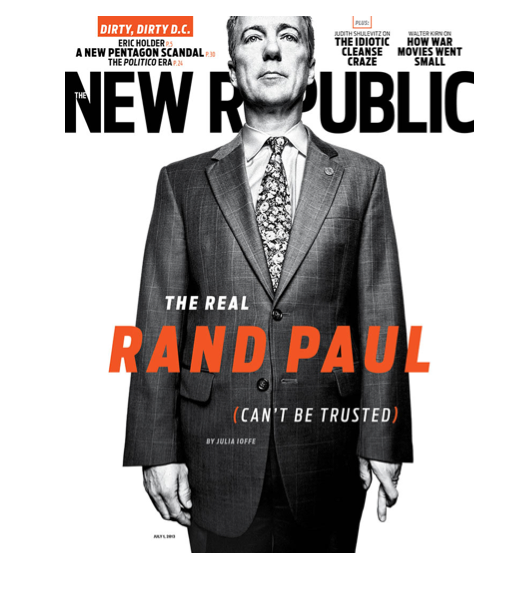
What Chait did is hardly unique. In the political press, it happens again and again: libertarian leaning folks are portrayed as if they’re radical, extremist ideologues, even when they’re expressing ideas that are widely held by Americans across the political spectrum. Here is the absurd cover The New Republic chose for the issue in which the Paul profile appears:

TNR Rand Paul cover

This would seem to imply that, relative to other politicians, the guy who went on Rachel Maddow to discuss the nuances of his take on the Civil Rights Act is the one hiding his “real” self from us. Remember the conservatives who kept saying, “Obama is hiding something — he’s not one of us”? That magazine cover is what it looks like when liberals cave to a similar pathology.

V for Vinegar

Filed under: Americas, Media, Soccer — Tags: , , , , , — Nicholas @ 08:29

The Economist reports on the rising tide of protest in Brazil:

All that changed on June 13th when the state’s unaccountable, ill-trained and brutal military police turned a mostly peaceful demonstration into a terrifying rout. Dozens of videos, some from journalists, others from participants and bystanders, show officers with their name tags removed firing stun grenades and rubber bullets indiscriminately at fleeing protesters and bystanders and hunting stragglers through the streets. Motorists trapped in the mayhem ended up breathing pepper spray and tear gas. Demonstrators found with vinegar (which can be used to lessen the effect of tear gas) were arrested. Several journalists were injured, two shot in the face with rubber bullets at close range. One has been told he is likely to lose his sight in one eye. The following day’s editorials took a markedly different tone.

By June 17th what has become dubbed the “V for Vinegar” movement or “Salad Revolution” had spread to a dozen state capitals as well as the federal capital, Brasília. The aims had also grown more diffuse, with marchers demanding less corruption, better public services and control of inflation. Many banners protested against the disgraceful cost of the stadiums being built for next year’s football World Cup. Brazil has already spent 7 billion reais, three times South Africa’s total four years earlier, and only half the stadiums are finished. “First-world stadiums; third-world schools and hospitals”, ran one placard.

[. . .]

So, why now? One reason is surely a recent spike in inflation, which is starting to eat into the buying power of the great majority of Brazilians who are still getting by on modest incomes, just as a big ramp-up in consumer credit in recent years has left them painfully overstretched. Bus fares have not risen for 30 months (mayors routinely freeze fares in municipal-election years, such as 2012, and in January this year the mayors of Rio and São Paulo agreed to wait until June before hiking in order to help the federal government massage the inflation figures). In fact, the rise in São Paulo’s and Rio’s bus fares comes nowhere close to matching inflation over that 30-month period. But bus fares are under government control, unlike other fast-rising costs such as those for housing and food. Perhaps they were simply chosen as a scapegoat.

More broadly, the very middle class that Brazil has created in the past decade — 40m people have escaped from absolute poverty, but are still only one paycheck from falling back into it, and 2009 was the first year in which more than half the population could be considered middle class — is developing an entirely new relationship with the government. They see further improvements in their living standards as their right and will fight tooth and nail not to fall back into poverty. And rather than being grateful for the occasional crumb thrown from rich Brazilians’ tables, they are waking up to the fact that they pay taxes and deserve something in return. Perhaps their government’s triumphalism over those shiny new stadiums was the final straw.

June 18, 2013

Radley Balko’s new book

Filed under: Books, Law, Liberty, Media, USA — Tags: , , — Nicholas @ 11:17

I’m a fan of Radley Balko’s work (I quote him and hat-tip him a fair bit), so I’m looking forward to reading his new book, Rise of the Warrior Cop, The Militarization of America’s Police Forces. Here’s a glowing review from Scott Greenfield:

The book, published by Public Affairs and scheduled for release on July 9, 2013, starts at the beginning, taking us from the days when Americans policed themselves to the birth of the occupation of policing. While I was well aware of Radley’s persistence and acumen at chronicling current events, I never realized what a thorough researching her is. The history of policing is remarkably impressive.

It’s critical to appreciate the history of policing, to understand that what we now see as normal and inescapable wasn’t always the case. For most of our history, this country did not have a group of people with shields and guns who wandered the streets ordering people about. The fall from grace, If you perceive it as I do, came fast and hard.

American attitudes toward police were built on images of Andy Griffith, strolling the streets of Mayberry to save random cats and, an allusion Radley employs, serving as guest umpire in the occasional baseball game. Good. Honest, One of us. This was the police officer upon whom we relied, and the one we pictured as we told our children that they were here to help us; they were our friend.

Starting in the 1960’s, Radley takes us decade by decades down the road to perdition. As he wears his libertarian politics on his sleeve, it came as no surprise that he gave the politics of law enforcement special scrutiny. His hatred of Richard Nixon for manipulating the silent majority’s hatred of hippies and counterculture into the War on Drugs is palpable. On the other hand, there is no reluctance to blame Bill Clinton for his deceitful abuse of the COPS program, and its infusion of billions into the drug war a few decades later.

Radley is not only a surprisingly good story teller, generally low key in recounting tales of individual harm interspersed with broad influences that gave rise to putting heavy weaponry into the hands of children. There are times when the narrative gets a bit breathless, trying hard to capture the confluence of political deceit on the part of some and ignorance on the part of others. Then again, the alternative would be to simply call out the liars and morons for their contribution to a state of affairs that served to put a naïve American public at grave risk for such puny and transitory purposes as winning an election.

June 17, 2013

Orwell, Huxley, and the world we’re in

Filed under: Books, Government, Media, Politics — Tags: , , — Nicholas @ 09:06

In Salon, Andrew O’Hehir considers the separate strains of George Orwell, Aldous Huxley, and Philip K. Dick that predicted the way we’d be:

In 1946, two years before writing 1984, Orwell wrote an essay about the new form of social organization he saw on the horizon. He predicted it would do away with private property, which didn’t happen – but if we suppose that his idea of private property meant individual autonomy and freedom from debt slavery, this starts to sound more familiar:

    These people will eliminate the old capitalist class, crush the working class, and so organize society that all power and economic privilege remain in their own hands. Private property rights will be abolished, but common ownership will not be established. The new “managerial” societies will not consist of a patchwork of small, independent states, but of great super-states grouped round the main industrial centres in Europe, Asia, and America. These super-states will fight among themselves for possession of the remaining uncaptured portions of the earth, but will probably be unable to conquer one another completely. Internally, each society will be hierarchical, with an aristocracy of talent at the top and a mass of semi-slaves at the bottom.

That vision of the future, so much more sober than what we’re used to calling “Orwellian,” sounds eerily like the world we actually live in (with a few doses of Ayn Rand thrown in). So far as we know, our Huxley-Orwell hybrid society emerged organically from the end of the Cold War, rather than resulting from an apocalypse or a grand plan. It’s almost a case of life imitating art, as if Earth’s rulers had selected the most effective elements from various dystopian visions and strategically blended them. But I’m not sure we can blame all this on a secret meeting of the Bilderberg Group, or some Lee Atwater ad campaign. As in The Matrix, we chose the simulacrum of democracy and bumper stickers about “freedom” instead of the real things. We chose to believe that our political leaders stood for something besides rival castes within the ruling elite, chose to believe that a regime of torture and secrecy and endless global warfare was a rational response to the tragedy of 9/11. We still believe those things, but our dystopia is still messy, still incoherent, still incomplete. Which means, in theory, that it can still be undone.

June 16, 2013

Recognizing a sociopath

Filed under: Books, Health, Media — Tags: , , — Nicholas @ 10:06

At Marginal Revolution, Tyler Cowen discusses a book that may or may not be a dependable guide to sociopaths:

The author argues that sociopaths are often very smart, have a lot of natural cognitive advantages in manipulating data, and are frequently sought out as friends for their ability to appeal to others. It is claimed that, ceteris paribus, we will stick with the sociopath buddies, as we are quite ready to use sociopaths to suit our own ends, justly or not. It is claimed that for all of their flaws, many but not all sociopaths are capable of understanding what is in essence the contractarian case for being moral — rational self-interest — and sticking with it. Citing some research in the area (pdf), the author speculates that sociopaths may have an “attention bottleneck,” so they do not receive the cognitive emotional and moral feedback which others do, unless they decide very consciously to focus on a potential emotion. For sociopaths, top down processing of emotions is not automatic.

We even learn that (supposedly) sociopaths are often infovores. It seems many but not all sociopaths are relatively conscientious, and the author of this book (supposedly) teaches Sunday school and tithes ten percent to the church. It just so happens sociopaths sometimes think about killing or destroying other people, without feeling much in the way of remorse.

[. . .]

I cannot evaluate the scientific claims in this book, and would I trust the literature on sociopaths anyway, given that the author claims it is subject to the severe selection bias of having more access to the sociopathic losers and criminals? (I buy this argument, by the way.) It did occur to me however, that for the rehabilitation of sociopaths, whether through books or other means, perhaps they should consider…a rebranding exercise? But wait, “Sorry, I could not find synonyms for ‘sociopath’.”

If nothing else, this book will wake you up as to how little you (probably) know about sociopaths.

Emmanuel Goldstein? Isn’t that some C-list celebrity from the 70s?

Filed under: Books, Government, Liberty, Media — Tags: , , — Nicholas @ 00:01

In Maclean’s, Colin Horgan says it’s the Huxley dystopia we’ve actually fallen into, rather than the Orwellian:

Over at the New Yorker, Ian Crouch wondered this week whether we really are living in some version of George Orwell’s Nineteen Eighty-Four. It seems like a perpetual question, but it has renewed relevance now, both in light of the revelations last week from the Glenn Greenwald at the Guardian that the National Security Association is, apparently, mining internet data from users (whether guilty or not), without their knowledge or consent, and because in the subsequent days, sales of Nineteen Eighty-Four skyrocketed.

But, as Crouch asked, are we living in Nineteen Eighty-Four? Not quite. It all looks pretty bad, and the nightmare scenario Orwell depicted is, technically speaking, quite possible but, Crouch noted, “all but the most outré of political thinkers would have to grant that we are far from the crushing, violent, single-party totalitarian regime of Orwell’s imagination.” Surely, though, this is not what was envisioned – even when the Patriot Act was debated back at the turn of the century, few (if any) could have envisioned that the laws might be one day stretched quite as far as they appear to have been under the Obama administration. So, if not Nineteen Eighty-Four then when? What time is this?

[. . .]

There are two ways for a culture to die, Neil Postman wrote back in the 1980s: One is Orwellian, “where culture becomes a prison,” and the second is Huxleyan, where “culture becomes a burlesque.” To answer Crouch’s question, we are living the second reality more than the first. Big Brother does not watch us by his choice; rather, as Postman put it, we watch him by ours. “Orwell feared that the truth would be concealed from us. Huxley feared the truth would be drowned in a sea of irrelevance,” Postman wrote.

[. . .]

To paraphrase Postman, we have not been ruined by what we hate, but instead, as Huxley predicted, by what we love. We are prisoners to our own egoism and passivity, drowning in a sea of irrelevant streaming data, presented not in with any hierarchy or inherent importance, but as equal and unweighted. The Harlem Shake and Nyan Cat are just as relevant as a civil war in Syria or a democratic nation spying on its own citizens, just as being watched by millions of strangers via webcam or TV broadcast feels just the same as being watched by the government. And, as Huxley thought we might, we have convinced ourselves that is freedom.

June 15, 2013

Ontario’s abusive relationship with sex ed

Filed under: Cancon, Education, Health, Media — Tags: , , , , , — Nicholas @ 10:31

In Maclean’s, Emma Teitel talks about the failure of Ontario’s sex-ed classes to keep up with the times:

In the fifth grade, my friends and I had a special afternoon tradition. When school let out at 3:30, we would walk to Katherine’s house (a pseudonym), raid her fridge, go upstairs to her bedroom, lock the door and watch Internet pornography. Where were Katherine’s parents? They were at work. But it wouldn’t have mattered. When they were around, we just turned off the sound, or read erotic literature on a website called Kristen Archives. This is how we gained the indispensable knowledge that some women like to be ravished by farmhands, and others, by farm animals. The year was 1999. We had not yet sat through our first sex-ed class, but when we did, almost two years later, it was spectacularly disappointing. We had seen it all, and now we were shading in a diagram of the vas deferens.

Since our special after-school tradition came to an end over a decade ago, Friendster, Myspace, Facebook, Flickr, Formspring, Instagram and Twitter have emerged. But against all logic, nothing has changed in the sex-ed business. Our century is literally on the cusp of puberty, and yet despite these enormous social and technological changes, we remain largely incapable of giving kids the resources they need to deal with their own puberty. I’m talking here, specifically, about the province of Ontario. As you read this, kids from Sarnia to Kingston — kids who, on average, have viewed Internet porn by age 11 — are probably shading in the exact same vas deferens diagram I did. There’s nothing wrong with the vas deferens — or so I’m told — but surely there is more to sexual education in the 21st century than anatomy and colouring. Ontario currently boasts the most out-of-date sex-ed curriculum in Canada. It was last revised in 1998, which means sex ed was out of date when I took it.

[. . .]

Kids shouldn’t watch porn, but they do. We can’t un-invent the Internet. And we can’t reverse puberty. Case in point: In 2001, one of the most determined voyeurs in our special after-school group skipped sex ed at the request of her religious father — for whom an hour of vas deferens shading was just too much to bear. He told her to go to the library instead, which was fine with her. Who, after all, could resist an afternoon with the Kristen Archives?

Hiding your data in plain sight

Filed under: Liberty, Media, Technology — Tags: , , , , , — Nicholas @ 09:12

Ronald Bailey gathers up some resources you might want to investigate if you’d prefer not to have the NSA or other government agencies watching your online activities:

First, consider not putting so much stuff out there in the first place. Wuergler devised a program he calls Stalker that can siphon off nearly all of your digital information to put together an amazingly complete portrait of your life and pretty much find out where you are at all times. Use Facebook if you must, but realize you’re making it easy for the government to track and find you when they choose to do so.

A second step toward increased privacy is to use a browser like DuckDuckGo, which does not collect the sort of information — say, your IP address — that can identify you with your Internet searches. Thus, if the government bangs on their doors to find out what you’ve been up to, DuckDuckGo has nothing to hand over. I have decided to make DuckDuckGo my default for general browsing, turning to Google only for items such as breaking news and scholarly articles. (Presumably, the NSA would be able to tap into my searches on DuckDuckGo in real time.)

Third, TOR offers free software and a network of relays that can shield your location from prying eyes. TOR operates by bouncing your emails and files around the Internet through encrypted relays. Anyone intercepting your message once it exits a TOR relay cannot trace it back to your computer and your physical location. TOR is used by dissidents and journalists around the world. On the downside, in my experience it operates more slowly than, say, Google.

Fourth, there is encryption. An intriguing one-stop encryption solution is Silent Circle. Developed by Phil Zimmerman, the inventor of the Pretty Good Privacy encryption system, Silent Circle enables users to encrypt their text messages, video, and phone calls, as well as their emails. Zimmerman and his colleagues claim that they, or anyone else, cannot decrypt our messages across their network, period. As Wuergler warned, this security doesn’t come free. Silent Circle charges $10 per month for its encryption services.

However, your mobile phone is a beacon that can’t be easily masked or hidden:

Now for some bad news. Telephone metadata of the sort the NSA acquired from Verizon is hard — read: impossible — to hide. As the ACLU’s Soghoian notes, you can’t violate the laws of physics: In order to connect your mobile phone, the phone company necessarily needs to know where you are located. Of course, you can avoid being tracked through your cell phone by removing its batteries (unless you have an iPhone), but once you slot it back in, there you are.

For lots more information on how to you might be able to baffle government monitoring agencies, check out the Electronic Frontier Foundation’s Surveillance Self-Defense Web pages.

Prog rock fans, unite!

Filed under: Books, Britain, Media — Tags: , , , , — Nicholas @ 09:01

In Maclean’s, Stephen Skratt talks about a new book on prog rock:

Let the hating begin. ELP are often cited as the reason punk had to happen. After the Beatles and before the Sex Pistols, they, along with Genesis, Yes, King Crimson and Pink Floyd, sold millions of records, topped critics’ polls and ushered in a golden era of prog rock. There were capes, songs about supernatural anaesthetists, a trilogy of albums about a “radio gnome,” and King Arthur on ice — literally, with skating pantomime horses (courtesy of a Rick Wakeman show). Prog virtuosos fused rock, classical, folk, jazz and Renaissance music, and took little from blues. The music couldn’t get more white — or more unfashionable. Twenty-minute songs performed by earnest young men trying to sound like an orchestra, hopping from one instrument to another, or playing several at once: this was large-scale, ambitious music meant to accompany grand lyrics and stage spectacles. Gone was sex, drugs and rock ’n’ roll, replaced by Kubrickian space-outs, Eastern philosophy and walls of synthesizers — or guitars trying to sound like synthesizers.

[. . .]

Now the music is crawling out from under its toadstool in Yes Is The Answer, edited by Tyson Cornell and Marc Weingarten. Cornell, founder of L.A.-based Rare Bird Books and a musician himself, admits the idea of having respectable writers challenge the accepted gospel about prog was far-fetched. “When Marc and I started doing this,” he says, “everybody we talked about it with was just laughing at us. But then people started to tell their stories, and it just unfolded.”

[. . .]

The book — a tribute to what Weingarten identifies in the introduction as “prog rock’s grandeur, its mushy mysticism, its blissed-out mystery” — is a high point in a renaissance that’s been building: a reverential 2009 BBC documentary (Prog Britannia), a magazine (Classic Prog), and a growing number of festivals, including Prog Angeles, organized by Cornell and featuring members of Weezer and others. Tastemaking online music journal Pitchfork drops the P-word on an almost weekly basis in describing some impossibly cool band’s music, from metal monsters Mastodon to French electronic duo Justice — an admission, finally, that someone was listening. And there is the full-on revival of the band responsible for a concept album about hemispheres of the brain: Rush. As Nirvana’s Dave Grohl said in his speech inducting Rush into the Rock and Roll Hall of Fame, “There’s one mystery that eclipses them all: when the f–k did Rush become cool?”

For all this, it’s unlikely prog will get the reappraisal its supporters feel it’s due. The biggest strike against the genre has long been that it’s bloated, corporate, the antithesis of punk — even though in spirit prog may not have been all that far off from punk. They shared a broad political ideology. Henry Cow and the other bands make up “rock in opposition,” a popular subgenre of prog, which, aside from influencing avant-garde jazz musicians over the years, make the Clash look like weekend protesters. King Crimson’s 21st Century Schizoid Man opens with the snarl of, “Nothing he’s got he really needs.” Prog explored dystopian worlds of environmental apocalypse and corporate greed, occasionally with more subtlety and whimsy than punk. And prog rockers were as committed to their outlandish musical vision as punk was to its three chords; far from all being pampered middle-class kids, they too struggled for an audience and money during their formative years. The average punk band just imploded within a few years of forming — they never stuck around long enough to be derided as “dinosaurs.”

« Newer PostsOlder Posts »

Powered by WordPress

