
Quotulatiousness

July 2, 2013

Learning to love the leaker

Filed under: Government, Law, Media — Tags: , , , , — Nicholas @ 15:16

Glenn Reynolds, aka the Instapundit, explains why people who like government legitimacy should love the leakers:

… the Snowden affair occurs in the context of an unprecedented administration war on whistleblowers. And that’s a bad idea because whistleblowing is one of the things that maintains the legitimacy of a government as big, and otherwise unaccountable, as ours.

As recently reported by the McClatchy Newspapers, the Obama administration views whistleblowing and leaks as a species of terrorism. According to McClatchy: “President Obama’s unprecedented initiative, known as the Insider Threat Program, is sweeping in its reach. It has received scant public attention even though it extends beyond the U.S. national security bureaucracies to most federal departments and agencies nationwide, including the Peace Corps, the Social Security Administration and the Education and Agriculture departments. It emphasizes leaks of classified material, but catchall definitions of ‘insider threat’ give agencies latitude to pursue and penalize a range of other conduct. … Leaks to the media are equated with espionage.”

The Peace Corps? The Department of Agriculture? Really? There’s irony in this, given President Obama’s famous 2009 pledge to make transparency a “touchstone” in his administration. “For a long time,” he said, “there’s been too much secrecy in this city.” His views on this subject seem to have evolved. Now, like many officeholders, he wants to control information to avoid embarrassment.

But that’s a mistake. Because while leaks can bring embarrassment, leaks — or at least their possibility — also bring legitimacy.

The federal government is so huge that no one can really oversee it. (This was, remember, an excuse offered by Obama’s defenders in the IRS scandals.) It’s certainly too big for congressional oversight to do the job, as is evidenced by the numerous unfolding scandals ranging from the NSA to Benghazi to the IRS, all of which seem to have caught Congress by surprise.
June 30, 2013

Confessions of a reformed Manic Pixie Dream Girl

Filed under: Media — Tags: , , — Nicholas @ 11:10

In the New Statesman, Laurie Penny talks about the MPDG stereotype and her recovery from it:

Like scabies and syphilis, Manic Pixie Dream Girls were with us long before they were accurately named. It was the critic Nathan Rabin who coined the term in a review of the film Elizabethtown, explaining that the character of the Manic Pixie Dream Girl “exists solely in the fevered imaginations of sensitive writer-directors to teach broodingly soulful young men to embrace life and its infinite mysteries and adventures”. She pops up everywhere these days, in films and comics and novels and television, fascinating lonely geek dudes with her magical joie-de-vivre and boring the hell out of anybody who likes their women to exist in all four dimensions.

Writing about Doctor Who this week got me thinking about sexism in storytelling, and how we rely on lazy character creation in life just as we do in fiction. The Doctor has become the ultimate soulful brooding hero in need of a Manic Pixie Dream Girl to save him from the vortex of self-pity usually brought on by the death, disappearance or alternate-universe-abandonment of the last girl. We cannot have the Doctor brooding. A planet might explode somewhere, or he might decide to use his powers for evil, or his bow-tie might need adjusting. The companions of the past three years, since the most recent series reboot, have been the ultimate in lazy sexist tropification, any attempt at actually creating interesting female characters replaced by… That Girl.

[. . .]

So here’s what I’ve learned, in 26 years of reading books and kissing boys. Firstly, averagely pretty white women in their late teens and twenties are not the biggest, most profoundly unsolvable mystery in the universe. Trust me. I should know. Those of us with an ounce of lust for life are almost universally less interesting than we will be in our thirties and forties. The one abiding secret about us is that we’re not fantasies, and we weren’t made to save you: we’re real people, with flaws and cracked personalities and big dreams and digestive tracts. It’s no actual mystery, but it remains a fact that the half of the human race with a tendency to daydream about a submissive, exploitable, transcendent ideal of the other seems perversely unwilling to discover.

Secondly, you can spend your whole life being a story that happens to somebody else. You can twist and cram and shave down every aspect of your personality that doesn’t quite fit into the story boys have grown up expecting, but eventually, one day, you’ll wake up and want something else, and you’ll have to choose.

Because the other thing about stories is that they end. The book closes, and you’re left with yourself, a grown fucking woman with no more pieces of cultural detritus from which to construct a personality. I tried and failed to be a character in a story somebody else had written for me. What concerns me now is the creation of new narratives, the opening of space in the collective imagination for women who have not been permitted such space before, for women who don’t exist to please, to delight, to attract men, for women who have more on our minds. Writing is a different kind of magic, and everyone knows what happens to women who do their own magic — but it’s a risk you have to take.

The Observer has an embarrassing day

Filed under: Britain, Media, USA — Tags: , , , — Nicholas @ 10:56

In his Forbes column, Tim Worstall gleefully recounts the steps in a publishing cock-up by The Observer:

It looks like The Guardian/Observer* has managed to get itself mightily stung over a revelation about PRISM and the NSA. Which is all very amusing given the paper’s part in the Glenn Greenwald/Edward Snowden revelations. But what turns it into an absolute joy is that, while the news originally came from someone with, hmm, rather “out there” views, the actual information itself seems to be roughly true. And yet they’ve still taken the piece down.

The story starts here, at a site called The Privacy Surgeon. The site does an interview with an ex-NSA guy called Wayne Madsen. In which he claims that there are various European and other countries that cooperate with the NSA in the collection and then dissemination of information picked up from the monitoring of communications.

[. . .]

So, The Guardian/Observer has published a piece using allegations made by someone we’d already be predisposed to think of as being less than entirely correct in his descriptions of the real world. And, as a result, they’ve taken the piece down:

    This article has been taken down pending an investigation.

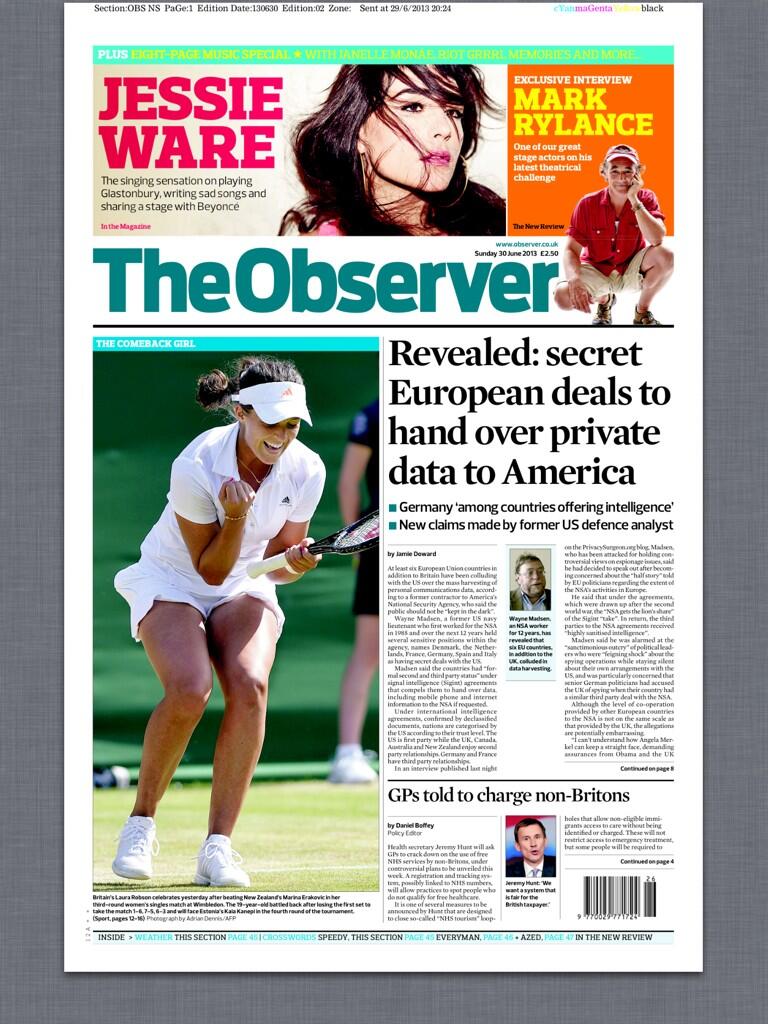
So far so good, just as in any other walk of life you think you’ve made a mistake you try to correct it. Just as Mother always told you you should. The slightly unfortunate thing is that the Sunday papers in the UK print quite early on the Saturday evening. Thus we get this front page of the physical paper:

Observer front page 20130630

The paper is now running as its front page a story that it has already retracted online. This is something of an “Ooops!” moment and as such one to be treasured as an example of the fallibility of both human beings and organisations that contain them.

However, the story really gets even better than this.

Steps towards a police state

Rick Falkvinge thinks that the United States is at the point of no return as far as civil liberties are concerned:

While this may seem a trivial observation, it is critical in this context: people tend to be focused on what affects them in the here and now. While some people can connect the dots and follow the line with their eyes into the future, the vast majority of people don’t bother with something that doesn’t affect them directly, personally, and in the present. In 1932, families were still skating in the park in Berlin on weekends. All that nasty stuff was theoretical, rumored, and somewhere else. People who look ahead and try to sound the alarm bell tend to be regarded as tinfoil hats, eccentric, and nuts.

One of the first things that happens past the point of no return into a police state is the persecution of reporters. As a society is closing down, those persecuted first are those with the audience and an interest in reporting the worrying trends that society seems to be closing. This is the proverbial canary in the coal mine. This is the alarm bell. Once that happens, get out of the mine.

An event horizon is a term from astrophysics. It is the edge of a black hole – so the event horizon appears like a black sphere, if you like. Nothing, not even light, can escape from within the event horizon – hence the term black hole. But if you were traveling through space, in direction of the black hole (which may be as large as an entire solar system), then you would notice absolutely nothing as you crossed the event horizon. You would pass a point of no return, and register not a single thing while doing so. The analogy is depressingly apt.

I’ve written before that I believe that the U.S. is lost to encroaching totalitarianism, which it will likely endure for a number of years before it collapses under its own weight (as all empires do sooner or later). With Edward Snowden being hunted relentlessly across the globe for leaking evidence of systematic abuse of power, Glenn Greenwald – who published Snowden’s leaks – was recently criticized for aiding and abetting the leak itself. This is a key choice of words, for aiding and abetting a crime is itself a crime – the wording suggested that the reporter who published evidence of abuse of power is himself a criminal.

Social media marks the end of the red carpet

Filed under: Media, Technology — Tags: , , , — Nicholas @ 00:01

In Reason, Nick Gillespie gets to the root of Alec Baldwin’s problem with social media:

In an interview with Gothamist, the talented actor and annoying loudmouth inadvertently lays bare the real online dynamic behind his anger with new media — and it has less to do with factually incorrect journalism than you might think.

Baldwin’s real issue with new media — he slags Tumblr, Vine, MySpace, Facebook, and more — is that they level kings and queens and even celebrities into a mosh pit of direct, unmediated exchange that is hard as hell to control. It turns out that there’s really no red carpet or champagne room when it comes to the way that stars (read: world leaders, sitcom heroes, famous authors, former child actors, you name it) are treated.

In the Q&A, Baldwin says,

    Twitter began for me as a way to bypass the mainstream media and talk directly to my audience and say, “hey here’s a show I’m doing, here’s something I’m doing.”… But I realized it’s something I’m not really… it certainly isn’t worth the trouble. Rosie O’Donnell is on my podcast this week, and she said that she’s getting off of Twitter, and I said “God, I was thinking the same thing.” I said “you just end up absorbing so much hatred.” You get these body blows of all this hatred from people who… their profiles are almost identical, like “tea party mom, I love my job, I love my kids, I love my country #millitary #guns” and there’s a screaming eagle in the background of their profile, grasping some arrows and tanks rolling in the background and they all want to tell me how much they can’t stand my politics. And I go, “OK.” What kills me is these are people who want to put me out of business, so to speak, as fast as they possibly can, but they don’t want to put BP out of business, who turned the Gulf of Mexico into a cesspool….

Baldwin sputters that the very tools he can use to bypass “the mainstream media and talk directly” to his audience also empowers all those dim people out there in the dark. What’s more, his followers have minds of their own. They may enjoy his turns in Glenngarry Glenn Ross and 30 Rock and guest-hosting on Turner Classic Movies but not really find his views on fracking to be worth a damn. It’s a real kick in the pants for a celebrity to be reduced to asking, “Do you think I’m really changing anybody’s mind?”

[. . .]

Reading Baldwin’s comments, I’m struck by how his comments strongly vindicate what we’ve been stressing at Reason since the dawn of the Internet Age: That the audience has a mind of its own that it’s always been dying to express. What’s different now is that we can. Baldwin’s complaint that “there’s no journalism anymore” (except for the people he likes) and his attack on “tea party moms” who thrill to see the Gulf of Mexico foam with oil are best understood as howls of rage from the ancien regime as new-media sans-culottes storm the gates of privilege and power. Being in charge — of government, of media, of art, of business, of religion — just ain’t what it used to be.

Given his temperament and the massive amount of abuse he seems to have taken, Baldwin’s probably right to vacate Twitter and other forums that allow direct, unmediated access to him. That’s his right to exercise. But among the costs he and other powerful people — pols, pashas, pundits, etc. — will bear is lack of engagement with exactly where the world is literally and figuratively trending.

June 29, 2013

Finding replacements for Google Reader

Filed under: Media, Technology — Tags: , , — Nicholas @ 10:39

If you use Google Reader, you’ve got until Monday to find a replacement tool or give up on your RSS feeds. Lifehacker wants to help:

The first thing you’ll want to do is back up your data as an OPML file through Google Takeout. You won’t be able to access it ever again once the service shuts down, so this officially qualifies as crunch time. Luckily, it’s really simple, and we’ve shown you how to do it in three easy steps. Once you’re done, I’d also make sure you have several secure backups saved at home and on the cloud, just to be sure.

As soon as your data is safe and sound, it’s time to go shopping for a new RSS home. Feedly is the most popular alternative at the moment, but there are tons of other options if it doesn’t check all of your boxes. In case you missed it, we’ve rounded up some of the best to help make the transition a little easier. All of these services will import that all-important OPML file, but some can pull your Reader data directly off of Google’s servers while it’s still available, including starred and read items in many cases, so it’s probably worth it to set up a new account over the weekend. In fact, if you haven’t settled on one alternative yet, you might want to sign up for several to hedge your bets and preserve this valuable metadata.

I’ve been using Google Reader to stay on top of news for my weekly Guild Wars 2 community round-ups at GuildMag, so finding a replacement was necessary. I settled on The Old Reader for my GW2 feeds and I’m experimenting with Newsvibe for other feeds.

I’ve been very pleased with The Old Reader, which has been a great replacement and the transition was nearly seamless. I’m still not completely sold on Newsvibe, as it has a couple of issues that reduce its usefulness to me: the session times out very quickly (less than an hour) and it can’t handle certain RSS feeds and refuses to indicate why (it just fails to add the new subscription silently).

Jeff Jarvis calls for private encryption

Filed under: Liberty, Media, Technology — Tags: , , , — Nicholas @ 10:27

In the Guardian, Jeff Jarvis makes the case for internet communications to be protected by encryption:

Assuring the security of private communications regardless of platform — email, VOIP, direct message — should be a top priority of the internet industry in the aftermath of Edward Snowden’s revelations that US and UK governments are tapping into the net’s traffic.

The industry needs to at least come together to offer encryption for private communications as protection against government surveillance.

Guarantee of private communications should be a matter of law already. But, of course, it is not. In the US, only our first-class physical mail is protected from government surveillance without a warrant. In the UK, it was a case of opened mail that led to the closing of the Secret Department of the Post Office. As a matter of principle, the protection afforded our physical mail should extend to any private communication using any means. Just because the authors of the Fourth Amendment could not anticipate the internet and email, let alone Facebook, that should not grant government spies a loophole from the founders’ intent.

That protection could come from Congress, but it won’t. It could come from the courts, but it hasn’t.

I argued in my book Public Parts that government may try to portray itself as the protector of our privacy, but it is instead the most dangerous enemy of privacy, for it can gather our information without our knowledge and consent — that is the lesson of Snowden’s leaks — and has the power to use it against us.

June 28, 2013

Edmonton and Calgary – united by mutual dislike

Filed under: Cancon, Media — Tags: , , , , — Nicholas @ 13:51

When the flooding hit Calgary, some of the first responders to the scene from outside the city were soldiers from Edmonton. There were several jokes on Twitter about the war of words between the two cities, and a few “invasion” hints, but for those of us outside Alberta local politics, we just didn’t know:

Calgary and Edmonton mutual dislike

I think we have a new meme.

Turkish PM throws treason accusation against BBC journalist

Filed under: Britain, Europe, Media — Tags: , , , , — Nicholas @ 09:07

I guess the BBC is doing a fair job of agitating the powers-that-be, at least in Turkey:

Selin Gerit, a London-based presenter for BBC’s Turkish service, was until last week relatively unknown in her home country. However, that changed when Recep Tayyip Erdoğan told parliament she was guilty of treason over her coverage of the anti-government protests sweeping the nation.

The prime minister’s condemnation has triggered concerns among fellow journalists, who believe Erdoğan — who accuses the media of fanning the demonstrations — is attempting to stifle dissent.

The campaign against Girit was launched last weekend when the mayor of Ankara, Melih Gökçek, posted a series of angry tweets. The BBC criticised what it called government intimidation. The corporation’s comments triggered Erdoğan to claim in parliament the following day that Girit was “part of a conspiracy against her own country”.

Turkish journalists see the focus on Girit as a warning to them all — an example to cow the rest of them into submission. Serdar Korucu, editor of a major domestic news outlet, said: “The prime minister is telling us, ‘Be careful what you say and do, or you can easily be next’.”

The mainstream media have ignored much of the unrest, with CNNTürk airing a documentary on penguins while the central square in Istanbul became the scene of street protests unprecedented in Erdoğan’s 10-year rule. The public was outraged, and protests were staged outside local news outlets.

Many journalists, however, were not surprised. Fatma Demirelli, managing editor of Today’s Zaman, the English-language daily, said self-censorship had long become the norm in newsrooms. “Journalists now have a sort of split brain: on the one hand you see what the news is, but on the other you immediately try to gauge how to report it without stepping on anyone’s foot,” she said. “Self-censorship has become an automatic reflex.”

June 27, 2013

Calgary’s mayor Naheed Nenshi gets praise from unexpected source

Filed under: Cancon, Government, Media — Tags: , , , , , — Nicholas @ 09:23

The Calgary Sun gets all gushy and enthusiastic over the mayor they usually like to beat up:

No one goes after the mayor of this city harder than we do.

We don’t apologize for that. It’s our job and we like to think we do it louder than most.

But it’s never personal.

So, with that as background, we would like to take this space today to commend Mayor Naheed Nenshi for his amazing leadership under the most trying of circumstances.

He has been a beacon of strength, support and optimism as Calgary battles the affects of the single-biggest disaster to hit our city.

The mayor, as always, has been a great communicator.

Through social media, traditional media and constant briefings, Nenshi has made it his personal undertaking to deliver the most up-to-date information to all Calgarians through all mediums.

Section 13 repealed

Filed under: Cancon, Law, Liberty, Media — Tags: , , , — Nicholas @ 09:15

In all the news from the US yesterday, this little civil liberties tidbit got pushed off the front page:

As I write this I am still only being updated by text message on the proceedings in the Senate chamber but I am told Bill C-304 has passed third reading and will receive Royal Assent tonight making it law.

What does this bill do?

There are a number of amendments to the act that help limit abuse but the main one is this:

2. Section 13 of the Act is repealed.

To put it bluntly, the means you can’t take someone through the federal human rights apparatus over hurt feelings via a blog post or a Facebook comment.

Now the bill is passed and will become law but like many acts of Parliament it will not come into force for a year.

Still after a long hard battle to restore free speech in Canada, this is a victory.

How many “environmental” groups are actually harming the environment

Filed under: Economics, Environment, Media — Tags: , , , — Nicholas @ 00:01

Willis Eschenbach at Watts Up With That:

Now, given that poverty is the greatest threat to the global environment, the inescapable conclusion is that the only way the global environment stands a chance is if poor countries can develop economically.

And that is why the anti-development, pro-expensive energy stance of the large environmental NGOs is one of the great environmental tragedies of our times.

Here’s the chain of causality:

1. Climate alarmists, with the strong support of the major environmental NGOs like Greenpeace and WWF, declared war on CO2.

2. The method that they chose to fight CO2 was to discourage fossil fuel use by making energy more expensive, using a combination of taxation, legislation, international pressure, and expensive subsidies to achieve that end. Obama’s War on Coal, announced today, is just one of hundreds of examples of the wealthy NGOs and the rich governments working to increase the price of energy.

3. Since energy is development, expensive energy keeps poor countries in poverty. When the World Bank denies loans for coal fired plants in India, the poor suffer … but the environment suffers more. Until they can afford to use coal and gas, they’ll run the country on wood … I refer you back to Figure 1 for how well that works out.

4. Expensive energy slows a country’s economic development, and as President Obama pointed out, people worried about money don’t pay attention to the environment.

This ends up in a bizarre position—the actions of the major environmental NGOs are ensuring continued environmental destruction in the developing world.

June 26, 2013

Mark Steyn on the rise of UKIP

Filed under: Britain, Europe, Media, Politics — Tags: , , , , — Nicholas @ 00:01

It’s the attack of the swivel-eyed loons:

It’s all but impossible to launch a new political party under America’s electoral arrangements, and extremely easy to do so under Continental proportional representation. The Westminster first-past-the-post system puts the task somewhere in between: tough, but not entirely the realm of fantasy. The Labour party came into being at the dawn of the 20th century, and formed its first government in 1924. The United Kingdom Independence party was born in 1993 and now, a mere two decades later, is on the brink of … well, okay, not forming its first government, but it did do eerily well in May’s local elections. The Liberals were reduced to their all-time lowest share of the vote, the Tories to their lowest since 1982, and for the first time ever, none of the three “mainstream” parties cracked 30 percent: Labour had a good night with 29, the Conservatives came second at 25, and nipping at their heels was the United Kingdom Independence party with 23 percent.

They achieved this impressive result against not three opponents but also a fourth — a media that have almost universally derided the party as a sinkhole of nutters and cranks. UKIP’s leader, the boundlessly affable Nigel Farage, went to P. G. Wodehouse’s old high school, Dulwich College, and to a sneering metropolitan press, Farage’s party is a déclassé Wodehousean touring company mired in an elysian England that never was, populated only by golf-club duffers, halfwit toffs, rustic simpletons, and hail-fellow-well-met bores from the snug of the village pub. When I shared a platform with him in Toronto a few months back, Mr. Farage explained his party’s rise by citing not Wodehouse but another Dulwich old boy, the late British comic Bob Monkhouse: “They all laughed when I said I’d become a comedian. Well, they’re not laughing now.”

The British media spent 20 years laughing at UKIP. But they’re not laughing now — not when one in four electors takes them seriously enough to vote for them. So, having dismissed him as a joke, Fleet Street now warns that Farage uses his famous sense of humor as a sly cover for his dark totalitarian agenda — the same well-trod path to power used by other famous quipsters and gag-merchants such as Adolf Hitler, whose Nuremberg open-mike nights were legendary. “Nigel Farage is easy to laugh at … that means he’s dangerous,” declared the Independent. The Mirror warned of an “unfulfilled capacity for evil.” “Stop laughing,” ordered Jemma Wayne in the British edition of the Huffington Post. “Farage would lead us back to the dark ages.” The more the “mainstream” shriek about how mad, bad, and dangerous UKIP is, the more they sound like the ones who’ve come unhinged.

June 24, 2013

Finally, a semi-rational explanation for the slow adoption of deodorant in Britain

Filed under: Britain, Health, History, Media — Tags: , , — Nicholas @ 11:57

Richard Smith talks about the British Medical Association’s “official” stance on heterosexual and homosexual “indulgences” from the 1950s on, and also explains why British use of deodorant always lagged the rest of the western world:

I was once responsible for Family Doctor Publications, which were a series of booklets owned by the BMA, had titles like You and Your Bowels, and sold in huge numbers in the 1950s because they were almost the only information on health available to the public. I was much amused that in the 50s the BMA agreed that the booklets could include advertising for cigarettes and alcohol, but under no circumstances could they advertise contraceptives. And at about the same time thousands of copies of one booklet had to be pulped because it seemed to accept the possibility of sex before marriage. Now I’ve learnt more about the prudishness and “severe, restrictive morality” of the BMA.

[. . .]

The BMA was also happy to ignore science and evidence when it launched into explanations of what at the time was perceived as “an epidemic of homosexuality.” “Many men see in homosexual practices as a way of satisfying their sexual desires without running the risks of sequelae of heterosexual intercourse. They believe, for example, that there is no danger of contracting venereal disease in homosexual activity. Other men adopt homosexual practices as a substitute for extramarital heterosexual intercourse because there is no fear of causing pregnancy or emotional complications as in the life of a woman.” The idea that “women” equals “emotional complications” was a very 50s idea.

It was unsurprising, thought the BMA, that the public would be hostile to homosexuals because of the propensity of its practitioners in “positions of authority to give preferential treatment to homosexuals or to require homosexual subjection as an expedient for promotion. The existence of practising homosexuals in the Church, Parliament, Civil Service, Armed Forces, Press, radio, stage and other institutions constitutes a special problem.” Medicine is conspicuously absent from that list. God (heterosexual, of course, even though capable of insemination without intercourse) forbid that the BMA would have homosexuals in its membership.

The BMA found sexual acts between men “repulsive” and that “homosexuals congregating blatantly in public houses, streets, and restaurants are an outrage to public decency. Effeminate men wearing make-up and using scent are objectionable to everybody.” Born in 1952 I was infused with this kind of thinking and didn’t use a deodorant until I was 45 for fear of what people might think. My father, born in 1922, didn’t like me to buy half a pint rather than a pint of beer in case I be thought homosexual.

Having made its position clear, the BMA concluded that “if degenerate sodomists” persist then “it would be in the public interest to deal with them in the same way as mentally deranged offenders.” In other words, commit them to state lunatic asylums.

Don’t judge a book – especially a science fiction book – by its cover

Filed under: Books, Humour, Media — Tags: , , — Nicholas @ 07:54

H/T to Lois McMaster Bujold, who sent this link to her mailing list.

« Newer PostsOlder Posts »

Powered by WordPress


